Go 内存调优:用逃逸分析减少堆分配
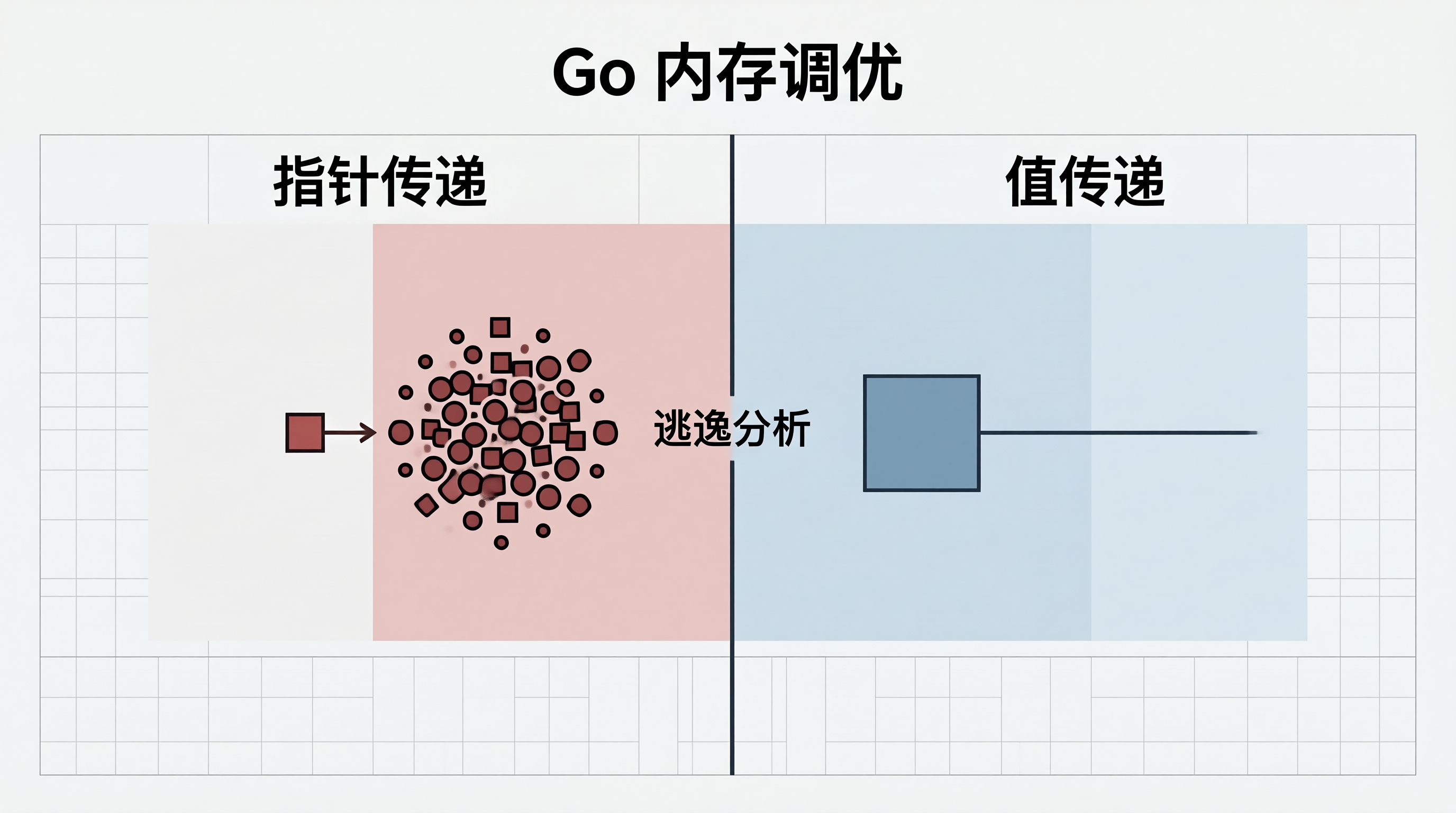
Go内存调优通过逃逸分析减少指针传递下的堆分配频次
Go 内存调优:通过逃逸分析减少指针传递下的堆分配频次
一、前言
年初参与一个 API 网关的重构,核心链路是从 HTTP 请求中提取认证信息,经过多层中间件验证后生成上下文对象。代码的架构层次很清晰------每一层都通过 context.Context 传递值,但 pprof 一跑发现 runtime.mallocgc 占了 38%。
仔细排查发现,罪魁祸首是指针传递。架构师为了「减少内存拷贝」,大量使用了指针传参和指针返回值。结果适得其反------指针导致逃逸,堆分配的频次比值拷贝高了几个数量级,GC 开销远超拷贝带来的那点 CPU 周期。
这篇文章会用实际案例说明:在 Go 中,指针传递不是免费的。理解逃逸分析如何判定指针逃逸,以及如何用值传递替代指针传递来减少堆分配。
二、指针传递的成本
先看一个简单的 Benchmark:
go
type LargeStruct struct {
    Buf [1024]byte
    ID  int64
    Tag string
}

// 值传递:整个结构体拷贝到栈上
func processByValue(ls LargeStruct) int64 {
    return ls.ID
}

// 指针传递:只拷贝 8 字节指针,但结构体逃逸到堆
func processByPointer(ls *LargeStruct) int64 {
    return ls.ID
}

func BenchmarkValuePass(b *testing.B) {
    s := LargeStruct{ID: 42, Tag: "test"}
    b.ResetTimer()
    for i := 0; i < b.N; i++ {
        processByValue(s)
    }
}

func BenchmarkPointerPass(b *testing.B) {
    s := &LargeStruct{ID: 42, Tag: "test"}
    b.ResetTimer()
    for i := 0; i < b.N; i++ {
        processByPointer(s)
    }
}
结果:
BenchmarkValuePass-8         1000000000    0.32 ns/op    0 B/op    0 allocs/op
BenchmarkPointerPass-8       30000000     45.20 ns/op  1040 B/op    1 allocs/op
指针传递版本慢了 141 倍,还多分配了 1040 字节! 原因很简单:s := &LargeStruct{...} 在堆上分配,processByPointer 接收指针后,指针又被传递到其他函数,继续逃逸。
三、逃逸分析的核心规则
Go 编译器的逃逸分析遵循一条核心原则:如果一个变量的地址逃逸到了函数返回之后还存在的区域,就必须分配在堆上。
以下场景必然触发逃逸:
go
// 场景 1:返回局部变量指针
func newObj() *Object {
    return &Object{ID: 1} // 逃逸:栈帧被回收后指针依然被引用
}

// 场景 2:将指针存储在接口中
func storeInInterface() interface{} {
    obj := Object{ID: 1}
    return obj // 逃逸:接口的动态类型信息在堆上
}

// 场景 3:闭包捕获变量
func captureInClosure() func() int {
    x := 42
    return func() int {
        return x // x 逃逸:闭包可能在函数返回后被调用
    }
}

// 场景 4:指针存储在全局变量或堆上
var global *Object
func storeGlobal() {
    obj := &Object{ID: 1}
    global = obj // obj 逃逸:全局变量生命周期无限
}
四、网关场景的逃逸优化
4.1 原始代码(大量指针传递)
go
type AuthContext struct {
    UserID    string
    Roles     []string
    Token     string
    ExpiresAt time.Time
    Metadata  map[string]string
}

// 中间件链:大量指针传递
func authMiddleware(next http.Handler) http.Handler {
    return http.HandlerFunc(func(w http.ResponseWriter, r *http.Request) {
        ctx := &AuthContext{}           // 逃逸
        token := extractToken(r)
        ctx.Token = token

        // 指针传递给下一个中间件
        r = r.WithContext(context.WithValue(r.Context(), "auth", ctx))
        next.ServeHTTP(w, r)
    })
}

func rbacMiddleware(next http.Handler) http.Handler {
    return http.HandlerFunc(func(w http.ResponseWriter, r *http.Request) {
        ctx := r.Context().Value("auth").(*AuthContext)  // 接口断言
        if !checkRole(ctx.Roles) {
            http.Error(w, "forbidden", http.StatusForbidden)
            return
        }
        next.ServeHTTP(w, r)
    })
}
逃逸分析结果:
./auth.go:15:10: &AuthContext{} escapes to heap
./auth.go:22:40: ctx escapes to heap
./auth.go:23:23: r escapes to heap
./auth.go:30:42: ctx escapes to heap (interface assertion)
4.2 优化:值传递 + sync.Pool
go
type AuthContextPool struct {
    pool sync.Pool
}

func NewAuthContextPool() *AuthContextPool {
    return &AuthContextPool{
        pool: sync.Pool{
            New: func() interface{} {
                return &AuthContext{}
            },
        },
    }
}

func (p *AuthContextPool) Acquire() *AuthContext {
    return p.pool.Get().(*AuthContext)
}

func (p *AuthContextPool) Release(ctx *AuthContext) {
    ctx.UserID = ""
    ctx.Roles = ctx.Roles[:0]
    ctx.Token = ""
    ctx.Metadata = nil
    p.pool.Put(ctx)
}

// 优化后的中间件
func authMiddlewareV2(pool *AuthContextPool, next http.Handler) http.Handler {
    return http.HandlerFunc(func(w http.ResponseWriter, r *http.Request) {
        ctx := pool.Acquire()
        defer pool.Release(ctx)

        ctx.Token = extractToken(r)
        // 通过具体类型传递,避免 interface{}
        r = r.WithContext(newAuthContext(r.Context(), ctx))
        next.ServeHTTP(w, r)
    })
}
4.3 极致优化:消除指针,纯值类型
go
// 如果 AuthContext 的结构相对简单
// 可以使用值类型 + 按位标识
type AuthContextCompact struct {
    UserID    [32]byte   // 固定长度
    TokenHash [8]byte    // token 的 xxhash
    Flags     uint32     // 按位存储角色等信息
    ExpiresAt int64      // unix timestamp
}

// 通过 context 传递值类型
type authContextKey struct{}

func WithAuthContext(ctx context.Context, auth AuthContextCompact) context.Context {
    return context.WithValue(ctx, authContextKey{}, auth) // 值类型
}

func GetAuthContext(ctx context.Context) (AuthContextCompact, bool) {
    auth, ok := ctx.Value(authContextKey{}).(AuthContextCompact)
    return auth, ok
}
五、指针传递 vs 值传递的决策矩阵
| 结构体大小 | 指针传递(堆分配) | 值传递(栈拷贝) | 推荐 |
|---|---|---|---|
| ≤ 32 bytes | 1 alloc + GC 扫描 | 栈拷贝 ~2ns | 值传递 |
| 32-512 bytes | 1 alloc + GC 扫描 | 栈拷贝 ~8ns | 值传递 |
| 512-2048 bytes | 1 alloc + GC 扫描 | 栈拷贝 ~25ns | 取决于频率 |
| > 2048 bytes | 1 alloc + GC 扫描 | 栈拷贝 ~100ns | 指针传递 |
| 含指针字段 | 1 alloc + GC 扫描 | 栈拷贝 + GC 追踪 | 取决于场景 |
核心结论:不要为了「减少拷贝」而使用指针传递。在 Go 中,栈上拷贝的开销(纳秒级)远小于堆分配 + GC 的开销(微秒级)。
六、优化技巧与避坑指南
1. sync.Pool 在 GC 时会被清空
每次 GC 后,sync.Pool 中的对象会被丢弃。如果服务 GC 频率较高(每秒多次),sync.Pool 的命中率会很低。此时用 chan 做固定大小的对象池更可靠:
go
type FixedPool struct {
    objects chan *AuthContext
}

func NewFixedPool(size int) *FixedPool {
    pool := make(chan *AuthContext, size)
    for i := 0; i < size; i++ {
        pool <- &AuthContext{}
    }
    return &FixedPool{objects: pool}
}

func (p *FixedPool) Get() *AuthContext {
    select {
    case obj := <-p.objects:
        return obj
    default:
        return &AuthContext{} // 池空时新分配
    }
}

func (p *FixedPool) Put(obj *AuthContext) {
    select {
    case p.objects <- obj:
    default:
        // 池满,丢弃
    }
}
2. interface{} 参数一定逃逸
go
// 错误:interface{} 参数导致逃逸
func setValue(ctx context.Context, key string, val interface{}) {
    // val 逃逸到堆
}

// 优化:使用泛型(Go 1.18+)
func setValueGeneric[T any](ctx context.Context, key string, val T) {
    // 具体类型可以栈上分配
}
3. context.WithValue 的逃逸
go
// context.WithValue 的第二个参数是 interface{}
// 如果传入的是指针,指针指向的内容逃逸
// 如果传入的是值类型,值类型也会因为 interface{} 逃逸
// 但值类型逃逸后的对象大小 = 结构体本身
// 指针逃逸后的对象大小 = 结构体 + 指针(少 8 字节)
// 两者差不多,推荐用值类型------值语义更清晰
4. --gcflags=-m 的局限性
逃逸分析结果依赖于编译器的内联决策。同一个函数在内联和不内联时的逃逸结果可能不同。调试时加上 -l 禁止内联,可以观察「最坏情况」下的逃逸。
5. 不要手动实现「引用传递」
go
// 错误:手动实现引用传递
func updateUser(u **User) {
    *u = &User{Name: "new"} // 双重指针,更复杂,不会减少逃逸
}

// 正确:返回新值
func updateUser(u User) User {
    u.Name = "new"
    return u
}
在这个 API 网关项目中,通过将指针传递改为值传递 + 对象池,GC 频率从每秒 15 次降到了每秒 2 次,P99 延迟从 120ms 降到了 35ms。优化原则很简单:能用值传递就别用指针,能用栈就别用堆。