案例:分析K线图来评估股票价格趋势
案例背景
接下来我们用一个具体的案例来简单说明CNN的应用,使用CNN来分析K线图
数据读取与划分
python
use_gpu = True
use_dataparallel = True
python
import os
import sys
sys.path.insert(0, '..')

import time
import datetime
import numpy as np
import pandas as pd
from tqdm import tqdm

import torch
import torch.nn as nn
from torch.utils.data import Dataset
from torch.utils.data import DataLoader
from torch.utils.data import random_split

torch.manual_seed(42)

IMAGE_WIDTH = {5: 15, 20: 60, 60: 180}
IMAGE_HEIGHT = {5: 32, 20: 64, 60: 96}
选取 1993-2001年的数据作为训练集,剩下的作为测试集
python
train_year_list = np.arange(1993,2001,1)

images = []
label_df = []
for year in train_year_list:
    images.append(np.memmap(os.path.join("./monthly_20d", f"20d_month_has_vb_[20]_ma_{year}_images.dat"), dtype=np.uint8, mode='r').reshape(
                        (-1, IMAGE_HEIGHT[20], IMAGE_WIDTH[20])))
    label_df.append(pd.read_feather(os.path.join("./monthly_20d", f"20d_month_has_vb_[20]_ma_{year}_labels_w_delay.feather")))

images = np.concatenate(images)
label_df = pd.concat(label_df)

print(images.shape)
print(label_df.shape)(793019, 64, 60)
(793019, 8)构建DataSet
python
class MyDataset(Dataset):

    def __init__(self, img, label):
        self.img = torch.Tensor(img.copy())
        self.label = torch.Tensor(label)
        self.len = len(img)

    def __len__(self):
        return self.len

    def __getitem__(self, idx):
        return self.img[idx], self.label[idx]
划分测试集和验证集
python
train_val_ratio = 0.7
split_idx = int(images.shape[0] * 0.7)
train_dataset = MyDataset(images[:split_idx], (label_df.Ret_20d > 0).values[:split_idx])
val_dataset = MyDataset(images[split_idx:], (label_df.Ret_20d > 0).values[split_idx:])

train_dataloader = DataLoader(train_dataset, batch_size=128, shuffle=True, pin_memory=True)
val_dataloader = DataLoader(val_dataset, batch_size=256, shuffle=False, pin_memory=True)
模型搭建与可视化
python
class Net(nn.Module):
    def __init__(self):
        super().__init__()
        self.layer1 = nn.Sequential(
            nn.Conv2d(1, 64, kernel_size=(5,3), stride=(3,1), dilation=(2,1), padding=(12,1)),
            nn.BatchNorm2d(64),
            nn.LeakyReLU(negative_slope=0.01, inplace=True),
            nn.MaxPool2d((2, 1), stride=(2, 1)),
        )
        self.layer2 = nn.Sequential(
            nn.Conv2d(64, 128, kernel_size=(5,3), stride=(3,1), dilation=(2,1), padding=(12,1)),
            nn.BatchNorm2d(128),
            nn.LeakyReLU(negative_slope=0.01, inplace=True),
            nn.MaxPool2d((2, 1), stride=(2, 1)),
        )
        self.layer3 = nn.Sequential(
            nn.Conv2d(128, 256, kernel_size=(5,3), stride=(3,1), dilation=(2,1), padding=(12,1)),
            nn.BatchNorm2d(256),
            nn.LeakyReLU(negative_slope=0.01, inplace=True),
            nn.MaxPool2d((2, 1), stride=(2, 1)),
        )
        self.fc1 = nn.Sequential(
            nn.Dropout(p=0.5),
            nn.Linear(46080, 2),
        )
        self.softmax = nn.Softmax(dim=1)

    def forward(self, x):
        x = x.reshape(-1,1,64,60)
        x = self.layer1(x)
        x = self.layer2(x)
        x = self.layer3(x)
        x = x.reshape(-1,46080)
        x = self.fc1(x)
        x = self.softmax(x)
        return x
python
def init_weights(m):
    if isinstance(m, nn.Linear):
        torch.nn.init.xavier_uniform_(m.weight)
        m.bias.data.fill_(0.)
    elif isinstance(m, nn.Conv2d):
        torch.nn.init.xavier_uniform_(m.weight)
python
device = 'cuda' if use_gpu else 'cpu'
net = Net().to(device)
net.apply(init_weights)Net(
(layer1): Sequential(
(0): Conv2d(1, 64, kernel_size=(5, 3), stride=(3, 1), padding=(12, 1), dilation=(2, 1))
(1): BatchNorm2d(64, eps=1e-05, momentum=0.1, affine=True, track_running_stats=True)
(2): LeakyReLU(negative_slope=0.01, inplace=True)
(3): MaxPool2d(kernel_size=(2, 1), stride=(2, 1), padding=0, dilation=1, ceil_mode=False)
)
(layer2): Sequential(
(0): Conv2d(64, 128, kernel_size=(5, 3), stride=(3, 1), padding=(12, 1), dilation=(2, 1))
(1): BatchNorm2d(128, eps=1e-05, momentum=0.1, affine=True, track_running_stats=True)
(2): LeakyReLU(negative_slope=0.01, inplace=True)
(3): MaxPool2d(kernel_size=(2, 1), stride=(2, 1), padding=0, dilation=1, ceil_mode=False)
)
(layer3): Sequential(
(0): Conv2d(128, 256, kernel_size=(5, 3), stride=(3, 1), padding=(12, 1), dilation=(2, 1))
(1): BatchNorm2d(256, eps=1e-05, momentum=0.1, affine=True, track_running_stats=True)
(2): LeakyReLU(negative_slope=0.01, inplace=True)
(3): MaxPool2d(kernel_size=(2, 1), stride=(2, 1), padding=0, dilation=1, ceil_mode=False)
)
(fc1): Sequential(
(0): Dropout(p=0.5, inplace=False)
(1): Linear(in_features=46080, out_features=2, bias=True)
)
(softmax): Softmax(dim=1)
)
python
count = 0
for name, parameters in net.named_parameters():
    print(name, ':', parameters.size())
    count += parameters.numel()
print('total_parameters : {}'.format(count))layer1.0.weight : torch.Size([64, 1, 5, 3])
layer1.0.bias : torch.Size([64])
layer1.1.weight : torch.Size([64])
layer1.1.bias : torch.Size([64])
layer2.0.weight : torch.Size([128, 64, 5, 3])
layer2.0.bias : torch.Size([128])
layer2.1.weight : torch.Size([128])
layer2.1.bias : torch.Size([128])
layer3.0.weight : torch.Size([256, 128, 5, 3])
layer3.0.bias : torch.Size([256])
layer3.1.weight : torch.Size([256])
layer3.1.bias : torch.Size([256])
fc1.1.weight : torch.Size([2, 46080])
fc1.1.bias : torch.Size([2])
total_parameters : 708866
python
import torch.onnx
x = torch.randn([1,1,64,60]).to(device)
torch.onnx.export(net,               # model being run
                  x,                         # model input (or a tuple for multiple inputs)
                  "./cnn_baseline.onnx",   # where to save the model (can be a file or file-like object)
                  export_params=False,        # store the trained parameter weights inside the model file
                  opset_version=10,          # the ONNX version to export the model to
                  do_constant_folding=False,  # whether to execute constant folding for optimization
                  input_names = ['input_images'],   # the model's input names
                  output_names = ['output_prob'], # the model's output names
                  dynamic_axes={'input_images' : {0 : 'batch_size'},    # variable length axes
                                 'output_prob' : {0 : 'batch_size'}})
模型训练与评估
python
def train_loop(dataloader, net, loss_fn, optimizer):

    running_loss = 0.0
    current = 0
    net.train()

    with tqdm(dataloader) as t:
        for batch, (X, y) in enumerate(t):
            X = X.to(device)
            y = y.to(device)
            y_pred = net(X)
            loss = loss_fn(y_pred, y.long())

            optimizer.zero_grad()
            loss.backward()
            optimizer.step()

            running_loss = (len(X) * loss.item() + running_loss * current) / (len(X) + current)
            current += len(X)
            t.set_postfix({'running_loss':running_loss})

    return running_loss
python
def val_loop(dataloader, net, loss_fn):

    running_loss = 0.0
    current = 0
    net.eval()

    with torch.no_grad():
        with tqdm(dataloader) as t:
            for batch, (X, y) in enumerate(t):
                X = X.to(device)
                y = y.to(device)
                y_pred = net(X)
                loss = loss_fn(y_pred, y.long())

                running_loss += loss.item()
                running_loss = (len(X) * running_loss + loss.item() * current) / (len(X) + current)
                current += len(X)

    return running_loss
python
if use_gpu and use_dataparallel and 'DataParallel' not in str(type(net)):
    net = net.to(device)
    net = nn.DataParallel(net)
python
loss_fn = nn.CrossEntropyLoss()
optimizer = torch.optim.Adam(net.parameters(), lr=1e-5)

start_epoch = 0
min_val_loss = 1e9
last_min_ind = -1
early_stopping_epoch = 5

from torch.utils.tensorboard import SummaryWriter
tb = SummaryWriter()
python
start_time = datetime.datetime.now().strftime('%Y%m%d_%H-%M-%S')
os.makedirs(os.path.join("pt",start_time),)
epochs = 100
for t in range(start_epoch, epochs):
    print(f"Epoch {t}\n-------------------------------")
    time.sleep(0.2)
    train_loss = train_loop(train_dataloader, net, loss_fn, optimizer)
    val_loss = val_loop(val_dataloader, net, loss_fn)
    tb.add_histogram("train_loss", train_loss, t)
    torch.save(net, './pt'+os.sep+start_time+os.sep+'baseline_epoch_{}_train_{:5f}_val_{:5f}.pt'.format(t, train_loss, val_loss))
    if val_loss < min_val_loss:
        last_min_ind = t
        min_val_loss = val_loss
    elif t - last_min_ind >= early_stopping_epoch:
        break

print('Done!')
print('Best epoch: {}, val_loss: {}'.format(last_min_ind, min_val_loss))Epoch 0
-------------------------------
100%|██████████████████████████████████████████████████████████| 4337/4337 [02:54<00:00, 24.84it/s, running_loss=0.734]
100%|████████████████████████████████████████████████████████████████████████████████| 930/930 [00:26<00:00, 34.89it/s]
Epoch 1
-------------------------------
100%|██████████████████████████████████████████████████████████| 4337/4337 [02:58<00:00, 24.35it/s, running_loss=0.717]
100%|████████████████████████████████████████████████████████████████████████████████| 930/930 [00:22<00:00, 40.62it/s]
Epoch 2
-------------------------------
100%|██████████████████████████████████████████████████████████| 4337/4337 [02:48<00:00, 25.76it/s, running_loss=0.707]
100%|████████████████████████████████████████████████████████████████████████████████| 930/930 [00:22<00:00, 40.56it/s]
Epoch 3
-------------------------------
100%|██████████████████████████████████████████████████████████| 4337/4337 [02:47<00:00, 25.82it/s, running_loss=0.702]
100%|████████████████████████████████████████████████████████████████████████████████| 930/930 [00:22<00:00, 40.66it/s]
Epoch 4
-------------------------------
100%|██████████████████████████████████████████████████████████| 4337/4337 [02:47<00:00, 25.84it/s, running_loss=0.698]
100%|████████████████████████████████████████████████████████████████████████████████| 930/930 [00:22<00:00, 40.54it/s]
Epoch 5
-------------------------------
100%|██████████████████████████████████████████████████████████| 4337/4337 [02:47<00:00, 25.86it/s, running_loss=0.695]
100%|████████████████████████████████████████████████████████████████████████████████| 930/930 [00:22<00:00, 40.71it/s]
Epoch 6
-------------------------------
100%|██████████████████████████████████████████████████████████| 4337/4337 [02:47<00:00, 25.85it/s, running_loss=0.693]
100%|████████████████████████████████████████████████████████████████████████████████| 930/930 [00:22<00:00, 40.56it/s]
Done!
Best epoch: 1, val_loss: 0.693060862993489
python
test_year_list = np.arange(2001,2020,1)
python
images = []
label_df = []
for year in test_year_list:
    images.append(np.memmap(os.path.join("./monthly_20d", f"20d_month_has_vb_[20]_ma_{year}_images.dat"), dtype=np.uint8, mode='r').reshape(
                        (-1, IMAGE_HEIGHT[20], IMAGE_WIDTH[20])))
    label_df.append(pd.read_feather(os.path.join("./monthly_20d", f"20d_month_has_vb_[20]_ma_{year}_labels_w_delay.feather")))

images = np.concatenate(images)
label_df = pd.concat(label_df)
python
dataset = MyDataset(images, (label_df.Ret_20d > 0).values)
python
test_dataloader = DataLoader(dataset, batch_size=2048, shuffle=False)
python
net_path = './pt/20231115_15-51-08/baseline_epoch_1_train_0.717068_val_0.693061.pt'
device = 'cuda' if use_gpu else 'cpu'
net = torch.load(net_path)
python
def eval_loop(dataloader, net, loss_fn):

    running_loss = 0.0
    total_loss = 0.0
    current = 0
    net.eval()
    target = []
    predict = []
    with torch.no_grad():
        with tqdm(dataloader) as t:
            for batch, (X, y) in enumerate(t):
                X = X.to(device)
                y = y.to(device)
                y_pred = net(X)
                target.append(y.detach())
                predict.append(y_pred.detach())
                loss = loss_fn(y_pred, y.long())

                running_loss = (len(X) * loss.item() + running_loss * current) / (len(X) + current)
                current += len(X)
                t.set_postfix({'running_loss':running_loss})

    return total_loss, torch.cat(predict), torch.cat(target)
python
loss_fn = nn.CrossEntropyLoss()
test_loss, y_pred, y_target = eval_loop(test_dataloader, net, loss_fn)

predict_logit = (torch.nn.Softmax(dim=1)(y_pred)[:,1]).cpu().numpy()100%|████████████████████████████████████████████████████████████| 686/686 [02:35<00:00, 4.42it/s, running_loss=0.696]
python
from matplotlib import pyplot as plt
python
threshold = 0.

label_df['ret'] = (predict_logit>threshold) * label_df.Ret_20d
label_filtered = label_df[predict_logit>threshold]
ret_baseline = label_filtered .groupby(['Date'])['Ret_20d'].mean()

threshold = 0.58

label_df['ret'] = (predict_logit>threshold) * label_df.Ret_20d
label_filtered = label_df[predict_logit>threshold]
ret_cnn = label_filtered .groupby(['Date'])['Ret_20d'].mean()
python
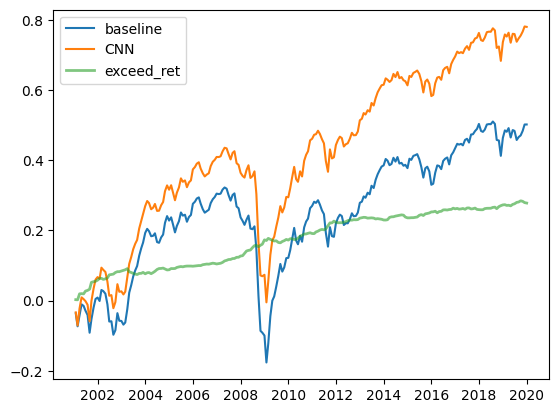
log_ret_baseline = np.log10((ret_baseline+1).cumprod().fillna(method='ffill'))
log_ret_cnn = np.log10((ret_cnn+1).cumprod().fillna(method='ffill'))
fig = plt.figure()
plt.plot(log_ret_baseline, label='baseline')
plt.plot(log_ret_cnn, label='CNN')
plt.plot(log_ret_cnn - log_ret_baseline, alpha=0.6, lw=2, label='exceed_ret')
plt.legend()
plt.show()
fig.savefig('performance1.png',dpi=300)