Architecture: Single Controller + Multiple ActorGroups
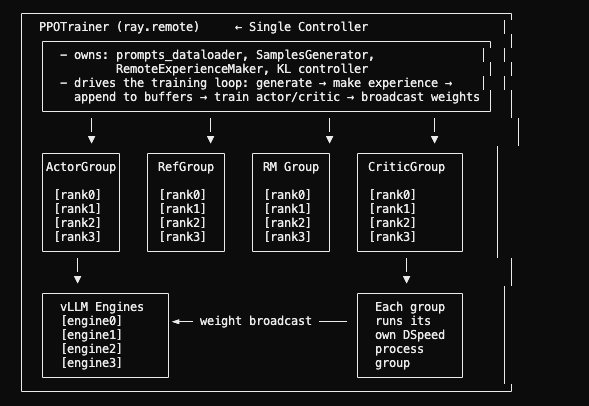
It wraps a group of Ray actors that form a single distributed model:
actor_model = RayActorGroup(
    args.actor_num_nodes,          # e.g., 1
    args.actor_num_gpus_per_node,  # e.g., 8
    PolicyModelActor,              # the @ray.remote class
    pg=pg,                         # optional placement group
    num_gpus_per_actor=0.2 if pg else 1,  # fractional GPU for colocation
    duplicate_actors=args.ring_attn_size * args.ds_tensor_parallel_size,
)
What happens inside RayActorGroup.init (launcher.py:228):
- Create a placement group (if no shared one provided). A placement group is Ray's way of reserving GPU bundles atomically --- all-or-nothing scheduling. This prevents partial allocation where some GPUs are on node A and others on node B when you need them co-located.
- Spawn rank 0 (master actor) --- it discovers its own IP and a free port, then returns master_addr and master_port via ray.get().
- Spawn ranks 1...N (worker actors) --- they receive the master's address and connect to the same process group.
Each actor inside the group is a @ray.remote(num_gpus=1) class. The num_gpus=1 tells Ray to assign exactly 1 GPU to each actor. When num_gpus_per_actor=0.2 (hybrid engine mode), 5 actors share 1 GPU --- this is how models get colocated.
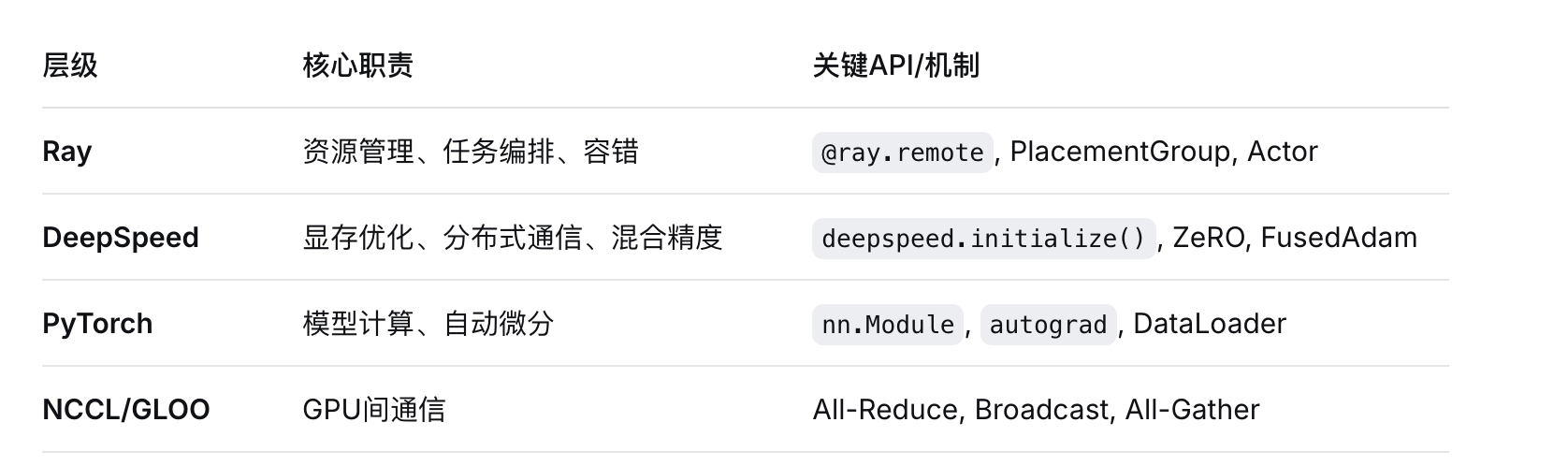
┌─────────────────────────────────────────────────────┐
│  RAY (控制平面 - 决策者)                              │
│  • 资源分配:决定用几个GPU、几个节点                    │
│  • 任务编排:启动/停止/重启训练进程                     │
│  • 容错恢复:worker挂了自动重启                        │
│  • 超参搜索:并行运行多个实验                          │
└─────────────────┬───────────────────────────────────┘
                  │ 创建并管理worker进程
                  ▼
┌─────────────────────────────────────────────────────┐
│  DEEPSPEED (执行平面 - 加速器)                        │
│  • 显存优化:ZeRO分片、CPU卸载                        │
│  • 通信优化:重叠计算与通信、梯度聚合                    │
│  • 混合精度:自动管理FP16损失缩放                     │
│  • Kernel优化:Fused Adam, CUDA算子融合              │
└─────────────────┬───────────────────────────────────┘
                  │ 包装模型、优化器
                  ▼
┌─────────────────────────────────────────────────────┐
│  PYTORCH (计算平面 - 执行者)                          │
│  • 前向传播:计算loss                                 │
│  • 反向传播:计算梯度                                  │
│  • 参数更新:优化器step                               │
└─────────────────────────────────────────────────────┘

用户执行: python main.py --num-gpus 2
    │
    ▼
┌─────────────────────────────────────────────┐
│ Ray.init() - 资源发现                         │
│ • 扫描可用GPU设备                              │
│ • 建立分布式对象存储                           │
│ • 启动GCS (Global Control Service)           │
└──────────────┬──────────────────────────────┘
               │
               ▼
┌─────────────────────────────────────────────┐
│ RayDeepSpeedController.setup_workers()       │
│ • 创建Placement Group (请求2个GPU)           │
│ • Ray调度器分配GPU资源                        │
│ • 创建2个DeepSpeedRayWorker Actor            │
└──────────────┬──────────────────────────────┘
               │
               ▼
┌─────────────────────────────────────────────┐
│ DeepSpeedRayWorker.__init__ (在每个GPU上)    │
│ • 设置分布式环境变量(Master地址、Rank等)       │
│ • 创建PyTorch模型                             │
│ • 调用 deepspeed.initialize()                │
│   - 根据ZeRO配置分片模型参数                   │
│   - 创建Fused Adam优化器                      │
│   - 初始化梯度累加器                          │
│   - 设置混合精度管理器                         │
└──────────────┬──────────────────────────────┘
               │
               ▼
┌─────────────────────────────────────────────┐
│ controller.run_training()                    │
│ • Ray并行调用所有worker的train方法            │
│ • Ray自动处理分布式对象引用                    │
└──────────────┬──────────────────────────────┘
               │
               ▼
┌─────────────────────────────────────────────┐
│ 训练循环 (每个worker独立但通过NCCL通信)        │
│                                              │
│ for batch in dataloader:                    │
│   loss = model(batch)    # 前向              │
│   engine.backward(loss)  # DeepSpeed后向     │
│   engine.step()          # 参数更新          │
│   • DeepSpeed自动all-reduce梯度              │
│   • 处理ZeRO参数同步                          │
│   • 更新学习率调度器                          │
└──────────────────────────────────────────────┘
┌────────────────────────────────────────────────────────────────────────┐
│  PPOTrainer.fit() --- Single Controller Loop                            │
│                                                                        │
│  1. GET PROMPTS                                                        │
│     prompts_dataloader → rand_prompts, labels                          │
│                                                                        │
│  2. GENERATE SAMPLES (via vLLM)                                        │
│     SamplesGenerator.generate_samples(rand_prompts, labels, ...)       │
│     ├── vllm_engines[i].add_requests.remote(sampling_params, tokens)  │
│     ├── ray.get(refs)  # wait for generation to complete              │
│     └── vllm_engines[i].get_responses.remote()  # collect results     │
│     → returns List[Experience] with sequences, action_mask             │
│                                                                        │
│  3. MAKE EXPERIENCE (add logprobs, values, rewards, KL)               │
│     RemoteExperienceMaker.make_experience_batch(rollout_samples)       │
│     ├── actor_model_group.async_run_method_batch("forward", ...)       │
│     │   → each actor replica forward-passes to get action_log_probs   │
│     ├── reference_model_group.async_run_method_batch("forward", ...)  │
│     │   → each ref replica forward-passes to get base_log_probs       │
│     ├── critic_model_group.async_run_method_batch("forward", ...)     │
│     │   → each critic replica forward-passes to get values            │
│     ├── reward_model_group.async_run_method_batch("forward", ...)     │
│     │   → each RM replica forward-passes to get rewards               │
│     │      (or remote_rm_url → HTTP call to external RM)              │
│     ├── compute_approx_kl(action_log_probs, base_log_probs)           │
│     └── compute_advantages_and_returns(...)                            │
│     → returns List[Experience] with full training data                 │
│                                                                        │
│  4. APPEND TO REPLAY BUFFERS                                           │
│     actor_model_group.async_run_method_batch("append", experience=..) │
│     critic_model_group.async_run_method_batch("append", experience=..)│
│     → each actor/critic replica appends to its local NaiveReplayBuffer│
│                                                                        │
│  5. TRAIN (ppo_train)                                                  │
│     ├── critic_model_group.async_run_method("fit")                    │
│     │   → each CriticModelActor runs CriticPPOTrainer.ppo_train()     │
│     │      → iterates replay_buffer, calls training_step()            │
│     │      → backward + optimizer_step (DeepSpeed handles sync)       │
│     ├── actor_model_group.async_run_method("fit", kl_ctl=value)       │
│     │   → each PolicyModelActor runs ActorPPOTrainer.ppo_train()      │
│     │      → iterates replay_buffer, calls training_step()            │
│     │      → backward + optimizer_step (DeepSpeed handles sync)       │
│     └── broadcast_to_vllm()                                           │
│         → actor rank 0 pushes updated weights to vLLM engines         │
│                                                                        │
│  6. LOG & CHECKPOINT                                                   │
│     → wandb/tensorboard logging, save checkpoint on actor/critic      │
│                                                                        │
│  → repeat from step 1                                                  │
└────────────────────────────────────────────────────────────────────────┘
The async trainer (ppo_trainer_async.py (OpenRLHF/openrlhf/trainer/ppo_trainer_async.py)) decouples generation from training using a producer-consumer queue:
GenerateSamplesActor ──→ queue ──→ PPOTrainerAsync
(producer) (consumer)
continuously generates continuously trains on
samples via vLLM dequeued experiences

-
单进程多GPU vs 多进程单GPU
- 每个Ray Actor占用一个GPU
- 通过num_gpus=1确保独占
- DeepSpeed在actor内部管理该GPU上的模型并行
-
Ray负责跨节点,DeepSpeed负责节点内
- Ray:节点发现、资源分配、容错恢复
- DeepSpeed:GPU间通信、显存优化、梯度同步
-
混合并行策略
- 数据并行:不同actor组处理不同数据块
- 模型并行:同一组内的多个actor(duplicate_actors)运行相同模型的不同部分
- Ring Attention:通过ring_attn_group实现长序列并行