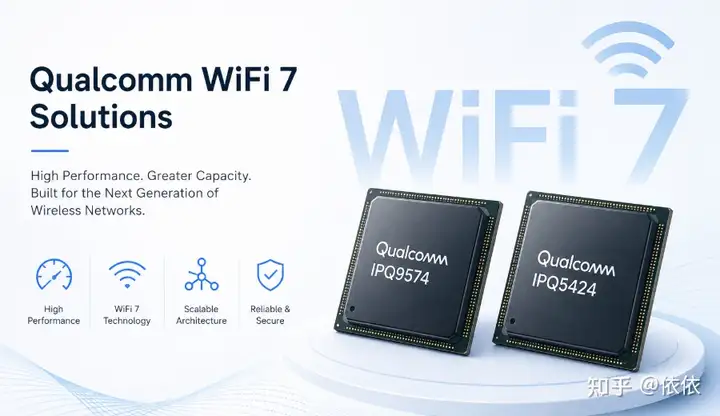
As WiFi 7 moves into large-scale commercial deployment, Qualcomm's IPQ9574 and IPQ5424 have become two of the most discussed platforms among networking equipment manufacturers.
While both platforms support key WiFi 7 technologies such as 320MHz channels, 4096-QAM, Multi-Link Operation (MLO), OFDMA, and MU-MIMO, they are designed for very different markets. Simply put, the IPQ9574 targets high-performance enterprise deployments, while the IPQ5424 focuses on cost-effective consumer and SMB applications.
Performance Is More Than Just CPU Power
Many discussions focus on processor specifications, but the real difference between these two platforms goes far beyond CPU performance.
The IPQ9574 was built with enterprise networking in mind. It is designed to handle high-density deployments, complex traffic management, large numbers of connected devices, and demanding data-processing workloads. This makes it well suited for enterprise access points, industrial gateways, carrier-grade equipment, and other networking products that operate under sustained heavy loads.
The IPQ5424 takes a different approach. Rather than maximizing performance, it focuses on balancing performance, power efficiency, and system cost. For home routers, mesh systems, and small-business access points, it delivers more than enough processing capability while helping manufacturers reduce overall product costs.
Wireless Architecture Defines the Product Ceiling
If the CPU is the brain of a networking device, the wireless architecture determines its long-term potential.
The IPQ9574 supports highly flexible radio configurations and is capable of powering high-performance tri-band WiFi 7 systems. Its architecture is designed to provide greater wireless capacity, improved user density, and stronger performance in demanding environments.
This becomes particularly important in locations such as office buildings, hotels, schools, shopping centers, and industrial campuses, where hundreds of devices may be connected simultaneously.
The IPQ5424 focuses on practical deployment efficiency. Its streamlined design simplifies RF development, reduces hardware complexity, and shortens time-to-market. For manufacturers targeting the consumer market, these advantages can significantly improve product competitiveness.
Enterprise and Consumer Markets Require Different Approaches
From a market perspective, the IPQ9574 and IPQ5424 serve fundamentally different customer segments.
The IPQ9574 is better suited for products such as enterprise WiFi 7 access points, industrial wireless gateways, outdoor wireless backhaul systems, carrier CPEs, and edge networking platforms. Its strengths lie in scalability, performance headroom, and long-term reliability.
The IPQ5424, on the other hand, is primarily aimed at WiFi 7 home routers, mesh networking systems, SMB access points, and smart home gateways. It offers a balanced combination of performance and affordability, making it an attractive choice for high-volume deployments.
For manufacturers, the goal should not be choosing the most powerful platform, but selecting the platform that best aligns with the needs of the target market.
Which Platform Should You Choose?
If your product is expected to support high-density connectivity, advanced network management, industrial applications, or continuous 24/7 operation, the IPQ9574 offers greater performance reserves and expansion flexibility.
If your focus is on delivering cost-effective WiFi 7 products for residential users, mesh networking, or small-business environments, the IPQ5424 provides a more balanced and economical solution.
Rather than competing directly, these two platforms complement each other by addressing different segments of the WiFi 7 ecosystem.
Looking Ahead
As the 6GHz spectrum becomes more widely available and multi-gigabit broadband adoption continues to grow, WiFi 7 is rapidly becoming the foundation of next-generation wireless networks.sales@wallystech.com
Understanding the differences between platforms such as the IPQ9574 and IPQ5424 is increasingly important for manufacturers planning future networking products. Choosing the right architecture at the beginning of a project can have a significant impact on performance, cost, scalability, and long-term market success.