文章目录
-
- [阶段二:LIO 前端 - 深入学习点云预处理模块](#阶段二:LIO 前端 - 深入学习点云预处理模块)
-
- [一、PointCloudPreprocess 类的功能](#一、PointCloudPreprocess 类的功能)
- [二、核心函数 1:通用 Process() - 处理标准 ROS PointCloud2](#二、核心函数 1:通用 Process() - 处理标准 ROS PointCloud2)
- [三、核心函数 2:Livox 专用 Process()](#三、核心函数 2:Livox 专用 Process())
- [四、核心函数 3:VelodyneHandler() - 处理 Velodyne 雷达](#四、核心函数 3:VelodyneHandler() - 处理 Velodyne 雷达)
- [五、Oust64Handler() 和 RoboSenseHandler()](#五、Oust64Handler() 和 RoboSenseHandler())
- 六、预处理模块总结
- 七、为什么抽稀?
- 重点总结
- 下一步
阶段二:LIO 前端 - 深入学习点云预处理模块
来看点云预处理模块,这是 LIO 前端的第一步!
先看结构很清晰,这个模块的功能:把不同厂家的雷达数据统一处理!
一、PointCloudPreprocess 类的功能
看 pointcloud_preprocess.h
这个类支持 4 种常见的激光雷达:
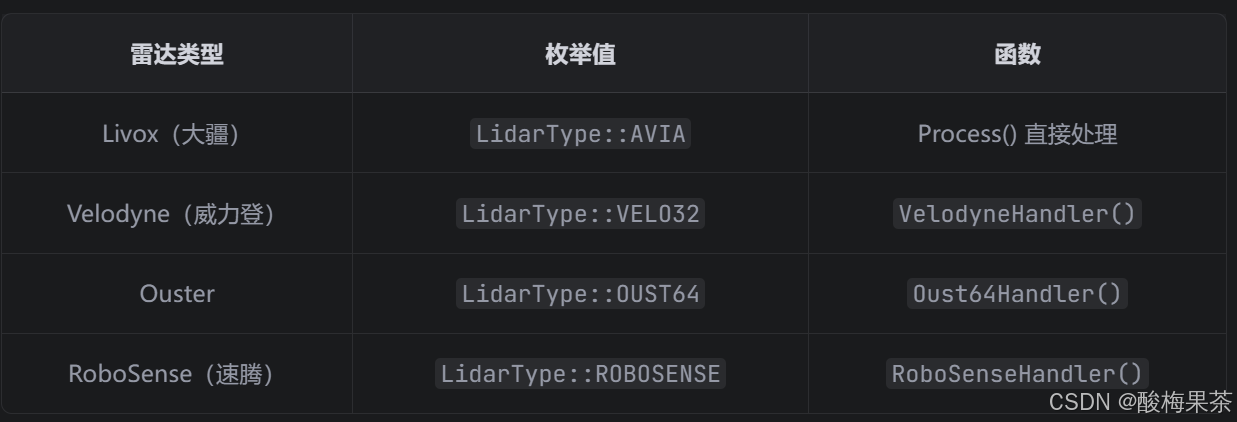
核心的成员变量:
cpp
LidarType lidar_type_ = LidarType::AVIA;  // 雷达类型
int point_filter_num_ = 1;  // 抽稀点数(比如设为 2,每 2 个点取 1 个)
int num_scans_ = 6;  // 扫描线数
double blind_ = 0.01;  // 盲区(太近的点去掉)
float time_scale_ = 1e-3;  // 时间戳缩放
float height_min_ = -1.0;  // 高度 ROI 最小值
float height_max_ = 1.0;  // 高度 ROI 最大值
二、核心函数 1:通用 Process() - 处理标准 ROS PointCloud2
看 pointcloud_preprocess.cc
cpp
void PointCloudPreprocess::Process(const sensor_msgs::msg::PointCloud2::SharedPtr &msg,
                                   PointCloudType::Ptr &pcl_out)
很简单,根据 lidar_type_ 调用对应的 Handler:
cpp
switch (lidar_type_) {
  case LidarType::OUST64: Oust64Handler(msg); break;
  case LidarType::VELO32: VelodyneHandler(msg); break;
  case LidarType::ROBOSENSE: RoboSenseHandler(msg); break;
}
三、核心函数 2:Livox 专用 Process()
看 pointcloud_preprocess.cc
Livox 雷达的特点 :非重复扫描,自带高精度时间戳!
步骤 :
-
数据准备
cppcloud_out_.clear(); cloud_full_.clear(); int plsize = msg->point_num; cloud_out_.reserve(plsize); cloud_full_.resize(plsize); -
并行处理每个点 , 用了并行!
cppstd::for_each(std::execution::par_unseq, index.begin(), index.end(), [&](const uint &i) { // 抽稀 if (i % point_filter_num_ != 0) return; // 赋值坐标 cloud_full_[i].x = msg->points[i].x; cloud_full_[i].y = msg->points[i].y; cloud_full_[i].z = msg->points[i].z; // 赋值强度 cloud_full_[i].intensity = msg->points[i].reflectivity; // 赋值时间戳(从 ns 转成 ms) cloud_full_[i].time = msg->points[i].offset_time / double(1000000); // 高度 ROI 滤波 if (cloud_full_[i].z < height_min_ || cloud_full_[i].z > height_max_) return; // 盲区滤波 + 去重 if (... && (x²+y²+z² > blind²)) { is_valid_pt[i] = 1; } }); -
收集有效点
cppfor (uint i = 1; i < plsize; i++) { if (is_valid_pt[i]) cloud_out_.points.push_back(cloud_full_[i]); }
四、核心函数 3:VelodyneHandler() - 处理 Velodyne 雷达
看 pointcloud_preprocess.cc
Velodyne 雷达的特点 :旋转扫描,有些旧款不自带时间戳!
这个函数的重点 :如果没有时间戳, 根据旋转角度估计时间戳!
VelodyneHandler() 步骤详解:
-
检查是否有自带时间戳
cppif (pl_orig.points[plsize - 1].time > 0) { given_offset_time_ = true; // 太好了,有时间戳! } else { given_offset_time_ = false; // 没有,需要自己算! // 计算第一个点和最后一个点的 yaw double yaw_first = atan2(pl_orig.points[0].y, pl_orig.points[0].x) * 57.29578; // ... } -
如果没有时间戳,根据角度估计
这是重点!
cppif (!given_offset_time_) { int layer = pl_orig.points[i].ring; // 第几根线 double yaw_angle = atan2(added_pt.y, added_pt.x) * 57.2957; // 当前点的航向角 if (is_first[layer]) { // 这根线的第一个点 yaw_fp[layer] = yaw_angle; is_first[layer] = false; added_pt.time = 0.0; continue; } // 计算偏移时间:根据 yaw 差和角速度! if (yaw_angle <= yaw_fp[layer]) { added_pt.time = (yaw_fp[layer] - yaw_angle) / omega_l; } else { added_pt.time = (yaw_fp[layer] - yaw_angle + 360.0) / omega_l; } // 处理跨越 360 度的情况 if (added_pt.time < time_last[layer]) { added_pt.time += 360.0 / omega_l; } }原理 :
-
Velodyne 雷达是旋转的,角速度是固定的(比如 10Hz)
-
知道了角度差,就知道时间差!
-
time = delta_angle / omega
-
-
抽稀和盲区滤波
cppif (i % point_filter_num_ == 0) { if (x² + y² + z² > blind²) { cloud_out_.points.push_back(added_pt); } }
五、Oust64Handler() 和 RoboSenseHandler()
看 pointcloud_preprocess.cc
这两个比较简单,因为都自带时间戳!
共同点 :
- 从 ROS 消息转成 PCL 点云
- 抽稀(每 N 个点取一个)
- 盲区滤波
- 高度 ROI 滤波
- 提取时间戳
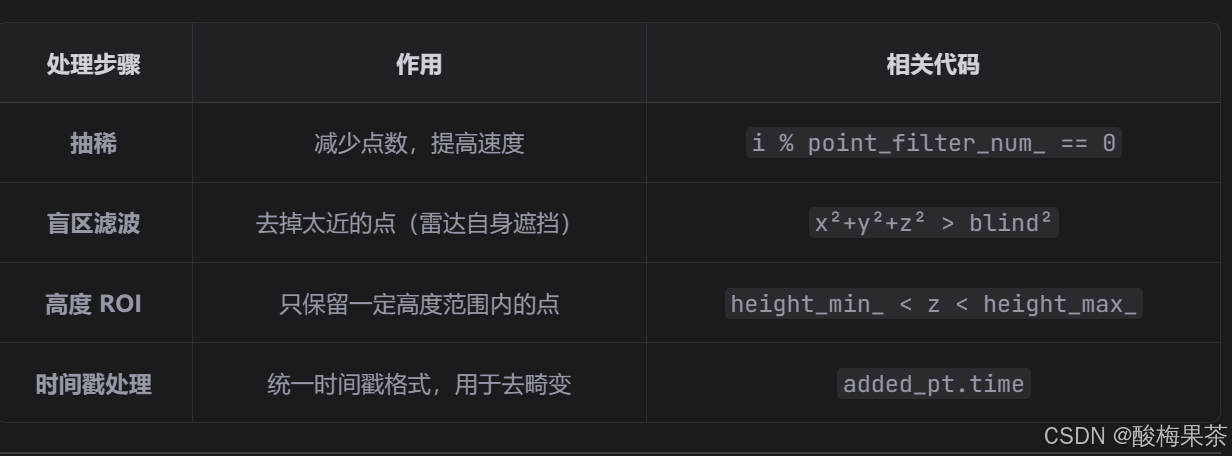
六、预处理模块总结
七、为什么抽稀?
原因 :
- 雷达点太多了(比如 32 线雷达每秒 10 万点)
- 太多点处理不过来
- 相邻点信息冗余,去掉一些影响不大
抽稀方法 :
- point_filter_num_ = 1 → 不抽稀
- point_filter_num_ = 2 → 每 2 个点取 1 个
- point_filter_num_ = 3 → 每 3 个点取 1 个
重点总结
- 支持 4 种常见雷达 :Livox、Velodyne、Ouster、RoboSense
- Livox 处理 :并行处理,速度快
- Velodyne 特殊处理 :没有时间戳时根据角度估计
- 预处理的 4 个步骤 :抽稀、盲区滤波、高度 ROI、时间戳处理
下一步
现在 LIO 前端的主要模块都学完了!
- LaserMapping 主流程
- ESKF 滤波器
- IMU 处理
- 点云预处理
接下来可以学习:
- IVox 局部地图 ( ivox3d.h )
- 回环检测模块 ( loop_closing.h/cc )
- 定位模块 ( loc_system.h/cc )