概念、yield/next/throw/return、Iterator 协议
写在前面
你每天都在写 async/await,但有没有想过------JS 引擎是怎么做到「暂停执行,等异步回来再继续」的?
这个问题,和 Generator 函数有关。
在 JS 异步编程的演进链路上------回调 → Promise → Generator → async/await------Generator 是承前启后的一环。它第一次让异步代码拥有了同步写法的可读性。后来 async/await 借鉴了这个思路,把「同步风格写异步」内置到了语言层面。
需要说明的是,async/await 在引擎层面有自己独立的实现(基于 Promise 微任务),并不是 Generator 的语法糖。但 Generator 是这条演进链路上理解「为什么异步代码能写成同步风格」的关键一环,了解了它,你会更清楚 async/await 在解决什么问题。
这系列拆成三篇:
- 第一篇(本文):Generator 概念、核心语法、Iterator 协议
- 第二篇:Babel 编译产物剖析、V8 引擎层面的暂停机制
- 第三篇:自动执行器、async/await 与 Generator 的关系、高阶玩法 + 面试题
一、Generator 是什么?
1.1 一句话概念
Generator 函数是一个可以「暂停」和「恢复」执行的函数。
普通函数一旦调用,从头跑到尾,中间不停。Generator 不一样------它可以执行到一半暂停,把控制权交出去,等外面告诉它继续,再从暂停的地方接着跑。
1.2 看个例子
js
function* helloGenerator() {
  yield 'hello';
  yield 'world';
  return 'ending';
}

const g = helloGenerator();

g.next(); // { value: 'hello', done: false }
g.next(); // { value: 'world', done: false }
g.next(); // { value: 'ending', done: true }
g.next(); // { value: undefined, done: true }和普通函数相比,就两个区别:function 后面多了个星号 *,函数体内用 yield 关键字标记「暂停点」。
有个细节容易忽略------调用 Generator 函数不会立刻执行函数体 ,而是返回一个遍历器对象(Iterator)。调用这个对象的 .next() 方法,函数体才会开始执行,执行到 yield 处暂停。
这和普通函数完全不同。普通函数是「调用即执行」,Generator 是「调用只拿到句柄,next 才真正跑」。
1.3 协程:Generator 的前世
要真正理解 Generator 为什么能暂停,得先聊一个概念------协程(Coroutine)。
普通函数是「子例程」(Subroutine),调用关系是单向的:A 调用 B,B 执行完返回 A,中间不能「暂停「切换回去」。协程不一样,它可以随时挂起自己,把控制权还给调用者,等调用者再次唤起它时从挂起的位置继续。
css
普通函数:  A → B → B 执行完 → A 继续
协程:      A → B → B 挂起 → A 继续 → A 唤起 B → B 从挂起处继续
很多人容易把协程和线程搞混。简单来说------
线程是操作系统调度的,协程是用户态调度的。
通俗一点来说:线程是操作系统帮你切换,你管不了什么时候切,所以要加锁防冲突;协程是你自己(或者说代码)主动让出控制权,什么时候切你说了算,不存在抢夺,自然不用加锁。
JS 是单线程的,所以它走的路线就是协程这条路------Generator 的 yield 就是「主动让出控制权」,next() 就是「主动拿回控制权」。没有操作系统的参与,没有线程切换的开销。
线程 vs 协程调度对比图 --- 左右对比两种调度方式的执行时间线和核心差异
Generator 就是 JS 对协程的轻量实现。yield 是挂起点,next() 是恢复信号。虽然 JS 的 Generator 不是完整的协程(不能从任意位置恢复,只能在 yield 处),但核心思想完全一致。
理解了这一层,你就明白为什么 Generator 能做异步编程了------它可以在异步操作开始时挂起,等异步完成后再从外部 next() 恢复执行。这正是 async/await 同步写法的灵感来源。
二、为什么需要 Generator?
2.1 异步演进的痛点
JS 异步编程的演进路线是这样的:
回调 → Promise → Generator → async/await
每一步都在解决上一步的痛点。回调地狱就不用再展开了,写过的人都懂。Promise 把嵌套改成了链式,好多了,但写复杂逻辑还是很别扭:
js
// Promise 版本:条件分支 + 循环,写起来很别扭
function processItems(items) {
  return items.reduce(
    (promise, item) =>
      promise.then(results =>
        fetchDetail(item.id).then(detail => {
          if (detail.type === 'special') {
            return fetchExtra(detail.id).then(extra => {
              results.push({ ...detail, extra });
              return results;
            });
          }
          results.push(detail);
          return results;
        })
      ),
    Promise.resolve([])
  );
}
逻辑不复杂------遍历 items,逐个请求详情,遇到 special 类型就额外请求一次。但用 Promise 写出来,嵌套和 .then 的层级让你得多读两遍才能看明白它在干嘛。
2.2 Generator 的定位
Generator 的价值在于------它让异步代码可以写成同步风格:
js
function* processItems(items) {
  const results = [];
  for (const item of items) {
    const detail = yield fetchDetail(item.id);
    if (detail.type === 'special') {
      const extra = yield fetchExtra(detail.id);
      results.push({ ...detail, extra });
    } else {
      results.push(detail);
    }
  }
  return results;
}
同样的逻辑,Generator 版本读起来和同步代码几乎一样------for 循环、if 判断、变量赋值,该怎么写就怎么写。唯一的区别是异步操作前面加了 yield。
Generator 在异步演进中的定位就是这个:它第一次让 JS 开发者用同步写法写异步逻辑。 后来 async/await 借鉴了这个思路,把同步风格写异步的能力内置到了语言层面。不过两者在引擎层面的实现是独立的------async/await 基于 Promise 微任务机制实现,并非直接基于 Generator,但 Generator 是这条演进链路上不可或缺的一环。
三、Generator 核心语法
3.1 next():启动和恢复
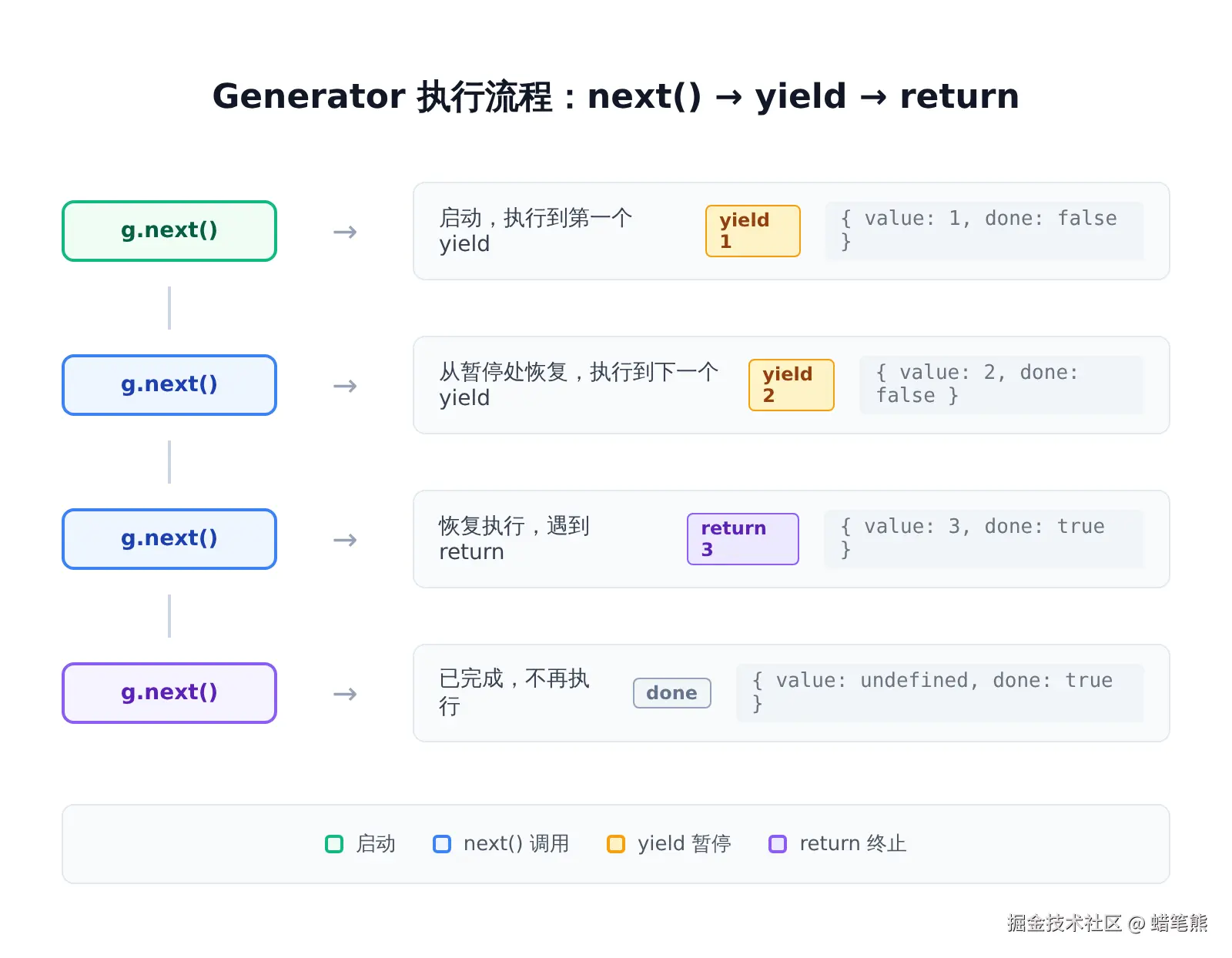
.next() 是控制 Generator 执行的基本方法。每次调用,Generator 从当前暂停处恢复执行,直到遇到下一个 yield 或 return,然后再次暂停。
js
function* gen() {
  console.log('开始执行');
  yield 1;
  console.log('第一次恢复');
  yield 2;
  console.log('第二次恢复');
  return 3;
}

const g = gen();
g.next();
// 打印:开始执行
// 返回:{ value: 1, done: false }

g.next();
// 打印:第一次恢复
// 返回:{ value: 2, done: false }

g.next();
// 打印:第二次恢复
// 返回:{ value: 3, done: true }

g.next();
// 不打印任何东西
// 返回:{ value: undefined, done: true }
几个要点:
- 第一次
next()启动 Generator,执行到第一个yield暂停 yield后面的表达式值会被包装成{ value, done: false }返回- 遇到
return,done变成true done: true之后再调next(),永远返回{ value: undefined, done: true }
Generator 执行流程图 --- 展示 next() 调用如何驱动 Generator 从 yield 到 return 的完整流程
3.2 yield 的双向通信
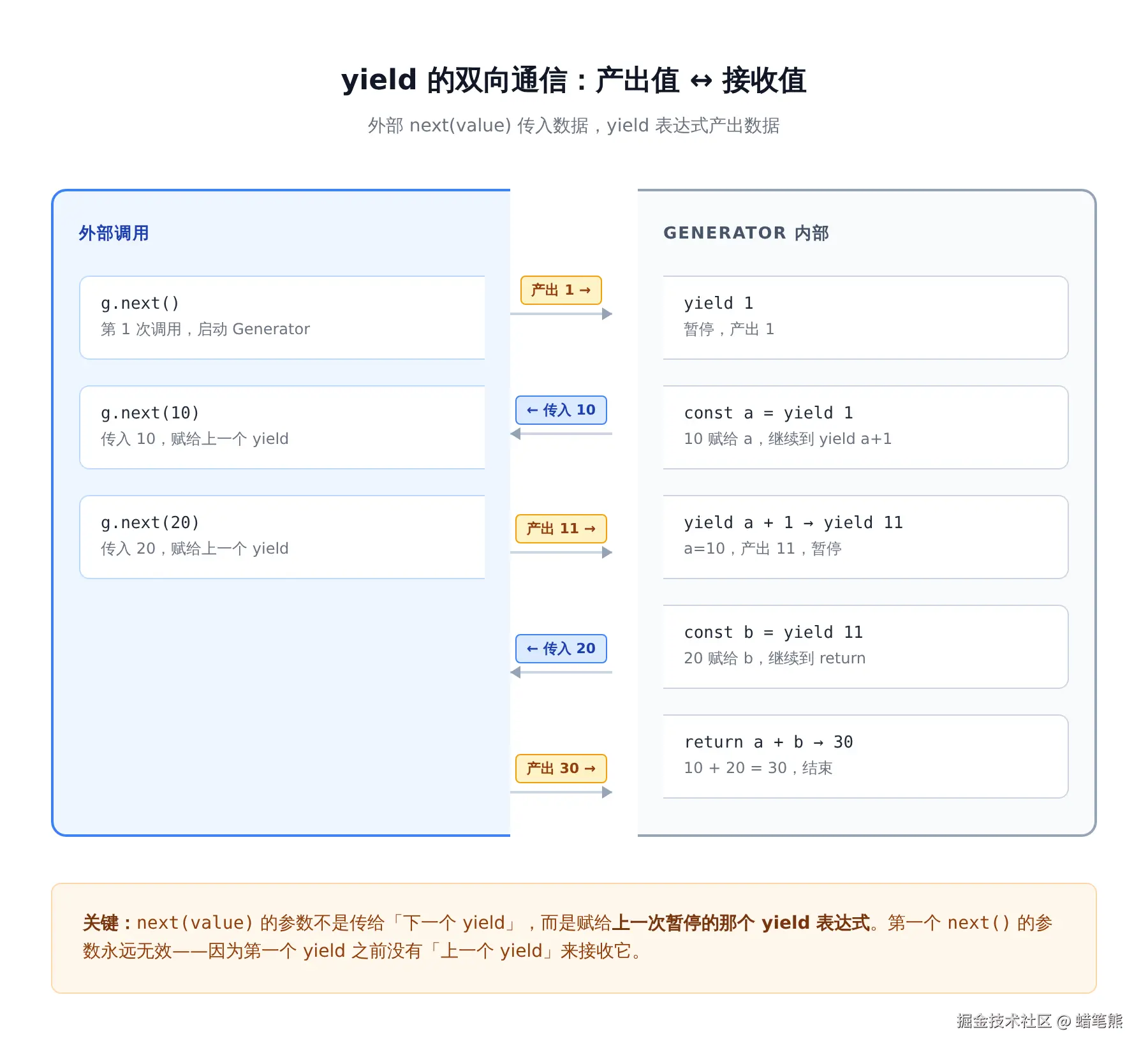
yield 不只是往外产出值,还能接收外面传进来的值。这是 Generator 做异步编程的关键。
js
function* gen() {
  const a = yield 1;
  const b = yield a + 1;
  return a + b;
}

const g = gen();
g.next();     // { value: 1, done: false } ------ 执行到 yield 1,暂停
g.next(10);   // { value: 11, done: false } ------ 10 赋给 a,执行到 yield 11
g.next(20); // { value: 30, done: true } ------ 20 赋给 b,return 10+20这里有个反直觉的点:next(10) 的参数 10 不是传给「下一个 yield」,而是赋给上一次暂停的那个 yield 表达式。
也就是说,const a = yield 1 这行代码被拆成了两步:
- 第一次
next():执行到yield 1,产出1,暂停 - 第二次
next(10):10作为yield 1整体的返回值赋给a,继续执行,可以理解为const a = 10
第一个 next() 的参数永远无效------因为第一个 yield 之前没有「上一个 yield」来接收它。这是个高频踩坑点,记住这个心智模型:
lua
next()      → 启动/恢复,执行到下一个 yield,产出值
next(value) → value 填入「刚才暂停处的 yield」,继续执行到下一个 yield
说实话,我第一次学 Generator 的时候在这个地方卡了很久------直觉上总以为 next(10) 的 10 是传给下一个 yield 的。后来才想明白,这个设计确实不直观,但理解了之后你会觉得它其实很合理。
来个更实际的例子------用 yield 双向通信模拟一个交互式问答流程:
js
function* interview() {
  const name = yield '你叫什么名字?';
  const years = yield `你好 ${name},你有几年经验?';
  const skill = yield `收到,${years} 年经验。你最擅长什么技术?`;
  return `面试结束:${name},${years}年经验,擅长${skill}`;
}

const it = interview();
console.log(it.next().value);            // 你叫什么名字?
console.log(it.next('蜡笔熊').value);     // 你好 蜡笔熊,你有几年经验?
console.log(it.next('5').value);          // 收到,5 年经验。你最擅长什么技术?
console.log(it.next('前端工程化').value);  // 面试结束:蜡笔熊,5年经验,擅长前端工程化
Generator 像一个可以「暂停等待输入」的状态机。每次 next(value) 把外面的数据传进去,Generator 处理后再 yield 出新的问题。Redux Saga 里的交互逻辑就是这么实现的。
yield 双向通信数据流图** --- 展示 next(value) 参数如何传入、yield 产出值如何传出,以及「参数赋给上一个 yield」的核心机制
3.3 yield*:委托给另一个 Generator
yield* 后面跟一个可迭代对象(另一个 Generator、数组、字符串等),会把它们的值逐个产出:
js
function* inner() {
  yield 'a';
  yield 'b';
  return 'inner-result';
}

function* outer() {
  yield 1;
  yield* inner();
  yield 2;
}

const g = outer();
g.next(); // { value: 1, done: false }
g.next(); // { value: 'a', done: false }
g.next(); // { value: 'b', done: false }
g.next(); // { value: 2, done: false }
g.next(); // { value: undefined, done: true }
yield* 和手动遍历有个关键区别:yield* 能拿到内层 Generator 的 return 值。
js
function* outer() {
  const result = yield* inner();
  console.log(result); // 'inner-result'
}
而 for...of 遍历 Generator 时会忽略 return 值------这点后面踩坑篇会细说。
3.4 throw():从外部抛入错误
.throw(error) 会在上次暂停的 yield 表达式处 抛出一个错误。如果 Generator 内部有 try/catch,可以捕获它并继续执行:
js
function* gen() {
  try {
    yield '正常执行';
  } catch (e) {
    console.log('内部捕获:', e.message);
    yield '错误后恢复';
  }
  return '结束';
}

const g = gen();
g.next();                       // { value: '正常执行', done: false }
g.throw(new Error('出错了'));   // 打印:内部捕获: 出错了
                                // → { value: '错误后恢复', done: false }
g.next();                       // { value: '结束', done: true }
如果内部没有 try/catch,错误会穿透到外部,Generator 直接终止:
js
function* gen() {
  yield 1;
  yield 2;
}

const g = gen();
g.next();  // { value: 1, done: false }

try {
  g.throw(new Error('没人接'));
} catch (e) {
  console.log('外部捕获:', e.message);  // 外部捕获: 没人接
}

// Generator 已终止,后续 next() 只返回 { value: undefined, done: true }
g.next();  // { value: undefined, done: true }
3.5 return():强制终止
.return(value) 立即终止 Generator,返回 { value, done: true }:
js
function* gen() {
  yield 1;
  yield 2;
  yield 3;
}

const g = gen();
g.next();              // { value: 1, done: false }
g.return('强制结束');  // { value: '强制结束', done: true }
g.next();              // { value: undefined, done: true }
如果 Generator 内部有 try...finally,return() 会先执行 finally 块:
js
function* gen() {
  try {
    yield 1;
    yield 2;
  } finally {
    console.log('finally 执行了');  // ← return() 触发了它
  }
}

const g = gen();
g.next();             // { value: 1, done: false }
g.return('结束');     // 打印:finally 执行了
// → { value: '结束', done: true }这三个方法(next、throw、return)构成了 Generator 的外部控制接口。普通函数你只能调用它,不能从外部干预它的执行流程。而 Generator 把「暂停/恢复/报错/终止」的控制权都交给了外部,也是后面理解自动执行器和 Redux Saga 的基础。
3.6 方法速查表
| 方法 | 作用 |
|---|---|
next() |
启动或恢复执行,返回 { value, done } |
next(value) |
恢复执行,value 作为上一个 yield 的返回值 |
throw(error) |
在上次暂停的 yield 处抛出错误 |
return(value) |
强制终止 Generator 并返回值 |
yield* |
委托另一个 Generator 或可迭代对象 |
四、Generator 与 Iterator 协议
为什么有些对象能用
for...of遍历,有些不能?答案就在这里。
4.1 Iterator 是什么?
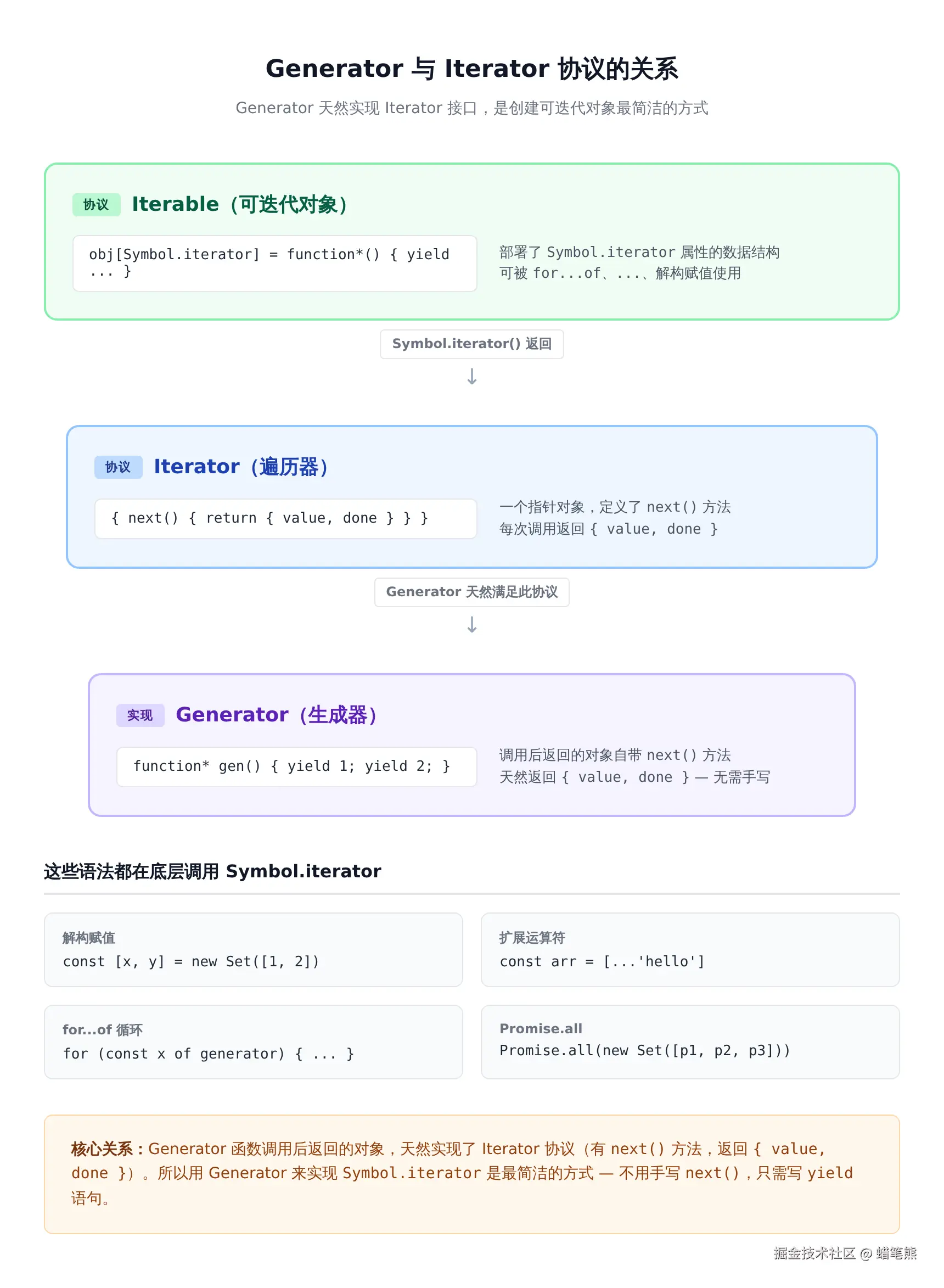
Generator 函数调用后返回的对象,天然就是一个 Iterator(遍历器)。要理解这层关系,得先知道 Iterator 是什么。
Generator 与 Iterator 协议关系图 --- 三层关系:Iterable → Iterator → Generator,以及常用语法如何调用 Symbol.iterator
JS 有很多数据结构需要遍历:Array、Map、Set、String、NodeList......如果每种结构都有一套自己的遍历方式,代码会很混乱。Iterator 的作用就是为所有数据结构提供统一的访问机制。
Iterator 的本质是一个指针对象,定义了 next() 方法,每次调用返回 { value, done }:
js
// 手写一个最简单的 Iterator
function makeIterator(array) {
  let index = 0;
  return {
    next() {
      return index < array.length
        ? { value: array[index++], done: false }
        : { value: undefined, done: true };
    }
  };
}

const it = makeIterator(['a', 'b']);
it.next();  // { value: 'a', done: false }
it.next();  // { value: 'b', done: false }
it.next();  // { value: undefined, done: true }
Iterator 不一定需要对应真实的数据结构。你可以写一个无限运行的 Iterator:
js
function idMaker() {
  let index = 0;
  return {
    next() {
      return { value: index++, done: false };
    }
  };
}

const ids = idMaker();
ids.next().value;  // 0
ids.next().value;  // 1
ids.next().value;  // 2
// ...无限产出
这个特性跟Generator特别契合,Generator 本质上就是一个自带 next 方法的 Iterator 生成器。
4.2 Symbol.iterator:可遍历协议
ES6 规定,一个数据结构只要部署了 Symbol.iterator 属性,就被视为可遍历的(iterable)。for...of、展开运算符 ...、解构赋值等语法在内部都会自动调用这个属性。
原生具备 Iterator 接口的数据结构:Array、Map、Set、String、TypedArray、arguments、NodeList。
普通对象(Object)没有------因为对象的属性遍历顺序不确定,需要开发者手动指定。
js
let arr = ['a', 'b', 'c'];
let iter = arr[Symbol.iterator]();

iter.next();  // { value: 'a', done: false }
iter.next();  // { value: 'b', done: false }
iter.next();  // { value: 'c', done: false }
iter.next();  // { value: undefined, done: true }
你可能不知不觉已经在用 Iterator 了------这些场景都会默认调用 Symbol.iterator:
js
// 解构赋值
const [x, y] = new Set([1, 2]);  // 调用 Set 的 Iterator

// 扩展运算符
const arr = [...'hello'];  // ['h', 'e', 'l', 'l', 'o']

// yield*
yield* [2, 3, 4];

// Promise.all 接受任何可迭代对象
Promise.all(new Set([p1, p2, p3]));
任何接受可迭代对象的 API,内部都在调用 Symbol.iterator。只要部署了这个接口,就可以用 for...of、...、解构等所有语法糖。
4.3 用 Generator 实现 Iterator 接口
手动写 Iterator 的 next() 方法很繁琐。用 Generator,只需要写 yield 语句:
js
// 让普通对象可被 for...of 遍历
const obj = { a: 1, b: 2, c: 3 };

obj[Symbol.iterator] = function* () {
  for (const key of Object.keys(this)) {
    yield [key, this[key]];
  }
};

for (const [k, v] of obj) {
  console.log(k, v);  // a 1 → b 2 → c 3
}

// 现在也可以用展开运算符了
console.log([...obj]);  // [['a', 1], ['b', 2], ['c', 3]]
Generator 函数调用后返回的对象,天然实现了 next() 方法,天然返回 { value: xxx, done: true/false }------天生就是一个 Iterator。这就是为什么用 Generator 来实现 Symbol.iterator 是最简洁的方式。
五、基础应用场景
场景一:异步流程的同步化表达
js
function* loadPage() {
  showLoading();
  const data = yield fetch('/api/data');   // 暂停等请求
  render(data);
  hideLoading();
}

// 手动执行
const loader = loadPage();
loader.next().value.then(response => {
  loader.next(response);
});
这是 Generator 最经典的用法------把异步操作写成同步风格。当然,手动执行很痛苦(每次都要调 next),第二篇会讲怎么用执行器自动化。而这正是 async/await 设计思路的来源。
场景二:惰性序列
Generator 天然适合生成无限序列,因为它是「按需产出」的:
js
function* naturalNumbers() {
  let n = 1;
  while (true) {
    yield n++;
  }
}

const numbers = naturalNumbers();
numbers.next().value;  // 1
numbers.next().value;  // 2
numbers.next().value;  // 3
// ...永远不会爆内存
while(true) 在普通函数里是个灾难,但在 Generator 里完全没问题------因为只有调用 next() 才会执行一步。这就是惰性求值的威力。
场景三:状态机
js
function* trafficLight() {
  while (true) {
    yield '🟢 绿灯';
    yield '🟡 黄灯';
    yield '🔴 红灯';
  }
}

const light = trafficLight();
setInterval(() => {
  console.log(light.next().value);
}, 3000);
// 每 3 秒切换一次信号灯
用 Generator 实现状态机,不需要外部变量来保存状态------状态就内嵌在函数的执行位置里。执行到哪个 yield,就是哪个状态。
本篇小结
| 要点 | 说明 |
|---|---|
function* |
声明 Generator 函数 |
yield |
暂停执行并产出值 |
.next(value) |
恢复执行,value 作为上一个 yield 的返回值 |
.throw(error) |
向 Generator 内部抛出错误 |
.return(value) |
终止 Generator 并返回值 |
yield* |
委托另一个 Generator 或可迭代对象 |
Symbol.iterator |
可遍历协议,Generator 天然实现这个接口 |
Generator 的核心就这些------function* 声明、yield 暂停、next 恢复、throw/return 外部控制。语法本身不复杂,但它的执行机制和普通函数完全不同。
那么JS 引擎到底是怎么实现「暂停」的? 一个函数执行到一半挂起,它的调用栈、局部变量、执行上下文是怎么保存的?yield 在底层到底发生了什么?
下一篇我们会把 Generator 放到 Babel 编译器下,看看 ES6 的 function* 被编译成 ES5 后是什么样子------你会发现,所谓的「暂停」和「恢复」,本质上是一个状态机。答案可能出乎你的意料。
系列预告:
- 第二篇:Babel 编译产物剖析 + V8 引擎层面的暂停机制
- 第三篇:自动执行器 + async/await 与 Generator 的关系 + 高阶玩法 + 面试题(系列收尾)
如果觉得有帮助,欢迎关注。