在 Agent 执行过程中的各个环节暴露出来的钩子函数,使用中间件可以控制和定制 Agent 的执行过程、输出以及增加健壮性(添加一些业务相关的逻辑,比如日志)。
此外中间件还能把一些通用的与业务关系不大的业务抽离出来,让 Agent 具有更好的复用性;带有钩子函数的 Agent 执行逻辑
内置中间件
在 Langchain 中也提供了一系列的内置中间件;
py
from langchain.agents.middleware import SummarizationMiddleware, ...
from deepagents.middleware.subagents import SubAgentMiddleware, ...Summarization对历史消息进行摘要总结(避免上下文爆炸)HumanInTheLoop暂停执行、等待人工审核ModelCallLimit | ToolCallLimit限制模型或工具的执行次数ModelFalback当主模型发生故障时,自动回退到备用模型。PIIDetetion敏感信息检测转码TodoList让 Agent 做事前先列计划LLMToolSelector当工具太多时,用子模型筛选最相关的几个工具ToolRetry | ModelRetry通过指数退避算法,设置工具或模型失败时的重试策略LLMToolEmulator当工具未完善时,模拟工具执行 mock 方案ContextEditing上下文编辑,可以控制最终给模型哪些消息FileSearch基于 Glob 和 Grep 检索工具给 Agent 赋予本地文件检索和分析的FileSystem为代理提供文件系统,用于存储上下文和长期记忆;来源于 DeepAgentsSubagent创建子 Agent 来源于 DeepAgents
SummarizationMiddleware
对历史消息进行摘要总结、有压缩上下文的效果;
model摘要模型,字符串或者init_chat_model返回值trigger触发条件,列表嵌套元组messages摘要的消息树tokens摘要 token 数量fraction摘要的百分比模型 token 上限 * 系数百分比,浮点数keep与trigger参数一致,但是仅接受一个值,需要保留的内容summary_prompt总结消息的 prompttrim_tokens_to_summarize总结调用的最大值,超过则会被修剪
py
model = init_chat_model(
    "openai:kimi-k2.6",
    base_url=os.environ.get("OPENAI_BASE_URL"),
    # 手动设置模型最大 token 数
    profile={"max_input_tokens": 262144}
)

messages  = [
  HumanMessage("你好派大星,我是海绵宝宝"),
  AIMessage("你好海绵宝宝"),
  HumanMessage("我们一起去抓水母吧~"),
  AIMessage("等等我,海绵宝宝!我的水母网... "),
  HumanMessage("今天工作日,我要去蟹老板那里打工了~")
]
agent = create_agent(
    model,
    middleware=[
      SummarizationMiddleware(
        model,
        trigger=[
            ("messages", 2),
            # max token 的 10% 触发
            # 有些模型 langchain 无法知道最大 token 数,所以要手动设置
            ("fraction", 0.1),
            ("tokens", 100)
        ],
        # 和 trigger 配合,需要保留的消息数
        keep=("messages", 2),
        # {messages} 一定要有,不然模型也不知道你想摘要什么内容
        summary_prompt="用中文繁体总结消息内容 \n{messages}"
      )
    ]
)
result = agent.invoke({"messages": messages})

for message in result["messages"]:
    print(message.pretty_print())
HumanInTheLoopMiddleware
中断 Agent 调用工具的过程,审核后再执行;
interrupt_on审核动作,字段类型<tool_name>: boolTrue 表示[approve, reject, edit]False 表示跳过<tool_name>: { allowed_decisions: [approve, reject, edit], description: xxx }可以直接通过数组指定模型和描述
description_prefix中断的描述信息,没有内部description的优先级高
py
from langgraph.checkpoint.memory import InMemorySaver
from langgraph.types import Command

@tool
def get_weather(city: str, is_forcast=False) -> str:
    """获取指定城市天气预报"""
    return f"{city} 是晴天 {'明天有雨' if is_forcast else '明天晴天'}"

agent = create_agent(
    model,
    tools=[get_weather],
    middleware=[
      HumanInTheLoopMiddleware(
        interrupt_on={
          # "get_weather": True,
          "get_weather": {
            "allowed_decisions": ["edit"],
            "description": "优先级更高的中断描述信息"
          }
        },
        description_prefix="工具调用中断~"
      )
    ],
    # 保证中断和回复在一个会话中,所以要有记忆
    checkpointer=InMemorySaver()
)

config = {"configurable": {"thread_id": "1"}}
result = agent.invoke({"messages": [HumanMessage("上海的天气怎么样?")]}, config=config)

# 被中断响应中,拥有 __interrupt__ 属性,数组类型
# rprint(result["__interrupt__"])
# [
#     Interrupt(
#         value={
#             'action_requests': [{'name': 'get_weather', 'args': {'city': '上海'}, 'description': '优先级更高的中断描述'}],
#             'review_configs': [{'action_name': 'get_weather', 'allowed_decisions': ['edit']}]
#         },
#         id='481eead7a0f73bd98af8892baa7e7be5'
#     )
# ]

if result["__interrupt__"]:
    # 通过 command 回复执行
    resume_result = agent.invoke(
        Command(resume={
            "decisions": [
              # 编辑的话,需要指定 edited_action 从新调用 tool
              # 实际就是参考 result["__interrupt__"][0].value["action_requests"] 中的内容调整参数从新调用一下
              {
                  "type": "edit",
                  "edited_action": {
                      "name": "get_weather",
                      "args": {"city": "上海", "is_forcast": False}
                  }
              }
              # 通过
              {"type": "approve"}
            ]
        }),
        config=config
    )

    rprint(resume_result)
PIIMiddleware
敏感信息加密
pii_type需要被加密的数据类型,支持自定义;"email" | "credit_card" | "url" | "ip" | "mac_address"strategy加密方案redact默认值,替换为[REDACTED_EMAIL]常量mask部分屏蔽,显示最后几个字符hash转换为 hashblock直接抛异常
detector自定义检测函数正则字符串或者函数apply_to_input模型调用前检查 默认 Trueapply_to_output模型调用后检查 默认 Falseapply_to_tool_results工具执行后检查 默认 False
py
agent = create_agent(
    model,
    middleware=[
        PIIMiddleware("email", strategy="redact"),
        PIIMiddleware("url", strategy="hash"),
        PIIMiddleware("credit_card", strategy="mask"),
        PIIMiddleware("mac_address", strategy="mask"),
        PIIMiddleware("ip", strategy="mask")
    ],
)

result = agent.invoke({
  "messages": HumanMessage("""这是什么邮箱 1234567890@qq.com
                            这是什么 mac 地址 02:4A:7C:9E:3F:1B
                            这是什么 ip 192.168.0.1
                            这是什么银行卡号 6226 1234 5678 9012
                            这是什么 url http://www.baidu.com"""
                        )
})

# 这是什么邮箱 [REDACTED_EMAIL]
# 这是什么 mac 地址 **:**:**:**:**:1B
# 这是什么 ip *.*.*.1
# 这是什么银行卡号 6226 1234 5678 9012
# 这是什么 url <url_hash:035db66d>
rprint(result["messages"][0].content)
TodoListMiddleware
应对比较复杂任务时,可以为模型提供规划能力,减缓降智
py
agent = create_agent(
    model,
    middleware=[
      # 接受两个参数
      # system_prompt 系统系统词 内置
      # tool_description 工具描述信息,内置
      TodoListMiddleware()
    ],
)
# 实际内部就是通过 write_todos 创建规划任务,创建一个列表一项项的完成
# {
#     'name': 'write_todos',
#     'args': {
#         'todos': [
#             {'content': '确定上海一日游的主题和必去景点(如外滩、豫园、陆家嘴等)', 'status': 'in_progress'},
#             {'content': '规划合理的游览路线和时间安排,避免走回头路', 'status': 'pending'},
#             {'content': '安排用餐时间和地点,体验上海本帮菜或特色小吃', 'status': 'pending'},
#             {'content': '考虑交通方式(地铁/打车/步行)及各景点间的通勤时间', 'status': 'pending'},
#             {'content': '准备备选方案和注意事项(天气、人流、门票预约等)', 'status': 'pending'}
#         ]
#     },
#     'id': 'write_todos_0',
#     'type': 'tool_call'
# }
result = agent.invoke({"messages": HumanMessage("使用 write_todos 帮我规划一个上海一日游")})
ModelCallLimitMiddleware
thread_limit线程内模型调用上限run_limit本次运行模型调用上限exit_behaviorend | error优雅退出和抛出异常
py
agent = create_agent(
    model,
    middleware=[
      ModelCallLimitMiddleware(
        thread_limit=1,
        # run_limit=1,
        # exit_behavior="end",
        exit_behavior="error"
      )
    ],
    tools=[get_weather],
    checkpointer=InMemorySaver()
)
config = {"configurable": {"thread_id": "1"}}

# Model call limits exceeded: run limit (1/1)
# Model call limits exceeded: thread limit (1/1)
# langchain.agents.middleware.model_call_limit.ModelCallLimitExceededError
result = agent.invoke({"messages": HumanMessage("今天上海天气怎么样")}, config=config)
ToolCallLimitMiddleware
tool_name不指定就监控所有工具,否则就指定工具thread_limit线程内工具调用上限run_limit本次运行工具调用上限exit_behavior比较模型中间多出continue表示继续运行 Agent,模型自主决策后续行为
ModelFallbackMiddleware
后备模型,当主模型失败时,会使用该模型
py
model = init_chat_model(
    "openai:kimi-k100",
    base_url=os.environ.get("OPENAI_BASE_URL"),
)
agent = create_agent(
    model,
    middleware=[
      ModelFallbackMiddleware("deepseek:deepseek-v4-flash")
    ],
)
result = agent.invoke({"messages": [HumanMessage("你是什么模型?")]})
LLMToolSelectorMiddleware
工具选择
py
agent = create_agent(
    model,
    middleware=[
      LLMToolSelectorMiddleware(
        model=model, # 选择工具的模型
        max_tools=2, # 最多支持选择工具的数量
        # always_include=["get_weather"] # 在这里面的工具不会被计数
      )
    ],
    tools=[get_news, get_weather]
)
result = agent.invoke({"messages": [HumanMessage("上海天气如何?使用 get_news 看看新闻")]})
ToolRetryMiddleware
基于指数退避算法,设置工具调用失败时的重试策略并且结合 jitter 实现抖动,防止短期迎来并发
py
class ToolRetryMiddleware(
    *,
    # 最大重试次数,不包含初次调用 2 + 1 = 3
    max_retries: int = 2,
    # None 表示所有工具
    tools: list[BaseTool | str] | None = None,
    # 捕获的异常
    retry_on: RetryOn = (Exception, ),
    # 返回包含错误详细信息的"ToolMessage" error 则是抛异常
    on_failure: OnFailure = "continue",
    # 每次重试等待时间 * 2
    backoff_factor: float = 2,
    # 初始重试等待时间
    initial_delay: float = 1,
    # 最大等待延迟上限
    max_delay: float = 60,
    # 增加抖动
    jitter: bool = True
)
py
agent = create_agent(
    model,
    middleware=[
      ToolRetryMiddleware(
          max_retries=5,
          max_delay=10.0,
          retry_on=(TimeoutError,)
      )
    ],
    tools=[get_weather]
)
res = agent.invoke({"messages": [HumanMessage("上海天气怎么样")]})
rprint(res["messages"])
# 包含信息
# ToolMessage(
#     content="Tool 'get_weather' failed after 6 attempts with TimeoutError: . Please try again.",
#     name='get_weather',
#     id='12a5e2a3-b044-4dc1-909f-a5339ccb77a3',
#     tool_call_id='call_00_D4JALj3Ptmtaj5ogGQy27292',
#     status='error'
# ),
ModelRetryMiddleware
参数与 ToolRetryMiddleware 一致
py
agent = create_agent(
    'deepseek:deepseek-cat',
    middleware=[
      ModelRetryMiddleware(
          max_retries=5,
          max_delay=10.0,
          on_failure="continue"
      )
    ]
)

res = agent.invoke({"messages": [HumanMessage("上海天气怎么样")]})
rprint(res["messages"])
# AIMessage(
#       content="Model call failed after 6 attempts with BadRequestError: Error code: 400 - {'error': {'message': 'The supported API model names are deepseek-v4-pro or
# deepseek-v4-flash, but you passed deepseek-cat.', 'type': 'invalid_request_error', 'param': None, 'code': 'invalid_request_error'}}",
#       additional_kwargs={},
#       response_metadata={},
#       id='aafb281c-234b-4b63-96e5-9775ddc8fabb',
#       tool_calls=[],
#       invalid_tool_calls=[]
# )
LLMToolEmulator
当工具不完善的时候,可以使用该中间件达到 mock 的效果
py
agent = create_agent(
    model,
    middleware=[
      # 会默认使用这个去模拟工具的执行
      LLMToolEmulator(model=model, tools=['get_weather'])
    ],
    tools=[get_weather]
)

res = agent.invoke({"messages": [HumanMessage("上海天气怎么样")]})
rprint(res["messages"])
中间件的执行顺序
遵循先进后出的策略,
1 -> 2 -> 3 -> 3 -> 2 -> 1
自定义中间件
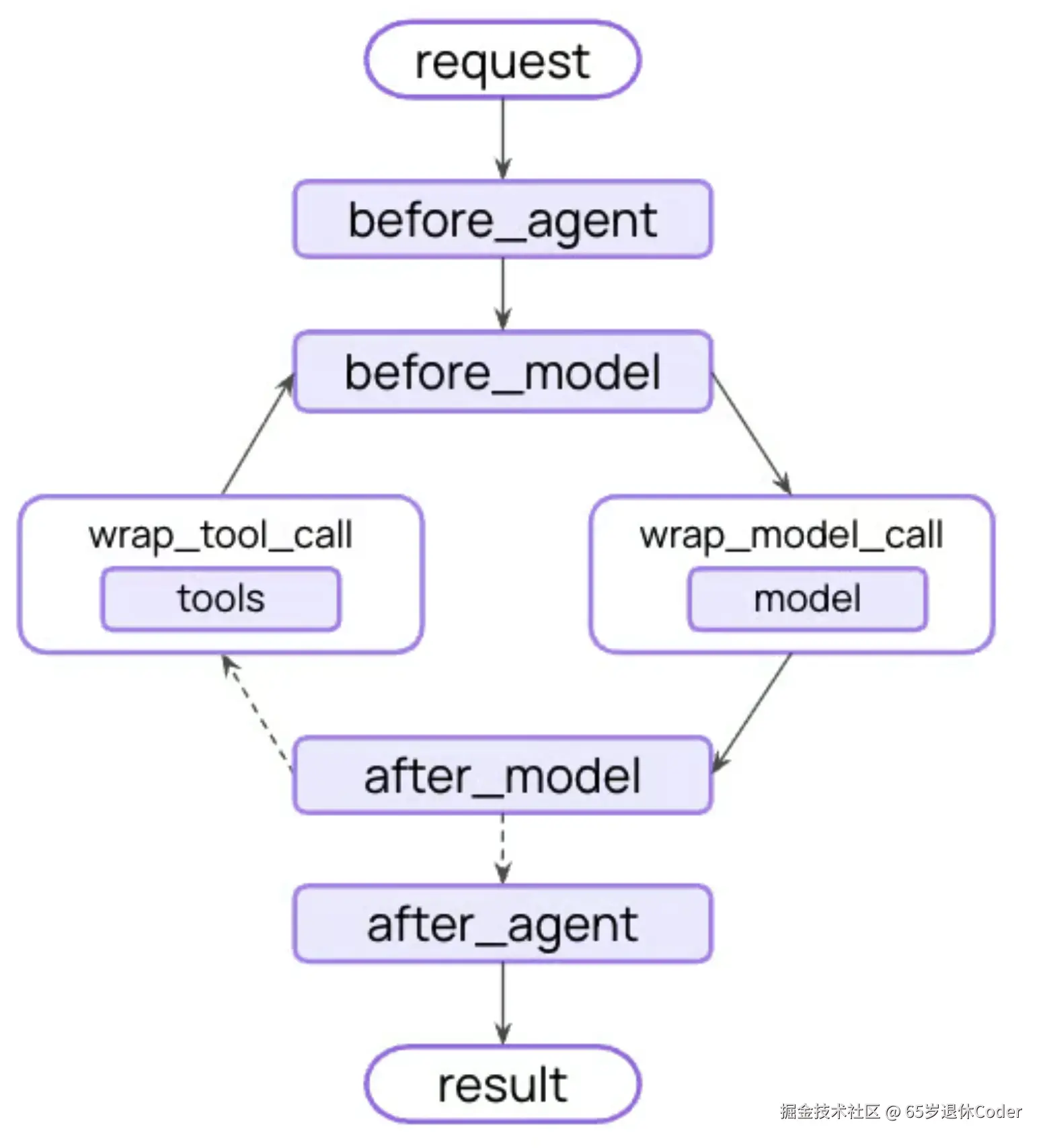
中间件提供了六个钩子函数,按照功能可划分为两组
Node-style hooks
before_agent智能体调用前after_agent智能体调用后before_model模型调用前after_model模型调用后
Wrap-style hooks
wrap_model_call模型调用前后执行wrap_tool_call工具调用前后执行
每个中间件都会用到其中多个或一个钩子函数,针对中间件的书写也提供了函数式和类两种方案(函数式一般仅使用一个钩子时使用);函数最终也会被内部包装成类去执行
Node Style -> function
py
@before_agent
def before_agent_middleware(state: AgentState, runtime: Runtime):
    print("=== before_agent ===")
    return None

@after_agent
def after_agent_middleware(state: AgentState, runtime: Runtime):
    print("=== after_agent ===")
    return None

@before_model
def before_model_middleware(state: AgentState, runtime: Runtime):
    print("=== before_model ===")
    return None

@after_model
def after_model_middleware(state: AgentState, runtime: Runtime):
    print("=== after_model ===")
    return None

agent = create_agent(
    model,
    middleware=[before_agent_middleware, after_agent_middleware, before_model_middleware, after_model_middleware],
)
agent.invoke({"messages": [HumanMessage("hello")]})

# === before_agent ===
# === before_model ===
# === after_model ===
# === after_agent ===
接收 AgentState | Runtime 两个参数,返回值为 dict[str, Any] | None。
AgentState是 Agent 运行中的状态,随着 Agent 的运行发行变化,包括消息列表也在其中。Runtime是 Agent 运行中的上下文环境,包括上下文和长期记忆。- 返回值如果是
None表示不做任何操作,返回字典可以状态;返回特定字段可以控制 Agent 流程;
py
def before_model(self, state, runtime):
    if state.get("count", 0) > 10:
      #  tools 调到工具节点
      return {"jump_to": "__end__"} # 跳过模型,直接结束

# 修改 state
@after_agent
def after_agent_middleware(state: AgentState, runtime: Runtime):
    state["messages"][-1].content += "after_agent"
    return None
state | runtime 的信息如下
py
# 随着不同的钩子数据也会有变化,比如 before_agent 只有 human 消息, after_agent 就会多一条 AI 消息
{'messages': [HumanMessage(content='hello', additional_kwargs={}, response_metadata={}, id='f577b4bc-722a-4cf7-9891-263d37120559')]}

Runtime(
    context=None,
    store=None,
    stream_writer=<function Pregel.stream.<locals>.stream_writer at 0x10f47c4a0>,
    heartbeat=<function _no_op_heartbeat at 0x1084f5620>,
    previous=None,
    execution_info=ExecutionInfo(
        checkpoint_id='1f184dd4-4b99-6b70-8001-aef8a60a67cd',
        checkpoint_ns='before_model_middleware.before_model:550f9db1-2052-10ef-6835-8c4766468404',
        task_id='550f9db1-2052-10ef-6835-8c4766468404',
        thread_id=None,
        run_id=None,
        node_attempt=1,
        node_first_attempt_time=1784622130.085105
    ),
    server_info=None,
    control=<langgraph.runtime.RunControl object at 0x10f33ebc0>
)
before_** 通常用于消息修剪、数据脱敏、数据输入验证等操作
after_** 通常用于状态统计、输出验证、格式化响应
can_jump_to 参数
中间件装饰器的参数,决定钩子可以直接跳转到流程的哪些地方
tools跳转至工具节点end跳转至 Agent 流程的末尾,或者第一个after_agent钩子model跳转至模型节点,或者第一个before_model钩子
py
@after_model(can_jump_to=["tools"])
def after_model_middleware(state: AgentState, runtime: Runtime):
    print("=== after_model ===")
    return None
Node Style -> class
类实现要继承 AgentMiddleware 这个类
py
from langchain.agents.middleware from AgentMiddleware, hook_config

class CustomMiddleware(AgentMiddleware):
    def __init__(self):
        super().__init__()

    @hook_config(['end', 'tools', 'model'])
    def before_agent(self, state, runtime):
        return None

    def before_model(self, state, runtime):
        return None

    def after_agent(self, state, runtime):
        return None

    def after_model(self, state, runtime):
        return None
Wrap Style -> function
py
@wrap_model_call
def wrap_model_call_middleware(request: ModelRequest, handler: Callable[[ModelRequest], ModelResponse],) -> ModelResponse:
    rprint(request)
#     ModelRequest(
#     model=ChatDeepSeek(
#         metadata={'lc_versions': {'langchain-core': '1.4.9', 'langchain': '1.3.12', 'langchain-openai': '1.3.4'}},
#         output_version=None,
#         profile={
#             'name': 'DeepSeek Chat',
#             'release_date': '2025-12-01',
#             'last_updated': '2026-02-28',
#             'open_weights': True,
#             'max_input_tokens': 1000000,
#             'max_output_tokens': 384000,
#             'text_inputs': True,
#             'image_inputs': False,
#             'audio_inputs': False,
#             'video_inputs': False,
#             'text_outputs': True,
#             'image_outputs': False,
#             'audio_outputs': False,
#             'video_outputs': False,
#             'reasoning_output': False,
#             'tool_calling': True,
#             'attachment': True,
#             'temperature': True
#         },
#         client=<openai.resources.chat.completions.completions.Completions object at 0x114384980>,
#         async_client=<openai.resources.chat.completions.completions.AsyncCompletions object at 0x114385400>,
#         root_client=<openai.OpenAI object at 0x111e50ad0>,
#         root_async_client=<openai.AsyncOpenAI object at 0x114384ad0>,
#         model_name='deepseek-chat',
#         model_kwargs={},
#         openai_api_key=SecretStr('**********'),
#         openai_proxy=None,
#         stream_chunk_timeout=120.0,
#         extra_body={'thinking': {'type': 'disabled'}},
#         api_key=SecretStr('**********'),
#         api_base='https://api.deepseek.com/v1'
#     ),
#     messages=[HumanMessage(content='你好派大星', additional_kwargs={}, response_metadata={}, id='94c72eca-8068-4c30-9a77-731bb6f43af5')],
#     system_message=None,
#     tool_choice=None,
#     tools=[],
#     response_format=None,
#     state={'messages': [HumanMessage(content='你好派大星', additional_kwargs={}, response_metadata={}, id='94c72eca-8068-4c30-9a77-731bb6f43af5')]},
#     runtime=Runtime(
#         context=None,
#         store=None,
#         stream_writer=<function Pregel.stream.<locals>.stream_writer at 0x11454c180>,
#         heartbeat=<function _no_op_heartbeat at 0x110641620>,
#         previous=None,
#         execution_info=ExecutionInfo(
#             checkpoint_id='1f184e4e-eab6-694a-8000-417655033d5c',
#             checkpoint_ns='model:cecf60ab-f4c0-d4f6-decf-f5ee3248f1c4',
#             task_id='cecf60ab-f4c0-d4f6-decf-f5ee3248f1c4',
#             thread_id=None,
#             run_id=None,
#             node_attempt=1,
#             node_first_attempt_time=1784625421.681778
#         ),
#         server_info=None,
#         control=<langgraph.runtime.RunControl object at 0x1128d64a0>
#     ),
#     model_settings={}
# )

    # 调用模型的动作
    response = handler(request)
    return response
py
@wrap_tool_call
def model_tool_call_middleware(request: ToolCallRequest, handler: Callable[[ToolCallRequest], ToolMessage | Command]) -> ToolMessage | Command:
    rprint(request)
#   ToolCallRequest(
#     tool_call={'name': 'get_weather', 'args': {'city': '上海'}, 'id': 'call_00_WgdCPVqeejoaDfDinENH6195', 'type': 'tool_call'},
#     tool=StructuredTool(
#         name='get_weather',
#         description='获取天气状况',
#         args_schema=<class 'langchain_core.utils.pydantic.get_weather'>,
#         func=<function get_weather at 0x1076b9b20>
#     ),
#     state={
#         'messages': [
#             HumanMessage(content='上海天气怎么样', additional_kwargs={}, response_metadata={}, id='2662c1f2-f87c-451e-ad29-443ecbd2f3be'),
#             AIMessage(
#                 content='好的,我来查询一下上海的天气情况。',
#                 additional_kwargs={'refusal': None},
#                 response_metadata={
#                     'token_usage': {
#                         'completion_tokens': 53,
#                         'prompt_tokens': 273,
#                         'total_tokens': 326,
#                         'completion_tokens_details': None,
#                         'prompt_tokens_details': {'audio_tokens': None, 'cache_write_tokens': None, 'cached_tokens': 256},
#                         'prompt_cache_hit_tokens': 256,
#                         'prompt_cache_miss_tokens': 17
#                     },
#                     'model_provider': 'deepseek',
#                     'model_name': 'deepseek-v4-flash',
#                     'system_fingerprint': 'fp_8b330d02d0_prod0820_fp8_kvcache_20260402',
#                     'id': 'd892560b-e329-4bcb-8f81-9a30db3776c3',
#                     'finish_reason': 'tool_calls',
#                     'logprobs': None
#                 },
#                 id='lc_run--019f83fe-5ee8-70b3-9edc-389b4917dd67-0',
#                 tool_calls=[{'name': 'get_weather', 'args': {'city': '上海'}, 'id': 'call_00_WgdCPVqeejoaDfDinENH6195', 'type': 'tool_call'}],
#                 invalid_tool_calls=[],
#                 usage_metadata={'input_tokens': 273, 'output_tokens': 53, 'total_tokens': 326, 'input_token_details': {'cache_read': 256}, 'output_token_details': {}}
#             )
#         ]
#     },
#     runtime=ToolRuntime(
#         state={
#             'messages': [
#                 HumanMessage(content='上海天气怎么样', additional_kwargs={}, response_metadata={}, id='2662c1f2-f87c-451e-ad29-443ecbd2f3be'),
#                 AIMessage(
#                     content='好的,我来查询一下上海的天气情况。',
#                     additional_kwargs={'refusal': None},
#                     response_metadata={
#                         'token_usage': {
#                             'completion_tokens': 53,
#                             'prompt_tokens': 273,
#                             'total_tokens': 326,
#                             'completion_tokens_details': None,
#                             'prompt_tokens_details': {'audio_tokens': None, 'cache_write_tokens': None, 'cached_tokens': 256},
#                             'prompt_cache_hit_tokens': 256,
#                             'prompt_cache_miss_tokens': 17
#                         },
#                         'model_provider': 'deepseek',
#                         'model_name': 'deepseek-v4-flash',
#                         'system_fingerprint': 'fp_8b330d02d0_prod0820_fp8_kvcache_20260402',
#                         'id': 'd892560b-e329-4bcb-8f81-9a30db3776c3',
#                         'finish_reason': 'tool_calls',
#                         'logprobs': None
#                     },
#                     id='lc_run--019f83fe-5ee8-70b3-9edc-389b4917dd67-0',
#                     tool_calls=[{'name': 'get_weather', 'args': {'city': '上海'}, 'id': 'call_00_WgdCPVqeejoaDfDinENH6195', 'type': 'tool_call'}],
#                     invalid_tool_calls=[],
#                     usage_metadata={'input_tokens': 273, 'output_tokens': 53, 'total_tokens': 326, 'input_token_details': {'cache_read': 256}, 'output_token_details': {}}
#                 )
#             ]
#         },
#         context=None,
#         config={
#             'tags': [],
#             'metadata': {
#                 'ls_integration': 'langchain_create_agent',
#                 'langgraph_step': 2,
#                 'langgraph_node': 'tools',
#                 'langgraph_triggers': ('__pregel_push',),
#                 'langgraph_path': ('__pregel_push', 0, False),
#                 'langgraph_checkpoint_ns': 'tools:3de491c7-7a2b-4851-d2d4-910543884caf',
#                 'checkpoint_ns': 'tools:3de491c7-7a2b-4851-d2d4-910543884caf'
#             },
#             'callbacks': <langchain_core.callbacks.manager.CallbackManager object at 0x110a0c6d0>,
#             'recursion_limit': 9999,
#             'configurable': {
#                 '__pregel_runtime': Runtime(
#                     context=None,
#                     store=None,
#                     stream_writer=<function Pregel.stream.<locals>.stream_writer at 0x1107ad6c0>,
#                     heartbeat=<function _no_op_heartbeat at 0x105ce5620>,
#                     previous=None,
#                     execution_info=ExecutionInfo(
#                         checkpoint_id='1f184e61-4810-6b56-8001-fb803c7cb82d',
#                         checkpoint_ns='tools:3de491c7-7a2b-4851-d2d4-910543884caf',
#                         task_id='3de491c7-7a2b-4851-d2d4-910543884caf',
#                         thread_id=None,
#                         run_id=None,
#                         node_attempt=1,
#                         node_first_attempt_time=1784625914.654541
#                     ),
#                     server_info=None,
#                     control=<langgraph.runtime.RunControl object at 0x11066ce80>
#                 ),
#                 '__pregel_replay_state': None,
#                 '__pregel_task_id': '3de491c7-7a2b-4851-d2d4-910543884caf',
#                 '__pregel_send': <built-in method extend of collections.deque object at 0x11076c4f0>,
#                 '__pregel_read': functools.partial(<function local_read at 0x105ce6520>, PregelScratchpad(step=2, stop=9999, call_counter=<langgraph.pregel._algo.LazyAtomicCounter
# object at 0x1101f1f90>, interrupt_counter=<langgraph.pregel._algo.LazyAtomicCounter object at 0x1107f48e0>, get_null_resume=<function _scratchpad.<locals>.get_null_resume at
# 0x1107adbc0>, resume=[], subgraph_counter=<langgraph.pregel._algo.LazyAtomicCounter object at 0x1107f4280>), {'messages': <langgraph.channels.binop.BinaryOperatorAggregate object
# at 0x1107cb080>, 'jump_to': <langgraph.channels.ephemeral_value.EphemeralValue object at 0x1107cb180>, 'structured_response': <langgraph.channels.last_value.LastValue object at
# 0x1107caec0>, '__start__': <langgraph.channels.ephemeral_value.EphemeralValue object at 0x1107cab80>, '__pregel_tasks': <langgraph.channels.topic.Topic object at 0x1107cad40>,
# 'branch:to:model': <langgraph.channels.ephemeral_value.EphemeralValue object at 0x1107cac40>, 'branch:to:tools': <langgraph.channels.ephemeral_value.EphemeralValue object at
# 0x1107caac0>}, {}, PregelTaskWrites(path=('__pregel_push', 0, False), name='tools', writes=deque([]), triggers=('__pregel_push',))),
#                 '__pregel_checkpointer': None,
#                 'checkpoint_map': {'': '1f184e61-4810-6b56-8001-fb803c7cb82d'},
#                 'checkpoint_id': None,
#                 'checkpoint_ns': 'tools:3de491c7-7a2b-4851-d2d4-910543884caf',
#                 '__pregel_scratchpad': PregelScratchpad(
#                     step=2,
#                     stop=9999,
#                     call_counter=<langgraph.pregel._algo.LazyAtomicCounter object at 0x1101f1f90>,
#                     interrupt_counter=<langgraph.pregel._algo.LazyAtomicCounter object at 0x1107f48e0>,
#                     get_null_resume=<function _scratchpad.<locals>.get_null_resume at 0x1107adbc0>,
#                     resume=[],
#                     subgraph_counter=<langgraph.pregel._algo.LazyAtomicCounter object at 0x1107f4280>
#                 ),
#                 '__pregel_call': functools.partial(<function _call at 0x105d1fb00>, <weakref at 0x1107e76a0; to 'langgraph.types.PregelExecutableTask' at 0x1107ad9f0>,
# retry_policy=None, futures=<weakref at 0x1107a2200; to 'langgraph.pregel._runner.FuturesDict' at 0x1107e74d0>, schedule_task=<bound method SyncPregelLoop.accept_push of
# <langgraph.pregel._loop.SyncPregelLoop object at 0x1107cc690>>, submit=<weakref at 0x1107fc450; to 'langgraph.pregel._executor.BackgroundExecutor' at 0x1107cc7d0>)
#             }
#         },
#         stream_writer=<function Pregel.stream.<locals>.stream_writer at 0x1107ad6c0>,
#         tool_call_id='call_00_WgdCPVqeejoaDfDinENH6195',
#         store=None,
#         tools=[
#             StructuredTool(
#                 name='get_weather',
#                 description='获取天气状况',
#                 args_schema=<class 'langchain_core.utils.pydantic.get_weather'>,
#                 func=<function get_weather at 0x1076b9b20>
#             )
#         ],
#         execution_info=ExecutionInfo(
#             checkpoint_id='1f184e61-4810-6b56-8001-fb803c7cb82d',
#             checkpoint_ns='tools:3de491c7-7a2b-4851-d2d4-910543884caf',
#             task_id='3de491c7-7a2b-4851-d2d4-910543884caf',
#             thread_id=None,
#             run_id=None,
#             node_attempt=1,
#             node_first_attempt_time=1784625914.654541
#         ),
#         server_info=None
#     )
# )
    # 调用工具
    request.tool_call["args"]["is_forcast"] = True
    result = handler(request)
    return result
Wrap Style -> class
py
class WrapMiddleware(AgentMiddleware):
    def __init__(self):
        super().__init__()

    def wrap_model_call(self, request, handler):
        return None

    def wrap_tool_call(self, request, handler):
        return None
中间件执行顺序
py
class CustomMiddleware(AgentMiddleware):
    def __init__(self):
        super().__init__()

    def before_agent(self, state, runtime):
        print("====== before_agent ======")
        return None

    def before_model(self, state, runtime):
        print("====== before_model ======")
        return None

    def after_agent(self, state, runtime):
        print("====== after_agent ======")
        return None

    def after_model(self, state, runtime):
        print("====== after_model ======")
        return None

    def wrap_model_call(self, request, handler):
        print("====== wrap_model_call ====== before")
        result =  handler(request)
        print("====== wrap_model_call ====== after")
        return result

    def wrap_tool_call(self, request, handler):
        print("====== wrap_tool_call ====== before")
        result = handler(request)
        print("====== wrap_tool_call ====== after")
        return result


agent = create_agent(
    model,
    middleware=[CustomMiddleware()],
    tools=[get_weather]
)

# ====== before_agent ======
# ====== before_model ======
# ====== wrap_model_call ====== before
# ====== wrap_model_call ====== after
# ====== after_model ======
# ====== wrap_tool_call ====== before
# ====== wrap_tool_call ====== after
# ====== before_model ======
# ====== wrap_model_call ====== before
# ====== wrap_model_call ====== after
# ====== after_model ======
# ====== after_agent ======