目录
[stl_set.h 源码核心](#stl_set.h 源码核心)
[stl_map.h 源码核心](#stl_map.h 源码核心)
[stl_tree.h 红黑树底层源码](#stl_tree.h 红黑树底层源码)
[常见疑问:既然 Value 控制节点存储类型,为什么还需要第一个模板参数 Key?](#常见疑问:既然 Value 控制节点存储类型,为什么还需要第一个模板参数 Key?)
[一:初始版本:耦合 pair 的红黑树(仅支持 map)](#一:初始版本:耦合 pair 的红黑树(仅支持 map))
[二:搭建初始 set、map 外层框架](#二:搭建初始 set、map 外层框架)
[四:修改 set 与 map,新增 key 提取仿函数](#四:修改 set 与 map,新增 key 提取仿函数)
[五:扩展红黑树模板参数,接收 KeyOfT 仿函数](#五:扩展红黑树模板参数,接收 KeyOfT 仿函数)
引言:
提示:阅读本文前,需要掌握红黑树------------C++ 高阶数据结构:红黑树万字详解|完整原理推导 + 插入实现 + 完整性校验【STL 底层】-CSDN博客
序列式容器(vector/list/deque)底层依托连续空间、双向链表实现;而关联式容器 map、set 依靠平衡搜索树完成数据管理。SGI-STL 选择红黑树作为底层结构,借助泛型与仿函数设计,用一套红黑树同时支撑 set /map/multiset /multimap,这套复用思想非常值得拆解学习。
本篇将对照 SGI-STL 原始源码,从零模拟实现可复用红黑树,逐层封装出简易版 map 与 set,理清底层设计思路。
那么话不多说,接下来进入正文------------------------------>

源码及框架分析
在讲解序列式容器时,我多次提到过阅读 STL 源码的方式,本篇直接提取 SGI-STL 核心源码进行分析。
头文件依赖
cpp
//set头文件依赖
#ifndef __SGI_STL_INTERNAL_TREE_H
#include <stl_tree.h>
#endif
#include <stl_set.h>
#include <stl_multiset.h>

//map头文件依赖
#ifndef __SGI_STL_INTERNAL_TREE_H
#include <stl_tree.h>
#endif
#include <stl_map.h>
#include <stl_multimap.h>从头文件依赖可以看出:map 和 set 底层共用同一套数据结构,核心实现都放在 stl_tree.h,也就是红黑树。
stl_set.h 源码核心
cpp
#ifndef __STL_LIMITED_DEFAULT_TEMPLATES
template <class Key, class Compare = less<Key>, class Alloc = alloc>
#else
template <class Key, class Compare, class Alloc = alloc>
#endif
class set {
public:
  // 类型别名
  typedef Key key_type;
  typedef Key value_type;
private:
  typedef rb_tree<key_type, value_type,
                  identity<value_type>, Compare, Alloc> rep_type;
  rep_type t;  // 承载set的红黑树
};
这里对 Key 设置两个别名:key_type 和 value_type,目的是和 map 的设计保持统一。
key_type 用于查找、删除接口;value_type 用于插入接口。
stl_map.h 源码核心
cpp
#ifndef __STL_LIMITED_DEFAULT_TEMPLATES
template <class Key, class T, class Compare = less<Key>, class Alloc = alloc>
#else
template <class Key, class T, class Compare, class Alloc = alloc>
#endif
class map {
public:
  // 类型别名
  typedef Key key_type;
  typedef T data_type;
  typedef T mapped_type;
  typedef pair<const Key, T> value_type;
private:
  typedef rb_tree<key_type, value_type,
                  select1st<value_type>, Compare, Alloc> rep_type;
  rep_type t;  // 承载map的红黑树
};
重点:map 的 value_type 并不是 T,而是 pair<const Key, T>。
const Key 保证外部无法修改 pair 中的 key,避免破坏红黑树有序性,这也是最关键的设计约束。 set 与 map 采用这套统一范式,是为了方便上层泛型编程。
stl_tree.h 红黑树底层源码
cpp
// 红黑树颜色定义
typedef bool __rb_tree_color_type;
const __rb_tree_color_type __rb_tree_red = false;
const __rb_tree_color_type __rb_tree_black = true;
补充:SGI-STL 使用 bool 常量标记颜色,我们自己实现时常选用枚举,只是编码风格差异。
cpp
// 红黑树节点基类:只保存指针关系,不存储业务数据
struct __rb_tree_node_base
{
  typedef __rb_tree_color_type color_type;
  typedef __rb_tree_node_base* base_ptr;

  color_type color;
  base_ptr parent;
  base_ptr left;
  base_ptr right;
};

// 派生节点:继承基类指针结构,通过模板存放真实数据
template <class Value>
struct __rb_tree_node : public __rb_tree_node_base
{
  typedef __rb_tree_node<Value>* link_type;
  Value value_field;
};采用基类 + 派生模板节点的分离设计,把指针拓扑和存储数据解耦。
cpp
template <class Key, class Value, class KeyOfValue, class Compare,
          class Alloc = alloc>
class rb_tree {
protected:
  typedef void* void_pointer;
  typedef __rb_tree_node_base* base_ptr;
  typedef __rb_tree_node<Value> rb_tree_node;
  typedef simple_alloc<rb_tree_node, Alloc> rb_tree_node_allocator;
  typedef __rb_tree_color_type color_type;
public:
  typedef Key key_type;
  typedef Value value_type;
  typedef value_type* pointer;
  typedef const value_type* const_pointer;
  typedef value_type& reference;
  typedef const value_type& const_reference;
  typedef rb_tree_node* link_type;
  typedef size_t size_type;
  typedef ptrdiff_t difference_type;

public:
  // 插入、删除接口
  pair<iterator,bool> insert_unique(const value_type& x);
  size_type erase(const key_type& x);
  // 查找接口
  iterator find(const key_type& x);
};
框架核心思想解读
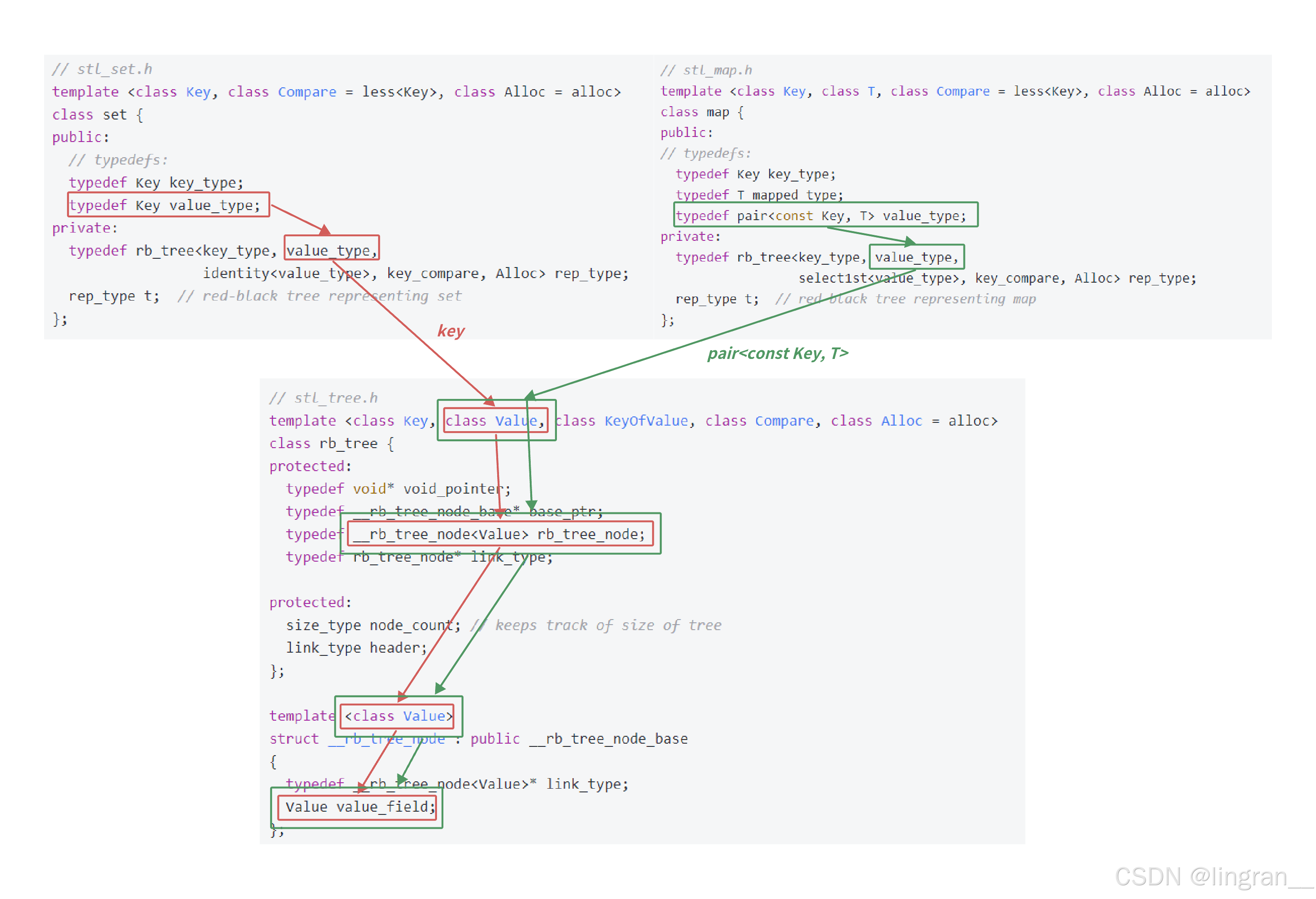
结合上图的调用链路可以清晰看到: SGI-STL 的 rb_tree 依靠泛型实现高度复用,没有把 "纯 key 场景" 和 "key-value 场景" 写死在代码内部。
第二个模板参数 Value,决定 __rb_tree_node 内部存储的数据类型:
set实例化 rb_tree:Value = Keymap实例化 rb_tree:Value =pair<const Key, T>
同一套红黑树底层,同时支撑 set、map,这是整套封装最巧妙的地方。
重要概念区分:
STL 源码里的
value_type≠ 日常口语中 map 的 value。源码中的
value_type指节点上完整存储的实体:
- set:value_type 就是 key
- map:value_type 是完整的 pair<const K,T>
常见疑问:既然 Value 控制节点存储类型,为什么还需要第一个模板参数 Key?
很多人学到这里都会产生疑惑:set 场景下 Key 和 Value 完全相同,为什么要额外多出 Key 参数?
核心原因: find()、erase() 这类接口接收的参数类型是 Key。
- set:插入元素类型 = 查找元素类型(都是 Key);
- map:插入的是完整
pair<const K,T>,但查找、删除只需要传入 Key。
如果不单独抽离 Key 作为模板参数,底层红黑树无法统一处理两种场景的查找入参。
**附:**我们基于手写红黑树封装 set 与 map 时,可以先实现最简版本:暂时只支持基础 key/value 模型、暂不开放自定义排序仿函数。只要理解这套分层思想,后续拓展自定义比较器、multiset/multimap 只是增量开发。
模拟实现map和set
1.实现出可复用红黑树的框架并支持insert和find
我们先实现基础版本红黑树,节点内部直接存储pair<K,V>。该版本红黑树强绑定键值对结构,只能给 map 使用,无法适配只存储单个 key 的 set。后续借助模板 + 仿函数抽取 key的思路进行改造,让同一套红黑树底层同时支撑 set 和 map。
一:初始版本:耦合 pair 的红黑树(仅支持 map)
RBTree.h
cpp
#pragma once
#include <iostream>
#include<utility>//pair头文件

enum Color
{
	Red,
	Black
};

template<class K, class V>
struct RBTreeNode
{
	using Node = RBTreeNode<K, V>;

	RBTreeNode() = default;
	RBTreeNode(const std::pair<K, V>& kv)
		:_kv(kv)
		, _col(Red)
	{

	}


	std::pair<K, V> _kv;
	Node* _left = nullptr;
	Node* _right = nullptr;
	Node* _parent = nullptr;
	Color _col;
};

template<class K, class V>
class RBTree
{
	using Node = RBTreeNode<K, V>;

public:
	bool insert(const std::pair<K, V>& kv);
	void RotateLL(Node* parent);
	void RotateRR(Node* parent);
	Node* find(const K& key);
	bool isRBTree();
	void InOrder();

private:
	bool _isRBTree(Node* root, int tmp, int Blen);
	void _InOrder(Node* cur);

	Node* _root = nullptr;
};


template<class K, class V>
bool RBTree<K, V>::insert(const std::pair<K, V>& kv)
{
	if (_root == nullptr)
	{
		_root = new Node(kv);
		_root->_col = Black;
		return true;
	}
	Node* cur = _root;
	Node* parent = nullptr;
	while (cur)
	{
		if (cur->_kv.first > kv.first)
		{
			parent = cur;
			cur = cur->_left;
		}
		else if (cur->_kv.first < kv.first)
		{
			parent = cur;
			cur = cur->_right;
		}
		else
			return false;
	}
	cur = new Node(kv);
	if (parent->_kv.first > kv.first)
		parent->_left = cur;
	else
		parent->_right = cur;
	cur->_parent = parent;

	while (cur->_col == Red && parent->_col == Red)
	{
		Node* u;
		Node* grand = parent->_parent;

		if (grand->_left == parent)
		{
			u = grand->_right;
			if (u && u->_col == Red)
			{
				u->_col = parent->_col = Black;
				grand->_col = Red;
				cur = grand;
				parent = cur->_parent;
			}
			else
			{
				if (parent->_left == cur)
				{
					RotateLL(grand);
					grand->_col = Red;
					parent->_col = Black;
				}
				else
				{
					RotateRR(parent);
					RotateLL(grand);
					cur->_col = Black;
					grand->_col = Red;
				}
				break;
			}
		}
		else
		{
			u = grand->_left;
			if (u && u->_col == Red)
			{
				u->_col = parent->_col = Black;
				grand->_col = Red;
				cur = grand;
				parent = cur->_parent;
			}
			else
			{
				if (parent->_right == cur)
				{
					RotateRR(grand);
					grand->_col = Red;
					parent->_col = Black;
				}
				else
				{
					RotateLL(parent);
					RotateRR(grand);
					cur->_col = Black;
					grand->_col = Red;
				}
				break;
			}
		}
		if (_root == cur)
			break;
	}
	_root->_col = Black;
	return true;
}

template<class K, class V>
void RBTree<K, V>::RotateLL(Node* parent)
{
	Node* grand = parent->_parent;
	Node* subL = parent->_left;
	Node* subLR = subL->_right;
	if (grand == nullptr)
		_root = subL;

	else
	{
		if (grand->_left == parent)
			grand->_left = subL;
		else
			grand->_right = subL;
	}
	subL->_parent = grand;
	subL->_right = parent;
	parent->_parent = subL;
	parent->_left = subLR;
	if (subLR)
		subLR->_parent = parent;
}

template<class K, class V>
void RBTree<K, V>::RotateRR(Node* parent)
{
	Node* grand = parent->_parent;
	Node* subR = parent->_right;
	Node* subRL = subR->_left;
	if (grand == nullptr)
		_root = subR;
	else
	{
		if (grand->_left == parent)
			grand->_left = subR;
		else
			grand->_right = subR;
	}
	subR->_parent = grand;
	subR->_left = parent;
	parent->_parent = subR;
	parent->_right = subRL;
	if (subRL)
		subRL->_parent = parent;
}

template<class K, class V>
typename RBTree<K, V>::Node* RBTree<K, V>::find(const K& key)
{
	Node* cur = _root;
	while (cur)
	{
		if (cur->_kv.first < key)
			cur = cur->_right;
		else if (cur->_kv.first > key)
			cur = cur->_left;
		else
			return cur;
	}
	return nullptr;
}

template<class K, class V>
bool RBTree<K, V>::isRBTree()
{
	if (_root == nullptr)
		return true;
	if (_root->_col == Red)
		return false;
	int Blen = 0;
	Node* cur = _root;
	while (cur)
	{
		if (cur->_col == Black)
			Blen++;
		cur = cur->_left;
	}

	return _isRBTree(_root, 0, Blen);
}

template<class K, class V>
bool RBTree<K, V>::_isRBTree(Node* root, int tmp, int Blen)
{
	if (root == nullptr)
	{
		if (tmp != Blen)
		{
			std::cout << "黑高异常" << std::endl;
			return false;
		}
		return true;
	}
	if (root->_col == Red && root->_parent->_col == Red)
	{
		std::cout << "双红节点" << std::endl;
		return false;
	}
	if (root->_col == Black)
		tmp++;
	return _isRBTree(root->_left, tmp, Blen) && _isRBTree(root->_right, tmp, Blen);
}

template<class K, class V>
void RBTree<K, V>::InOrder()
{
	_InOrder(_root);
}

template<class K, class V>
void RBTree<K, V>::_InOrder(Node* cur)
{
	if (cur == nullptr)
		return;
	_InOrder(cur->_left);
	std::cout << cur->_kv.first << ":" << cur->_kv.second << std::endl;
	_InOrder(cur->_right);
}
二:搭建初始 set、map 外层框架
map.h
cpp
#pragma once
#include "RBTree.h"

namespace qiu
{
	template<class K,class V>
	class map
	{
	public:
		bool insert(const std::pair<K, V>& kv)
		{
			_t.insert(kv);;
		}
	private:
		RBTree<K, std::pair<const K, V>> _t;
	};
}
set.h
cpp
#pragma once
#include "RBTree.h"

namespace qiu
{
	template<class K>
	class set
	{
	public:
		bool insert(const K& kv)
		{
			_t.insert(kv);
		}
	private:
		RBTree<K, K> _t;
	};
}
观察上面的代码可以发现问题:set 存储单个 K,map 存储pair<K,V>,两者需要复用同一套红黑树底层。原有红黑树模板参数是K,V,结构固定,无法兼容两种存储类型。 因此我们对红黑树模板参数进行重构:将存储的数据类型统一命名为KV;保留 K 类型,用于 find 查找接口。
三:修改红黑树节点与类模板
RBTree.h
cpp
template<class KV>
struct RBTreeNode
{
	using Node = RBTreeNode<KV>;

	RBTreeNode() = default;
	RBTreeNode(const KV& kv)
		:_kv(kv)
		, _col(Red)
	{

	}


	KV _kv;
	Node* _left = nullptr;
	Node* _right = nullptr;
	Node* _parent = nullptr;
	Color _col;
};

template<class K, class KV>
class RBTree
{
	using Node = RBTreeNode<KV>;

public:
	bool insert(const KV& kv);
	void RotateLL(Node* parent);
	void RotateRR(Node* parent);
	Node* find(const K& key);
	bool isRBTree();
	void InOrder();

private:
	bool _isRBTree(Node* root, int tmp, int Blen);
	void _InOrder(Node* cur);

	Node* _root = nullptr;
};
现在产生新问题:红黑树底层不知道 KV 到底是 set 的 K,还是 map 的pair<K,V>。 我们insert和find函数内如果直接使用类型默认比较规则:pair 会同时对比 key 和 value,而我们容器的要求是只根据 key 比较大小、判断重复。
解决方案:在 set 和 map 内部各自定义一个仿函数,专门负责从存储对象 KV 中提取 key ,再将这个仿函数传入红黑树。红黑树内部统一依靠仿函数获取 key 进行比较,不再硬编码kv.first。
四:修改 set 与 map,新增 key 提取仿函数
map.h
cpp
#pragma once
#include "RBTree.h"

namespace qiu
{
	template<class K, class V>
	class map
	{
		class MapKeyOfT
		{
		public:
			const K& operator()(const std::pair<const K, V>& kv)
			{
				return kv.first;
			}
		};
	public:
		bool insert(const std::pair<K, V>& kv)
		{
			return _t.insert(kv);
		}
	private:
		RBTree<K, std::pair<K, V>, MapKeyOfT> _t;
	};
}
set.h
cpp
#pragma once
#include "RBTree.h"

namespace qiu
{
	template<class K>
	class set
	{
		class SetKeyOfT
		{
		public:
			const K& operator()(const K& k)
			{
				return k;
			}
		};
	public:
		bool insert(const K& kv)
		{
			return _t.insert(kv);
		}
	private:
		RBTree<K, K, SetKeyOfT> _t;
	};
}
五:扩展红黑树模板参数,接收 KeyOfT 仿函数
给 RBTree 增加模板参数KeyOfT接收上层传入的 key 提取仿函数,把代码里所有硬编码_kv.first全部替换为仿函数调用。重点改造 insert 和 fiind 函数,其余接口同步适配模板参数。
RBTree.h
cpp
template<class K, class KV,class KeyOfT>
bool RBTree<K, KV, KeyOfT>::insert(const KV& kv)
{
	if (_root == nullptr)
	{
		_root = new Node(kv);
		_root->_col = Black;
		return true;
	}
	Node* cur = _root;
	Node* parent = nullptr;
	KeyOfT key;
	while (cur)
	{
		if (key(cur->_kv) > key(kv))
		{
			parent = cur;
			cur = cur->_left;
		}
		else if (key(cur->_kv) < key(kv))
		{
			parent = cur;
			cur = cur->_right;
		}
		else
			return false;
	}
	cur = new Node(kv);
	if (key(parent->_kv) > key(kv))
		parent->_left = cur;
	else
		parent->_right = cur;
	cur->_parent = parent;

	while (cur->_col == Red && parent->_col == Red)
	{
		Node* u;
		Node* grand = parent->_parent;

		if (grand->_left == parent)
		{
			u = grand->_right;
			if (u && u->_col == Red)
			{
				u->_col = parent->_col = Black;
				grand->_col = Red;
				cur = grand;
				parent = cur->_parent;
			}
			else
			{
				if (parent->_left == cur)
				{
					RotateLL(grand);
					grand->_col = Red;
					parent->_col = Black;
				}
				else
				{
					RotateRR(parent);
					RotateLL(grand);
					cur->_col = Black;
					grand->_col = Red;
				}
				break;
			}
		}
		else
		{
			u = grand->_left;
			if (u && u->_col == Red)
			{
				u->_col = parent->_col = Black;
				grand->_col = Red;
				cur = grand;
				parent = cur->_parent;
			}
			else
			{
				if (parent->_right == cur)
				{
					RotateRR(grand);
					grand->_col = Red;
					parent->_col = Black;
				}
				else
				{
					RotateLL(parent);
					RotateRR(grand);
					cur->_col = Black;
					grand->_col = Red;
				}
				break;
			}
		}
		if (_root == cur)
			break;
	}
	_root->_col = Black;
	return true;
}

template<class K, class V, class KeyOfT>
typename RBTree<K, V, KeyOfT>::Node* RBTree<K, V, KeyOfT>::find(const K& key)
{
	Node* cur = _root;
	KeyOfT Key;
	while (cur)
	{
		if (Key(cur->_kv) < key)
			cur = cur->_right;
		else if (Key(cur->_kv) > key)
			cur = cur->_left;
		else
			return cur;
	}
	return nullptr;
}
至此,支持 insert 和 find 的泛型红黑树改造完成,实现了一套底层同时供给 set 与 map 使用。
2.支持iterator实现
为了避免代码冗余、保证阅读流畅,我会先完整讲解迭代器实现思路,最后统一展示最终代码
2.1.iterator核心源代码
cpp
struct __rb_tree_base_iterator
{
 typedef __rb_tree_node_base::base_ptr base_ptr;
 base_ptr node;
 void increment()
 {
 if (node->right != 0) {
 node = node->right;
 while (node->left != 0)
 node = node->left;
 }
 else {
 base_ptr y = node->parent;
 while (node == y->right) {
 node = y;
 y = y->parent;
 }
 if (node->right != y)
 node = y;
 }
 }
 void decrement()
 {
 if (node->color == __rb_tree_red &&
 node->parent->parent == node)
 node = node->right;
 else if (node->left != 0) {
 base_ptr y = node->left;
 while (y->right != 0)
 y = y->right;
 node = y;
 }
 else {
 base_ptr y = node->parent;
 while (node == y->left) {
 node = y;
 y = y->parent;
 }
 node = y;
 }
 }
};
template <class Value, class Ref, class Ptr>
struct __rb_tree_iterator : public __rb_tree_base_iterator
{
 typedef Value value_type;
 typedef Ref reference;
 typedef Ptr pointer;
 typedef __rb_tree_iterator<Value, Value&, Value*> iterator;
 __rb_tree_iterator() {}
 __rb_tree_iterator(link_type x) { node = x; }
 __rb_tree_iterator(const iterator& it) { node = it.node; }
 reference operator*() const { return link_type(node)->value_field; }
#ifndef __SGI_STL_NO_ARROW_OPERATOR
 pointer operator->() const { return &(operator*()); }
#endif /* __SGI_STL_NO_ARROW_OPERATOR */
 self& operator++() { increment(); return *this; }
 self& operator--() { decrement(); return *this; }

inline bool operator==(const __rb_tree_base_iterator& x,
 const __rb_tree_base_iterator& y) {
 return x.node == y.node;
}
inline bool operator!=(const __rb_tree_base_iterator& x,
 const __rb_tree_base_iterator& y) {
 return x.node != y.node;
}
观察 STL 源码可以发现,红黑树迭代器的整体架构和 list 迭代器非常相似,都是通过封装节点指针、重载运算符,让迭代器具备类似指针的访问行为。二者最大的区别,在于红黑树迭代器的 ++、-- 遍历逻辑更加复杂。
2.2.iterator实现思路分析
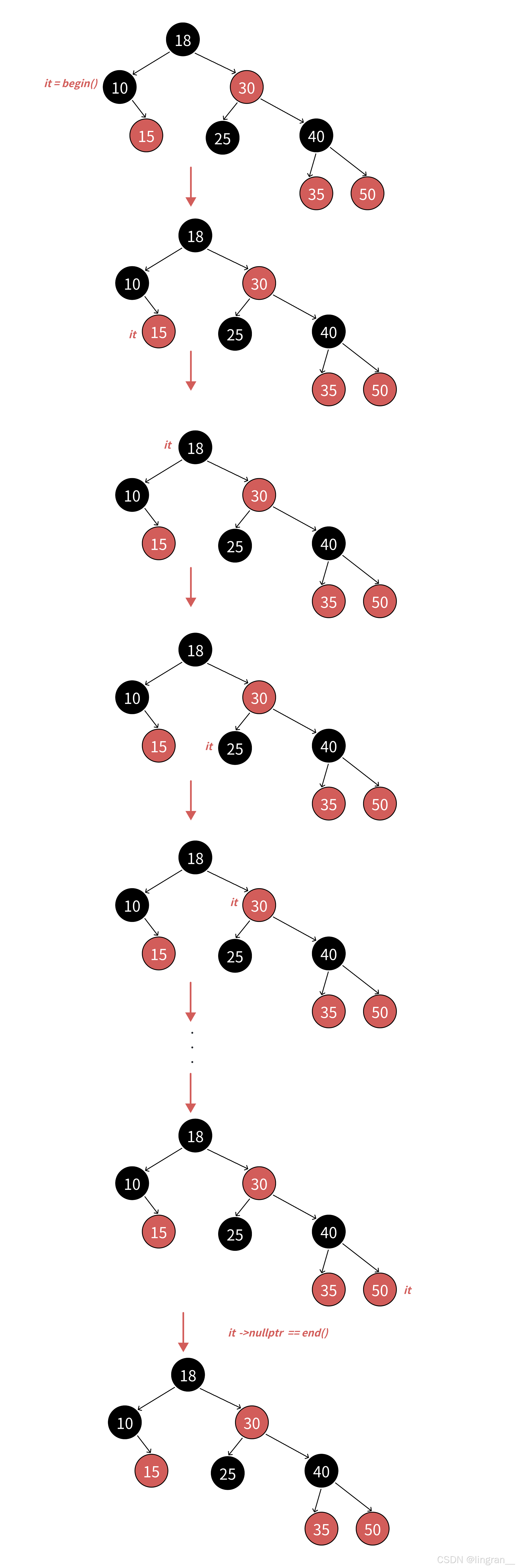
map 与 set 的迭代器遍历遵循二叉树中序遍历规则:左子树 → 根节点 → 右子树 ,因此 begin() 返回的是整棵树中序遍历的第一个节点。
迭代器自增的核心思想不依赖全局树结构,只依靠当前节点的局部关系,以此找到中序遍历的下一个节点:
- 如果当前节点的右子树不为空,说明当前节点及其左子树已经遍历完毕,下一个节点是右子树的最左节点,也就是右子树中序遍历的首个节点。
- 如果当前节点的右子树为空,说明当前节点所在子树已经完全遍历完成,需要向上回溯祖先节点 寻找下一个遍历节点。
- 若当前节点是父节点的左孩子,按照中序规则,下一个遍历节点就是其父节点。
- 若当前节点是父节点的右孩子,说明父节点所在子树也已经遍历完成,需要持续向上回溯,直到找到当前节点是父节点左孩子的祖先节点,该节点即为下一个遍历节点。
对于 end() 的实现:当遍历到树的最右节点后,继续执行迭代器自增,会一直向上回溯直至父节点为空,此时将迭代器节点置为 nullptr,以此作为 end() 位置。
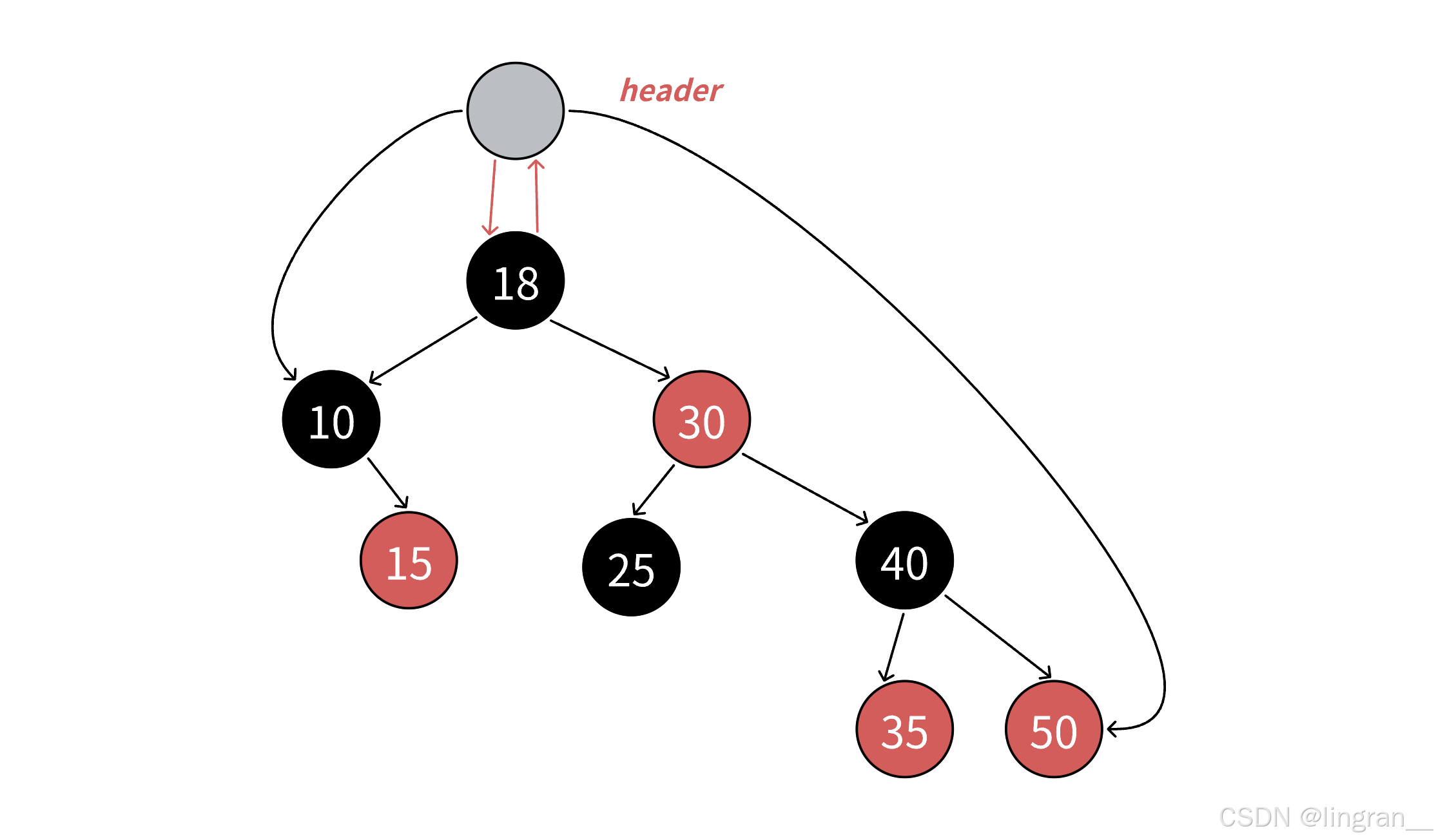
需要说明的是,原生 SGI-STL 并没有使用 nullptr 作为尾后迭代器,而是额外维护一个哨兵头节点 作为 end(),该哨兵节点与根节点互置父子关系,分别指向整棵树的最左、最右节点。
为了兼容我们此前手写的红黑树整体架构、避免大规模代码重构,本实现选择用 nullptr 充当 end()。功能上与原生 STL 完全等价,仅在 --end() 反向遍历时需要特殊处理:当迭代器为空时,直接跳转至整棵树的最右节点,保证反向遍历正常执行。
迭代器自减的逻辑与自增完全对称,遍历顺序反向为:右子树 → 根节点 → 左子树,整体回溯思路同理反向推导即可。
最后补充 set 与 map 的迭代器常量属性设计:
- set 容器不允许修改元素,因此底层红黑树存储类型为
const K,从根源禁止迭代器修改数据。 - map 容器允许修改 value、禁止修改 key,因此底层存储
pair<const K, V>,保证键值不可变、映射值可修改。
另外需要注意:迭代器绝对不能通过数值比较的方式更新节点 。如果依靠大小比较寻找下一个节点,在 multiset、multimap 等支持重复 key 的容器中会出现遍历错乱。因此迭代器遍历必须完全依靠节点父子关系回溯,保证适配所有场景。
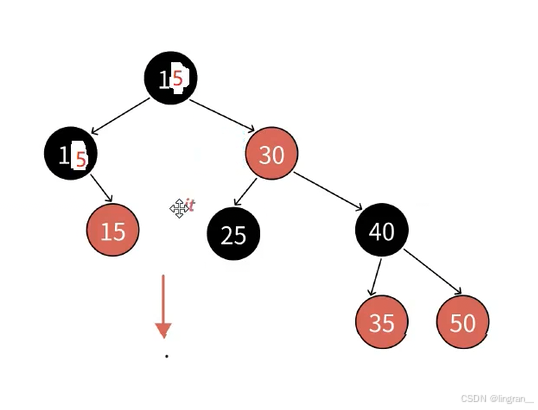
附:上述是 SGI-STL 原生迭代器实现逻辑。原生依靠哨兵头节点实现统一遍历,无需特殊判断空节点;但该方案需要对整棵红黑树结构大改,为了保证学习代码连贯性,本文不采用哨兵方案。
3.map支持\[\]
map 想要实现 [] 运算符,核心前提是修改红黑树的 Insert 接口,将返回值调整为:
cpp
pair<Iterator, bool> Insert(const KV& kv)在红黑树 Insert 具备该返回形式后,[] 的实现逻辑会变得十分简洁,具体实现参考下方代码。
4.qiu::map和qiu::set实现
RBTree.h
cpp
#pragma once
#include <iostream>
#include<utility>//pair头文件

enum Color
{
	Red,
	Black
};

template<class KV>
struct RBTreeNode
{
	using Node = RBTreeNode<KV>;

	RBTreeNode() = default;
	RBTreeNode(const KV& kv)
		:_kv(kv)
		, _col(Red)
	{

	}


	KV _kv;
	Node* _left = nullptr;
	Node* _right = nullptr;
	Node* _parent = nullptr;
	Color _col;
};

template<class KV,class Ptr,class Ref>
struct RBTreeIterator
{
	using Self = RBTreeIterator<KV, Ptr, Ref>;
	using Node = RBTreeNode<KV>;

	RBTreeIterator(Node* node, Node* root)
		:_node(node)
		, _root(root)
	{}

	Ref operator*()
	{
		return _node->_kv;
	}

	Ptr operator->()
	{
		return &_node->_kv;
	}

	bool operator==(const Self& s) const
	{
		return _node == s._node;
	}

	bool operator!=(const Self& s) const
	{
		return _node != s._node;
	}

	Self& operator++()
	{
		if (_node->_right)
		{
			_node = _node->_right;
			while (_node->_left)
				_node = _node->_left;
		}
		else
		{
			Node* parent = _node->_parent;
			while (parent && _node == parent->_right)
			{
				_node = parent;
				parent = _node->_parent;
			}
			_node = parent;
		}
		return *this;
	}
	Self operator++(int)
	{
		Self tmp = *this;
		++(*this);
		return tmp;
	}
	Self& operator--()
	{
		if (_root == nullptr)
			return *this;
		if (_node == nullptr)
		{
			_node = _root;
			while (_node->_right)
				_node = _node->_right;
			return *this;
		}

		if (_node->_left)
		{
			_node = _node->_left;
			while (_node->_right)
				_node = _node->_right;
		}
		else
		{
			Node* parent = _node->_parent;
			while (parent && _node == parent->_left)
			{
				_node = parent;
				parent = _node->_parent;
			}
			_node = parent;
		}
		return *this;
	}
	Self operator--(int)
	{
		Self tmp = *this;
		--(*this);
		return tmp;
	}

	Node* _root;
	Node* _node;
};


template<class K, class KV, class KeyOfT>
class RBTree
{
	using Node = RBTreeNode<KV>;

public:
	using Iterator = RBTreeIterator<KV, KV*, KV&>;
	using const_Iterator = RBTreeIterator<KV, const KV*, const KV&>;

	Iterator begin()
	{
		Node* leftmost = _root;
		while (leftmost && leftmost->_left)
			leftmost = leftmost->_left;
		return Iterator(leftmost, _root);
	}
	Iterator end()
	{
		return Iterator(nullptr, _root);
	}
	const_Iterator begin() const
	{
		Node* leftmost = _root;
		while (leftmost && leftmost->_left)
			leftmost = leftmost->_left;
		return const_Iterator(leftmost, _root);
	}
	const_Iterator end() const
	{
		return const_Iterator(nullptr, _root);
	}
	RBTree() = default;

	~RBTree()
	{
		Destory(_root);
		_root = nullptr;
	}

	std::pair<Iterator,bool> insert(const KV& kv);
	void RotateLL(Node* parent);
	void RotateRR(Node* parent);
	Iterator find(const K& key);

private:
	void Destory(Node* root)
	{
		if (root == nullptr)
			return;
		Destory(root->_left);
		Destory(root->_right);
		delete root;
	}

	Node* _root = nullptr;
};


template<class K, class KV,class KeyOfT>
std::pair<typename RBTree<K, KV, KeyOfT>::Iterator, bool> RBTree<K, KV, KeyOfT>::insert(const KV& kv)
{
	if (_root == nullptr)
	{
		_root = new Node(kv);
		_root->_col = Black;
		return std::make_pair(Iterator(_root, _root), false);
	}
	Node* cur = _root;
	Node* parent = nullptr;
	KeyOfT key;
	while (cur)
	{
		if (key(cur->_kv) > key(kv))
		{
			parent = cur;
			cur = cur->_left;
		}
		else if (key(cur->_kv) < key(kv))
		{
			parent = cur;
			cur = cur->_right;
		}
		else
			return std::make_pair(Iterator(cur, _root), false);

	}
	cur = new Node(kv);
	if (key(parent->_kv) > key(kv))
		parent->_left = cur;
	else
		parent->_right = cur;
	cur->_parent = parent;

	while (cur->_col == Red && parent->_col == Red)
	{
		Node* u;
		Node* grand = parent->_parent;

		if (grand->_left == parent)
		{
			u = grand->_right;
			if (u && u->_col == Red)
			{
				u->_col = parent->_col = Black;
				grand->_col = Red;
				cur = grand;
				parent = cur->_parent;
			}
			else
			{
				if (parent->_left == cur)
				{
					RotateLL(grand);
					grand->_col = Red;
					parent->_col = Black;
				}
				else
				{
					RotateRR(parent);
					RotateLL(grand);
					cur->_col = Black;
					grand->_col = Red;
				}
				break;
			}
		}
		else
		{
			u = grand->_left;
			if (u && u->_col == Red)
			{
				u->_col = parent->_col = Black;
				grand->_col = Red;
				cur = grand;
				parent = cur->_parent;
			}
			else
			{
				if (parent->_right == cur)
				{
					RotateRR(grand);
					grand->_col = Red;
					parent->_col = Black;
				}
				else
				{
					RotateLL(parent);
					RotateRR(grand);
					cur->_col = Black;
					grand->_col = Red;
				}
				break;
			}
		}
		if (_root == cur)
			break;
	}
	_root->_col = Black;
	return std::make_pair(Iterator(cur, _root), true);

}

template<class K, class KV, class KeyOfT>
void RBTree<K, KV, KeyOfT>::RotateLL(Node* parent)
{
	Node* grand = parent->_parent;
	Node* subL = parent->_left;
	Node* subLR = subL->_right;
	if (grand == nullptr)
		_root = subL;

	else
	{
		if (grand->_left == parent)
			grand->_left = subL;
		else
			grand->_right = subL;
	}
	subL->_parent = grand;
	subL->_right = parent;
	parent->_parent = subL;
	parent->_left = subLR;
	if (subLR)
		subLR->_parent = parent;
}

template<class K, class KV, class KeyOfT>
void RBTree<K, KV, KeyOfT>::RotateRR(Node* parent)
{
	Node* grand = parent->_parent;
	Node* subR = parent->_right;
	Node* subRL = subR->_left;
	if (grand == nullptr)
		_root = subR;
	else
	{
		if (grand->_left == parent)
			grand->_left = subR;
		else
			grand->_right = subR;
	}
	subR->_parent = grand;
	subR->_left = parent;
	parent->_parent = subR;
	parent->_right = subRL;
	if (subRL)
		subRL->_parent = parent;
}

template<class K, class KV, class KeyOfT>
typename RBTree<K,KV,KeyOfT>::Iterator RBTree<K,KV,KeyOfT>::find(const K& key)
{
	Node* cur = _root;
	KeyOfT Key;
	while (cur)
	{
		if (Key(cur->_kv) < key)
			cur = cur->_right;
		else if (Key(cur->_kv) > key)
			cur = cur->_left;
		else
			return Iterator(cur, _root);
	}
	return Iterator(nullptr, _root);
}
map.h
cpp
#pragma once
#include "RBTree.h"

namespace qiu
{


	template<class K, class V>
	class map
	{
		class MapKeyOfT
		{
		public:
			const K& operator()(const std::pair<const K, V>& kv)
			{
				return kv.first;
			}
		};
		using Node = RBTree<K, std::pair<const K, V>, MapKeyOfT>;
		using KV = std::pair<const K, V>;
	public:
		using iterator = typename RBTree<K, KV, MapKeyOfT>::Iterator;
		using const_iterator = typename RBTree<K, KV, MapKeyOfT>::const_Iterator;
		std::pair<iterator, bool> insert(const std::pair<K, V>& kv)
		{
			return _t.insert(kv);
		}
		iterator begin()
		{
			return _t.begin();
		}
		iterator end()
		{
			return _t.end();
		}
		const_iterator begin() const
		{
			return _t.begin();
		}
		const_iterator end() const
		{
			return _t.end();
		}
		V& operator[](const K& key)
		{
			std::pair<iterator, bool> ret = insert(std::make_pair(key, V()));
			return ret.first->second;
		}
		iterator find(const K& k)
		{
			return _t.find(k);
		}

	private:
		Node _t;
	};
}
set.h
cpp
#pragma once
#include "RBTree.h"

namespace qiu
{
	template<class K>
	class set
	{
		class SetKeyOfT
		{
		public:
			const K& operator()(const K& k)
			{
				return k;
			}
		};
		using Node = RBTree<K,const K, SetKeyOfT>;
	public:
		using iterator = typename RBTree<K, const K, SetKeyOfT>::Iterator;
		using const_iterator = typename RBTree<K, const K, SetKeyOfT>::const_Iterator;
		std::pair<iterator, bool> insert(const K& kv)
		{
			return _t.insert(kv);
		}
		iterator begin()
		{
			return _t.begin();
		}
		iterator end()
		{
			return _t.end();
		}
		const_iterator begin() const
		{
			return _t.begin();
		}
		const_iterator end() const
		{
			return _t.end();
		}
		iterator find(const K& k)
		{
			return _t.find(k);
		}


	private:
		Node _t;
	};
}
test.h
cpp
#define _CRT_SECURE_NO_WARNINGS
#include <iostream>
#include <string>
#include "map.h"
#include "set.h"
using namespace std;


int  main()
{

	qiu::map<string, string> dict;
	dict.insert({ "sort", "排序" });
	dict.insert({ "left", "左边" });
	dict.insert({ "right", "右边" });

	dict["left"] = "左边,剩余";
	dict["insert"] = "插入";
	dict["string"];

	qiu::map<string, string>::iterator it = dict.begin();
	while (it != dict.end())
	{
		// 不能修改first,可以修改second
		//it->first += 'x';
		it->second += 'x';
		cout << it->first << ":" << it->second << endl;
		++it;
	}
	cout << endl;
	qiu::set<int> s;
	int a[] = { 4, 2, 6, 1, 3, 5, 15, 7, 16, 14 };
	for (auto e : a)
	{
		s.insert(e);
	}
	for (auto e : s)
	{
		cout << e << " ";
	}
	cout << endl;


	return 0;
}
结语:
那么,C++set和map底层实现部分的内容就全部讲解完毕啦,希望以上内容对你有所帮助,感谢观看,若觉得写的还可以,可以分享给朋友一起来看哦,毕竟一起进步更有动力嘛,当然能关注一下就更好啦。