Sum of Suffix Sums
Given an array which is initially empty, you need to perform q operations:
Given two non-negative integers t and v, take out the element from the end of the array for t times and then append v to the end of the array. It is guaranteed that t does not exceed the length of the array before this operation
After each operation, let a1,a2,...,an be the current array, find the sum of s1,s2,...,snwhere si=ai+ai+1+...+an is the sum of the suffix starting from position iii.
World Finals
The ICPC World Finals are coming. Due to some reasons, the 46th and 47th World Finals will be held simultaneously. For the teams qualified in both competitions, they should choose one to take part in.
The first line contains one integer n (1≤n≤105), denoting the number of teams qualified in the 46th World Finals.
Next n lines each contain one string S (1≤∣S∣≤10) and two integers p,t (1≤p,t≤109)p,,denoting the name, the predicted number of solved problems, and time penalty of one team in the 46th World Finals respectively.
Next one line contains one integer m (1≤m≤105), denoting the number of teams qualified in the 47th World Finals.
Next m lines each contain one string S (1≤∣S∣≤10)Sand two integers p,t (1≤p,t≤109), denoting the name, the predicted number of solved problems, and time penalty of one team in the 47th World Finals respectively.
Output one line containing one integer, denoting the best possible ranking of lzr010506's team.
the competition choices of the double-qualified teams can be arbitrarily arranged by him.
#include<bits/stdc++.h>

using namespace std;

#define int long long

struct node{
	string name;
	int s;
	int t;
};

bool cmp(node a, node b){
	if(a.s > b.s)
		return true;
	else if(a.s == b.s)
		return a.t < b.t;
	return false;
}

void solve(){
	vector<node> q1;
	vector<node> q2;
	unordered_map<string, int> st1;
	unordered_map<string, int> st2;
	int n, m;
	cin >> n;
	for(int i = 0; i < n; i ++){
		string a;
		int s, t;
		cin >> a >> s >> t;
		q1.push_back({a, s, t});
		if(!st1.count(a))
			st1[a] = 1;
	}
	cin >> m;
	for(int i = 0; i < m; i ++){
		string a;
		int b, c;
		cin >> a >> b >> c;
		q2.push_back({a, b, c});
		if(!st2.count(a))
			st2[a] = 1;
	}
	sort(q1.begin(), q1.end(), cmp);
	sort(q2.begin(), q2.end(), cmp);
	int cnt1 = 0;
	for(int i = 0; i < n; i ++){
		if(q1[i].name == "lzr010506"){
			cnt1 ++;
			break;
		}
		if(!st2.count(q1[i].name))
			cnt1 ++;
	}
	int cnt2 = 0;
	for(int i = 0; i < m; i ++){
		if(q2[i].name == "lzr010506"){
			cnt2 ++;
			break;
		}
		if(!st1.count(q2[i].name))
			cnt2 ++;
	}

	cout << min(cnt1, cnt2);

}

signed main()
{
    ios::sync_with_stdio(false);
    cin.tie(0);
    solve();
    return 0;
}
A Bit Common
Given two integers n and m, among all the sequences containing n non-negative integers less than 2^m, you need to count the number of such sequences A that there exists a non-empty subsequence of A in which the bitwise AND of the integers is 1
Note that a non-empty subsequence of a sequenceA is a non-empty sequence that can be obtained by deleting zero or more elements from AAA and arranging the remaining elements in their original order.
Since the answer may be very large, output it modulo a positive integer q.
The bitwise AND of non-negative integers AAA and BBB, A AND BA\ \texttt{AND}\ BA AND B is defined as follows:


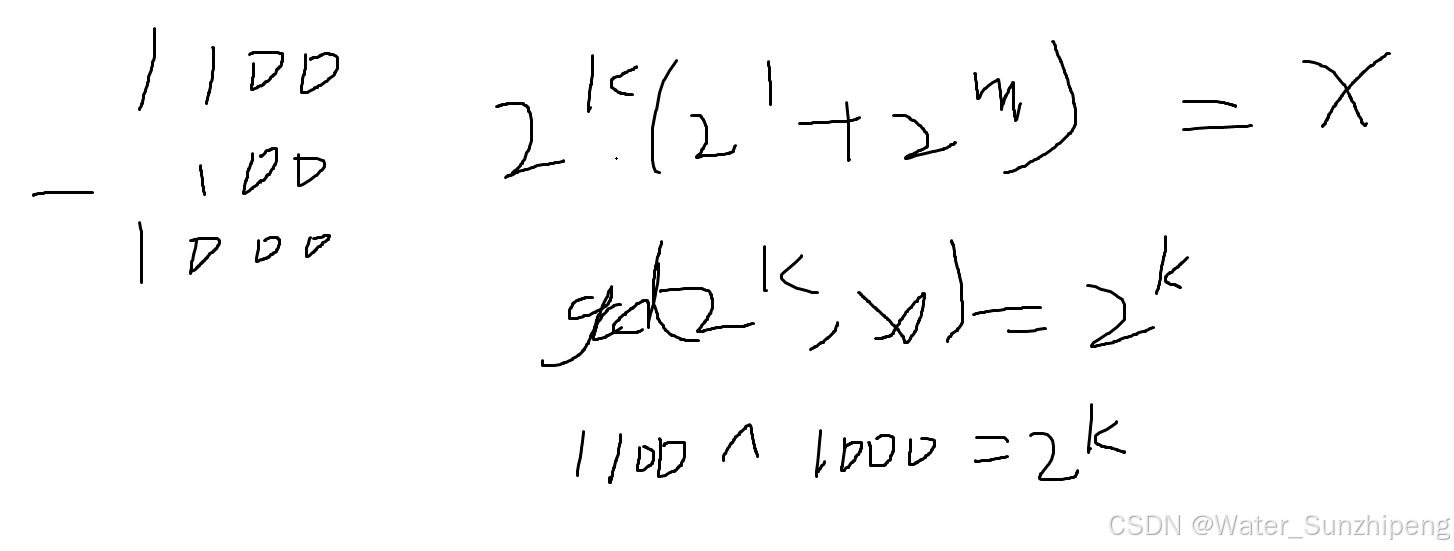
GCD VS XOR
Red Walking on Grid
Red is on a 2⋅n, with some cells being red and others being white.
Red can initially choose a red cell, and at each step, can choose a red cell above, below, to the left, or to the right. When Red leaves a cell, the cell immediately turns white.
Red wants to know the maximum number of steps she can take.
If there are no initial red cells, please output 0.