Research Proposal
File available
Reconstructing the AI Principles of the New Era of Human-Machine Mutual Assistance through Order-Position Logic -A Paradigm Shift from Computationalism to Order-Position Field Theory
September 2026
DOI:
10.13140/RG.2.2.28431.55206
Xiaohui Zou
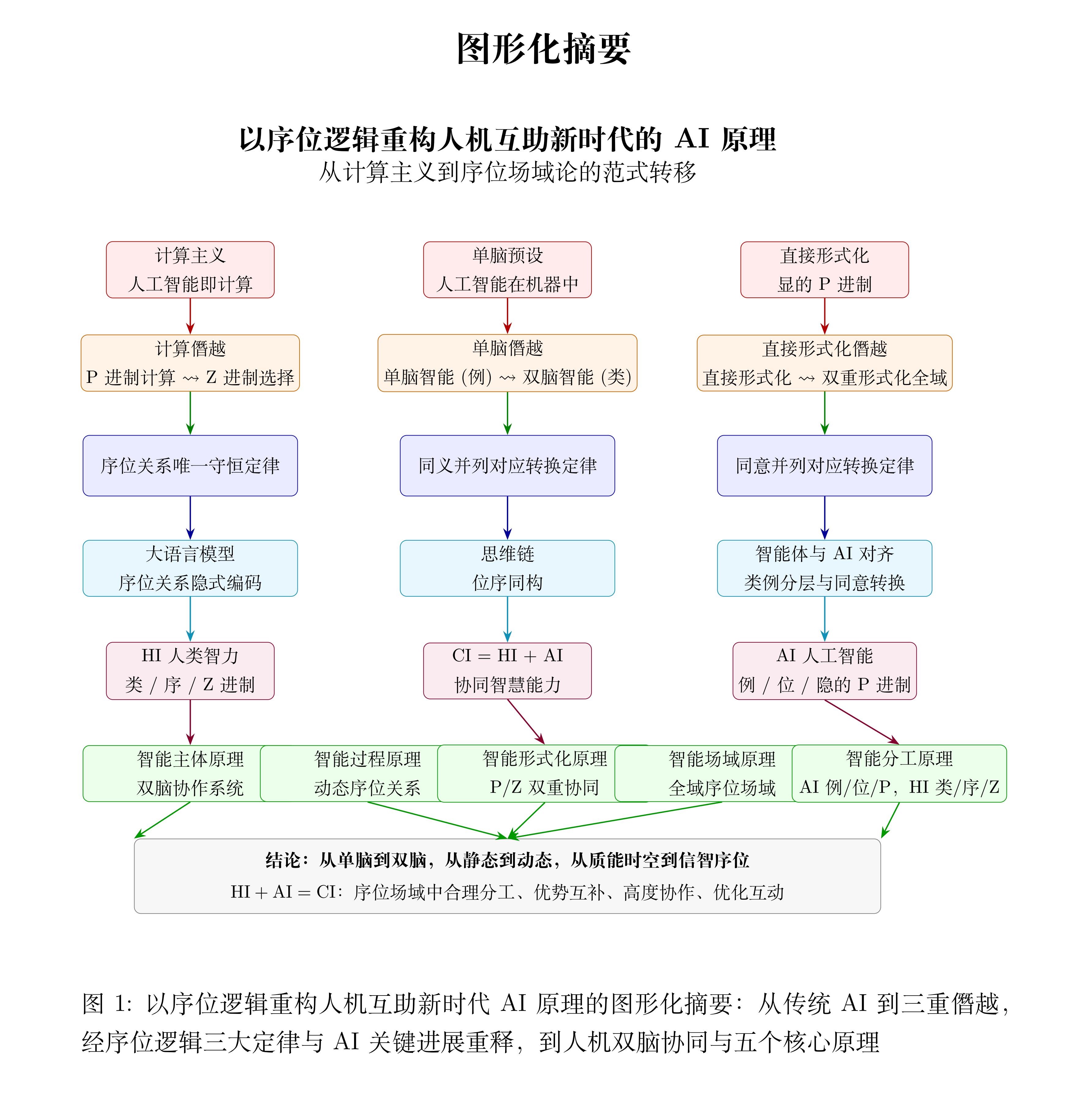
Since its birth at the Dartmouth Conference in 1956, artificial intelligence has always taken "computationalism" as its default paradigm-intelligence is presupposed to be symbolic operation or numerical computation. However, the popular-ization of generative AI is fundamentally challenging this presupposition: AI systems are beginning to exhibit capabilities that traditional computationalism cannot explain (in-context learning, emergent reasoning, etc.), while also exposing predicaments that traditional computationalism cannot resolve (such as interpretability, value alignment, and the absence of intentionality). This paper takes Order-Position Logic (OPL) of Smart System Studies (SSS) as its analytical framework to systematically reconstruct the AI principles of the new era of human-machine mutual assistance. The core thesis of this paper is that contemporary AI is undergoing a paradigm shift from "computationalism" to "order-position field theory," and that the three fundamental laws of Order-Position Logic-the Unique Conservation Law of Order-Position Relations, the Synonymous Parallel Corresponding Transformation Law, and the Synonymous-Intentional Parallel Corresponding Transformation Law-provide a unified formal foundation for this paradigm shift. This paper first 1 2 reveals the triple "usurpations" in traditional AI (computational, single-brain, and formalizational) and their consequences. Then, it reinterprets the key advances of AI (large language models, chain-of-thought, agents, and alignment) through Order-Position Logic. Furthermore, it constructs an order-position field AI principle based on "reasonable division of labor and complementary advantages between human and machine dual brains." Finally, it proposes five core principles and four theoretical challenges for AI in the new era of human-machine mutual assistance. The conclusion of this paper is that AI principles need to shift from the static inquiry of "what intelligence is" to the dynamic inquiry of "how intelligence is generated in human-machine dual-brain collaboration." This is precisely the paradigm innovation direction that Order-Position Logic provides for 21st-century AI.
Reconstructing the AI Principles of the New Era.pdf
以序位逻辑重构人机互助新时代的AI 原理
------从计算主义到序位场域论的范式转移
邹晓辉
ORCID: 0000-0002-5577-8245
摘要
人工智能自 1956 年达特茅斯会议诞生以来,始终以"计算主义"为默认范式 ------智能被预设为符号操作或数值计算。然而,生成式人工智能的普及使这一预设 面临根本性挑战:AI 系统开始展现出传统计算主义无法解释的能力(上下文学习、涌现推理等), 同时也暴露出传统计算主义无法解决的困境(如可解释性、价值对 齐、意向性缺失)。本文以融智学序位逻辑为分析框架对人机互助新时代的 AI 原理 进行系统性重构。本文核心论点是当代 AI 正处于从"计算主义"到"序位场域论"的范式转移之中,序位逻辑的三大基本定律------序位关系唯一守恒定律、同义并列 对应转换定律、同意并列对应转换定律, 为这一范式转移提供了统一的形式化基础。本文首先揭示传统 AI 中(计算、单机、形式化) 三重"僭越"及其后果,然后,以 序位逻辑重新解释 AI 的关键进展(大语言模型、思维链、智能体、对齐), 进而,构建基于"人机双脑合理分工、优势互补"序位场域 AI 原理,最后提出人机互助 新时代 AI 的五个核心原理与四个理论挑战。本文的结论是: AI 原理需要从"智能 是什么"的静态追问,转向"智能如何在人机双脑协作中生成"的动态追问。这正 是序位逻辑为 21 世纪 AI 提供的范式革新方向。
关键词:人工智能原理;序位逻辑;人机互助新时代; 位序同构;类例分层;协同智能;序位场域; P/Z 双进制;AI 对齐
OPL (60)以序位逻辑重构人机互助新时代的AI原理.pdf