电信网络诈骗话术语义特征挖掘分析系统-简介
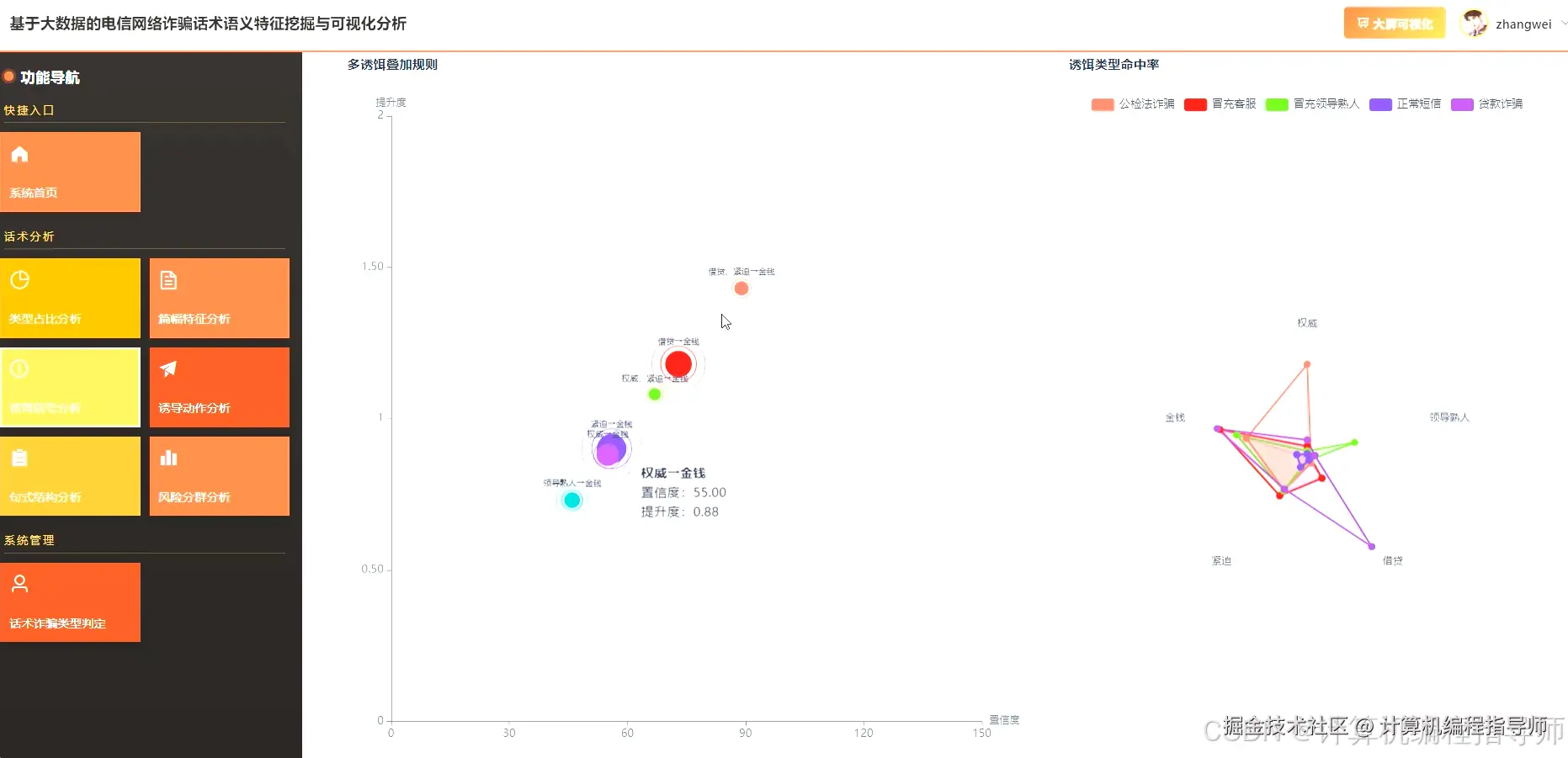
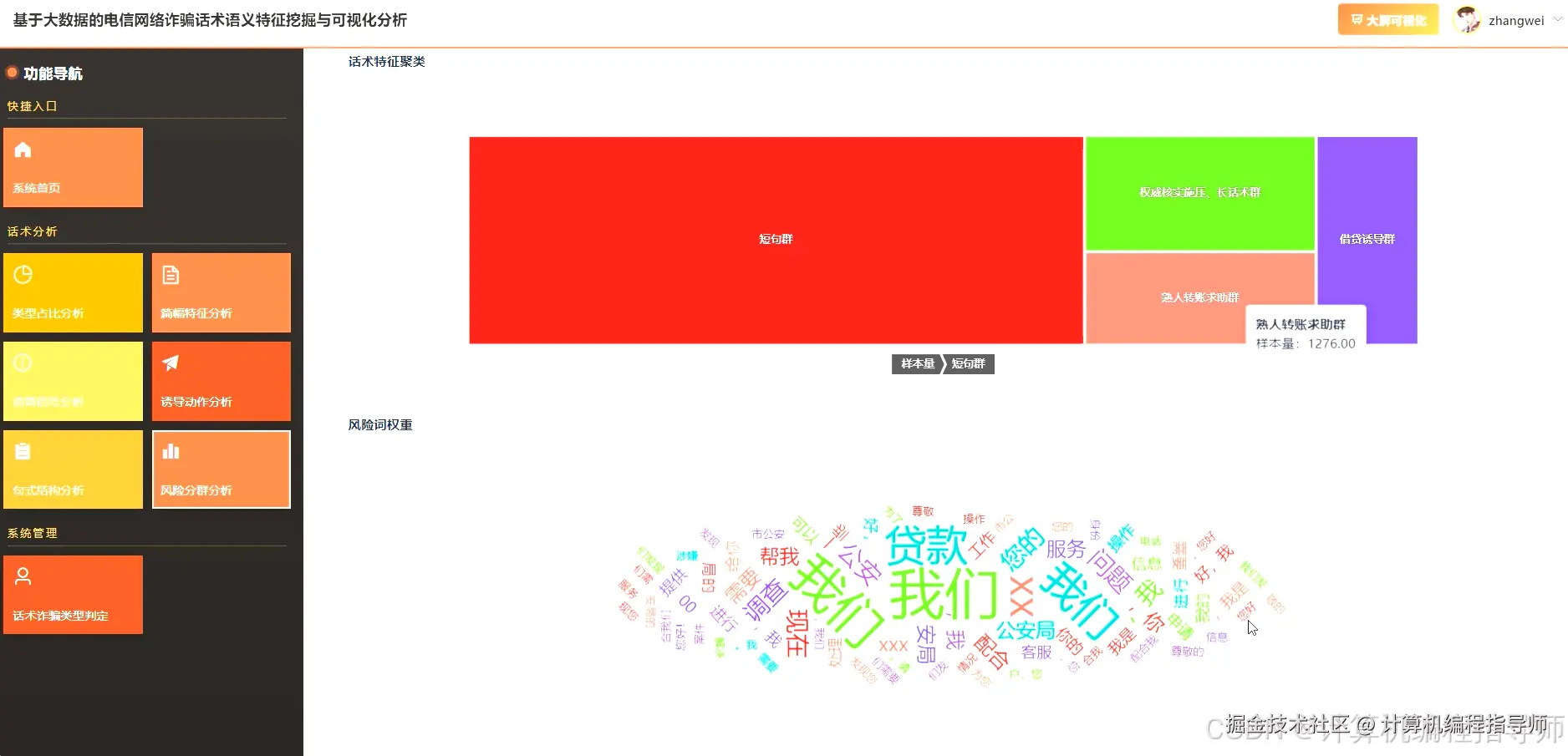
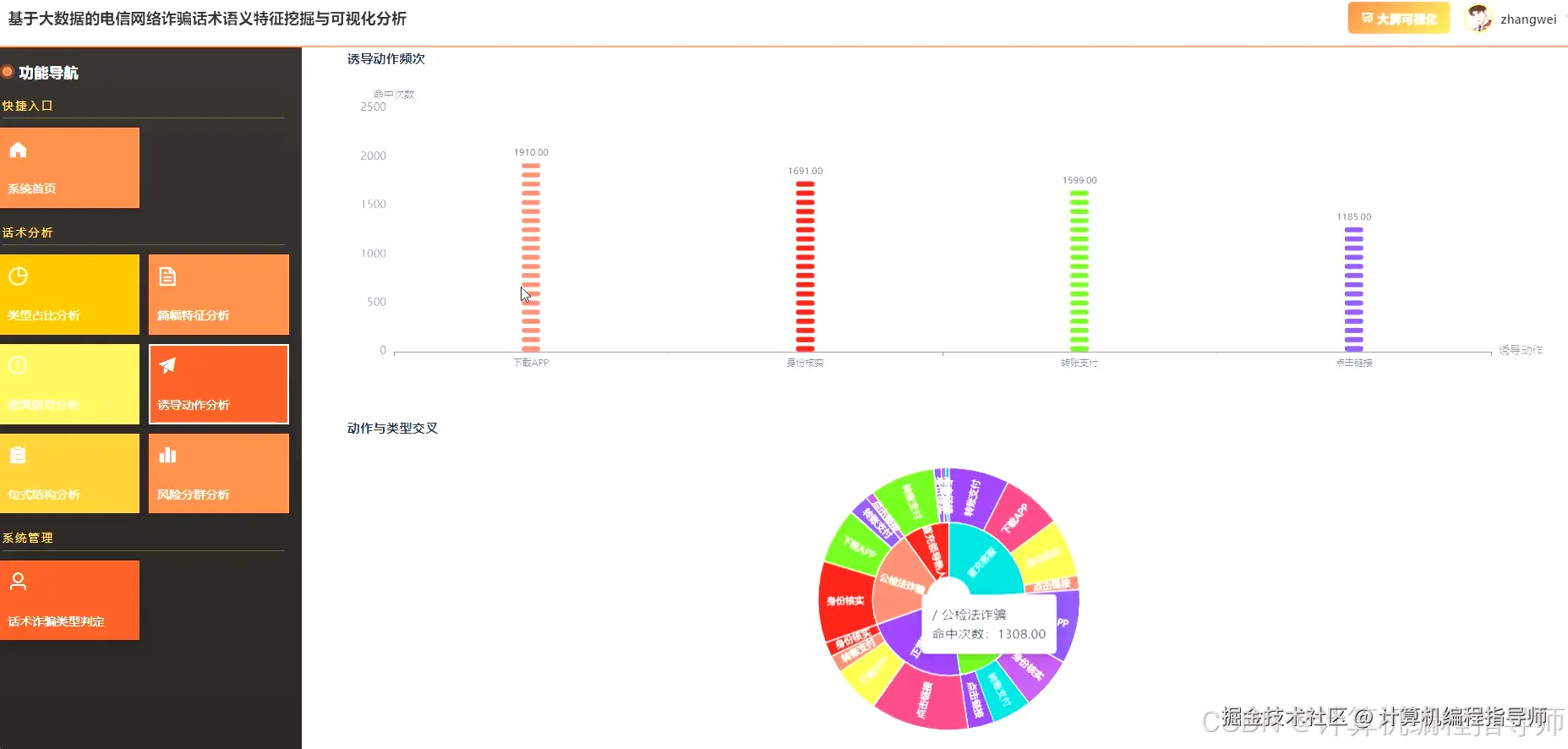
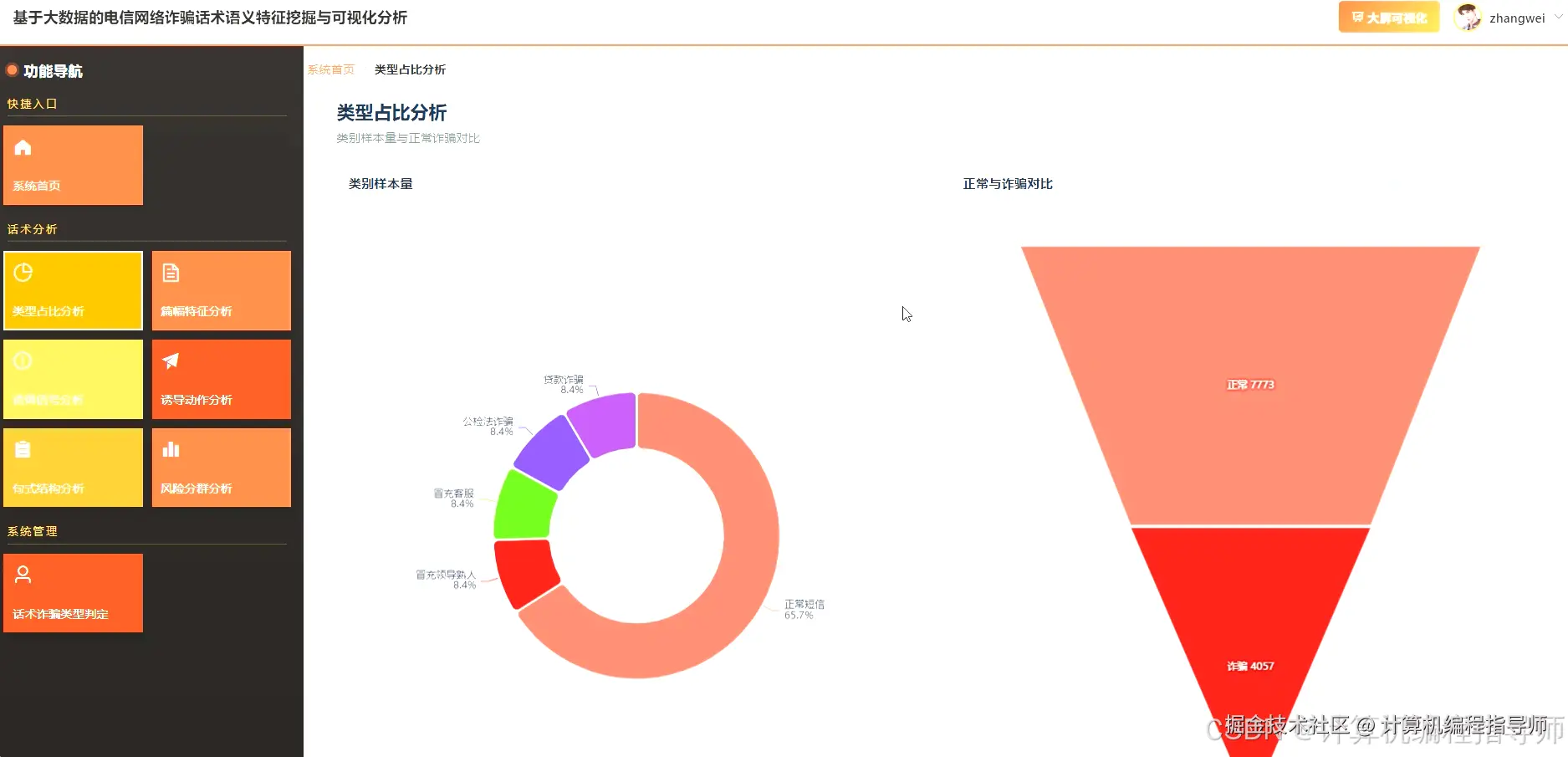
本系统是一个面向电信网络诈骗话术分析的大数据平台,整体技术栈采用Python语言进行开发。在后端服务上,系统选用Django框架搭建稳定的API接口,前端则基于Vue框架配合ElementUI和Echarts组件,构建出直观的数据可视化大屏。系统的大数据处理引擎核心依赖Hadoop生态体系,底层运用HDFS实现海量文本数据的分布式高容错存储,计算层引入Spark与Spark SQL进行内存级加速处理,并结合Pandas与NumPy完成数据预处理与统计分析。在业务功能层面,系统紧密围绕话术语义特征构建了六大分析维度。类型占比分析模块主要对比正常短信与五类诈骗话术的样本基数;篇幅特征分析模块通过文本长度分箱,区分短诱骗与长话术施压的差异;诱饵信号分析模块不仅统计权威、紧迫、借贷等单一诱饵的命中概率,还进一步调用PySpark MLlib中的FP-Growth算法,挖掘多重诱饵叠加的频繁项集与关联规则,还原复合施压话术模式;诱导动作分析模块聚焦点击链接、下载应用、转账支付等动作词,刻画诈骗分子的诱导路径;句式结构分析模块从标点密度与数字占比等表层量化特征入手,补充语义之外的形态差异;风险分群分析模块作为系统的算法核心,先对标准化后的数值与布尔特征应用K-Means算法进行无监督聚类,通过肘部法则确定最优簇数并赋予群体中文含义,同时利用TF-IDF算法对不同簇或诈骗类型的内容进行文本特征提取,输出高权重风险关键词。整个系统通过Hadoop与Spark的协同计算,有效处理了庞大且不规则的话术语料,为电信反诈工作提供了一套从数据清洗、特征提取到聚类挖掘的完整技术闭环与可视化展示方案。
电信网络诈骗话术语义特征挖掘分析系统-技术
开发语言:Python或Java 大数据框架:Hadoop+Spark(本次没用Hive,支持定制) 后端框架:Django+Spring Boot(Spring+SpringMVC+Mybatis) 前端:Vue+ElementUI+Echarts+HTML+CSS+JavaScript+jQuery 详细技术点:Hadoop、HDFS、Spark、Spark SQL、Pandas、NumPy 数据库:MySQL
电信网络诈骗话术语义特征挖掘分析系统-背景
现在大家手机里几乎每天都能收到几条垃圾短信,里面混着不少骗子发来的诈骗信息。这些诈骗话术变着花样出现,有的冒充领导让你转账,有的假装公检法吓唬人,还有的用贷款额度来诱惑。虽然运营商和手机自带的一些拦截功能一直在升级,但骗子们也在不断改写文案,把关键信息拆散或者换个说法,让传统的基于关键词匹配的拦截方法越来越吃力。很多话术表面上看起来挺正常的,其实里面藏着好多诱导动作和心理施压的套路。面对越积越多的诈骗短信数据,单靠普通的数据库去查去筛,很难把那些隐藏的语义规律找出来。所以就想借着Hadoop和Spark这些大数据处理工具,把杂乱无章的话术文本拿来拆解分析,看看能不能从篇幅、诱饵信号这些角度找出骗子们的通用套路,这也就是做这个课题的出发点。
做这个系统的实际意义,主要是想给反诈工作提供一点数据上的参考。从技术练手的角度来说,把Hadoop、Spark这些大数据框架用到一个具体的文本分析场景里,能把书本上的理论变成能跑起来的代码,对个人技术积累挺有帮助。从业务角度来看,系统通过分析各类话术的长度、标点密度,再用FP-Growth找找诱饵词是怎么组合出现的,用K-Means把话术分个群,这些结果能帮我们看清骗子平时喜欢用什么套路去施压或者诱导。虽然这只是个毕业设计,算力有限,肯定比不上专业公司的风控系统,但整理出来的特征维度和可视化图表,或许能给相关防护人员在做规则配置时提供一些思路,让大家在防范诈骗时能更有针对性一点。
电信网络诈骗话术语义特征挖掘分析系统-视频展示
video(video-GxLxv6vp-1791028236084)(type-csdn)(url-[live.csdn.net/v/embed/546...](https://link.juejin.cn?target=https%3A%2F%2Flive.csdn.net%2Fv%2Fembed%2F546825)(image-https%3A%2F%2Fv-blog.csdnimg.cn%2Fasset%2Fe444885587f5184bce7f2556c3ab21e0%2Fcover%2FCover0.jpg)(title-%25E5%259F%25BA%25E4%25BA%258EHadoop%25E7%259A%2584%25E7%2594%25B5%25E4%25BF%25A1%25E7%25BD%2591%25E7%25BB%259C%25E8%25AF%2588%25E9%25AA%2597%25E8%25AF%259D%25E6%259C%25AF%25E8%25AF%25AD%25E4%25B9%2589%25E7%2589%25B9%25E5%25BE%2581%25E6%258C%2596%25E6%258E%2598%25E5%2588%2586%25E6%259E%2590%25E7%25B3%25BB%25E7%25BB%259F "https://live.csdn.net/v/embed/546825)(image-https://v-blog.csdnimg.cn/asset/e444885587f5184bce7f2556c3ab21e0/cover/Cover0.jpg)(title-%E5%9F%BA%E4%BA%8EHadoop%E7%9A%84%E7%94%B5%E4%BF%A1%E7%BD%91%E7%BB%9C%E8%AF%88%E9%AA%97%E8%AF%9D%E6%9C%AF%E8%AF%AD%E4%B9%89%E7%89%B9%E5%BE%81%E6%8C%96%E6%8E%98%E5%88%86%E6%9E%90%E7%B3%BB%E7%BB%9F"))
电信网络诈骗话术语义特征挖掘分析系统-图片展示
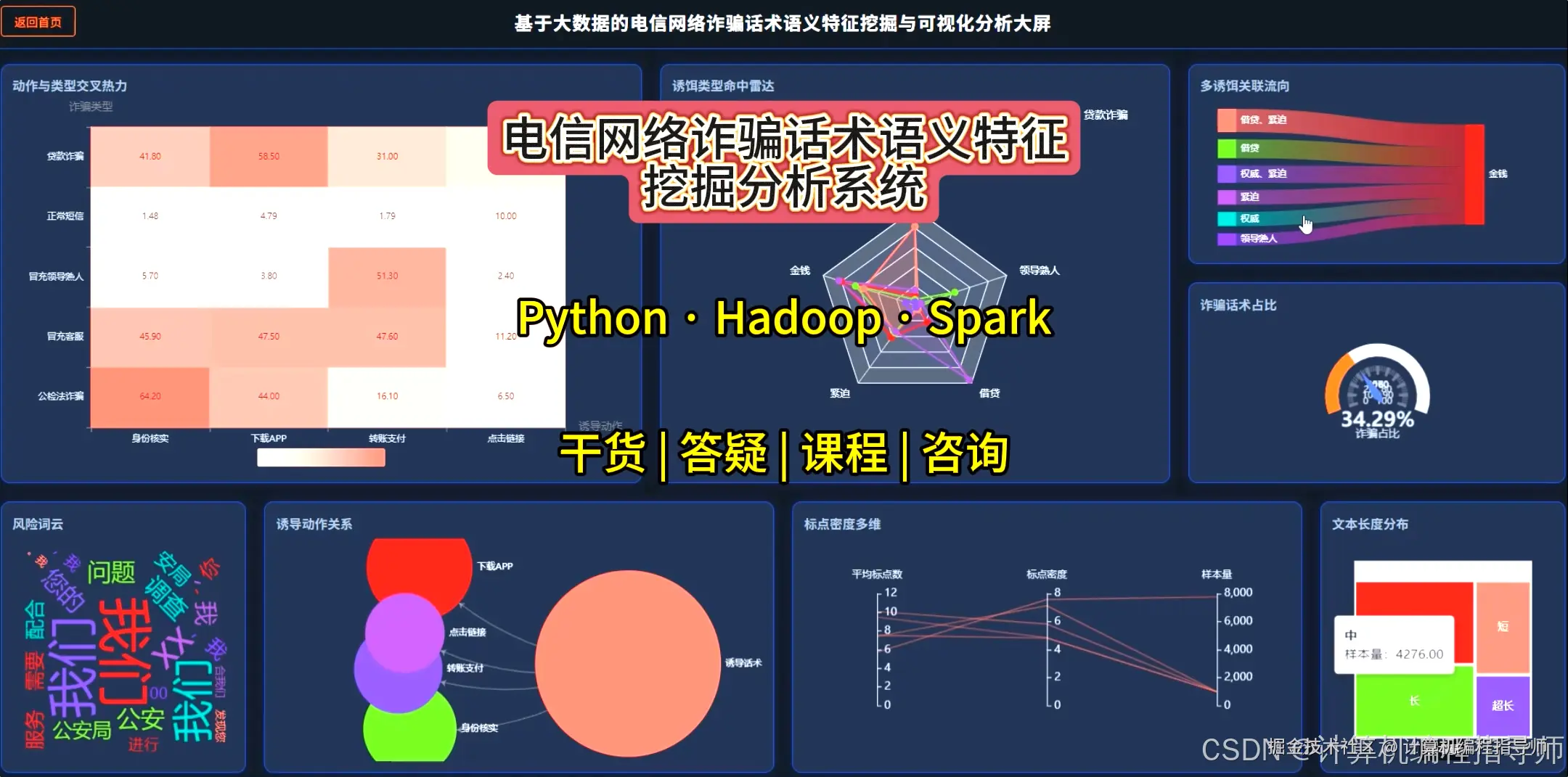

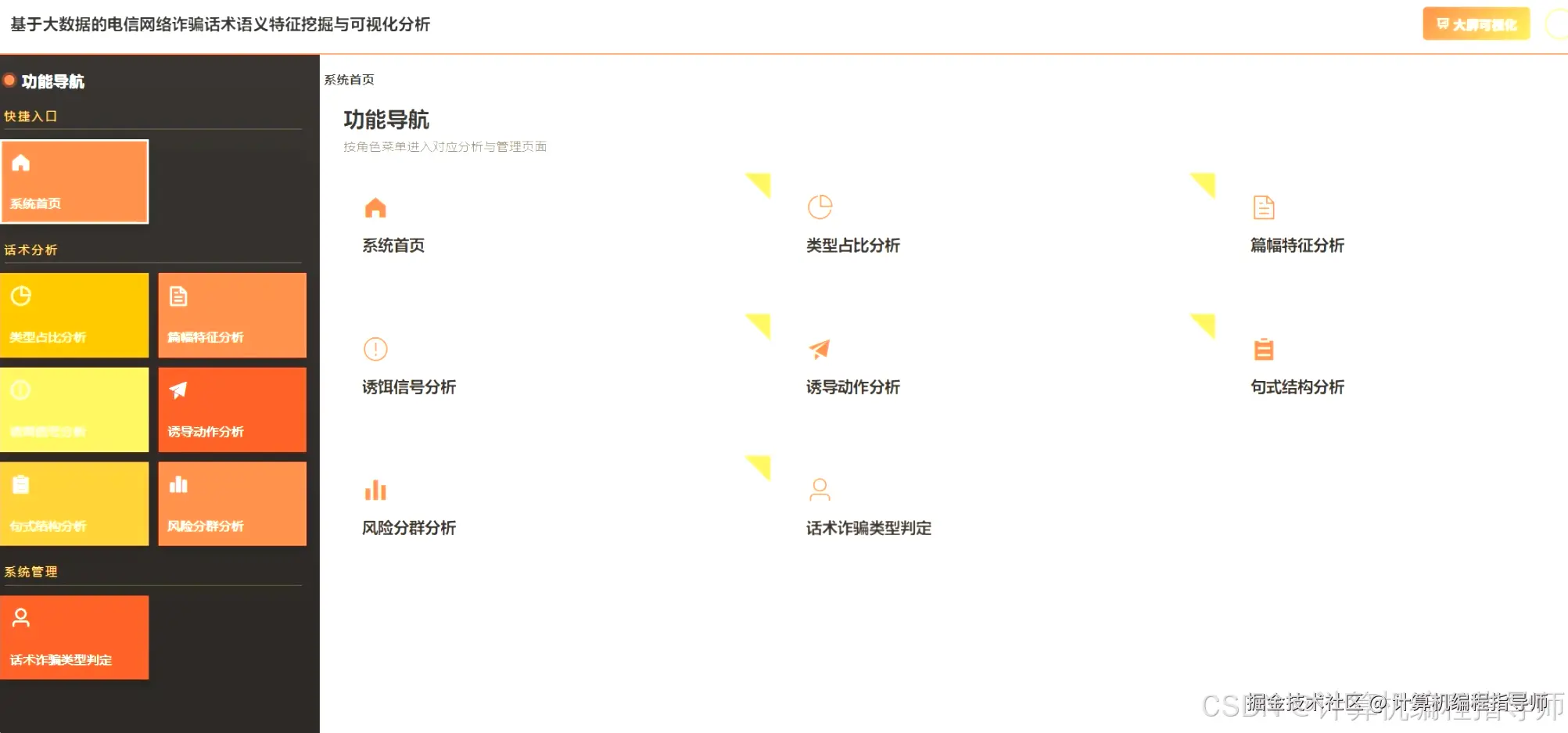
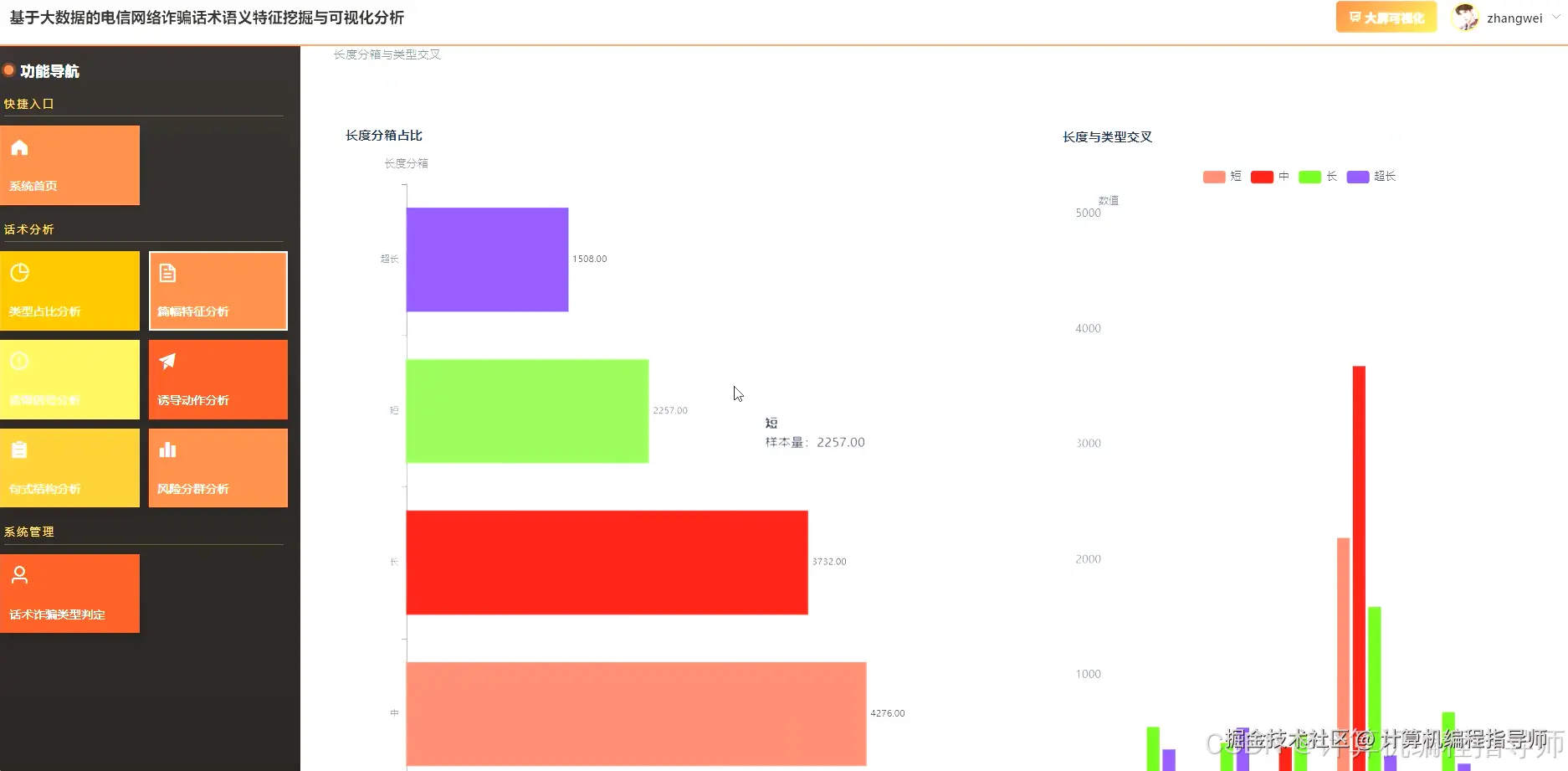
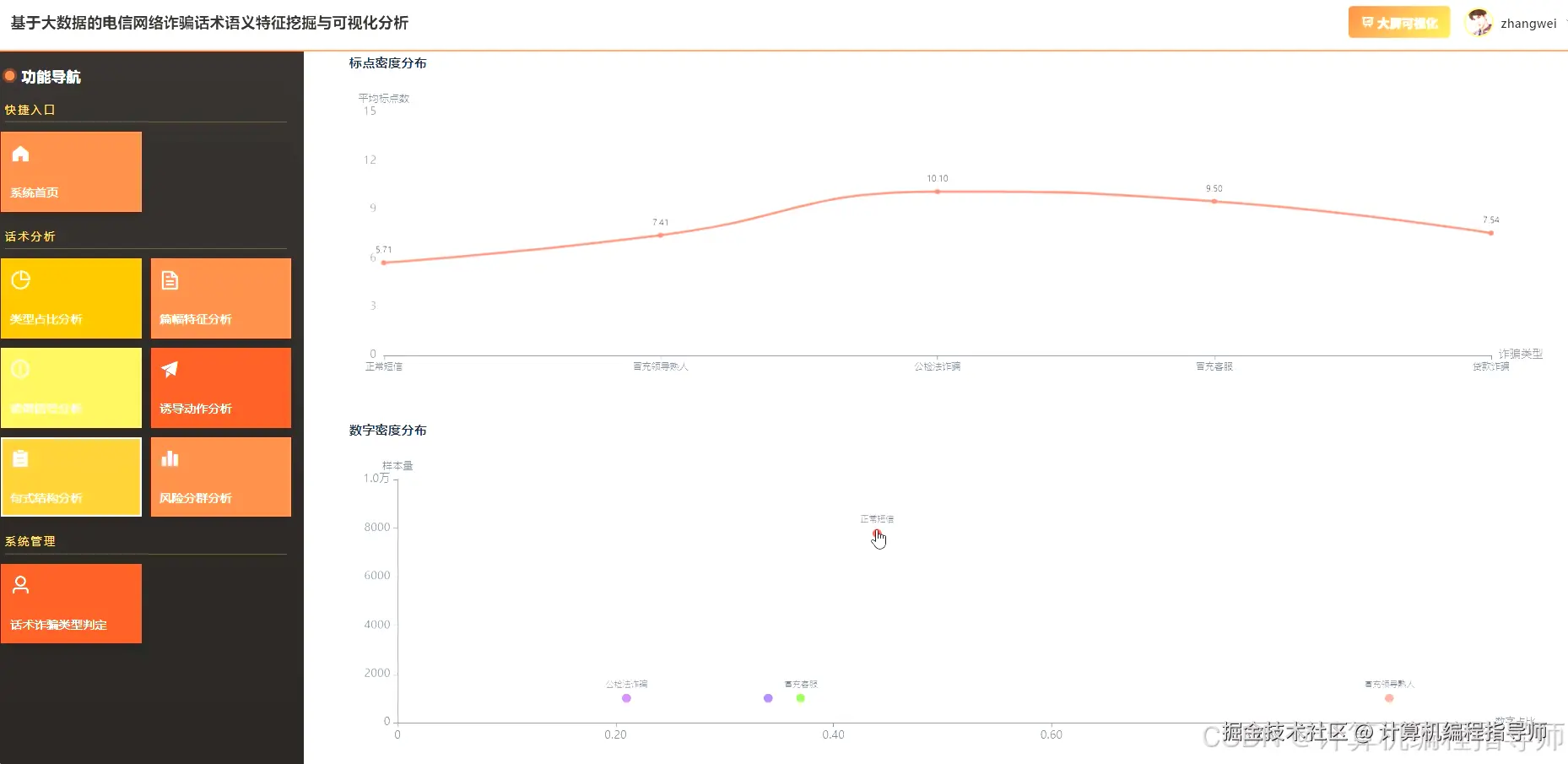
电信网络诈骗话术语义特征挖掘分析系统-代码展示
python
from pyspark.sql import SparkSession
from pyspark.ml.clustering import KMeans
from pyspark.ml.feature import HashingTF, IDF, VectorAssembler, StandardScaler
from pyspark.ml.fpm import FPGrowth
spark = SparkSession.builder.appName("FraudSemanticsAnalysis").config("spark.sql.shuffle.partitions", "4").config("spark.driver.memory", "2g").enableHiveSupport().getOrCreate()
def analyze_fraud_cue_fpgrowth(df):
    cue_cols = ["cue_authority", "cue_urgency", "cue_loan", "cue_money", "cue_leader"]
    def extract_cues(row):
        cues = []
        for col in cue_cols:
            if hasattr(row, col) and getattr(row, col) == 1:
                cues.append(col)
        return cues
    cue_data_rdd = df.rdd.map(lambda row: (extract_cues(row),))
    cue_df = spark.createDataFrame(cue_data_rdd, ["items"])
    fp_growth = FPGrowth(itemsCol="items", minSupport=0.1, minConfidence=0.5)
    model = fp_growth.fit(cue_df)
    freq_itemsets = model.freqItemsets
    assoc_rules = model.associationRules
    freq_itemsets_pd = freq_itemsets.toPandas()
    assoc_rules_pd = assoc_rules.toPandas()
    return {"freq_itemsets": freq_itemsets_pd.to_dict('records'), "rules": assoc_rules_pd.to_dict('records')}
def cluster_fraud_risk_kmeans(df):
    feature_cols = ["text_length", "digit_ratio", "punct_cnt", "cue_authority", "cue_urgency", "cue_loan", "cue_money", "cue_leader", "act_click", "act_app", "act_pay", "act_verify"]
    assembler = VectorAssembler(inputCols=feature_cols, outputCol="raw_features")
    assembled_data = assembler.transform(df)
    scaler = StandardScaler(inputCol="raw_features", outputCol="scaled_features", withStd=True, withMean=True)
    scaler_model = scaler.fit(assembled_data)
    scaled_data = scaler_model.transform(assembled_data)
    kmeans_estimator = KMeans(featuresCol="scaled_features", predictionCol="cluster", k=5, maxIter=20, seed=42)
    kmeans_model = kmeans_estimator.fit(scaled_data)
    clustered_data = kmeans_model.transform(scaled_data)
    cluster_sizes = clustered_data.groupBy("cluster").count().orderBy("cluster")
    cluster_centers = kmeans_model.clusterCenters()
    cluster_sizes_pd = cluster_sizes.toPandas()
    return {"cluster_sizes": cluster_sizes_pd.to_dict('records'), "centers": [c.tolist() for c in cluster_centers]}
def extract_risk_keywords_tfidf(df):
    words_df = df.select("fraud_type", "content")
    hashing_tf = HashingTF(inputCol="content", outputCol="raw_features", numFeatures=10000)
    featurized_data = hashing_tf.transform(words_df)
    idf = IDF(inputCol="raw_features", outputCol="features")
    idf_model = idf.fit(featurized_data)
    rescaled_data = idf_model.transform(featurized_data)
    def get_top_keywords(feat_idx, feat_val, top_n=10):
        pairs = sorted(zip(feat_idx, feat_val), key=lambda x: x[1], reverse=True)[:top_n]
        return [str(idx) for idx, val in pairs]
    rescaled_data_rdd = rescaled_data.rdd.map(lambda row: (row.fraud_type, row.features.indices.tolist(), row.features.values.tolist()))
    keyword_stats = {}
    for row in rescaled_data_rdd.collect():
        f_type, indices, values = row
        if f_type not in keyword_stats:
            keyword_stats[f_type] = {}
        for idx, val in zip(indices, values):
            if idx not in keyword_stats[f_type]:
                keyword_stats[f_type][idx] = 0.0
            keyword_stats[f_type][idx] += val
    final_keywords = {}
    for f_type, word_dict in keyword_stats.items():
        sorted_words = sorted(word_dict.items(), key=lambda item: item[1], reverse=True)[:15]
        final_keywords[f_type] = [{"word_id": str(k), "weight": round(v, 4)} for k, v in sorted_words]
    return final_keywords
电信网络诈骗话术语义特征挖掘分析系统-结语
做计算机毕设遇到卡壳太正常了,谁还没被报错和需求文档折磨过呢😂。这篇文章我把系统的整体思路和关键实现都梳理清楚了,希望能帮你理清头绪、少走弯路。
如果这期分享对你准备计算机毕设有帮助,别忘了顺手点赞、收藏、关注支持一下,你的支持就是我持续更新的动力。
也欢迎大家在评论区多交流技术和选题想法,你踩过的坑、卡住的地方,都可以拿出来说说,互相参考,争取计算机毕设顺顺利利通过、答辩稳稳过关!🎓