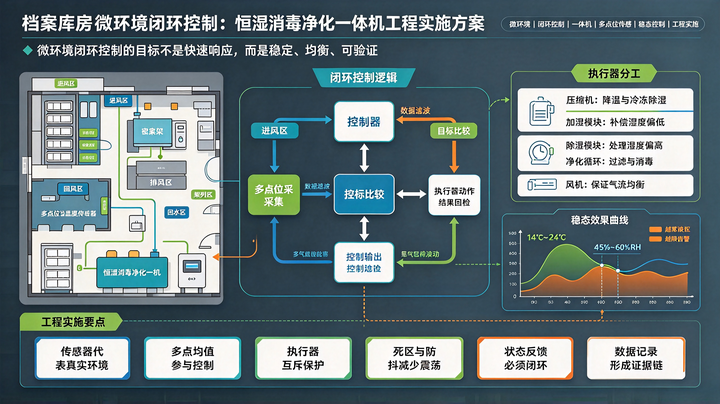
档案库房微环境闭环控制:恒湿消毒净化一体机工程实施方案
物联网 · 盛世宏博 · 恒湿消毒净化一体机
添加描述
一、为什么需要一体机:单设备替代多设备堆叠
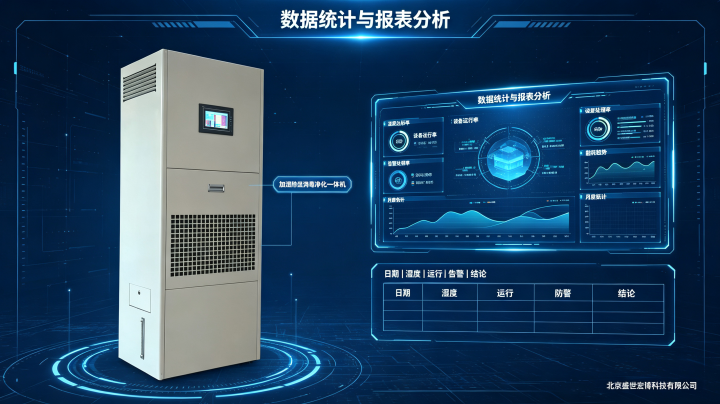
加湿除湿消毒净化一体机
传统档案库房要实现恒湿+消毒+净化,通常需要分别部署除湿机、加湿机、臭氧发生器/UV灯、空气净化器,再加一套联动控制系统。设备多、占地大、管线复杂、互相干扰(除湿放热影响温控、净化风机扰动气流分布)。
恒湿消毒净化一体机将除湿、加湿、消毒、净化四重功能集成于单一设备,通过内部风道设计和控制逻辑协调各模块运行,实现"一台设备覆盖库房微环境调控全部需求"。
| 对比维度 | 传统多设备方案 | 一体机方案 |
|---|---|---|
| 设备数量 | 4~6台 | 1~2台 |
| 占地 | 分散布置,占用通道 | 集中放置,节省空间 |
| 功耗 | 各设备独立运行,叠加耗电 | 协同调度,总功耗更低 |
| 互相干扰 | 除湿放热→温控对抗;净化气流→湿度不均 | 内部风道优化,功能模块错峰运行 |
| 联动复杂度 | 需外部控制器协调多设备互锁 | 内置逻辑,外部只需发目标参数 |
| 维护 | 多品牌多接口 | 单一厂家单一接口 |
二、一体机内部功能模块与运行逻辑
┌─────────────────────────────────────────────────────────────────────┐ │ 恒湿消毒净化一体机内部结构 │ │ │ │ ┌─────────┐ ┌─────────┐ ┌─────────┐ ┌─────────┐ │ │ │ 除湿模块 │ │ 加湿模块 │ │ 消毒模块 │ │ 净化模块 │ │ │ │ 压缩机+ │ │ 超声波/ │ │ 臭氧/ │ │ HEPA+ │ │ │ │ 蒸发器 │ │ 湿膜 │ │ UV-C/ │ │ 活性炭 │ │ │ │ │ │ │ │ PCO │ │ +离子 │ │ │ └────┬────┘ └────┬────┘ └────┬────┘ └────┬────┘ │ │ │ │ │ │ │ │ ┌────▼──────────────▼──────────────▼──────────────▼────┐ │ │ │ 中央风道 + 变频风机 │ │ │ │ (内部气流组织:回风→处理→送风) │ │ │ └───────────────────────┬──────────────────────────────┘ │ │ │ │ │ ┌──────────────────────▼──────────────────────────────┐ │ │ │ 内置控制器(MCU/PLC) │ │ │ │ · 目标参数接收(Modbus/BACnet/HTTP) │ │ │ │ · 功能模块调度(互斥/错峰/协同) │ │ │ │ · 本地闭环PID(湿度/风量) │ │ │ │ · 故障自检与上报 │ │ │ └─────────────────────────────────────────────────────────┘ │ │ │ │ │ ┌──────────────────────▼──────────────────────────────┐ │ │ │ 外部通信接口 │ │ │ │ RS485 / Ethernet / WiFi → 上位系统 │ │ │ └─────────────────────────────────────────────────────────┘ │ └─────────────────────────────────────────────────────────────────────┘ 复制
核心运行逻辑
integrated_unit_controller.py from dataclasses import dataclass from typing import Dict, List, Optional import time @dataclass class UnitTarget: humidity_setpoint: float = 55.0 # %RH humidity_deadband: float = 3.0 # 回差±%RH disinfection_mode: str = "off" # off / ozone / uv_c / pco purification_level: str = "auto" # off / low / medium / high / auto fan_speed: str = "auto" # low / medium / high / auto class IntegratedUnitController: """一体机内置控制器------本地闭环+功能模块调度""" def init(self, unit_id: str, zone_id: str): self.unit_id = unit_id self.zone_id = zone_id self.target = UnitTarget() self.current_state = { "humidity": 50.0, "temperature": 22.0, "active_module": "none", # 当前运行的功能模块 "fan_rpm": 0, "error_code": 0 } self.module_status = { "dehumidify": "idle", "humidify": "idle", "disinfection": "idle", "purification": "idle" } # 互斥组:同一时间只能运行其中一个 self.mutex_groups = \["dehumidify", "humidify", # 除湿与加湿互斥 ] def update_readings(self, humidity: float, temperature: float): """更新传感器读数""" self.current_state"humidity" = humidity self.current_state"temperature" = temperature def set_target(self, target: UnitTarget): """接收上位系统下发的目标参数""" self.target = target def control_loop(self) -> dict: """本地控制循环------决定当前激活哪个模块""" actions = {} # 1. 湿度控制(最高优先级) humi = self.current_state"humidity" setpoint = self.target.humidity_setpoint deadband = self.target.humidity_deadband if humi > setpoint + deadband: # 需要除湿 if self._can_activate("dehumidify"): actions"dehumidify" = "start" self.module_status"dehumidify" = "running" self.current_state"active_module" = "dehumidify" # 除湿时关闭加湿 actions"humidify" = "stop" self.module_status"humidify" = "idle" elif humi < setpoint - deadband: # 需要加湿 if self._can_activate("humidify"): actions"humidify" = "start" self.module_status"humidify" = "running" self.current_state"active_module" = "humidify" # 加湿时关闭除湿 actions"dehumidify" = "stop" self.module_status"dehumidify" = "idle" else: # 湿度在死区内,两个都停 actions"dehumidify" = "stop" actions"humidify" = "stop" self.module_status"dehumidify" = "idle" self.module_status"humidify" = "idle" # 2. 消毒模块调度(与湿度控制协同) if self.target.disinfection_mode != "off": # 消毒期间如果同时需要除湿,优先消毒(短时) if self.target.disinfection_mode == "ozone": actions"disinfection" = "start_ozone" self.module_status"disinfection" = "running_ozone" elif self.target.disinfection_mode == "uv_c": actions"disinfection" = "start_uv" self.module_status"disinfection" = "running_uv" elif self.target.disinfection_mode == "pco": actions"disinfection" = "start_pco" self.module_status"disinfection" = "running_pco" else: actions"disinfection" = "stop" self.module_status"disinfection" = "idle" # 3. 净化模块(最低优先级,可与其他模块并行) if self.target.purification_level == "auto": # 自动模式:根据湿度模块运行状态决定风量 if self.current_state"active_module" == "dehumidify": actions"purification" = "low" # 除湿已有大风量,净化低档 else: actions"purification" = "medium" elif self.target.purification_level != "off": actions"purification" = self.target.purification_level self.module_status"purification" = "running" else: actions"purification" = "stop" self.module_status"purification" = "idle" # 4. 风机调速 active_count = sum(1 for m in self.module_status.values() if "running" in m) if active_count == 0: actions"fan" = "stop" self.current_state"fan_rpm" = 0 elif active_count == 1: actions"fan" = "low" self.current_state"fan_rpm" = 800 else: actions"fan" = "high" self.current_state"fan_rpm" = 1500 return actions def _can_activate(self, module: str) -> bool: """检查模块是否可以被激活(互斥检查)""" for group in self.mutex_groups: if module in group: for other in group: if other != module and "running" in self.module_status.get(other, ""): return False return True def get_status(self) -> dict: """上报状态""" return { "unit_id": self.unit_id, "zone_id": self.zone_id, "target": self.target, "current": self.current_state, "modules": self.module_status, "error": self.current_state"error_code" } 复制
三、工程实施:部署与管路设计
3.1 设备选型与布置
| 参数 | 选型要点 |
|---|---|
| 除湿量 | 按库房面积×层高×换气次数计算,预留30%余量 |
| 加湿量 | 按库房围护结构渗透+人员散湿量计算 |
| 消毒方式 | 推荐PCO(持续净化+低浓度消毒)或UV-C(定期照射) |
| 净化效率 | HEPA H13级以上,活性炭≥5kg |
| 风量 | 按库房容积每小时循环6~8次 |
| 通信接口 | 至少支持RS485 Modbus RTU,推荐增加以太网 |
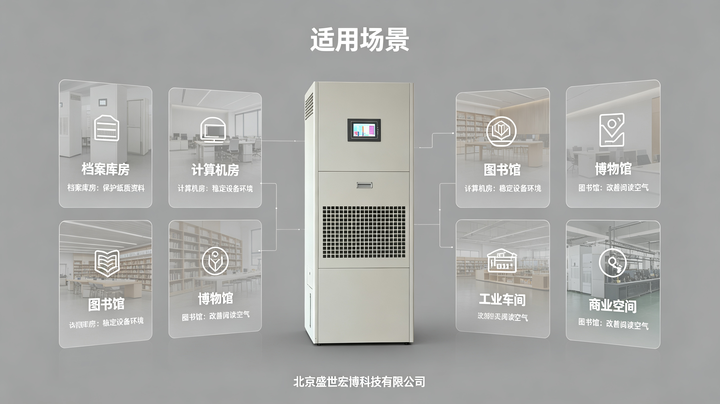
布置原则:
恒湿消毒净化一体机
-
靠近库房中央或回风侧,避免直吹档案密集架
-
送风口朝向库房长边方向,确保气流覆盖均匀
-
设备底部预留排水管坡度(除湿冷凝水排放)
-
加湿进水需安装电磁阀+过滤器
3.2 管路与风口设计
┌──────────────────────────────────────────────────────────┐ │ 库房平面示意图 │ │ │ │ ┌─────────────────────────────────────────────────┐ │ │ │ 密集架区 │ │ │ │ ┌──┐ ┌──┐ ┌──┐ ┌──┐ ┌──┐ │ │ │ │ │ │ │ │ │ │ │ │ │ │ 回风口 ◀── 一体机 │ │ │ │ └──┘ └──┘ └──┘ └──┘ └──┘ (底部/侧面) │ │ │ │ │ │ │ │ ┌──┐ ┌──┐ ┌──┐ ┌──┐ ┌──┐ │ │ │ │ │ │ │ │ │ │ │ │ │ │ 送风口 ──▶ 散流 │ │ │ │ └──┘ └──┘ └──┘ └──┘ └──┘ (顶部均布) │ │ │ └─────────────────────────────────────────────────┘ │ │ │ │ 一体机位置:库房短边侧墙,送风向上+回风向下 │ │ 气流组织:上送下回,形成垂直循环 │ └──────────────────────────────────────────────────────────┘ 复制
3.3 电气与通信接线
wiring_spec.py """一体机工程接线规格""" WIRING_SPEC = { "power": { "voltage": "220V AC", "cable": "3×2.5mm² 铜芯线", "breaker": "16A 独立空开", "grounding": "独立接地桩,接地电阻<4Ω" }, "drainage": { "pipe": "PVC Φ20mm", "slope": ">1% 坡向排水口", "note": "冷凝水含微量有机物,不可直排饮用水管道" }, "water_supply": { "pipe": "PPR Φ15mm", "valve": "电磁阀+手动旁通", "filter": "前置过滤器 40μm", "pressure": "0.1~0.4 MPa" }, "communication": { "primary": "RS485 Modbus RTU, 屏蔽双绞线 2×0.75mm²", "backup": "Ethernet TCP/IP, CAT5e", "termination": "RS485末端120Ω电阻", "addressing": "每台设备独立站号 1~247" }, "safety": { "leakage_protection": "30mA漏电保护器", "emergency_stop": "就地急停按钮(硬接线)", "overflow_protection": "水盘+浮球开关→自动停机" } } 复制
四、上位系统对接与联动
4.1 通信协议定义
modbus_register_map.py """一体机Modbus寄存器映射表""" HOLDING_REGISTERS = { # 目标参数(写) 40001: {"name": "humidity_setpoint", "type": "float", "unit": "%RH", "range": 40, 65}, 40003: {"name": "humidity_deadband", "type": "float", "unit": "%RH", "range": 1, 10}, 40005: {"name": "disinfection_mode", "type": "uint16", "enum": {0: "off", 1: "ozone", 2: "uv_c", 3: "pco"}}, 40006: {"name": "purification_level", "type": "uint16", "enum": {0: "off", 1: "low", 2: "medium", 3: "high", 4: "auto"}}, 40007: {"name": "fan_speed_override", "type": "uint16", "enum": {0: "auto", 1: "low", 2: "medium", 3: "high"}}, 40008: {"name": "remote_start_stop", "type": "uint16", "enum": {0: "stop", 1: "start"}}, # 运行参数(读/写) 40010: {"name": "dehumidify_enable", "type": "uint16", "enum": {0: "disabled", 1: "enabled"}}, 40011: {"name": "humidify_enable", "type": "uint16", "enum": {0: "disabled", 1: "enabled"}}, 40012: {"name": "disinfection_enable", "type": "uint16", "enum": {0: "disabled", 1: "enabled"}}, 40013: {"name": "purification_enable", "type": "uint16", "enum": {0: "disabled", 1: "enabled"}}, } INPUT_REGISTERS = { # 实时数据(只读) 30001: {"name": "current_humidity", "type": "float", "unit": "%RH"}, 30003: {"name": "current_temperature", "type": "float", "unit": "°C"}, 30005: {"name": "current_pm25", "type": "uint16", "unit": "μg/m³"}, 30006: {"name": "current_voc", "type": "float", "unit": "mg/m³"}, 30008: {"name": "fan_rpm", "type": "uint16", "unit": "rpm"}, 30009: {"name": "active_module", "type": "uint16", "enum": {0: "none", 1: "dehumidify", 2: "humidify", 3: "disinfection", 4: "purification"}}, 30010: {"name": "error_code", "type": "uint16"}, 30011: {"name": "uptime_hours", "type": "uint32"}, 30013: {"name": "total_dehumidify_hours", "type": "uint32"}, 30015: {"name": "total_disinfection_hours", "type": "uint32"}, 30017: {"name": "filter_life_remaining", "type": "uint16", "unit": "%"}, } COIL_REGISTERS = { # 控制线圈(写) 1: {"name": "emergency_stop", "desc": "紧急停机(1=停机)"}, 2: {"name": "reset_error", "desc": "复位错误(1=复位)"}, 3: {"name": "local_override", "desc": "就地优先(1=就地控制)"}, } DISCRETE_INPUTS = { # 状态输入(只读) 10001: {"name": "water_tank_full", "desc": "水箱满"}, 10002: {"name": "filter_dirty", "desc": "滤网脏堵"}, 10003: {"name": "door_open", "desc": "检修门开启"}, 10004: {"name": "power_ok", "desc": "电源正常"}, 10005: {"name": "comm_ok", "desc": "通信正常"}, } 复制
4.2 上位系统调度逻辑
supervisor.py class UnitSupervisor: """上位系统对一体机的调度管理""" def init(self, modbus_client, unit_address: int): self.client = modbus_client self.addr = unit_address def set_humidity_target(self, setpoint: float, deadband: float = 3.0): """设定湿度目标""" self.client.write_float(self.addr, 40001, setpoint) self.client.write_float(self.addr, 40003, deadband) def set_disinfection_schedule(self, mode: str, start_hour: int, duration_min: int): """设定消毒计划""" mode_map = {"off": 0, "ozone": 1, "uv_c": 2, "pco": 3} self.client.write_register(self.addr, 40005, mode_map.get(mode, 0)) def read_status(self) -> dict: """读取设备状态""" regs = self.client.read_input_registers(self.addr, 30001, 17) return { "humidity": regs0, "temperature": regs2, "pm25": regs4, "voc": regs5, "fan_rpm": regs7, "active_module": regs8, "error_code": regs9, "filter_life": regs16 } def emergency_stop(self): """紧急停机""" self.client.write_coil(self.addr, 1, 1) def reset_error(self): """复位错误""" self.client.write_coil(self.addr, 2, 1) def check_health(self) -> list: """健康检查,返回异常列表""" issues = \[\] discrete = self.client.read_discrete_inputs(self.addr, 10001, 5) if discrete0: issues.append("水箱满") if discrete1: issues.append("滤网脏堵,需更换") if discrete2: issues.append("检修门开启") if not discrete3: issues.append("电源异常") if not discrete4: issues.append("通信异常") status = self.read_status() if status"error_code" != 0: issues.append(f"设备错误码: {status'error_code'}") if status"filter_life" < 10: issues.append(f"滤网寿命仅剩{status'filter_life'}%,请更换") return issues 复制
五、消毒净化时序与一体机协同
5.1 一体机内置时序 vs 外部调度
| 方式 | 优点 | 缺点 | 适用场景 |
|---|---|---|---|
| 一体机内置时序 | 断网可独立运行,不依赖上位系统 | 多台设备间无法协同 | 单库房单设备 |
| 外部调度 | 多设备协同、与门禁/消防联动 | 依赖通信链路 | 多库房/多设备 |
推荐方案:一体机内置基础时序(保障断网可用性),上位系统叠加高级调度(多设备协同+安全边界)。
5.2 内置时序配置
builtin_schedule.py BUILTIN_SCHEDULES = { "daily_pco": { "description": "每日PCO净化(凌晨时段)", "schedule": "0 2 * * *", # cron格式:每天凌晨2:00 "duration": 120, # 分钟 "actions": { "disinfection_mode": "pco", "purification_level": "high", "fan_speed": "high" } }, "weekly_uv": { "description": "每周UV-C照射(周日)", "schedule": "0 3 * * 0", # 每周日凌晨3:00 "duration": 60, "actions": { "disinfection_mode": "uv_c", "purification_level": "off", "fan_speed": "low" } }, "monthly_ozone": { "description": "每月臭氧消毒(第一个周六)", "schedule": "0 1 1-7 * 6", # 每月第一个周六凌晨1:00 "duration": 120, "actions": { "disinfection_mode": "ozone", "purification_level": "off", "fan_speed": "off" # 臭氧期间风机停转,保持密闭 }, "pre_conditioning": { "duration": 30, "actions": {"fan_speed": "high"} # 预处理:先全速循环均匀浓度 } } } 复制
六、工程调试步骤
| 步骤 | 内容 | 验收标准 |
|---|---|---|
| 1. 单机通电 | 检查电源、接地、急停按钮 | 上电自检无报错 |
| 2. 传感器校准 | 对比手持式温湿度计 | 偏差<±3%RH |
| 3. 各模块单独测试 | 逐一启动除湿/加湿/消毒/净化 | 各模块运行正常,无异常噪音 |
| 4. 通信测试 | Modbus读写寄存器 | 读写成功率100% |
| 5. 联动测试 | 上位系统下发目标参数 | 一体机正确响应并调整运行模块 |
| 6. 闭环测试 | 人为改变库房湿度(开门/加湿器) | 一体机自动启动对应模块,湿度回归设定值 |
| 7. 安全测试 | 模拟水箱满、滤网堵、通信断 | 设备正确报警并进入安全状态 |
| 8. 长时间运行 | 连续运行72小时 | 温湿度波动在±5%RH以内,无故障 |
七、常见问题与处理
| 问题 | 原因 | 处理 |
|---|---|---|
| 除湿效果差 | 冷凝水排放不畅/滤网脏堵 | 清理排水管,更换滤网 |
| 加湿量不足 | 进水压力低/电磁阀未全开 | 检查水压,清洗电磁阀 |
| 消毒后异味 | 活性炭饱和/净化模块未启动 | 更换活性炭滤芯,确认后处理阶段净化运行 |
| 通信频繁掉线 | RS485终端电阻未接/屏蔽层未接地 | 加装120Ω终端电阻,屏蔽层单点接地 |
| 设备频繁启停 | 死区设置过小 | 增大humidity_deadband至5%RH |
| 风机噪音大 | 安装不牢固/风道有异物 | 加固安装,清理风道 |
八、经验总结
-
一体机的核心价值不是"省设备",而是"省协调"。多设备方案最大的工程难点在于联动逻辑和互锁保护,一体机把这些内置了,外部系统只需下发目标值。
-
内置控制器必须有独立运行能力。网络断了、上位系统挂了,一体机应该能根据本地传感器继续维持恒湿,这是档案保护的底线。
-
消毒时序优先用PCO持续净化,而非定期高浓度臭氧。臭氧对档案材料的长期影响仍有争议,PCO在较低浓度下持续运行更安全。
-
通信协议选Modbus RTU+TCP双模。RTU用于本地可靠通信,TCP用于远程监控,双模互为备份。
-
滤网寿命管理不能靠人工记忆。一体机应内置运行时间计数和压差检测,剩余寿命<20%时主动上报,避免"滤网堵了还在跑"的情况。
-
调试时重点验证"模块切换平滑性"。除湿切加湿、消毒切净化时不应出现风机骤停或大幅波动,应在代码中设置过渡期(如重叠运行30秒)。
关键词:档案库房,微环境,闭环控制,恒湿消毒净化一体机,工程实施,Modbus,联动调度,内置时序,模块互斥,气流组织
标签:#档案库房 #微环境 #闭环控制 #恒湿消毒净化一体机 #工程实施 #Modbus #联动调度 #内置时序 #模块互斥 #气流组织