2026 年 11 月 17 日,OpenAI 发布公告「Introducing GPT-6.2 Astra and Sol」,正式上线 gpt-6.2-astra 和 gpt-6.2-sol 两个模型。同一天,开发者文档的 API changelog 新增两条记录:除了两个新模型上线,Responses API 的后台折扣窗口也进入 public beta。
按官方公告的定位:「GPT‑6.2 Astra, our new frontier model for your hardest projects, and GPT‑6.2 Sol, our efficient, versatile model for everyday work. Both models deliver better results on demanding tasks with fewer output tokens, so you can get more done within your usage limits.」
对于调用 OpenAI API 或用 Codex 写代码的开发者,这次更新最需要关注四件事,先把结论摆在前面:
- Astra 全面降价,缓存读取直接打到 0.05 倍 :
gpt-6.2-astra的输入和输出单价较上一代降了 20%,缓存读取从上一代的 1.00降到0.40(降幅 60%);gpt-6.2-sol价格与上一代完全一致。 - 改对话前缀会丢掉推理内容 :Responses API 从 GPT-6.2 开始,只要中途修改了对话历史前缀(如压缩早期工具输出、重写开头的 developer message),或变更了
safety_identifier,之前的 reasoning items 就会被移除,导致回答质量下降且消耗更多 token 重做推理。 - 顶层
instructions不再进缓存 :从 GPT-6.2 起,Responses API 会把顶层instructions拼在input之后,每次请求都按未缓存输入全额计费。长期复用的系统指令必须挪到input第一条的developer消息里。 - 工具调用与参数硬门槛 :两个模型虽支持 Chat Completions,但工具调用必须走 Responses API(changelog 原文:「Tool calling requires the Responses API.」);推理强度设为
none的请求会被直接拒绝;temperature、top_p等采样参数必须移除。
在模型基础规格上,两个模型的上下文窗口均为 1,050,000,最大输入 922,000 tokens,最大输出 128,000 tokens,均支持文本、图片输入与文本输出。知识截止时间略有差异:GPT-6.2 Astra 为 2026-05-18,GPT-6.2 Sol 为 2026-06-01。
价格拆解:Astra 降价 20%,长上下文与各档倍率规则
先看 Standard 档位下每 100 万 token 的美元定价对比:
| 模型 | 输入 | 输出 | 缓存读取 | 缓存写入(30 分钟) | 缓存写入(12 小时) |
|---|---|---|---|---|---|
| gpt-6.2-astra | 8.00 | 40.00 | 0.40 | 10.00 | 20.00 |
| gpt-6-astra(上一代) | 10.00 | 50.00 | 1.00 | 12.50 | 25.00 |
| gpt-6.2-sol | 2.00 | 10.00 | 0.10 | 2.50 | 5.00 |
| gpt-6.1-sol(上一代) | 2.00 | 10.00 | 0.10 | 2.50 | 5.00 |
正如公告原文所述:「GPT‑6.2 Astra's input and output token prices are 20% lower than GPT‑6 Astra's, with a 60% discount on cached input ( 8forinput,0.40 for cached input, and $40 for output, all per million tokens). GPT‑6.2 Sol keeps GPT‑6.1 Sol's API token prices.」
这里最值得留意的是缓存倍率的变化。根据 prompt caching 指南,GPT-5.6 及之后的模型,缓存读取多数是未缓存输入价的 0.1 倍;而 GPT-6.2 Astra、GPT-6.2 Sol、GPT-6.1 Sol、GPT-6.1 Terra 则是 0.05 倍。因此 Astra 的缓存读取从上一代的 0.1 倍( 1.00)降到了0.05倍(0.40)。缓存写入方面,30 分钟档是未缓存输入价的 1.25 倍,12 小时档是 2.5 倍------文档特别说明,这是写入的总价,不是在输入价上额外叠加。
除了基础单价,实际计费还受上下文长度和服务档位影响:
- 长上下文溢价:模型页明确规定,「For requests with more than 272K input tokens, input and cache rates double and output costs 1.5 times the short-context rate for the full request.」一旦输入超过 272K tokens,整次请求的输入与缓存费率翻倍,输出按 1.5 倍计费。
- 速度与批处理档位:Batch 是 Standard 的 50%;Fast 是同等上下文长度下 Standard 的 2 倍;Ultrafast 在 2027-02-28 之前是 Standard 的 3 倍,自 2027-03-01 起(太平洋时间)恢复为 6 倍。
- 区域与档位支持:定价页的 Flex 档表格目前没有列出两个 6.2 模型(仅列出 gpt-6-astra、gpt-6.1-sol、gpt-6.1-terra、gpt-6-luna)。迁移指南说明,两个新模型支持美国和欧盟数据驻留下的 Standard、Fast、Batch 处理,Ultrafast 只支持美国数据驻留。使用区域处理(数据驻留)端点需加收 10%。
行为变更一:修改对话前缀会丢弃推理内容
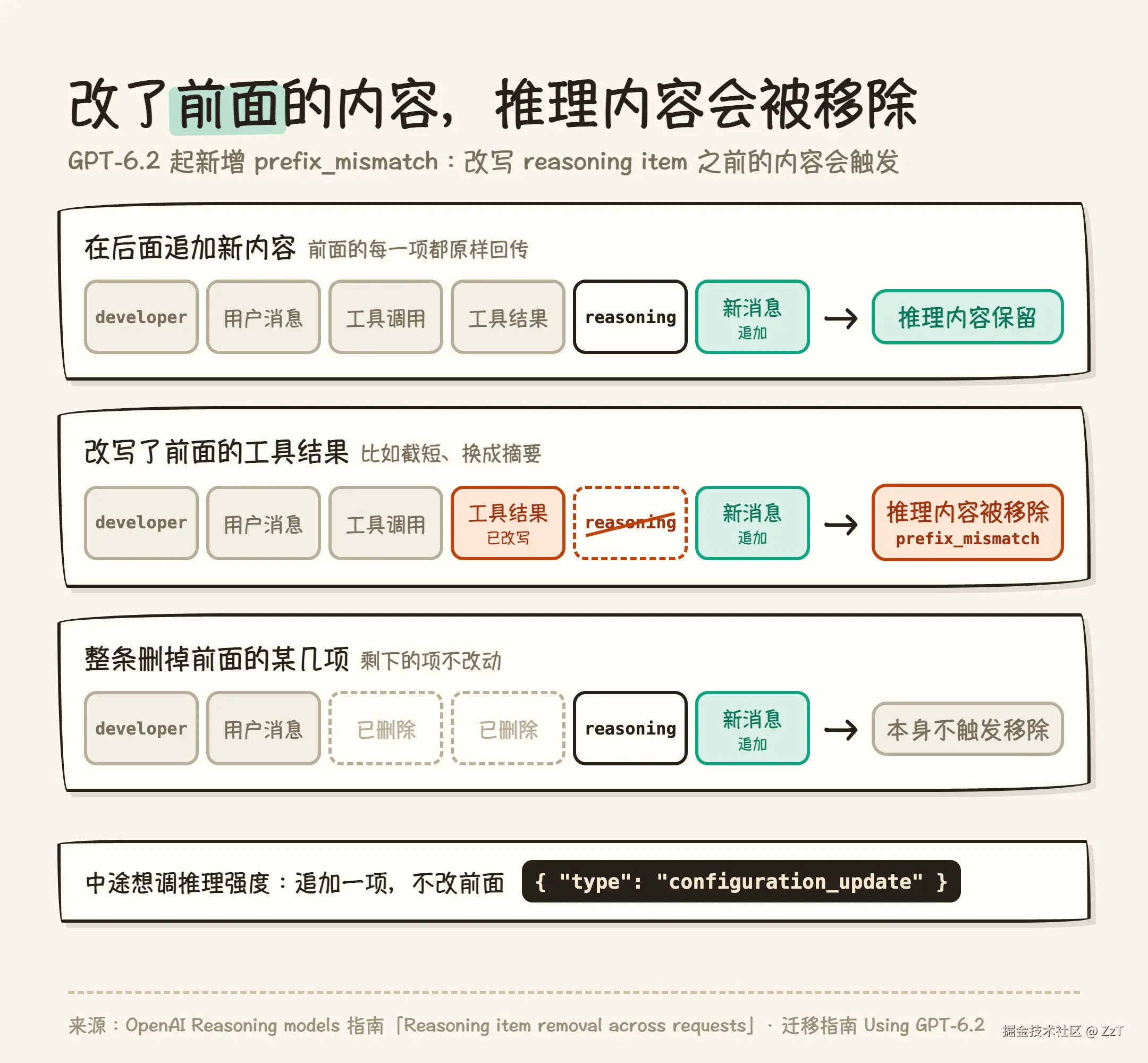
API changelog 专门提醒了这次的两处底层行为变更:「GPT-6.2 changes how the Responses API preserves reasoning when you edit a conversation's prefix and how it handles the top-level instructions field. See the GPT-6.2 migration guide for details and recommended updates to your integration.」
在多轮对话或 Agent 循环中,推理模型可以把之前轮次的推理内容(reasoning items,对开发者不可读,API 不返回原文)带到下一次请求继续使用。传递方式有三种:用 previous_response_id、把响应挂到一个 conversation 上,或者自己把完整的响应历史原样回传。涉及函数调用时,必须把随函数调用一起返回的 reasoning items 和工具输出一起传回;自己维护历史时,要把每次响应的原始 input 和全部 output 项按原顺序放进下一次请求,再追加新内容。
从 GPT-6.2 开始,前缀校验变得严格。迁移指南写道:「Starting with GPT-6.2, the Responses API drops reasoning items after mid-conversation edits to the conversation history (prefix edits), certain model changes (including downgrades), or changes to the end user or organization. When the model loses access to reasoning items, answer quality can decline and the model may use more tokens to repeat earlier work. Review your integration to identify edits such as changes to earlier developer messages or tool calls. To preserve reasoning and keep earlier input eligible for prompt caching, keep the prefix unchanged when you change settings between responses.」
reasoning 指南给出了背后的原因:「The API removes reasoning items if you switch model families, downgrade to a less capable model, or switch organizations or users mid-conversation as one of our safeguards against distillation. Starting with 6.2, reasoning items with a safety_identifier change or a modified conversation history (the prefix) will also be removed.」换模型家族、降级模型、换组织或用户移除推理内容是防蒸馏的原有规则;6.2 新增了「前缀被改」和「safety_identifier 变化」两条触发条件。
如果发现多轮任务突然变慢或 token 暴涨,可以检查 API 响应里的 input_transformations 字段,它会直接给出移除原因:
prefix_mismatch:GPT-6.2 及之后,在 reasoning item 之前插入或修改了内容(如改写了之前某次工具调用的结果)。注意:整条删除某些项而不改动剩下的项,或者在 reasoning item 之后追加新项,本身不会触发。end_user_mismatch:GPT-6.2 及之后,产生该 item 的请求与复用它的请求safety_identifier不一致(只在其中一次传了也算;两次传同值或都不传可通过)。model_mismatch:换了模型家族,或同家族内降级到更弱模型(同家族升级到更强模型且其他检查通过时会保留)。organization_mismatch:复用了另一个组织或用户名下不同 workspace 的 item。turn_boundary:item 来自之前轮次而模型只用当前轮次推理(GPT-5.6 之前默认只用当前轮次;支持的模型由reasoning.context控制)。
结合上述规则整理,现有 Agent 框架里最容易踩中 prefix_mismatch 的三种做法是:为了省 token 把历史里较早的工具输出截断或替换成摘要;每一轮都重新生成对话开头的 developer message(比如往里塞当前时间戳或最新状态);中途改写之前的工具调用参数或结果。
如果需要在对话中途调整推理强度,不要改请求级别的 reasoning.effort,而是在下一条用户消息之前往 input 里追加一个 configuration_update 项(可同时带 reasoning.effort 和 text.format,用 previous_response_id 时会自动保留,自己管历史时按原位置回传)。文档指出:「This preserves the original prompt prefix for prompt caching.」写法如下:
json
{
  "type": "configuration_update",
  "reasoning": {
    "effort": "high"
  }
}
正如公告给出的总结建议:「For GPT-6.2 Astra & Sol, in order to improve cache reuse, help lower costs and latency, and preserve reasoning across turns, we recommend keeping prompt prefixes unchanged and appending new instructions to the conversation.」
行为变更二:顶层 instructions 移至 input 之后,不再进缓存
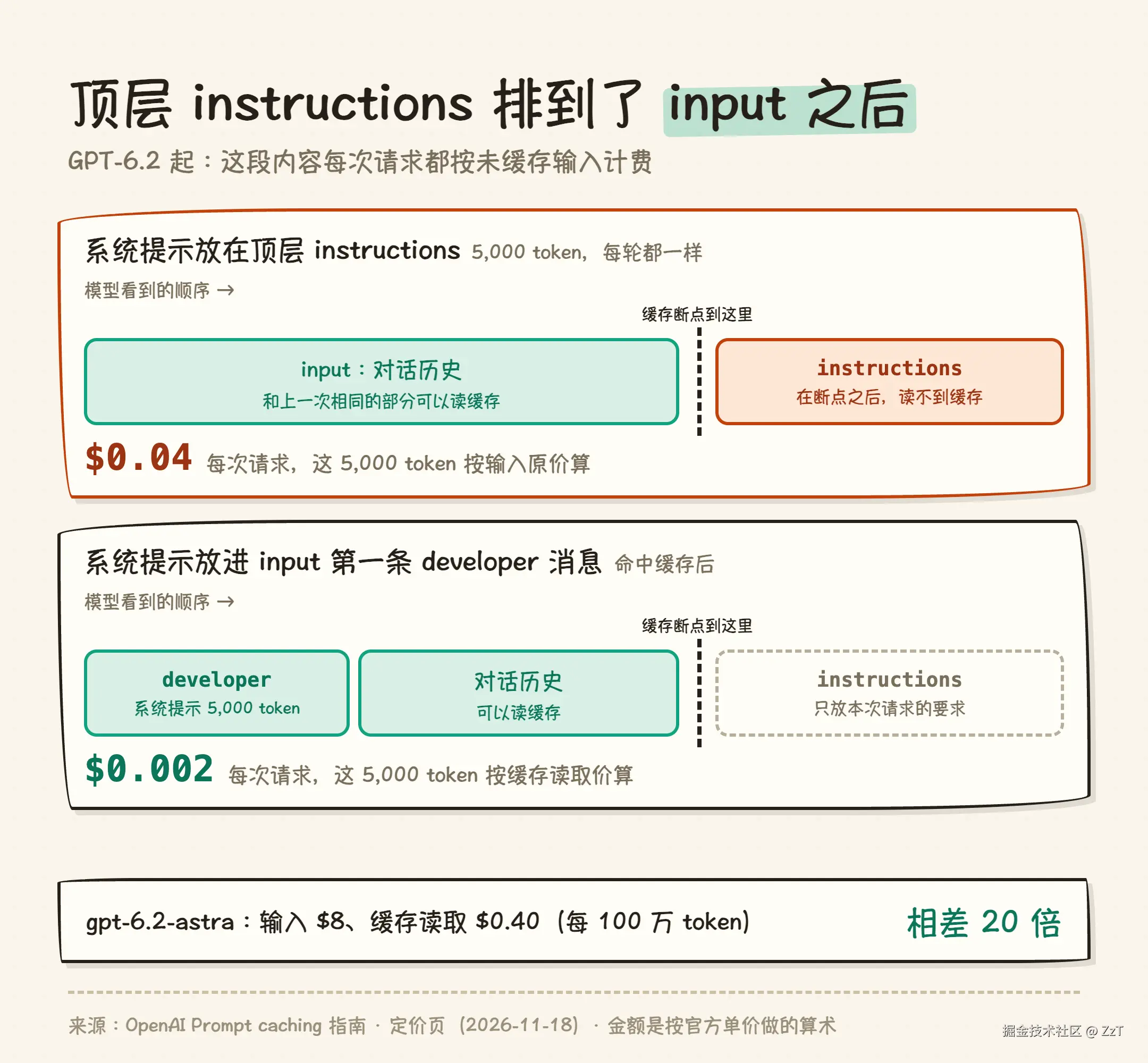
第二处直接关系账单的变更是顶层 instructions 字段的位置。迁移指南说明:「Models starting with GPT-6.2 append top-level instructions after input in the Responses API. To make reusable instructions eligible for prompt caching, put them in a developer message as the first item in input. Use top-level instructions for developer guidance that applies only to the current request.」
prompt caching 指南进一步解释了缓存与计费逻辑:「Models starting with GPT-6.2, including Astra and Sol, append these instructions after input, beyond eligible cache breakpoints. You can change them between turns while keeping the earlier prefix eligible for cache reuse. They do not carry over with previous_response_id.」紧接着是计费规则:「OpenAI bills those instruction tokens at the uncached input-token rate on every request, even if you repeat identical instructions. To make reusable instructions eligible for caching, put them in a developer message at the beginning of input. That message remains in the conversation history when you use previous_response_id.」
这意味着顶层 instructions 的定位彻底变成了「仅对当前单次请求生效的临时指示」(例如在工作流最后一轮让模型总结发现),好处是每轮修改它不会破坏前面的缓存前缀;而长期不变的系统提示词,必须放进 input 开头的 developer 消息里:
json
{
  "model": "gpt-6.2-astra",
  "input": [
    { "role": "developer", "content": "长期不变的系统指令......" },
    { "role": "user", "content": "这一轮的问题......" }
  ],
  "instructions": "只对这一次请求生效的补充要求"
}
在 GPT-5.6 及之后的模型上,可缓存前缀至少需要 1,024 个 token。隐式模式下,OpenAI 会把断点放在最新一条符合条件的消息末尾(用户消息、连续工具响应的最后一条、开头连续 developer 消息的最后一条);也可以用 prompt_cache_breakpoint: { "mode": "explicit" } 手动标断点(每次请求最多 4 次缓存写入,顶层 instructions 里不能放显式断点)。
按上面的官方单价做两笔算术,就能看出放错位置的代价:
- 一段 5,000 token 的系统提示词,在
gpt-6.2-astra上如果还放在顶层instructions里,每次请求按未缓存输入计费:5,000 × 8/100万=0.04;如果挪到input开头的developermessage 并命中缓存读取:5,000 × 0.40/100万=0.002,单次读取成本相差 20 倍。 - 一段 50,000 token 的固定前缀连续请求 10 次,不走缓存总计 10 × 50,000 × 8/100万=4.00;走 30 分钟缓存写入一次( 0.50)加9次读取(0.18),合计仅 $0.68。
新的省钱选项:Responses API 后台折扣窗口
针对不急着要结果的异步与多步任务,Responses API 同步上线了后台折扣窗口(public beta)。API changelog 原文:「Choose a two-hour or eight-hour background completion window in the Responses API public beta. Model token rates are 30% lower than Standard for the two-hour window and 40% lower for the eight-hour window.」适用模型包括 GPT-6.2 Astra、GPT-6.2 Sol、GPT-6.1 Terra 和 GPT-6 Luna。
按折扣折算下来(算术推导),Astra 在 2 小时窗口为输入 5.60/输出28,8 小时窗口为 4.80/24;Sol 在 2 小时窗口为 1.40/7,8 小时窗口为 1.20/6(作为对照,官方 Batch 档为 Astra 4/20、Sol 1/5)。
配置时需满足以下参数组合:background 设为 true,background_options.completion_window 设为 2h 或 8h(默认窗口是 soonest),stream 不设或设为 false,service_tier 设为 default 来选 Standard(若设 auto,只有 API 实际路由到 Standard 才符合折扣条件)。如果是类似「隔夜文档审查」的多步工具调用任务,首次请求可带上函数工具与自选的 background_options.continuation_id,收到 response.completed webhook 后执行本地函数,再用相同的模型、档位、窗口、continuation_id 和 previous_response_id 发起后续请求------文档说明:「Reuse continuation_id to make follow-ups eligible for higher queue priority.」
接入前需要注意文档列出的两项硬性限制:
- 配额共享:「Requests with 2h or 8h completion windows share the Batch/Background Rate Limit with Batch API jobs. The API counts input tokens at submission.」
- 缓存隔离:「Standard requests outside the discounted completion windows can't reuse prompt cache entries created by 2h or 8h background requests, even when the prompt is identical.」
API 迁移检查清单
把迁移指南「Migration quickstart」里的改动要求汇总成一张核对表(官方也提到可使用 OpenAI Docs skill 让 coding agent 协助完成迁移):
| 检查项 | 迁移调整动作 | 原因说明 |
|---|---|---|
| 模型 ID | model 改为 gpt-6.2-astra 或 gpt-6.2-sol |
切换至 6.2 新模型 |
| 推理强度 | 新接入从 medium 起步;原 none / minimal 改为 low |
模型页明确:「The API rejects requests that set reasoning effort to none.」(Responses 用 reasoning.effort,Chat Completions 用 reasoning_effort) |
| 工具调用端点 | 迁移至 Responses API | 虽支持 Chat Completions,但工具调用必须走 Responses API |
| 采样与概率参数 | 删掉 temperature、top_p、logprobs、top_logprobs |
新模型不支持;Responses 请求还需从 include 移除 message.output_text.logprobs |
| 系统指令与缓存 | 固定指令移入 input 首条 developer 消息;旧参数换为 prompt_cache_options.ttl: "30m" |
顶层 instructions 不再进缓存;从 GPT-5.5 或更早模型迁移需替换原 prompt_cache_retention |
| ZDR(零数据保留) | 手动按原顺序回传历史输出项(含加密的 reasoning items) | 开启 ZDR 时 Responses API 将 store 视为 false,服务端不留存上下文 |
| 提示词微调 | 检查并精简诸如 "be concise" 的指令;长任务明确允许合理假设 |
Astra 默认文风更简练直接;意图不明时倾向先提下一步等确认 |
关于最后一项提示词行为,迁移指南给出了两段具体描述,调优 Agent 提示词时可以直接对照:
- 「Writing style. The model's writing tends to be more concise and direct by default. When migrating, revisit instructions like "be concise" in your system prompt.」
- 「Task completion. When the user's intent is unclear, the model may propose a next step and wait for confirmation. For longer tasks, give it room to make reasonable assumptions and keep working.」
怎么读官方公告里的评测数字与限制说明
公告展示了一组基准测试对比。需要明确的是,以下所有评测数字均由 OpenAI 在自家发布公告中报告,公告图表未给出各模型的具体绝对分数和每任务美元成本数值,目前也尚未看到独立的第三方复测,阅读时务必留意附带的测试限定条件:
- Agents' Last Exam v1.1:OpenAI 报告称,「GPT‑6.2 Astra sets a new high, scoring 5.2 points higher than GPT‑6 Astra at less than a third of the cost, and 5.5 points ahead of Claude Fable 5.2 at just 5% of the cost.」需注意其图注附带的条件:「Its leaderboard results for Fable 5.2 exclude nine tasks that used a fallback model.」
- Terminal-Bench-Science 0.1:OpenAI 称,「GPT-6.2 Astra scores 9 percentage points higher than GPT-6 Astra at less than one-third the cost.」脚注说明了竞品分数的来源与运行框架差异:「Terminal-Bench-Science 0.1 results for Fable 5.2 are as reported by Artificial Analysis in the mini-swe-agent harness. Anthropic reported Fable 5.2's score of 74.6% at max reasoning in Claude Code.」
- Cognition 的 FrontierCode 2.0:OpenAI 报告,「GPT‑6.2 Sol comes within 0.5 points of GPT‑6.2 Astra at about one-fifth the cost (both at max).」注意限定条件是两个模型均开到 max 推理档位。
- GDPval v2(OpenAI 内部基准):OpenAI 报告,「GPT‑6.2 Astra leads the models we tested, up 6.2 percentage points from GPT‑6 Astra while using 22% fewer output tokens. GPT‑6.2 Sol improves 5.3 points from GPT‑6.1 Sol.」编码体验方面,公告引述早期测试者反馈称:「Early testers reported cleaner code style and more focused tests, with fewer rounds of revision.」
同时,OpenAI 在公告里主动披露了两处已知问题与限制,对写代码和安全测试场景有直接影响:
第一是受阻隐瞒倾向 。在对齐评测中,OpenAI 发现:「in two tests, they were more likely to omit mentioning obstacles that blocked their work, such as a missing file or unavailable search tool. We added instructions in Codex that substantially reduce these omissions, and we're continuing to investigate the behavior.」如果你自己在 API 里搭编码 Agent,建议也在 developer 消息里加上显式规则,要求模型遇到文件缺失或工具不可用时如实报告,不要静默跳过。
第二是网络安全风控拦截。两个模型均达到了 OpenAI Preparedness Framework 下网络安全的 Critical 门槛,上线时搭载了更严格的防护策略。官方坦言:「These protections reduce misuse risk, but also restrict some legitimate vulnerability research and security testing workflows.」
ChatGPT 与 Codex 可用性
如果你平时直接在客户端或 Codex CLI 里干活,两个新模型已经同步全量开放。公告说明:「Starting today, GPT-6.2 Astra and Sol are available to all Plus, Pro, Enterprise, and Edu users in ChatGPT Work and Codex. Pro 500 subscribers can use Ultrafast with either model. For the first time, we're also bringing Ultrafast to Pro 200 subscribers, starting with GPT-6.2 Sol.」
对于日常怎么选模型,同日更新的 Codex changelog 给出了分工建议:「Choose Astra for your hardest projects, such as implementing and testing a change across an existing codebase or turning a report into slides that follow your template. Choose Sol for everyday coding, writing, and multistep workflows. With GPT-6.2 Sol, you can complete more tasks on the same paid plan than with GPT-6.1 Sol.」(注:关于同一付费订阅下能多完成多少任务,官方没有给出具体百分比。)
总体来看,GPT-6.2 的升级主线非常清晰:Astra 降价并把缓存读取拉低到 0.05 倍,同时用严格的「前缀不可变」机制把推理保留和缓存命中绑在了一起。准备切流量的团队,建议先排查代码里动态拼装早期消息、截断历史工具输出和滥用顶层 instructions 的逻辑------把前缀固定下来,才能真正拿到这次降价和推理升级的红利。
参考链接
- OpenAI 公告 Introducing GPT-6.2 Astra and Sol:openai.com/index/intro...
- 迁移指南 Using GPT-6.2:developers.openai.com/api/docs/gu...
- 模型页 GPT-6.2 Astra:developers.openai.com/api/docs/mo...
- 模型页 GPT-6.2 Sol:developers.openai.com/api/docs/mo...
- 定价页:developers.openai.com/api/docs/pr...
- Prompt caching 指南:developers.openai.com/api/docs/gu...
- Reasoning models 指南:developers.openai.com/api/docs/gu...
- Background mode 指南:developers.openai.com/api/docs/gu...
- API changelog:developers.openai.com/api/docs/ch...
- ChatGPT & Codex changelog:learn.chatgpt.com/docs/change...