给你一个整数数组
nums和一个整数k,请你返回其中出现频率前k高的元素。你可以按 任意顺序 返回答案。示例 1:
**输入:**nums = 1,1,1,2,2,3, k = 2
输出:1,2
示例 2:
**输入:**nums = 1, k = 1
输出:1
示例 3:
**输入:**nums = 1,2,1,2,1,2,3,1,3,2, k = 2
输出:1,2
解法一:首先使用哈希表来进行计数
然后利用sort库函数来进行排序,但是这个排序只能针对序列式容器,所以需要使用vector<pair<int,int>>temp来进行存储
使用lambda表达式给sort传对象
Lambda 就是一个 匿名的仿函数对象。
cpp
class Solution {
public:
    vector<int> topKFrequent(vector<int>& nums, int k) {
        vector<int> res;
        unordered_map<int, int> dict; // 用哈希表来计数每个值出现的次数
        for(auto e : nums)
            dict[e]++;
        // 因为哈希结构是关联式容器,想使用sort排序必须放入vector这样的序列式容器中
        vector<pair<int,int>> temp; // 用vector<>来存储哈希结构的pair
        for(auto &e : dict)         // 每个 e 就是 pair<int, int>
            temp.push_back(e);      // cout << p.first << ", " << p.second << endl;

        sort(temp.begin(), temp.end(),   // 使用sort的lammbda表达式
            [](const auto &left, const auto &right)
            {
                return left.second > right.second;
            });

        for(int i = 0; i < k; i++)
        {
            res.push_back(temp[i].first);
        }
        return res;
    }
};
另外排序可以使用下面的lambda表达式 也可以使用仿函数
使用仿函数给sort传对象
cpp
class Com
{
public:  // 1.没有用public 修饰
    // 2 没有bool修饰
    // 3 参数错误用的vector<pair<int,int>>  sort() 会把 元素本身传入比较器,也就是:pair<int,int>
    // 	例如只是对简单int类型数组进行排序就是  bool operator()(const int& left, const int& right)
    bool operator()(const pair<int,int> &left, const pair<int,int> &right)
    {
        return left.second > right.second;
    }
};

class Solution {
public:
    vector<int> topKFrequent(vector<int>& nums, int k) {
        vector<int> res;
        unordered_map<int, int> dict; // 用哈希表来计数每个值出现的次数
        for(auto e : nums)
            dict[e]++;
        // 因为哈希结构是关联式容器,想使用sort排序必须放入vector这样的序列式容器中
        vector<pair<int,int>> temp; // 用vector<>来存储哈希结构的pair
        for(auto &e : dict)         // 每个 e 就是 pair<int, int>
            temp.push_back(e);      // cout << p.first << ", " << p.second << endl;

        sort(temp.begin(), temp.end(), Com());

        for(int i = 0; i < k; i++)
        {
            res.push_back(temp[i].first);
        }
        return res;
    }
};
对哈希结构迭代器的再认知:
使用返回for访问每个元素,每个元素都是一个pair<int, int>
cppfor(auto &e : dict) // 每个 e 就是 pair<int, int> temp.push_back(e); // cout << e.first << ", " << e.second << endl;使用迭代器从头到尾访问map,每个迭代器it 解引用之后就是e
cppfor (auto it = mp.begin(); it != mp.end(); ++it) { cout << it->first << " " << it->second << endl;}(*it) == e == pair<int, int>
(*it).second == e.second == it->second
解法二:使用priority_queue来排序
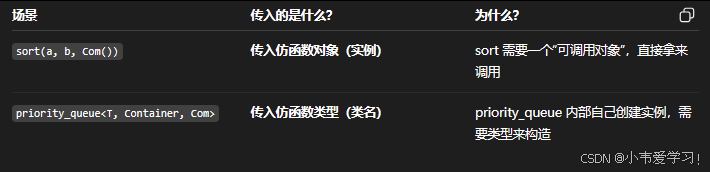
注意区分,二者传参时的不同,sort函数需要一个对象,传入一个匿名对象Com()
而优先级队列,需要的是一个类型,它内部会自己进行构造
cpp
class Com
{
public:  // 1.没有用public 修饰
    // 2 没有bool修饰
    // 3 参数错误用的vector<pair<int,int>>  sort() 会把 元素本身传入比较器,也就是:pair<int,int>
    // 	例如只是对简单int类型数组进行排序就是  bool operator()(const int& left, const int& right)
    bool operator()(const pair<int,int> &left, const pair<int,int> &right)
    {
        return left.second < right.second;
    }
};

class Solution {
public:
    vector<int> topKFrequent(vector<int>& nums, int k) {
        vector<int> res;
        unordered_map<int, int> dict; // 用哈希表来计数每个值出现的次数
        for(auto e : nums)
            dict[e]++;
        priority_queue <pair<int,int>, vector<pair<int, int>>, Com> q; // 注意这里和sort库函数的区别
        for(auto &e : dict)
        {
            q.push(e);
        }

        for(int i = 0; i < k; i++)
        {
            res.push_back(q.top().first);
            q.pop();
        }
        return res;
    }
};