前情提要:ABINIT入门教程三:Si的结构优化与能带结构计算
能带的数据保存在.agr格式文件夹中,可通过abipy或者xmgrace等软件读取,在Xmgrace中也可与直接导出数据,如无法安装Xmgrace则可依赖本文脚本则直接跳过其他软件直接输出能带的图片以及可以供Origin读取的绘图文本。或者手工处理agr内的文本。
使用方法:将附件代码保存为analyze_abinit_bands.py然后执行
python analyze_abinit_bands.py tbase3_5o_DS2_GSR.nc.agrnacl-scf-bando_DS2_EBANDS.agr文件则为实际能带计算的任务的结果文件,该文件的根据不同任务设置可能存在不同格式,本文代码根据笔者目前遇到的情况进行适配设置。
而脚本输出界面为
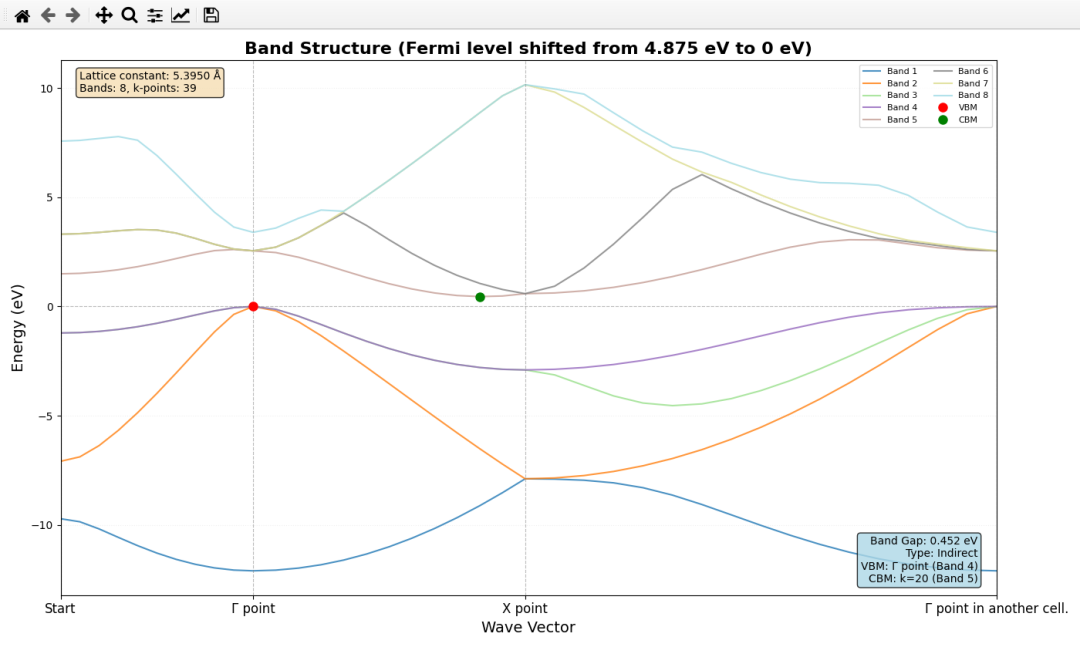
自动找到ABI文件: tbase3_5.abi自动找到ABO文件: tbase3_5.abo输出目录: abinit_band_output正在解析AGR文件: tbase3_5o_DS2_GSR.nc.agr...当前工作目录: abinit-10.4.7/test/si文件是否存在: True文件大小: 8734 bytes成功读取文件,共 435 行晶格常数: 3.814814 Å原始费米能级: 4.8751878246455025 eV找到/推断 39 个k点找到 8 条能带,每条 39 个点k_path类型: <class 'tuple'>k_path[0]长度: 39, k_path[1]长度: 39正在解析ABINIT输入文件: tbase3_5.abi晶格常数: 5.394961665156084 Å (转换自 10.195 Bohr)找到原胞基矢从输入文件中找到 3 个高对称点 点 0: [0.0, 0.0, 0.0] - Γ point 点 1: [0.0, 0.5, 0.5] - X point 点 2: [1.0, 1.0, 1.0] - Γ point in another cell.从输入文件中找到能带数量: 8从输入文件中找到能量单位设置enunit2: 1正在解析ABINIT输出文件: tbase3_5.aboΓ点能量值: [-7.22396, 4.87519, 4.87519, 4.87519, 7.42159, 7.42159, 7.42159, 8.26902]AGR文件中Γ点能量值: [-9.71448709, -7.08619275, -1.21380886, -1.21380886, 1.49401177, 3.30684394, 3.30684394, 7.5652733]正在将能带数据相对于费米能级进行偏移...原始费米能级: 4.875188 eVAGR能量零点是否已设置为费米能级: TrueAGR文件中的能量零点已经是费米能级,无需再次偏移当前费米能级: 0.0 eV晶格常数: 5.394961665156084 Å倒格子基矢大小 (单位: 2π/Å):|b| = 1.164639数据已保存到: abinit_band_output/tbase3_5o_DS2_GSR.nc_bands.csv======================================================================开始带隙分析(在绘图之前完成)========================================================================= 开始带隙分析 ===当前费米能级: 0.0 eV原始费米能级: 4.8751878246455025 eV1. 分析每条能带的行为: 能带 1: 完全在费米能级以下 能带 2: 刚好在费米能级上 (2个点,如Γ point点) 能带 3: 刚好在费米能级上 (2个点,如Γ point点) 能带 4: 刚好在费米能级上 (2个点,如Γ point点) 能带 5: 完全在费米能级以上 能带 6: 完全在费米能级以上 能带 7: 完全在费米能级以上 能带 8: 完全在费米能级以上2. 查找真正穿过费米能级的能带: 真正穿过费米能级的能带数: 0注意: 从AGR文件中读取了费米能级 4.8751878246455025 eV检查价带顶和导带底是否基于正确的费米能级3. 情况A: 没有能带真正穿过费米能级 分析: 没有能带真正穿过费米能级,寻找价带顶和导带底价带顶: 0.000000 eV (能带 4)导带底: 0.452084 eV (能带 5)带隙: 0.452084 eV带隙类型: 间接带隙4. 带隙分析结果: 结果: 半导体材料 价带顶: 0.000000 eV (能带 4) 位置: Γ point点 导带底: 0.452084 eV (能带 5) 位置: k点 20 (路径坐标: 0.4479) 带隙: 0.452084 eV 带隙类型: 间接带隙 材料类型: 窄带隙半导体高对称点 Γ point 对应k点索引: 10高对称点 X point 对应k点索引: 22高对称点 Γ point in another cell. 对应k点索引: 38能带图已保存到: abinit_band_output/tbase3_5o_DS2_GSR.nc_bands.png能带图高对称点标记:------------------------------------------------------------Start: k点索引 = 0, 路径坐标 = 0.000000, 分数坐标 = [0.5000, 0.0000, 0.0000]Γ point: k点索引 = 10, 路径坐标 = 0.205605, 分数坐标 = [0.0000, 0.0000, 0.0000]X point: k点索引 = 22, 路径坐标 = 0.496374, 分数坐标 = [0.0000, 0.5000, 0.5000]Γ point in another cell.: k点索引 = 38, 路径坐标 = 1.000000, 分数坐标 = [1.0000, 1.0000, 1.0000]是否需要调整费米能级?(y/n): n高对称点 Γ point 对应k点索引: 10高对称点 X point 对应k点索引: 22高对称点 Γ point in another cell. 对应k点索引: 38================================================================================ABINIT能带数据分析报告================================================================================分析文件: tbase3_5o_DS2_GSR.nc.agr文件路径: abinit-10.4.7/test/si输入文件: tbase3_5.abi分析时间: 2025-12-12T13:25:091. 晶体结构信息----------------------------------------晶格常数: 5.394961665156084 Å原胞基矢: a₁ = [0.000000, 0.500000, 0.500000] a₂ = [0.500000, 0.000000, 0.500000] a₃ = [0.500000, 0.500000, 0.000000]2. 计算参数----------------------------------------能带数量: 8k点数量: 39原始费米能级: 4.875188 eV当前费米能级: 0.0 eV3. 高对称点信息----------------------------------------Start k点索引: 0 归一化坐标: 0.000000 分数坐标: [0.5000, 0.0000, 0.0000]Γ point k点索引: 10 归一化坐标: 0.205605 分数坐标: [0.0000, 0.0000, 0.0000]X point k点索引: 22 归一化坐标: 0.496374 分数坐标: [0.0000, 0.5000, 0.5000]Γ point in another cell. k点索引: 38 归一化坐标: 1.000000 分数坐标: [1.0000, 1.0000, 1.0000]4. 带隙分析----------------------------------------分析结果: 半导体材料价带顶 (VBM): 能量: 0.000000 eV 能带: 4 k点索引: 10 归一化路径坐标: 0.205605 高对称点: Γ point 分数坐标: [0.0000, 0.0000, 0.0000]导带底 (CBM): 能量: 0.452084 eV 能带: 5 k点索引: 20 归一化路径坐标: 0.447912 分数坐标: [0.0000, 0.4167, 0.4167]带隙: 0.452084 eV带隙类型: 间接带隙材料类型: 窄带隙半导体================================================================================分析报告已保存到: abinit_band_output/tbase3_5o_DS2_GSR.nc_report.txt======================================================================分析完成!输出目录: abinit_band_output数据文件: abinit_band_output/tbase3_5o_DS2_GSR.nc_bands.csv能带图: abinit_band_output/tbase3_5o_DS2_GSR.nc_bands.png分析报告: abinit_band_output/tbase3_5o_DS2_GSR.nc_report.txt======================================================================也将直接绘制能带的图片
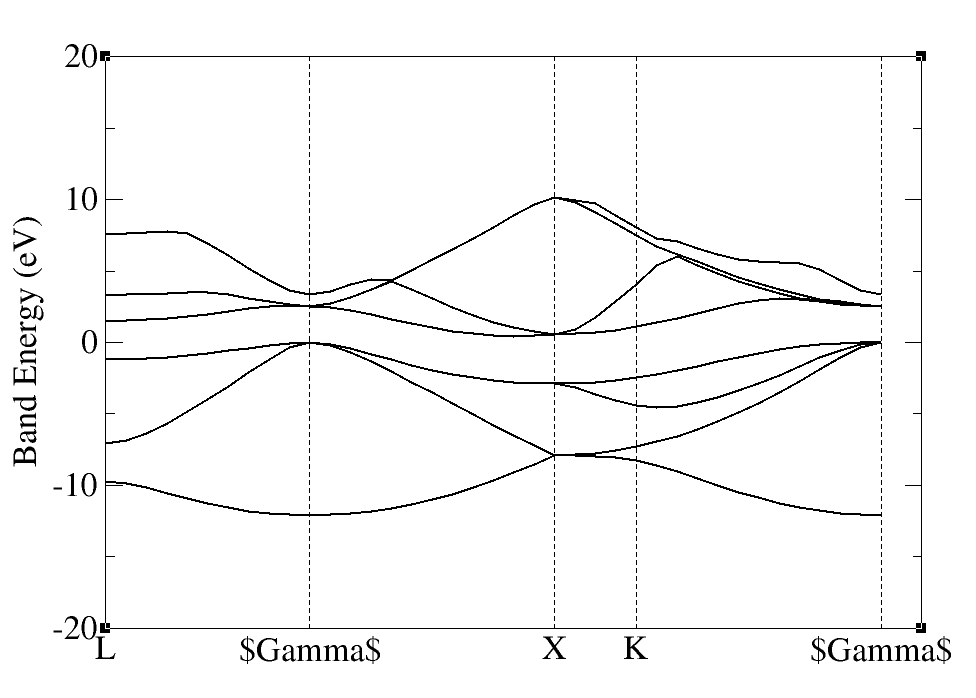
与xmgrace的对比
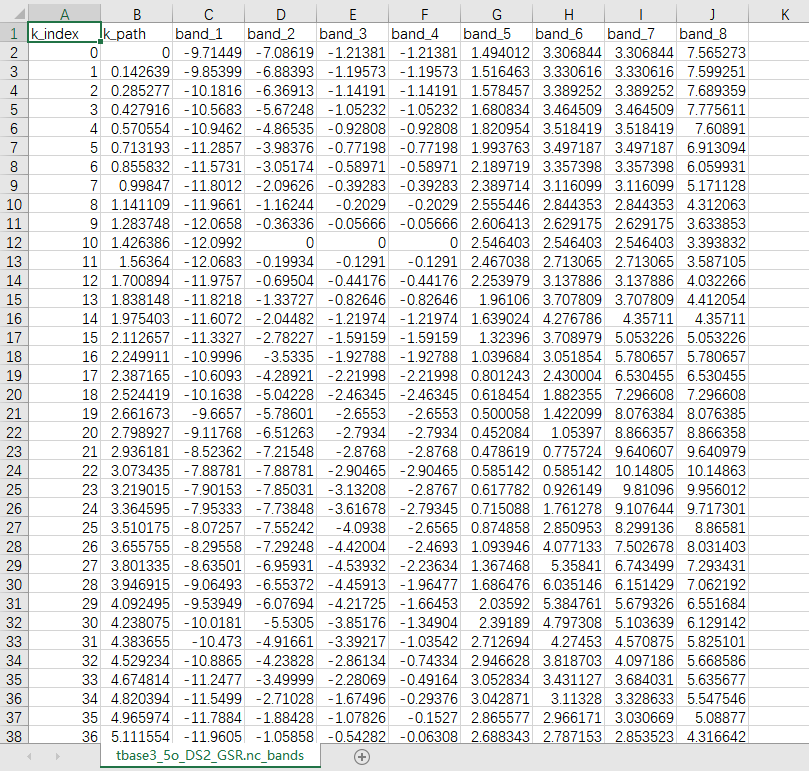
数据输出格式为
还有report文件
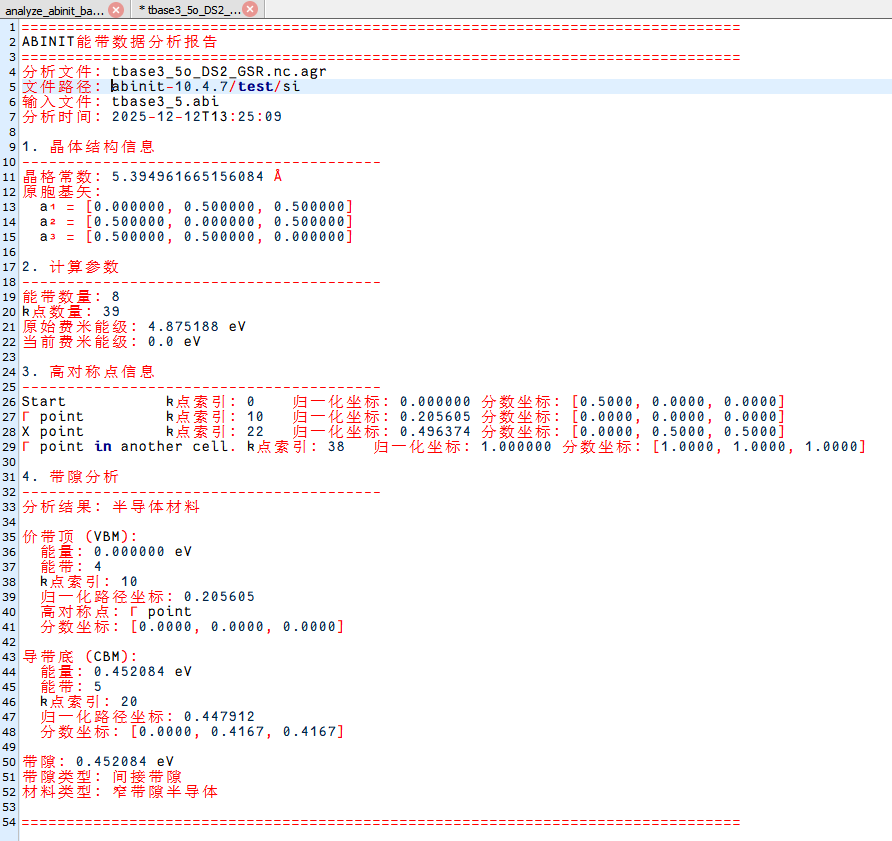
从文本中的高对称点信息可获得在Origin中,添加高对称点的横坐标位置。
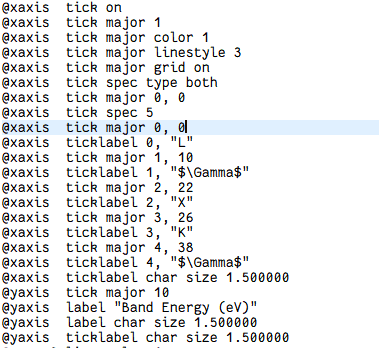
或者直接根据数据数据点位置,部分agr文件中会有提示来标记
代码全文:
#!/usr/bin/env python3
# -*- coding: utf-8 -*-
"""
ABINIT能带数据分析工具 - 增强版
支持多种ABINIT输出格式,自动处理高对称点路径
用法: python abinit_band_analyzer.py <agr文件> [--input-file <abi文件>]
"""
import numpy as np
import matplotlib.pyplot as plt
import re
import os
import sys
import argparse
from pathlib import Path
class AbinitBandAnalyzer:
def __init__(self, agr_file, abi_file=None):
"""
初始化分析器
Parameters:
-----------
agr_file : str
AGR格式的能带文件路径
abi_file : str, optional
ABINIT输入文件路径(用于获取晶格和高对称点信息)
"""
self.agr_file = agr_file
self.abi_file = abi_file
self.lattice_constant = None # 晶格常数 (Å)
self.rprim = None # 原胞基矢
self.k_points = [] # k点分数坐标
self.band_data = [] # 能带数据
self.high_sym_points = {} # 从AGR文件中提取的高对称点信息
self.high_sym_path = [] # 从输入文件中提取的高对称点路径
self.fermi_energy = 0.0 # 费米能级 (eV)
self.num_bands = 0
self.num_kpoints = 0
self.efermi_original = None # 原始费米能级
self.band_gap_info = None # 带隙分析结果
self.k_path = None # k路径坐标
self.k_path_length = None # 归一化的k路径长度
self.enunit2 = None # 能量单位设置 (1 = eV, 0 = Hartree)
self.agr_energy_zero_is_efermi = False # 标记AGR文件中的能量零点是否已经是费米能级
def parse_agr_file(self):
"""解析AGR格式的文件(支持多种格式)"""
print(f"正在解析AGR文件: {self.agr_file}...")
print(f"当前工作目录: {os.getcwd()}")
print(f"文件是否存在: {os.path.exists(self.agr_file)}")
if os.path.exists(self.agr_file):
print(f"文件大小: {os.path.getsize(self.agr_file)} bytes")
try:
with open(self.agr_file, 'r', encoding='utf-8') as f:
lines = f.readlines()
print(f"成功读取文件,共 {len(lines)} 行")
except FileNotFoundError:
print(f"错误: 文件不存在 - {self.agr_file}")
sys.exit(1)
except Exception as e:
print(f"错误: 无法读取文件 - {e}")
import traceback
traceback.print_exc()
sys.exit(1)
# 尝试提取晶格常数(不同格式)
for line in lines:
if 'abc' in line and ':' in line: # 格式1: abc : 3.814814 3.814814 3.814814
parts = line.split(':')
if len(parts) > 1:
lattice_str = parts[1].strip()
# 提取第一个晶格常数(对于立方晶系,a=b=c)
try:
self.lattice_constant = float(lattice_str.split()[0])
print(f"晶格常数: {self.lattice_constant} Å")
except:
pass
break
elif 'acell' in line: # 可能在注释中有acell信息
match = re.search(r'acell\s+([\d\.]+)\s+([\d\.]+)\s+([\d\.]+)', line)
if match:
try:
self.lattice_constant = float(match.group(1))
print(f"从注释中找到晶格常数: {self.lattice_constant} Å")
except:
pass
# 提取原始费米能级
efermi_found = False
self.agr_energy_zero_is_efermi = False # 标记AGR文件中的能量零点是否已经是费米能级
for line in lines:
if 'Zero set to efermi' in line or 'previously it was at:' in line:
matches = re.findall(r'[-+]?\d*\.\d+[Ee]?[-+]?\d*', line)
if matches:
try:
self.efermi_original = float(matches[0])
print(f"原始费米能级: {self.efermi_original} eV")
efermi_found = True
self.agr_energy_zero_is_efermi = True
except:
pass
break
# 如果没有找到费米能级,使用默认值
if not efermi_found:
self.efermi_original = 0.0
print(f"未找到原始费米能级,使用默认值: {self.efermi_original} eV")
# 提取k点坐标 - 支持多种格式
in_kpoints_section = False
kpoints_started = False
# 查找k点列表的行范围
kpoints_start_idx = -1
kpoints_end_idx = -1
for i, line in enumerate(lines):
if 'List of k-points' in line or 'k-points and their index' in line:
kpoints_start_idx = i + 1
break
if kpoints_start_idx != -1:
for i in range(kpoints_start_idx, len(lines)):
line = lines[i]
if line.strip() and not line.strip().startswith('#'):
kpoints_end_idx = i
break
# 解析k点列表
if kpoints_start_idx != -1 and kpoints_end_idx != -1:
for line in lines[kpoints_start_idx:kpoints_end_idx]:
if line.strip().startswith('#'):
# 解析k点行,支持多种格式:
# 格式1: "# 0 [0.5 0. 0. ]"
# 格式2: "# 0 [ 0.0000E+00, 0.0000E+00, 0.0000E+00]"
# 格式3: "# 0 0.5 0.0 0.0" (不常见)
# 尝试格式1和格式2
match1 = re.search(r'#\s*(\d+)\s*\[([\d\.\s\-,E+]+)\]', line)
if match1:
k_index = int(match1.group(1))
coords_str = match1.group(2)
# 清理坐标字符串,移除逗号,处理科学计数法
coords_str = coords_str.replace(',', ' ')
# 将科学计数法的E替换为e以便Python解析
coords_str = coords_str.replace('E', 'e')
# 提取三个坐标值
coords = []
for x in coords_str.split():
try:
coords.append(float(x))
except:
pass
if len(coords) >= 3:
self.k_points.append(coords[:3])
else:
# 尝试其他格式
match2 = re.search(r'#\s*(\d+)\s+([-\d\.Ee+]+)\s+([-\d\.Ee+]+)\s+([-\d\.Ee+]+)', line)
if match2:
k_index = int(match2.group(1))
coords = [float(match2.group(2)), float(match2.group(3)), float(match2.group(4))]
self.k_points.append(coords)
# 如果没有从AGR文件中找到k点列表,尝试从能带数据中推断k点数量
if not self.k_points:
print("未找到k点列表,将从能带数据中推断k点数量")
# 先解析能带数据,获取k点数量
temp_bands = []
temp_band = []
current_band = -1
for line in lines:
if '@target G0.S' in line:
if temp_band and current_band >= 0:
temp_bands.append(temp_band)
temp_band = []
match = re.search(r'S(\d+)', line)
if match:
current_band = int(match.group(1))
elif line.strip() and (line.strip()[0].isdigit() or line.strip()[0] == '-' or line.strip()[0] == '.'):
parts = line.split()
if len(parts) >= 2:
try:
energy = float(parts[1])
temp_band.append(energy)
except:
continue
if temp_band and current_band >= 0:
temp_bands.append(temp_band)
if temp_bands:
self.num_kpoints = len(temp_bands[0])
print(f"从能带数据推断k点数量: {self.num_kpoints}")
# 生成默认的k点坐标(0到1之间的均匀分布)
for i in range(self.num_kpoints):
# 生成简单的分数坐标,假设是线性路径
self.k_points.append([i/(self.num_kpoints-1) if self.num_kpoints > 1 else 0.0, 0.0, 0.0])
else:
self.num_kpoints = len(self.k_points)
print(f"找到/推断 {self.num_kpoints} 个k点")
# 提取高对称点信息(从AGR文件的xaxis标记中)
for line in lines:
if '@xaxis tick major' in line and 'ticklabel' in line:
parts = line.split('"')
if len(parts) >= 2:
# 格式: @xaxis tick major 0, "L"
try:
# 提取坐标和标签
coord_part = parts[0].split()
for item in coord_part:
if item.replace('.', '').isdigit():
coord = float(item)
break
label = parts[1]
self.high_sym_points[label] = coord
except:
continue
elif '@xaxis tick major' in line and not 'ticklabel' in line:
# 有些文件只有tick major位置,没有标签
parts = line.split()
try:
for i, part in enumerate(parts):
if part == 'major' and i+2 < len(parts):
coord = float(parts[i+2].replace(',', ''))
# 如果没有标签,使用默认标签
if coord not in self.high_sym_points.values():
self.high_sym_points[f"Point_{int(coord)}"] = coord
except:
pass
# 提取能带数据
current_band = -1
band_values = []
for line in lines:
# 检测新的能带数据开始
if '@target G0.S' in line:
if band_values and current_band >= 0:
self.band_data.append(band_values)
band_values = []
# 提取能带编号
match = re.search(r'S(\d+)', line)
if match:
current_band = int(match.group(1))
# 解析数据行(数字开头)
elif line.strip() and (line.strip()[0].isdigit() or line.strip()[0] == '-' or line.strip()[0] == '.'):
parts = line.split()
if len(parts) >= 2:
try:
# 第一个值是k点索引或x坐标,第二个是能量值
energy = float(parts[1])
band_values.append(energy)
except:
continue
# 添加最后一个能带的数据
if band_values and current_band >= 0:
self.band_data.append(band_values)
self.num_bands = len(self.band_data)
print(f"找到 {self.num_bands} 条能带,每条 {len(self.band_data[0]) if self.band_data else 0} 个点")
# 验证数据一致性
if self.band_data:
for i, band in enumerate(self.band_data):
if len(band) != self.num_kpoints:
print(f"警告: 能带 {i} 有 {len(band)} 个点,但期望 {self.num_kpoints} 个点")
# 计算k路径坐标
self.k_path = self.calculate_k_path_coordinates()
print(f"k_path类型: {type(self.k_path)}")
if self.k_path and len(self.k_path) == 2:
print(f"k_path[0]长度: {len(self.k_path[0])}, k_path[1]长度: {len(self.k_path[1])}")
return True
def parse_abo_file(self, abo_file):
"""解析ABINIT输出文件,获取额外信息(不再提取费米能级)"""
print(f"正在解析ABINIT输出文件: {abo_file}")
try:
with open(abo_file, 'r', encoding='utf-8') as f:
content = f.read()
except Exception as e:
print(f"错误: 无法读取输出文件 - {e}")
return False
# 从ABO文件中提取Γ点的价带顶和导带底能量(仅用于信息展示)
# 匹配格式: kpt# 11, nband= 8, wtk= 1.00000, kpt= 0.0000 0.0000 0.0000 (reduced coord)
# -2.6548E-01 1.7916E-01 1.7916E-01 1.7916E-01 2.7274E-01 2.7274E-01 2.7274E-01 3.0388E-01
gamma_match = re.search(r'kpt#\s+\d+,\s+nband=\s+\d+,\s+wtk=\s+\d+\.\d+,\s+kpt=\s+0\.0000\s+0\.0000\s+0\.0000\s+\(reduced coord\)\s*\n\s*([-+\d\.\sEe]+)', content)
if gamma_match:
gamma_energies_str = gamma_match.group(1)
gamma_energies = list(map(float, gamma_energies_str.split()))
print(f"Γ点能量值: {gamma_energies}")
# 检查这些能量值是否与AGR文件中的值一致
if self.band_data and len(self.band_data) >= 5:
agr_gamma_energies = [band[0] for band in self.band_data]
print(f"AGR文件中Γ点能量值: {agr_gamma_energies[:8]}")
return True
def parse_abi_file(self):
"""解析ABINIT输入文件,获取晶体结构和高对称点路径(不获取费米能级)"""
if not self.abi_file or not os.path.exists(self.abi_file):
print("警告: 未提供ABINIT输入文件或文件不存在")
return False
print(f"正在解析ABINIT输入文件: {self.abi_file}")
try:
with open(self.abi_file, 'r', encoding='utf-8') as f:
content = f.read()
except Exception as e:
print(f"错误: 无法读取输入文件 - {e}")
return False
lines = content.split('\n')
# 提取晶格常数
# 支持多种格式: acell 3*10.195 或 acell 10.195 10.195 10.195
acell_value = None
for line in lines:
line_stripped = line.strip()
if not line_stripped or line_stripped.startswith('#'):
continue
# 匹配 acell 3*10.195 格式
acell_match = re.search(r'acell\s+3\*([\d\.]+)', line_stripped)
if acell_match:
try:
acell_value = float(acell_match.group(1))
break
except:
pass
# 匹配 acell 10.195 10.195 10.195 格式
acell_match = re.search(r'acell\s+([\d\.]+)\s+([\d\.]+)\s+([\d\.]+)', line_stripped)
if acell_match:
try:
acell_value = float(acell_match.group(1))
break
except:
pass
if acell_value is not None:
# 通常acell以Bohr为单位,需要转换为Å(1 Bohr = 0.529177210903 Å)
bohr_to_ang = 0.529177210903
self.lattice_constant = acell_value * bohr_to_ang
print(f"晶格常数: {self.lattice_constant} Å (转换自 {acell_value} Bohr)")
# 提取原胞基矢
rprim_values = []
rprim_found = False
for line in lines:
line_stripped = line.strip()
if not line_stripped or line_stripped.startswith('#'):
continue
if 'rprim' in line_stripped and not rprim_found:
rprim_found = True
# 提取当前行的rprim值
parts = line_stripped.split()[1:] # 跳过 'rprim' 关键字
rprim_values.extend([float(x) for x in parts if x.replace('.', '').replace('-', '').isdigit()])
continue
if rprim_found:
# 继续提取后续行的rprim值
if len(rprim_values) >= 9:
break
# 检查是否是新的变量行
if ':' in line_stripped or any(keyword in line_stripped for keyword in ['ntypat', 'znucl', 'natom', 'typat', 'xred', 'xcart', 'ecut', 'kptopt']):
break
# 提取当前行的rprim值
parts = line_stripped.split()
rprim_values.extend([float(x) for x in parts if x.replace('.', '').replace('-', '').isdigit()])
if len(rprim_values) >= 9:
self.rprim = np.array(rprim_values[:9]).reshape(3, 3)
print(f"找到原胞基矢")
# 提取高对称点路径 - 支持多种数据集和kptbounds格式
kpt_points = []
# 支持多个数据集的kptbounds(kptbounds1, kptbounds2, ...)
for dataset_num in range(1, 11): # 最多检查10个数据集
kptbounds_keyword = f'kptbounds{dataset_num}'
in_kptbounds = False
kptbounds_start = False
for i, line in enumerate(lines):
line_stripped = line.strip()
if kptbounds_keyword in line_stripped and not line_stripped.startswith('#'):
in_kptbounds = True
continue
if in_kptbounds:
# 跳过注释行
if line_stripped.startswith('#'):
continue
# 检查是否为空行或新变量开始
if not line_stripped:
break
# 检查是否是数字行(高对称点坐标)
parts = line_stripped.split()
if len(parts) >= 3:
try:
# 尝试解析三个坐标
coords = [float(parts[0]), float(parts[1]), float(parts[2])]
# 提取标签(如果有)
label = None
if '#' in line:
label_part = line.split('#')[1].strip()
# 移除可能的$符号和转义字符
label_part = label_part.replace('$', '').replace('\\', '').strip()
if label_part:
label = label_part
# 标准化标签
if label:
# 替换常见的标签名称
label = label.replace('Gamma', 'Γ')
label = label.replace('gamma', 'Γ')
kpt_points.append({
'coords': coords,
'label': label or f"Point_{len(kpt_points)}"
})
kptbounds_start = True
except:
# 如果不是数字,可能是下一个变量
if kptbounds_start:
break
elif kptbounds_start:
# 已经开始了但遇到非数字行,结束
break
if kpt_points:
break # 找到第一个数据集的kptbounds就退出
if kpt_points:
self.high_sym_path = kpt_points
print(f"从输入文件中找到 {len(kpt_points)} 个高对称点")
for i, point in enumerate(kpt_points):
print(f" 点 {i}: {point['coords']} - {point['label']}")
# 提取能带数量
nband = None
for line in lines:
line_stripped = line.strip()
if not line_stripped or line_stripped.startswith('#'):
continue
# 支持多个数据集的nband(nband1, nband2, ...)
nband_match = re.search(r'nband(\d*)\s+(\d+)', line_stripped)
if nband_match:
try:
nband = int(nband_match.group(2))
print(f"从输入文件中找到能带数量: {nband}")
break
except:
pass
# 提取能量单位设置(enunit2)
for line in lines:
line_stripped = line.strip()
if not line_stripped or line_stripped.startswith('#'):
continue
enunit2_match = re.search(r'enunit2\s+(\d+)', line_stripped)
if enunit2_match:
try:
self.enunit2 = int(enunit2_match.group(1))
print(f"从输入文件中找到能量单位设置enunit2: {self.enunit2}")
break
except:
pass
return True
def calculate_reciprocal_lattice(self):
"""计算倒易空间晶格"""
if not self.lattice_constant and self.rprim is None:
print("警告: 未找到晶格信息,使用默认值估算")
# 尝试从k点坐标估算
if self.k_points:
# 假设是立方晶系,估算晶格常数
# 寻找最大的k点坐标差异
max_coord = max([max(abs(c) for c in k) for k in self.k_points])
if max_coord > 0:
# 假设最大k点坐标对应布里渊区边界
self.lattice_constant = 2 * np.pi / max_coord
print(f"估算晶格常数: {self.lattice_constant:.4f} Å")
if self.lattice_constant:
a = self.lattice_constant
print(f"\n晶格常数: {a} Å")
# 对于立方晶系,简化计算
# 倒格矢: b_i = 2π/a
b_mag = 2 * np.pi / a
print(f"\n倒格子基矢大小 (单位: 2π/Å):")
print(f"|b| = {b_mag:.6f}")
return b_mag
elif self.rprim is not None:
print(f"\n原胞基矢:")
print(f"a₁ = [{self.rprim[0,0]:.6f}, {self.rprim[0,1]:.6f}, {self.rprim[0,2]:.6f}]")
print(f"a₂ = [{self.rprim[1,0]:.6f}, {self.rprim[1,1]:.6f}, {self.rprim[1,2]:.6f}]")
print(f"a₃ = [{self.rprim[2,0]:.6f}, {self.rprim[2,1]:.6f}, {self.rprim[2,2]:.6f}]")
# 计算原胞体积
volume = np.abs(np.linalg.det(self.rprim))
print(f"原胞体积: {volume:.6f} ų")
# 计算倒格子基矢
b1 = 2 * np.pi * np.cross(self.rprim[1], self.rprim[2]) / volume
b2 = 2 * np.pi * np.cross(self.rprim[2], self.rprim[0]) / volume
b3 = 2 * np.pi * np.cross(self.rprim[0], self.rprim[1]) / volume
print(f"\n倒格子基矢 (单位: 2π/Å):")
print(f"b₁ = [{b1[0]:.6f}, {b1[1]:.6f}, {b1[2]:.6f}]")
print(f"b₂ = [{b2[0]:.6f}, {b2[1]:.6f}, {b2[2]:.6f}]")
print(f"b₃ = [{b3[0]:.6f}, {b3[1]:.6f}, {b3[2]:.6f}]")
return b1, b2, b3
return None
def get_k_point_symbol(self, k_coords, tolerance=1e-4):
"""判断k点是否在高对称点上,返回高对称点符号"""
# 首先检查从输入文件解析的高对称点路径
if self.high_sym_path:
for point in self.high_sym_path:
ref_coords = point['coords']
if (abs(k_coords[0] - ref_coords[0]) < tolerance and
abs(k_coords[1] - ref_coords[1]) < tolerance and
abs(k_coords[2] - ref_coords[2]) < tolerance):
return point['label']
# 检查常见的高对称点
common_sym_points = {
(0.0, 0.0, 0.0): "Γ",
(0.5, 0.0, 0.5): "X",
(0.5, 0.5, 0.5): "L",
(0.5, 0.25, 0.75): "W",
(0.375, 0.375, 0.75): "K",
(0.625, 0.25, 0.625): "U",
}
for sym_coords, symbol in common_sym_points.items():
if (abs(k_coords[0] - sym_coords[0]) < tolerance and
abs(k_coords[1] - sym_coords[1]) < tolerance and
abs(k_coords[2] - sym_coords[2]) < tolerance):
return symbol
return None
def calculate_k_path_coordinates(self):
"""计算k路径的实际坐标(考虑倒易空间距离)"""
if not self.k_points:
print("错误: 未找到k点数据")
return np.zeros(1), np.zeros(1)
# 尝试使用晶格信息计算更精确的路径长度
if self.rprim is not None:
# 有原胞基矢,计算倒格矢
volume = np.abs(np.linalg.det(self.rprim))
b1 = 2 * np.pi * np.cross(self.rprim[1], self.rprim[2]) / volume
b2 = 2 * np.pi * np.cross(self.rprim[2], self.rprim[0]) / volume
b3 = 2 * np.pi * np.cross(self.rprim[0], self.rprim[1]) / volume
# 计算每个k点在倒易空间中的直角坐标
k_cartesian = []
for k_frac in self.k_points:
k_cart = k_frac[0] * b1 + k_frac[1] * b2 + k_frac[2] * b3
k_cartesian.append(k_cart)
elif self.lattice_constant:
# 立方晶系简化计算
a = self.lattice_constant
b_mag = 2 * np.pi / a
# 对于立方晶系,简化处理
k_cartesian = []
for k_frac in self.k_points:
# 近似处理
k_cart = np.array(k_frac) * b_mag
k_cartesian.append(k_cart)
else:
# 没有晶格信息,使用分数坐标的欧几里得距离
k_cartesian = [np.array(k) for k in self.k_points]
# 计算路径长度(累加直线距离)
k_path_coords = np.zeros(self.num_kpoints)
for i in range(1, self.num_kpoints):
# 计算相邻k点间的距离
distance = np.linalg.norm(k_cartesian[i] - k_cartesian[i-1])
k_path_coords[i] = k_path_coords[i-1] + distance
# 归一化到0-1范围,便于绘图
if k_path_coords[-1] > 0:
k_path_normalized = k_path_coords / k_path_coords[-1]
else:
k_path_normalized = k_path_coords
return k_path_coords, k_path_normalized
def find_high_symmetry_indices(self):
"""在k点列表中查找高对称点的索引"""
if not self.high_sym_path or not self.k_points:
return {}
high_sym_indices = {}
tolerance = 1e-4
for point in self.high_sym_path:
point_coords = point['coords']
label = point['label']
# 在k点列表中查找匹配的坐标
for i, k_coords in enumerate(self.k_points):
if (abs(k_coords[0] - point_coords[0]) < tolerance and
abs(k_coords[1] - point_coords[1]) < tolerance and
abs(k_coords[2] - point_coords[2]) < tolerance):
if label not in high_sym_indices:
high_sym_indices[label] = i
print(f"高对称点 {label} 对应k点索引: {i}")
break
# 如果没有从输入文件找到高对称点,尝试从AGR文件中提取
if not high_sym_indices and self.high_sym_points:
for label, coord in self.high_sym_points.items():
idx = int(coord)
if 0 <= idx < len(self.k_path):
high_sym_indices[label] = idx
return high_sym_indices
def analyze_band_gap(self, interactive_mode=False):
"""
分析带隙信息
"""
print("\n=== 开始带隙分析 ===")
print(f"当前费米能级: {self.fermi_energy} eV")
print(f"原始费米能级: {self.efermi_original} eV")
if not self.band_data:
print("错误: 没有能带数据")
return None
if self.k_path is None:
print("错误: 未计算k路径坐标")
return None
# 1. 分析每条能带的行为
print("\n1. 分析每条能带的行为:")
band_behavior = []
for band_idx in range(self.num_bands):
behavior = self._analyze_single_band(band_idx)
band_behavior.append(behavior)
print(f" 能带 {band_idx+1}: {behavior['description']}")
# 2. 找出所有真正穿过费米能级的能带
print("\n2. 查找真正穿过费米能级的能带:")
crossing_bands = []
for band_idx, behavior in enumerate(band_behavior):
if behavior['crosses_fermi']:
crossing_info = {
'band_idx': band_idx,
'crossing_points': behavior['crossing_points'],
'is_same_point': behavior['is_same_point']
}
crossing_bands.append(crossing_info)
print(f" 能带 {band_idx+1} 真正穿过费米能级")
for cp in behavior['crossing_points']:
symbol_text = f" ({cp['symbol']})" if cp['symbol'] else ""
print(f" - 在k点 {cp['k_idx']}{symbol_text}, 路径坐标: {cp['k_path']:.4f}")
print(f"\n 真正穿过费米能级的能带数: {len(crossing_bands)}")
# 特殊处理:如果从AGR文件中读取了费米能级,调整能带数据
if self.efermi_original != 0.0:
print(f"注意: 从AGR文件中读取了费米能级 {self.efermi_original} eV")
print("检查价带顶和导带底是否基于正确的费米能级")
# 3. 根据情况分类处理
if len(crossing_bands) == 0:
# 情况A: 没有能带真正穿过费米能级
print("\n3. 情况A: 没有能带真正穿过费米能级")
self.band_gap_info = self._analyze_case_no_crossing(band_behavior)
elif len(crossing_bands) == 1:
# 情况B: 只有一条能带穿过费米能级
print("\n3. 情况B: 只有一条能带穿过费米能级")
self.band_gap_info = self._analyze_case_single_crossing(
crossing_bands[0], band_behavior, interactive_mode
)
else:
# 情况C: 多条能带穿过费米能级
print("\n3. 情况C: 多条能带穿过费米能级")
# 检查是否所有穿越点都接近费米能级
all_close = True
for cb in crossing_bands:
for cp in cb['crossing_points']:
# 获取该k点的实际能量
energy = self.band_data[cb['band_idx']][cp['k_idx']]
# 检查是否接近费米能级
if abs(energy - self.fermi_energy) > 0.1: # 100 meV阈值
all_close = False
break
if not all_close:
break
if all_close:
print(" 所有穿越点都接近费米能级,可能是金属")
self.band_gap_info = self._analyze_case_multiple_crossing(
crossing_bands, band_behavior, interactive_mode
)
else:
print(" 穿越点远离费米能级,重新检查带隙")
# 尝试重新分析,不考虑穿越点
self.band_gap_info = self._analyze_case_no_crossing(band_behavior)
# 输出分析结果
print("\n4. 带隙分析结果:")
if self.band_gap_info:
self._display_band_gap_results(self.band_gap_info)
return self.band_gap_info
def _analyze_single_band(self, band_idx, crossing_threshold=1e-6):
"""分析单条能带的行为"""
energies = self.band_data[band_idx]
# 检查能带是否真正穿过费米能级(从负到正或正到负)
crossing_points = []
for i in range(len(energies) - 1):
e1 = energies[i]
e2 = energies[i + 1]
# 检查是否跨越费米能级(当前费米能级为参考点)
if (e1 - self.fermi_energy) * (e2 - self.fermi_energy) < 0: # 异号,说明跨越了费米能级
# 线性插值找到精确的穿越点
k1 = self.k_path[1][i] # 归一化的路径坐标
k2 = self.k_path[1][i + 1]
# 使用当前费米能级作为参考点
e1_rel = e1 - self.fermi_energy
e2_rel = e2 - self.fermi_energy
fraction = abs(e1_rel) / (abs(e1_rel) + abs(e2_rel))
k_cross = k1 + fraction * (k2 - k1)
# 获取最近k点的坐标信息
nearest_idx = i if abs(e1_rel) < abs(e2_rel) else i + 1
k_coords = self.k_points[nearest_idx]
symbol = self.get_k_point_symbol(k_coords)
crossing_points.append({
'k_idx': nearest_idx,
'k_path': k_cross,
'k_coords': k_coords,
'symbol': symbol,
'sign_change': 'negative_to_positive' if e1_rel < 0 else 'positive_to_negative'
})
# 检查是否有能量刚好在费米能级上的点
zero_points = []
for i, energy in enumerate(energies):
if abs(energy - self.fermi_energy) < crossing_threshold:
k_coords = self.k_points[i]
symbol = self.get_k_point_symbol(k_coords)
zero_points.append({
'k_idx': i,
'k_path': self.k_path[1][i],
'k_coords': k_coords,
'symbol': symbol,
'energy': energy
})
# 判断所有穿越点是否是同一个等价高对称点
is_same_point = False
if crossing_points:
first_symbol = crossing_points[0]['symbol']
if first_symbol:
same_count = sum(1 for cp in crossing_points if cp['symbol'] == first_symbol)
is_same_point = (same_count == len(crossing_points))
# 分析能带的整体行为
min_energy = min(energies)
max_energy = max(energies)
# 判断能带整体在费米能级的哪一侧
if max_energy <= self.fermi_energy:
overall_position = 'below_fermi'
elif min_energy >= self.fermi_energy:
overall_position = 'above_fermi'
else:
overall_position = 'crosses_fermi'
# 生成描述
if crossing_points:
if is_same_point and crossing_points[0]['symbol']:
description = f"真正穿过费米能级 ({len(crossing_points)}次,都在{crossing_points[0]['symbol']}点)"
else:
description = f"真正穿过费米能级 ({len(crossing_points)}次)"
elif zero_points:
if zero_points and zero_points[0]['symbol']:
description = f"刚好在费米能级上 ({len(zero_points)}个点,如{zero_points[0]['symbol']}点)"
else:
description = f"刚好在费米能级上 ({len(zero_points)}个点)"
elif overall_position == 'below_fermi':
description = "完全在费米能级以下"
elif overall_position == 'above_fermi':
description = "完全在费米能级以上"
else:
description = "部分在费米能级以上,部分以下但未穿越"
return {
'band_idx': band_idx,
'crosses_fermi': len(crossing_points) > 0,
'crossing_points': crossing_points,
'zero_points': zero_points,
'is_same_point': is_same_point,
'overall_position': overall_position,
'min_energy': min_energy,
'max_energy': max_energy,
'description': description,
'energies': energies
}
def _analyze_case_no_crossing(self, band_behavior):
"""情况A: 没有能带真正穿过费米能级"""
print(" 分析: 没有能带真正穿过费米能级,寻找价带顶和导带底")
# 寻找价带顶(所有低于费米能级的能量中的最大值)
valence_candidates = []
for behavior in band_behavior:
if behavior['max_energy'] <= self.fermi_energy: # 整个能带都在费米能级以下
# 找到这个能带的最大能量点
energies = behavior['energies']
max_val = max(energies)
max_idx = list(energies).index(max_val)
k_coords = self.k_points[max_idx]
symbol = self.get_k_point_symbol(k_coords)
valence_candidates.append({
'energy': max_val,
'band_idx': behavior['band_idx'],
'k_idx': max_idx,
'k_path': self.k_path[1][max_idx], # 归一化的路径坐标
'k_coords': k_coords,
'symbol': symbol,
'description': f"能带{behavior['band_idx']+1}的最大值"
})
elif behavior['min_energy'] < self.fermi_energy: # 部分在费米能级以下
# 找到低于费米能级的能量中的最大值
energies = np.array(behavior['energies'])
below_fermi_indices = np.where(energies <= self.fermi_energy)[0]
if len(below_fermi_indices) > 0:
below_fermi_energies = energies[below_fermi_indices]
max_below_idx = below_fermi_indices[np.argmax(below_fermi_energies)]
k_coords = self.k_points[max_below_idx]
symbol = self.get_k_point_symbol(k_coords)
valence_candidates.append({
'energy': energies[max_below_idx],
'band_idx': behavior['band_idx'],
'k_idx': max_below_idx,
'k_path': self.k_path[1][max_below_idx],
'k_coords': k_coords,
'symbol': symbol,
'description': f"能带{behavior['band_idx']+1}的低于费米能级部分最大值"
})
# 寻找导带底(所有高于费米能级的能量中的最小值)
conduction_candidates = []
for behavior in band_behavior:
if behavior['min_energy'] >= self.fermi_energy: # 整个能带都在费米能级以上
# 找到这个能带的最小能量点
energies = behavior['energies']
min_val = min(energies)
min_idx = list(energies).index(min_val)
k_coords = self.k_points[min_idx]
symbol = self.get_k_point_symbol(k_coords)
conduction_candidates.append({
'energy': min_val,
'band_idx': behavior['band_idx'],
'k_idx': min_idx,
'k_path': self.k_path[1][min_idx],
'k_coords': k_coords,
'symbol': symbol,
'description': f"能带{behavior['band_idx']+1}的最小值"
})
elif behavior['max_energy'] > self.fermi_energy: # 部分在费米能级以上
# 找到高于费米能级的能量中的最小值
energies = np.array(behavior['energies'])
above_fermi_indices = np.where(energies >= self.fermi_energy)[0]
if len(above_fermi_indices) > 0:
above_fermi_energies = energies[above_fermi_indices]
min_above_idx = above_fermi_indices[np.argmin(above_fermi_energies)]
k_coords = self.k_points[min_above_idx]
symbol = self.get_k_point_symbol(k_coords)
conduction_candidates.append({
'energy': energies[min_above_idx],
'band_idx': behavior['band_idx'],
'k_idx': min_above_idx,
'k_path': self.k_path[1][min_above_idx],
'k_coords': k_coords,
'symbol': symbol,
'description': f"能带{behavior['band_idx']+1}的高于费米能级部分最小值"
})
# 选择最佳的价带顶和导带底
if valence_candidates:
valence_top = max(valence_candidates, key=lambda x: x['energy'])
else:
print("警告: 未找到价带顶")
valence_top = None
if conduction_candidates:
conduction_bottom = min(conduction_candidates, key=lambda x: x['energy'])
else:
print("警告: 未找到导带底")
conduction_bottom = None
# 计算带隙
if valence_top and conduction_bottom:
band_gap = conduction_bottom['energy'] - valence_top['energy']
is_direct = (valence_top['k_idx'] == conduction_bottom['k_idx'])
print(f"价带顶: {valence_top['energy']:.6f} eV (能带 {valence_top['band_idx']+1})")
print(f"导带底: {conduction_bottom['energy']:.6f} eV (能带 {conduction_bottom['band_idx']+1})")
print(f"带隙: {band_gap:.6f} eV")
print(f"带隙类型: {'直接' if is_direct else '间接'}带隙")
return {
'case': 'semiconductor',
'valence_top': valence_top,
'conduction_bottom': conduction_bottom,
'band_gap': band_gap,
'is_direct': is_direct,
'material_type': self._classify_material(band_gap),
'note': '标准半导体:价带顶在费米能级以下,导带底在费米能级以上'
}
else:
print("错误: 无法确定价带顶和导带底")
return {
'case': 'unknown',
'note': '无法确定价带顶和导带底'
}
def _analyze_case_single_crossing(self, crossing_band, band_behavior, interactive_mode):
"""情况B: 只有一条能带穿过费米能级"""
band_idx = crossing_band['band_idx']
behavior = band_behavior[band_idx]
print(f" 分析能带 {band_idx+1} 的穿越行为:")
# 检查穿越点是否都是同一个等价高对称点
if crossing_band['is_same_point'] and behavior['crossing_points'] and behavior['crossing_points'][0]['symbol']:
symbol = behavior['crossing_points'][0]['symbol']
print(f" 所有穿越点都在同一个高对称点: {symbol}")
# 检查能带整体行为
if behavior['overall_position'] == 'crosses_fermi':
print(f" 能带在{symbol}点穿越费米能级")
# 检查能带在其他点的行为
other_energies = []
for i, energy in enumerate(behavior['energies']):
is_crossing_point = any(cp['k_idx'] == i for cp in behavior['crossing_points'])
if not is_crossing_point:
other_energies.append(energy)
if other_energies:
avg_other = np.mean(other_energies)
print(f" 其他点平均能量: {avg_other:.4f} eV")
if avg_other < self.fermi_energy - 0.01: # 大部分点在费米能级以下
print(f" 结论: 这是价带顶刚好在费米能级上")
# 寻找其他能带的导带底
conduction_candidates = []
for b_idx, b_behavior in enumerate(band_behavior):
if b_idx == band_idx:
continue
# 找到高于费米能级的能量中的最小值
energies = np.array(b_behavior['energies'])
positive_indices = np.where(energies > self.fermi_energy + 0.01)[0]
if len(positive_indices) > 0:
positive_energies = energies[positive_indices]
min_pos_idx = positive_indices[np.argmin(positive_energies)]
k_coords = self.k_points[min_pos_idx]
symbol_cb = self.get_k_point_symbol(k_coords)
conduction_candidates.append({
'energy': energies[min_pos_idx],
'band_idx': b_idx,
'k_idx': min_pos_idx,
'k_path': self.k_path[1][min_pos_idx],
'k_coords': k_coords,
'symbol': symbol_cb,
'description': f"能带{b_idx+1}的最小正能量"
})
if conduction_candidates:
conduction_bottom = min(conduction_candidates, key=lambda x: x['energy'])
band_gap = conduction_bottom['energy'] - self.fermi_energy # 价带顶在当前费米能级
# 创建假的价带顶信息
valence_top = {
'energy': self.fermi_energy,
'band_idx': band_idx,
'k_idx': behavior['crossing_points'][0]['k_idx'],
'k_path': behavior['crossing_points'][0]['k_path'],
'k_coords': behavior['crossing_points'][0]['k_coords'],
'symbol': symbol,
'description': f"能带{band_idx+1}在{symbol}点刚好在费米能级"
}
is_direct = (valence_top['k_idx'] == conduction_bottom['k_idx'])
return {
'case': 'valence_top_at_fermi',
'valence_top': valence_top,
'conduction_bottom': conduction_bottom,
'band_gap': band_gap,
'is_direct': is_direct,
'material_type': self._classify_material(band_gap),
'note': f'能带{band_idx+1}在{symbol}点刚好在费米能级上作为价带顶'
}
elif avg_other > self.fermi_energy + 0.01: # 大部分点在费米能级以上
print(f" 结论: 这是导带底刚好在费米能级上")
# 寻找其他能带的价带顶
valence_candidates = []
for b_idx, b_behavior in enumerate(band_behavior):
if b_idx == band_idx:
continue
# 找到低于费米能级的能量中的最大值
energies = np.array(b_behavior['energies'])
negative_indices = np.where(energies < self.fermi_energy - 0.01)[0]
if len(negative_indices) > 0:
negative_energies = energies[negative_indices]
max_neg_idx = negative_indices[np.argmax(negative_energies)]
k_coords = self.k_points[max_neg_idx]
symbol_vb = self.get_k_point_symbol(k_coords)
valence_candidates.append({
'energy': energies[max_neg_idx],
'band_idx': b_idx,
'k_idx': max_neg_idx,
'k_path': self.k_path[1][max_neg_idx],
'k_coords': k_coords,
'symbol': symbol_vb,
'description': f"能带{b_idx+1}的最大负能量"
})
if valence_candidates:
valence_top = max(valence_candidates, key=lambda x: x['energy'])
band_gap = self.fermi_energy - valence_top['energy'] # 导带底在当前费米能级
# 创建假的导带底信息
conduction_bottom = {
'energy': self.fermi_energy,
'band_idx': band_idx,
'k_idx': behavior['crossing_points'][0]['k_idx'],
'k_path': behavior['crossing_points'][0]['k_path'],
'k_coords': behavior['crossing_points'][0]['k_coords'],
'symbol': symbol,
'description': f"能带{band_idx+1}在{symbol}点刚好在费米能级"
}
is_direct = (valence_top['k_idx'] == conduction_bottom['k_idx'])
return {
'case': 'conduction_bottom_at_fermi',
'valence_top': valence_top,
'conduction_bottom': conduction_bottom,
'band_gap': band_gap,
'is_direct': is_direct,
'material_type': self._classify_material(band_gap),
'note': f'能带{band_idx+1}在{symbol}点刚好在费米能级上作为导带底'
}
# 如果穿越点在不同位置,可能是金属
print(f" 能带在不同位置穿越费米能级,可能是金属")
# 检查与其他能带的交叉
intersecting_bands = self._check_band_intersections(band_idx)
if intersecting_bands:
print(f" 与能带 {[b+1 for b in intersecting_bands]} 有交叉")
if interactive_mode:
response = input("是否检查带隙可能性?(y/n): ").strip().lower()
if response == 'y':
return self._check_gap_possibility(band_idx, behavior, band_behavior)
# 默认判断为金属
return {
'case': 'metal',
'crossing_band': band_idx,
'crossing_points': crossing_band['crossing_points'],
'note': f'能带{band_idx+1}在不同位置穿越费米能级,可能为金属'
}
def _analyze_case_multiple_crossing(self, crossing_bands, band_behavior, interactive_mode):
"""情况C: 多条能带穿过费米能级"""
print(" 多条能带穿过费米能级,可能为金属")
if interactive_mode:
print(" 需要用户交互分析...")
# 简化处理:询问是否分析特定能带
response = input("是否分析特定能带的带隙可能性?(y/n): ").strip().lower()
if response == 'y':
band_num = int(input(f"选择要分析的能带编号(1-{self.num_bands}): ")) - 1
if 0 <= band_num < self.num_bands:
behavior = band_behavior[band_num]
if behavior['crosses_fermi']:
return self._check_gap_possibility(band_num, behavior, band_behavior)
# 默认返回金属特性
return {
'case': 'metal_multiple_bands',
'crossing_bands': [cb['band_idx'] for cb in crossing_bands],
'note': f'多条能带{[cb["band_idx"]+1 for cb in crossing_bands]}穿过费米能级,可能为金属'
}
def _check_band_intersections(self, band_idx, threshold=0.1):
"""检查能带是否与其他能带相交"""
intersecting_bands = []
for other_idx in range(self.num_bands):
if other_idx == band_idx:
continue
# 检查每个k点的能量差
for k_idx in range(self.num_kpoints):
energy1 = self.band_data[band_idx][k_idx]
energy2 = self.band_data[other_idx][k_idx]
if abs(energy1 - energy2) < threshold:
if other_idx not in intersecting_bands:
intersecting_bands.append(other_idx)
break
return intersecting_bands
def _check_gap_possibility(self, band_idx, behavior, band_behavior):
"""检查带隙可能性"""
# 寻找其他能带的导带底
conduction_candidates = []
for b_idx, b_behavior in enumerate(band_behavior):
if b_idx == band_idx:
continue
# 找到高于费米能级的能量中的最小值
energies = np.array(b_behavior['energies'])
positive_indices = np.where(energies > self.fermi_energy + 0.01)[0]
if len(positive_indices) > 0:
positive_energies = energies[positive_indices]
min_pos_idx = positive_indices[np.argmin(positive_energies)]
k_coords = self.k_points[min_pos_idx]
symbol = self.get_k_point_symbol(k_coords)
conduction_candidates.append({
'energy': energies[min_pos_idx],
'band_idx': b_idx,
'k_idx': min_pos_idx,
'k_path': self.k_path[1][min_pos_idx],
'k_coords': k_coords,
'symbol': symbol
})
if conduction_candidates:
conduction_bottom = min(conduction_candidates, key=lambda x: x['energy'])
# 假设当前能带在穿越点作为价带顶
valence_top = {
'energy': self.fermi_energy,
'band_idx': band_idx,
'k_idx': behavior['crossing_points'][0]['k_idx'],
'k_path': behavior['crossing_points'][0]['k_path'],
'k_coords': behavior['crossing_points'][0]['k_coords'],
'symbol': behavior['crossing_points'][0]['symbol'],
}
band_gap = conduction_bottom['energy'] - self.fermi_energy
is_direct = (valence_top['k_idx'] == conduction_bottom['k_idx'])
return {
'case': 'possible_indirect_gap',
'valence_top': valence_top,
'conduction_bottom': conduction_bottom,
'band_gap': band_gap,
'is_direct': is_direct,
'material_type': self._classify_material(band_gap),
'note': f'假设能带{band_idx+1}在穿越点作为价带顶'
}
return {
'case': 'metal_no_conduction',
'note': '未找到其他能带的导带底,可能为金属'
}
def _classify_material(self, band_gap):
"""根据带隙大小分类材料"""
if band_gap < 0.01:
return "金属/半金属"
elif band_gap < 1.5:
return "窄带隙半导体"
elif band_gap < 3.0:
return "半导体"
else:
return "宽带隙半导体/绝缘体"
def _display_band_gap_results(self, band_gap_info):
"""显示带隙分析结果"""
case = band_gap_info.get('case', 'unknown')
if case == 'semiconductor':
v = band_gap_info['valence_top']
c = band_gap_info['conduction_bottom']
print(f" 结果: 半导体材料")
print(f" 价带顶: {v['energy']:.6f} eV (能带 {v['band_idx']+1})")
if v['symbol']:
print(f" 位置: {v['symbol']}点")
else:
print(f" 位置: k点 {v['k_idx']} (路径坐标: {v['k_path']:.4f})")
print(f" 导带底: {c['energy']:.6f} eV (能带 {c['band_idx']+1})")
if c['symbol']:
print(f" 位置: {c['symbol']}点")
else:
print(f" 位置: k点 {c['k_idx']} (路径坐标: {c['k_path']:.4f})")
print(f" 带隙: {band_gap_info['band_gap']:.6f} eV")
print(f" 带隙类型: {'直接' if band_gap_info['is_direct'] else '间接'}带隙")
print(f" 材料类型: {band_gap_info['material_type']}")
elif case in ['valence_top_at_fermi', 'conduction_bottom_at_fermi']:
v = band_gap_info['valence_top']
c = band_gap_info['conduction_bottom']
if case == 'valence_top_at_fermi':
print(f" 结果: 价带顶刚好在费米能级上")
else:
print(f" 结果: 导带底刚好在费米能级上")
print(f" 说明: {band_gap_info.get('note', '')}")
print(f" 价带顶: {v['energy']:.6f} eV (能带 {v['band_idx']+1})")
print(f" 导带底: {c['energy']:.6f} eV (能带 {c['band_idx']+1})")
print(f" 带隙: {band_gap_info['band_gap']:.6f} eV")
print(f" 材料类型: {band_gap_info['material_type']}")
elif case == 'metal':
print(f" 结果: 金属性材料")
print(f" 说明: {band_gap_info.get('note', '')}")
if 'crossing_points' in band_gap_info:
print(f" 穿越费米能级的位置:")
for cp in band_gap_info['crossing_points']:
if cp['symbol']:
print(f" {cp['symbol']}点 (路径坐标: {cp['k_path']:.4f})")
elif case == 'metal_multiple_bands':
print(f" 结果: 金属性材料(多条能带穿越费米能级)")
print(f" 说明: {band_gap_info.get('note', '')}")
elif case == 'possible_indirect_gap':
print(f" 结果: 可能的间接带隙半导体")
print(f" 说明: {band_gap_info.get('note', '')}")
print(f" 带隙: {band_gap_info['band_gap']:.6f} eV")
print(f" 材料类型: {band_gap_info['material_type']}")
else:
print(f" 结果: {band_gap_info.get('note', '未知情况')}")
def organize_band_data(self, output_csv=None):
"""整理能带数据并保存为CSV格式"""
if not self.band_data or not self.k_points:
print("错误: 数据未正确解析")
return None
if self.k_path is None:
print("错误: 未计算k路径坐标")
return None
# 准备输出数据
output_data = []
# 表头
header = ["k_index", "k_path", "k_path_norm"]
for i in range(self.num_bands):
header.append(f"band_{i+1}")
output_data.append(header)
# 数据行
for i in range(self.num_kpoints):
row = [i, f"{self.k_path[0][i]:.6f}", f"{self.k_path[1][i]:.6f}"]
for band_idx in range(self.num_bands):
if i < len(self.band_data[band_idx]):
row.append(f"{self.band_data[band_idx][i]:.9f}")
else:
row.append("NaN")
output_data.append(row)
# 保存为CSV文件
if output_csv:
try:
with open(output_csv, 'w', encoding='utf-8') as f:
for row in output_data:
f.write(','.join(map(str, row)) + '\n')
print(f"数据已保存到: {output_csv}")
except Exception as e:
print(f"错误: 无法保存CSV文件 - {e}")
return output_data
def get_high_symmetry_points_for_plot(self):
"""获取用于绘图的高对称点信息"""
if self.k_path is None:
return [], []
# 首先尝试从输入文件中找到的高对称点路径
high_sym_indices = self.find_high_symmetry_indices()
if high_sym_indices:
tick_positions = []
tick_labels = []
for label, idx in sorted(high_sym_indices.items(), key=lambda x: x[1]):
if 0 <= idx < len(self.k_path[1]): # 使用归一化的路径坐标
tick_positions.append(self.k_path[1][idx])
tick_labels.append(label)
# 确保包含起点和终点
if 0 not in high_sym_indices.values():
tick_positions.insert(0, self.k_path[1][0])
tick_labels.insert(0, "Start")
if self.num_kpoints-1 not in high_sym_indices.values():
tick_positions.append(self.k_path[1][-1])
tick_labels.append("End")
return tick_positions, tick_labels
# 如果没有从输入文件找到,使用AGR文件中的信息
elif self.high_sym_points:
tick_positions = []
tick_labels = []
for label, coord in self.high_sym_points.items():
idx = int(coord)
if 0 <= idx < len(self.k_path[1]):
tick_positions.append(self.k_path[1][idx])
tick_labels.append(label)
return tick_positions, tick_labels
# 都没有,使用默认的重要点
else:
# 使用一些常见的k点索引作为高对称点
default_points = {
0: "Γ",
57: "X",
85: "W"
}
tick_positions = []
tick_labels = []
for idx, label in default_points.items():
if idx < len(self.k_path[1]):
tick_positions.append(self.k_path[1][idx])
tick_labels.append(label)
return tick_positions, tick_labels
def adjust_fermi_level(self):
"""
调整费米能级的交互功能
"""
print("\n" + "="*70)
print("费米能级调整功能")
print("="*70)
print(f"当前费米能级: {self.fermi_energy:.6f} eV")
print(f"原始费米能级: {self.efermi_original:.6f} eV")
while True:
print("\n请选择操作:")
print("1. 向上调整费米能级")
print("2. 向下调整费米能级")
print("3. 直接设置费米能级")
print("4. 重置为原始费米能级")
print("5. 完成调整")
choice = input("请输入选择 (1-5): ").strip()
if choice == '1':
try:
delta = float(input("请输入向上调整的能量值 (eV): ").strip())
self.fermi_energy += delta
print(f"费米能级已向上调整 {delta:.6f} eV,当前值: {self.fermi_energy:.6f} eV")
except ValueError:
print("输入无效,请输入数字")
elif choice == '2':
try:
delta = float(input("请输入向下调整的能量值 (eV): ").strip())
self.fermi_energy -= delta
print(f"费米能级已向下调整 {delta:.6f} eV,当前值: {self.fermi_energy:.6f} eV")
except ValueError:
print("输入无效,请输入数字")
elif choice == '3':
try:
new_fermi = float(input("请输入新的费米能级值 (eV): ").strip())
self.fermi_energy = new_fermi
print(f"费米能级已设置为: {self.fermi_energy:.6f} eV")
except ValueError:
print("输入无效,请输入数字")
elif choice == '4':
self.fermi_energy = 0.0 # 重置为原始参考点
print(f"费米能级已重置为: {self.fermi_energy:.6f} eV")
elif choice == '5':
print("\n费米能级调整完成!")
print(f"最终费米能级: {self.fermi_energy:.6f} eV")
break
else:
print("输入无效,请输入1-5之间的数字")
# 重新分析带隙
print("\n重新分析带隙...")
self.analyze_band_gap()
return self.fermi_energy
def plot_band_structure(self, output_image=None, dpi=300, show_plot=True):
"""绘制能带结构图"""
if not self.band_data or not self.k_points:
print("错误: 数据未正确解析,无法绘图")
return
if self.k_path is None:
print("错误: 未计算k路径坐标")
return
# 创建图形
plt.figure(figsize=(14, 8))
# 定义颜色列表(为每条能带分配不同颜色)
colors = plt.cm.tab20(np.linspace(0, 1, min(20, self.num_bands)))
# 绘制每条能带
for band_idx in range(self.num_bands):
if len(self.band_data[band_idx]) == len(self.k_path[1]):
plt.plot(self.k_path[1], self.band_data[band_idx],
color=colors[band_idx % len(colors)],
linewidth=1.5,
alpha=0.8,
label=f'Band {band_idx+1}')
# 获取高对称点信息
tick_positions, tick_labels = self.get_high_symmetry_points_for_plot()
# 添加高对称点垂直线
for pos in tick_positions:
plt.axvline(x=pos, color='gray', linestyle='--', alpha=0.5, linewidth=0.8)
# 设置x轴范围
plt.xlim(min(self.k_path[1]), max(self.k_path[1]))
# 设置x轴刻度 - 显示所有重要高对称点
if tick_positions and tick_labels:
plt.xticks(tick_positions, tick_labels, fontsize=12)
# 添加费米能级线(灰色虚线,不显眼)
plt.axhline(y=0, color='gray', linestyle='--', alpha=0.5, linewidth=0.8)
# 设置图形属性
plt.xlabel('Wave Vector', fontsize=14)
plt.ylabel('Energy (eV)', fontsize=14)
# 根据是否有原始费米能级信息设置标题
if self.efermi_original:
plt.title(f'Band Structure (Fermi level shifted from {self.efermi_original:.3f} eV to 0 eV)',
fontsize=16, fontweight='bold')
else:
plt.title('Band Structure', fontsize=16, fontweight='bold')
# 添加网格
plt.grid(True, alpha=0.2, linestyle=':')
# 自动设置y轴范围(考虑所有能带)
all_energies = []
for band in self.band_data:
all_energies.extend(band)
y_min, y_max = min(all_energies), max(all_energies)
y_range = y_max - y_min
plt.ylim(y_min - 0.05 * y_range, y_max + 0.05 * y_range)
# 在图上标注带隙信息
if self.band_gap_info:
self._annotate_band_gap_on_plot()
# 添加图例(如果带数不太多)
if self.num_bands <= 20:
plt.legend(loc='upper right', fontsize=8, ncol=2)
# 添加文本说明
info_text = f'Bands: {self.num_bands}, k-points: {self.num_kpoints}'
if self.lattice_constant:
info_text = f'Lattice constant: {self.lattice_constant:.4f} Å\n' + info_text
plt.text(0.02, 0.98, info_text,
transform=plt.gca().transAxes, fontsize=10,
verticalalignment='top',
bbox=dict(boxstyle='round', facecolor='wheat', alpha=0.8))
plt.tight_layout()
# 保存图像
if output_image:
try:
plt.savefig(output_image, dpi=dpi, bbox_inches='tight')
print(f"能带图已保存到: {output_image}")
except Exception as e:
print(f"错误: 无法保存图像 - {e}")
# 显示图像
if show_plot:
plt.show()
else:
plt.close()
# 输出高对称点信息
print("\n能带图高对称点标记:")
print("-" * 60)
for pos, label in zip(tick_positions, tick_labels):
# 找到对应的k点索引
k_idx = None
for i, kp in enumerate(self.k_path[1]):
if abs(kp - pos) < 1e-6:
k_idx = i
break
if k_idx is not None and k_idx < len(self.k_points):
k_coord = self.k_points[k_idx]
print(f"{label}: k点索引 = {k_idx}, 路径坐标 = {pos:.6f}, 分数坐标 = [{k_coord[0]:.4f}, {k_coord[1]:.4f}, {k_coord[2]:.4f}]")
def _annotate_band_gap_on_plot(self):
"""在图上标注带隙信息"""
if not self.band_gap_info:
return
case = self.band_gap_info.get('case', 'unknown')
# 准备标注文本
annotation_text = ""
if case == 'semiconductor':
v = self.band_gap_info['valence_top']
c = self.band_gap_info['conduction_bottom']
annotation_text = f"Band Gap: {self.band_gap_info['band_gap']:.3f} eV\n"
annotation_text += f"Type: {'Direct' if self.band_gap_info['is_direct'] else 'Indirect'}\n"
v_symbol = v['symbol'] if v['symbol'] else f"k={v['k_idx']}"
c_symbol = c['symbol'] if c['symbol'] else f"k={c['k_idx']}"
annotation_text += f"VBM: {v_symbol} (Band {v['band_idx']+1})\n"
annotation_text += f"CBM: {c_symbol} (Band {c['band_idx']+1})"
# 在价带顶和导带底处添加标记
plt.plot(v['k_path'], v['energy'], 'ro', markersize=8, label='VBM')
plt.plot(c['k_path'], c['energy'], 'go', markersize=8, label='CBM')
elif case in ['valence_top_at_fermi', 'conduction_bottom_at_fermi']:
v = self.band_gap_info['valence_top']
c = self.band_gap_info['conduction_bottom']
annotation_text = f"Band Gap: {self.band_gap_info['band_gap']:.3f} eV\n"
if case == 'valence_top_at_fermi':
annotation_text += "VBM at Fermi level\n"
else:
annotation_text += "CBM at Fermi level\n"
v_symbol = v['symbol'] if v['symbol'] else f"k={v['k_idx']}"
c_symbol = c['symbol'] if c['symbol'] else f"k={c['k_idx']}"
annotation_text += f"VBM: {v_symbol}\n"
annotation_text += f"CBM: {c_symbol}"
# 添加标记
if v['energy'] != 0:
plt.plot(v['k_path'], v['energy'], 'ro', markersize=8, label='VBM')
if c['energy'] != 0:
plt.plot(c['k_path'], c['energy'], 'go', markersize=8, label='CBM')
elif case == 'metal':
annotation_text = "Metallic behavior\n"
if 'crossing_points' in self.band_gap_info:
annotation_text += f"Band {self.band_gap_info['crossing_band']+1} crosses Fermi level"
# 标记穿越点
if 'crossing_points' in self.band_gap_info:
for cp in self.band_gap_info['crossing_points']:
plt.plot(cp['k_path'], 0, 'mo', markersize=6, alpha=0.7)
elif case == 'metal_multiple_bands':
annotation_text = "Metallic behavior\n"
annotation_text += f"{len(self.band_gap_info['crossing_bands'])} bands cross Fermi level"
elif case == 'possible_indirect_gap':
annotation_text = f"Possible indirect gap: {self.band_gap_info['band_gap']:.3f} eV\n"
annotation_text += f"Assumed VBM at Fermi level"
# 添加标注文本框
if annotation_text:
plt.text(0.98, 0.02, annotation_text,
transform=plt.gca().transAxes, fontsize=10,
verticalalignment='bottom', horizontalalignment='right',
bbox=dict(boxstyle='round', facecolor='lightblue', alpha=0.8))
def generate_summary_report(self, output_file=None):
"""生成分析报告"""
report_lines = []
report_lines.append("=" * 80)
report_lines.append("ABINIT能带数据分析报告")
report_lines.append("=" * 80)
report_lines.append(f"分析文件: {os.path.basename(self.agr_file)}")
report_lines.append(f"文件路径: {os.path.dirname(os.path.abspath(self.agr_file))}")
if self.abi_file:
report_lines.append(f"输入文件: {os.path.basename(self.abi_file)}")
report_lines.append(f"分析时间: {np.datetime64('now')}")
report_lines.append("")
# 晶体结构信息
report_lines.append("1. 晶体结构信息")
report_lines.append("-" * 40)
if self.lattice_constant:
report_lines.append(f"晶格常数: {self.lattice_constant} Å")
if self.rprim is not None:
report_lines.append(f"原胞基矢:")
report_lines.append(f" a₁ = [{self.rprim[0,0]:.6f}, {self.rprim[0,1]:.6f}, {self.rprim[0,2]:.6f}]")
report_lines.append(f" a₂ = [{self.rprim[1,0]:.6f}, {self.rprim[1,1]:.6f}, {self.rprim[1,2]:.6f}]")
report_lines.append(f" a₃ = [{self.rprim[2,0]:.6f}, {self.rprim[2,1]:.6f}, {self.rprim[2,2]:.6f}]")
report_lines.append("")
# 计算信息
report_lines.append("2. 计算参数")
report_lines.append("-" * 40)
report_lines.append(f"能带数量: {self.num_bands}")
report_lines.append(f"k点数量: {self.num_kpoints}")
if self.efermi_original:
report_lines.append(f"原始费米能级: {self.efermi_original:.6f} eV")
report_lines.append(f"当前费米能级: {self.fermi_energy} eV")
report_lines.append("")
# 高对称点信息
report_lines.append("3. 高对称点信息")
report_lines.append("-" * 40)
tick_positions, tick_labels = self.get_high_symmetry_points_for_plot()
for pos, label in zip(tick_positions, tick_labels):
# 找到对应的k点索引
k_idx = None
for i, kp in enumerate(self.k_path[1]):
if abs(kp - pos) < 1e-6:
k_idx = i
break
if k_idx is not None and k_idx < len(self.k_points):
k_coord = self.k_points[k_idx]
report_lines.append(f"{label:<15} k点索引: {k_idx:<4} 归一化坐标: {pos:.6f} 分数坐标: [{k_coord[0]:.4f}, {k_coord[1]:.4f}, {k_coord[2]:.4f}]")
report_lines.append("")
# 带隙分析
report_lines.append("4. 带隙分析")
report_lines.append("-" * 40)
if self.band_gap_info:
case = self.band_gap_info.get('case', 'unknown')
if case == 'semiconductor':
v = self.band_gap_info['valence_top']
c = self.band_gap_info['conduction_bottom']
report_lines.append("分析结果: 半导体材料")
report_lines.append("")
report_lines.append("价带顶 (VBM):")
report_lines.append(f" 能量: {v['energy']:.6f} eV")
report_lines.append(f" 能带: {v['band_idx']+1}")
report_lines.append(f" k点索引: {v['k_idx']}")
report_lines.append(f" 归一化路径坐标: {v['k_path']:.6f}")
if v['symbol']:
report_lines.append(f" 高对称点: {v['symbol']}")
report_lines.append(f" 分数坐标: [{v['k_coords'][0]:.4f}, {v['k_coords'][1]:.4f}, {v['k_coords'][2]:.4f}]")
report_lines.append("")
report_lines.append("导带底 (CBM):")
report_lines.append(f" 能量: {c['energy']:.6f} eV")
report_lines.append(f" 能带: {c['band_idx']+1}")
report_lines.append(f" k点索引: {c['k_idx']}")
report_lines.append(f" 归一化路径坐标: {c['k_path']:.6f}")
if c['symbol']:
report_lines.append(f" 高对称点: {c['symbol']}")
report_lines.append(f" 分数坐标: [{c['k_coords'][0]:.4f}, {c['k_coords'][1]:.4f}, {c['k_coords'][2]:.4f}]")
report_lines.append("")
report_lines.append(f"带隙: {self.band_gap_info['band_gap']:.6f} eV")
report_lines.append(f"带隙类型: {'直接' if self.band_gap_info['is_direct'] else '间接'}带隙")
report_lines.append(f"材料类型: {self.band_gap_info['material_type']}")
elif case in ['valence_top_at_fermi', 'conduction_bottom_at_fermi']:
v = self.band_gap_info['valence_top']
c = self.band_gap_info['conduction_bottom']
if case == 'valence_top_at_fermi':
report_lines.append("分析结果: 价带顶刚好在费米能级上")
else:
report_lines.append("分析结果: 导带底刚好在费米能级上")
report_lines.append(f"说明: {self.band_gap_info.get('note', '')}")
report_lines.append("")
report_lines.append("价带顶 (VBM):")
report_lines.append(f" 能量: {v['energy']:.6f} eV")
report_lines.append(f" 能带: {v['band_idx']+1}")
if v['symbol']:
report_lines.append(f" 位置: {v['symbol']}点")
report_lines.append(f" 归一化路径坐标: {v['k_path']:.6f}")
report_lines.append("")
report_lines.append("导带底 (CBM):")
report_lines.append(f" 能量: {c['energy']:.6f} eV")
report_lines.append(f" 能带: {c['band_idx']+1}")
if c['symbol']:
report_lines.append(f" 位置: {c['symbol']}点")
report_lines.append(f" 归一化路径坐标: {c['k_path']:.6f}")
report_lines.append("")
report_lines.append(f"带隙: {self.band_gap_info['band_gap']:.6f} eV")
report_lines.append(f"材料类型: {self.band_gap_info['material_type']}")
elif case == 'metal':
report_lines.append("分析结果: 金属性材料")
report_lines.append(f"说明: {self.band_gap_info.get('note', '')}")
if 'crossing_points' in self.band_gap_info:
report_lines.append("穿越费米能级的位置:")
for cp in self.band_gap_info['crossing_points']:
if cp['symbol']:
report_lines.append(f" {cp['symbol']}点 (归一化路径坐标: {cp['k_path']:.6f})")
elif case == 'metal_multiple_bands':
report_lines.append("分析结果: 金属性材料(多条能带穿越费米能级)")
report_lines.append(f"说明: {self.band_gap_info.get('note', '')}")
elif case == 'possible_indirect_gap':
report_lines.append("分析结果: 可能的间接带隙半导体")
report_lines.append(f"说明: {self.band_gap_info.get('note', '')}")
report_lines.append(f"带隙: {self.band_gap_info['band_gap']:.6f} eV")
report_lines.append(f"材料类型: {self.band_gap_info['material_type']}")
else:
report_lines.append(f"分析结果: {self.band_gap_info.get('note', '未知情况')}")
else:
report_lines.append("未进行带隙分析")
report_lines.append("")
report_lines.append("=" * 80)
# 输出到控制台
for line in report_lines:
print(line)
# 保存到文件
if output_file:
try:
with open(output_file, 'w', encoding='utf-8') as f:
f.write('\n'.join(report_lines))
print(f"\n分析报告已保存到: {output_file}")
except Exception as e:
print(f"错误: 无法保存报告文件 - {e}")
return report_lines
def main():
"""主函数"""
try:
# 设置命令行参数解析
parser = argparse.ArgumentParser(
description='ABINIT能带数据分析工具 - 增强版',
formatter_class=argparse.RawDescriptionHelpFormatter,
epilog="""
使用示例:
python %(prog)s band_structure.agr
python %(prog)s band_structure.agr --abi-file input.abi
python %(prog)s band_structure.agr --abo-file output.abo
python %(prog)s band_structure.agr --no-plot
python %(prog)s band_structure.agr --interactive
python %(prog)s band_structure.agr --output-prefix my_analysis
python %(prog)s tbase3_5o_DS2_EBANDS.agr # 自动寻找tbase3_5.abi和tbase3_5.abo文件
"""
)
parser.add_argument('agr_file', help='AGR格式的能带文件')
parser.add_argument('--abi-file', help='ABINIT输入文件(用于获取晶格和高对称点信息)')
parser.add_argument('--abo-file', help='ABINIT输出文件(用于获取费米能级)')
parser.add_argument('--no-plot', action='store_true', help='不显示能带图')
parser.add_argument('--interactive', action='store_true', help='使用交互模式进行带隙分析')
parser.add_argument('--output-prefix', help='输出文件前缀')
parser.add_argument('--dpi', type=int, default=300, help='图像分辨率(默认: 300)')
args = parser.parse_args()
# 检查AGR文件是否存在
if not os.path.exists(args.agr_file):
print(f"错误: AGR文件不存在 - {args.agr_file}")
sys.exit(1)
# 确定输出文件前缀
if args.output_prefix:
base_name = args.output_prefix
else:
base_name = os.path.splitext(os.path.basename(args.agr_file))[0]
# 自动寻找相同前缀的.abi和.abo文件
agr_basename = os.path.basename(args.agr_file)
# 尝试提取任务前缀(比如tbase3_5o_DS2_EBANDS.agr -> tbase3_5)
task_prefix = None
# 方法1: 尝试不同的分隔符组合
if '_' in agr_basename:
# 例如: tbase3_5o_DS2_EBANDS.agr -> 检查tbase3_5o, tbase3_5, tbase3
parts = agr_basename.split('_')
for i in range(len(parts), 0, -1):
# 检查不同长度的前缀
for j in range(i, 0, -1):
potential_prefix = '_'.join(parts[:j])
# 移除可能的数字后缀(如tbase3_5o -> tbase3_5)
import re
cleaned_prefix = re.sub(r'[a-zA-Z]$', '', potential_prefix)
potential_abi = f"{cleaned_prefix}.abi"
if os.path.exists(potential_abi):
task_prefix = cleaned_prefix
break
if task_prefix:
break
# 方法2: 如果方法1失败,尝试简单的前缀匹配
if not task_prefix:
# 例如: tbase3_5o_DS2_EBANDS.agr -> tbase3_5
potential_prefix = agr_basename.split('_')[0]
# 检查是否包含数字
if any(c.isdigit() for c in potential_prefix):
# 保留数字部分,移除字母后缀
import re
match = re.search(r'([a-zA-Z]+\d+)', potential_prefix)
if match:
potential_prefix = match.group(1)
potential_abi = f"{potential_prefix}.abi"
if os.path.exists(potential_abi):
task_prefix = potential_prefix
# 如果找到了任务前缀,自动设置.abi和.abo文件
if task_prefix and not args.abi_file:
potential_abi = f"{task_prefix}.abi"
if os.path.exists(potential_abi):
args.abi_file = potential_abi
print(f"自动找到ABI文件: {args.abi_file}")
if task_prefix and not args.abo_file:
potential_abo = f"{task_prefix}.abo"
if os.path.exists(potential_abo):
args.abo_file = potential_abo
print(f"自动找到ABO文件: {args.abo_file}")
# 检查ABI文件是否存在(如果提供)
if args.abi_file and not os.path.exists(args.abi_file):
print(f"警告: ABINIT输入文件不存在 - {args.abi_file}")
args.abi_file = None
# 检查ABO文件是否存在(如果提供)
if args.abo_file and not os.path.exists(args.abo_file):
print(f"警告: ABINIT输出文件不存在 - {args.abo_file}")
args.abo_file = None
# 创建输出目录(如果不存在)
output_dir = "abinit_band_output"
os.makedirs(output_dir, exist_ok=True)
print(f"输出目录: {output_dir}")
# 创建分析器实例
analyzer = AbinitBandAnalyzer(args.agr_file, args.abi_file)
# 解析AGR文件
if not analyzer.parse_agr_file():
print("错误: AGR文件解析失败")
sys.exit(1)
# 解析ABI文件(如果提供)
if args.abi_file:
analyzer.parse_abi_file()
# 不再从ABO文件中读取费米能级,只使用AGR文件中的数据
# 解析ABO文件(仅用于额外信息,如Γ点能量)
if args.abo_file:
analyzer.parse_abo_file(args.abo_file)
# 将能带数据相对于费米能级进行偏移
print(f"\n正在将能带数据相对于费米能级进行偏移...")
print(f"原始费米能级: {analyzer.efermi_original:.6f} eV")
print(f"AGR能量零点是否已设置为费米能级: {analyzer.agr_energy_zero_is_efermi}")
# 应用费米能级偏移逻辑
# 1. 如果AGR文件中的能量零点已经是费米能级,无需再次偏移
# 2. 否则,如果从ABO文件中读取了有效费米能级,使用它进行偏移
if analyzer.agr_energy_zero_is_efermi:
print(f"AGR文件中的能量零点已经是费米能级,无需再次偏移")
analyzer.fermi_energy = 0.0
print(f"当前费米能级: {analyzer.fermi_energy} eV")
elif analyzer.efermi_original != 0.0:
# 将所有能带数据减去费米能级,使费米能级变为0 eV
for band_idx in range(len(analyzer.band_data)):
analyzer.band_data[band_idx] = [energy - analyzer.efermi_original for energy in analyzer.band_data[band_idx]]
print(f"已将能带数据相对于费米能级 {analyzer.efermi_original:.6f} eV 进行偏移")
analyzer.fermi_energy = 0.0
print(f"当前费米能级: {analyzer.fermi_energy} eV")
else:
analyzer.fermi_energy = 0.0
print(f"未找到有效的费米能级,使用默认值: {analyzer.fermi_energy} eV")
# 计算倒易空间
analyzer.calculate_reciprocal_lattice()
# 整理数据并保存为CSV
csv_file = os.path.join(output_dir, f"{base_name}_bands.csv")
analyzer.organize_band_data(output_csv=csv_file)
# 在绘图前完成带隙分析
print("\n" + "="*70)
print("开始带隙分析(在绘图之前完成)")
print("="*70)
analyzer.analyze_band_gap(interactive_mode=args.interactive)
# 绘制初始能带图(带隙分析结果会标注在图上)
png_file = os.path.join(output_dir, f"{base_name}_bands.png")
analyzer.plot_band_structure(
output_image=png_file,
dpi=args.dpi,
show_plot=not args.no_plot
)
# 询问用户是否要调整费米能级
if not args.no_plot: # 只有在显示图像的情况下才提供交互调整
adjust_choice = input("\n是否需要调整费米能级?(y/n): ").strip().lower()
if adjust_choice == 'y':
# 保存原始能带数据,用于调整费米能级时恢复
original_band_data = [band.copy() for band in analyzer.band_data]
# 调整费米能级
final_fermi = analyzer.adjust_fermi_level()
# 重新绘制调整后的能带图
adjusted_png_file = os.path.join(output_dir, f"{base_name}_bands_adjusted.png")
analyzer.plot_band_structure(
output_image=adjusted_png_file,
dpi=args.dpi,
show_plot=not args.no_plot
)
print(f"\n调整后的能带图已保存到: {adjusted_png_file}")
# 生成分析报告
report_file = os.path.join(output_dir, f"{base_name}_report.txt")
analyzer.generate_summary_report(output_file=report_file)
print("\n" + "="*70)
print("分析完成!")
print(f"输出目录: {output_dir}")
print(f"数据文件: {csv_file}")
print(f"能带图: {png_file}")
print(f"分析报告: {report_file}")
print("="*70)
except Exception as e:
import traceback
print(f"错误: {e}")
traceback.print_exc()
sys.exit(1)
if __name__ == "__main__":
main()