一、原型模式
1.1、定义
原型实例指定创建对象的种类,并通过拷贝这些原型,创建新的对象。即克隆,细胞分裂等。
1.2、核心思想
通过复制现有对象(原型)来创建新对象,而不是通过new新建实例
1.3、为什么需要原型模式
问题场景
创建角色,以孙悟空为例
cpp
// 装备类
class Equipment {
private:
    std::string name;
    int power;

public:
    Equipment(std::string name, int power) : name(name), power(power) {}

    Equipment* clone() const {
        return new Equipment(name, power);
    }

    std::string getName() const { return name; }
    int getPower() const { return power; }

    void display() const {
        std::cout << "  " << name << " (威力:" << power << ")" << std::endl;
    }
};
cpp
class SunWuKong {
    private:
        std::string name;
        int health;
        int attack;
        std::vector<std::string> skills;
        std::vector<Equipment*> equipment;
    public:
        SunWuKong(std::string name, int health, int attack)
        : name(name), health(health), attack(attack)
        {
            // 初始化技能
            skills.push_back("七十二变");
            skills.push_back("筋斗云");
            skills.push_back("火眼金睛");
            skills.push_back("法天象地");
            skills.push_back("身外身");

            // 初始化装备
            equipment.push_back(new Equipment("金箍棒", 1000));
            equipment.push_back(new Equipment("锁子黄金甲", 500));
            equipment.push_back(new Equipment("凤翅紫静", 300));
            equipment.push_back(new Equipment("藕丝步云履", 200));
        }

        // 复制构造函数
        SunWuKong(const SunWuKong& other)
        : name(other.name), health(other.health), attack(other.attack), skills(other.skills), equipment(other.equipment)
        {
        }

        // 拷贝赋值运算符
        SunWuKong& operator=(const SunWuKong& other)
        {
            if (this != &other) {
                name = other.name;
                health = other.health;
                attack = other.attack;
                skills = other.skills;
                equipment = other.equipment;
            }
            return *this;
        }

        ~SunWuKong()
        {
            for (auto& eq : equipment) {
                delete eq;
            }
        }
};

// 创建分身
void createCloneMonkey()
{
    // 创建本体
    SunWuKong* original = new SunWuKong("齐天大圣", 1000, 100);

    // 吹毛化兵,创建分身
    vector<SunWuKong*> clones;

    for(int i = 0; i < 100000; ++i){
        std::count<<"创建第 "<< i << " 个分身\n";

        SunWuKong* clone = new SunWuKong(*original);
        clones.push_back(clone);
    }

    delete original;
    // 删除分身
    for (auto& clone : clones) {
        delete clone;
    }
}
问题点:
- 性能上:每次创建分身时,都需要初始化技能和装备,效率低下
- 灵活性差,如果修改了本体,分身不会自动进行更新
- 浅拷贝问题,容易导致双重释放或访问已释放内存
解决方案
使用原型模式之后
- 创建原型抽象类
cpp
class CharacterPrototype
{
    public:
        virtual ~CharacterPrototype() {} = default;
        virtual CharacterPrototype* clone() const = 0;
        virtual void display() const = 0;
        virtual std::string getName() const = 0;
        virtual void setName(std::string name) = 0;
};- 具体原型类
cpp
class SunWuKong : public CharacterPrototype
{
    private:
        std::string name;
        int health;
        int attack;
        std::vector<std::string> skills;
        std::vector<Equipment*> equipment;
    public:
        SunWuKong(std::string name, int health, int attack)
        : name(name), health(health), attack(attack)
        {
            // 初始化技能
            skills.push_back("七十二变");
            skills.push_back("筋斗云");
            skills.push_back("火眼金睛");
            skills.push_back("法天象地");

            // 初始化装备
            equipment.push_back(new Equipment("金箍棒", 1000));
            equipment.push_back(new Equipment("锁子黄金甲", 500));
            equipment.push_back(new Equipment("凤翅紫金冠", 300));
            equipment.push_back(new Equipment("藕丝步云履", 200));
        }

        // 拷贝构造函数(采用深拷贝)
        SunWuKong(const SunWuKong& other)
        {
            name = other.name;
            health = other.health;
            attack = other.attack;
            skills = other.skills;

            equipment.clear();
            for(auto& eq : other.equipment){
                equipment.push_back(eq->clone());
            }
        }

        // 拷贝赋值运算符(采用深拷贝)
        SunWuKong& operator=(const SunWuKong& other)
        {
            if (this != &other) {
                name = other.name;
                health = other.health;
                attack = other.attack;
                skills = other.skills;

                equipment.clear();
                for(auto& eq : other.equipment){
                    equipment.push_back(eq->clone());
                }
            }
        }

        // 克隆方法(核心)
        CharacterPrototype* clone() const override
        {
            return new SunWuKong(*this);        // 调用拷贝构造函数
        }

        void setName(std::string name) override
        {
            this->name = name;
        }

        std::string getName() const override
        {
            return name;
        }

        void display() const override
        {
            std::cout<<"name: "<< this->name <<" , "
                     <<"health: "<< this->health <<" , "
                     <<"attack: "<< this->attack <<" , "
                     <<"skills: \n";
            for(const auto& skill : skills){
                std::cout<< skill << " ";
            }
            std::cout<<"\n";
            std::cout<<"equipment:\n";
            for(const auto& eq : equipment){
                eq->display();
            }
        }

        ~SunWuKong()
        {
            for (auto& eq : equipment) {
                delete eq;
            }
        }
};- 原型管理器
cpp
class PrototypeManager {
private:
    std::unordered_map<std::string, CharacterPrototype*> prototypes;

public:
    ~PrototypeManager() {
        for (auto& pair : prototypes) {
            delete pair.second;
        }
    }

    void addPrototype(std::string key, CharacterPrototype* prototype) {
        prototypes[key] = prototype;
    }

    CharacterPrototype* getPrototype(std::string key) {
        if (prototypes.find(key) != prototypes.end()) {
            return prototypes[key]->clone();
        }
        return nullptr;
    }
};- 使用
cpp
void usePrototype()
{
    // 1. 创建原型
    SunWukong* original = new SunWukong("齐天大圣孙悟空", 1500, 150);
    original->display();

    std::cout << "\n--- 孙悟空吹毫毛变分身 ---\n";

    // 2. 创建多个分身
    std::vector<CharacterPrototype*> clones;
    for (int i = 1; i <= 30; i++) {
        // 使用克隆方法创建分身
        CharacterPrototype* clone = original->clone();
        clone->setName("孙悟空分身" + to_string(i));
        clones.push_back(clone);
    }

    // 3. 分身展示
    for (auto& clone : clones) {
        clone->display();
    }

    // 4. 清理内存
    for (auto& clone : clones) {
        delete clone;
    }
    delete original;
}

void usePrototypeManager()
{
    PrototypeManager manager;
    manager.addPrototype("孙悟空", new SunWuKong("齐天大圣孙悟空", 1500, 150));

    // 从管理器获取原型并克隆
    auto cloneFromManager = manager.getPrototype("sunwukong");
    if (cloneFromManager) {
        cloneFromManager->setName("管理器中克隆的分身");
        cloneFromManager->display();
        delete cloneFromManager;
    }
}

void comparison() {
    auto start1 = std::chrono::high_resolution_clock::now();

    // 传统方式创建10000个分身
    std::vector<SunWuKong*> clones1;
    SunWuKong* original = new SunWuKong("齐天大圣", 1000, 100);
    for (int i = 0; i < 10000; i++) {
        clones1.push_back(new SunWuKong("分身", 1000, 100));
    }

    auto end1 = std::chrono::high_resolution_clock::now();

    auto start2 = std::chrono::high_resolution_clock::now();

    // 原型模式创建10000个分身
    std::vector<CharacterPrototype*> clones2;
    for (int i = 0; i < 10000; i++) {
        clones2.push_back(original->clone());
    }

    auto end2 = std::chrono::high_resolution_clock::now();

    std::cout << "传统方式耗时: "
        << std::chrono::duration_cast<std::chrono::milliseconds>(end1 - start1).count()
        << "ms\n";
    std::cout << "原型模式耗时: "
        << std::chrono::duration_cast<std::chrono::milliseconds>(end2 - start2).count()
        << "ms\n";
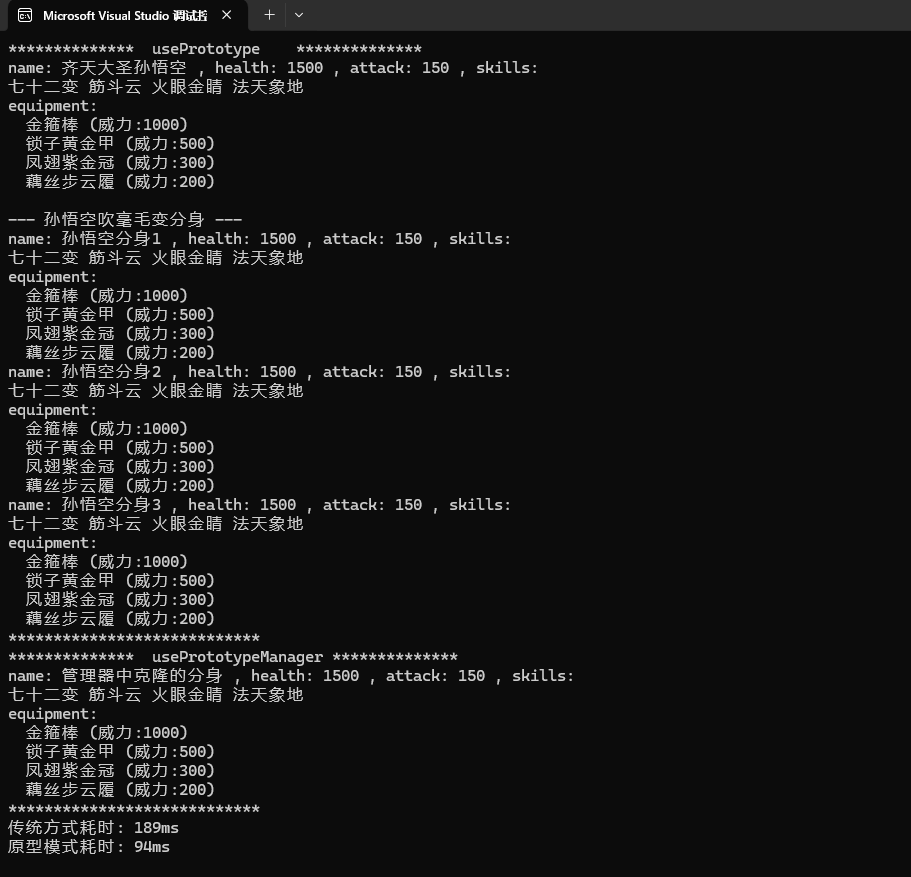
}
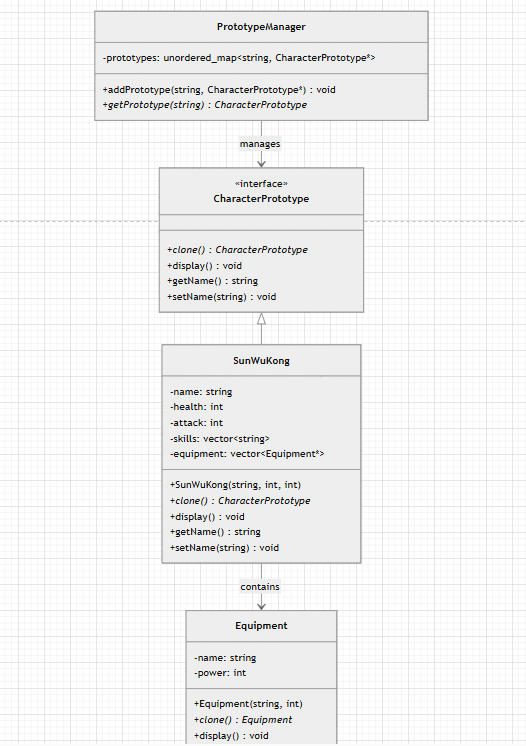
附上UML图:
二、总结
2.1、与传统方式进行对比
| 特点 | 传统创建方式 | 原型模式 |
|---|---|---|
| 性能 | 低,每次都要执行完整初始化 | 高,一次初始化,多次复制 |
| 内存 | 每个对象独立内存 | 可共享不变部分 |
| 代码复杂度 | 低 | 高,需要实现clone |
| 灵活性 | 低 | 高,可动态修改原型 |
| 适用场景 | 对象创建简单 | 对象创建复杂,批量创建 |
2.2、深拷贝 VS 浅拷贝
- 浅拷贝:亦可称为值拷贝。将源对象的值拷贝到目标对象中,如果对象中某个成员是指针类型数据,并且是在堆上创建的,那么源对象和目标对象都指向同一块内存区域,此时如果其中一个对象释放了内存,那么另一个对象的指针就会变成野指针。
- 深拷贝:在拷贝的时候,先开辟出与源对象大小一样的空间,然后将源对象的内容拷贝到新开辟的空间中。这样无论哪个对象释放内存,都不会影响另一个对象的正常使用。
2.3、原型模式 VS 工厂模式
- 原型模式:通过克隆原型对象来创建新的对象,适用于创建复杂对象,特别是当对象的创建过程较为耗时或复杂时。
- 工厂模式:通过工厂方法来创建对象,适用于创建不同类型的对象,特别是当对象的创建逻辑较为复杂时。
三、附加
由于C++语法的灵活性,原型模式实现可以有多种方式
1. 结合智能指针版--原型模式
cpp
// 使用智能指针和移动语义
class SunWuKong1 : public CharacterPrototype
{
private:
    string name;
    int health;
    int attack;
    vector<string> skills;
    vector<unique_ptr<Equipment>> equipment;  // 使用unique_ptr

public:
    SunWuKong1(string name, int health, int attack)
        : name(name), health(health), attack(attack)
    {
        // 初始化技能
        skills.push_back("七十二变");
        skills.push_back("筋斗云");
        skills.push_back("火眼金睛");
        skills.push_back("法天象地");

        // 初始化装备
        equipment.push_back(new Equipment("金箍棒", 1000));
        equipment.push_back(new Equipment("锁子黄金甲", 500));
        equipment.push_back(new Equipment("凤翅紫金冠", 300));
        equipment.push_back(new Equipment("藕丝步云履", 200));
    }

    // 使用移动构造函数提高效率
    SunWuKong1(SunWuKong1&& other) noexcept
        : name(move(other.name)), health(other.health), attack(other.attack),
          skills(move(other.skills)), equipment(move(other.equipment))
    {}

    CharacterPrototype* clone() const override
    {
        // 先创建一个副本
        auto clone = make_unique<SunWuKong1>(name, health, attack);
        // 深拷贝equipment
        for (const auto& eq : equipment) {
            clone->equipment.push_back(make_unique<Equipment>(*eq));
        }
        return clone.release();
    }
};
2. 结合函数模板,通过注册的方式--原型模式
cpp
class PrototypeRegistry {
private:
    static unordered_map<string, function<unique_ptr<CharacterPrototype>()>> registry;

public:
    static void registerPrototype(const string& key,
                                  function<unique_ptr<CharacterPrototype>()> creator)
    {
        registry[key] = move(creator);
    }

    static unique_ptr<CharacterPrototype> clone(const string& key)
    {
        if (auto it = registry.find(key); it != registry.end()) {
            return it->second();
        }
        return nullptr;
    }
};