Salidroside(Rhodioloside,红景天苷,M3899)是一种从红景天(Rhodiola rosea L.)中提取的苯丙素苷类活性成分,近年来因其广泛的生物活性成为研究热点。其作用机制涉及代谢调控、自噬调节、氧化应激抑制及炎症调控等多条通路1。在代谢调控方面,研究发现Salidroside可通过下调肝脏中胆固醇、酯化胆固醇、脂肪酸及甘油三酯的生物合成相关基因,显著改善脂质代谢紊乱1。此外,分子对接实验证实,Salidroside与细胞自噬通路中的mTOR、SIRT1和AKT1等蛋白具有高亲和力,提示其可能通过调控这些靶点影响细胞的自噬过程2。Salidroside( CAS No.:10338-51-9)在神经保护领域,对阿尔茨海默症(AD)模型表现出显著改善作用:有研究以APPswe/PS1ΔE9转基因小鼠和Aβ1-40(Amyloid β Protein 1-40)损伤的PC12细胞作为动物和细胞模型,发现Salidroside(红景天苷)可减轻神经元损伤并改善认知功能3。此外,在自然衰老的C57小鼠模型中,Salidroside通过降低β-半乳糖苷酶水平、提高了海马神经元活性,延缓衰老相关的神经退化4。Salidroside在氧化应激与炎症相关研究中,对急性肺损伤(ALI)模型(BALB/c小鼠)和脓毒症模型(Sprague-Dawley大鼠)均表现出保护作用,其机制涉及抑制中性粒细胞的浸润、降低TNF-α等炎症因子的水平,并上调PPP1R15A表达以缓解内质网应激5。在肿瘤研究方面,Salidroside(Rhodioloside,红景天苷,AbMole,M3899)对多种癌细胞系(如胃癌SNU-216、MGC803细胞,结直肠癌HCT-116、SW620细胞,肾癌A498、786-0细胞)具有浓度和时间依赖性抑制作用,其机制涉及阻滞G1期细胞周期、下调WNT/β-catenin通路及抑制EMT标志物(如Vimentin)的表达6。
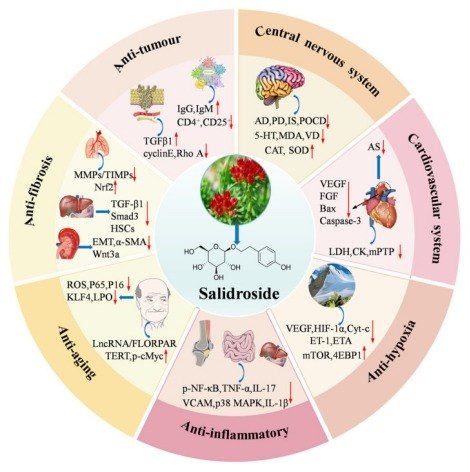
Salidroside的生物学效应和潜在的分子机制7
综上,Salidroside(Rhodioloside,红景天苷,M3899)作为一种多靶点调控分子,在代谢疾病、神经退行性变、炎症及肿瘤等领域展现出广泛的应用潜力,其机制研究为后续深入探索提供了重要工具。
参考文献及鸣谢
1 Song, T.; Wang, P.; Li, C.; et al. Salidroside simultaneously reduces de novo lipogenesis and cholesterol biosynthesis to attenuate atherosclerosis in mice. Biomedicine & pharmacotherapy = Biomedecine & pharmacotherapie 2021, 134, 111137.
2 Chai, Y.; Chen, F.; Li, H.; et al. Mechanism of salidroside regulating autophagy based on network pharmacology and molecular docking. Anti-cancer drugs 2024, 35 (6), 525-534.
3 Huang, X.; Xing, S.; Chen, C.; et al. Salidroside protects PC12 cells from Abeta1‑40‑induced cytotoxicity by regulating the nicotinamide phosphoribosyltransferase signaling pathway. Molecular medicine reports 2017, 16 (3), 2700-2706.
4 Zhu, L.; Liu, Z.; Ren, Y.; et al. Neuroprotective effects of salidroside on ageing hippocampal neurons and naturally ageing mice via the PI3K/Akt/TERT pathway. Phytotherapy research : PTR 2021, 35 (10), 5767-5780.
5 Lan, K. C.; Chao, S. C.; Wu, H. Y.; et al. Salidroside ameliorates sepsis-induced acute lung injury and mortality via downregulating NF-kappaB and HMGB1 pathways through the upregulation of SIRT1. Scientific reports 2017, 7 (1), 12026.
6 Yang, L.; Yu, Y.; Zhang, Q.; et al. Anti-gastric cancer effect of Salidroside through elevating miR-99a expression. Artificial cells, nanomedicine, and biotechnology 2019 , 47 (1), 3500-3510. Lv, C.; Huang, Y.; Liu, Z. X.; et al. Salidroside reduces renal cell carcinoma proliferation by inhibiting JAK2/STAT3 signaling. Cancer biomarkers : section A of Disease markers 2016, 17 (1), 41-47.
7 Liang, K.; Ma, S.; Luo, K.; et al. Salidroside: An Overview of Its Promising Potential and Diverse Applications. Pharmaceuticals (Basel, Switzerland) 2024, 17 (12).