目录
[1. 字符串 & 数字相互转换](#1. 字符串 & 数字相互转换)
[1. x的平方根](#1. x的平方根)
[2. 阶乘后的零](#2. 阶乘后的零)
[3. 用rand7实现rand10](#3. 用rand7实现rand10)
[4. 计算质数](#4. 计算质数)
[5. H指数](#5. H指数)
[6. 基本计算器](#6. 基本计算器)
[6.1. 基本计算器](#6.1. 基本计算器)
[6.2. 基本计算器II](#6.2. 基本计算器II)
[7. 逆波兰表达式](#7. 逆波兰表达式)
[8. 小于n的最大数](#8. 小于n的最大数)
[9. 最大矩形](#9. 最大矩形)
[10. 最大正方形](#10. 最大正方形)
[11. 直线上最多的点](#11. 直线上最多的点)
[12. 四数之和](#12. 四数之和)
[13. 3D接雨水](#13. 3D接雨水)
[14. 打家劫舍②](#14. 打家劫舍②)
[15. 使用最小花费爬楼梯](#15. 使用最小花费爬楼梯)
[16. 分发饼干](#16. 分发饼干)
[17. 分发糖果](#17. 分发糖果)
[18. 加油站](#18. 加油站)
[19. 寻找峰值](#19. 寻找峰值)
[20. 用最少数量的箭引爆气球](#20. 用最少数量的箭引爆气球)
[20. 最长递增子序列系列](#20. 最长递增子序列系列)
[20.1 最长递增子序列的个数](#20.1 最长递增子序列的个数)
[20.2. 最长连续递增子序列](#20.2. 最长连续递增子序列)
[21. 买卖股票](#21. 买卖股票)
[21.1. 买卖股票的最佳时机②](#21.1. 买卖股票的最佳时机②)
[21.2. 买卖股票的最佳时期③](#21.2. 买卖股票的最佳时期③)
[21.3. 买卖股票的最佳时期④](#21.3. 买卖股票的最佳时期④)
[21.4. 买卖股票的最佳时期含冷冻期](#21.4. 买卖股票的最佳时期含冷冻期)
[21.5. 买卖股票的最佳时期含手续费](#21.5. 买卖股票的最佳时期含手续费)
[22. 下一个更大元素(下一个更大元素① & ②)](#22. 下一个更大元素(下一个更大元素① & ②))
一、常用知识点
1. 字符串 & 数字相互转换
python
'A'~'Z': 65~90
'a'~'z': 97~122

[ord('A'), ord('Z')] = [65, 90]
[ord('a'), ord('z')] = [97, 122]

chr(65), chr(90) = 'A', 'Z'
chr(97), chr(122) = 'a', 'z'
chr(ord('a')), chr(ord('z')) = 'a', 'z'
二、非hot100高频题
1. x的平方根
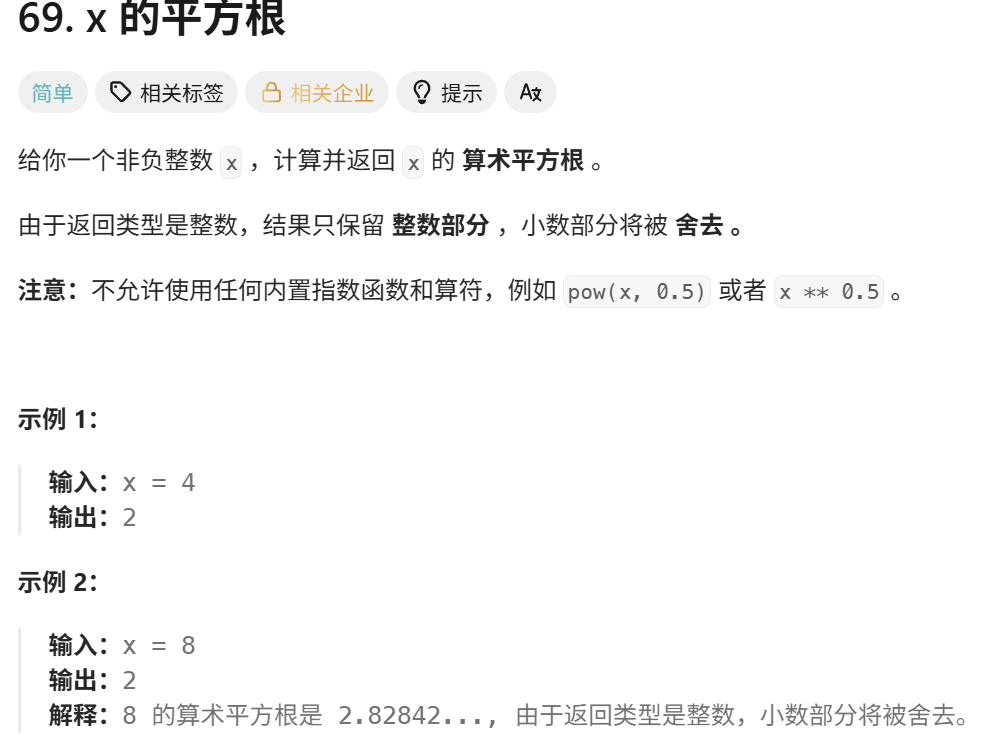
python
# 方法(1):牛顿迭代法
class Solution(object):
    def mySqrt(self, x):
        num = x
        while num * num > x:
            num = (num + x // num) // 2
        return num
# 方法(2):二分查找
class Solution(object):
    def mySqrt(self, x):
        left, right = 0, x + 1
        # [left, right)
        while left < right:
            mid = left + (right - left) // 2
            if mid ** 2 == x:
                return mid
            if mid ** 2 < x:
                left = mid + 1
            else:
                right = mid
        return left - 1
2. 阶乘后的零
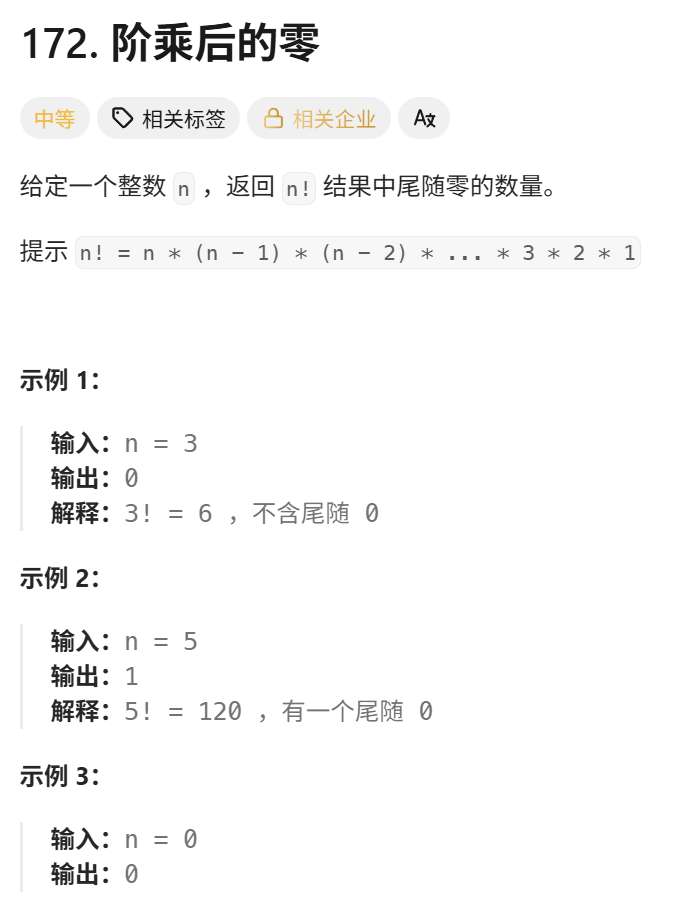
python
class Solution(object):
    def trailingZeroes(self, n):
        num = 0
        while n > 0:
            num += n // 5
            n = n // 5
        return num
3. 用rand7实现rand10
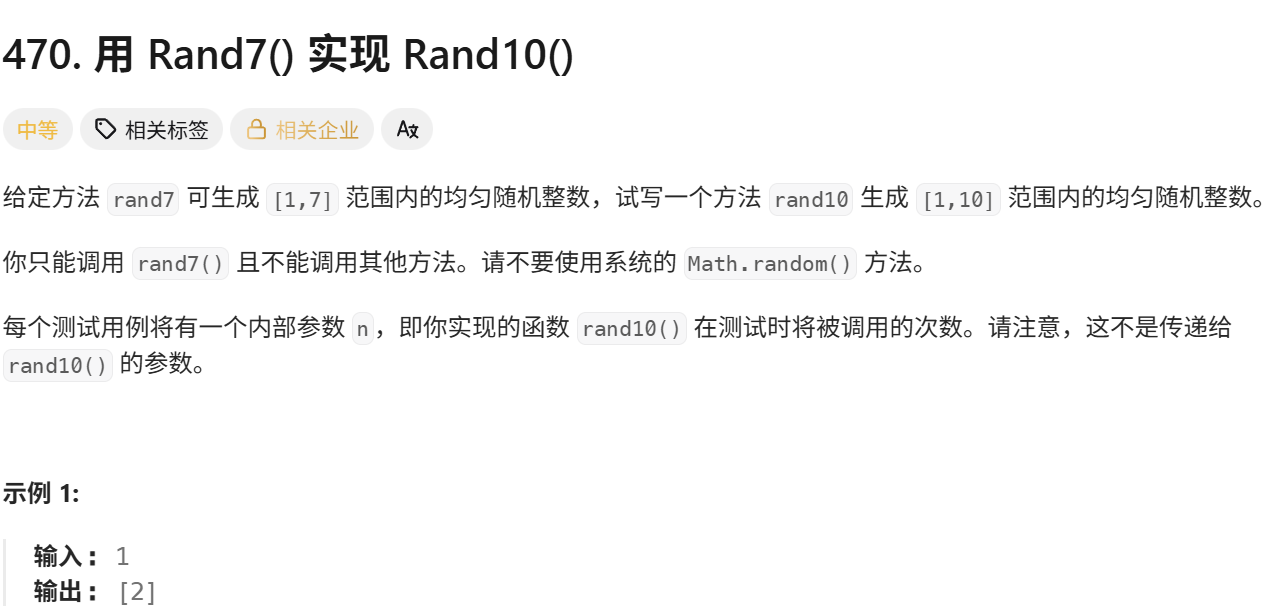
python
class Solution(object):
    def rand10(self):
        return (rand7()+rand7()+rand7()+rand7()+rand7()+rand7()+rand7()+rand7()+rand7()+rand7())%10+1
4. 计算质数
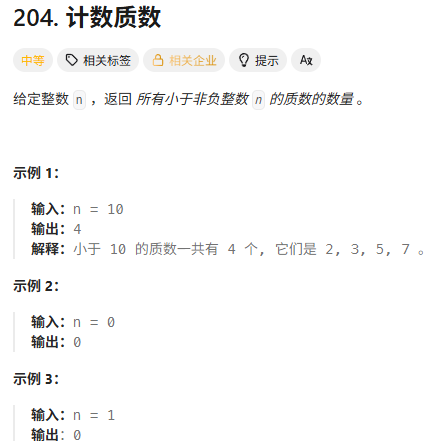
python
# 方法(1):时空复杂度分别为:O(nlogn)、O(n)。
class Solution(object):
def countPrimes(self, n):
if n <= 2:
return 0
is_prime = [True] * n
is_prime[0] = is_prime[1] = False # 0和1不是质数
for i in range(2, int(n ** 0.5) + 1):
if is_prime[i]:
# 标记i的所有倍数为非质数
for j in range(i*i, n, i):
is_prime[j] = False
return sum(is_prime)
"""
n = 10:初始化 is_prime = [True] * 10(索引 0-9)。
标记过程:
i=2:标记 4、6、8 为 False。
i=3:标记 9 为 False(i*i=9开始)。
最终 is_prime = [F, F, T, T, F, T, F, T, F, F],统计 True的数量为 4(质数:2, 3, 5, 7)。
"""
# 方法(2):O(n**2)
num=[]
for i in range(2,n):
for j in range(2,i):
if(i%j==0):
break
else:
num.append(i)
print(num)5. H指数
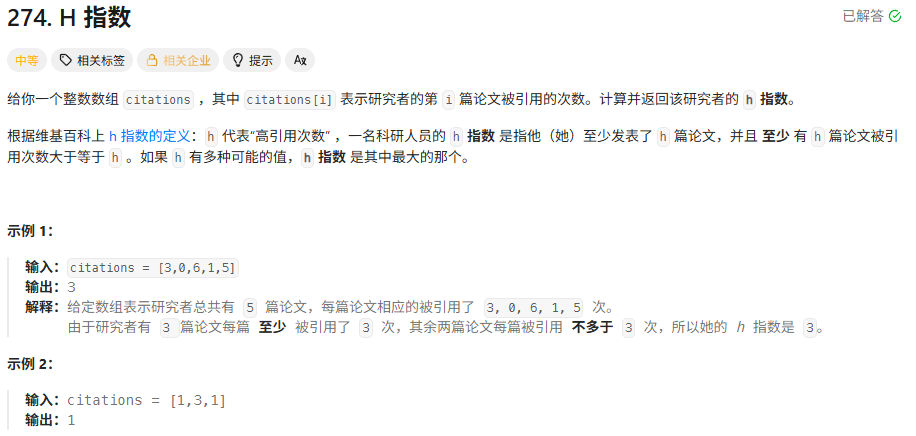
python
# 时空复杂度分别为:O(nlogn)、O(1)
class Solution(object):
    def hIndex(self, citations):
        citations.sort(reverse=True)
        h = 0
        for i, citation in enumerate(citations):
            if citation > i:
                h = i + 1
            else:
                break
        return h
"""
citations=[3,0,6,1,5] --> sorted, [6, 5, 3, 1, 0] --> 3
0:6, 1:5, 2:3, 3:1
"""
6. 基本计算器
6.1. 基本计算器
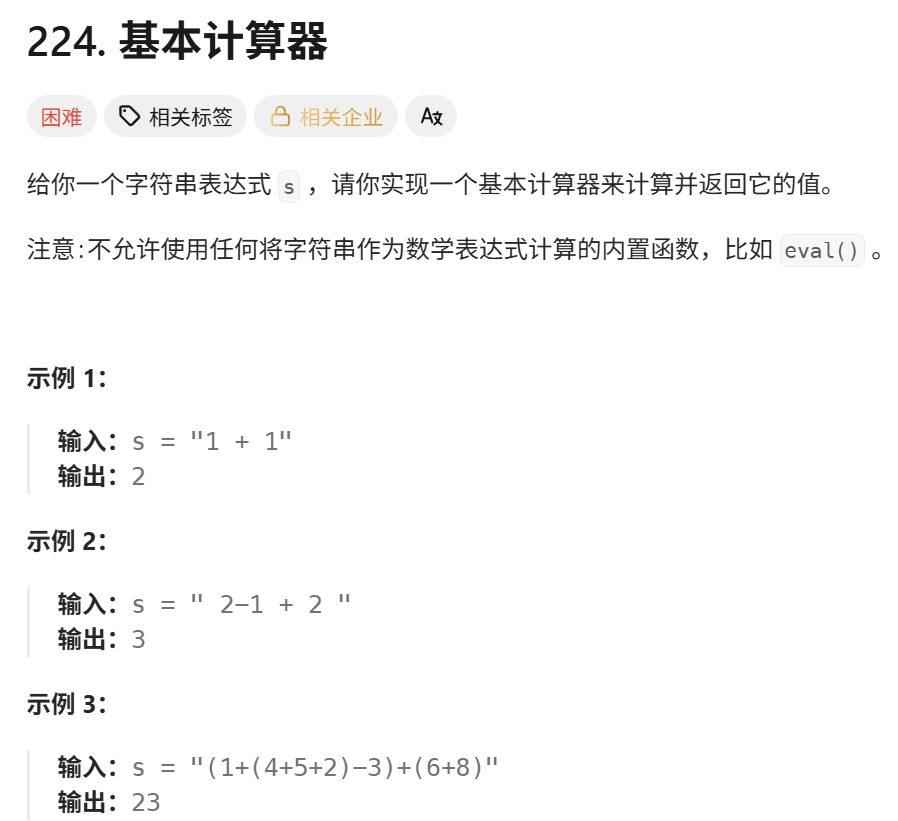
python
class Solution:
    def calculate(self, s: str) -> int:
        stack = []
        # 当连续数字是追加
        tmp_str = ''
        for i in s[::-1]:
            if i == ' ':
                continue
            if i.isdigit():
                # 追加连续数字
                tmp_str += i
                continue
            # 遇到非数字场景
            if tmp_str:
                # 先将tmp_str 逆序后添加至stack中
                stack.append(int(tmp_str[::-1]))
                # 重置
                tmp_str = ''
            # 遇到-号,取出尾数,添加负号后重新放入
            if i == '-':
                stack.append(-stack.pop())
            # 正常添加
            elif i == ')':
                stack.append(i)
            # 开始合并左括号到右括号之间的数字
            elif i == '(':
                num = 0
                while True:
                    if stack[-1] == ')':
                        stack.pop()
                        break
                    num += stack.pop()
                stack.append(num)
        # 未加入的临时数字,进行追加
        if tmp_str:
            stack.append(int(tmp_str[::-1]))
        return sum(stack)
6.2. 基本计算器II
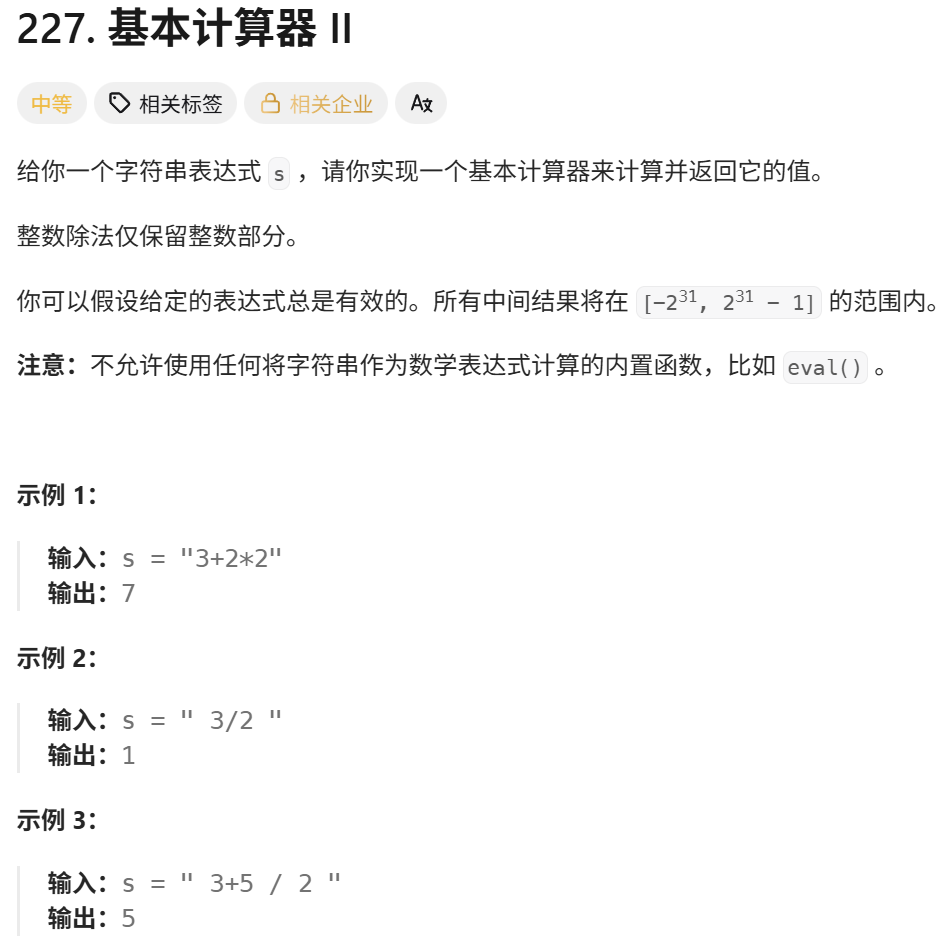
python
class Solution:
    def calculate(self, s):
        stack = []
        pre_op = '+'
        num = 0
        for i, each in enumerate(s):
            if each.isdigit():
                num = 10 * num + int(each)
            if i == len(s) - 1 or each in '+-*/':
                if pre_op == '+':
                    stack.append(num)
                elif pre_op == '-':
                    stack.append(-num)
                elif pre_op == '*':
                    stack.append(stack.pop() * num)
                elif pre_op == '/':
                    top = stack.pop()
                    if top < 0:
                        stack.append(int(top / num))
                    else:
                        stack.append(top // num)
                pre_op = each
                num = 0
        return sum(stack)
7. 逆波兰表达式
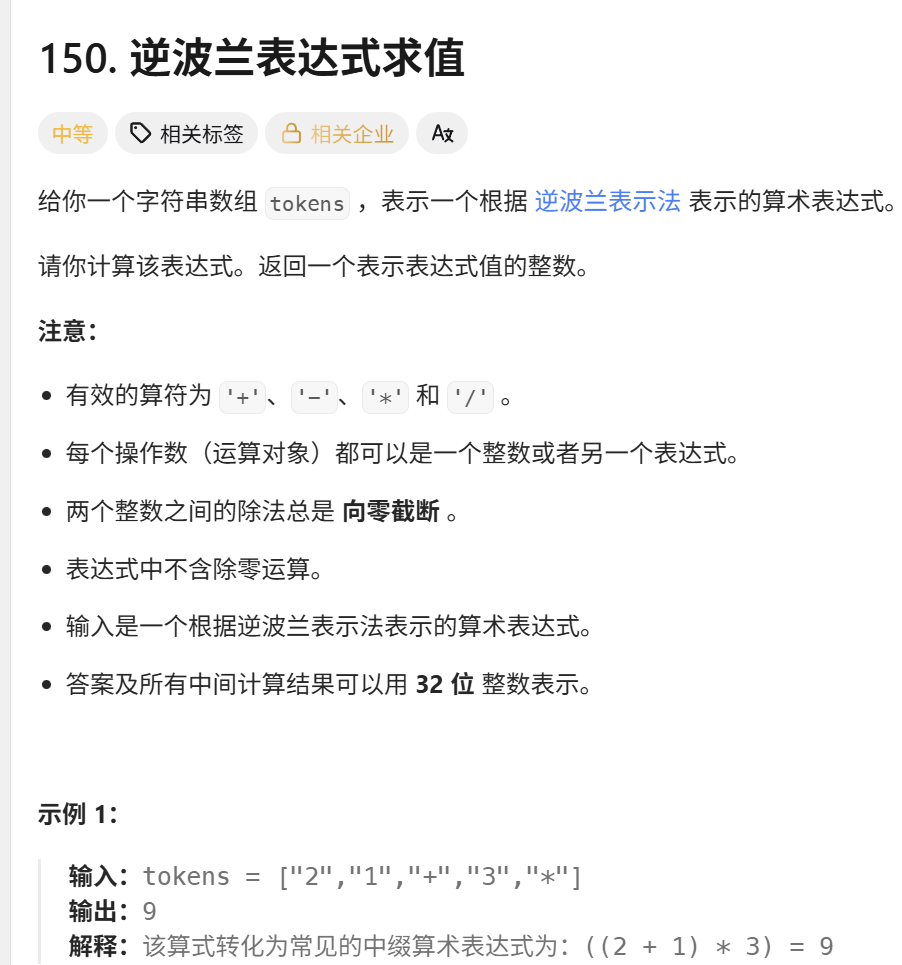
python
import operator
class Solution:
    def evalRPN(self, tokens: List[str]) -> int:
        ops = {'+': operator.add, '-': operator.sub, '*': operator.mul, '/': operator.truediv}
        s = []
        for x in tokens:
            if x not in ops:
                s.append(x)
            else:
                a = s.pop()
                b = s.pop()
                # 这里使用 truediv 处理类似 6 / -3 的情况
                s.append(int(ops[x](int(b), int(a))))
        return int(s[0])
8. 小于n的最大数
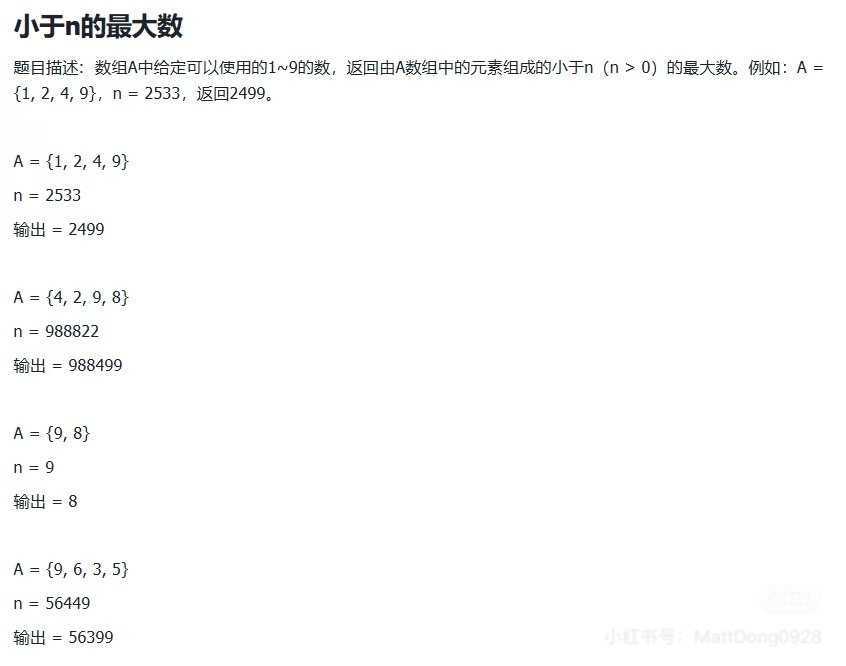
python
def largest_number_less_than_n(A, n):
    s = str(n)
    length = len(s)
    digits = sorted(map(str, A))
    max_digit = max(digits)
    # 生成所有位数相同且小于n的数
    candidates = []
    # 使用DFS生成所有可能
    def dfs(index, tight, path):
        if index == length:
            num_str = ''.join(path)
            if int(num_str) < n:
                candidates.append(num_str)
            return
        if tight:
            for d in digits:
                if d <= s[index]:
                    new_tight = (d == s[index])
                    dfs(index+1, new_tight, path+[d])
        else:
            for d in digits:
                dfs(index+1, False, path+[d])
    dfs(0, True, [])
    if candidates:
        return int(max(candidates))
    else:
        # 构造位数少一位的最大数
        if length - 1 == 0:
            return 0
        return int(max_digit * (length - 1))
print(largest_number_less_than_n(['1','2','4','9'], 2533))  # 2499
print(largest_number_less_than_n(['9','6','3','5'], 56449))  # 56399
9. 最大矩形
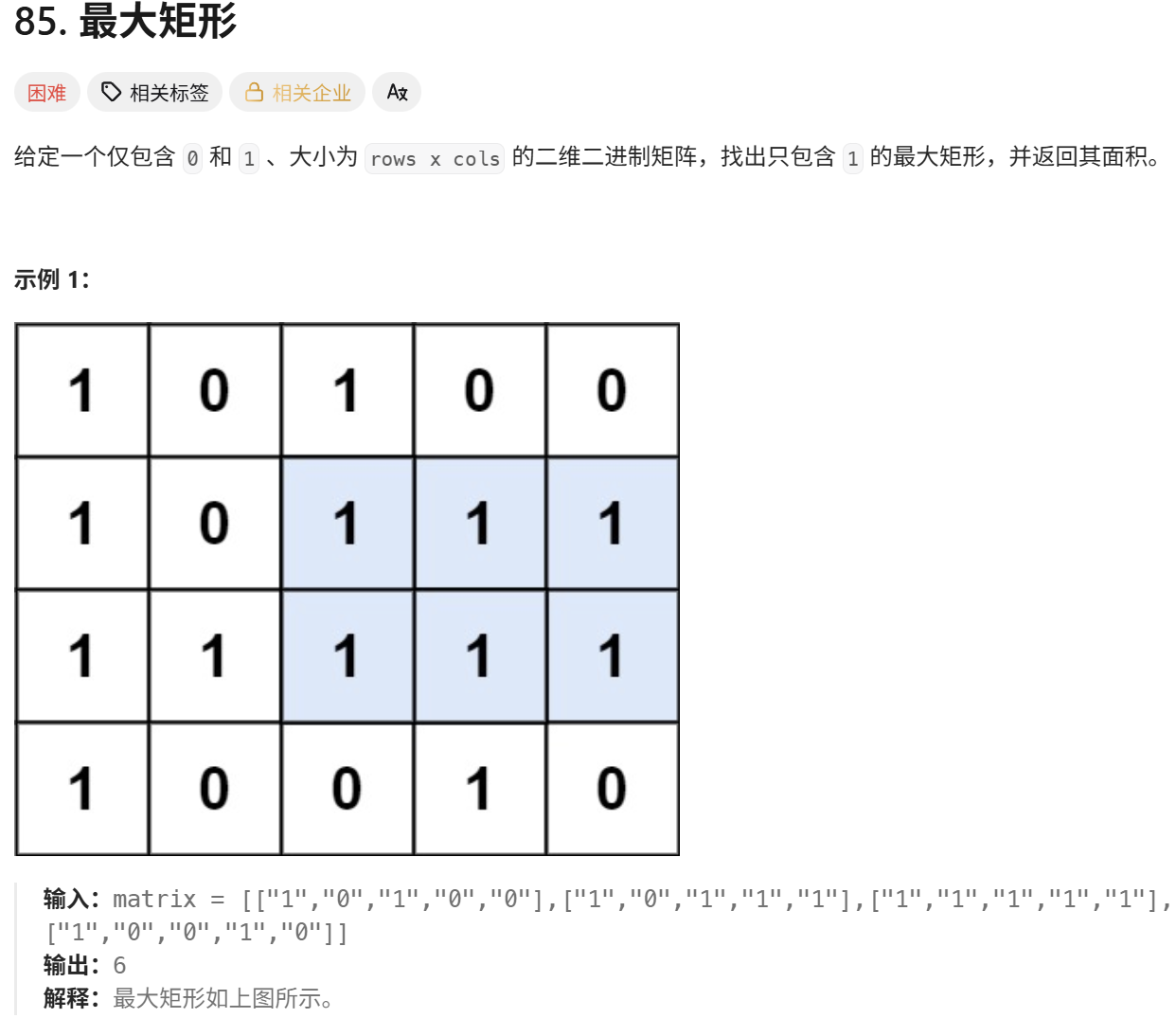
python
class Solution(object):
    def maximalRectangle(self, matrix):
        if not matrix:return 0
        m,n=len(matrix),len(matrix[0])
        # 记录当前位置上方连续"1"的个数
        pre=[0]*(n+1)
        res=0
        for i in range(m):
            for j in range(n):
                # 前缀和
                pre[j]=pre[j]+1 if matrix[i][j]=="1" else 0
            # 单调栈
            stack=[-1]
            for k,num in enumerate(pre):
                while stack and pre[stack[-1]]>num:
                    index=stack.pop()
                    res=max(res,pre[index]*(k-stack[-1]-1))
                stack.append(k)
        return res
10. 最大正方形
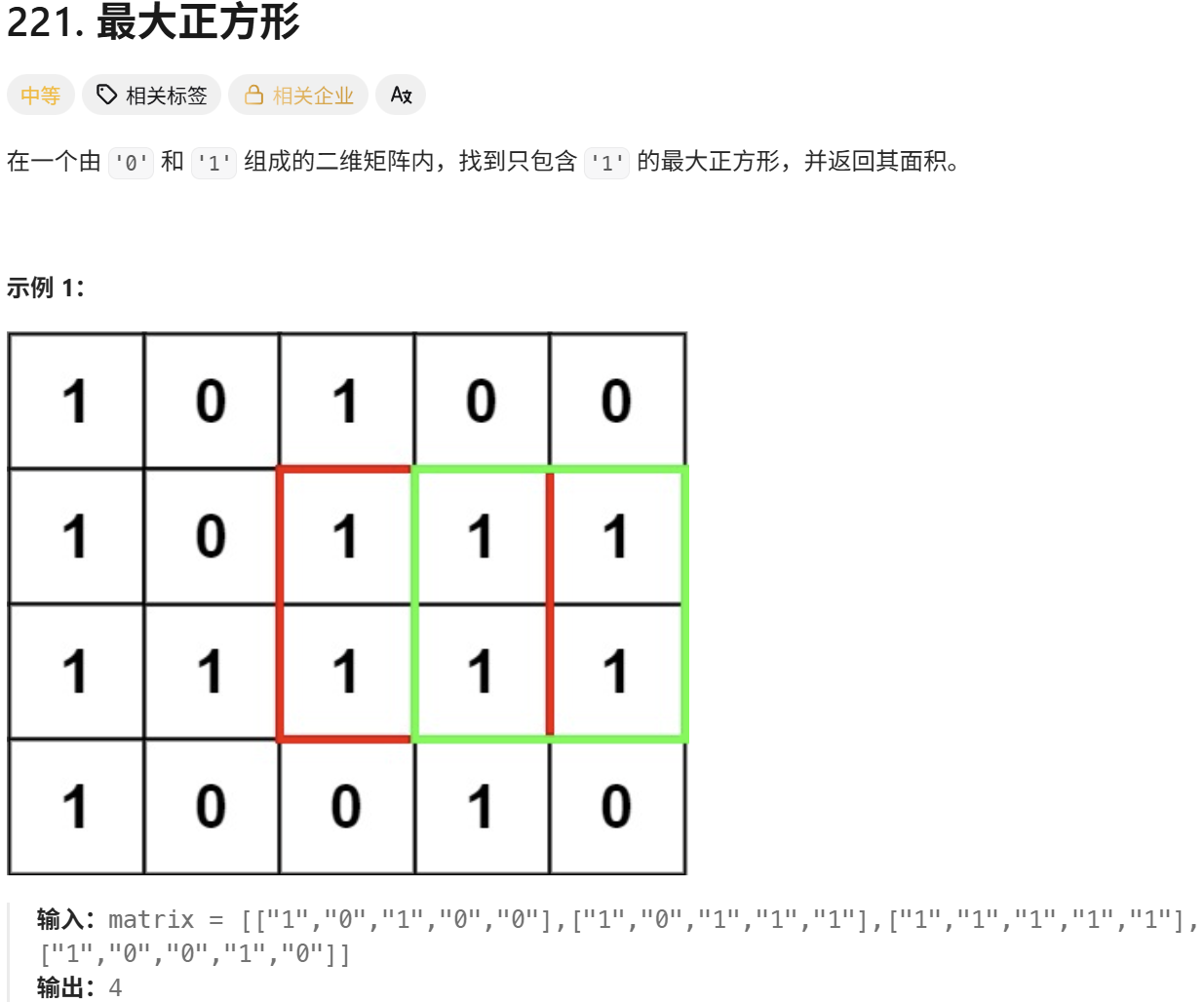
python
class Solution(object):
    def maximalSquare(self, matrix):
        res = 0
        m = len(matrix)
        if m == 0:
            return 0
        n = len(matrix[0])
        dp = [[0] * (n + 1) for _ in range(m + 1)]

        for i in range(1, m + 1):
            for j in range(1, n + 1):
                dp[i][j] = min(dp[i - 1][j], dp[i][j - 1], dp[i - 1][j - 1]) + 1 if matrix[i - 1][j - 1] == "1" else 0
                res = max(res, dp[i][j])
        return res ** 2
11. 直线上最多的点
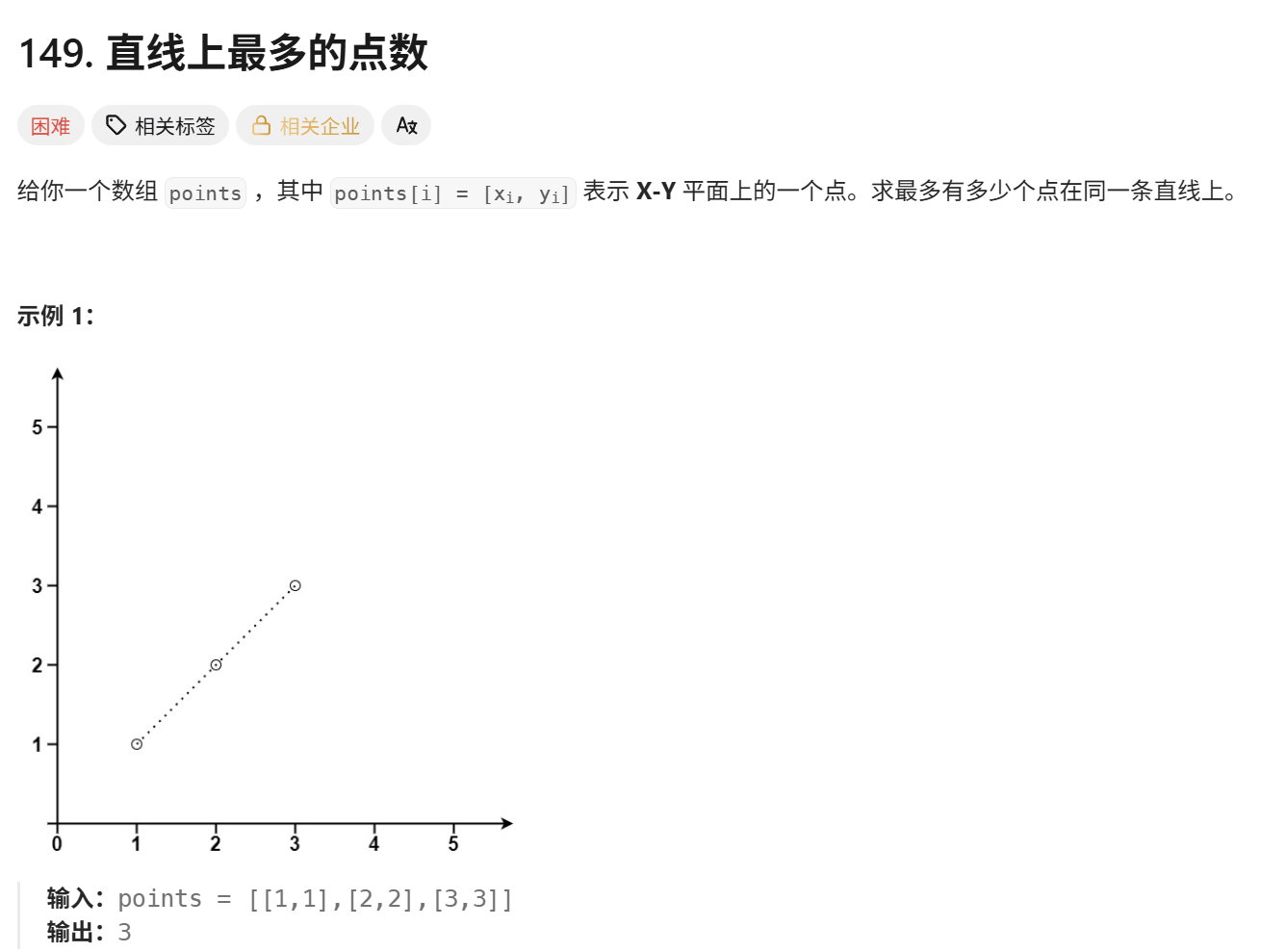
python
class Solution(object):
    def maxPoints(self, points):
        """
        通过两点[x1,y1],[x2,y2]可以计算一般式ax+by+c=0中的A,B,C三个参数分别为:
        A = y2 - y1
        B = x1 - x2
        C = x2y1 - x1y2
        """
        cnt = {}
        n = len(points)
        if n < 2:
            return 1
        m = 1
        for i in range(n-1):
            for j in range(i+1,n):
                x1=points[i][0]
                x2=points[j][0]
                y1=points[i][1]
                y2=points[j][1]
                A = float(y2 - y1)
                B = float(x1 - x2)
                C = float(x2*y1 - x1*y2)
                if A != 0:
                    A, B, C = 1, B/A, C/A
                elif B != 0:
                    A, B, C = A/B, 1, C/B
                elif C != 0:
                    A, B, C = A/C, B/C, 1
                f=(A,B,C)
                if f not in cnt:
                    cnt[f]=1
                else:
                    cnt[f]+=1
                    m=max(m,cnt[f])
        return int(ceil(sqrt(m * 2)))
12. 四数之和
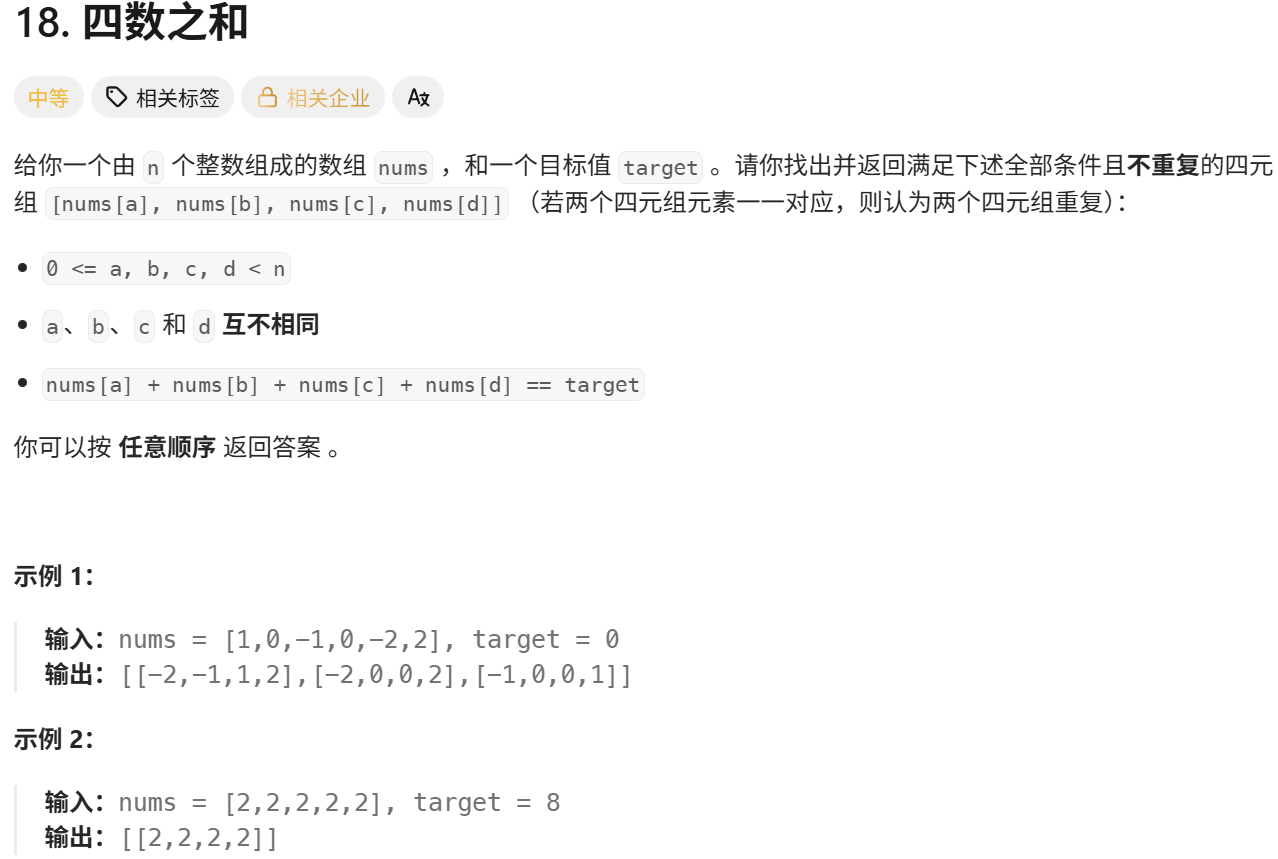
python
class Solution(object):
    def fourSum(self, nums, target):
        nums.sort()
        sets=set()
        for i in range(len(nums)-3):
            for j in range(i+1,len(nums)-2):#固定两个数
                left=j+1#左指针
                right=len(nums)-1#右指针
                while(right>left):
                    temp=nums[i]+nums[j]+nums[left]+nums[right]
                    if temp==target:
                        sets.add((nums[i],nums[j],nums[left],nums[right]))
                        left+=1
                        right-=1
                    if temp>target:right-=1#太大了,右指针左移
                    if temp<target:left+=1#反之
        #去重
        res=[]
        for i in sets:
            res.append(list(i))
        return res
13. 3D接雨水
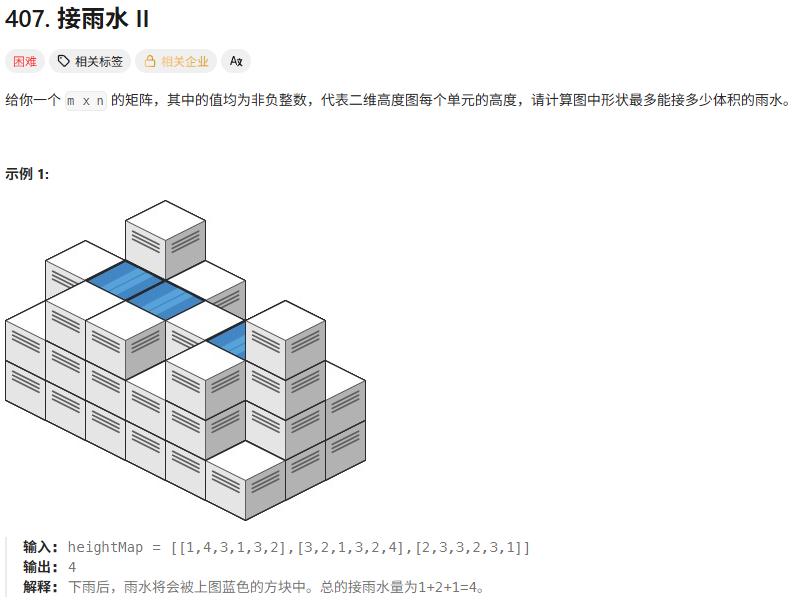
python
import heapq
class Solution(object):
    def trapRainWater(self, heightMap):
        if not heightMap: return 0
        m, n = len(heightMap), len(heightMap[0])
        if m < 3 or n < 3: return 0
        heap = []
        visited = [[False] * n for _ in range(m)]
        # 将边界存入堆
        for i in range(m):
            for j in [0, n-1]:
                heapq.heappush(heap, (heightMap[i][j], i, j))
                visited[i][j] = True
        for j in range(1, n-1):
            for i in [0, m-1]:
                heapq.heappush(heap, (heightMap[i][j], i, j))
                visited[i][j] = True
        res = 0
        dirs = [(-1,0), (1,0), (0,-1), (0,1)]
        while heap:
            h, x, y = heapq.heappop(heap)
            for dx, dy in dirs:
                nx, ny = x+dx, y+dy
                if 0<=nx<m and 0<=ny<n and not visited[nx][ny]:
                    res += max(0, h - heightMap[nx][ny])
                    heapq.heappush(heap, (max(h, heightMap[nx][ny]), nx, ny))
                    visited[nx][ny] = True
        return res
14. 打家劫舍②
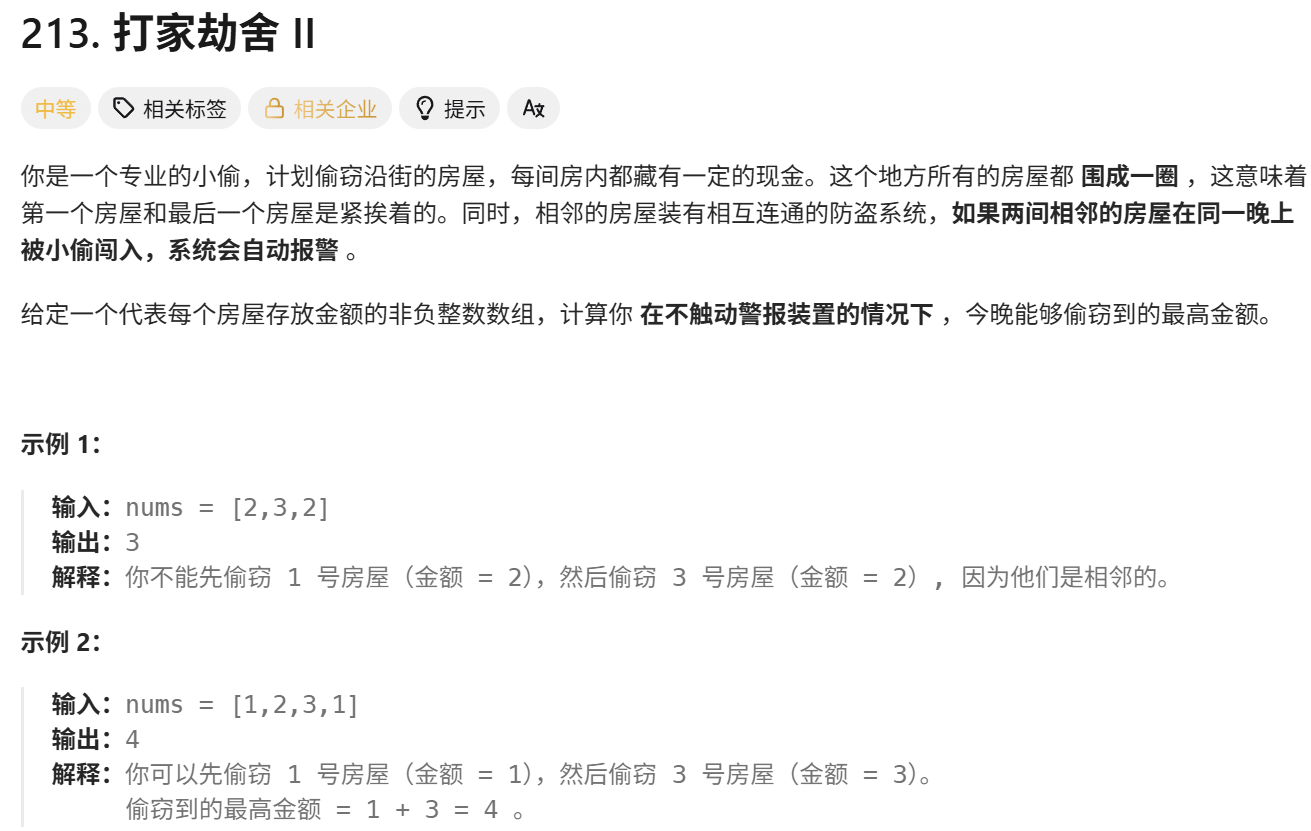
python
class Solution:
    def rob1(self, nums):
        f0 = f1 = 0
        for x in nums:
            f0, f1 = f1, max(f1, f0 + x)
        return f1
    def rob(self, nums):
        return max(nums[0] + self.rob1(nums[2:-1]), self.rob1(nums[1:]))
15. 使用最小花费爬楼梯
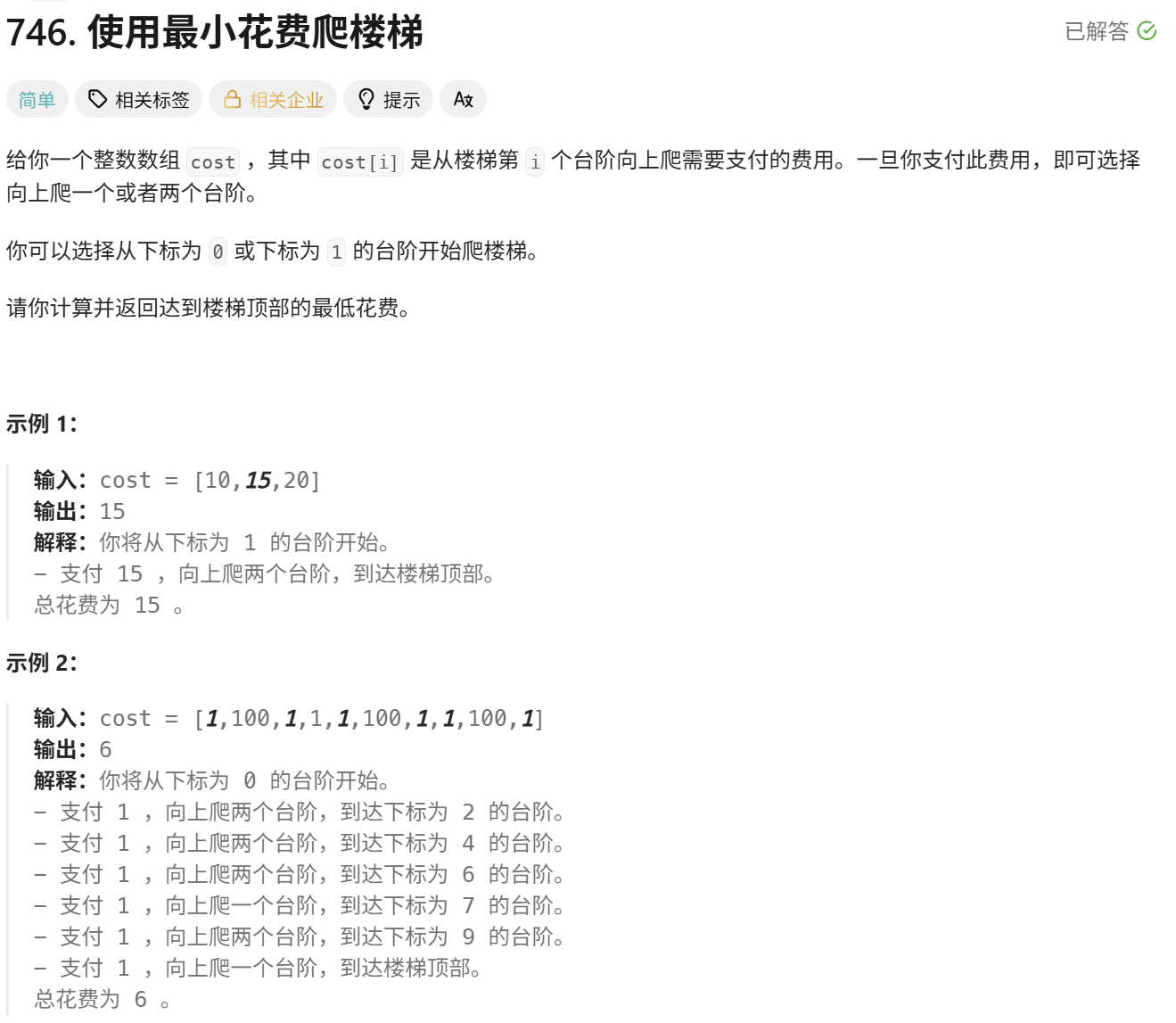
python
class Solution(object):
    def minCostClimbingStairs(self, cost):
        n = len(cost)
        dp = [0] * (n + 1)
        for i in range(2, n + 1):
            dp[i] = min(dp[i - 1] + cost[i - 1], dp[i - 2] + cost[i - 2])
        return dp[n]
16. 分发饼干
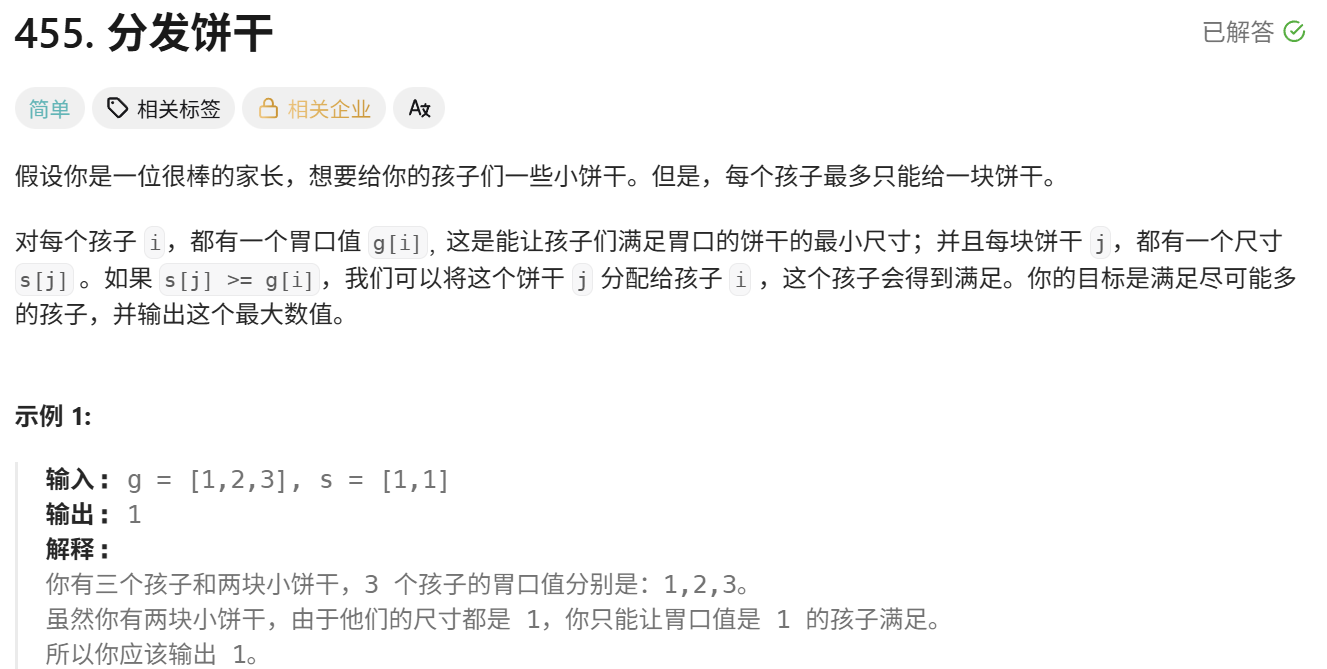
python
class Solution(object):
    def findContentChildren(self, g, s):
        # 将胃口和饼干排序
        g.sort()
        s.sort()
        # 孩子的数量
        n = len(g)
        # 饼干的数量
        m = len(s)
        # 记录结果
        res = 0
        for i in range(m):
            # 从胃口小的开始喂
            if res < n and g[res] <= s[i]:
                res += 1
        return res
17. 分发糖果
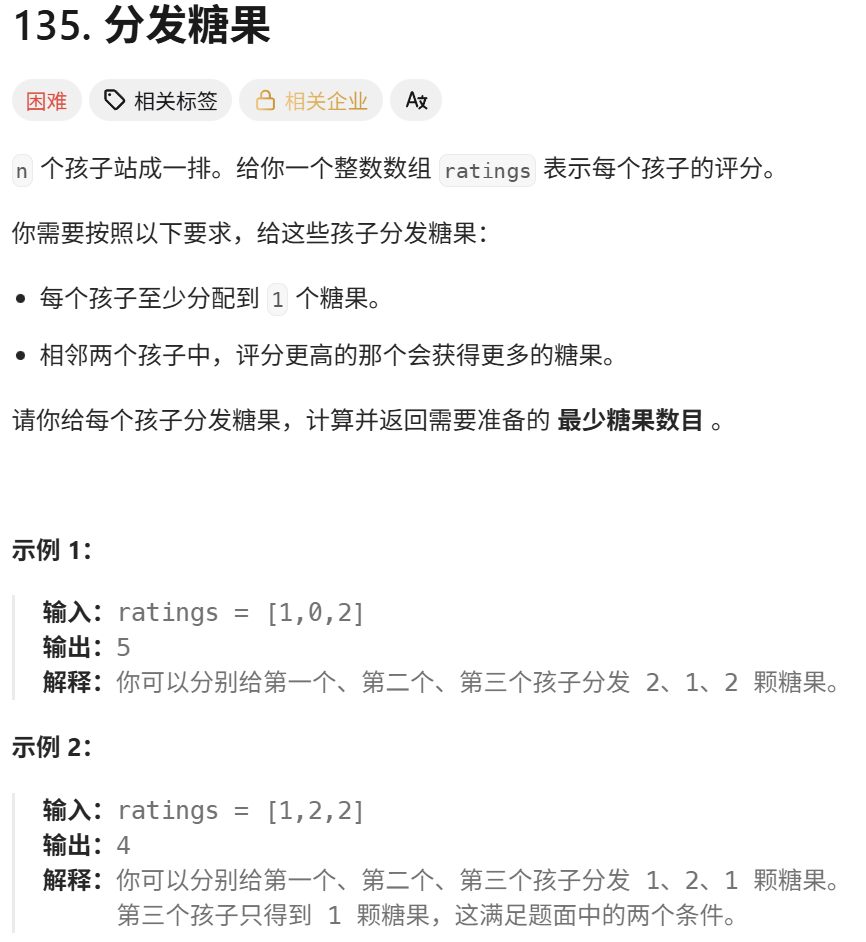
python
class Solution(object):
    def candy(self, ratings):
        n = len(ratings)
        candies = [1] * n
        for i in range(1, n):
            if ratings[i] > ratings[i - 1]:
                candies[i] = candies[i - 1] + 1
        for i in range(n - 2, -1, -1):
            if ratings[i] > ratings[i + 1]:
                candies[i] = max(candies[i], candies[i + 1] + 1)
        total = 0
        for num in candies:
            total += num
        return total
18. 加油站
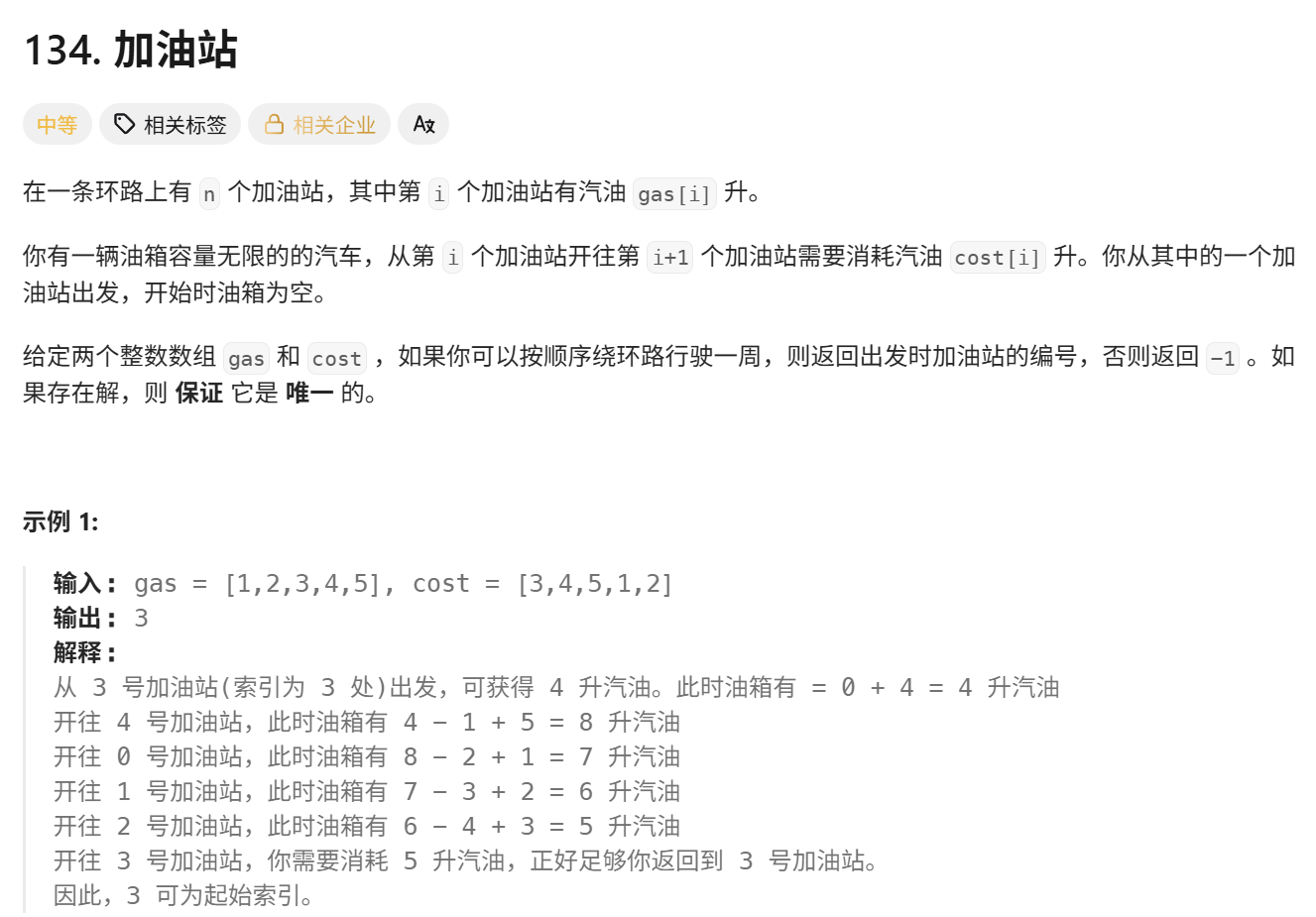
python
class Solution(object):
    def canCompleteCircuit(self, gas, cost):
        start = 0
        curSum = 0
        totalSum = 0
        for i in range(len(gas)):
            curSum += gas[i] - cost[i]
            totalSum += gas[i] - cost[i]
            if curSum < 0:
                curSum = 0
                start = i + 1
        if totalSum < 0: return -1
        return start
19. 寻找峰值
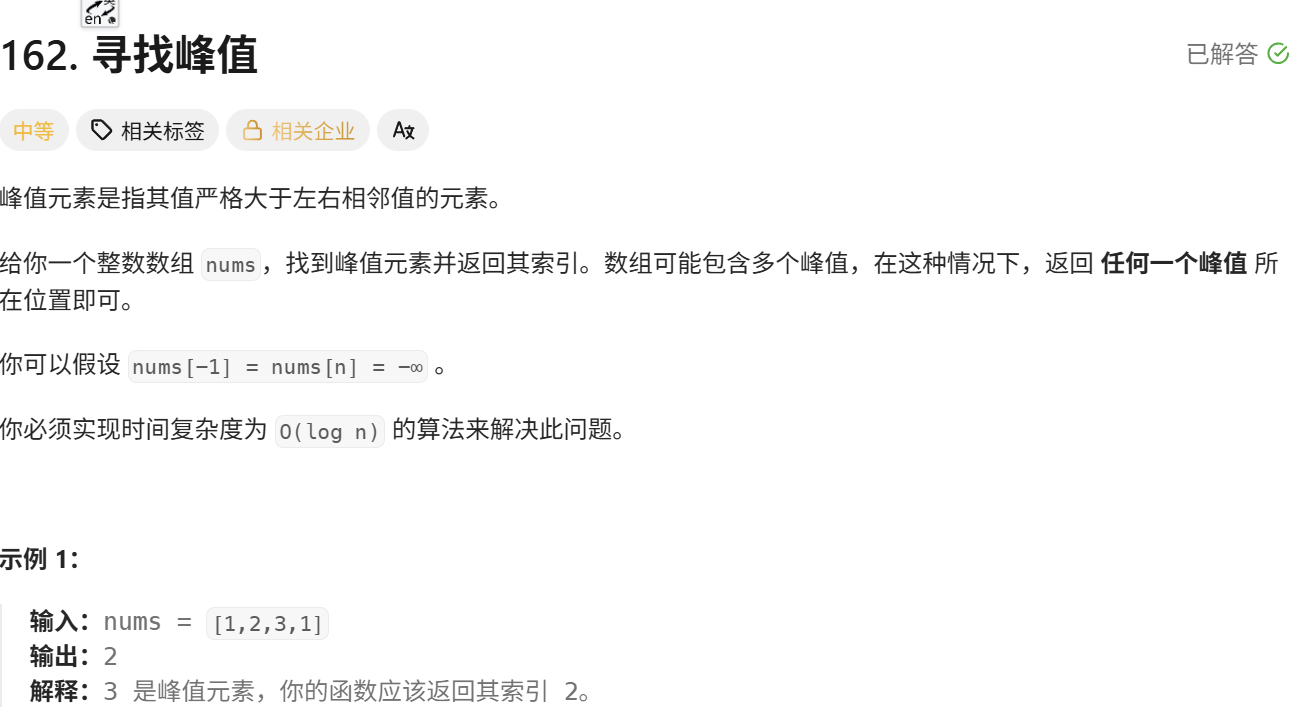
python
class Solution(object):
    def findPeakElement(self, nums):
        idx = 0
        for i in range(1, len(nums)):
            if nums[i] > nums[idx]:
                idx = i
        return idx
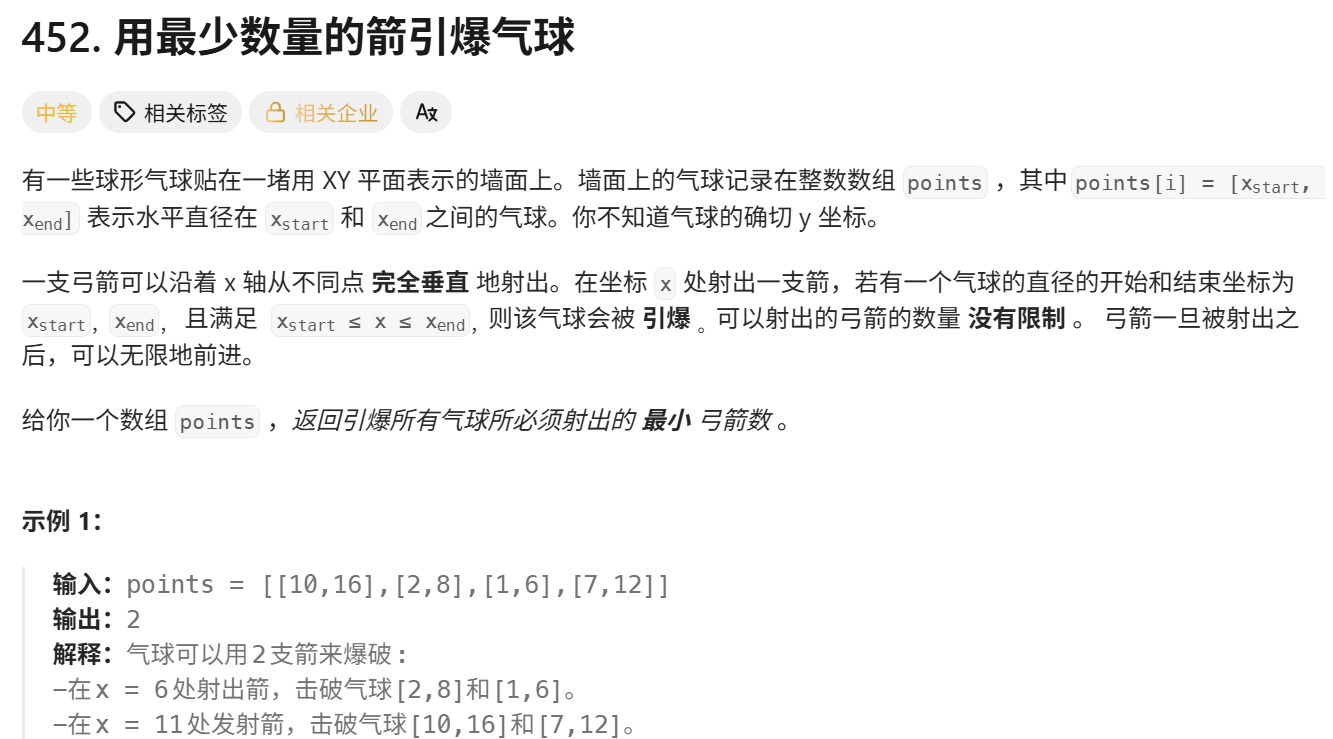
20. 用最少数量的箭引爆气球
python
class Solution(object):
    def findMinArrowShots(self, points):
        if len(points) == 0: return 0
        points.sort(key=lambda x: x[0])
        result = 1
        for i in range(1, len(points)):
            if points[i][0] > points[i - 1][1]: # 气球i和气球i-1不挨着,注意这里不是>=
                result += 1
            else:
                points[i][1] = min(points[i - 1][1], points[i][1]) # 更新重叠气球最小右边界
        return result
20. 最长递增子序列系列
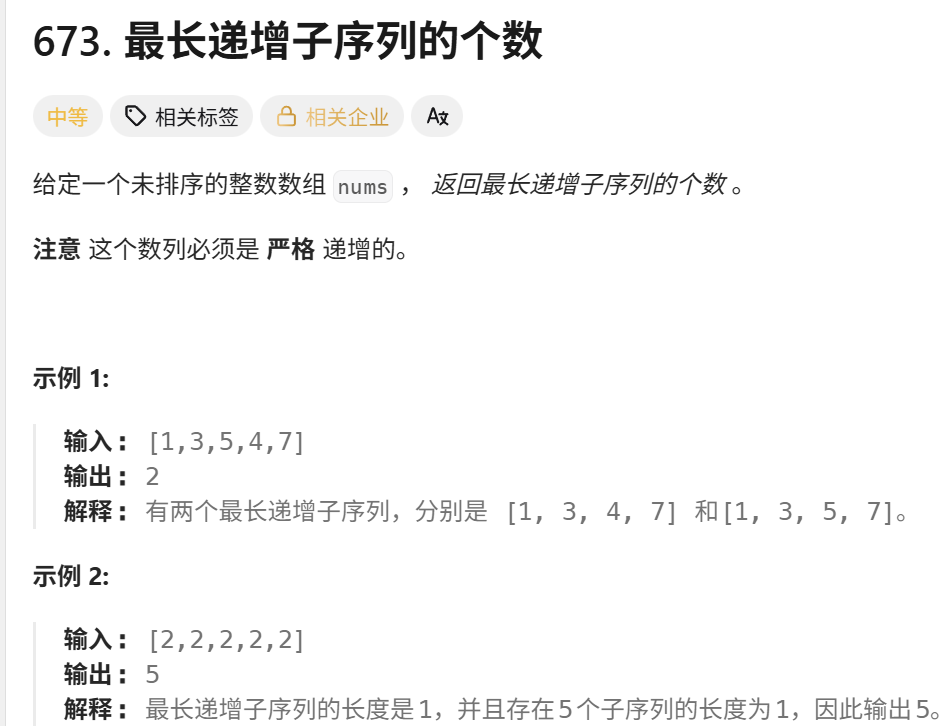
20.1 最长递增子序列的个数
python
class Solution(object):
    def findNumberOfLIS(self, nums):
        n = len(nums)
        if n == 1:
            return l
        max_l = 0
        dp = [1]*n
        count = [1]*n
        for i in range(1,n):
            for j in range(i):
                if nums[i]>nums[j]:
                    if dp[j] + 1 > dp[i]:
                        count[i] = count[j]
                        dp[i] = dp[j]+1
                    elif dp[j]+1 == dp[i]:
                        count[i] += count[j]
                max_l = max(max_l, dp[i])
        res = 0
        for i in range(n):
            if dp[i]==max_l:
                res += count[i]
        return res
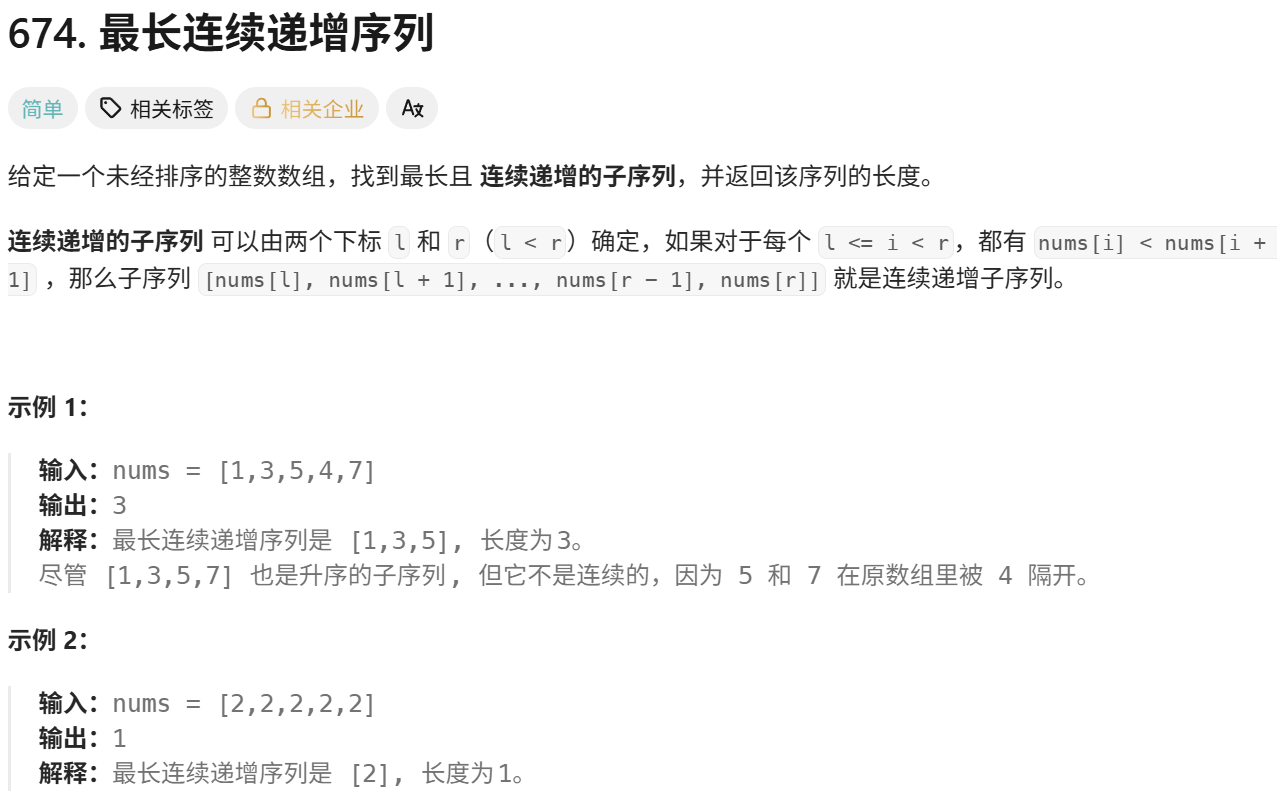
20.2. 最长连续递增子序列
python
class Solution(object):
    def findLengthOfLCIS(self, nums):
        res = 0
        n = len(nums)
        start = 0
        for i in range(n):
            if i > 0 and nums[i] <= nums[i - 1]:
                start = i
            res = max(res, i - start + 1)
        return res
21. 买卖股票
21.1. 买卖股票的最佳时机②
python
class Solution:
    def maxProfit(self, prices):
        max_profit = 0
        for i in range(1, len(prices)):
            if prices[i] > prices[i-1]:
                max_profit += prices[i] - prices[i-1]
        return max_profit
21.2. 买卖股票的最佳时期③
python
class Solution(object):
    def maxProfit(self, prices):
        b1, b2, s1, s2 = -float("inf"), -float("inf"), 0, 0
        for p in prices:
            b1 = max(b1, 0 - p)
            s1 = max(s1, b1 + p)
            b2 = max(b2, s1 - p)
            s2 = max(s2, b2 + p)
        return s2
21.3. 买卖股票的最佳时期④
python
class Solution(object):
    def maxProfit(self, k, prices):
        k = min(k, len(prices) // 2)
        buy = [-float("inf")] * (k+1)
        sell = [0] * (k+1)
        for p in prices:
            for i in range(1, k+1):
                buy[i] = max(buy[i], sell[i-1] - p)
                sell[i] = max(sell[i], buy[i] + p)
        return sell[-1]
21.4. 买卖股票的最佳时期含冷冻期
python
class Solution(object):
    def maxProfit(self, prices):
        buy, sell_pre, sell = -float("inf"), 0, 0
        for p in prices:
            buy = max(buy, sell_pre - p)
            sell_pre, sell = sell, max(sell, buy + p)
        return sell
21.5. 买卖股票的最佳时期含手续费
python
class Solution(object):
    def maxProfit(self, prices, fee):
        buy, sell = -float("inf"), 0
        for p in prices:
            buy = max(buy, sell - p - fee)
            sell = max(sell, buy + p)
        return sell
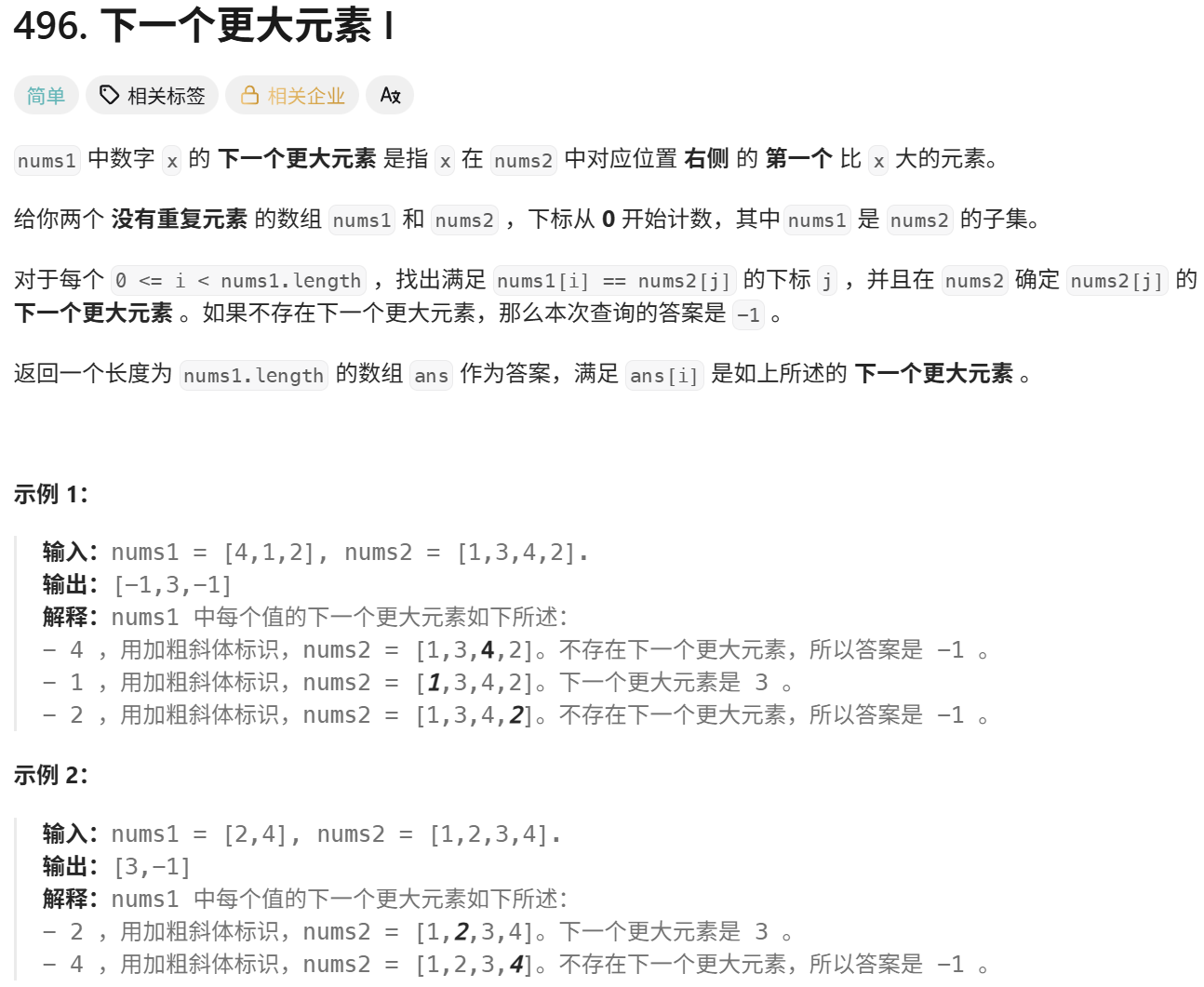
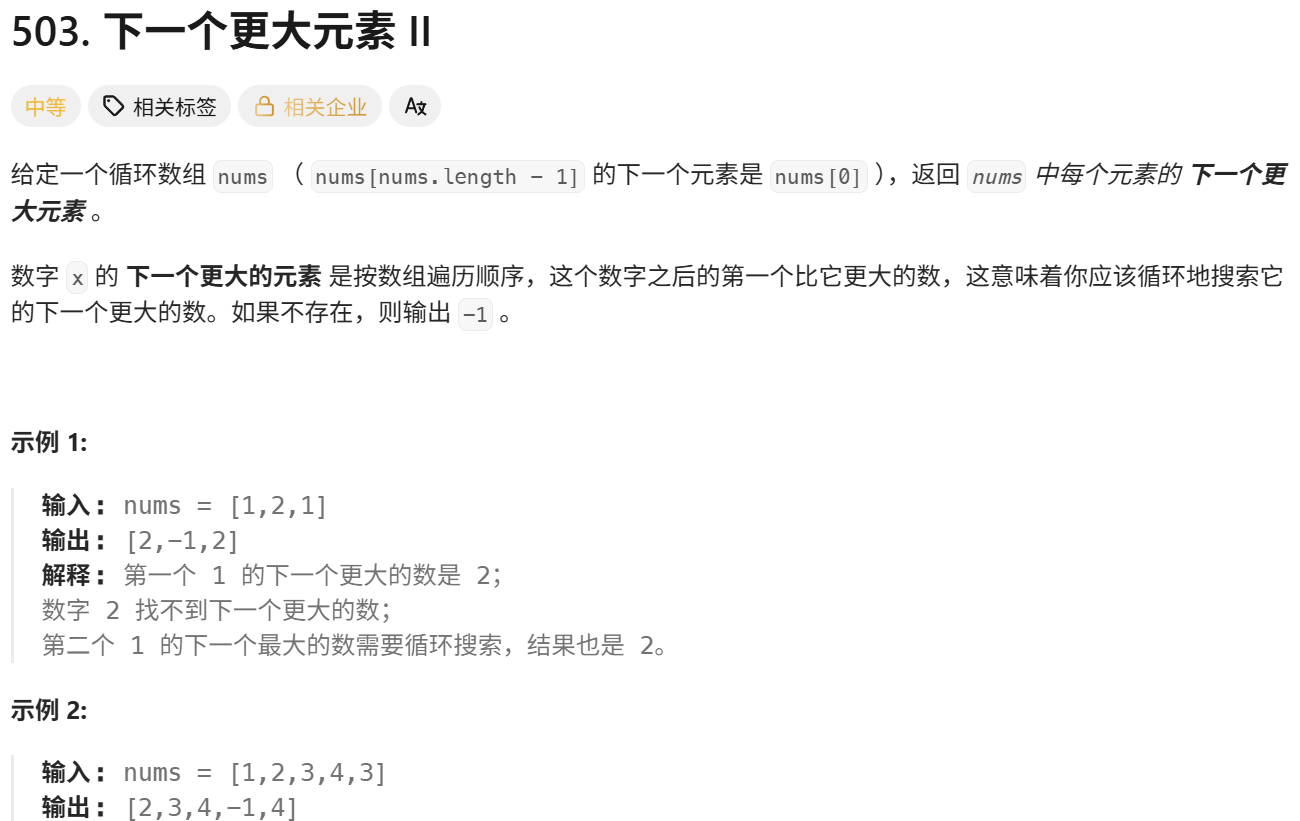
22. 下一个更大元素(下一个更大元素① & ②)
|------------------------------------------------------------------------------------------------------------------------------------------------------|---|
| 
 | |
| |
python
# 下一个更大元素①
class Solution(object):
    def nextGreaterElement(self, nums1, nums2):
        m, n = len(nums1), len(nums2)
        res = [0] * m
        for i in range(m):
            j = nums2.index(nums1[i])
            k = j + 1
            while k < n and nums2[k] < nums2[j]:
                k += 1
            res[i] = nums2[k] if k < n else -1
        return res
# 下一个更大元素②
class Solution(object):
    def nextGreaterElements(self, nums):
        n = len(nums)
        res = [-1] * n
        stk = list()
        for i in range(n * 2 - 1):
            while stk and nums[stk[-1]] < nums[i % n]:
                res[stk.pop()] = nums[i % n]
            stk.append(i % n)
        resurn res