1. 从零开始:如何用 Python 创建你的第一个 MCP(Model Context Protocol)
1.1 什么是 MCP?
Model Context Protocol (MCP) 是一个标准化协议,允许应用程序与大语言模型(LLM)进行安全、结构化的交互。通过 MCP,你可以:
- 为 LLM 提供自定义工具和资源
- 实现 LLM 和外部系统的无缝集成
- 构建可复用的、模块化的 AI 应用
1.2 核心概念
1.2.1 MCP Server(服务器)
定义工具、资源和提示词,通过 stdio 或其他传输方式提供给客户端。
1.2.2 MCP Client(客户端)
连接到 MCP 服务器,获取工具列表,调用工具,并与 LLM 集成。
1.2.3 Tools(工具)
服务器暴露给 LLM 的可调用函数,LLM 可以根据用户需求调用这些工具。
1.3 项目结构
hello-world/
├── server.py           # MCP 服务器定义
├── client-deepseek.py  # 使用 Deepseek LLM 的客户端
├── client.py           # 基础客户端
├── pyproject.toml      # 项目配置
└── uv.lock            # 依赖锁定文件
2. 第一步:创建 MCP 服务器
2.1 安装依赖
0
bash
cd hello-world
UV_INDEX_URL=https://mirrors.aliyun.com/pypi/simple/ uv sync
主要依赖:
mcp[cli]>=1.6.0- MCP 框架openai>=1.75.0- OpenAI 兼容的 LLM 客户端python-dotenv>=1.1.0- 环境变量管理
2.2 编写 Server 端代码
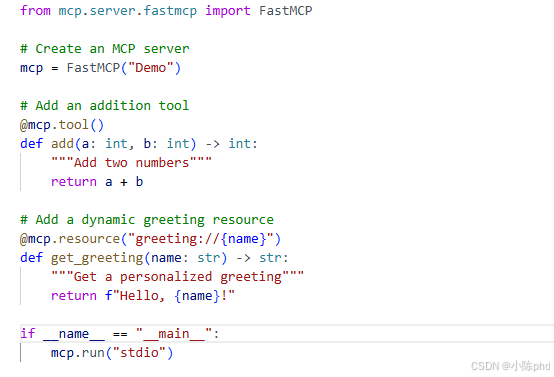
创建 server.py:
python
from mcp.server.fastmcp import FastMCP

# 创建一个 MCP 服务器实例
mcp = FastMCP("Demo")

# 定义一个工具:两数相加
@mcp.tool()
def add(a: int, b: int) -> int:
    """Add two numbers"""
    return a + b

# 定义一个资源:个性化问候
@mcp.resource("greeting://{name}")
def get_greeting(name: str) -> str:
    """Get a personalized greeting"""
    return f"Hello, {name}!"

# 启动服务器
if __name__ == "__main__":
    mcp.run("stdio")
核心概念解析:
- FastMCP - 简化的 MCP 服务器框架
- @mcp.tool() - 装饰器定义工具函数
- @mcp.resource() - 装饰器定义资源(带 URI 模式)
- mcp.run("stdio") - 通过标准输入输出运行服务器
3. 第二步:创建 MCP 客户端
3.1 基础客户端(无 LLM)
client.py 展示了如何直接调用工具:
python
import sys
import asyncio
from mcp import ClientSession
from mcp.client.stdio import stdio_client, StdioServerParameters

async def main():
    # 1. 启动 MCP 服务器进程
    server_script = "server.py"
    params = StdioServerParameters(
        command=sys.executable,
        args=[server_script],
    )
    transport = stdio_client(params)
    stdio, write = await transport.__aenter__()

    # 2. 建立客户端会话
    session = await ClientSession(stdio, write).__aenter__()
    await session.initialize()

    # 3. 调用工具
    result = await session.call_tool("add", {"a": 3, "b": 5})
    print(f"3 + 5 = {result}")

    # 4. 关闭连接
    await session.__aexit__(None, None, None)
    await transport.__aexit__(None, None, None)

if __name__ == "__main__":
    asyncio.run(main())
3.2 与 LLM 集成的客户端
client-deepseek.py 展示了如何让 LLM 自动调用工具:
python
import sys
import asyncio
import os
import json
from mcp import ClientSession
from mcp.client.stdio import stdio_client, StdioServerParameters
from openai import OpenAI
from dotenv import load_dotenv

load_dotenv()

async def main():
    # 1. 连接到 MCP 服务器
    print(">>> 初始化加法 LLM 工具客户端")
    server_script = "server.py"
    params = StdioServerParameters(
        command=sys.executable,
        args=[server_script],
    )
    transport = stdio_client(params)
    stdio, write = await transport.__aenter__()
    session = await ClientSession(stdio, write).__aenter__()
    await session.initialize()
    print(">>> 连接到MCP服务器成功")

    # 2. 初始化 LLM 客户端(使用通义千问)
    client = OpenAI(
        api_key=os.getenv("QWEN_API_KEY"),
        base_url=os.getenv("QWEN_BASE_URL")
    )

    # 3. 从 MCP 服务器获取工具列表
    resp = await session.list_tools()
    tools = [{
        "type": "function",
        "function": {
            "name": tool.name,
            "description": tool.description,
            "parameters": tool.inputSchema
        }
    } for tool in resp.tools]
    print("可用工具:", [t["function"]["name"] for t in tools])

    # 4. 主交互循环
    while True:
        print("\n请输入你的加法问题(如:5加7是多少?或'退出'):")
        user_input = input("> ")
        if user_input.strip().lower() == '退出':
            break

        print(f"\n📝 用户问题: {user_input}")

        # 构造对话
        messages = [
            {"role": "system", "content": "你是一个加法助手,遇到加法问题请调用工具add,最后用自然语言回答用户。"},
            {"role": "user", "content": user_input}
        ]

        # 5. LLM 与工具调用循环
        iteration = 0
        while True:
            iteration += 1
            print(f"\n🔄 第 {iteration} 次 LLM 调用...")

            # 调用 LLM
            response = client.chat.completions.create(
                model="qwen-plus",
                messages=messages,
                tools=tools,
                tool_choice="auto"
            )

            message = response.choices[0].message
            messages.append(message)

            # 检查是否有工具调用
            if not message.tool_calls:
                print(f"\n✅ LLM 最终回答:")
                print(f"\nAI 回答:\n {message.content}")
                break

            # 6. 执行工具调用
            for tool_call in message.tool_calls:
                args = json.loads(tool_call.function.arguments)
                print(f"\n🔧 调用工具: {tool_call.function.name}")
                print(f"📥 工具参数: {args}")

                result = await session.call_tool(tool_call.function.name, args)
                print(f"📤 工具返回结果: {result}")

                # 将工具结果加入对话历史
                messages.append({
                    "role": "tool",
                    "content": str(result),
                    "tool_call_id": tool_call.id
                })

    await session.__aexit__(None, None, None)
    await transport.__aexit__(None, None, None)
    print(">>> 客户端已关闭")

if __name__ == "__main__":
    asyncio.run(main())
4. 第三步:配置环境变量
创建或修改 .env 文件:

env
# 通义千问 API 配置(使用阿里云 DashScope)
QWEN_API_KEY=your-api-key-here
QWEN_BASE_URL=https://dashscope.aliyuncs.com/compatible-mode/v1
5. 第四步:运行程序
5.1 方式一:两个终端分别运行
终端 1:启动服务器
bash
cd 01-hello-world
UV_INDEX_URL=https://mirrors.aliyun.com/pypi/simple/ uv run python server.py
终端 2:运行客户端
bash
cd 01-hello-world
UV_INDEX_URL=https://mirrors.aliyun.com/pypi/simple/ \
QWEN_API_KEY="your-api-key" \
QWEN_BASE_URL="https://dashscope.aliyuncs.com/compatible-mode/v1" \
uv run python client-deepseek.py
5.2 方式二:非交互式测试
bash
cd 01-hello-world
timeout 60 bash -c 'echo -e "15加8等于多少?\n退出" | \
UV_INDEX_URL=https://mirrors.aliyun.com/pypi/simple/ \
QWEN_API_KEY="your-api-key" \
QWEN_BASE_URL="https://dashscope.aliyuncs.com/compatible-mode/v1" \
uv run python client-deepseek.py'
6. 执行流程示例
当用户输入 "15加8等于多少?" 时:
📝 用户问题: 15加8等于多少?

🔄 第 1 次 LLM 调用...

🔧 调用工具: add
📥 工具参数: {'a': 15, 'b': 8}
📤 工具返回结果: meta=None content=[TextContent(type='text', text='23', annotations=None)] isError=False

🔄 第 2 次 LLM 调用...

✅ LLM 最终回答:

AI 回答:
 15加8等于23。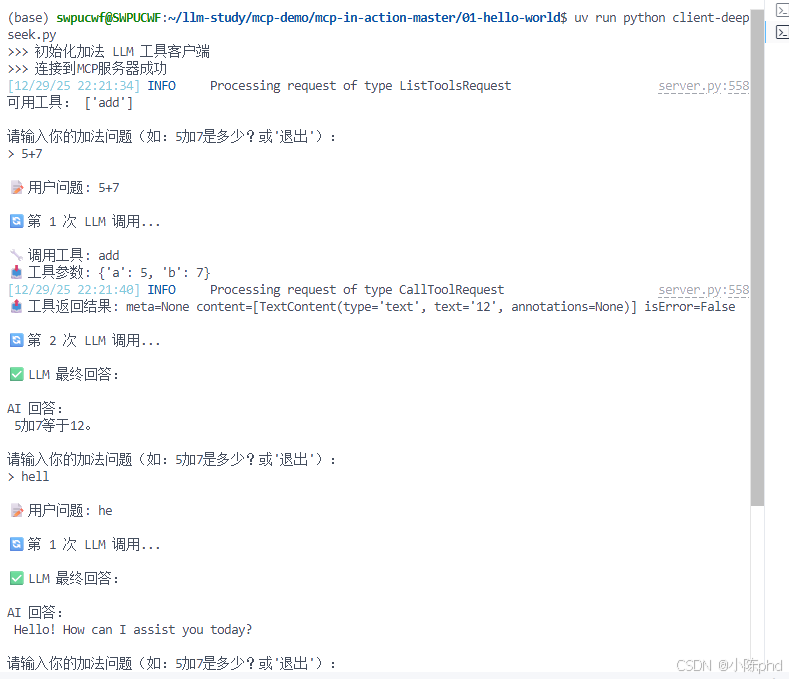
7. 关键要点
7.1 异步编程
MCP 使用 asyncio,所有网络操作都是异步的:
python
async def main():
    # 异步操作
    await session.initialize()
    result = await session.call_tool(...)
7.2 工具定义
简单易用的装饰器风格:
python
@mcp.tool()
def my_tool(param1: int, param2: str) -> str:
    """Tool description"""
    return f"Result: {param1} {param2}"
7.3 工具调用链
LLM 根据需要多次调用工具,直到得到最终答案:
用户输入 → LLM 分析 → 调用工具 → 获得结果 → LLM 再次分析 → 最终回答7.4 消息历史
保持对话历史以便 LLM 理解上下文:
python
messages = [
    {"role": "system", "content": "..."},
    {"role": "user", "content": "..."},
    {"role": "assistant", "content": "..."},
    {"role": "tool", "content": "..."},
]
8. 扩展应用
8.1 添加更多工具
python
@mcp.tool()
def multiply(a: int, b: int) -> int:
    """Multiply two numbers"""
    return a * b

@mcp.tool()
def divide(a: float, b: float) -> float:
    """Divide two numbers"""
    if b == 0:
        raise ValueError("Cannot divide by zero")
    return a / b
8.2 添加资源
python
@mcp.resource("user://{user_id}")
def get_user_info(user_id: str) -> str:
    """Get user information"""
    return f"User {user_id} information"
8.2.1 什么是资源(Resource)?
@mcp.resource() 装饰器用于定义一个可以根据参数返回不同数据的接口。资源是不同于工具的数据取...
资源 vs 工具的对比:
| 特性 | Resource(资源) | Tool(工具) |
|---|---|---|
| 用途 | 提供只读或结构化的数据 | 执行操作或计算 |
| 调用方式 | read_resource("uri://path") |
call_tool("name", args) |
| 参数传递 | URI 路径参数 | 函数参数 |
| 使用场景 | 获取文件、查询数据库 | 计算、修改数据 |
8.2.2 URI 模式详解
python
@mcp.resource("greeting://{name}")
def get_greeting(name: str) -> str:
    """Get a personalized greeting"""
    return f"Hello, {name}!"
语法分解:
| 部分 | 含义 | 说明 |
|---|---|---|
@mcp.resource() |
资源装饰器 | 定义资源的标记 |
"greeting://" |
资源协议(Scheme) | user://、file://、api:// |
{name} |
动态参数占位符 | 类似路由参数,接收不同值 |
get_greeting(name: str) |
处理函数 | 参数名必须与 URI 占位符一致 |
工作流程:
客户端请求 greeting://Alice
         ↓
MCP 框架识别 URI 模式
         ↓
提取参数 name = "Alice"
         ↓
调用函数 get_greeting("Alice")
         ↓
返回 "Hello, Alice!" 给客户端
8.2.3 常见资源示例
示例 1:用户信息资源
python
@mcp.resource("user://{user_id}")
def get_user_info(user_id: str) -> str:
    users = {"1": "Alice", "2": "Bob"}
    return users.get(user_id, "Not found")

# 客户端调用:await session.read_resource("user://1")
# 返回:Alice
示例 2:文件资源(多参数)
python
@mcp.resource("file://{folder}/{filename}")
def read_file(folder: str, filename: str) -> str:
    # 注意:参数名必须与 URI 中的占位符一致
    path = f"{folder}/{filename}"
    try:
        with open(path, 'r') as f:
            return f.read()
    except FileNotFoundError:
        return "File not found"

# 客户端调用:await session.read_resource("file://docs/readme.txt")
# 返回:文件内容
示例 3:API 文档资源
python
@mcp.resource("docs://api/{version}")
def get_api_docs(version: str) -> str:
    docs = {
        "v1": "API v1: 支持基础功能",
        "v2": "API v2: 新增高级功能"
    }
    return docs.get(version, "Version not found")
示例 4:多参数资源
python
@mcp.resource("product://{category}/{product_id}")
def get_product(category: str, product_id: str) -> str:
    # 访问歩骤:product://electronics/12345
    return f"Product {product_id} from {category}"
8.2.4 客户端中使用资源
python
# 方法 1:直接读取资源
result = await session.read_resource("greeting://Alice")
print(result)  # 输出: Hello, Alice!

# 方法 2:列出所有资源
resources = await session.list_resources()
for resource in resources.resources:
    print(f"Resource: {resource.uri} - {resource.description}")
8.2.5 资源 URI 命名最佳实践
✅ 好的设计:
python
@mcp.resource("user://{user_id}")          # 清晨的协议名
@mcp.resource("file://{path}/{filename}") # 多参数路径
@mcp.resource("docs://api/{version}")     # 泊根路径
❌ 避免的做法:
python
@mcp.resource("res://{id}")  # ❌ 不清楚的协议名

@mcp.resource("user://{user_id}")
def get_user(uid: str):  # ❌ 参数名不匹配!
    pass
8.3 自定义 System Prompt
python
system_prompt = """
你是一个数学助手。
当用户问到加法、减法、乘法、除法时,请调用相应的工具。
最后用清晰的中文回答用户的问题。
"""

messages = [
    {"role": "system", "content": system_prompt},
    {"role": "user", "content": user_input}
]
9. 常见问题
9.1 Q1: 如何调试 MCP 服务器?
使用日志输出:
python
import logging
logging.basicConfig(level=logging.DEBUG)
logger = logging.getLogger(__name__)

@mcp.tool()
def my_tool(x: int):
    logger.info(f"Tool called with x={x}")
    return x * 2
9.2 Q2: 如何处理工具调用错误?
python
try:
    result = await session.call_tool(tool_name, args)
except Exception as e:
    print(f"Tool call failed: {e}")
    # 错误恢复逻辑
9.3 Q3: 如何支持多轮对话?
保持 messages 列表,每次交互都添加新消息:
python
while True:
    user_input = input("> ")
    messages.append({"role": "user", "content": user_input})
    # ... 处理响应,添加到 messages ...
10. 性能优化建议
- 连接复用 - 不要频繁创建/销毁连接
- 超时设置 - 为 LLM 调用设置合理超时
- 错误重试 - 实现指数退避重试机制
- 日志级别 - 生产环境减少日志输出
11. 总结
通过 MCP,你可以轻松构建强大的 AI 应用,让 LLM 能够访问和使用自定义工具。核心步骤是:
- 定义工具(Server)
- 连接到服务器(Client)
- 让 LLM 自动调用工具
- 处理工具结果并返回给用户
希望这个教程能帮助你开始 MCP 的学习之旅!