一、概述
-
Completely Fair Scheduler,完全公平调度器,用于Linux系统中普通进程的调度。
-
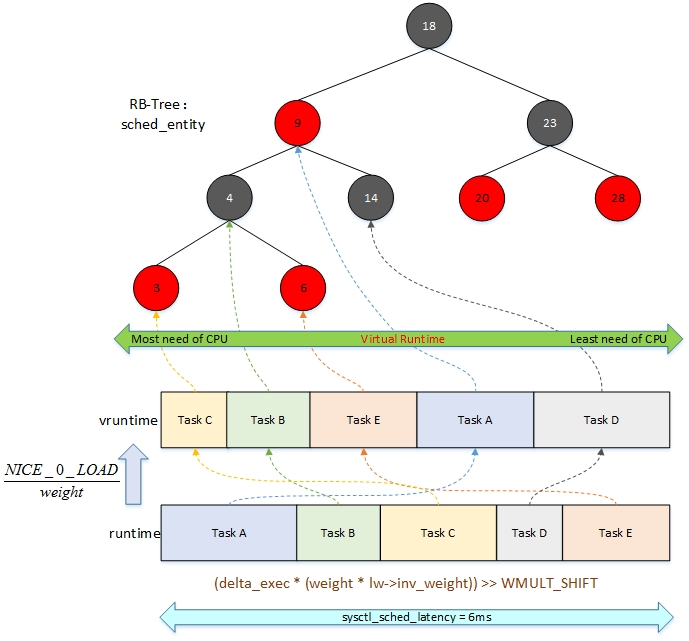
CFS采用了红黑树算法来管理所有的调度实体sched_entity,算法效率为0(log(n))。CFS跟踪调度实体 sched_entity 的虚拟运行时间 Vruntime,平等对待运行队列中的调度实体 sched_entity,将执行时间少的调度实体 sched_entity 排列到红黑树的左边。
-
调度实体 sched_entity 通过 enqueue_entity() 和 dequeue_entity() 来进行红黑树的出队入队。
-
每个 sched_latency 周期内,根据各个任务的权重值,可以计算出运行时间runtime;
-
运行时间runtime可以转换成虚拟运行时间Vruntime;
-
根据虚拟运行时间的大小,插入到CFS红黑树中,虚拟运行时间少的调度实体放置到左边;
-
在下一次任务调度的时候,选择虚拟运行时间少的调度实体来运行。
二、数据结构
调度类
Linux内核抽象了一个调度类 struct sched_class,这是一种典型的面向对象的设计思想,将共性的特征抽象出来封装成类,在实例化各个调度器的时候,可以根据具体的调度算法来实现。这种方法做到了高内聚低耦合,同时又很容易扩展新的调度器。
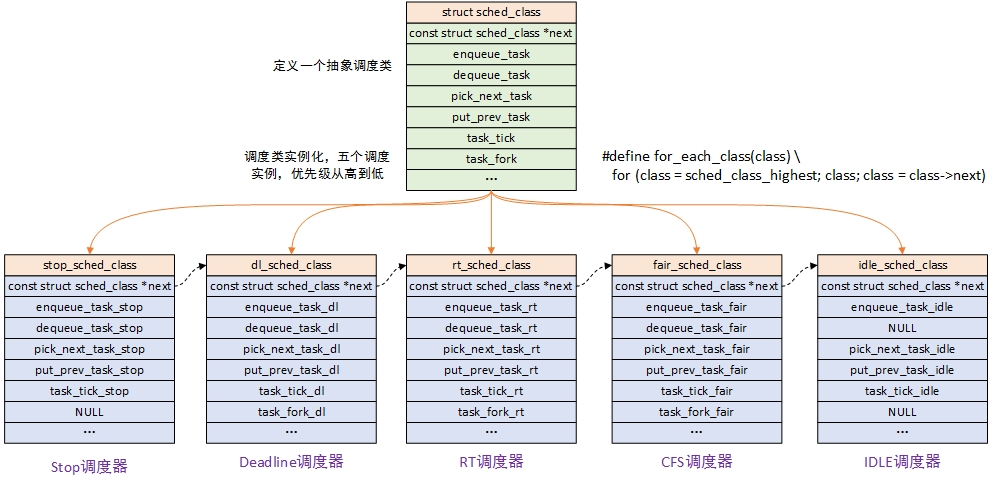
在调度核心代码 kernel/sched/core.c 中,使用的方式是 task->sched_class->xxx_func,其中task表示的是描述任务的结构体 struct task_struct,在该结构体中包含了任务所使用的调度器,进而能找到对应的函数指针来完成调用执行,有点类似于C++中的多态机制。
rq/cfs_rq/task_struct/task_group/sched_entity
-
struct rq:每个CPU都有一个对应的运行队列;
-
struct cfs_rq:CFS运行队列,该结构中包含了 struct rb_root_cached 红黑树,用于链接调度实体 struct sched_entity。rq 运行队列中对应了一个CFS运行队列,此外,在 task_group 结构中也会为每个CPU再维护一个CFS运行队列;
-
struct task_struct:任务的描述符,包含了进程的所有信息,该结构中的 struct sched_entity,用于参与CFS的调度;
-
struct task_group:组调度,Linux支持将任务分组来对CPU资源进行分配管理,该结构中为系统中的每个CPU都分配了 struct sched_entity 调度实体和 struct cfs_rq 运行队列,其中 struct sched_entity 用于参与CFS的调度;
-
struct sched_entity:调度实体,这个也是CFS调度管理的对象了。
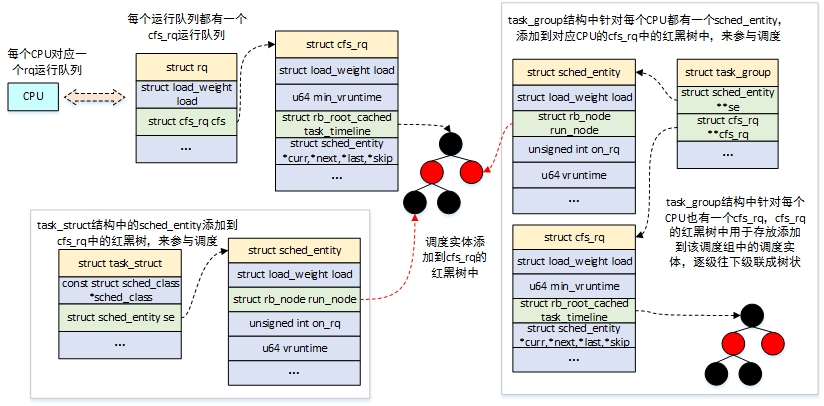
struct sched_entity 结构体字段注释如下:
cpp
struct sched_entity {
        /* For load-balancing: */
        struct load_weight                load;                   //调度实体的负载权重值
        struct rb_node                        run_node;             //用于连接到CFS运行队列的红黑树中的节点
        struct list_head                group_node;          //用于连接到CFS运行队列的cfs_tasks链表中的节点
        unsigned int                        on_rq;              //用于表示是否在运行队列中

        u64                                exec_start;             //当前调度实体的开始执行时间
        u64                                sum_exec_runtime;   //调度实体执行的总时间
        u64                                vruntime;           //虚拟运行时间,这个时间用于在CFS运行队列中排队
        u64                                prev_sum_exec_runtime;  //上一个调度实体运行的总时间

        u64                                nr_migrations;      //负载均衡

        struct sched_statistics                statistics;     //统计信息

#ifdef CONFIG_FAIR_GROUP_SCHED
        int                                depth;      //任务组的深度,其中根任务组的深度为0,逐级往下增加
        struct sched_entity                *parent;        //指向调度实体的父对象
        /* rq on which this entity is (to be) queued: */
        struct cfs_rq                        *cfs_rq;        //指向调度实体归属的CFS队列,也就是需要入列的CFS队列
        /* rq "owned" by this entity/group: */
        struct cfs_rq                        *my_q;      //指向归属于当前调度实体的CFS队列,用于包含子任务或子的任务组
#endif

#ifdef CONFIG_SMP
        /*
         * Per entity load average tracking.
         *
         * Put into separate cache line so it does not
         * collide with read-mostly values above.
         */
        struct sched_avg                avg ____cacheline_aligned_in_smp;   //用于调度实体的负载计算(`PELT`)
#endif
};
struct cfs_rq 结构体的关键字段:
cpp
/* CFS-related fields in a runqueue */
struct cfs_rq {
        struct load_weight load;        //CFS运行队列的负载权重值
        unsigned int nr_running, h_nr_running;  //nr_running:运行的调度实体数(参与时间片计算)

        u64 exec_clock;     //运行时间
        u64 min_vruntime;   //最少的虚拟运行时间,调度实体入队出队时需要进行增减处理
#ifndef CONFIG_64BIT
        u64 min_vruntime_copy;
#endif

        struct rb_root_cached tasks_timeline;   //红黑树,用于存放调度实体

        /*
         * 'curr' points to currently running entity on this cfs_rq.
         * It is set to NULL otherwise (i.e when none are currently running).
         */
        struct sched_entity *curr, *next, *last, *skip; //分别指向当前运行的调度实体、下一个调度的调度实体、CFS运行队列中排最后的调度实体、跳过运行的调度实体

#ifdef        CONFIG_SCHED_DEBUG
        unsigned int nr_spread_over;
#endif

#ifdef CONFIG_SMP
        /*
         * CFS load tracking
         */
        struct sched_avg avg;       //计算负载相关
        u64 runnable_load_sum;
        unsigned long runnable_load_avg;        //基于PELT的可运行平均负载
#ifdef CONFIG_FAIR_GROUP_SCHED
        unsigned long tg_load_avg_contrib;      //任务组的负载贡献
        unsigned long propagate_avg;
#endif
        atomic_long_t removed_load_avg, removed_util_avg;
#ifndef CONFIG_64BIT
        u64 load_last_update_time_copy;
#endif

#ifdef CONFIG_FAIR_GROUP_SCHED
        /*
         *   h_load = weight * f(tg)
         *
         * Where f(tg) is the recursive weight fraction assigned to
         * this group.
         */
        unsigned long h_load;
        u64 last_h_load_update;
        struct sched_entity *h_load_next;
#endif /* CONFIG_FAIR_GROUP_SCHED */
#endif /* CONFIG_SMP */

#ifdef CONFIG_FAIR_GROUP_SCHED
        struct rq *rq;        /* cpu runqueue to which this cfs_rq is attached */     //指向CFS运行队列所属的CPU RQ运行队列

        /*
         * leaf cfs_rqs are those that hold tasks (lowest schedulable entity in
         * a hierarchy). Non-leaf lrqs hold other higher schedulable entities
         * (like users, containers etc.)
         *
         * leaf_cfs_rq_list ties together list of leaf cfs_rq's in a cpu. This
         * list is used during load balance.
         */
        int on_list;
        struct list_head leaf_cfs_rq_list;
        struct task_group *tg;        /* group that "owns" this runqueue */       //CFS运行队列所属的任务组

#ifdef CONFIG_CFS_BANDWIDTH
        int runtime_enabled;    //CFS运行队列中使用CFS带宽控制
        u64 runtime_expires;    //到期的运行时间
        s64 runtime_remaining;      //剩余的运行时间

        u64 throttled_clock, throttled_clock_task;  //限流时间相关
        u64 throttled_clock_task_time;
        int throttled, throttle_count;      //throttled:限流,throttle_count:CFS运行队列限流次数
        struct list_head throttled_list;    //运行队列限流链表节点,用于添加到cfs_bandwidth结构中的cfttle_cfs_rq链表中
#endif /* CONFIG_CFS_BANDWIDTH */
#endif /* CONFIG_FAIR_GROUP_SCHED */
};
三、流程分析
整个流程分析,围绕着CFS调度类实体:fair_sched_class 中的关键函数来展开:
cpp
/*
 * All the scheduling class methods:
 */
const struct sched_class fair_sched_class = {
        .next                        = &idle_sched_class,
        .enqueue_task                = enqueue_task_fair,
        .dequeue_task                = dequeue_task_fair,
        .yield_task                = yield_task_fair,
        .yield_to_task                = yield_to_task_fair,

        .check_preempt_curr        = check_preempt_wakeup,

        .pick_next_task                = pick_next_task_fair,
        .put_prev_task                = put_prev_task_fair,

#ifdef CONFIG_SMP
        .select_task_rq                = select_task_rq_fair,
        .migrate_task_rq        = migrate_task_rq_fair,

        .rq_online                = rq_online_fair,
        .rq_offline                = rq_offline_fair,

        .task_dead                = task_dead_fair,
        .set_cpus_allowed        = set_cpus_allowed_common,
#endif

        .set_curr_task          = set_curr_task_fair,
        .task_tick                = task_tick_fair,
        .task_fork                = task_fork_fair,

        .prio_changed                = prio_changed_fair,
        .switched_from                = switched_from_fair,
        .switched_to                = switched_to_fair,

        .get_rr_interval        = get_rr_interval_fair,

        .update_curr                = update_curr_fair,

#ifdef CONFIG_FAIR_GROUP_SCHED
        .task_change_group        = task_change_group_fair,
#endif
};
runtime 与 vruntime
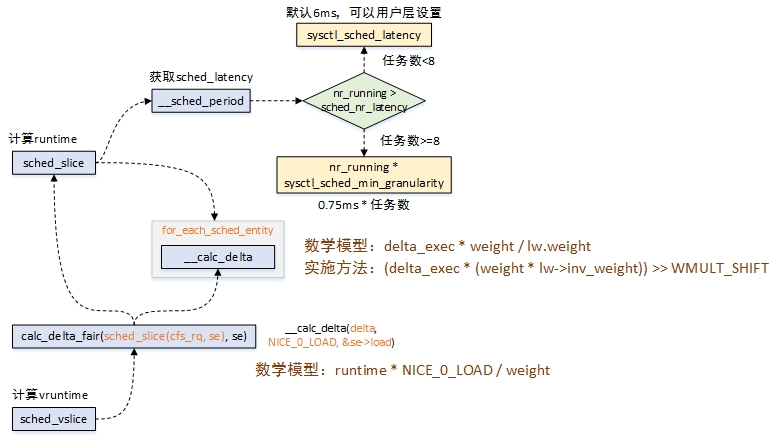
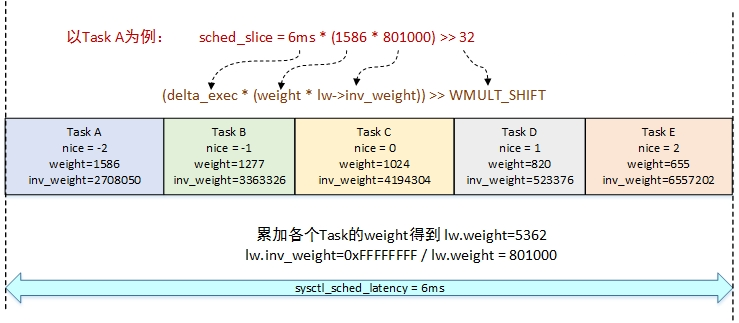
CFS调度器没有时间片的概念,而是根据实际运行时间和虚拟运行时间来对任务进行排序,从而选择调度。运行时间和虚拟运行时间计算如下:
-
Linux内核默认的 sysctl_sched_latency 是6ms,这个值用户态可设。sched_period 用于保证可运行任务都能至少运行一次的时间间隔;
-
当可运行任务大于8个的时候,sched_period 的计算则需要根据任务个数乘以最小调度颗粒值,这个值系统默认为0.75ms;
-
每个任务的运行时间计算,是用 sched_period 值,去乘以该任务在整个CFS运行队列中的权重占比;
-
虚拟运行的时间 = 实际运行时间 * NICE_0_LOAD / 该任务的权重。
还是来看一个实例吧,以5个Task为例,其中每个Task的nice值不一样(优先级不同),对应到的权重值在内核中提供了一个转换数组:
cpp
const int sched_prio_to_weight[40] = {
 /* -20 */     88761,     71755,     56483,     46273,     36291,
 /* -15 */     29154,     23254,     18705,     14949,     11916,
 /* -10 */      9548,      7620,      6100,      4904,      3906,
 /*  -5 */      3121,      2501,      1991,      1586,      1277,
 /*   0 */      1024,       820,       655,       526,       423,
 /*   5 */       335,       272,       215,       172,       137,
 /*  10 */       110,        87,        70,        56,        45,
 /*  15 */        36,        29,        23,        18,        15,
};
CFS调度tick
CFS调度器中的tick函数为 task_tick_fair,系统中每个调度tick都会调用到,此外如果使用了 hrtimer,也会调用到这个函数。
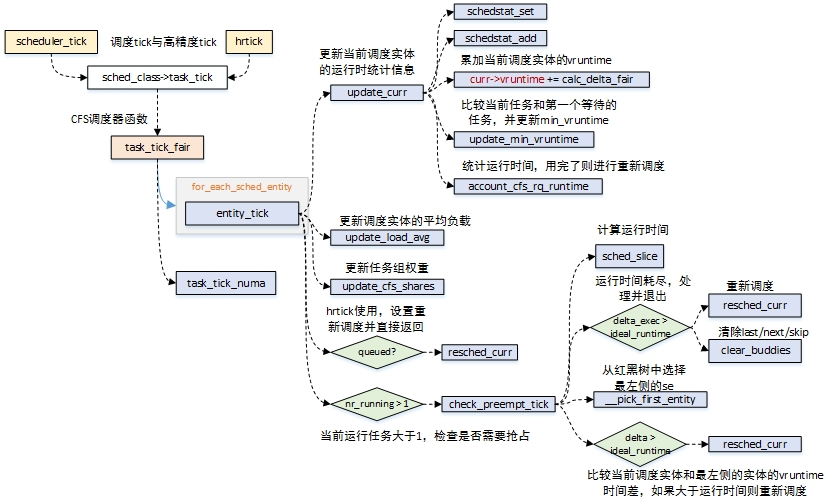
主要的工作包括:
-
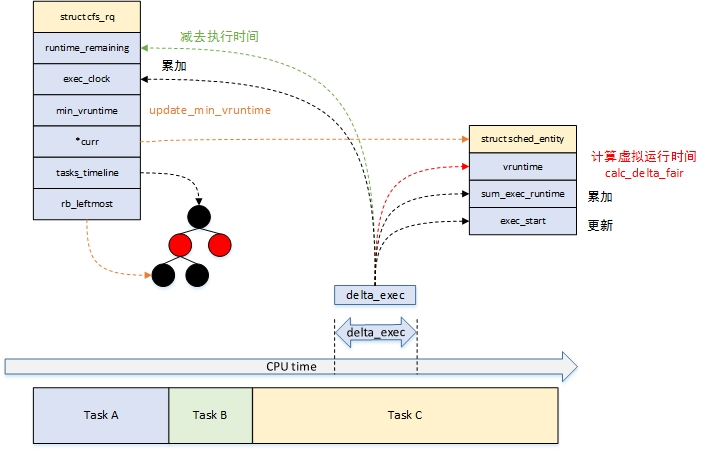
更新运行时的各类系统信息,比如vruntime,运行时间、负载值、权重值等;
-
检查是否需要抢占,主要是比较运行时间是否耗尽,以及vruntime的差值是否大于运行时间等。
任务出队入队
-
当任务进入可运行状态时,需要将调度实体放入到红黑树中,完成入队操作;
-
当任务退出可运行状态时,需要将调度实体从红黑树中移除,完成出队操作;
-
CFS调度器,使用 enqueue_task_fair 函数将任务入队到CFS队列,使用 dequeue_task_fair 函数将任务从CFS队列中出队操作。
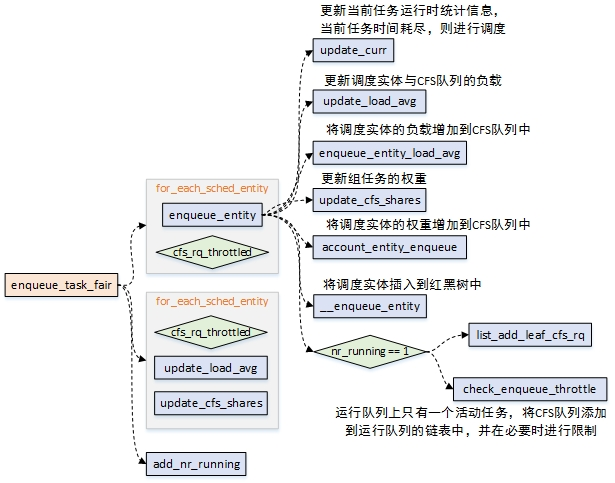
出队与入队的操作中,核心的逻辑可以分成两部分:
-
更新运行时的数据,比如负载、权重、组调度的占比等;
-
将 sched_entity 插入红黑树,或者从红黑树移除。
这个过程中,涉及到 CPU负载计算、task_group 组调度、CFS Bandwidth 带宽控制等。
创建任务
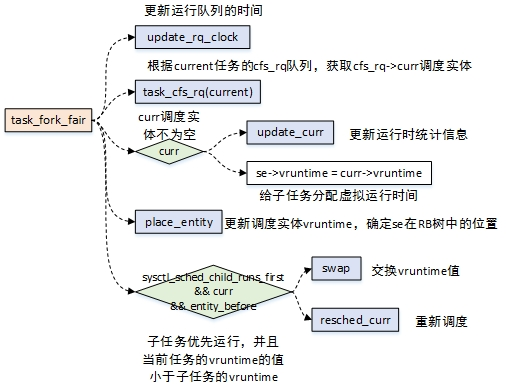
在父进程通过 fork 创建子进程的时候,task_fork_fair 函数会被调用,这个函数的传入参数是子进程的 task_struct。该函数的主要作用,就是确定子任务的 vruntime,因此也能确定子任务的调度实体在红黑树RB中的位置。task_fork_fair 流程如下:
任务选择
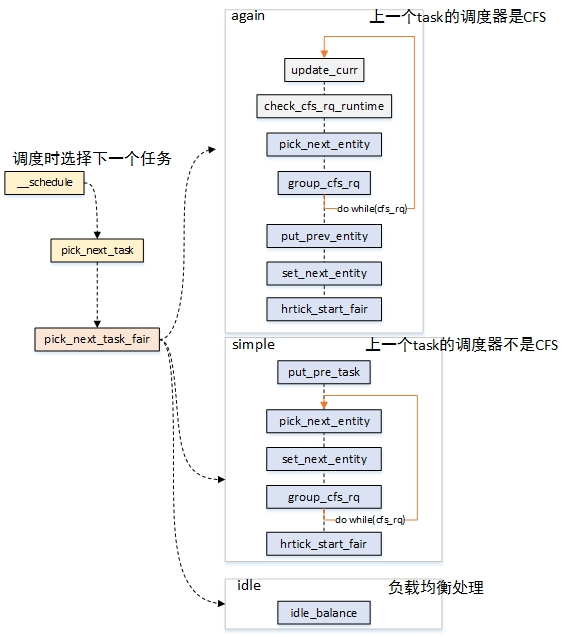
每当进程任务切换的时候,也就是 schedule 函数执行时,调度器都需要选择下一个将要执行的任务。在CFS调度器中,是通过 pick_next_task_fair 函数完成:
-
当需要进程任务切换的时候,pick_next_task_fair 函数的传入参数中包含了需要被切换出去的任务,也就是 pre_task;
-
当 pre_task 不是普通进程时,也就是调度类不是CFS,那么它就不使用 sched_entity 的调度实体来参数调度,因此会执行simple分支,通过 put_pre_task 函数来通知系统当前的任务需要被切换,而不是通过 put_prev_entity 函数来完成;
-
当 pre_task 是普通进程时,调用 pick_next_entity 来选择下一个执行的任务,这个选择过程实际是有两种情况:当调度实体对应Task时,do while() 遍历一次,当调度实体对应 task_group 时,则需要遍历任务组来选择下一个执行的任务了;
-
put_prev_entity,用于切换任务前的准备工作,更新运行时的统计数据,并不进行dequeue的操作,其中需要将CFS队列的curr指针置位成NULL;
-
set_next_entity,用于设置下一个要运行的调度实体,设置CFS队列的curr指针;
-
如果使能了hrtimer,则将hrtimer的到期时间设置为调度实体的剩余运行时间