本文将指导你如何为 Antigravity 编辑器安装全局 Skills(技能),特别是强大的 ui-ux-pro-max 设计系统,并演示如何在具体项目中调用它们。
1. 核心概念
在 Antigravity 中,技能系统分为两层:
- Skills (全局库) :实际的代码、脚本和指南,存储在系统级目录(如
~/.gemini/antigravity/skills)。它们是"能力"的本体。 - Workflows (项目级) :存储在项目根目录的
.agent/workflows中。它们是"遥控器",定义了如何在当前项目中调用全局的 Skills。
这种分离设计确保了你的项目代码库保持轻量,同时又能复用强大的全局能力。
2. 全局安装 Skills
2.1 准备目录
首先,确保全局 Skills 目录存在。Antigravity 通常使用以下路径:
bash
mkdir -p ~/.gemini/antigravity/skills
cd ~/.gemini/antigravity/skills
2.2 安装 Anthropic 官方 Skills
这是基础技能库,包含前端设计、文档编写、测试等通用能力。
bash
git clone https://github.com/anthropics/skills.git
# 此时目录结构应为 ~/.gemini/antigravity/skills/skills/...
2.3 安装 UI-UX-Pro-Max
这是进阶的前端设计技能,包含智能配色、排版和反模式检查。
bash
git clone https://github.com/nextlevelbuilder/ui-ux-pro-max-skill.git
# 此时目录结构应为 ~/.gemini/antigravity/skills/ui-ux-pro-max-skill/...
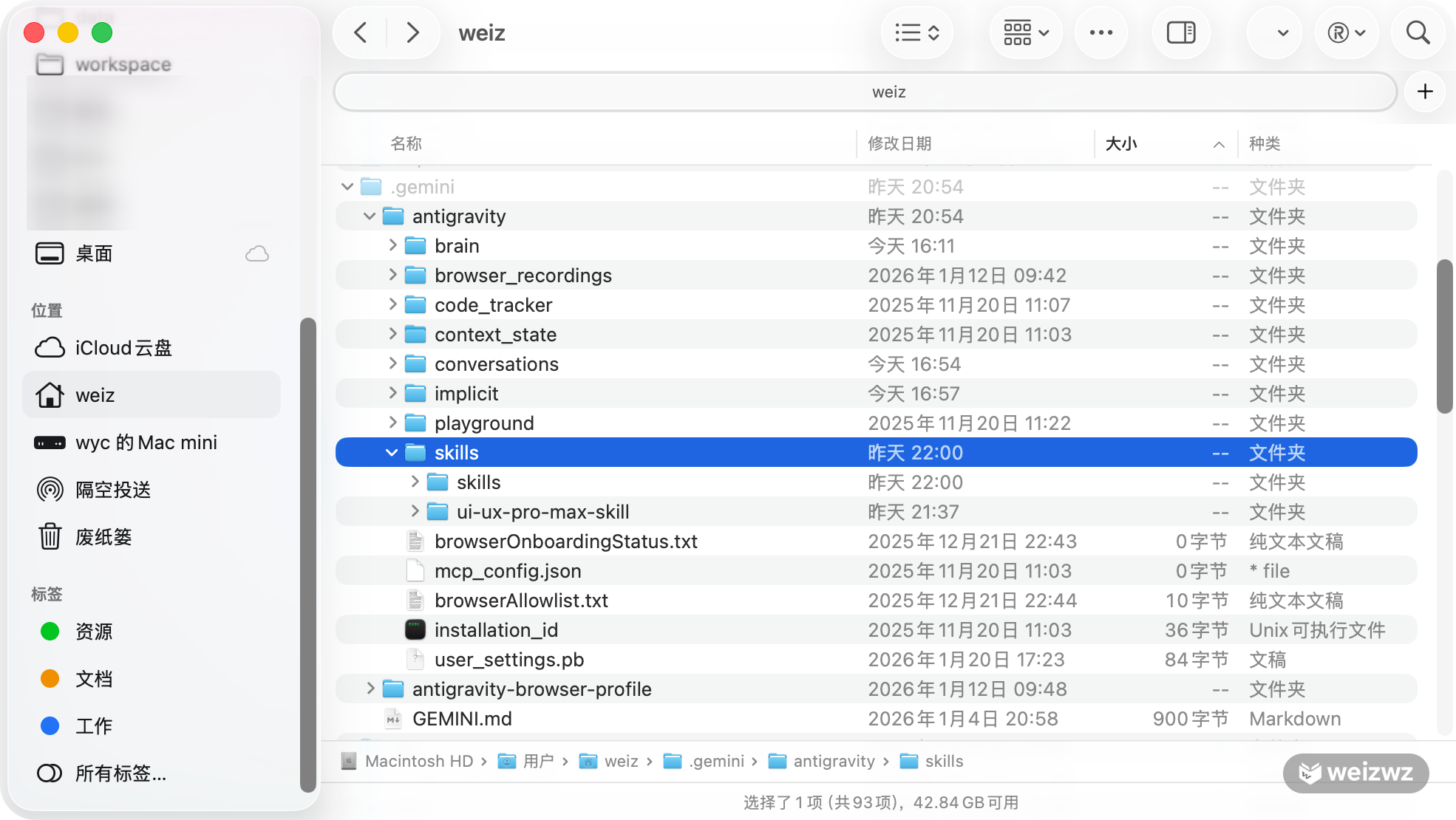
全部安装完成后,目录如下:
3. 项目级配置 (Workflows)
要在某个项目中使用这些技能,你需要创建 Workflow 文件。建议将 .agent/ 添加到 .gitignore 中,以免污染代码库。
3.1 配置 UI-UX-Pro-Max
在项目根目录下创建 .agent/workflows/ui-ux-pro-max.md:
markdown
---
description: Generate a professional design system using UI UX Pro Max skill.
---

# UI UX Pro Max Workflow

This workflow uses the globally installed `ui-ux-pro-max-skill` to generate a comprehensive design system and implementation guidelines.

## 1. Identify Requirements

- **Query**: What is the user trying to build? (e.g., "SaaS landing page", "Crypto dashboard").
- **Stack**: What is the tech stack? (Default: `vue` or `html-tailwind` based on project).

## 2. Generate Design System

- Run the search script to generate the design system.
- **Command**:
  ```bash
  python3 /Users/weiz/.gemini/antigravity/skills/ui-ux-pro-max-skill/src/ui-ux-pro-max/scripts/search.py "[User Query]" --design-system --format markdown --stack vue
  ```
  _(Replace `[User Query]` with the actual request)_

## 3. Apply Design

- Read the output from the script.
- Use the generated colors, typography, and patterns to implement the user's request.
- **Critical**: Follow the "Anti-patterns" section to avoid generic AI mistakes.
3.2 配置通用 Skills (如 Frontend Design)
创建 .agent/workflows/frontend-design.md:
markdown
---
description: Apply the frontend-design skill to create distinctive interfaces.
---

# Frontend Design Workflow

This workflow guides the creation of distinctive, production-grade frontend interfaces, avoiding generic "AI aesthetics".

## 1. Analyze Requirements

- **Context**: Understand the user's request (component, page, app).
- **Goal**: Identify the problem to solve and the target audience.

## 2. Adopt Design Persona

- **Tone**: Choose a bold aesthetic (e.g., Brutalist, Glassmorphism, Neobrutalism, Minimalist Luxury).
- **Differentiation**: What makes this design unforgettable?
- **Constraint**: Respect technical constraints (Vue/VitePress in this project).

## 3. Aesthetic Guidelines (The "Pro Max" Standard)

- **Typography**: Use distinctive font weights and tracking. Avoid generic system font stacks if possible, or style them uniquely.
- **Color**: Use cohesive, bold palettes. High contrast or subtle sophisticated gradients.
- **Motion**:
  - Use `transition-all duration-xxx` for smooth state changes.
  - Add entrance animations (e.g., `animate-fade-in`).
  - Micro-interactions on hover/active states.
- **Composition**:
  - Use generous negative space.
  - Break the grid where appropriate.
  - Use depth (shadows, layers, blur).
- **Details**:
  - Add texture (noise, gradients).
  - Custom cursors or scrollbars if appropriate.
  - Glassmorphism (`backdrop-blur`, `bg-opacity`).

## 4. Implementation Steps

1.  **Scaffold**: Create the file structure.
2.  **Style**: Apply Tailwind classes for the chosen aesthetic.
3.  **Interact**: Add Vue logic for state and animations.
4.  **Refine**: Review against the "Generic AI" trap. Is it too boring? Add more "juice".

## 5. Review Checklist

- [ ] Is the typography distinct?
- [ ] Are there micro-interactions?
- [ ] Is the layout responsive?
- [ ] Does it feel "Premium"?
3.3 配置技能列表查询
创建 .agent/workflows/list-skills.md:
markdown
---
description: List all available agent skills installed in the global workspace.
---

# List Available Skills (Global)

1.  **Check Global Skills Directory**:
    - List directories in `/Users/weiz/.gemini/antigravity/skills/skills/skills`.
2.  **Display Skills**:
    - Show the list of available skills to the user.
    - Provide a brief description if possible (by reading `SKILL.md`).

// turbo 3. **Run Command**:
`bash ls /Users/weiz/.gemini/antigravity/skills/skills/skills`
4. 如何在项目中使用
配置完成后,你可以通过 Slash Commands 或 自然语言 来调用这些能力。
场景 A:设计一个高大上的落地页
指令:
/ui-ux-pro-max 为我的 SaaS 产品设计一个落地页,风格要科技感强
Agent 行为:
- Agent 会自动运行全局的 Python 脚本。
- 脚本分析需求,生成一套包含配色(如深空蓝+霓虹绿)、排版(如 Inter + JetBrains Mono)和布局建议的设计系统。
- Agent 读取这些建议,并直接编写 Vue/React 代码实现页面。
场景 B:查看有哪些能力可用
指令:
/list-skills
Agent 行为:
- 列出所有已安装的全局技能包。
场景 C:日常开发辅助
指令:
使用 frontend-design skill 帮我优化这个按钮的交互
Agent 行为:
- Agent 会参考
frontend-design工作流中的"反平庸"指南。 - 它不会只写一个简单的
:hover,而是可能会添加transform: scale(1.05)、光影流光效果或磁吸效果,确保符合"Pro Max"标准。
5. 总结
通过这种 全局存储 + 本地引用 的方式,你可以:
- 节省空间:不需要在每个项目中重复下载几百 MB 的技能文件。
- 保持整洁:项目代码库中只有轻量级的 Workflow 配置文件。
- 能力复用:一次安装,所有项目受益。