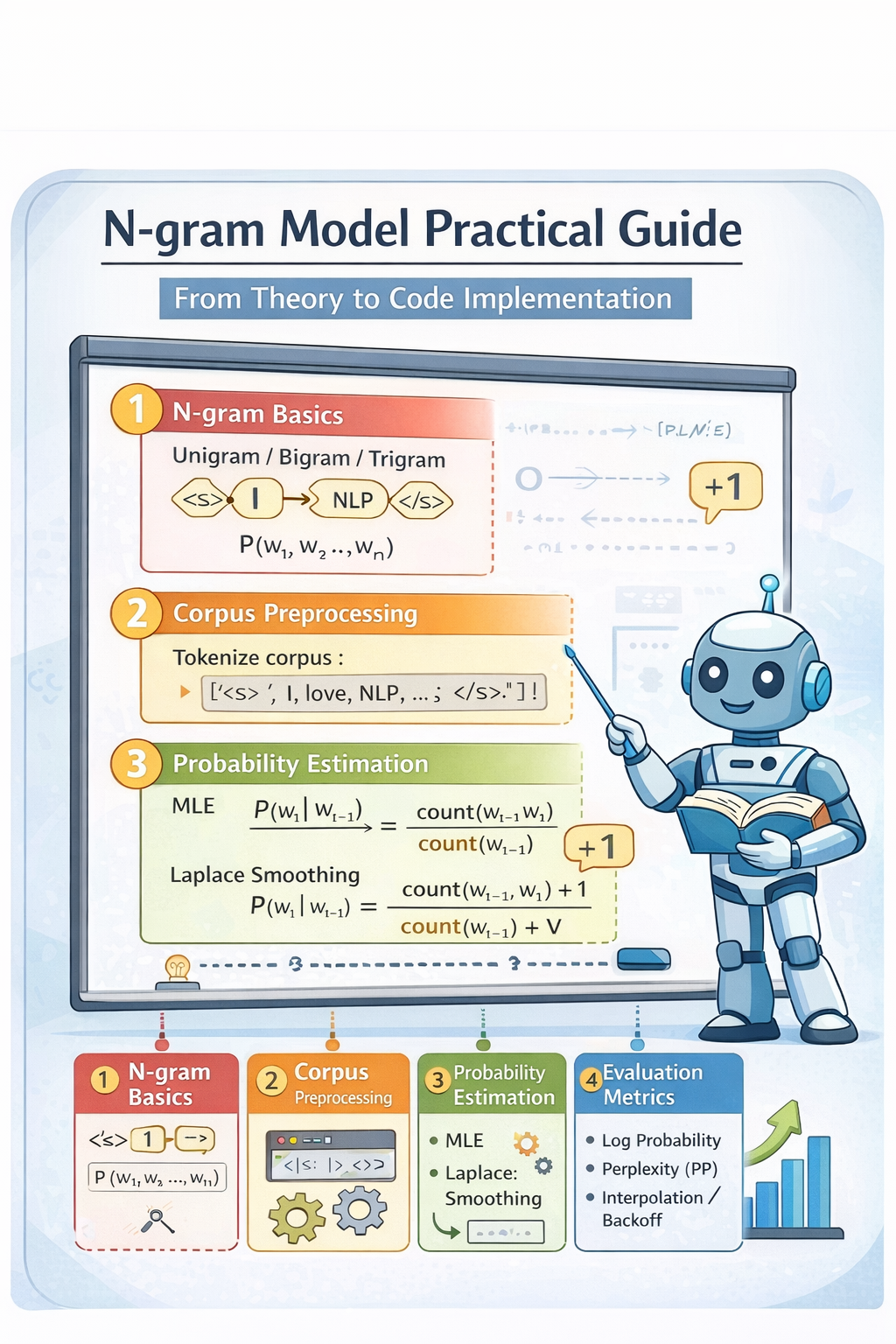
本文是一篇偏教学风格的 N-gram 实战技术博客,结合完整 Python 代码,逐步讲解:
- 什么是 N-gram
- 如何构建 Unigram / Bigram / Trigram
- 如何计算语言模型概率
- 什么是拉普拉斯平滑(Laplace Smoothing)
- 如何评估一句话的概率
第一章:N-gram 语言模型基础
1.1 什么是语言模型?
在自然语言处理中,我们希望估计一句话出现的概率有多大 :
P ( w 1 , w 2 , ... , w n ) P(w_1, w_2, \dots, w_n) P(w1,w2,...,wn)
其中, w i w_i wi表示句子中的第 i i i个词。
-
语言模型的核心任务是:判断一句话在自然语言中出现的合理性。
然而,真实语言存在复杂的长距离依赖关系,例如
"The book that I bought yesterday is interesting. -
因此,要精确建模这种依赖几乎不可行,因此需要对问题进行简化。
1.2 链式法则与概率分解
根据概率的链式法则(Chain Rule):
P ( w 1 , w 2 , ... , w n ) = ∏ i = 1 n P ( w i ∣ w 1 , ... , w i − 1 ) P(w_1, w_2, \dots, w_n) = \prod_{i=1}^{n} P(w_i \mid w_1, \dots, w_{i-1}) P(w1,w2,...,wn)=i=1∏nP(wi∣w1,...,wi−1)
这个公式是语言模型的数学基础, 但该公式的条件概率依赖历史所有词,参数规模指数级增长,无法直接估计。
1.3 马尔可夫假设与 N-gram 模型
为降低建模复杂度,引入 马尔可夫假设(Markov Assumption) :当前词只依赖前 N − 1 N-1 N−1个词。
于是得到 N-gram 语言模型:
-
Unigram :只考虑当前词
P ( w i ) P(w_i) P(wi) -
Bigram :只依赖前 1 个词
P ( w i ∣ w i − 1 ) P(w_i \mid w_{i-1}) P(wi∣wi−1) -
Trigram :只依赖前 2 个词
P ( w i ∣ w i − 2 , w i − 1 ) P(w_i \mid w_{i-2}, w_{i-1}) P(wi∣wi−2,wi−1)N-gram 模型的核心思想是:用局部上下文近似全局语言依赖关系。
1.4 N-gram 模型的直观理解
以 Bigram 为例,句子概率可以近似为:
P ( w 1 , ... , w n ) ≈ ∏ i = 2 n P ( w i ∣ w i − 1 ) P(w_1, \dots, w_n) \approx \prod_{i=2}^{n} P(w_i \mid w_{i-1}) P(w1,...,wn)≈i=2∏nP(wi∣wi−1)
即一句话的概率 = 相邻词对概率的连乘。
例如,对于<s> I love language models </s>
对应 Bigram:
(<s>, I)
(I, love)
(love, language)
(language, models)
(models, </s>) 模型通过统计这些词对的频率来学习语言规律。
第二章:语料预处理与分词
2.1 分词与句子边界标记
语言模型必须知道句子的起始与终止位置,因此需要加入边界标记:
python
from nltk.tokenize import word_tokenize

def tokenize_with_boundaries(sentence):
    tokens = word_tokenize(sentence)
return ["<s>"] + tokens + ["</s>"] 其中,<s> 表示句子开始,</s> 表示句子结束
这样模型可以学习:
P ( w 1 ∣ < s > ) , P ( < / s > ∣ w n ) P(w_1 \mid <s>), P(</s> \mid w_n) P(w1∣<s>),P(</s>∣wn)
2.2 构建语料分词结果
python
def tokenize_corpus(corpus):
    tokenized_corpus = [tokenize_with_boundaries(s) for s in corpus]
return tokenized_corpus 例如:
bash
I love natural language processing. 被转换为:
bash
<s> I love natural language processing . </s>第三章:N-gram 统计建模
本章介绍如何从语料中构建 Unigram、Bigram 和 Trigram 的频次统计,这是语言模型概率估计的基础。
3.1 Unigram 统计
python
from collections import Counter

def build_unigram(tokenized_corpus):
    unigram_counts = Counter()
    for tokens in tokenized_corpus:
        unigram_counts.update(tokens)
    return unigram_counts
(1) 数学定义
- Unigram 的统计量定义为: count ( w ) \text{count}(w) count(w)
表示词 w w w在整个语料中的出现次数。
- 对应的概率估计为:
P ( w ) = c o u n t ( w ) ∑ w ′ c o u n t ( w ′ ) P(w) = \frac{count(w)}{\sum_{w'} count(w')} P(w)=∑w′count(w′)count(w)
即词的经验频率估计(Maximum Likelihood Estimation, MLE)。
(2) 理论说明
Unigram 模型假设每个词是独立生成的,与上下文无关。
因此句子概率为:
P ( w 1 , ... , w n ) = ∏ i = 1 n P ( w i ) P(w_1, \dots, w_n) = \prod_{i=1}^{n} P(w_i) P(w1,...,wn)=i=1∏nP(wi)
该假设显然过于简单,但 Unigram 是所有语言模型的基础统计单元。
3.2 Bigram 统计
python
from collections import Counter

def build_bigram(tokenized_corpus):
    bigram_counts = Counter()
    for tokens in tokenized_corpus:
        bigram_counts.update(ngrams(tokens, 2))
return bigram_counts 例如,对于句子<s> I love language models </s>
Bigram 序列为:
bash
(<s>, I)
(I, love)
(love, language)
(language, models)
(models, </s>)
(1) 数学定义
Bigram 定义为连续两个词的组合:
( w i − 1 , w i ) (w_{i-1}, w_i) (wi−1,wi)
统计量为:
count ( w i − 1 , w i ) \text{count}(w_{i−1}, w_{i}) count(wi−1,wi)
条件概率估计公式为:
P ( w i ∣ w i − 1 ) = count ( w i − 1 , w i ) count ( w i − 1 ) P(w_i \mid w_{i−1})= \frac{\text{count}(w_{i-1}, w_i)}{\text{count}(w_{i−1})} P(wi∣wi−1)=count(wi−1)count(wi−1,wi)
(2) 理论说明
Bigram 模型假设当前词只依赖前一个词。
因此句子概率近似为:
P ( w 1 , ... , w n ) ≈ ∏ i = 2 n P ( w i ∣ w i − 1 ) P(w_1, \dots, w_n) \approx \prod_{i=2}^{n} P(w_i \mid w_{i-1}) P(w1,...,wn)≈i=2∏nP(wi∣wi−1)
这比 Unigram 模型捕捉了局部上下文信息。
3.3 Trigram 统计
python
from collections import Counter

def build_trigram(tokenized_corpus):
    trigram_counts = Counter()
    for tokens in tokenized_corpus:
        trigram_counts.update(ngrams(tokens, 3))
    return trigram_counts
(1) 数学定义
Trigram 定义为连续三个词的组合:
( w i − 2 , w i − 1 , w i ) (w_{i-2}, w_{i-1}, w_i) (wi−2,wi−1,wi)
条件概率估计为:
P ( w i ∣ w i − 2 , w i − 1 ) = count ( w i − 2 , w i − 1 , w i ) count ( w i − 2 , w i − 1 ) P(w_i \mid w_{i-2}, w_{i-1}) = \frac{\text{count}(w_{i-2}, w_{i-1}, w_i)}{\text{count}(w_{i-2}, w_{i-1})} P(wi∣wi−2,wi−1)=count(wi−2,wi−1)count(wi−2,wi−1,wi)
(2) 理论说明
Trigram 模型假设当前词依赖前两个词。
例如对于("New", "York", "City"),Trigram 能区分New York City和New York Times,这种能力是 Bigram 无法完全捕捉的。
3.4 小结
- Unigram 统计词频,用于估计词的先验概率
- Bigram/Trigram 建模上下文条件概率
- N N N越大,语言模型表达能力越强,但稀疏性与参数规模爆炸,这直接导致必须引入 平滑技术(Smoothing)
第四章:稀疏性问题与拉普拉斯平滑
4.1 数据稀疏问题
Zero Probability Problem
随着 N N N增大,参数空间呈指数级增长。
- 设词表大小为 V V V,则:
| 模型 | 参数规模 |
|---|---|
| Unigram | O ( V ) O(V) O(V) |
| Bigram | O ( V 2 ) O(V^2) O(V2) |
| Trigram | O ( V 3 ) O(V^3) O(V3) |
例如,若 V = 50 , 000 V = 50,000 V=50,000,Bigram 参数量 ≈ 2.5 × 10 9 2.5 \times 10^{9} 2.5×10⁹,Trigram 参数量 ≈ 1.25 × 10 14 1.25 \times 10^{14} 1.25×10¹⁴
几乎所有 n-gram 在语料中不会出现,导致概率为 0 ,这就是 数据稀疏性问题(Data Sparsity)。
4.2 拉普拉斯平滑(Laplace Smoothing)
为解决零概率问题,引入加一平滑(Add-One Smoothing)。
(1) 理论说明
拉普拉斯平滑的数学公式:
P ( w i ∣ w i − 1 ) = c o u n t ( w i − 1 , w i ) + 1 c o u n t ( w i − 1 ) + V P(w_i \mid w_{i-1}) = \frac{count(w_{i-1}, w_i) + 1}{count(w_{i-1}) + V} P(wi∣wi−1)=count(wi−1)+Vcount(wi−1,wi)+1
其中, V V V是词表大小(Vocabulary Size)
拉普拉斯平滑假设每个可能的词组合至少出现过一次(虚拟观测)。
因此,未出现的 n-gram 不再概率为 0。所有概率重新归一化
(2) 拉普拉斯平滑代码实现
python
def bigram_laplace_prob(w1, w2, bigram_counts, unigram_counts, V):
    """
    P(w2 | w1) = (count(w1,w2) + 1) / (count(w1) + V)
    """
    count_w1 = unigram_counts.get(w1, 0)
    count_bigram = bigram_counts.get((w1, w2), 0)
return (count_bigram + 1) / (count_w1 + V)-
代码对应数学公式
代码变量 数学符号 含义 count_bigram (count(w_{i-1}, w_i)) bigram 频次 count_w1 (count(w_{i-1})) 上下文频次 V (V) 词表大小
(3) Laplace 平滑的统计学解释
从贝叶斯角度,拉普拉斯平滑等价于对多项式分布使用 Dirichlet(1) 先验:
P ( θ ) ∼ D i r i c h l e t ( 1 , 1 , ... , 1 ) P(\theta) \sim Dirichlet(1,1,\dots,1) P(θ)∼Dirichlet(1,1,...,1)
即假设每个词组合先验出现 1 次。
4.3 句子概率的平滑估计
在 Bigram 模型下:
P ( w 1 , ... , w n ) = ∏ i = 2 n P ( w i ∣ w i − 1 ) P(w_1, \dots, w_n) = \prod_{i=2}^{n} P(w_i \mid w_{i-1}) P(w1,...,wn)=i=2∏nP(wi∣wi−1)
加入 Laplace 平滑:
P ( w 1 , ... , w n ) = ∏ i = 2 n c o u n t ( w i − 1 , w i ) + 1 c o u n t ( w i − 1 ) + V P(w_1, \dots, w_n) = \prod_{i=2}^{n} \frac{count(w_{i-1}, w_i) + 1}{count(w_{i-1}) + V} P(w1,...,wn)=i=2∏ncount(wi−1)+Vcount(wi−1,wi)+1
(1) 对应代码实现
python
def sentence_bigram_laplace_prob(tokens, bigram_counts, unigram_counts):
    V = len(unigram_counts)
    total_prob = 1.0

    for w1, w2 in ngrams(tokens, 2):
        p = bigram_laplace_prob(w1, w2, bigram_counts, unigram_counts, V)
        total_prob *= p

    return total_prob
4.4 拉普拉斯平滑缺点
尽管 Laplace 平滑简单,但存在严重问题:
-
对高频事件影响较大
-
对大词表严重过度平滑
-
概率分布被过度均匀化
因此在真实语言模型中几乎不使用。
第五章:语言模型评估与工程实践
本章介绍如何评估 N-gram 模型性能,并给出工程实践中常用指标与改进方法。
5.1 句子对数概率(Log Probability)
在实际计算中,句子概率是多个条件概率的乘积:
P ( w 1 , ... , w n ) = ∏ i = 2 n P ( w i ∣ w i − 1 ) P(w_1, \dots, w_n) = \prod_{i=2}^{n} P(w_i \mid w_{i-1}) P(w1,...,wn)=i=2∏nP(wi∣wi−1)
但每个概率通常远小于 1,直接连乘会导致 数值下溢(Underflow)。
因此实际工程中使用对数概率:
log P ( w 1 , ... , w n ) = ∑ i = 2 n log P ( w i ∣ w i − 1 ) \log P(w_1, \dots, w_n) = \sum_{i=2}^{n} \log P(w_i \mid w_{i-1}) logP(w1,...,wn)=i=2∑nlogP(wi∣wi−1)
- Python 实现
python
import math

def sentence_log_prob(tokens, bigram_counts, unigram_counts):
    V = len(unigram_counts)
    log_prob = 0.0

    for w1, w2 in ngrams(tokens, 2):
        p = bigram_laplace_prob(w1, w2, bigram_counts, unigram_counts, V)
        log_prob += math.log(p)

    return log_prob
5.2 困惑度(Perplexity)
困惑度是语言模型的标准评价指标,用于衡量模型对测试语料的不确定性。
-
定义:
PP ( W ) = exp ( − 1 N ∑ i = 1 N log P ( w i ∣ w i − 1 ) ) \text{PP}(W) = \exp\left(-\frac{1}{N} \sum_{i=1}^{N} \log P(w_i \mid w_{i-1})\right) PP(W)=exp(−N1i=1∑NlogP(wi∣wi−1)) -
直观理解:模型在预测下一个词时平均有多少种"困惑选择"
(1) Python 实现
python
def perplexity(tokens, bigram_counts, unigram_counts):
    N = len(tokens) - 1
    log_prob = sentence_log_prob(tokens, bigram_counts, unigram_counts)
return math.exp(-log_prob / N) 可以看到,这里计算时分母实际为 N − 1 N-1 N−1
设句子:
<s> w_1 w_2 ... w_T </s> 如果 tokens 长度是:
∣ W ∣ = T + 2 |W| = T + 2 ∣W∣=T+2
那么Bigram的数量是:
∣ Bigrams ∣ = ∣ W ∣ − 1 |\text{Bigrams}| = |W| - 1 ∣Bigrams∣=∣W∣−1
因为:
P ( w 1 , ⋯ , w T ) = ∏ t = 2 T P ( w i ∣ w i − 1 ) P(w_1, \cdots, w_T)=\prod_{t=2}^T P(w_i \mid w_{i−1}) P(w1,⋯,wT)=t=2∏TP(wi∣wi−1)
因此条件概率个数为tokens-1。
(2) Perplexity 解释
- PP 越小 → 模型越好
- PP = 1 → 完美预测
- PP ≈ V → 接近随机猜词
5.3 N-gram 模型的局限性
尽管 N-gram 是语言模型的基础,但存在根本缺陷:
(1) 长距离依赖问题
- N 只能捕捉有限上下文
- 无法建模句法与语义结构
(2) 参数爆炸
参数规模: O ( V N ) O(V^N) O(VN)
真实语言任务几乎不可存储。
(3) 数据稀疏问题
- 大多数 n-gram 永远不会出现
- 平滑方法只能缓解,不能根治