sudo apt update
sudo apt install -y build-essential
下载
wget https://www.openssl.org/source/openssl-3.3.0.tar.gz
解压
tar -zxvf openssl-3.3.0.tar.gz
cd openssl-3.3.0
OUT=/home/ubuntu22/ssl/openssl-3.3.0/output
./config --prefix=$OUT/openssl33 \
--openssldir=$OUT/openssl33/etc \
-Wl,-rpath=$OUT/openssl33/lib64
make -j$(nproc)
make install
////////////////////demo1
openssl req -x509 -newkey rsa:2048 -keyout server.key -out server.crt -days 365 -nodes
openssl s_server -accept 4433 -tls1_2 -cert server.crt -key server.key -www
curl -v --insecure https://localhost:4433
////////////////////demo2
curl -v --insecure https://localhost:4433
/////////////////// openssl1.2 demo
openssl s_client -connect www.baidu.com:443 -tls1_2 -servername www.baidu.com -quiet // 打印私钥
////////////
OUT=/home/ubuntu22/ssl/openssl-3.3.0/output
./config --prefix=$OUT/openssl33 \
--openssldir=$OUT/openssl33/etc \
-Wl,-rpath=$OUT/openssl33/lib64 \
-g -O0
make -j4
make install
//////////////////////////
gdb --args output/openssl33/bin/openssl s_client -connect www.baidu.com:443 -tls1_2 -servername www.baidu.com -quiet
b main
r
//////////////////////////
ssl/statem/statem_clnt.c
static int tls_construct_cke_ecdhe(SSL_CONNECTION *s, WPACKET *pkt)
{
unsigned char *encodedPoint = NULL;
size_t encoded_pt_len = 0;
EVP_PKEY *ckey = NULL, *skey = NULL;
int ret = 0;
skey = s->s3.peer_tmp;
if (skey == NULL) {
SSLfatal(s, SSL_AD_INTERNAL_ERROR, ERR_R_INTERNAL_ERROR);
return 0;
}
ckey = ssl_generate_pkey(s, skey);
if (ckey == NULL) {
SSLfatal(s, SSL_AD_INTERNAL_ERROR, ERR_R_SSL_LIB);
goto err;
}
//====================== 打印 P-256 私钥 ======================
{
BIGNUM *priv_bn = NULL;
unsigned char priv_bytes32 = {0};
EVP_PKEY_get_bn_param(ckey, OSSL_PKEY_PARAM_PRIV_KEY, &priv_bn);
if (priv_bn != NULL) {
BN_bn2binpad(priv_bn, priv_bytes, 32);
printf("\n+ TLS 1.2 CLIENT P-256 PRIVATE KEY = ");
for (int i = 0; i < 32; i++)
printf("%02x", priv_bytesi);
printf("\n");
BN_free(priv_bn);
}
}
//===========================================================
// ====================== 打印 客户端 P-256 公钥(发送给server) ======================
encoded_pt_len = EVP_PKEY_get1_encoded_public_key(ckey, &encodedPoint);
if (encoded_pt_len > 0 && encodedPoint != NULL) {
printf("+ TLS 1.2 CLIENT P-256 PUBLIC KEY (send to server) = ");
for (int i = 0; i < encoded_pt_len; i++)
printf("%02x", encodedPointi);
printf("\n");
}
// ==================================================================================
ssl/statem/statem_clnt.c
//publick key
static int tls_process_ske_ecdhe(SSL_CONNECTION *s, PACKET *pkt, EVP_PKEY **pkey)
{
if (EVP_PKEY_set1_encoded_public_key(s->s3.peer_tmp,
PACKET_data(&encoded_pt),
PACKET_remaining(&encoded_pt)) <= 0) {
SSLfatal(s, SSL_AD_ILLEGAL_PARAMETER, SSL_R_BAD_ECPOINT);
return 0;
}
// ====================== 打印 SERVER P-256 公钥 ======================
{
const unsigned char *pub_key_bytes = PACKET_data(&encoded_pt);
size_t pub_key_len = PACKET_remaining(&encoded_pt);
printf("\n+ TLS Server Public Key (P-256) = ");
for (size_t i = 0; i < pub_key_len; i++)
printf("%02x", pub_key_bytesi);
printf("\n");
}
///////////////共享密钥
providers/implementations/kdfs/tls1_prf.c
static int tls1_prf_alg(EVP_MAC_CTX *mdctx, EVP_MAC_CTX *sha1ctx,
const unsigned char *sec, size_t slen,
const unsigned char *seed, size_t seed_len,
unsigned char *out, size_t olen)
{
/* ====================== 打印 1:输入共享密钥 ====================== */
printf("\nTLS PRF Input Secret (共享密钥) - Length: %zu bytes\n", slen);
for (size_t i = 0; i < slen; i++) {
printf("%02x ", seci);
if ((i + 1) % 16 == 0) printf("\n");
}
printf("\n");
output/openssl33/bin/openssl s_client -connect www.baidu.com:443 -tls1_2 -servername www.baidu.com -quiet
+ TLS Server Public Key (P-256) = 04acd64c5f95631566d0f45abb0dfee729336d33b68903189652533bb1eeb2d58378c16fe04daccf0870e89c4beee97d94520da3ebfb579e2992433fe741484700
+ TLS 1.2 CLIENT P-256 PRIVATE KEY = 33c6dac5f402f14921eb7a559172efacb61e8c80cdddc305f8879c16ec68c904
+ TLS 1.2 CLIENT P-256 PUBLIC KEY (send to server) = 04c037222c28c78d19a2780a6102105d073a7fa3dc413d3f2b2675a67bc0f4aa5510b705524438841f86a160833fa336b8944e34e962e72ed4ff9ffb00e3d5abc7
TLS PRF Input Secret (共享密钥) - Length: 32 bytes
43 ef 63 0d e7 3e 2f eb 7f 5b cc d3 c7 7a 00 8c
3b 1b fa ce 93 c7 6a 3b b0 2a ad 1e 3e 07 7c f7
///////////////////////////////////////////
验证共享密钥的计算
#include <stdio.h>
#include <stdlib.h>
#include <string.h>
#include <openssl/evp.h>
#include <openssl/ec.h>
#include <openssl/err.h>
// 工具函数:十六进制字符串 → 二进制数组
static int hex2bin(const char *hex, unsigned char *bin, size_t *bin_len) {
size_t hex_len = strlen(hex);
if (hex_len % 2 != 0) return 0;
*bin_len = hex_len / 2;
for (size_t i = 0; i < *bin_len; i++) {
sscanf(hex + i*2, "%02hhx", &bini);
}
return 1;
}
int main() {
// ========== 你提供的真实密钥 ==========
const char *server_pub_hex =
"04acd64c5f95631566d0f45abb0dfee729336d33b68903189652533bb1eeb2d58378c16fe04daccf0870e89c4beee97d94520da3ebfb579e2992433fe741484700";
const char *client_pri_hex =
"33c6dac5f402f14921eb7a559172efacb61e8c80cdddc305f8879c16ec68c904";
// 转换为二进制
unsigned char server_pub128;
unsigned char client_pri64;
size_t server_pub_len, client_pri_len;
hex2bin(server_pub_hex, server_pub, &server_pub_len);
hex2bin(client_pri_hex, client_pri, &client_pri_len);
// ========== 1. 加载服务端原始 EC 公钥 (P-256) ==========
EC_KEY *server_ec = EC_KEY_new_by_curve_name(NID_X9_62_prime256v1);
const unsigned char *p = server_pub;
o2i_ECPublicKey(&server_ec, &p, server_pub_len);
EVP_PKEY *server_pkey = EVP_PKEY_new();
EVP_PKEY_set1_EC_KEY(server_pkey, server_ec);
// ========== 2. 加载客户端私钥 ==========
EC_KEY *client_ec = EC_KEY_new_by_curve_name(NID_X9_62_prime256v1);
BIGNUM *priv_bn = BN_bin2bn(client_pri, client_pri_len, NULL);
EC_KEY_set_private_key(client_ec, priv_bn);
EVP_PKEY *client_pkey = EVP_PKEY_new();
EVP_PKEY_set1_EC_KEY(client_pkey, client_ec);
// ========== 3. ECDH 计算共享密钥 ==========
EVP_PKEY_CTX *ctx = EVP_PKEY_CTX_new(client_pkey, NULL);
EVP_PKEY_derive_init(ctx);
EVP_PKEY_derive_set_peer(ctx, server_pkey);
size_t secret_len = 0;
EVP_PKEY_derive(ctx, NULL, &secret_len);
unsigned char *secret = malloc(secret_len);
EVP_PKEY_derive(ctx, secret, &secret_len);
// ========== 输出结果 ==========
printf("+ ECDH 共享密钥 (TLS 1.2 Premaster Secret):\n");
for (size_t i = 0; i < secret_len; i++)
printf("%02x", secreti);
printf("\n");
// 清理
free(secret);
BN_free(priv_bn);
EVP_PKEY_free(client_pkey);
EVP_PKEY_free(server_pkey);
EC_KEY_free(client_ec);
EC_KEY_free(server_ec);
EVP_PKEY_CTX_free(ctx);
return 0;
}
////////
ubuntu22@NYX:~/ssl/openssl-3.3.0/demo1$ ./a.out
+ ECDH 共享密钥 (TLS 1.2 Premaster Secret):
43ef630de73e2feb7f5bccd3c77a008c3b1bface93c76a3bb02aad1e3e077cf7
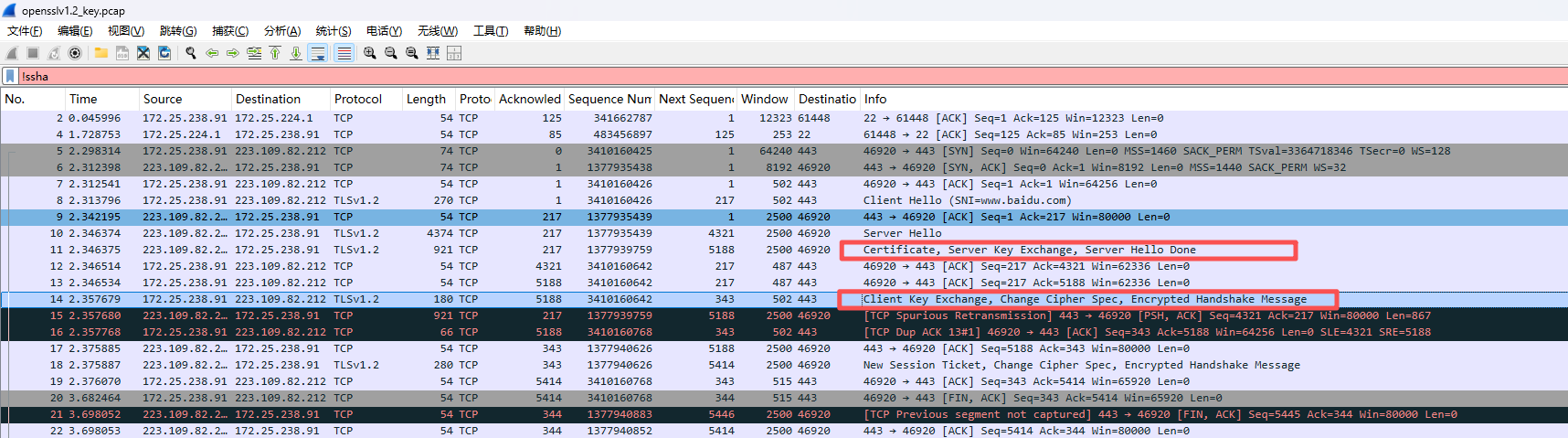
TLSv1.2的这一步交换各自的public key之后就可以生成共享密钥.