本文主要是通过自己构建一个VIT模型完成一个简单的分类任务。
一、环境搭建
电脑配置:win10+RTX4080SX4
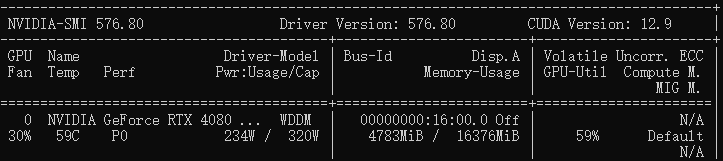
命令行执行以下命令,建一个虚拟环境,安装依赖库
python
# 创建虚拟环境
conda create -n vit python=3.10 -y
# 激活虚拟环境
conda activate vit
# 安装依赖库
pip3 install torch==2.6.0 torchvision==0.21.0 --index-url https://download.pytorch.org/whl/cu124
pip install pillow==12.1.1 matplotlib==3.10.8 einops==0.8.2 torchsummary==1.5.1
二、数据集下载
运行命令:
python
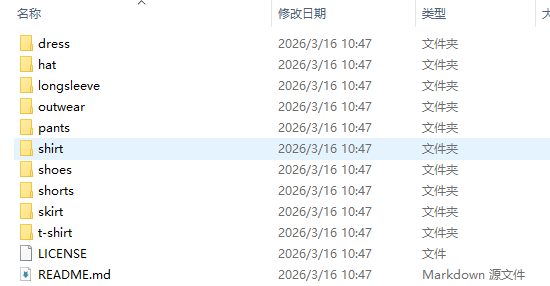
git clone https://github.com/lightly-ai/dataset_clothing_images.git my_data_dir下载完以后删除文件夹里面的git文件,最终训练数据如图所示。
三、代码构建
(1)本地创建python文件,vit_model.py。
python
import torch
from torch import nn, Tensor
from torchvision.transforms import Compose, Resize, ToTensor
from einops.layers.torch import Rearrange, Reduce
from einops import repeat
from PIL import Image
from torchsummary import summary

# ===================== 1. PatchEmbedding:图像分块与嵌入 =====================
class PatchEmbedding(nn.Module):
    """
    核心作用:将224x224的RGB图像切分为16x16的Patch,映射为固定维度的向量,
    并添加CLS Token(分类专用)和位置编码(保留空间信息)
    """
    def __init__(self,
                 in_channels: int = 3,  # 输入图像通道数(RGB=3)
                 patch_size: int = 16,  # 每个Patch的尺寸(16x16)
                 emb_size: int = 768,   # 每个Patch嵌入后的维度(ViT-Base标准)
                 img_size: int = 224):  # 输入图像尺寸
        super().__init__()
        self.patch_size = patch_size

        # 1. CLS Token:可学习的一维向量,拼接在所有Patch前,最终用它做分类
        # shape: [1, 1, 768](1个token,1个batch维度,768维)
        self.cls_token = nn.Parameter(torch.randn(1, 1, emb_size))

        # 2. 位置编码:为每个Patch(196个)+ CLS Token(1个)分配位置向量
        # shape: [197, 768](197个位置,每个768维),可学习
        self.positions = nn.Parameter(torch.randn((img_size // patch_size)**2 + 1, emb_size))

        # 3. Patch投影层:将每个16x16x3的Patch转为768维向量
        self.projection = nn.Sequential(
            # Rearrange:维度重排,把图像切分为Patch
            # 输入shape [b, 3, 224, 224] → 输出 [b, 196, 768]
            # (h s1)表示高度=h*s1,s1=patch_size,最终h=224/16=14,h*w=196个Patch
            Rearrange('b c (h s1) (w s2) -> b (h w) (s1 s2 c)', s1=patch_size, s2=patch_size),
            # Linear层:将每个Patch的像素值(16*16*3=768)映射为768维向量(维度不变,可学习)
            nn.Linear(patch_size * patch_size * in_channels, emb_size),
        )

    def forward(self, x: Tensor) -> Tensor:
        b, _, _, _ = x.shape  # 获取batch_size(b)
        x = self.projection(x)  # 第一步:图像切分+投影 → [b, 196, 768]

        # 复制CLS Token到整个批次:把[1,1,768] → [b,1,768](每个样本都有CLS Token)
        cls_tokens = repeat(self.cls_token, '() n e -> b n e', b=b)

        # 拼接CLS Token和Patch Embedding:[b,1,768] + [b,196,768] → [b,197,768]
        x = torch.cat([cls_tokens, x], dim=1)

        # 添加位置编码:每个位置的向量 += 对应位置编码(保留空间信息)
        x += self.positions
        return x  # 最终输出 [b, 197, 768]

# ===================== 2. MultiHeadSelfAttention:多头自注意力 =====================
class MultiHeadSelfAttention(nn.Module):
    """
    核心作用:让每个Patch关注其他Patch的信息(包括CLS Token),捕捉全局特征
    PyTorch的MultiHeadAttention要求输入格式为 [seq_len, batch, emb_size]
    """
    def __init__(self, emb_size: int, num_heads: int = 12, dropout: float = 0.):
        super().__init__()
        # 12个头的自注意力(ViT-Base标准),每个头处理768/12=64维
        self.attention = nn.MultiheadAttention(emb_size, num_heads, dropout=dropout, batch_first=False)

    def forward(self, x: Tensor) -> Tensor:
        # 输入shape [b, 197, 768] → 转置为 [197, b, 768] 适配PyTorch接口
        x = x.transpose(0, 1)
        # 自注意力:Q=K=V=x,输出shape [197, b, 768]
        x, _ = self.attention(x, x, x)
        # 转置还原:[197, b, 768] → [b, 197, 768]
        return x.transpose(0, 1)

# ===================== 3. ResidualAdd:残差连接 =====================
class ResidualAdd(nn.Module):
    """
    核心作用:实现残差连接(Residual Connection),解决深度网络梯度消失问题
    公式:output = fn(x) + x
    """
    def __init__(self, fn):
        super().__init__()
        self.fn = fn  # 传入需要执行的子模块(如注意力/前馈网络)

    def forward(self, x: Tensor, **kwargs) -> Tensor:
        res = x  # 保存原始输入作为残差
        x = self.fn(x, **kwargs)  # 执行子模块计算
        x += res  # 残差相加
        return x

# ===================== 4. FeedForwardBlock:前馈网络 =====================
class FeedForwardBlock(nn.Sequential):
    """
    核心作用:对每个Token的特征进行非线性变换,增强模型表达能力
    结构:Linear(768→3072) → GELU → Dropout → Linear(3072→768)
    """
    def __init__(self, emb_size: int, expansion: int = 4, drop_p: float = 0.):
        super().__init__(
            # 升维:768 → 768*4=3072(扩展系数4是ViT标准)
            nn.Linear(emb_size, expansion * emb_size),
            nn.GELU(),  # 激活函数(比ReLU更平滑,ViT专用)
            nn.Dropout(drop_p),  # 防止过拟合
            # 降维:3072 → 768(还原维度,适配残差连接)
            nn.Linear(expansion * emb_size, emb_size),
        )

# ===================== 5. TransformerEncoderBlock:Transformer编码器块 =====================
class TransformerEncoderBlock(nn.Sequential):
    """
    核心作用:单个Transformer编码器块,包含「注意力+残差」和「前馈+残差」两个子模块
    结构:LayerNorm → 注意力 → Dropout → 残差 + LayerNorm → 前馈 → Dropout → 残差
    """
    def __init__(self,
                 emb_size: int = 768,
                 drop_p: float = 0.,
                 forward_expansion: int = 4,
                 forward_drop_p: float = 0.,
                 num_heads: int = 12):
        super().__init__(
            # 第一个残差块:层归一化 + 自注意力 + Dropout
            ResidualAdd(nn.Sequential(
                nn.LayerNorm(emb_size),  # 层归一化(稳定训练)
                MultiHeadSelfAttention(emb_size, num_heads=num_heads, dropout=drop_p),
                nn.Dropout(drop_p)
            )),
            # 第二个残差块:层归一化 + 前馈网络 + Dropout
            ResidualAdd(nn.Sequential(
                nn.LayerNorm(emb_size),
                FeedForwardBlock(emb_size, expansion=forward_expansion, drop_p=forward_drop_p),
                nn.Dropout(drop_p)
            ))
        )

# ===================== 6. TransformerEncoder:堆叠编码器块 =====================
class TransformerEncoder(nn.Sequential):
    """
    核心作用:堆叠多个TransformerEncoderBlock(ViT-Base堆叠12层)
    """
    def __init__(self, depth: int = 12, **kwargs):
        # 生成depth个编码器块并堆叠
        super().__init__(*[TransformerEncoderBlock(**kwargs) for _ in range(depth)])

# ===================== 7. ClassificationHead:分类头 =====================
class ClassificationHead(nn.Sequential):
    """
    核心作用:将Transformer输出的特征转为分类结果
    步骤:全局平均池化 → 层归一化 → 线性分类
    """
    def __init__(self, emb_size: int = 768, n_classes: int = 1000):
        super().__init__(
            # Reduce:对197个Token做平均池化,[b,197,768] → [b,768]
            Reduce('b n e -> b e', reduction='mean'),
            nn.LayerNorm(emb_size),  # 归一化
            nn.Linear(emb_size, n_classes)  # 768维 → 分类类别数(如10类)
        )

# ===================== 8. ViT:完整模型 =====================
class ViT(nn.Sequential):
    """
    核心作用:整合所有模块,形成完整的Vision Transformer
    流程:PatchEmbedding → TransformerEncoder → ClassificationHead
    """
    def __init__(self,
                 in_channels: int = 3,
                 patch_size: int = 16,
                 emb_size: int = 768,
                 img_size: int = 224,
                 depth: int = 12,  # 编码器块数量(ViT-Base=12)
                 n_classes: int = 1000,
                 **kwargs):
        super().__init__(
            PatchEmbedding(in_channels, patch_size, emb_size, img_size),  # 分块+嵌入
            TransformerEncoder(depth, emb_size=emb_size, **kwargs),      # 特征提取
            ClassificationHead(emb_size, n_classes)                      # 分类
        )

# ===================== 9. 运行测试 =====================
if __name__ == "__main__":
    # 1. 图像预处理:读取→Resize→转Tensor(适配ViT输入)
    img_path = "01.jpg"  # 替换为你的图像路径
    img = Image.open(img_path).convert("RGB")  # 确保RGB格式(避免灰度图报错)
    transform = Compose([Resize((224, 224)), ToTensor()])  # 转为224x224的张量
    x = transform(img)  # 输出shape [3, 224, 224]
    x = x.unsqueeze(0)  # 添加batch维度 → [1, 3, 224, 224]
    print(f"输入图像张量形状: {x.shape}")

    # 2. 初始化模型:分类类别数设为10(可根据需求修改)
    vit_model = ViT(n_classes=10)
    print("\n=== ViT模型结构 ===")
    # 打印模型结构和参数:输入尺寸(3,224,224),batch_size=1
    summary(vit_model, input_size=(3, 224, 224), batch_size=1, device="cpu")

    # 3. 模型推理(评估模式,禁用梯度计算提升速度)
    vit_model.eval()  # 切换到评估模式(Dropout等层失效)
    with torch.no_grad():
        output = vit_model(x)  # 前向传播 → [1, 10](1个样本,10类概率)
        probabilities = torch.softmax(output, dim=1)  # 转为概率(总和=1)
        predicted_class = torch.argmax(probabilities, dim=1).item()  # 取概率最大的类别

    # 4. 输出结果
    print(f"\n模型输出形状: {output.shape}")
    print(f"预测类别索引: {predicted_class}")
    print(f"预测类别概率: {probabilities[0][predicted_class]:.4f}")
(2)本地创建python文件,vit_train.py。
python
import torch
import torch.nn as nn
import torch.optim as optim
from torch.utils.data import DataLoader, random_split
from torchvision.datasets import ImageFolder
from torchvision.transforms import Compose, Resize, ToTensor, Normalize
from vit_model import ViT  #

# ===================== 1. 基础配置 =====================
# 设置设备
device = torch.device('cuda' if torch.cuda.is_available() else 'cpu')
print(f'使用设备: {device}')

# 训练超参数(集中管理,方便修改)
CONFIG = {
    "BATCH_SIZE": 16,
    "EPOCHS": 50,
    "IMG_SIZE": 224,
    "LEARNING_RATE": 3e-4,
    "DATA_PATH": "my_data_dir",  # 你的数据集根目录
    "VAL_SPLIT_RATIO": 0.1,      # 验证集比例(10%)
    "SAVE_MODEL_PATH": "vit_classifier.pth",
    "CLASSES_PATH": "classes.txt"  # 保存类别列表的文件
}

# ===================== 2. 数据加载与划分 =====================
def load_and_split_data(data_path, img_size=224, batch_size=32, val_ratio=0.1):
    """
    加载数据集并按9:1划分训练集/验证集
    :param data_path: 数据集根目录(按类别分文件夹)
    :param img_size: 图像尺寸
    :param batch_size: 批次大小
    :param val_ratio: 验证集比例
    :return: 训练加载器、验证加载器、类别列表
    """
    # 数据预处理
    transform = Compose([
        Resize((img_size, img_size)),
        ToTensor(),
        Normalize(mean=[0.485, 0.456, 0.406],
                  std=[0.229, 0.224, 0.225])
    ])

    # 加载完整数据集
    full_dataset = ImageFolder(root=data_path, transform=transform)
    classes = full_dataset.classes  # 获取类别列表

    # 保存类别列表(供测试代码使用)
    with open(CONFIG["CLASSES_PATH"], 'w', encoding='utf-8') as f:
        f.write('\n'.join(classes))
    print(f"类别列表已保存到: {CONFIG['CLASSES_PATH']}")

    # 打印数据集信息
    print(f"数据集总样本数: {len(full_dataset)}")
    print(f"类别数: {len(classes)}, 类别: {classes}")

    # 划分训练集和验证集
    val_size = int(len(full_dataset) * val_ratio)
    train_size = len(full_dataset) - val_size
    train_dataset, val_dataset = random_split(full_dataset, [train_size, val_size])
    print(f"训练集样本数: {len(train_dataset)}, 验证集样本数: {len(val_dataset)}")

    # 创建数据加载器
    train_loader = DataLoader(
        train_dataset,
        batch_size=batch_size,
        shuffle=True,
        num_workers=0,
        #pin_memory=True if device.type == 'cuda' else False
        pin_memory=False
    )
    val_loader = DataLoader(
        val_dataset,
        batch_size=batch_size,
        shuffle=False,
        num_workers=0,
        #pin_memory=True if device.type == 'cuda' else False
        pin_memory=False
    )

    return train_loader, val_loader, classes

# ===================== 3. 训练与验证函数 =====================
def train_one_epoch(model, train_loader, criterion, optimizer, device):
    """训练一个epoch,返回训练损失和准确率"""
    model.train()
    total_loss = 0.0
    correct = 0
    total = 0

    for batch_idx, (images, labels) in enumerate(train_loader):
        images, labels = images.to(device), labels.to(device)

        # 前向传播
        outputs = model(images)
        loss = criterion(outputs, labels)

        # 反向传播
        optimizer.zero_grad()
        loss.backward()
        torch.nn.utils.clip_grad_norm_(model.parameters(), max_norm=1.0)
        optimizer.step()

        # 统计指标
        total_loss += loss.item()
        _, predicted = outputs.max(1)
        total += labels.size(0)
        correct += predicted.eq(labels).sum().item()

        # 每10个批次打印一次进度
        if (batch_idx + 1) % 10 == 0:
            batch_acc = 100. * correct / total
            print(f"  批次 {batch_idx+1}/{len(train_loader)} | 批次损失: {loss.item():.4f} | 批次准确率: {batch_acc:.2f}%")

    epoch_loss = total_loss / len(train_loader)
    epoch_acc = 100. * correct / total
    return epoch_loss, epoch_acc

def validate(model, val_loader, criterion, device):
    """验证一个epoch,返回验证损失和准确率"""
    model.eval()
    total_loss = 0.0
    correct = 0
    total = 0

    with torch.no_grad():
        for images, labels in val_loader:
            images, labels = images.to(device), labels.to(device)

            outputs = model(images)
            loss = criterion(outputs, labels)

            total_loss += loss.item()
            _, predicted = outputs.max(1)
            total += labels.size(0)
            correct += predicted.eq(labels).sum().item()

    val_loss = total_loss / len(val_loader)
    val_acc = 100. * correct / total
    return val_loss, val_acc

# ===================== 4. 主训练流程 =====================
def main():
    # 1. 加载数据
    train_loader, val_loader, classes = load_and_split_data(
        data_path=CONFIG["DATA_PATH"],
        img_size=CONFIG["IMG_SIZE"],
        batch_size=CONFIG["BATCH_SIZE"],
        val_ratio=CONFIG["VAL_SPLIT_RATIO"]
    )

    # 2. 创建模型
    model = ViT(
        in_channels=3,
        patch_size=16,
        emb_size=768,
        img_size=CONFIG["IMG_SIZE"],
        depth=12,
        n_classes=len(classes),
        num_heads=12,
        drop_p=0.1,
        forward_drop_p=0.1
    ).to(device)
    print("\n==================== 模型信息 ====================")
    print(f"模型总参数量: {sum(p.numel() for p in model.parameters()):,}")

    # 3. 定义损失函数和优化器
    criterion = nn.CrossEntropyLoss()
    optimizer = optim.AdamW(
        model.parameters(),
        lr=CONFIG["LEARNING_RATE"],
        weight_decay=0.01
    )

    # 4. 开始训练
    print("\n==================== 开始训练 ====================")
    best_val_acc = 0.0
    for epoch in range(CONFIG["EPOCHS"]):
        # 训练
        train_loss, train_acc = train_one_epoch(model, train_loader, criterion, optimizer, device)

        # 验证
        val_loss, val_acc = validate(model, val_loader, criterion, device)

        # 打印epoch结果
        print(f"\nEpoch {epoch+1}/{CONFIG['EPOCHS']}")
        print(f"训练损失: {train_loss:.4f} | 训练准确率: {train_acc:.2f}%")
        print(f"验证损失: {val_loss:.4f} | 验证准确率: {val_acc:.2f}%")

        # 保存最佳模型
        if val_acc > best_val_acc:
            best_val_acc = val_acc
            torch.save(model.state_dict(), CONFIG["SAVE_MODEL_PATH"])
            print(f"保存最佳模型(验证准确率: {best_val_acc:.2f}%)到 {CONFIG['SAVE_MODEL_PATH']}")

    print("\n==================== 训练完成 ====================")
    print(f"最佳验证准确率: {best_val_acc:.2f}%")
    print(f"模型保存路径: {CONFIG['SAVE_MODEL_PATH']}")
    print(f"类别列表保存路径: {CONFIG['CLASSES_PATH']}")

if __name__ == '__main__':
    main()
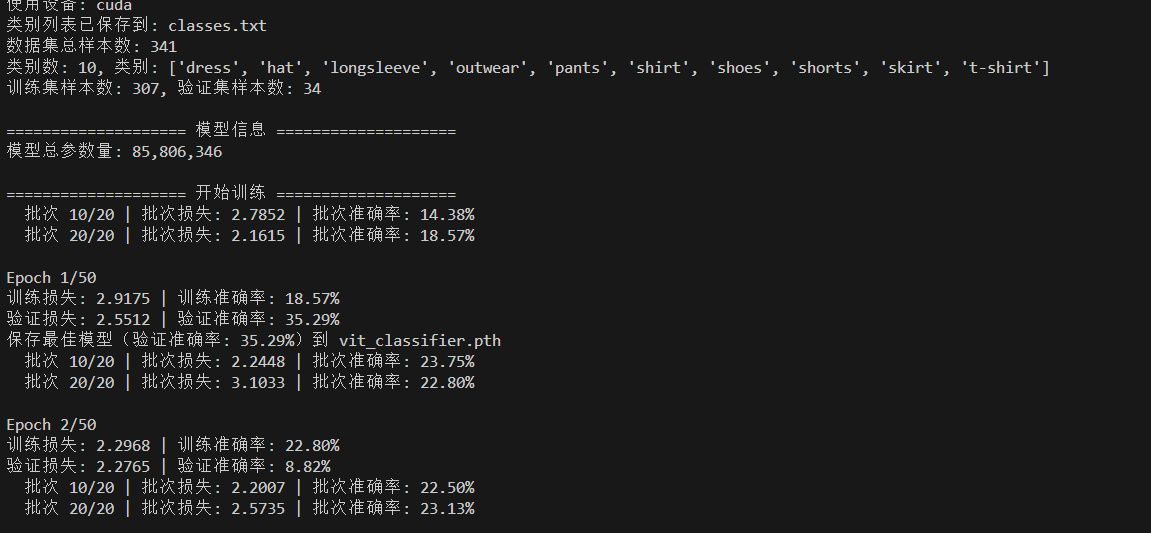
训练过程如下:
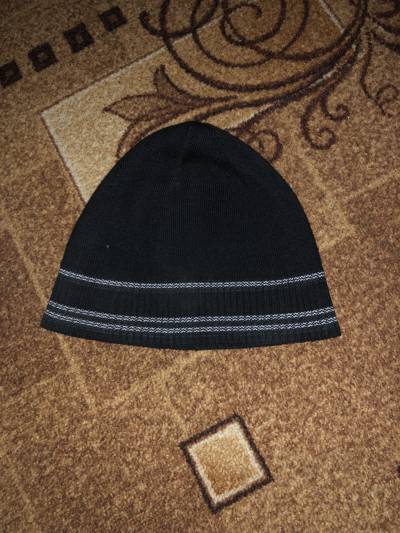
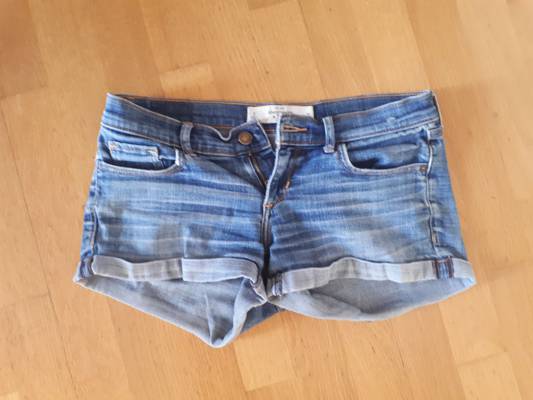
(2)本地创建python文件,vit_test.py。
python
import torch
import torch.nn as nn
from torchvision.transforms import Compose, Resize, ToTensor, Normalize
from PIL import Image
# 导入ViT模型(和训练代码保持一致)
from vit_model import ViT  # 若之前的类名是ViT_model,这里改为ViT_model

# ===================== 1. 配置参数 =====================
# 设置设备
device = torch.device('cuda' if torch.cuda.is_available() else 'cpu')
print(f'使用设备: {device}')

# 测试配置(需和训练时保持一致)
TEST_CONFIG = {
    "IMG_SIZE": 224,
    "MODEL_PATH": "vit_classifier.pth",  # 训练好的模型路径
    "CLASSES_PATH": "classes.txt",       # 保存类别列表的文件
    "TEST_IMAGES": ["01.jpg", "02.jpg"]  # 需要预测的图片路径
}

# ===================== 2. 加载类别列表 =====================
def load_classes(classes_path):
    """加载训练时保存的类别列表"""
    with open(classes_path, 'r', encoding='utf-8') as f:
        classes = [line.strip() for line in f if line.strip()]
    print(f"加载类别列表: {classes}")
    return classes

# ===================== 3. 加载模型 =====================
def load_model(model_path, classes, img_size=224, device=device):
    """加载训练好的ViT模型"""
    # 创建模型结构(参数需和训练时完全一致)
    model = ViT(
        in_channels=3,
        patch_size=16,
        emb_size=768,
        img_size=img_size,
        depth=12,
        n_classes=len(classes),
        num_heads=12,
        drop_p=0.1,
        forward_drop_p=0.1
    ).to(device)

    # 加载模型权重
    model.load_state_dict(torch.load(model_path, map_location=device))
    model.eval()  # 切换到评估模式
    print(f"模型加载完成: {model_path}")
    return model

# ===================== 4. 单张图片预测 =====================
def predict_single_image(model, image_path, classes, img_size=224, device=device):
    """
    单张图片预测
    :param model: 训练好的模型
    :param image_path: 图片路径
    :param classes: 类别列表
    :param img_size: 图像尺寸
    :param device: 设备
    """
    # 数据预处理(必须和训练时完全一致)
    transform = Compose([
        Resize((img_size, img_size)),
        ToTensor(),
        Normalize(mean=[0.485, 0.456, 0.406],
                  std=[0.229, 0.224, 0.225])
    ])

    try:
        # 加载并处理图片
        image = Image.open(image_path).convert('RGB')
        image_tensor = transform(image).unsqueeze(0).to(device)  # 添加batch维度

        # 预测
        with torch.no_grad():
            outputs = model(image_tensor)
            probabilities = torch.softmax(outputs, dim=1)  # 转为概率
            predicted_idx = torch.argmax(probabilities, dim=1).item()  # 预测类别索引
            confidence = probabilities[0][predicted_idx].item()  # 置信度

        # 打印结果
        print("\n==================== 预测结果 ====================")
        print(f"图片路径: {image_path}")
        print(f"预测类别: {classes[predicted_idx]}")
        print(f"置信度: {confidence:.2%}")

        # 可选:打印前3个高置信度的类别
        top3_probs, top3_idxs = torch.topk(probabilities, 3, dim=1)
        print("前3个高置信度类别:")
        for i in range(3):
            print(f"  {classes[top3_idxs[0][i].item()]}: {top3_probs[0][i].item():.2%}")

    except Exception as e:
        print(f"预测图片 {image_path} 失败: {str(e)}")

# ===================== 5. 批量预测 =====================
def batch_predict(model, image_paths, classes, img_size=224, device=device):
    """批量预测多张图片"""
    print("\n==================== 开始批量预测 ====================")
    for img_path in image_paths:
        predict_single_image(model, img_path, classes, img_size, device)

# ===================== 主测试流程 =====================
def main():
    # 1. 加载类别列表
    classes = load_classes(TEST_CONFIG["CLASSES_PATH"])

    # 2. 加载模型
    model = load_model(TEST_CONFIG["MODEL_PATH"], classes, TEST_CONFIG["IMG_SIZE"], device)

    # 3. 批量预测
    batch_predict(model, TEST_CONFIG["TEST_IMAGES"], classes, TEST_CONFIG["IMG_SIZE"], device)

if __name__ == '__main__':
    main()
测试图像01.jpg:
测试图像02.jpg:
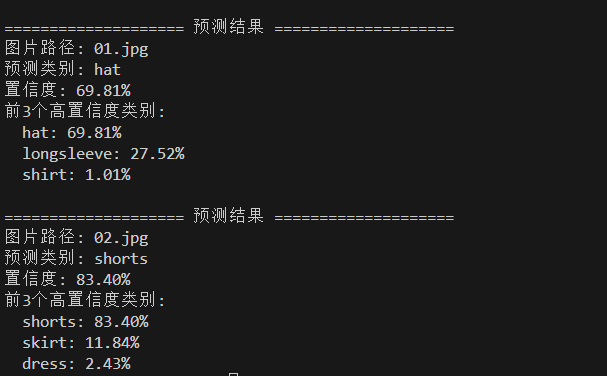
测试结果: