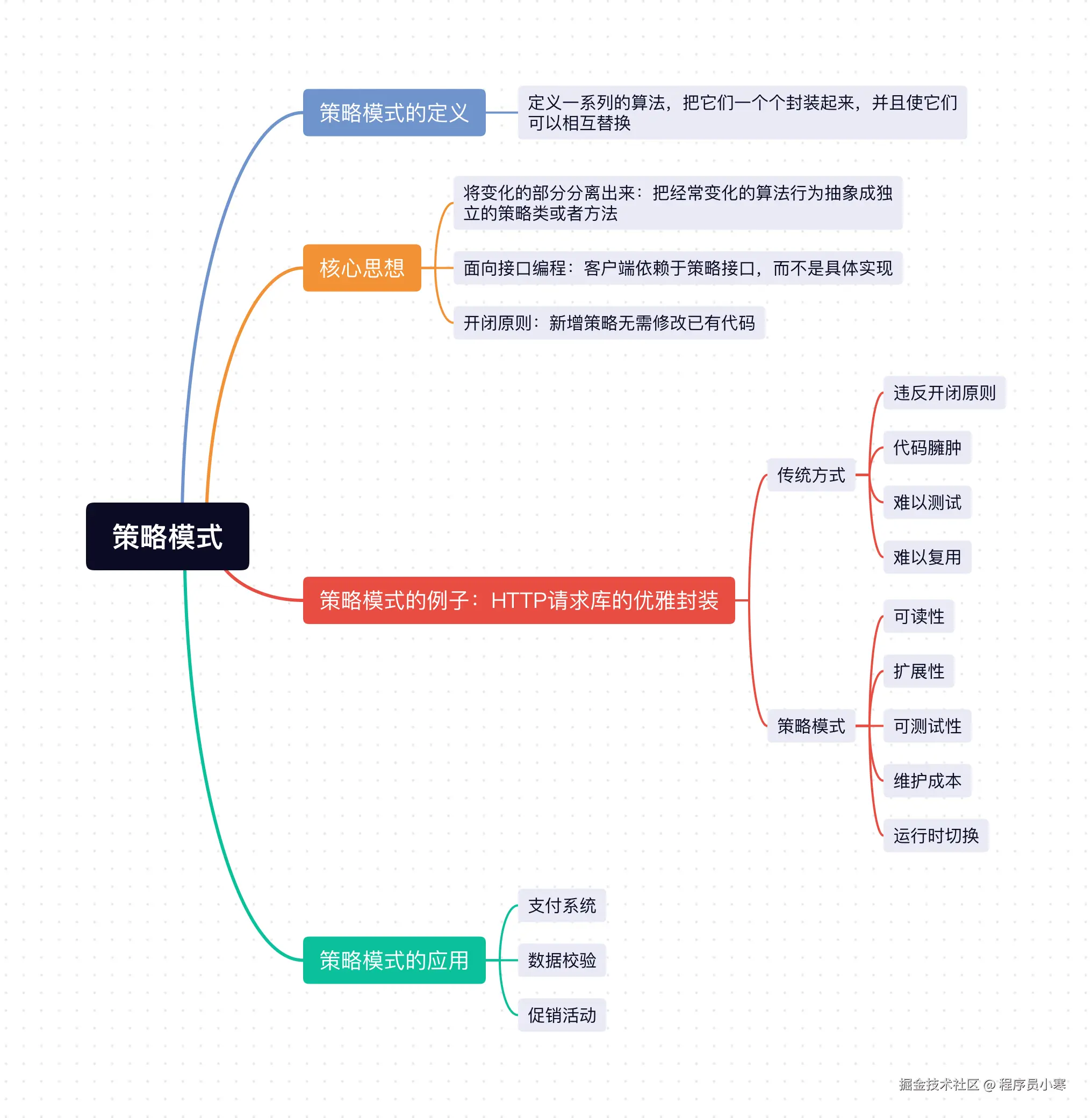
1、策略模式定义
策略模式的定义是:定义一系列的算法,把它们一个个封装起来,并且使它们可以相互替换。
2、核心思想
- 将变化的部分分离出来:把经常变化的算法行为抽象成独立的策略类或者方法。
- 面向接口编程:客户端依赖于策略接口,而不是具体实现。
- 开闭原则:新增策略无需修改已有代码。
3、例子:HTTP请求库的优雅封装
在实际项目开发中,有时候可能需要支持多种 HTTP 请求方式:
- 原生
XMLHttpRequest(兼容旧项目)。 fetch API(现代浏览器)。axios(第三方库)。
如果不用设计模式,写出来的代码会变得难以维护。
3.1 不用策略模式(传统方式)
js
// ❌ 传统方式:充满条件判断,修改困难,容易出错
function request() {
    if (this.type === 'xhr') {
        // XHR 逻辑
    } else if (this.type === 'fetch') {
        // fetch 逻辑
    } else if (this.type === 'axios') {
        //  axios 逻辑
    }
}
这段代码有以下问题:
- 违反开闭原则 。新增请求方式需要修改
request方法,增加新的else if。 - 代码臃肿。所有实现都堆在一个方法里,几百行代码难以阅读。
- 难以测试。无法单独测试某种请求方式的实现。
- 难以复用。每种请求方式的配置、拦截器等无法独立扩展。
3.2 重构版:使用策略模式
js
// ✅ 策略对象
const strategies = {
    xhr: ({ url, method = 'GET', data, headers = {} }) => {
        return new Promise((resolve, reject) => {
            const xhr = new XMLHttpRequest();
            xhr.open(method, url);
            Object.keys(headers).forEach(k => xhr.setRequestHeader(k, headers[k]));
            xhr.onload = () => resolve({ data: JSON.parse(xhr.responseText), status: xhr.status });
            xhr.onerror = () => reject(new Error('Network error'));
            xhr.send(method !== 'GET' ? JSON.stringify(data) : null);
        });
    },

    fetch: async ({ url, method = 'GET', data, headers = {} }) => {
        const res = await fetch(url, {
            method,
            headers: { 'Content-Type': 'application/json', ...headers },
            body: method !== 'GET' ? JSON.stringify(data) : undefined
        });
        return { data: await res.json(), status: res.status };
    },

    axios: async ({ url, method = 'GET', data, headers = {}, params }) => {
        const res = await axios({ url, method, data, params, headers });
        return { data: res.data, status: res.status };
    }
};

// 策略管理器
class RequestService {
    constructor(strategy = 'fetch') {
        this.setStrategy(strategy);
    }

    setStrategy(type) {
        if (!strategies[type]) {
            throw new Error(`Unknown strategy: ${type}`);
        }
        this.requestFn = strategies[type];
    }

    async request(config) {
        return this.requestFn(config);
    }

    // 便捷方法
    get(url, config = {}) {
        return this.request({ ...config, url, method: 'GET' });
    }

    post(url, data, config = {}) {
        return this.request({ ...config, url, method: 'POST', data });
    }
}

// 使用
const service = new RequestService('fetch');
const users = await service.get('https://api.example.com/users');

service.setStrategy('xhr');
const post = await service.post('https://api.example.com/posts', { title: 'Hello' });
改造前后代码对比:
| 维度 | 重构前 | 重构后 |
|---|---|---|
| 可读性 | 所有逻辑挤在一起 | 每种策略独立,易于阅读 |
| 扩展性 | 新增策略需修改核心方法 | 新增策略只需添加对象属性 |
| 可测试性 | 难以单独测试某一种策略 | 可独立测试每个策略函数 |
| 维护成本 | 修改一种策略可能影响其他 | 修改策略互不影响 |
| 运行时切换 | 需要重新判断 | 直接切换策略引用 |
4、策略模式的优缺点
4.1 优点:
- ✅ 开闭原则:新增策略无需修改上下文和其他策略。
- ✅ 消除条件判断:避免大量的 if-else 或 switch-case。
- ✅ 提高复用性:策略类可被不同上下文复用。
- ✅ 符合单一职责:每个策略类只负责一种算法。
4.2 缺点:
- ❌ 类/策略对象数量膨胀:每个策略都需要一个类或者策略对象,会占用更多内存(可通过享元模式优化)。
- ❌ 客户端需了解策略:客户端必须知道有哪些 strategy 可选,这样才能选择一个合适的 strategy。
5、策略模式的应用
策略模式常见有以下的应用场景:
- 支付系统:需要多种支付策略,包括支付宝、微信、银联等支付方式。
- 数据校验:根据数据用途制定校验策略,比如手机号、邮箱、身份证等。
- 促销活动:不同促销活动有不同优惠策略,包括满减、打折、赠品等。
- ...等等。
小结
上面介绍了Javascript最经典的设计模式之一策略模式,策略模式就是定义一系列的算法策略 strategy,把它们封装起来,然后根据场景分别调用,不同策略是平级关系,可以相互替换,修改新增策略不会影响其它策略。