The three fracture modes (classical classification)
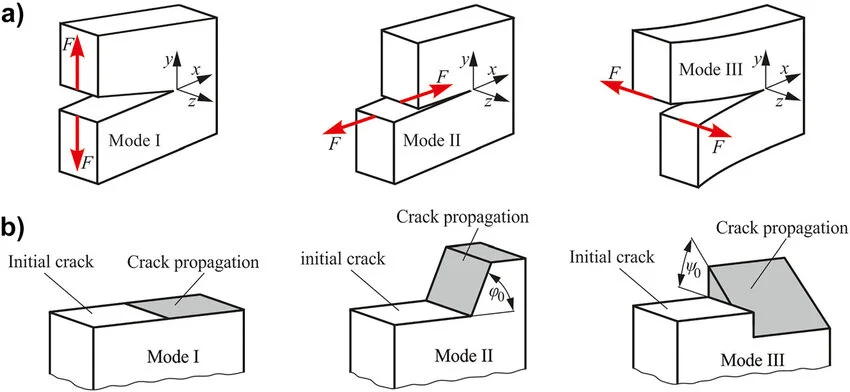
In fracture mechanics, cracks are classified into three fundamental modes:
-
Mode I → Opening (tensile)
-
Mode II → Sliding (in-plane shear)
-
Mode III → Tearing (anti-plane shear)
Key classification: in-plane vs anti-plane
In-plane modes (Modes I & II)
These involve motion within the crack plane
🔸 Mode I (Opening mode)
-
Displacement normal to the crack surface , but still within the 2D plane
-
Think: crack faces pull apart
🔸 Mode II (Sliding mode)
-
Displacement parallel to the crack front
-
Shear motion within the plane
👉 Both are in-plane because:
-
Motion is fully described by (u_x, u_y)
-
No out-of-plane component
Anti-plane mode (Mode III)
🔸 Mode III (Tearing mode)
-
Displacement is perpendicular to the plane
-
Crack surfaces slide out of the page
👉 This is anti-plane because:
-
Motion is entirely in (z)-direction
-
Decoupled scalar problem (SH wave)
Clean summary table
| Fracture Mode | Physical Meaning | Plane Category | Displacement |
|---|---|---|---|
| Mode I | Opening (tension) | in-plane | (u_x, u_y) |
| Mode II | Sliding (shear) | In-plane | (u_x, u_y) |
| Mode III | Tearing (shear) | Anti-plane | (u_z) |
Why this classification matters (deep insight)
This is not just naming---it reflects fundamental physics:
🔸 In-plane (Modes I & II)
-
Governed by coupled Navier equations
-
Generates:
-
P waves (compression)
-
SV waves (in-plane shear)
-
-
More complex:
-
dilation + shear coupling
-
important for real earthquakes
-
🔸 Anti-plane (Mode III)
-
Governed by scalar wave equation
-
Generates:
- SH waves only
-
Much simpler:
-
no volumetric strain
-
no coupling
-