LangChain 教程 03|快速开始:10 分钟创建第一个 Agent
📖 本篇导读:这是 LangChain 系列教程的第 3 篇。本篇将带你用 10 行代码创建第一个智能 Agent,体验 LangChain 的核心魅力。读完预计需要 10 分钟。
简单来说
快速开始只需 5 步:定义工具 → 创建 Agent → 配置参数 → 运行测试 → 扩展功能。
就像做一道菜:准备食材(工具)→ 点火(创建 Agent)→ 调味(配置)→ 翻炒(运行)→ 摆盘(扩展)。
🎯 本节目标
读完本节,你将能够回答这些问题:
- ❓ 如何用 10 行代码创建一个会查天气的 Agent?
- ❓ 系统提示(System Prompt)有什么用?如何写一个好的系统提示?
- ❓ 什么是结构化输出?为什么要用它?
- ❓ 如何让 Agent 记住之前的对话?
- ❓ 真实世界的 Agent 需要哪些组件?
核心痛点与解决方案
痛点:AI 开发的"起步困难症"
| 痛点 | 传统做法 | 有多痛苦 |
|---|---|---|
| 不知从何开始 | 面对一堆文档,无从下手 | 看了一天文档,一行代码没写 |
| 功能太简单 | 只能调用模型,不会用工具 | 说是 AI 助手,其实就是个聊天机器人 |
| 难以扩展 | 想加个功能,要重写一半代码 | 越写越复杂,最后成了"代码屎山" |
| 没有记忆 | 聊完就忘,无法持续对话 | 用户:"我刚才问什么来着?" |
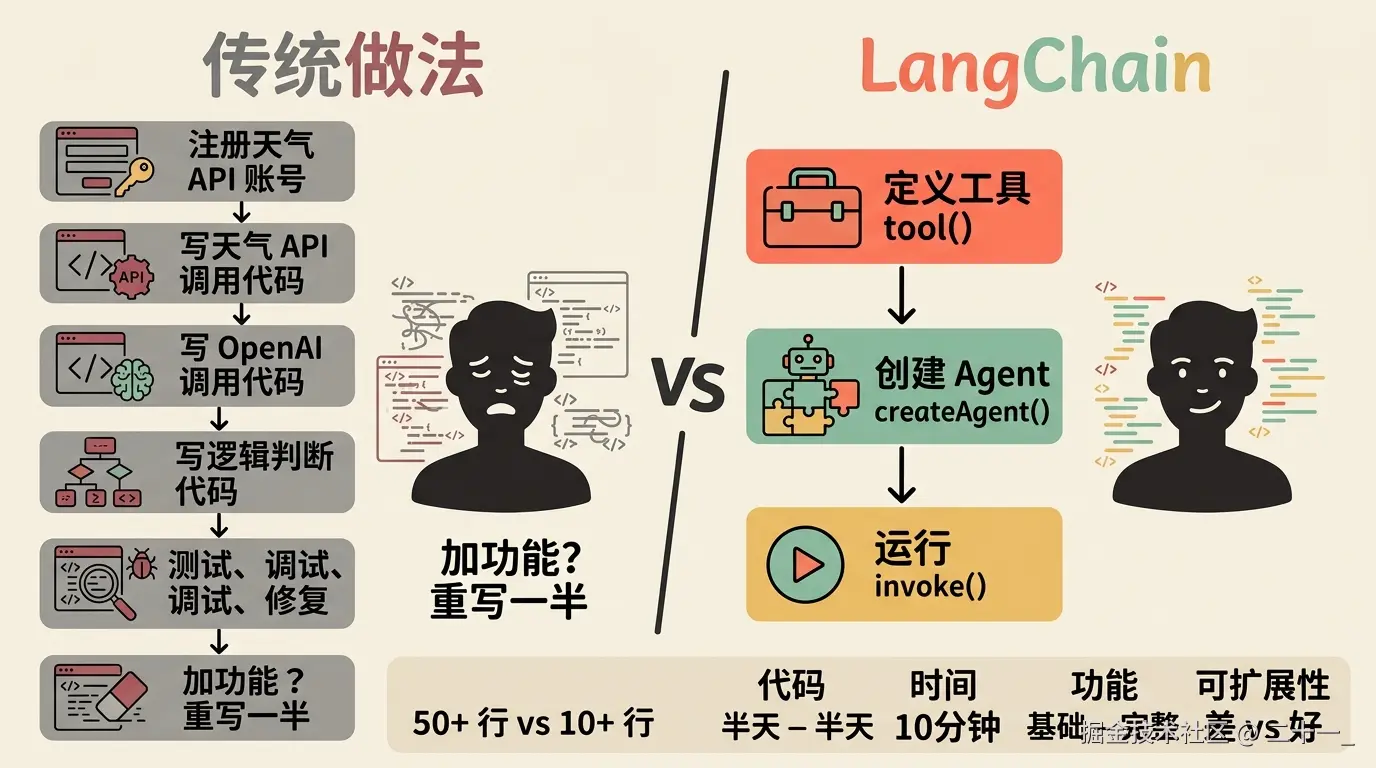
举个例子: 你想做一个能查天气的 AI 助手。
传统做法:
markdown
1. 注册天气 API 账号
2. 写天气 API 调用代码
3. 写 OpenAI 调用代码
4. 写逻辑:用户问天气就调用天气 API
5. 测试、调试、修复 bug
6. 想加记忆功能?重写一半代码
解决:LangChain 一键生成
typescript
import { createAgent, tool } from "langchain";
import * as z from "zod";

// 1. 定义天气工具
const getWeather = tool(
  (input) => `It's always sunny in ${input.city}!`,
  {
    name: "get_weather",
    description: "Get the weather for a given city",
    schema: z.object({ city: z.string() }),
  }
);

// 2. 创建 Agent
const agent = createAgent({
  model: "claude-sonnet-4-5-20250929",
  tools: [getWeather],
});

// 3. 运行测试
const result = await agent.invoke({
  messages: [{ role: "user", content: "东京天气怎么样?" }],
});

console.log(result.messages.at(-1)?.content);
// Output: It's always sunny in Tokyo!
效果对比:
| 指标 | 传统做法 | LangChain |
|---|---|---|
| 代码量 | 50+ 行 | 10+ 行 |
| 开发时间 | 半天 | 10 分钟 |
| 功能完整度 | 基础 | 完整(工具 + 推理 + 记忆) |
| 可扩展性 | 差 | 好(加工具就行) |
生活化类比:创建 Agent 就像开咖啡店
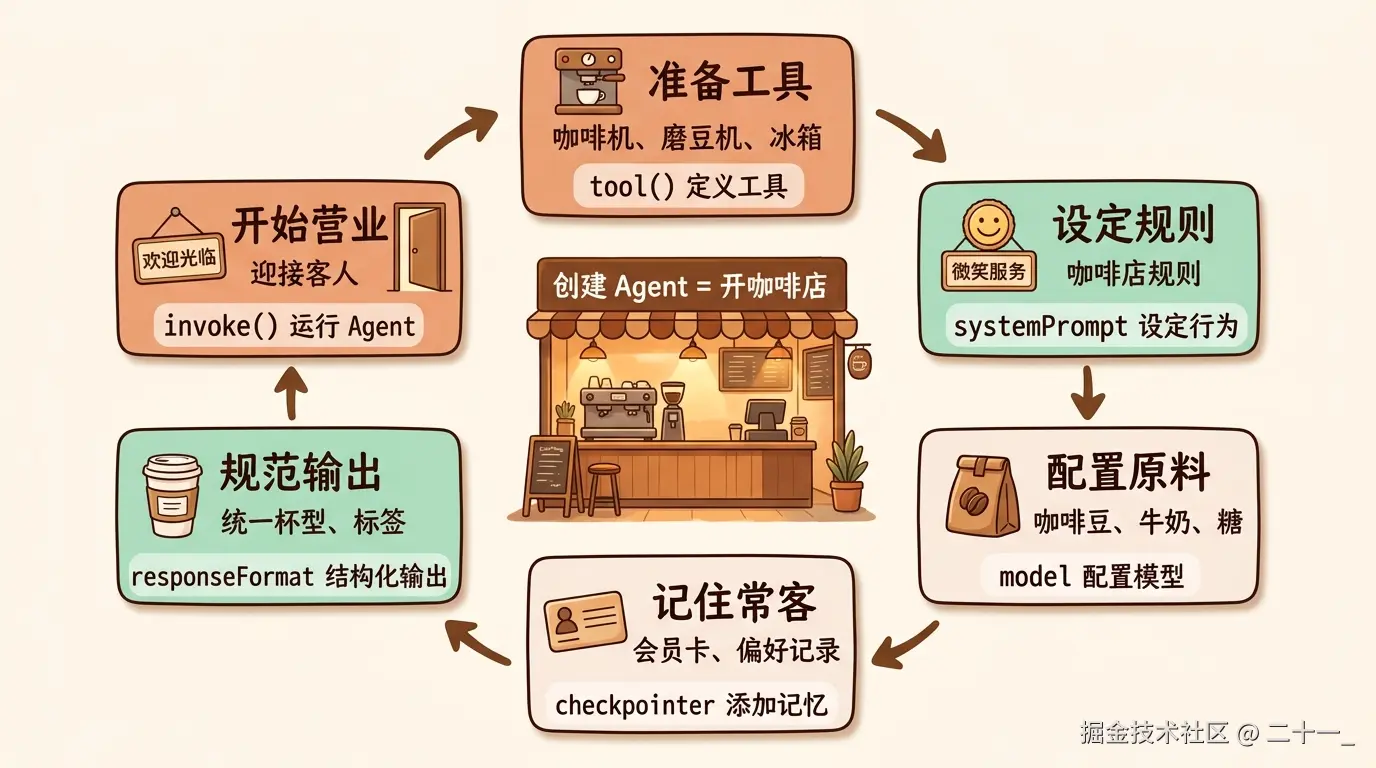
| 步骤 | 类比 | LangChain 对应 |
|---|---|---|
| 准备工具 | 咖啡机、磨豆机、冰箱 | tool() 定义工具 |
| 设定规则 | 咖啡店规则("微笑服务") | systemPrompt 设定行为 |
| 配置原料 | 咖啡豆、牛奶、糖 | model 配置模型 |
| 记住常客 | 会员卡、偏好记录 | checkpointer 添加记忆 |
| 规范输出 | 统一杯型、标签 | responseFormat 结构化输出 |
| 开始营业 | 迎接客人 | invoke() 运行 Agent |
步骤一:创建基础 Agent(10 行代码)
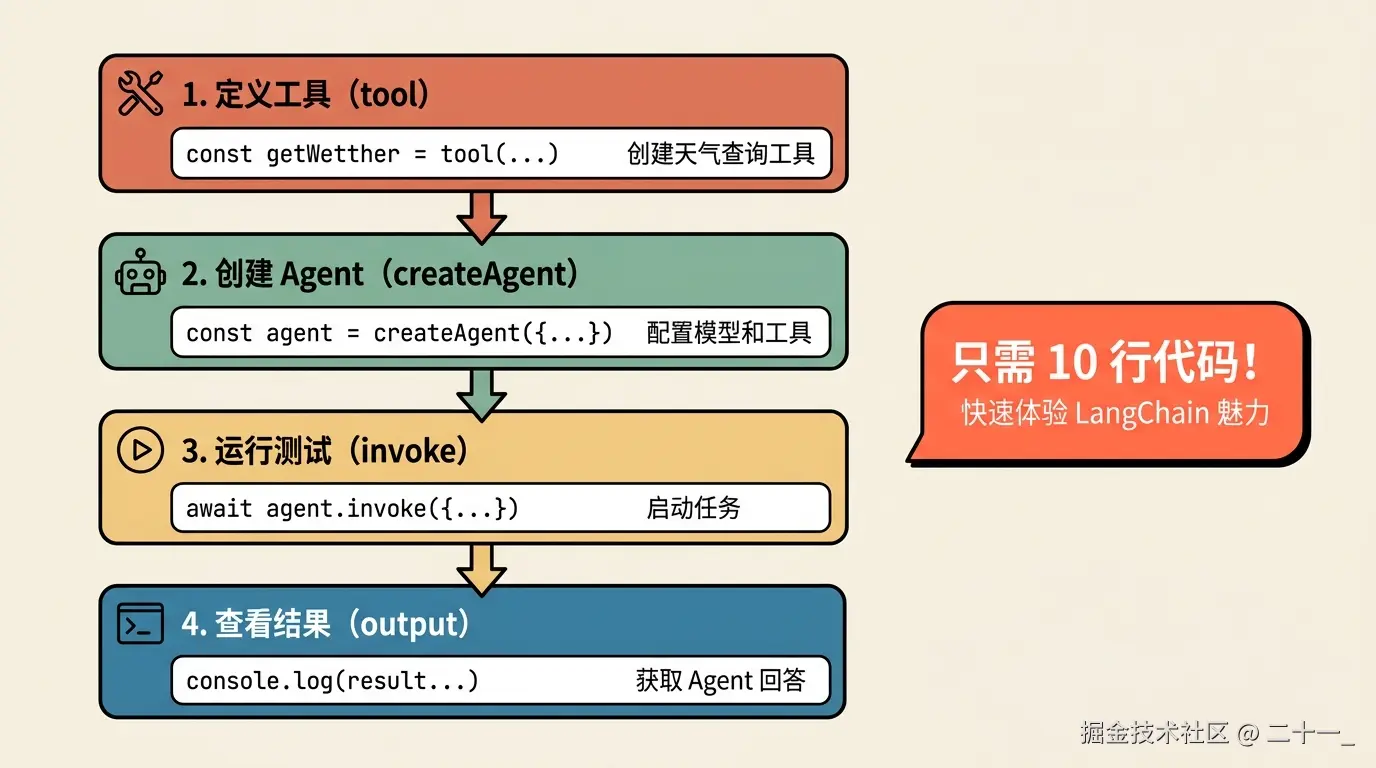
完整代码
typescript
import { createAgent, tool } from "langchain";
import * as z from "zod";

// 1. 定义天气工具
const getWeather = tool(
  (input) => `It's always sunny in ${input.city}!`,
  {
    name: "get_weather",
    description: "Get the weather for a given city",
    schema: z.object({ city: z.string() }),
  }
);

// 2. 创建 Agent
const agent = createAgent({
  model: "claude-sonnet-4-5-20250929",
  tools: [getWeather],
});

// 3. 运行测试
const result = await agent.invoke({
  messages: [{ role: "user", content: "东京天气怎么样?" }],
});

// 4. 查看结果
console.log(result.messages.at(-1)?.content);
// Output: It's always sunny in Tokyo!
代码解析
| 行号 | 代码 | 人话解读 |
|---|---|---|
| 5-14 | tool() 定义 |
"我创建了一个叫 get_weather 的工具,能查指定城市的天气" |
| 6 | 工具逻辑 | "工具被调用时,返回一个固定的天气信息" |
| 8-12 | 工具配置 | "告诉 Agent:这个工具叫什么、能做什么、需要什么参数" |
| 17-20 | createAgent() |
"创建一个 AI 助手,用 Claude 模型,会使用天气工具" |
| 23-26 | invoke() |
"启动任务:用户问东京天气,Agent 会自己决定调用什么工具" |
| 29 | 查看结果 | "从返回的消息中找到最后一条,那是 Agent 的回答" |
💡 人话解读:
tool()函数就像"注册一个技能",告诉 Agent 它会什么createAgent()就像"雇佣一个员工",给他技能和大脑invoke()就像"给员工派任务",他会自己想办法完成
步骤二:创建真实世界的 Agent
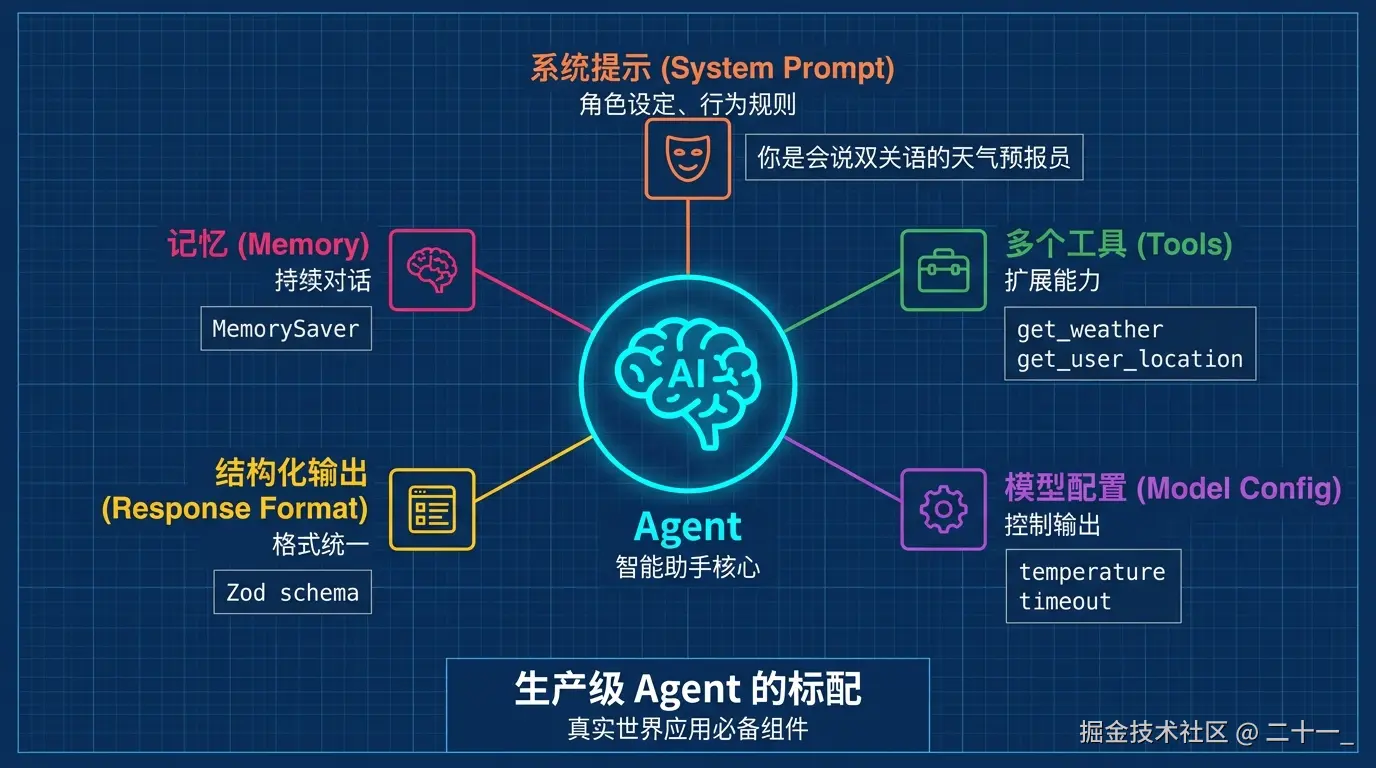
真实世界的 Agent 需要什么?
| 组件 | 作用 | 为什么需要 |
|---|---|---|
| 系统提示 | 设定角色和行为 | 让 Agent 知道自己是谁,该怎么说话 |
| 多个工具 | 扩展能力 | 一个工具不够用,需要多个工具配合 |
| 模型配置 | 控制输出 | 调整温度、超时等参数,让输出更稳定 |
| 结构化输出 | 格式统一 | 让 Agent 返回固定格式的数据,方便后续处理 |
| 记忆 | 持续对话 | 记住之前的对话,像人类一样聊天 |
完整示例:天气预报助手(会说双关语)
typescript
import { createAgent, tool } from "langchain";
import { MemorySaver } from "@langchain/langgraph";
import * as z from "zod";

// 1. 定义系统提示
const systemPrompt = `You are an expert weather forecaster, who speaks in puns.

You have access to two tools:

- get_weather_for_location: use this to get the weather for a specific location
- get_user_location: use this to get the user's location

If a user asks you for the weather, make sure you know the location.
If you can tell from the question that they mean wherever they are,
use the get_user_location tool to find their location.`;

// 2. 定义工具
const getWeather = tool(
  ({ city }) => `It's always sunny in ${city}!`,
  {
    name: "get_weather_for_location",
    description: "Get the weather for a specific location",
    schema: z.object({ city: z.string() }),
  }
);

const getUserLocation = tool(
  (_, config) => {
    const { user_id } = config.context;
    return user_id === "1" ? "Florida" : "SF";
  },
  {
    name: "get_user_location",
    description: "Get the user's current location",
    schema: z.object({}),
  }
);

// 3. 定义结构化输出格式
const responseFormat = z.object({
  punny_response: z.string(),
  weather_conditions: z.string().optional(),
});

// 4. 设置记忆
const checkpointer = new MemorySaver();

// 5. 创建 Agent
const agent = createAgent({
  model: "claude-sonnet-4-5-20250929",
  systemPrompt,
  tools: [getUserLocation, getWeather],
  responseFormat,
  checkpointer,
});

// 6. 运行 Agent
const config = {
  configurable: { thread_id: "1" },
  context: { user_id: "1" },
};

// 第一次提问:问外面的天气
const response1 = await agent.invoke(
  { messages: [{ role: "user", content: "外面天气怎么样?" }] },
  config
);
console.log("First response:", response1.structuredResponse);

// 第二次提问:继续对话
const response2 = await agent.invoke(
  { messages: [{ role: "user", content: "谢谢!" }] },
  config
);
console.log("Second response:", response2.structuredResponse);
预期输出
javascript
// 第一次回答
First response: {
  punny_response: "Florida is still having a 'sun-derful' day! The sunshine is playing 'ray-dio' hits all day long!",
  weather_conditions: "It's always sunny in Florida!"
}

// 第二次回答
Second response: {
  punny_response: "You're 'thund-erfully' welcome! It's always a 'breeze' to help you stay 'current' with the weather.",
  weather_conditions: undefined
}
💡 人话解读:
- 系统提示让 Agent 成为"会说双关语的天气预报员"
get_user_location工具让 Agent 知道用户在哪里- 结构化输出让 Agent 返回固定格式的数据
checkpointer让 Agent 记住之前的对话
核心组件详解
1. 系统提示(System Prompt)
什么是系统提示? 系统提示是给 Agent 的"身份说明书",告诉它:
- 你是谁(角色)
- 你该怎么说话(风格)
- 你有什么工具(能力)
- 你该怎么使用工具(规则)
好的系统提示的特点:
| 特点 | 示例 | 为什么重要 |
|---|---|---|
| 具体 | "你是会说双关语的天气预报员" | 让 Agent 知道自己的定位 |
| 可操作 | "如果不知道位置,使用 get_user_location 工具" | 给 Agent 明确的行动指南 |
| 简洁 | 控制在 100-200 字 | 避免占用太多上下文空间 |
| 个性化 | "说话要幽默,多用天气相关的双关语" | 让 Agent 有独特的人格 |
2. 工具(Tools)
工具的结构:
typescript
const myTool = tool(
  (input, config) => {
    // 工具逻辑:接收输入,返回结果
    return "工具执行结果";
  },
  {
    name: "tool_name",          // 工具名字
    description: "工具描述",     // Agent 靠这个决定何时使用
    schema: z.object({          // 参数验证
      param1: z.string(),
      param2: z.number(),
    }),
  }
);
工具的参数:
| 参数 | 类型 | 说明 | 例子 |
|---|---|---|---|
input |
object |
工具的输入参数 | { city: "Tokyo" } |
config |
object |
上下文信息 | { context: { user_id: "1" } } |
3. 结构化输出(Response Format)
什么是结构化输出? 让 Agent 返回固定格式的数据,而不是自由文本。
为什么要用?
- ✅ 格式统一,方便后续处理
- ✅ 类型安全,减少错误
- ✅ 前端展示更方便
使用方法:
typescript
const responseFormat = z.object({
  name: z.string(),         // 必需字段
  age: z.number().optional(), // 可选字段
  tags: z.array(z.string()), // 数组
});

const agent = createAgent({
  // ...
  responseFormat, // 告诉 Agent 返回这个格式
});

// 使用时
const result = await agent.invoke({/* ... */});
console.log(result.structuredResponse); // 直接得到结构化对象
4. 记忆(Memory)
什么是记忆? 让 Agent 记住之前的对话,保持上下文连续性。
如何使用?
typescript
import { MemorySaver } from "@langchain/langgraph";

// 创建记忆存储
const checkpointer = new MemorySaver();

const agent = createAgent({
  // ...
  checkpointer, // 添加记忆
});

// 运行时需要 thread_id
const config = {
  configurable: { thread_id: "conversation_1" }, // 每个对话一个 ID
};

// 第一次对话
await agent.invoke({/* ... */}, config);

// 第二次对话(用同一个 thread_id)
await agent.invoke({/* ... */}, config);
⚠️ 注意 :
MemorySaver是内存存储,重启后会丢失。生产环境要用持久化存储,比如数据库。
业务场景:不同类型的快速应用
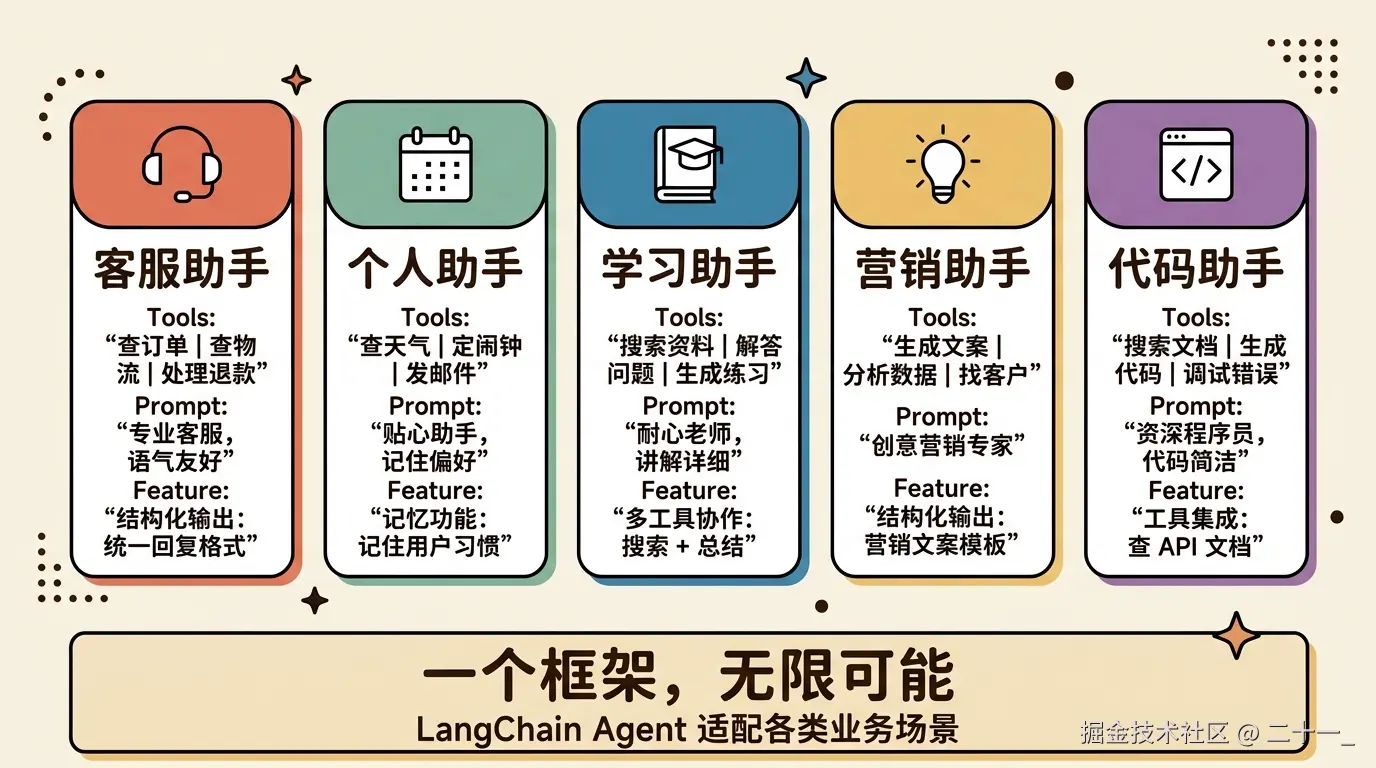
| 场景 | 工具需求 | 系统提示 | 特色功能 |
|---|---|---|---|
| 客服助手 | 查询订单、查物流、处理退款 | "你是专业客服,语气友好,解决问题" | |
| 结构化输出:统一回复格式 | |||
| 个人助手 | 查天气、定闹钟、发邮件 | "你是贴心助手,记住用户偏好" | 记忆功能:记住用户习惯 |
| 学习助手 | 搜索资料、解答问题、生成练习 | "你是耐心老师,讲解详细,鼓励学生" | 多工具协作:搜索 + 总结 |
| 营销助手 | 生成文案、分析数据、找客户 | "你是创意营销专家,善于抓痛点" | 结构化输出:营销文案模板 |
| 代码助手 | 搜索文档、生成代码、调试错误 | "你是资深程序员,代码简洁,注释清晰" | 工具集成:查 API 文档 |
示例:客服助手
工具:
query_order:查询订单状态track_shipment:查询物流信息process_refund:处理退款
系统提示:
rust
You are a helpful customer service agent.
Be friendly and patient.
Always try to solve the customer's problem.
If you need order information, use the query_order tool.
If you need shipping information, use the track_shipment tool.
If the customer wants a refund, use the process_refund tool.
使用:
typescript
const result = await agent.invoke({
  messages: [{ role: "user", content: "我的订单 #12345 发货了吗?" }]
});
常见问题与解决方案
| 问题 | 原因 | 解决方案 |
|---|---|---|
| Agent 不知道用工具 | 工具描述不够清晰 | 写更详细的 description,说明什么时候用 |
| Agent 回答格式不对 | 没有使用结构化输出 | 添加 responseFormat |
| Agent 记不住对话 | 没有添加记忆 | 使用 checkpointer 和 thread_id |
| Agent 说话风格不对 | 系统提示不够具体 | 写更详细的系统提示,指定风格 |
| 运行速度慢 | 模型参数设置不当 | 调整 temperature、timeout 等参数 |
| API Key 错误 | 环境变量没配置 | 检查环境变量是否正确设置 |
💡 调试技巧:
- 先从简单的工具开始
- 逐步添加功能
- 用
console.log打印中间结果- 检查 Agent 的思考过程
总结对比表
| 功能 | 基础 Agent | 真实世界 Agent | 区别 |
|---|---|---|---|
| 工具数量 | 1 个 | 多个 | 能力更全面 |
| 系统提示 | 无 | 详细 | 行为更规范 |
| 模型配置 | 默认 | 自定义 | 输出更稳定 |
| 结构化输出 | 无 | 有 | 格式更统一 |
| 记忆 | 无 | 有 | 能持续对话 |
| 代码量 | 10 行 | 50 行 | 功能更完整 |
| 适用场景 | 快速测试 | 生产环境 | 更专业可靠 |
核心要点回顾
-
✅ 快速开始 5 步:定义工具 → 创建 Agent → 配置参数 → 运行测试 → 扩展功能
-
✅ 10 行代码 :
tool()定义技能,createAgent()创建助手,invoke()启动任务 -
✅ 系统提示:给 Agent 设定角色、风格和规则,越具体越好
-
✅ 结构化输出:用 Zod 定义格式,让 Agent 返回固定结构的数据
-
✅ 记忆功能 :用
MemorySaver和thread_id让 Agent 记住对话 -
✅ 真实世界:多个工具、详细系统提示、自定义模型配置、结构化输出、记忆,这些是生产级 Agent 的标配
记住:快速开始的目的不是写完美的代码,而是快速体验 LangChain 的魅力。
先跑起来,再慢慢优化。你已经迈出了 AI 应用开发的第一步,接下来的路会越来越精彩!🚀
关注「WEB大前端」,每周分享技术实践和行业洞察。