BFS在算法中有极高的应用价值,我们也从这从这篇文章中来学习如何更好地使用!!!
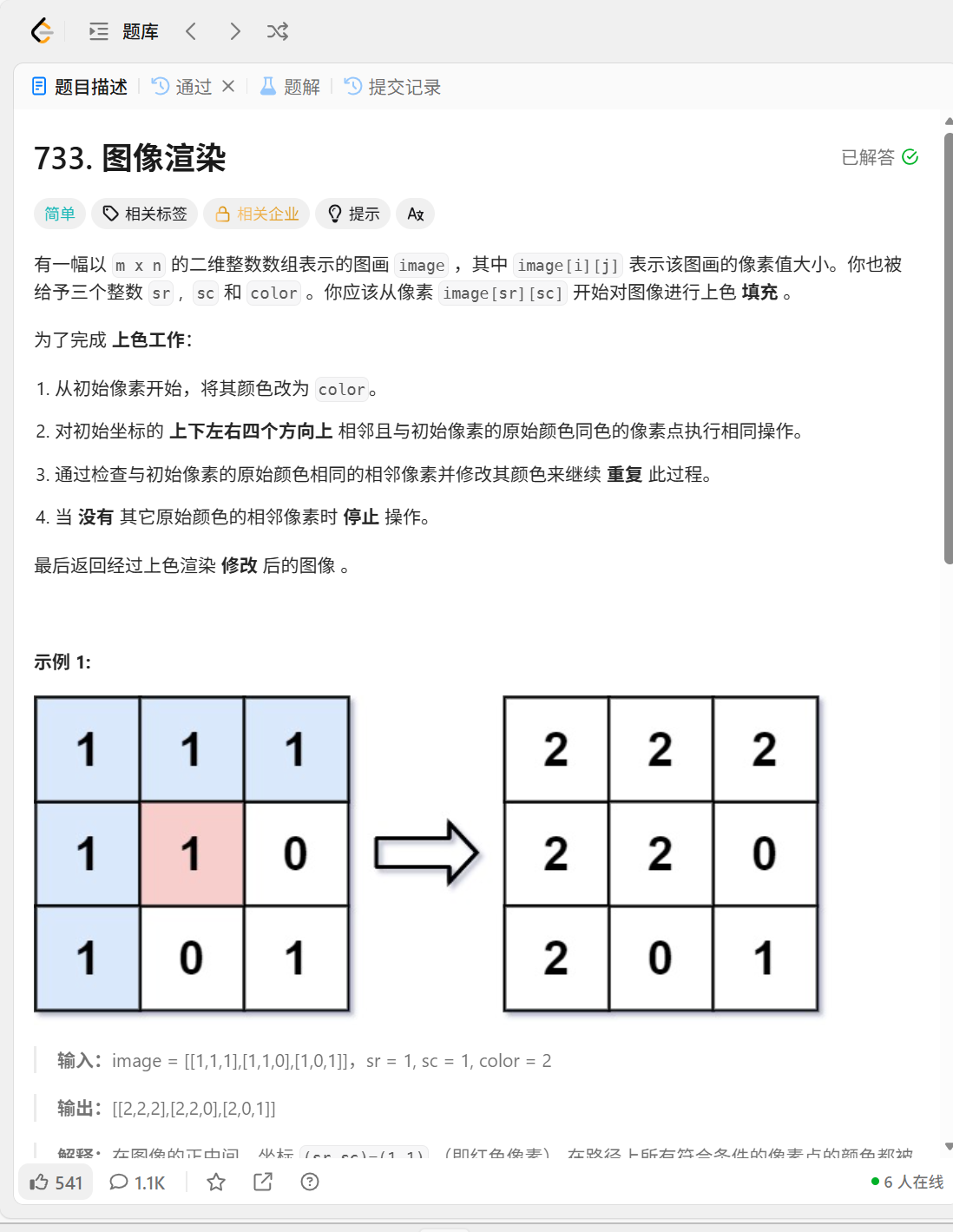

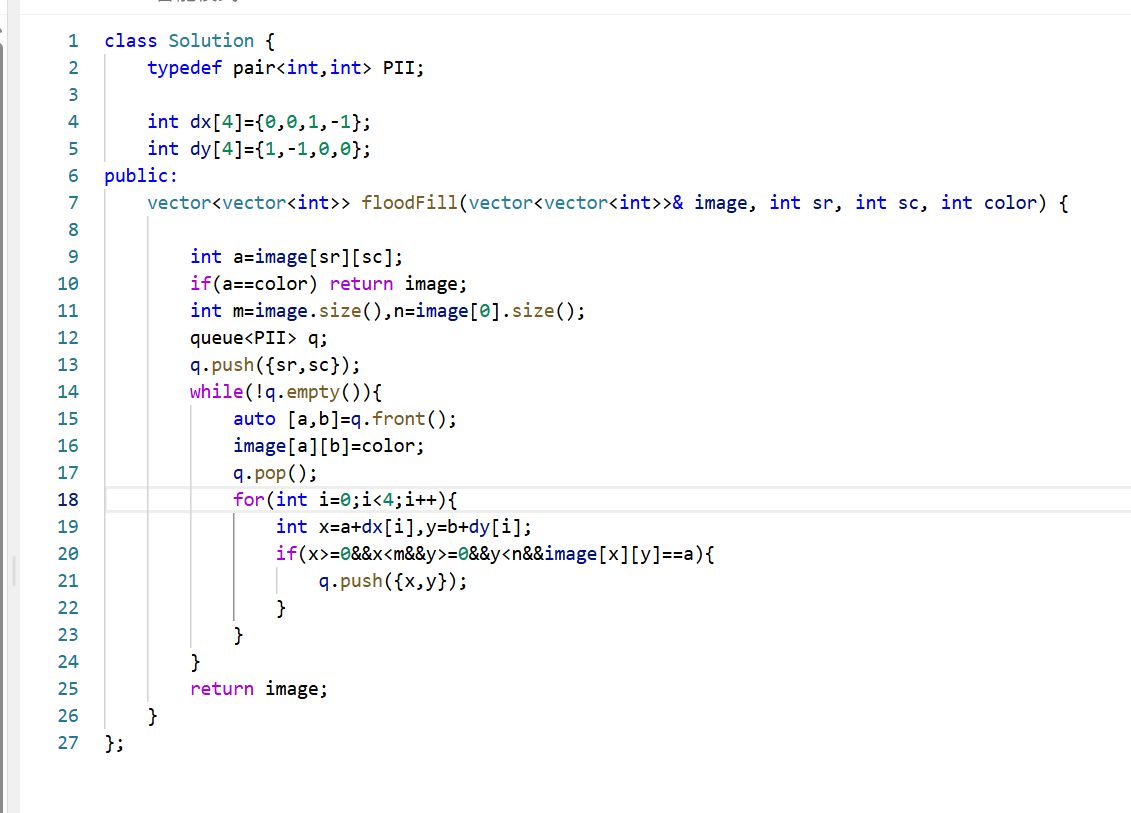
class Solution {
public:
const int dx4 = {1, 0, 0, -1};
const int dy4 = {0, 1, -1, 0};
vector<vector<int>> floodFill(vector<vector<int>>& image, int sr, int sc, int color) {
int currColor = imagesrsc;
if (currColor == color) {
return image;
}
int n = image.size(), m = image0.size();
queue<pair<int, int>> que;
que.emplace(sr, sc);
imagesrsc = color;
while (!que.empty()) {
int x = que.front().first, y = que.front().second;
que.pop();
for (int i = 0; i < 4; i++) {
int mx = x + dxi, my = y + dyi;
if (mx >= 0 && mx < n && my >= 0 && my < m && imagemxmy == currColor) {
que.emplace(mx, my);
imagemxmy = color;
}
}
}
return image;
}
};
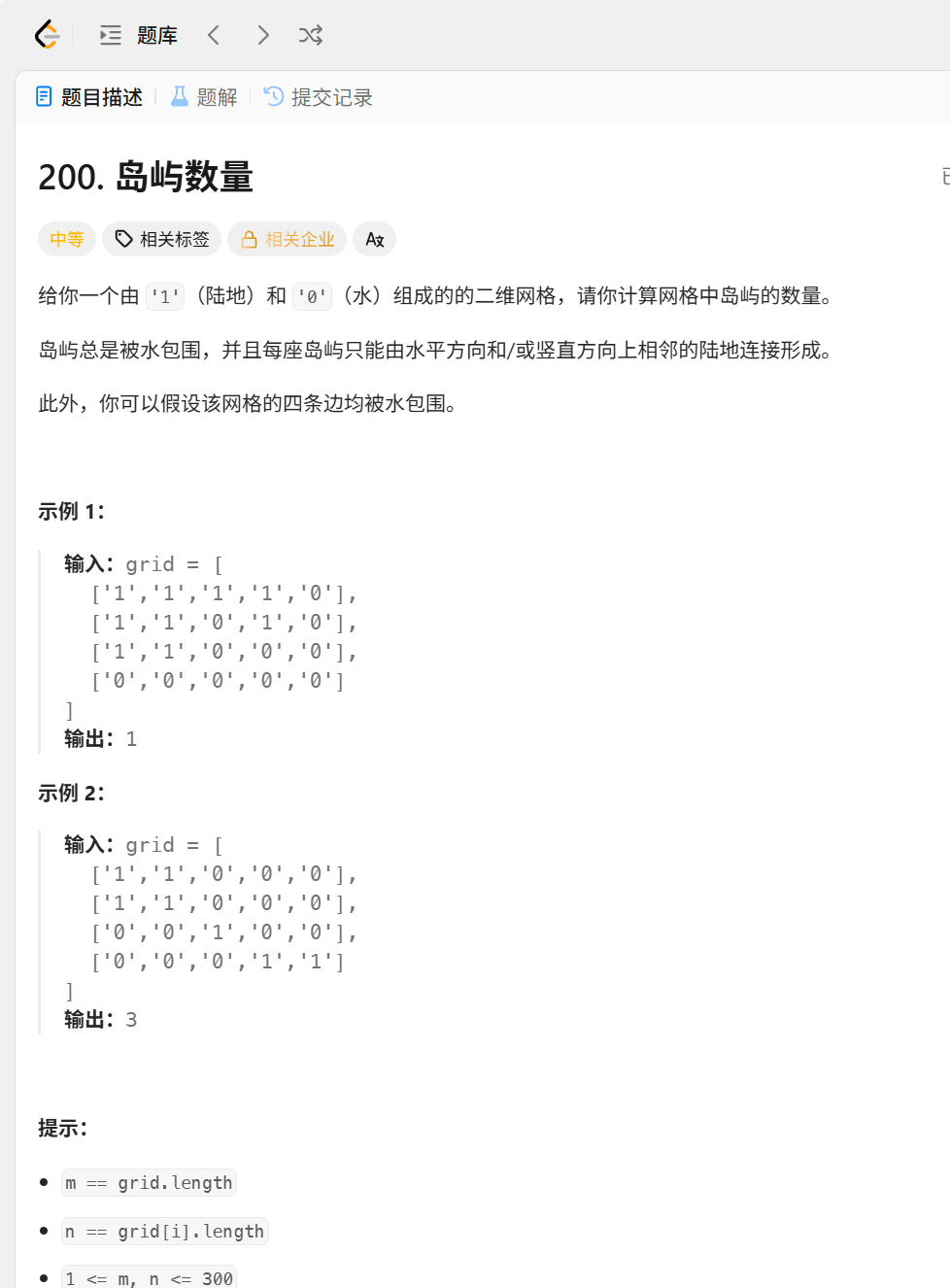
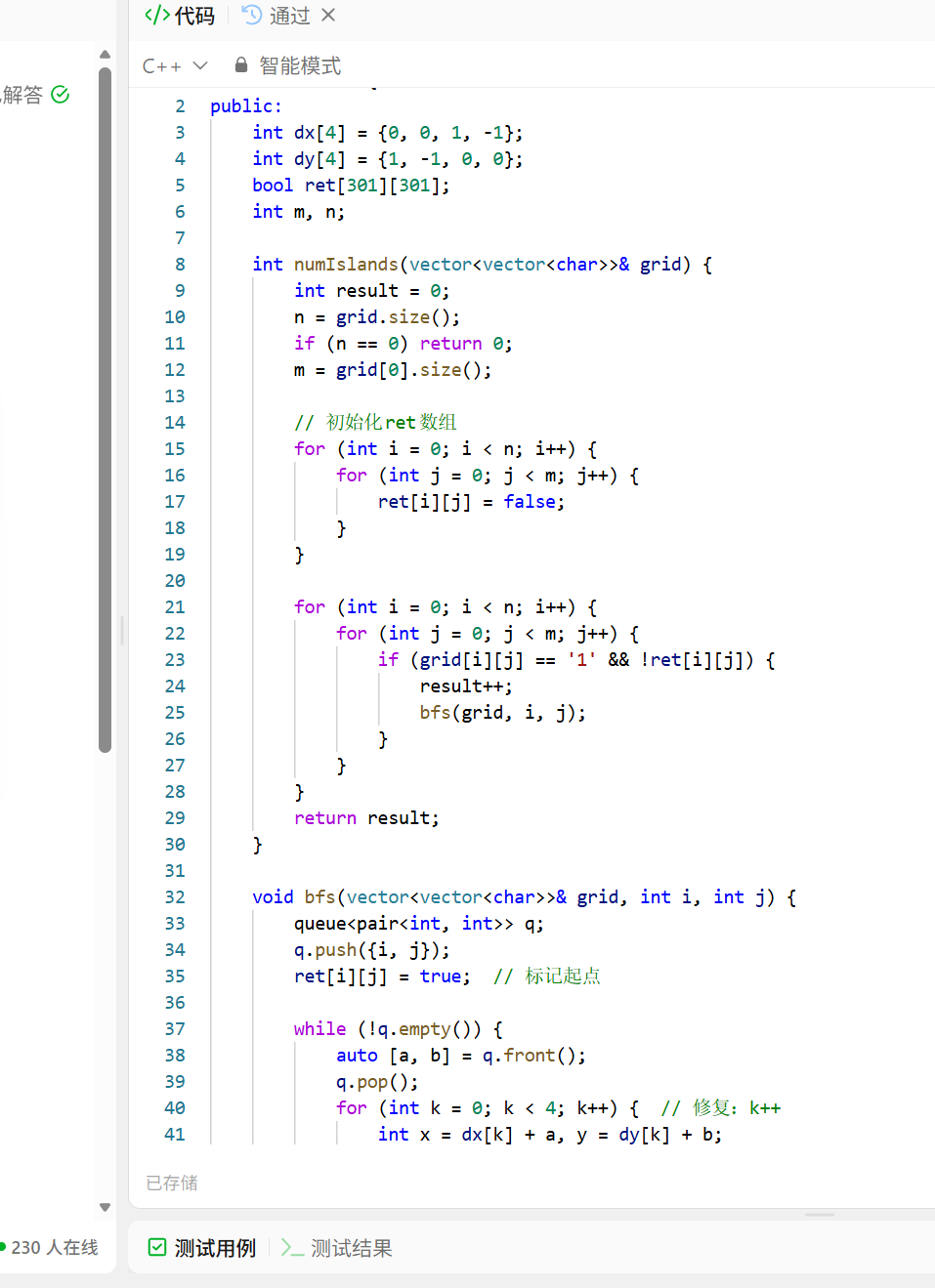
class Solution {
public:
int dx4 = {0, 0, 1, -1};
int dy4 = {1, -1, 0, 0};
bool ret301301;
int m, n;
int numIslands(vector<vector<char>>& grid) {
int result = 0;
n = grid.size();
if (n == 0) return 0;
m = grid0.size();
// 初始化ret数组
for (int i = 0; i < n; i++) {
for (int j = 0; j < m; j++) {
retij = false;
}
}
for (int i = 0; i < n; i++) {
for (int j = 0; j < m; j++) {
if (gridij == '1' && !retij) {
result++;
bfs(grid, i, j);
}
}
}
return result;
}
void bfs(vector<vector<char>>& grid, int i, int j) {
queue<pair<int, int>> q;
q.push({i, j});
retij = true; // 标记起点
while (!q.empty()) {
auto a, b = q.front();
q.pop();
for (int k = 0; k < 4; k++) { // 修复:k++
int x = dxk + a, y = dyk + b;
if (x >= 0 && x < n && y >= 0 && y < m &&
gridxy == '1' && !retxy) {
q.push({x, y});
retxy = true;
}
}
}
}
};
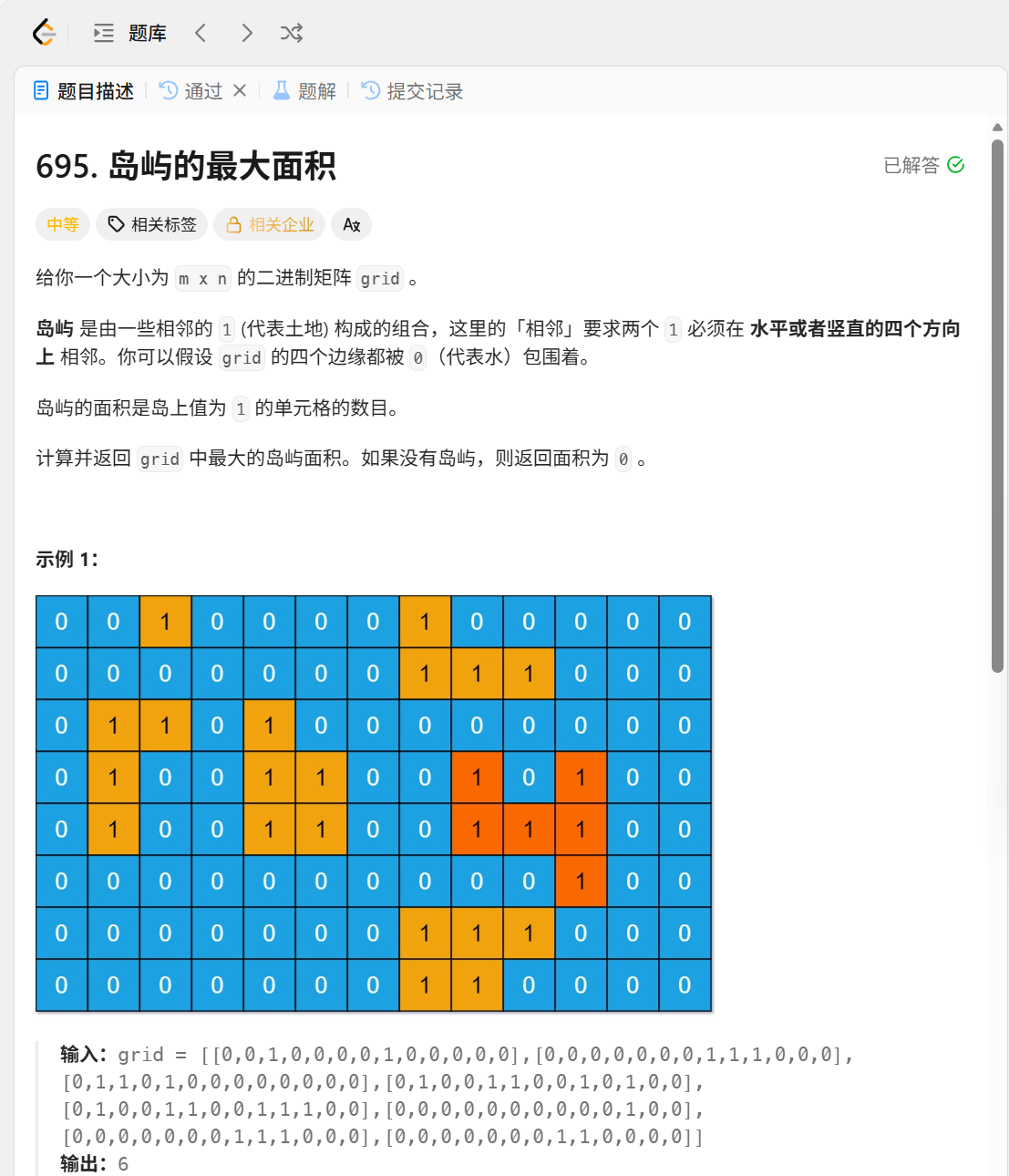
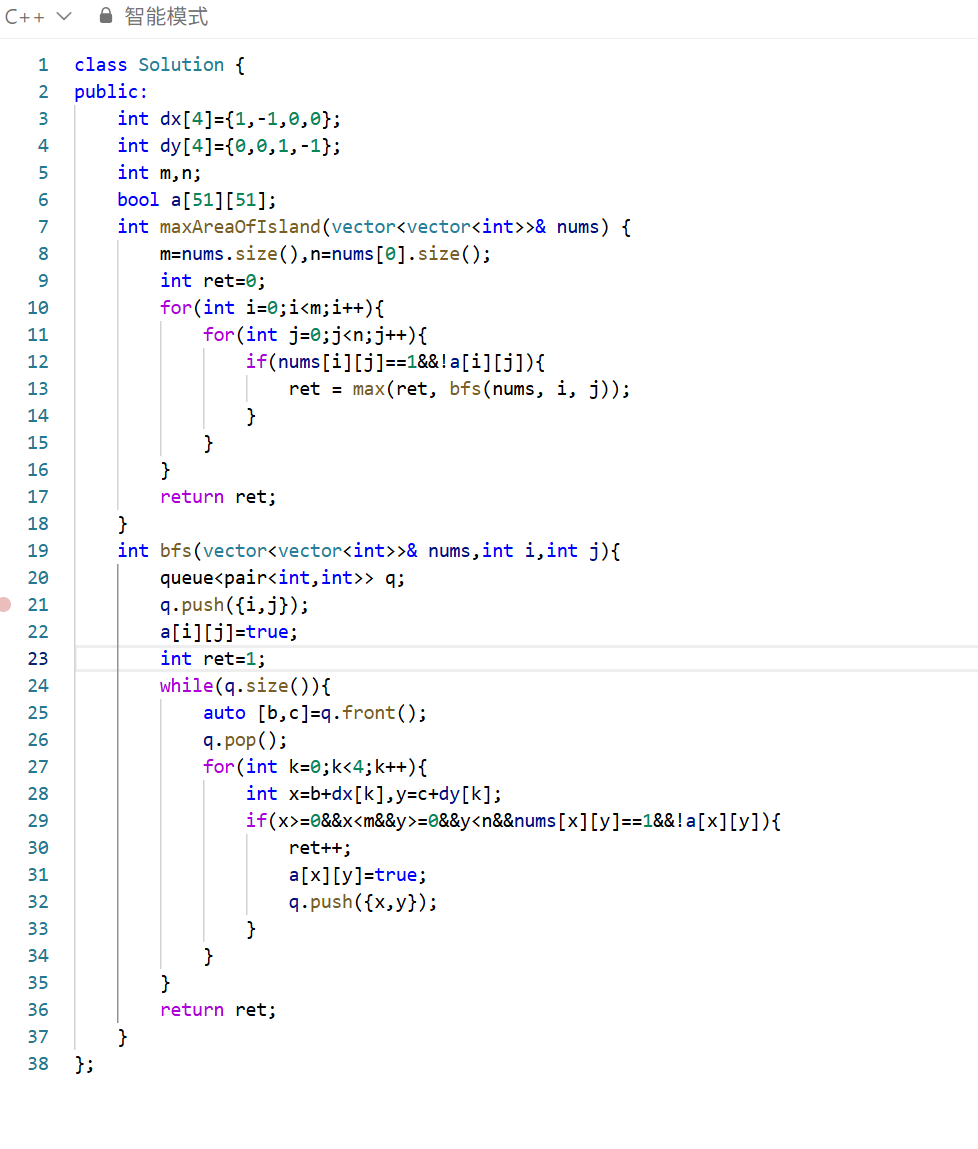

class Solution {
public:
int dx4={1,-1,0,0};
int dy4={0,0,1,-1};
int m,n;
bool a5151;
int maxAreaOfIsland(vector<vector<int>>& nums) {
m=nums.size(),n=nums0.size();
int ret=0;
for(int i=0;i<m;i++){
for(int j=0;j<n;j++){
if(numsij==1&&!aij){
ret = max(ret, bfs(nums, i, j));
}
}
}
return ret;
}
int bfs(vector<vector<int>>& nums,int i,int j){
queue<pair<int,int>> q;
q.push({i,j});
aij=true;
int ret=1;
while(q.size()){
auto b,c=q.front();
q.pop();
for(int k=0;k<4;k++){
int x=b+dxk,y=c+dyk;
if(x>=0&&x<m&&y>=0&&y<n&&numsxy==1&&!axy){
ret++;
axy=true;
q.push({x,y});
}
}
}
return ret;
}
};
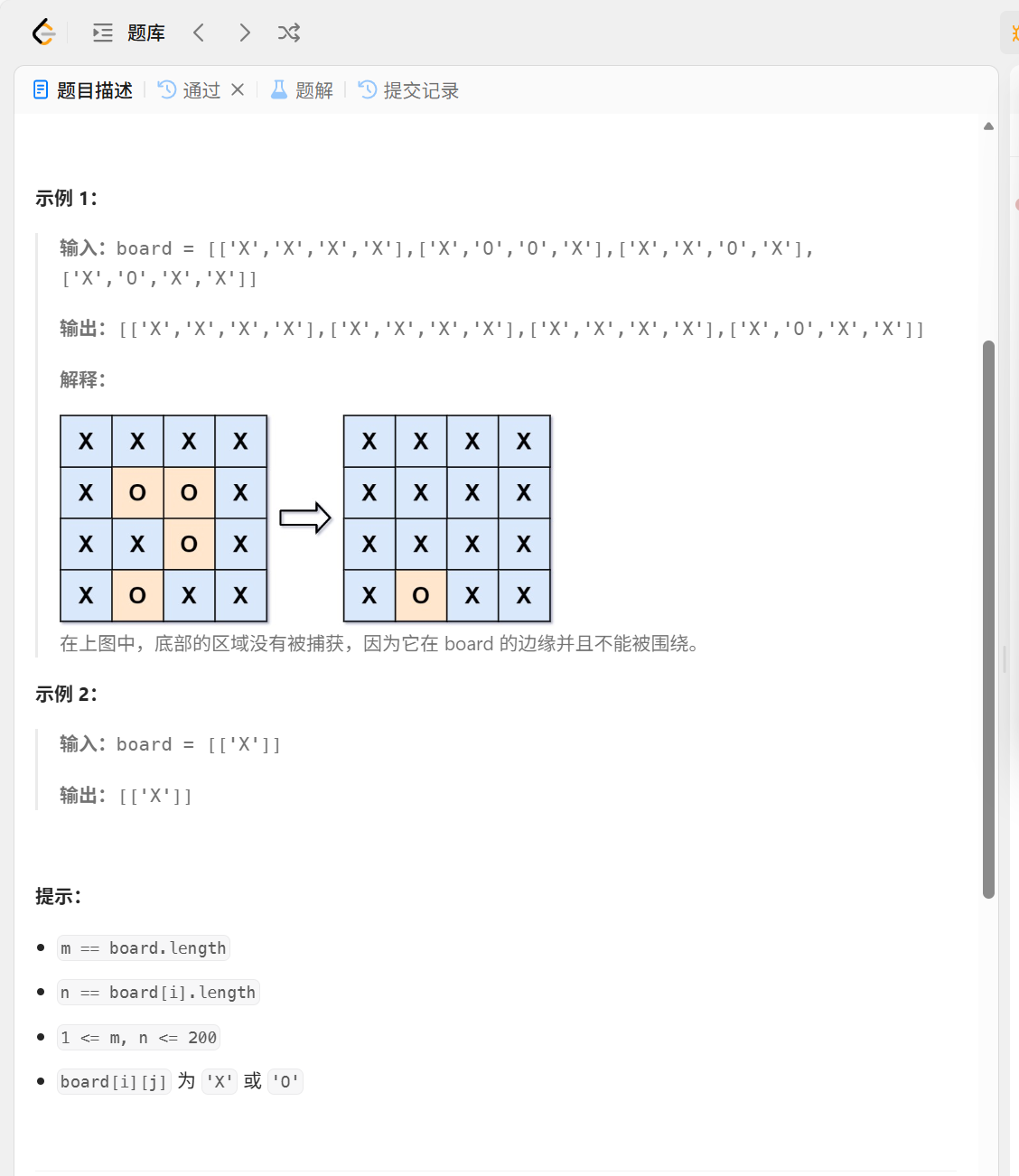
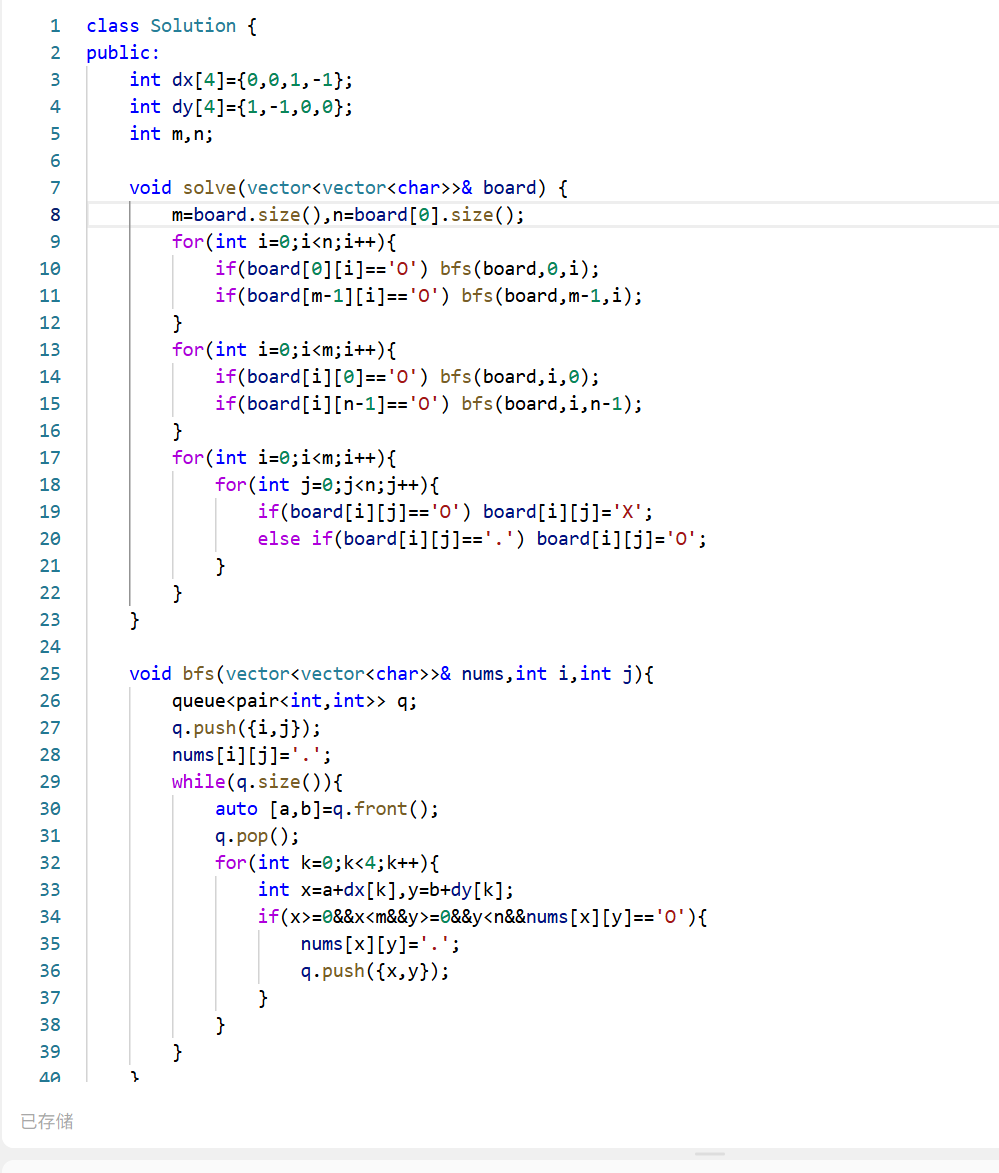

class Solution {
public:
    int dx[4]={0,0,1,-1};
    int dy[4]={1,-1,0,0};
    int m,n;

    void solve(vector<vector<char>>& board) {
        m=board.size(),n=board[0].size();
        for(int i=0;i<n;i++){
            if(board[0][i]=='O') bfs(board,0,i);
            if(board[m-1][i]=='O') bfs(board,m-1,i);
        }
        for(int i=0;i<m;i++){
            if(board[i][0]=='O') bfs(board,i,0);
            if(board[i][n-1]=='O') bfs(board,i,n-1);
        }
        for(int i=0;i<m;i++){
            for(int j=0;j<n;j++){
                if(board[i][j]=='O') board[i][j]='X';
                else if(board[i][j]=='.') board[i][j]='O';
            }
        }
    }

    void bfs(vector<vector<char>>& nums,int i,int j){
        queue<pair<int,int>> q;
        q.push({i,j});
        nums[i][j]='.';
        while(q.size()){
            auto [a,b]=q.front();
            q.pop();
            for(int k=0;k<4;k++){
                int x=a+dx[k],y=b+dy[k];
                if(x>=0&&x<m&&y>=0&&y<n&&nums[x][y]=='O'){
                    nums[x][y]='.';
                    q.push({x,y});
                }
            }
        }
    }
};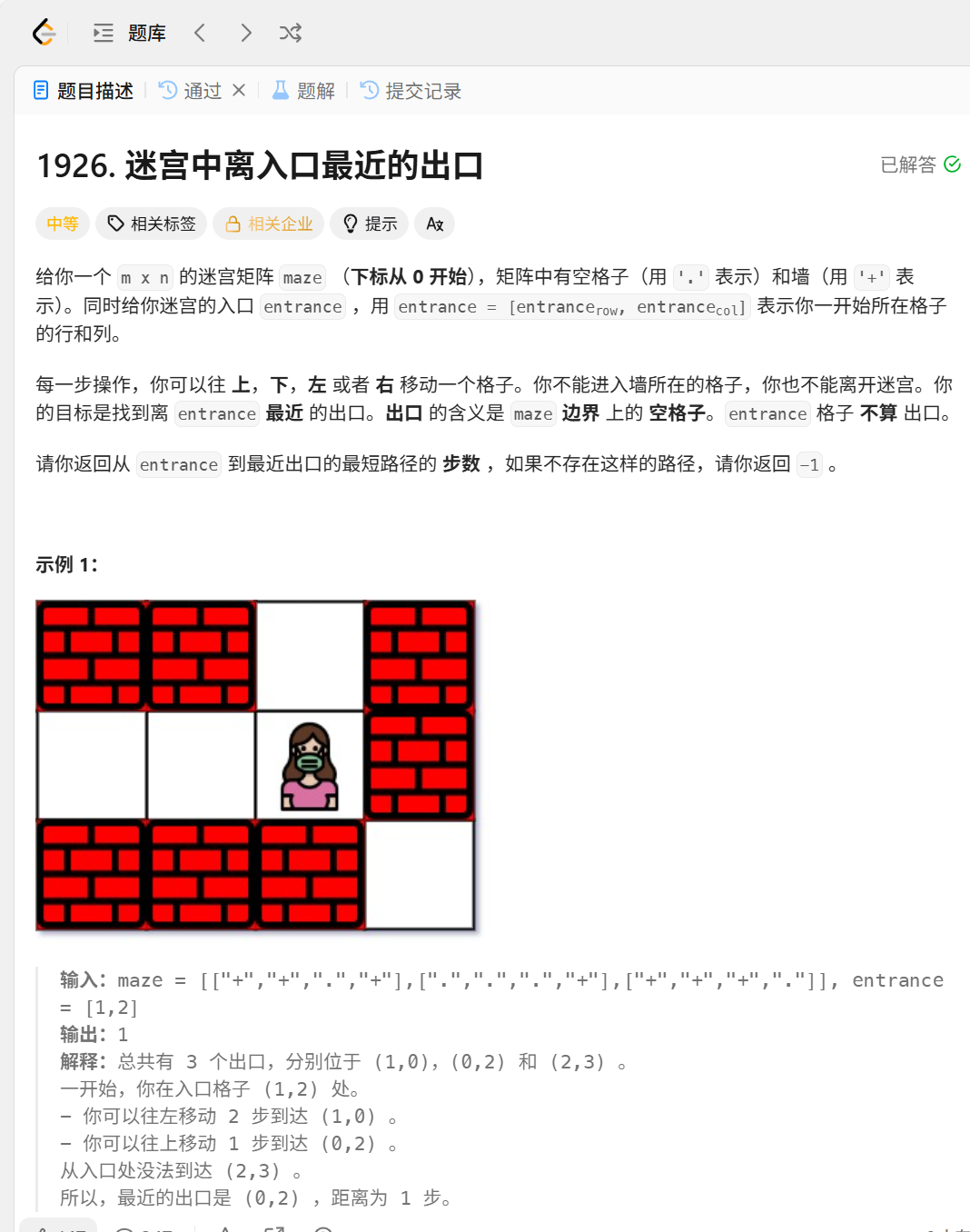
class Solution {
public:
int dx4={0,0,1,-1};
int dy4={1,-1,0,0};
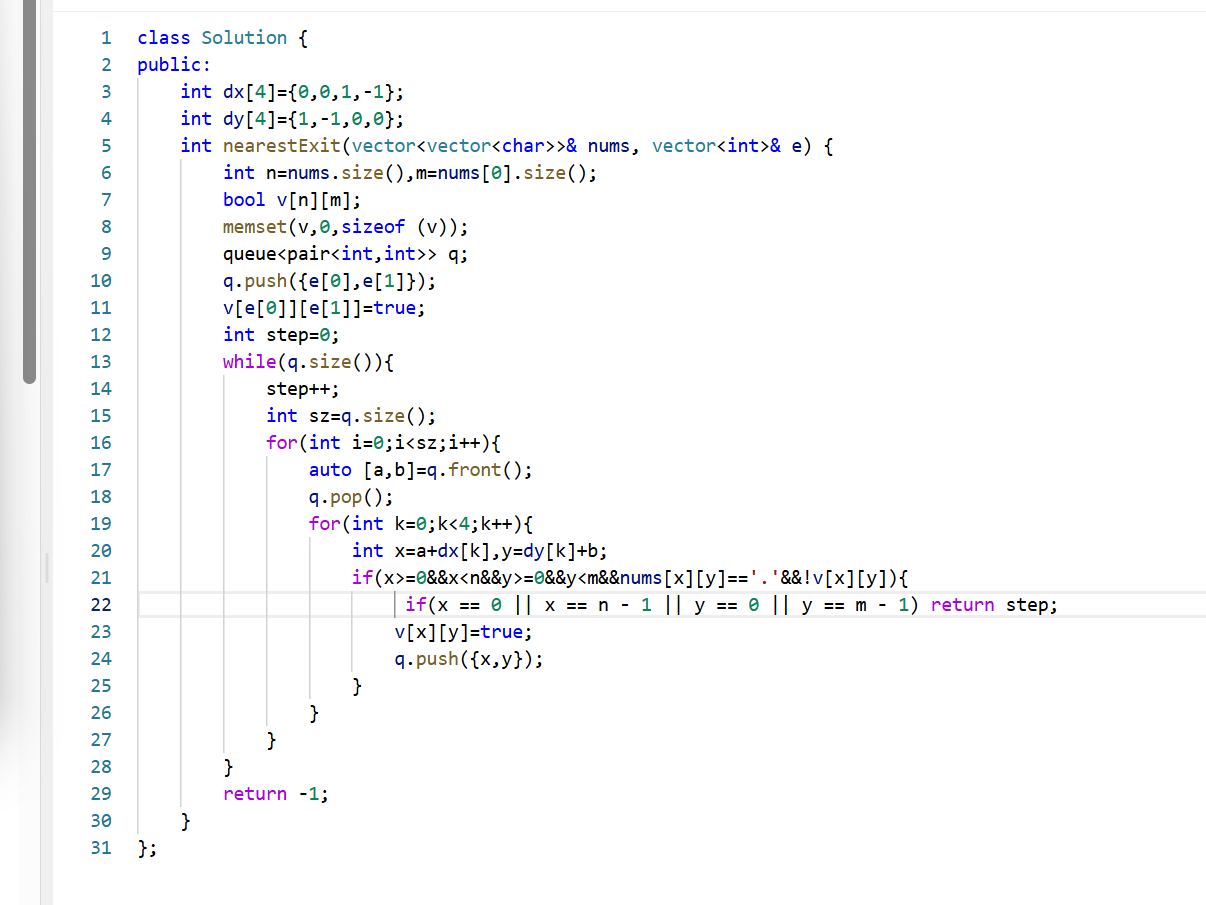
int nearestExit(vector<vector<char>>& nums, vector<int>& e) {
int n=nums.size(),m=nums0.size();
bool vnm;
memset(v,0,sizeof (v));
queue<pair<int,int>> q;
q.push({e0,e1});
ve\[0]e\[1]=true;
int step=0;
while(q.size()){
step++;
int sz=q.size();
for(int i=0;i<sz;i++){
auto a,b=q.front();
q.pop();
for(int k=0;k<4;k++){
int x=a+dxk,y=dyk+b;
if(x>=0&&x<n&&y>=0&&y<m&&numsxy=='.'&&!vxy){
if(x == 0 || x == n - 1 || y == 0 || y == m - 1) return step;
vxy=true;
q.push({x,y});
}
}
}
}
return -1;
}
};
z注:memset的作用是将整个数组清零

class Solution {
public:
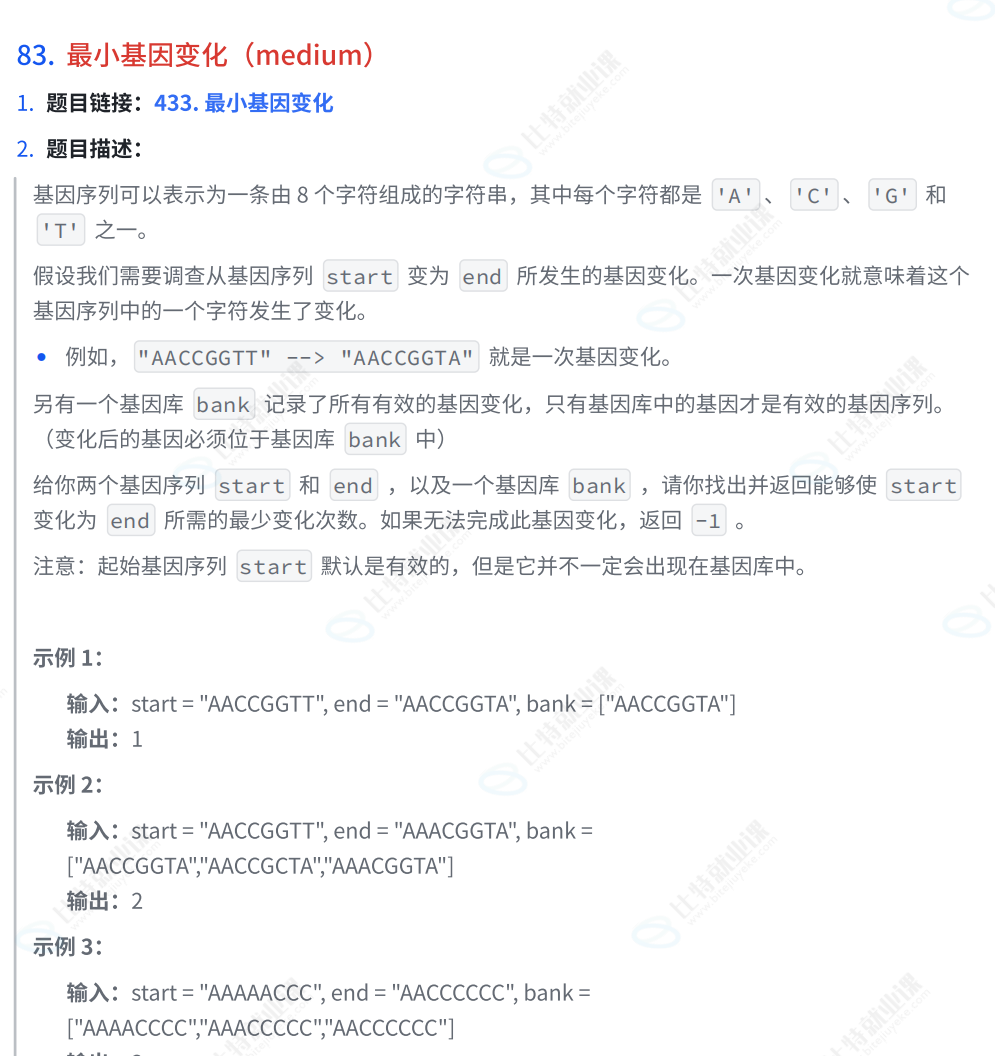
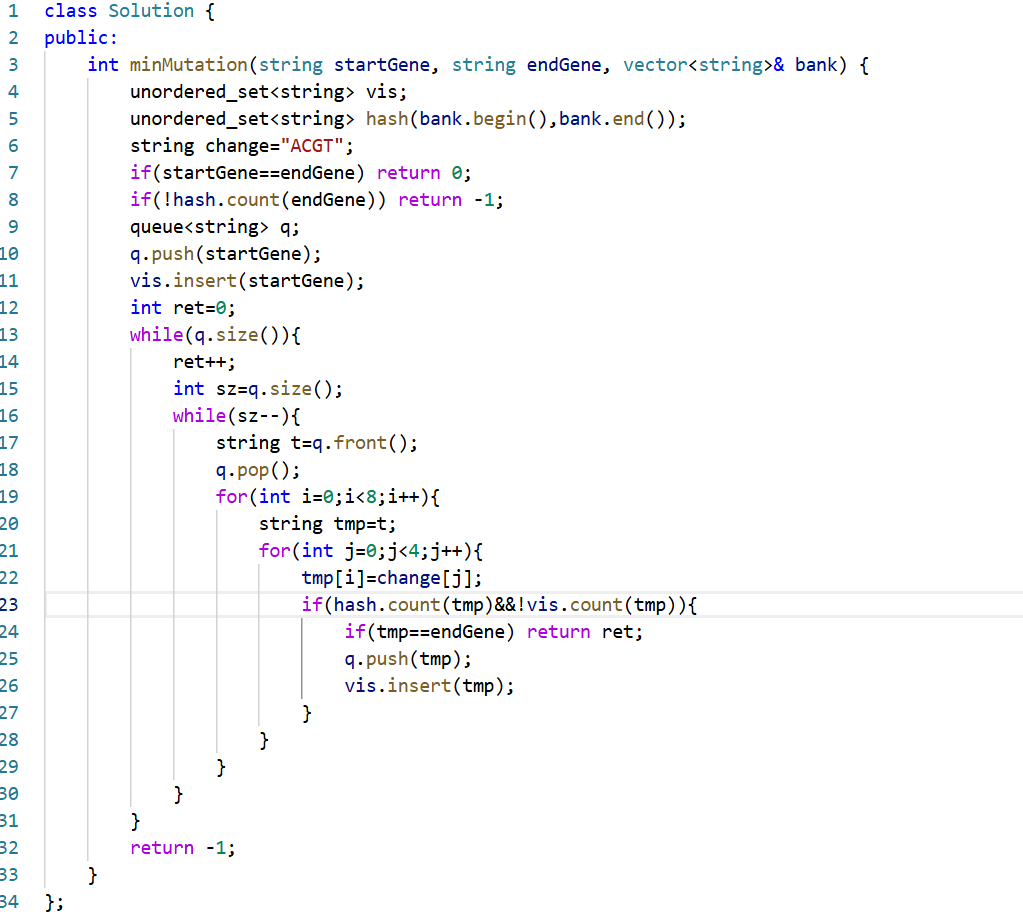
int minMutation(string startGene, string endGene, vector<string>& bank) {
unordered_set<string> vis;
unordered_set<string> hash(bank.begin(),bank.end());
string change="ACGT";
if(startGene==endGene) return 0;
if(!hash.count(endGene)) return -1;
queue<string> q;
q.push(startGene);
vis.insert(startGene);
int ret=0;
while(q.size()){
ret++;
int sz=q.size();
while(sz--){
string t=q.front();
q.pop();
for(int i=0;i<8;i++){
string tmp=t;
for(int j=0;j<4;j++){
tmpi=changej;
if(hash.count(tmp)&&!vis.count(tmp)){
if(tmp==endGene) return ret;
q.push(tmp);
vis.insert(tmp);
}
}
}
}
}
return -1;
}
};
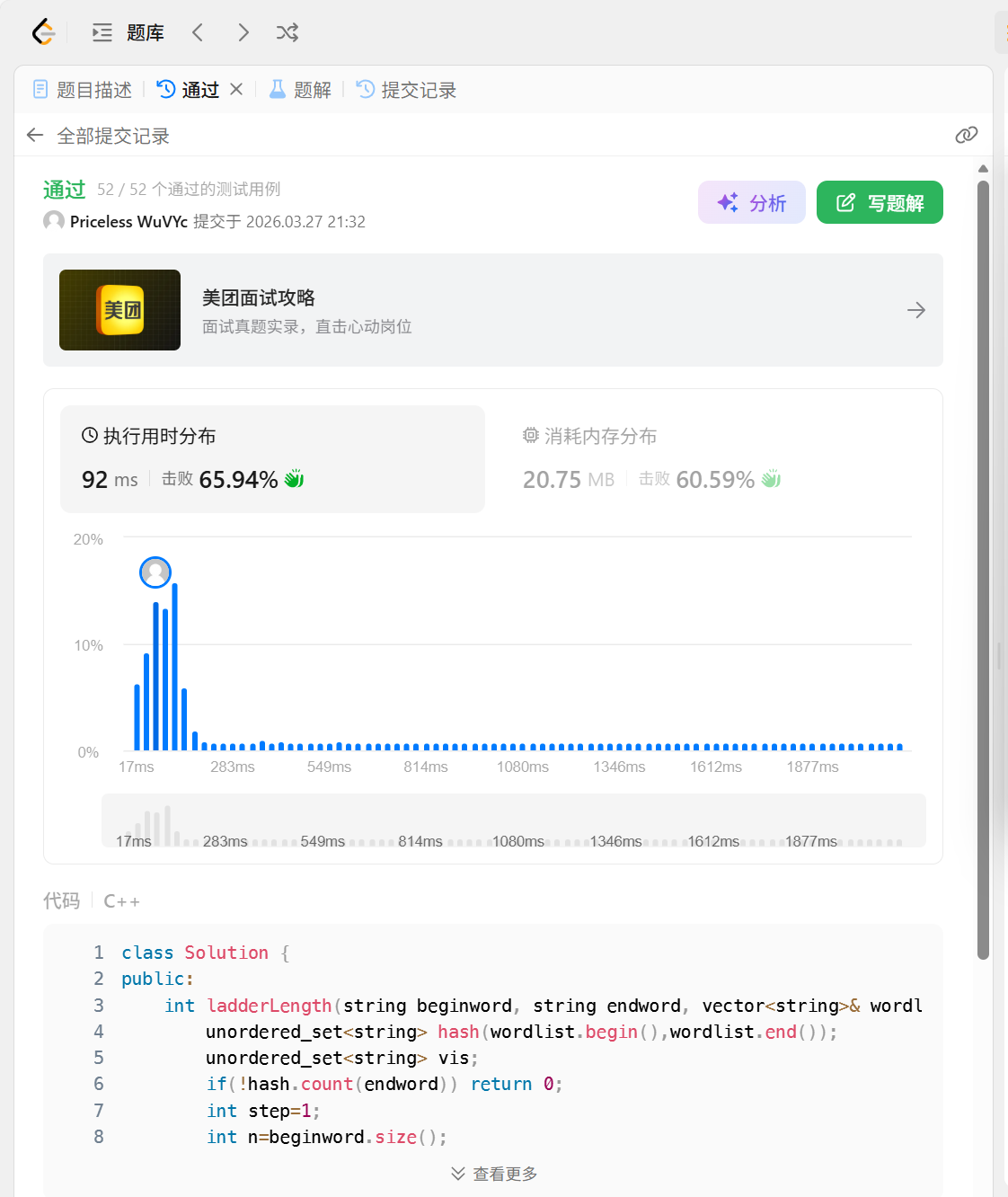
class Solution {
public:
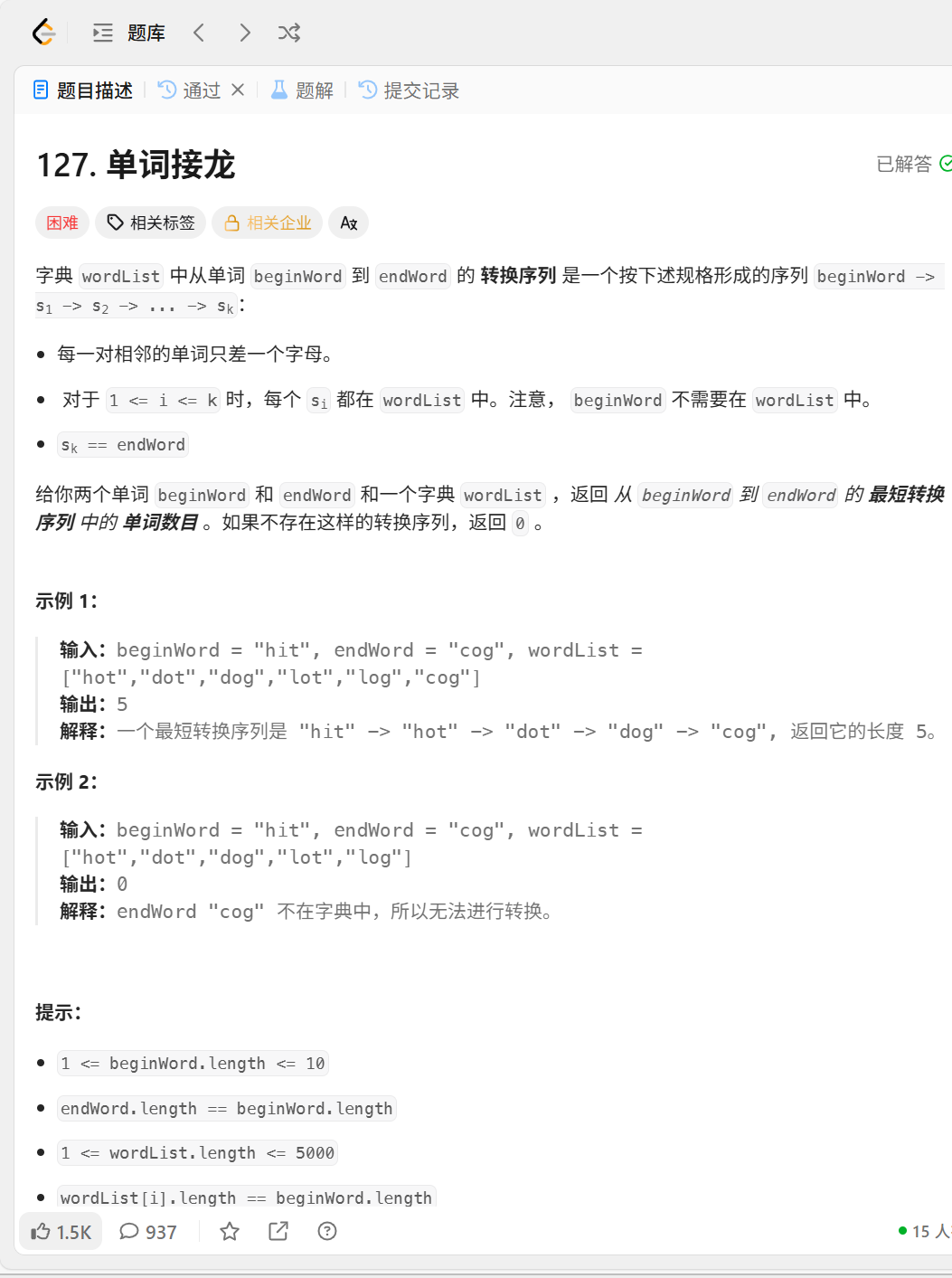
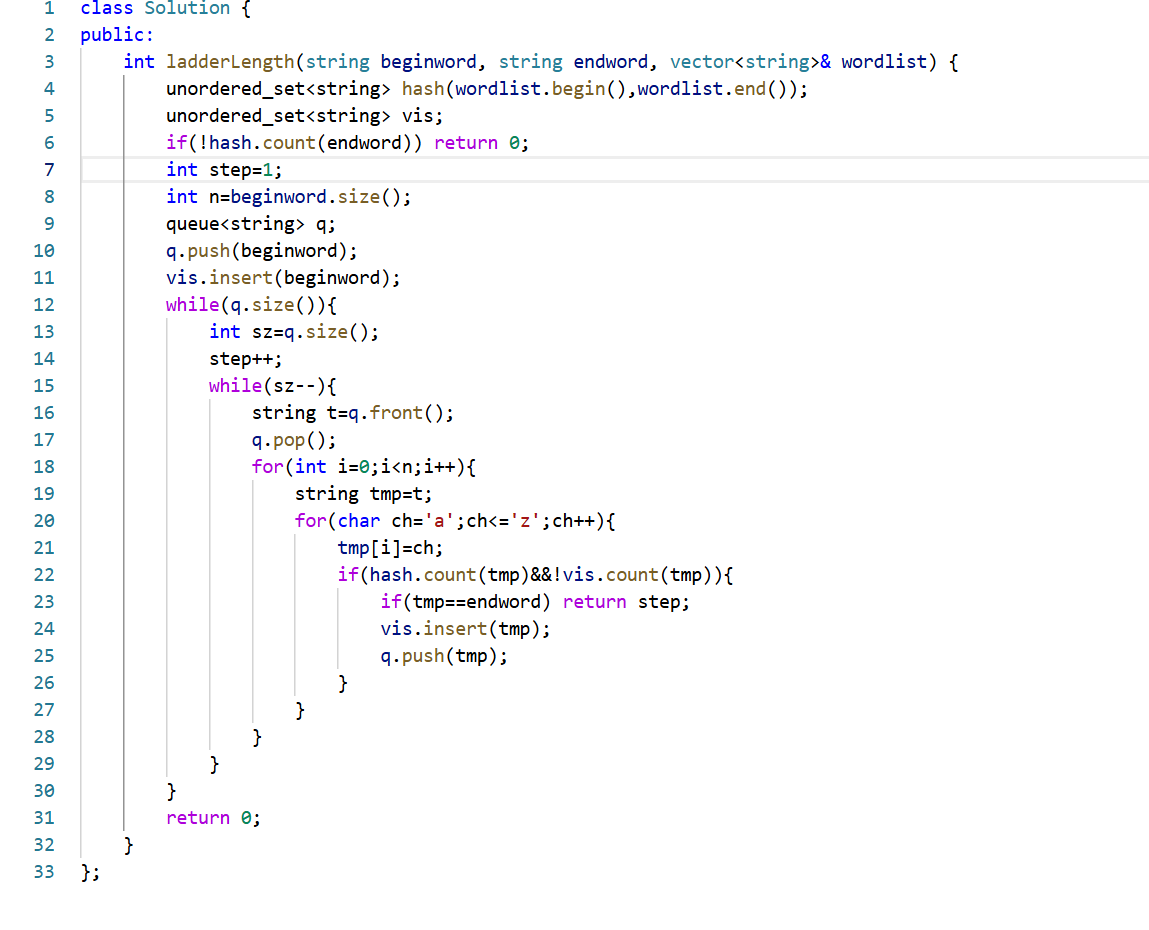
int ladderLength(string beginword, string endword, vector<string>& wordlist) {
unordered_set<string> hash(wordlist.begin(),wordlist.end());
unordered_set<string> vis;
if(!hash.count(endword)) return 0;
int step=1;
int n=beginword.size();
queue<string> q;
q.push(beginword);
vis.insert(beginword);
while(q.size()){
int sz=q.size();
step++;
while(sz--){
string t=q.front();
q.pop();
for(int i=0;i<n;i++){
string tmp=t;
for(char ch='a';ch<='z';ch++){
tmpi=ch;
if(hash.count(tmp)&&!vis.count(tmp)){
if(tmp==endword) return step;
vis.insert(tmp);
q.push(tmp);
}
}
}
}
}
return 0;
}
};
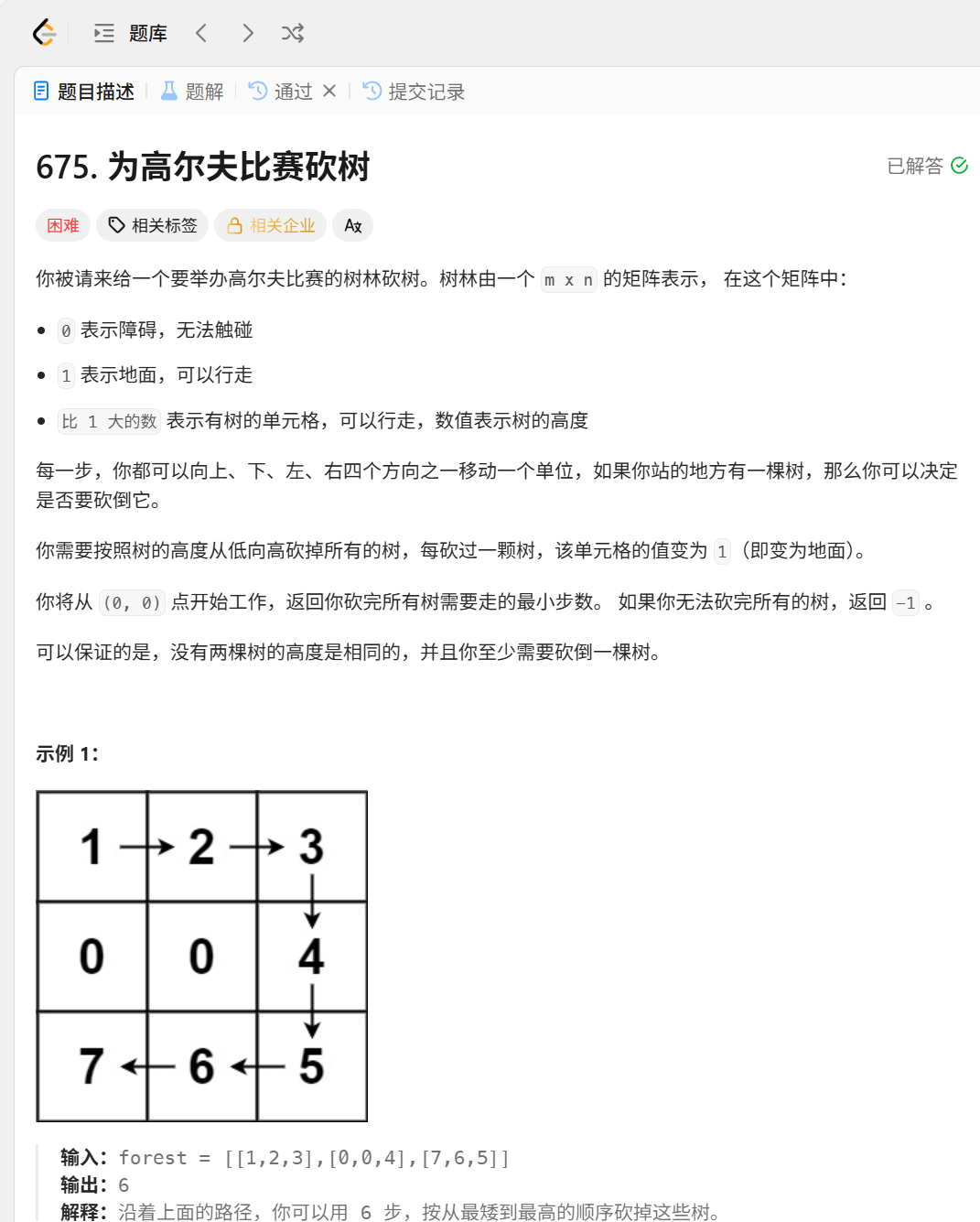
class Solution {
public:
int m, n;
int dx4 = {0, 0, 1, -1};
int dy4 = {1, -1, 0, 0};
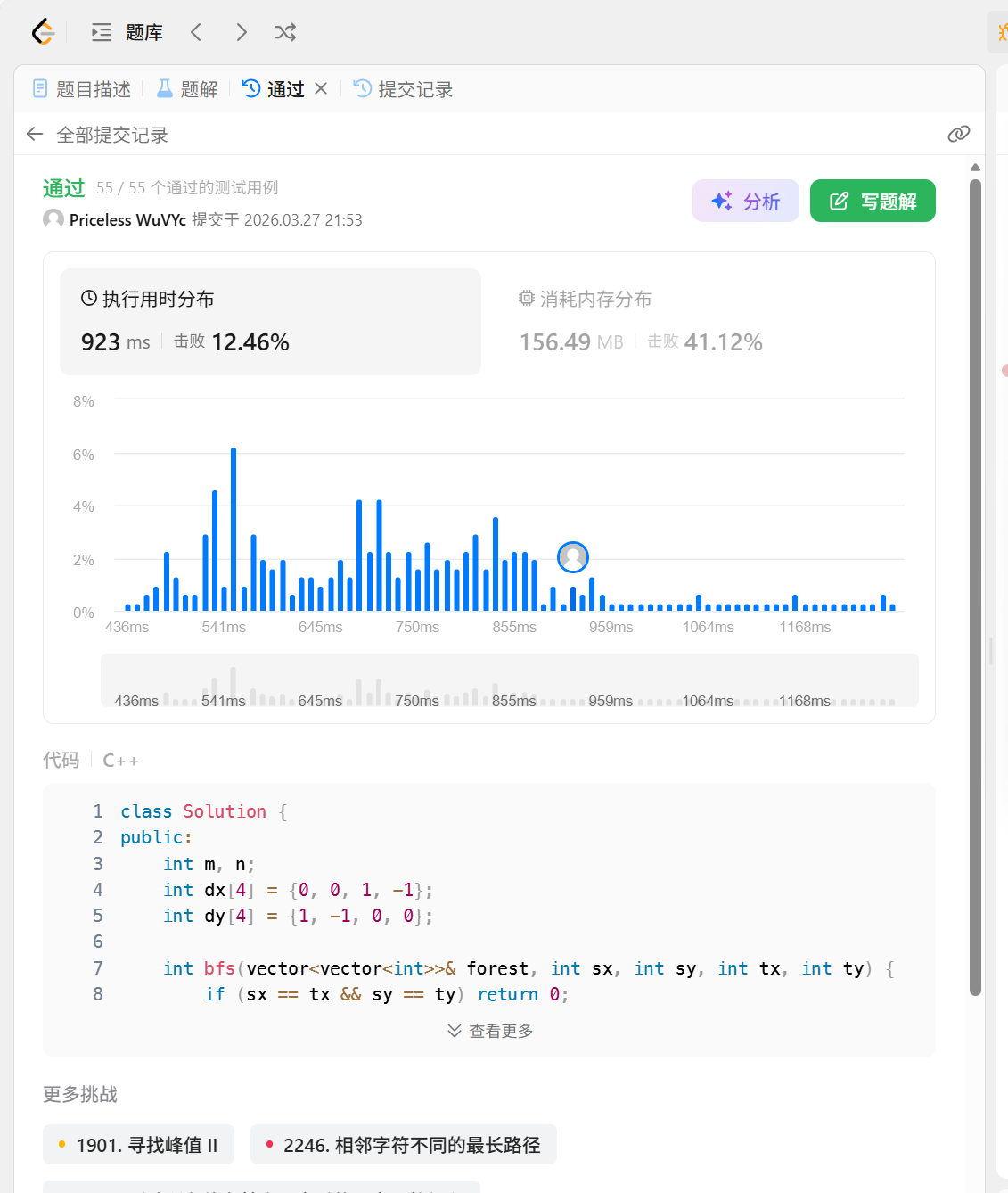
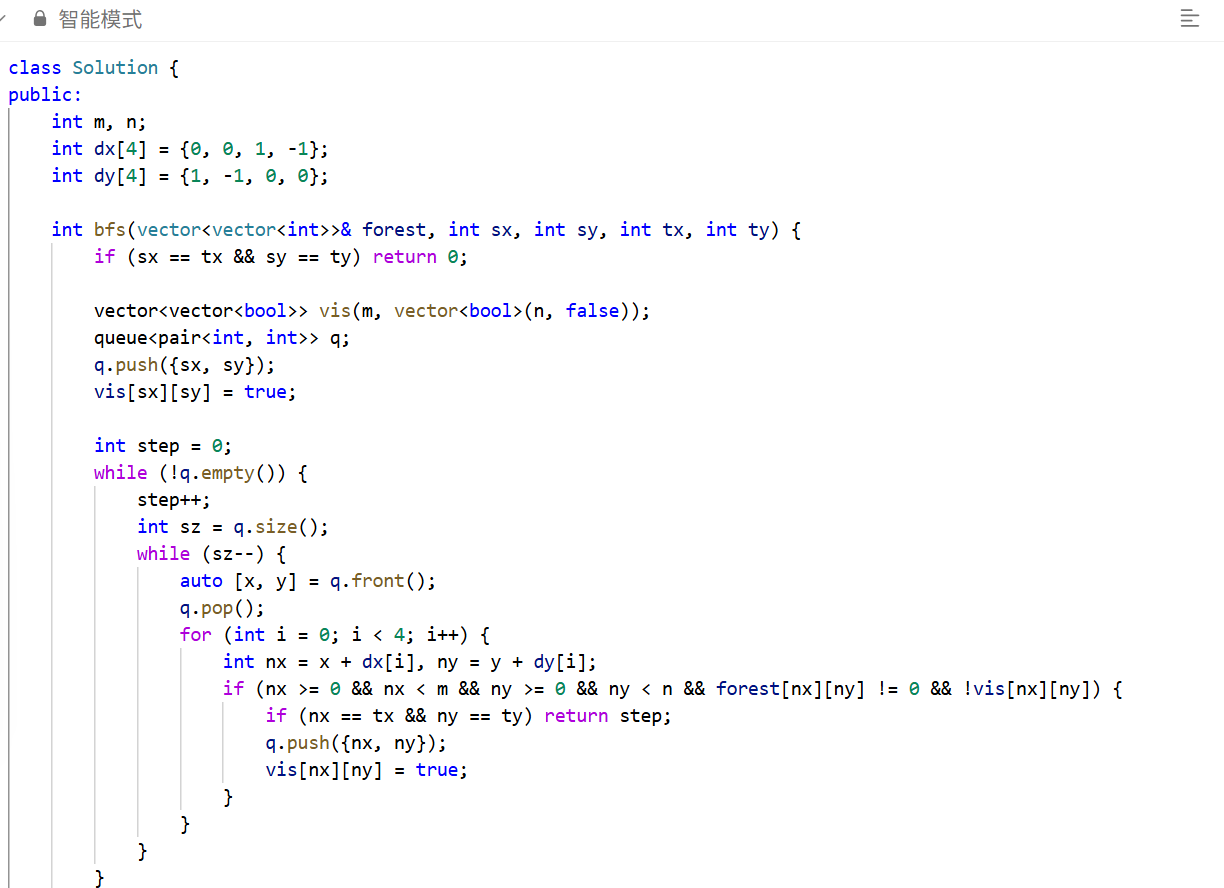
int bfs(vector<vector<int>>& forest, int sx, int sy, int tx, int ty) {
if (sx == tx && sy == ty) return 0;
vector<vector<bool>> vis(m, vector<bool>(n, false));
queue<pair<int, int>> q;
q.push({sx, sy});
vissxsy = true;
int step = 0;
while (!q.empty()) {
step++;
int sz = q.size();
while (sz--) {
auto x, y = q.front();
q.pop();
for (int i = 0; i < 4; i++) {
int nx = x + dxi, ny = y + dyi;
if (nx >= 0 && nx < m && ny >= 0 && ny < n && forestnxny != 0 && !visnxny) {
if (nx == tx && ny == ty) return step;
q.push({nx, ny});
visnxny = true;
}
}
}
}
return -1;
}
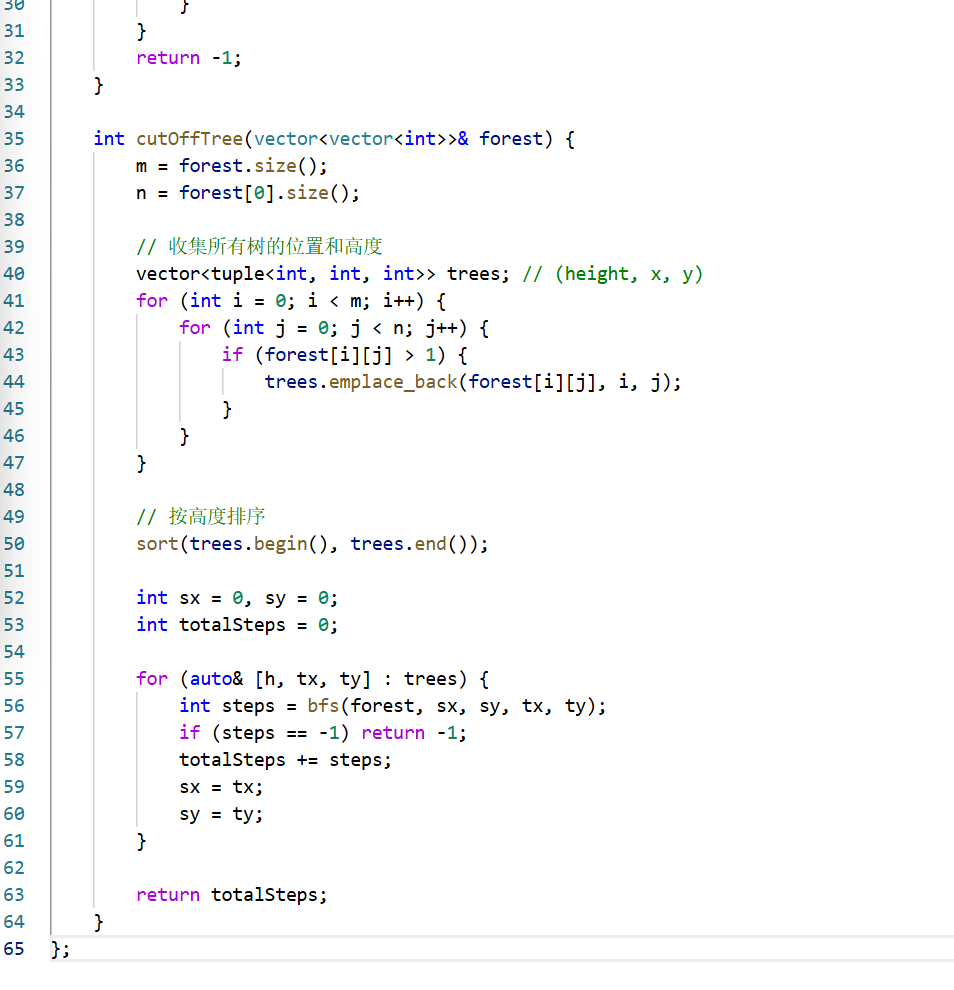
int cutOffTree(vector<vector<int>>& forest) {
m = forest.size();
n = forest0.size();
// 收集所有树的位置和高度
vector<tuple<int, int, int>> trees; // (height, x, y)
for (int i = 0; i < m; i++) {
for (int j = 0; j < n; j++) {
if (forestij > 1) {
trees.emplace_back(forestij, i, j);
}
}
}
// 按高度排序
sort(trees.begin(), trees.end());
int sx = 0, sy = 0;
int totalSteps = 0;
for (auto& h, tx, ty : trees) {
int steps = bfs(forest, sx, sy, tx, ty);
if (steps == -1) return -1;
totalSteps += steps;
sx = tx;
sy = ty;
}
return totalSteps;
}
};