注意力机制
Transformer 的核心是自注意力 与多头注意力,让序列每个位置都能动态关注全局相关信息,并行捕捉长程依赖。
自注意力公式
多头注意力公式
计算步骤
参照论文说明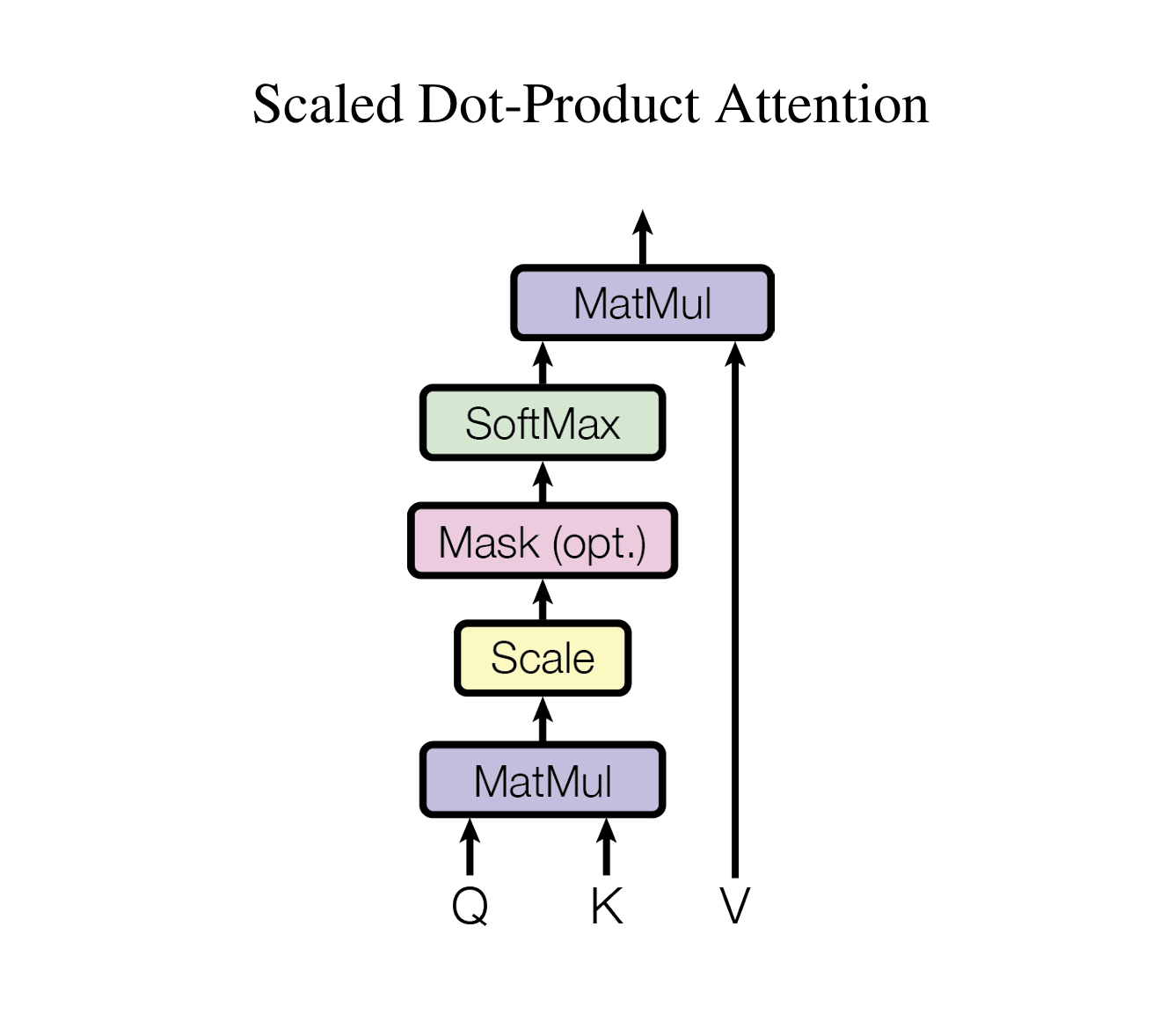
-
Q、 K矩阵相乘
-
缩放处理
-
加掩码处理 是可选项
-
Softmax 归一化指数函数
-
与V矩阵相乘
本着简单的原则,用一个实例来说明Q,K,V计算过程
实例
自注意力
实现代码
例子 "Welcome to Machine Learning Pad Pad" 经过 词嵌入 和**位置编码,**得到6X4矩阵,为了方便计算对这个矩阵手动设置特定的数据
cpp
/*

	{"Pad",      0},
	{"Welcome",  1},
	{"to",       2},
	{"Machine",  3},
	{"Learning", 4}

	1. Welcome to Machine Learning Pad Pad -- > [1,2,3,4,0,0]

	2. Embedding + PositionalEncoding        ->  x

	3. x: [6 ,4]

*/

	auto x = torch::tensor({
				{{1.0, 0.0, 0.0, 0.0}, // Welcome
				 {2.0, 0.0, 0.0, 0.0}, // to
				 {3.0, 0.0, 0.0, 0.0}, // Machine
				 {4.0, 0.0, 0.0, 0.0}, // Learning
				 {0.0, 0.0, 0.0, 0.0}, // Pad
				 {0.0, 0.0, 0.0, 0.0}  // Pad
				} }, torch::kFloat);
Q,K,V是一组权重 它的词嵌入的 维度**,**为了方便计算都它们设定单位矩阵
cpp
class SelfAttention : public torch::nn::Module
{
public:
	SelfAttention()
	{


	}
	void InitQKV(int64_t dim)
	{
		auto linear = torch::nn::LinearOptions(dim, dim).bias(false);

		Q = register_module("q", torch::nn::Linear(linear));
		K = register_module("k", torch::nn::Linear(linear));
		V = register_module("v", torch::nn::Linear(linear));

		norm_fact = 1.0 / sqrt(dim); // 缩放

		auto onesw = torch::eye(dim);  //单位矩阵

		Q->weight.set_data(onesw);
		K->weight.set_data(onesw);
		V->weight.set_data(onesw);
	}


	torch::nn::Linear Q{ nullptr };
	torch::nn::Linear K{ nullptr };
	torch::nn::Linear V{ nullptr };
	double norm_fact = 0 ;
};
torch::nn::Transformer 要求输入张量形状**seq, batch, dim,** 这里简单化为**seq,dim**
参照论文实现计算步骤
cpp
	auto forward(torch::Tensor x,torch::Tensor mask = {})
	{
		torch::Tensor q ;
		torch::Tensor k ;
		torch::Tensor v;
		torch::Tensor kt;
		torch::Tensor out;

		auto dim = x.dim();


		// x: [seq, dim]
		InitQKV(x.size(1));

		/// 1.输入x 与 q k v 运算  q k v是 单位矩阵所以 q k v = x
		 q = Q->forward(x);
		 k = K->forward(x);
		 v = V->forward(x);

		 cout << "q k v \n" << q << endl;


		kt = k.transpose(0, 1);// kt 是 k 的置换矩阵  kt: [dim,seq]


		cout << "kt \n" << kt << endl;

		auto attn_score = torch::matmul(q, kt); //2.  q:[seq, dim] X kt: [dim,seq] -> [seq, seq]
		cout << "q X kt \n" << attn_score << endl;

		attn_score = attn_score * norm_fact;     //3. 矩阵缩放
		cout << "scale q.X.kt  \n" << attn_score << endl;

		if (mask.defined())
		{
			attn_score += mask;
		}


		attn_score = torch::softmax(attn_score, -1);//4. Softmax 归一化指数函数
		cout << "torch::softmax q.X.kt  \n" << attn_score << endl;

		out = torch::matmul(attn_score, v); /// 5.与V矩阵相乘  [seq, seq] X v:[seq, dim] -> [seq, dim]

		cout << "torch::matmul V  \n" << out << endl;

		return out;
	}
重点解析
=
实际意义是
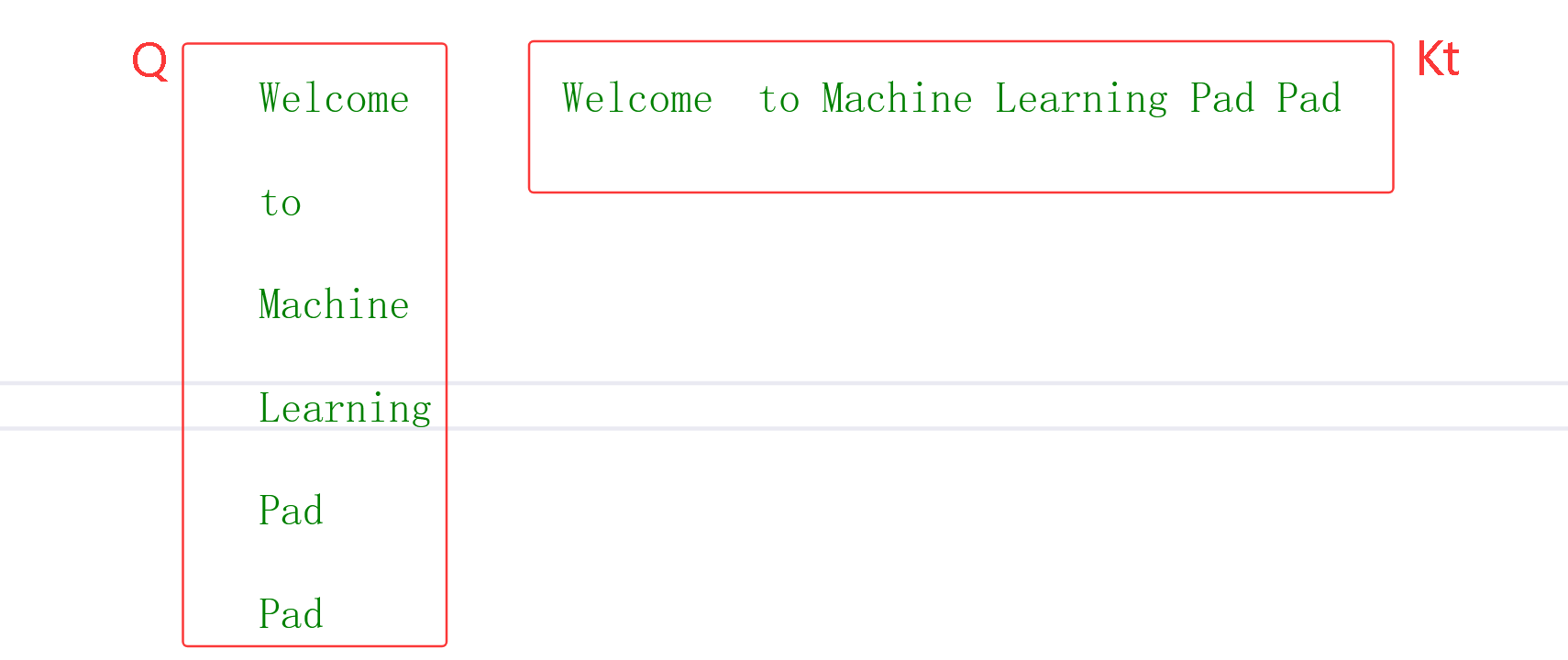
矩阵相乘结果
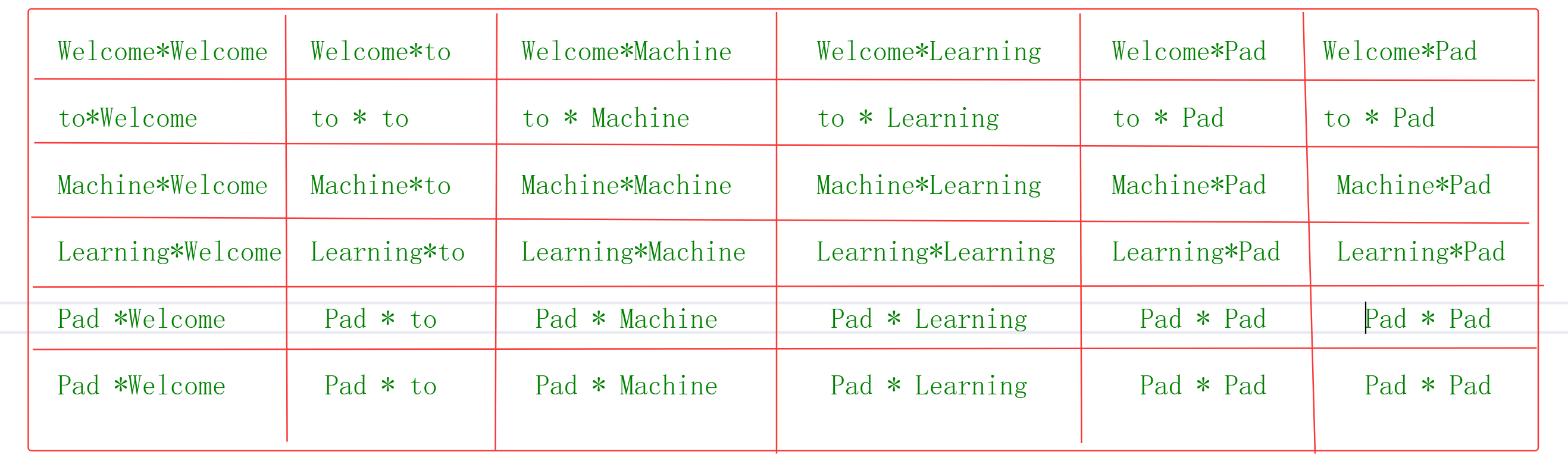
每个字符都能其他字符产生运算,也就是它能根据上下文来确定语意,字符序列长度N,Transformer时间复杂度为
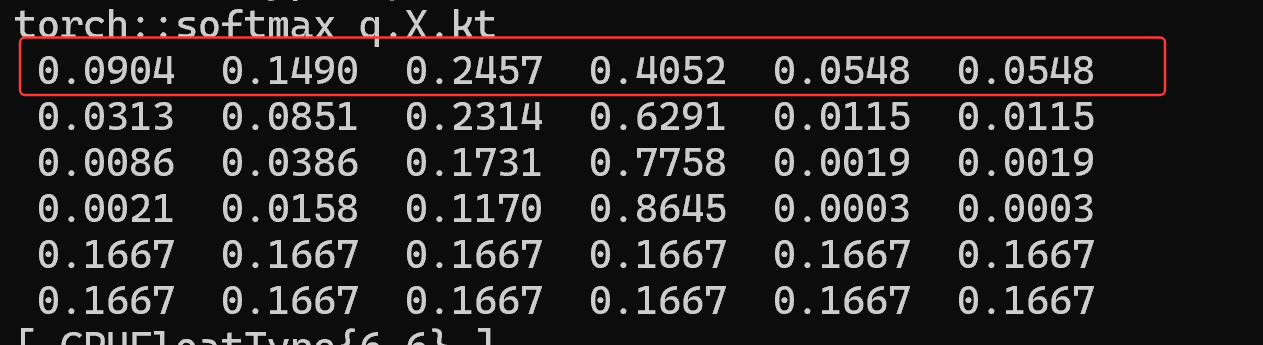
- Softmax 归一化指数函数
数学公: 式 输入向量
=
第 i 个元素的 Softmax 输出为
每行内所有数据相加等于1, 原数据按一定比例缩小
- 与V矩阵相乘
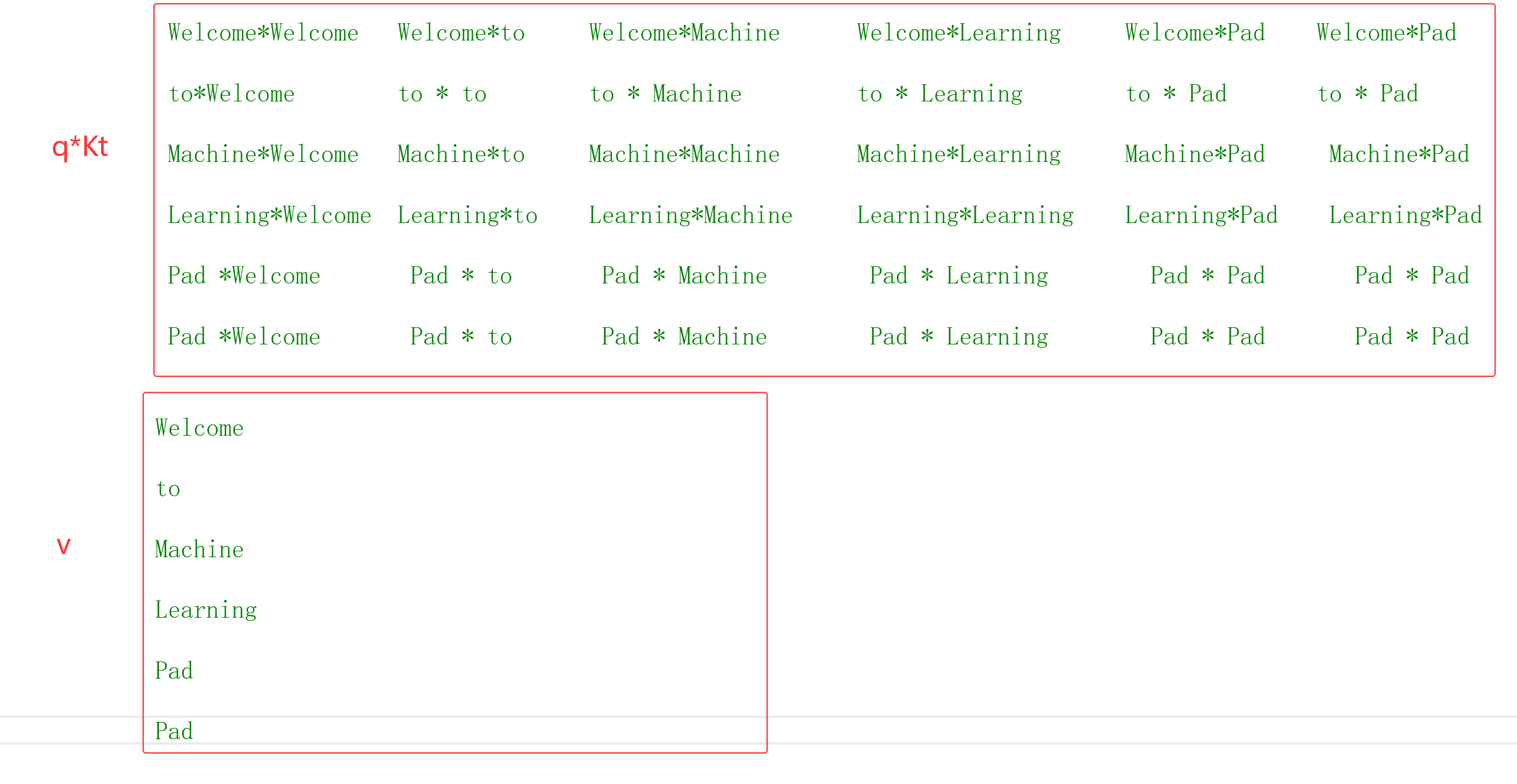
qkv现在全部建立关系了
当要求输入张量形状**seq, batch, dim**时,其流程都一样,要变换处理张量
高维张量矩阵相乘
公式: a..,..., M,N * b...,...,N, K = ..,...,M, K 看到最后两维和两维矩阵相乘一样
整理之的代码,支持两三维输入张量
cpp
	auto forward(torch::Tensor x,torch::Tensor mask = {})
	{
		torch::Tensor q ;
		torch::Tensor k ;
		torch::Tensor v;
		torch::Tensor kt;
		torch::Tensor out;

		auto dim = x.dim();


		if (dim == 3)
		{
			//x:  [batch, seq, dim]  --->  [seq, batch, dim]
			x = x.permute({1,0,2});
			InitQKV(x.size(2));
		}
		else
		{
			// x: [seq, dim]
			InitQKV(x.size(1));
		}
		/// 1.输入x 与 q k v 运算  q k v是 单位矩阵所以 q k v = x
		 q = Q->forward(x);
		 k = K->forward(x);
		 v = V->forward(x);

		 cout << "q k v \n" << q << endl;

		if (dim == 3)
		{
			kt = k.permute({ 1,2,0 });
		 	v = v.permute({ 1,0,2 });
		}
		else
		{
			kt = k.transpose(0, 1);// kt 是 k 的置换矩阵  kt: [dim,seq]
		}


		cout << "kt \n" << kt << endl;

		auto attn_score = torch::matmul(q, kt); //2.
		cout << "q X kt \n" << attn_score << endl;

		attn_score = attn_score * norm_fact;     //3. 矩阵缩放
		cout << "scale q.X.kt  \n" << attn_score << endl;

		if (mask.defined())
		{
			attn_score += mask;
		}


		attn_score = torch::softmax(attn_score, -1);//4. Softmax 归一化指数函数
		cout << "torch::softmax q.X.kt  \n" << attn_score << endl;

		out = torch::matmul(attn_score, v); /// 5. qKt * V

		cout << "torch::matmul V  \n" << out << endl;

		return out;
	}
多头注意力
在"自注意力"的基础上增加
- 维度被为多份 分别用于Q K V 计算
2.将多份重新拼接
3.最后加输出投影
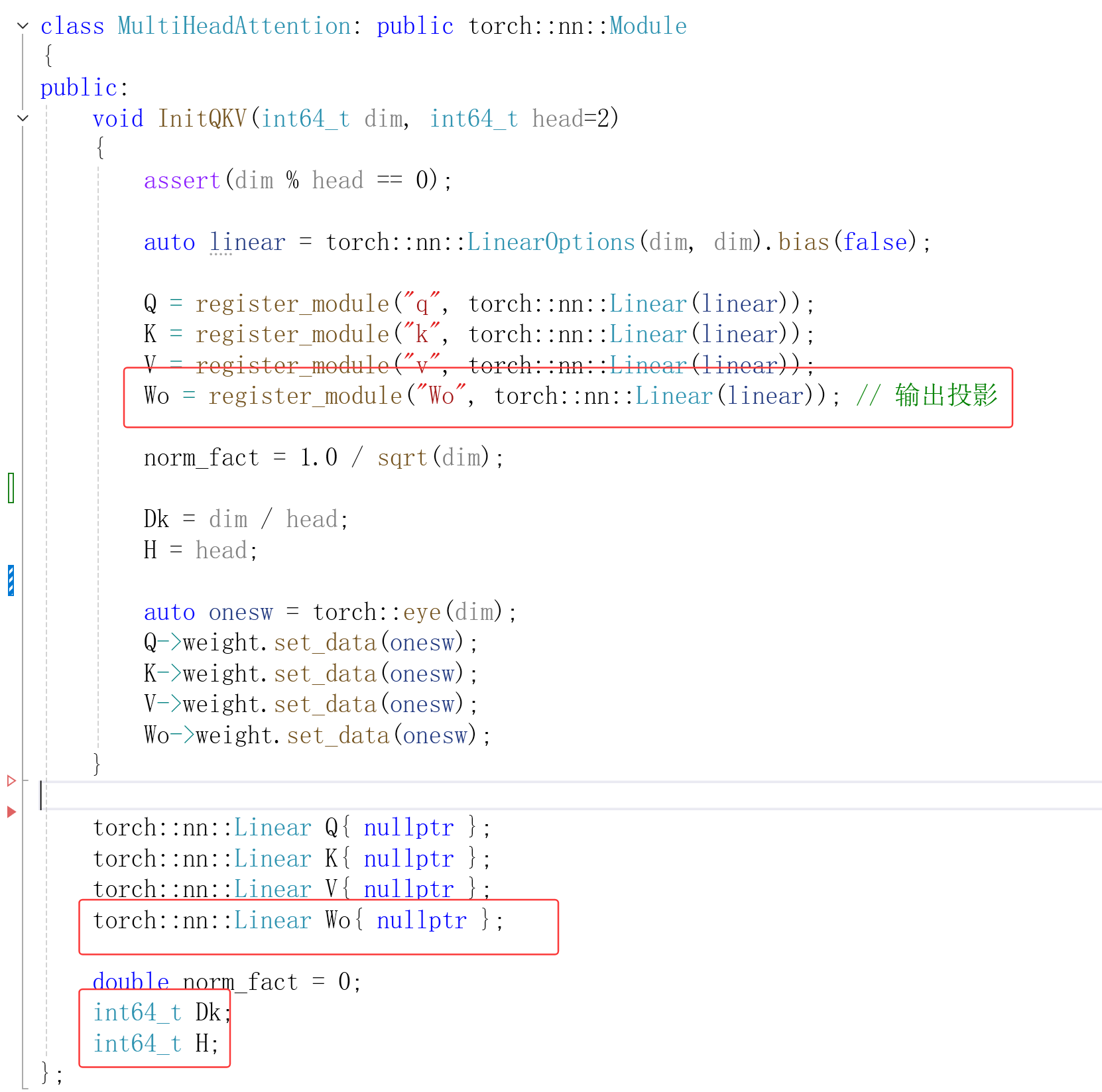
输入两维张量时,写一个函数forward
-
输入张量x 形状**seq, dim, q、k、v** 形状 seq, dim
-
将q、k、v 拆分成 H, S, Dk , seq简写S, H:头数量, Dk = dim/ H
cpp
q = q.view({ seq,H,Dk }); //q: [seq, dim] ->   [S, H, Dk]
k = k.view({ seq,H,Dk });
v = v.view({ seq,H,Dk });

q = q.permute({ 1,0,2 }); //[S, H, Dk] --->[H, S, Dk]
k = k.permute({ 1,0,2 });
v = v.permute({ 1,0,2 });- 调
cpp
auto kt = k.permute({ 0,2,1 }); //kt: [H, S, Dk] --> [H, Dk, S]- 与V矩阵相乘之后 输出形状 H, S, Dk, 要转换成 S, H, Dk
cpp
auto out = torch::matmul(attn_score, v); // [H, S, S] * [H, S, Dk] -> out: [H, S, Dk]- S, H, Dk 拼接成 **seq, dim,**最后输出投影
cpp
out = out.transpose(1, 0).contiguous().view({ seq, dim }); //  [H, S, Dk] --> [S, H, Dk] -> [seq, dim]

cout << "torch::matmul QK * V  \n" << out.squeeze() << endl;

out = Wo->forward(out);
输入三维张量时,写一个函数forward2去实现,除了张量形状调整不同外其他都一样,实现细节只能看代码
cpp
	auto forward(torch::Tensor x, int64_t head = 2, torch::Tensor mask = {})
	{
		x.squeeze_(); //x: [batch, seq ,dim]  -->   [seq, dim]
		assert(x.dim() == 2);
		//x: [seq, dim]

		InitQKV(x.size(1), head);

		auto seq = x.size(0);
		auto dim = x.size(1);

		auto q = Q->forward(x);
		auto k = K->forward(x);
		auto v = V->forward(x);
		q = q.view({ seq,H,Dk }); //q: [seq, dim] ->   [S, H, Dk]
		k = k.view({ seq,H,Dk });
		v = v.view({ seq,H,Dk });

		q = q.permute({ 1,0,2 }); //[S, H, Dk] --->[H, S, Dk]
		k = k.permute({ 1,0,2 });
		v = v.permute({ 1,0,2 });

		cout << "q k v \n" << q << endl;

		auto kt = k.permute({ 0,2,1 }); //kt:  [H, S, Dk] --> [H, Dk, S]

		cout << "kt \n" << kt << endl;

		auto attn_score = torch::matmul(q, kt);  // [H, S, Dk] *  [H, Dk, S]
		cout << "q X kt \n" << attn_score << endl;


		attn_score = attn_score * norm_fact;
		cout << "scale q.X.kt  \n" << attn_score << endl;

		if (mask.defined())
		{
			attn_score += mask;
		}

		attn_score = torch::softmax(attn_score, -1); /// attn_score: [H, S, S]
		cout << "torch::softmax q.X.kt  \n" << attn_score.squeeze() << endl;

		auto out = torch::matmul(attn_score, v); // [H, S, S] * [H, S, Dk]  ->  out: [H, S, Dk]
		out = out.transpose(1, 0).contiguous().view({ seq, dim }); //  [H, S, Dk] --> [S, H, Dk] -> [seq, dim]

		cout << "torch::matmul QK * V  \n" << out.squeeze() << endl;

		out = Wo->forward(out);

		return out;
	}


	auto forward2(torch::Tensor x, int64_t head = 2,torch::Tensor mask = {})
	{
		assert(x.dim() == 3);

		x = x.permute({ 1,0,2 });  //   x: x: [batch, seq, dim]-->  [seq, batch, dim]

		InitQKV(x.size(2), head);

		auto seq = x.size(0);
		auto batch = x.size(1);
		auto dim = x.size(2);

		auto q = Q->forward(x);
		auto k = K->forward(x);
		auto v = V->forward(x);
		q = q.view({ seq,batch,H,Dk}); //q: [seq, batch, dim] ->   [S, B, H, Dk]
		k = k.view({ seq,batch,H,Dk });
		v = v.view({ seq,batch,H,Dk });

		q = q.permute({1,2,0,3}); //[S, B, H, Dk] --->[B, H, S, Dk]
		k = k.permute({ 1,2,0,3 });
		v = v.permute({ 1,2,0,3 });

		cout << "q k v \n" << q << endl;

		auto kt = k.permute({ 0,1,3,2}); //kt:  [B, H, S, Dk] --> [B, H, Dk, S]

		cout << "kt \n" << kt.squeeze() << endl;

		auto attn_score = torch::matmul(q, kt);
		cout << "q X kt \n" << attn_score << endl;


		attn_score = attn_score * norm_fact;
		cout << "scale q.X.kt  \n" << attn_score << endl;

		if (mask.defined())
		{
			attn_score += mask;
		}

		attn_score = torch::softmax(attn_score, -1); /// attn_score: [B, H, S, S]
		cout << "torch::softmax q.X.kt  \n" << attn_score << endl;

		auto out = torch::matmul(attn_score, v); // [B, H, S, S] * [B, H, S, Dk]  ->  out: [B, H, S, Dk]
		out = out.transpose(1, 2).contiguous().view({ seq,batch, dim }); //  [B, H, S, Dk] --> [B, S, H, Dk] -> [seq,batch, dim]

		cout << "torch::matmul QK * V  \n" << out << endl;

		out = Wo->forward(out);

		return out;
	}
完整代码
cpp
#include <torch/torch.h>
#include <iostream>
#include <torch/serialize.h>
#include <regex>
//#include <iostream>
#include <fstream>
using namespace std;


class FeedForwardNet : public torch::nn::Module
{
	//Q = register_module("q", torch::nn::Linear(linear));
};


class SelfAttention : public torch::nn::Module
{
public:
	SelfAttention()
	{


	}
	void InitQKV(int64_t dim)
	{
		auto linear = torch::nn::LinearOptions(dim, dim).bias(false);

		Q = register_module("q", torch::nn::Linear(linear));
		K = register_module("k", torch::nn::Linear(linear));
		V = register_module("v", torch::nn::Linear(linear));

		norm_fact = 1.0 / sqrt(dim); // 缩放

		auto onesw = torch::eye(dim); //单位矩阵

		Q->weight.set_data(onesw);
		K->weight.set_data(onesw);
		V->weight.set_data(onesw);
	}


	auto forward(torch::Tensor x,torch::Tensor mask = {})
	{
		torch::Tensor q ;
		torch::Tensor k ;
		torch::Tensor v;
		torch::Tensor kt;
		torch::Tensor out;

		auto dim = x.dim();


		if (dim == 3)
		{
			//x:  [batch, seq, dim]  --->  [seq, batch, dim]
			x = x.permute({1,0,2});
			InitQKV(x.size(2));
		}
		else
		{
			// x: [seq, dim]
			InitQKV(x.size(1));
		}
		/// 1.输入x 与 q k v 运算  q k v是 单位矩阵所以 q k v = x
		 q = Q->forward(x);
		 k = K->forward(x);
		 v = V->forward(x);

		 cout << "q k v \n" << q << endl;

		if (dim == 3)
		{
			kt = k.permute({ 1,2,0 });
		 	v = v.permute({ 1,0,2 });
		}
		else
		{
			kt = k.transpose(0, 1);// kt 是 k 的置换矩阵  kt: [dim,seq]
		}


		cout << "kt \n" << kt << endl;

		auto attn_score = torch::matmul(q, kt); //2.
		cout << "q X kt \n" << attn_score << endl;

		attn_score = attn_score * norm_fact;     //3. 矩阵缩放
		cout << "scale q.X.kt  \n" << attn_score << endl;

		if (mask.defined())
		{
			attn_score += mask;
		}


		attn_score = torch::softmax(attn_score, -1);//4. Softmax 归一化指数函数
		cout << "torch::softmax q.X.kt  \n" << attn_score << endl;

		out = torch::matmul(attn_score, v); /// 5. qKt * V

		cout << "torch::matmul V  \n" << out << endl;

		return out;
	}

	torch::nn::Linear Q{ nullptr };
	torch::nn::Linear K{ nullptr };
	torch::nn::Linear V{ nullptr };
	double norm_fact = 0 ;
};

class MultiHeadAttention: public torch::nn::Module
{
public:
	void InitQKV(int64_t dim, int64_t head=2)
	{
		assert(dim % head == 0);

		auto linear = torch::nn::LinearOptions(dim, dim).bias(false);

		Q = register_module("q", torch::nn::Linear(linear));
		K = register_module("k", torch::nn::Linear(linear));
		V = register_module("v", torch::nn::Linear(linear));
		Wo = register_module("Wo", torch::nn::Linear(linear)); // 输出投影

		norm_fact = 1.0 / sqrt(dim);

		Dk = dim / head;
		H = head;

		auto onesw = torch::eye(dim);
		Q->weight.set_data(onesw);
		K->weight.set_data(onesw);
		V->weight.set_data(onesw);
		Wo->weight.set_data(onesw);
	}

	auto forward(torch::Tensor x, int64_t head = 2, torch::Tensor mask = {})
	{
		x.squeeze_(); //x: [batch, seq ,dim]  -->   [seq, dim]
		assert(x.dim() == 2);
		//x: [seq, dim]

		InitQKV(x.size(1), head);

		auto seq = x.size(0);
		auto dim = x.size(1);

		auto q = Q->forward(x);
		auto k = K->forward(x);
		auto v = V->forward(x);
		q = q.view({ seq,H,Dk }); //q: [seq, dim] ->   [S, H, Dk]
		k = k.view({ seq,H,Dk });
		v = v.view({ seq,H,Dk });

		q = q.permute({ 1,0,2 }); //[S, H, Dk] --->[H, S, Dk]
		k = k.permute({ 1,0,2 });
		v = v.permute({ 1,0,2 });

		cout << "q k v \n" << q << endl;

		auto kt = k.permute({ 0,2,1 }); //kt:  [H, S, Dk] --> [H, Dk, S]

		cout << "kt \n" << kt << endl;

		auto attn_score = torch::matmul(q, kt);  // [H, S, Dk] *  [H, Dk, S]
		cout << "q X kt \n" << attn_score << endl;


		attn_score = attn_score * norm_fact;
		cout << "scale q.X.kt  \n" << attn_score << endl;

		if (mask.defined())
		{
			attn_score += mask;
		}

		attn_score = torch::softmax(attn_score, -1); /// attn_score: [H, S, S]
		cout << "torch::softmax q.X.kt  \n" << attn_score.squeeze() << endl;

		auto out = torch::matmul(attn_score, v); // [H, S, S] * [H, S, Dk]  ->  out: [H, S, Dk]
		out = out.transpose(1, 0).contiguous().view({ seq, dim }); //  [H, S, Dk] --> [S, H, Dk] -> [seq, dim]

		cout << "torch::matmul QK * V  \n" << out.squeeze() << endl;

		out = Wo->forward(out);

		return out;
	}


	auto forward2(torch::Tensor x, int64_t head = 2,torch::Tensor mask = {})
	{
		assert(x.dim() == 3);

		x = x.permute({ 1,0,2 });  //   x: x: [batch, seq, dim]-->  [seq, batch, dim]

		InitQKV(x.size(2), head);

		auto seq = x.size(0);
		auto batch = x.size(1);
		auto dim = x.size(2);

		auto q = Q->forward(x);
		auto k = K->forward(x);
		auto v = V->forward(x);
		q = q.view({ seq,batch,H,Dk}); //q: [seq, batch, dim] ->   [S, B, H, Dk]
		k = k.view({ seq,batch,H,Dk });
		v = v.view({ seq,batch,H,Dk });

		q = q.permute({1,2,0,3}); //[S, B, H, Dk] --->[B, H, S, Dk]
		k = k.permute({ 1,2,0,3 });
		v = v.permute({ 1,2,0,3 });

		cout << "q k v \n" << q << endl;

		auto kt = k.permute({ 0,1,3,2}); //kt:  [B, H, S, Dk] --> [B, H, Dk, S]

		cout << "kt \n" << kt.squeeze() << endl;

		auto attn_score = torch::matmul(q, kt);
		cout << "q X kt \n" << attn_score << endl;


		attn_score = attn_score * norm_fact;
		cout << "scale q.X.kt  \n" << attn_score << endl;

		if (mask.defined())
		{
			attn_score += mask;
		}

		attn_score = torch::softmax(attn_score, -1); /// attn_score: [B, H, S, S]
		cout << "torch::softmax q.X.kt  \n" << attn_score << endl;

		auto out = torch::matmul(attn_score, v); // [B, H, S, S] * [B, H, S, Dk]  ->  out: [B, H, S, Dk]
		out = out.transpose(1, 2).contiguous().view({ seq,batch, dim }); //  [B, H, S, Dk] --> [B, S, H, Dk] -> [seq,batch, dim]

		cout << "torch::matmul QK * V  \n" << out << endl;

		out = Wo->forward(out);

		return out;
	}


	torch::nn::Linear Q{ nullptr };
	torch::nn::Linear K{ nullptr };
	torch::nn::Linear V{ nullptr };
	torch::nn::Linear Wo{ nullptr };

	double norm_fact = 0;
	int64_t Dk;
	int64_t H;
};


void TransformerAttentionMain()
{


	auto x = torch::tensor({
				{{1.0, 0.0, 0.0, 0.0}, // Welcome
				 {2.0, 0.0, 0.0, 0.0}, // to
				 {3.0, 0.0, 0.0, 0.0}, // Machine
				 {4.0, 0.0, 0.0, 0.0}, // Learning
				 {0.0, 0.0, 0.0, 0.0}, // Pad
				 {0.0, 0.0, 0.0, 0.0}  // Pad
				} }, torch::kFloat);


	auto w = torch::tensor({
			{
				{0.0, 1.0, 0.0, 0.0},
				{0.0, 2.0, 0.0, 0.0},
				{0.0, 3.0, 0.0, 0.0},
				{0.0, 4.0, 0.0, 0.0}
			}
		}, torch::kFloat);

	cout << "input\n" << x << endl;

	cout << "-------------SelfAttention--------------------\n"  << endl;
	auto x1 = x.squeeze();
	auto atten= SelfAttention();
	auto y = atten.forward(x1);
	cout << "-------------SelfAttention--------------------\n"  << endl;


	cout << "\n\n-------------MultiHeadAttention--------------------\n"  << endl;
	auto multiAtten = MultiHeadAttention();
	multiAtten.forward2(x,1);
	cout << "-------------MultiHeadAttention--------------------\n"  << endl;

}
感谢大家的支持,如要问题欢迎提问指正。