Ansible配置自动化
作用:掌握Ansible配置自动化工具,能实现多服务器批量管理!
一、Ansible环境搭建
1. 自动化运维
问题:假设我要去1000台服务器上做一个操作(如MySQL数据库服务器修改配置文件my.cnf里的某一个参数), 下面两种方法缺点明显:
第一种方案:按传统的方法, 一台连着一台服务器的ssh上去手动操作。
缺点: 效率太低。
第二种方案:写个Shell脚本来做。(最多只能部署几百台服务器)
缺点: 管理的机器平台(cnetos/ubuntu/kylin/rocky)不一致,脚本可能不具备通用性。传密码麻烦(在非免密登录的环境下, 需要expect来传密码),效率较低,循环1000次也需要一个一个的完成,如果用&符放到后台执行,则会产生1000个进程。
第三种方案:自动化运维
将日常IT运维中大量的重复性工作,小到简单的日常检查、配置变更和软件安装,大到整个变更流程的组织调度,由过去的手工执行转为自动化操作,从而减少乃至消除运维中的延迟,实现"零延时"的IT运维。
2. 自动化运维需要关注内容
假如管理很多台服务器,主要关注以下几个方面:
-
管理机与被管理机的连接(管理机如何将管理指令发送给被管理机)
-
服务器信息收集 (如果被管理的服务器有centos外还有其它linux发行版,如suse,ubuntu,kylin等。当你要做的事情在不同OS上有所不同,你需要收集信息,并将其分开处理)
-
服务器分组:因为有些时候我要做的事情不是针对所有服务器,可能只针对某一个分组
-
管理内容的主要分类
-
文件目录管理 (包括文件的创建,删除,修改,查看状态,远程拷贝等)
-
用户和组管理
-
cron 时间任务管理
-
yum 源配置与通过yum管理软件包
-
服务管理
-
远程执行脚本
-
远程执行命令
-
3. 常见运维工具对比
-
puppet:基于ruby语言,成熟稳定。适合于大型架构,相对于ansible和saltstack会复杂些。
-
saltstack:基于python语言,简单、并发能力比ansible要好, 需要维护被管理端的服务。如果服务断开,连接就会出问题。
-
**ansible:**基于python语言。简单快捷,被管理端不需要启服务。直接走ssh协议,需要验证所以机器多的话速度会较慢。
4. Ansible概述

ansible是一种由Python开发的自动化运维工具,集合了众多运维工具(puppet、cfengine、chef、func、fabric)的优点,实现了批量系统配置、批量程序部署、批量运行命令等功能。
特点:
-
部署简单
-
默认使用ssh进行管理,基于python里的paramiko模块开发
-
管理端和被管理端不需要启动服务
-
配置简单,功能强大,扩展性强
-
能过playbook(剧本)进行多个任务的编排(第一步、第二步、第三步...)
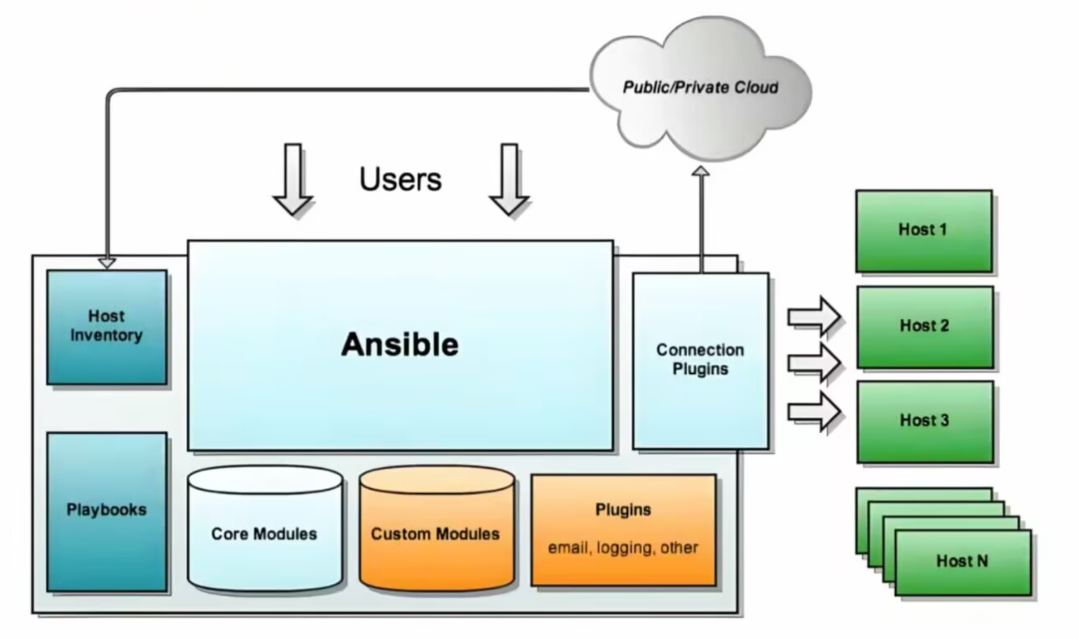
Host1 ~ HostN:被管理机(不需要额外安装任何服务,Ansible直接走SSH协议)
Ansible => Connection Plugins(连接插件)=> 连接所有的被管理机(走SSH协议)
Host Inventory:主机清单(就是通过一个配置文件把所有被管理机进行分组,如分成web组、mysql组、redis组等等)
Modules:Core Modules(核心模块)、Custom Modules(自定义模块)=> 重点学习内容 => 通过模块实现管理被管理机(copy模块 => 文件上传、user模块可以进行用户管理、yum模块实现管理安装卸载...)
Plugins:插件,连接被管理机,结合email邮件、logging日志等实现一些额外功能
Playbook:剧本(演电影都要有剧本),把我们管理工作变成剧本,可以让Ansible可以有逻辑的执行(高级)
Users:用户管理,由于Ansible底层走SSH协议,所以连接被管理机,要么通过账号+密码,要么通过(Public/Private)免密操作
大致流程:Ansible首先需要配置主机清单(配置要连接机器以及进行提前分组),然后通过Connection连接插件连接所有的被管理机,底层走SSH协议,连接后,可以通过模块以及插件的方式对所有被管理机进行管理操作。针对于复杂的业务场景,还可以配合Playbook、Roles实现任务编排(让任务有逻辑的执行),这个就是Ansible核心原理了。
5. Ansible环境搭建
实验准备: 三台机器,一台管理,两台被管理
| 编号 | IP | 角色 |
|---|---|---|
| node1 | 192.168.88.101 | 管理机master |
| node2 | 192.168.88.102 | 被管理机1 |
| node3 | 192.168.88.103 | 被管理机2 |
配置说明:
-
静态ip
-
主机名及IP互相绑定=>/etc/hosts
-
关闭防火墙, selinux
-
时间同步
-
确认和配置yum源
全服务器时间同步:
shell
# 安装 EPEL(Extra Packages for Enterprise Linux)软件源 安装扩展库
dnf install epel-release -y

# 安装 NTPsec(Network Time Protocol Secure)服务
dnf install ntpsec -y

# 立即同步系统时间到中国 NTP 服务器(cn.ntp.org.cn)
ntpdate cn.ntp.org.cn
第1步: 管理机上安装ansible,被管理节点必须打开ssh服务
注意:ansible不需要再每一台机器上安装,只需要在node1主节点安装即可。
shell
# yum install ansible -y
# ansible --version
ansible [core 2.14.17]
  config file = /etc/ansible/ansible.cfg
  configured module search path = ['/root/.ansible/plugins/modules', '/usr/share/ansible/plugins/modules']
  ansible python module location = /usr/lib/python3.9/site-packages/ansible
  ansible collection location = /root/.ansible/collections:/usr/share/ansible/collections
  executable location = /usr/bin/ansible
  python version = 3.9.19 (main, Aug 23 2024, 00:00:00) [GCC 11.5.0 20240719 (Red Hat 11.5.0-2)] (/usr/bin/python3)
  jinja version = 3.1.2
  libyaml = True
第2步: 实现master对agent的免密登录,只在master上做。(如果这一步不做,则在后面操作agent时都要加-k参数传密码;或者在主机清单里传密码)
shell
master# ssh-keygen
master# ssh-copy-id 192.168.88.102
master# ssh-copy-id 192.168.88.103
如果是CentOS7采用ssh-copy-id -i IP地址,如果CentOS Stream 9系列,要去掉-i参数,否则报错!!!
第3步: 在master上定义主机组(主机清单),并测试连接性
powershell
master# vim /etc/ansible/hosts
# 表示被管理的机器
[group1]
192.168.88.102    # 可以用IP也可以使用主机名
192.168.88.103

-m 代表模块 => module

master# ansible -m ping group1
192.168.88.103 | SUCCESS => {
  "changed": false,
  "ping": "pong"
}

192.168.88.102 | SUCCESS => {
  "changed": false,
  "ping": "pong"
}
powershell
master# ansible -m ping all
192.168.88.103 | SUCCESS => {
  "changed": false,
  "ping": "pong"
}

192.168.88.102 | SUCCESS => {
  "changed": false,
  "ping": "pong"
}
6. 服务器分组(重点理解)
https://docs.ansible.com/ansible/latest/inventory*guide/intro*inventory.html
Ansible通过一个"主机清单"功能来实现服务器分组。
Ansible的默认主机清单配置文件为/etc/ansible/hosts
案例1:
起始值:结束值,包含起始值也包含结束值(记住)
powershell
[nginx]			组名
apache[1:10].aaa.com	表示apache1.aaa.com到apache10.aaa.com这10台机器
nginx[a:z].aaa.com      表示nginxa.aaa.com到nginxz.aaa.com共26台机器
192.168.88.[161:165]	表示192.168.88.161到192.168.88.165这5台机器
案例2:如果底层ssh协议更改端口,需要在主机清单中进行指定(默认ssh走22端口)
powershell
[nginx]
10.1.1.13:2222			表示10.1.1.13这台,但ssh端口为2222
案例3:定义10.1.1.13:2222这台服务器的别名为nginx1
powershell
nginx1 ansible_ssh_host=10.1.1.13 ansible_ssh_port=2222案例4:没有做免密登录的服务器可以指定用户名与密码 => paramiko模块(记住)
powershell
nginx1 ansible_ssh_host=10.1.1.13 ansible_ssh_port=2222 ansible_ssh_user=root ansible_ssh_pass="123456"

注意:
    nginx1别名
    ansible_ssh_host:要连接的主机的IP地址
    ansible_ssh_port:ssh对应的端口号
    ansible_ssh_user:用户名
    ansible_ssh_pass:密码
补充:
临时:ANSIBLE_HOST_KEY_CHECKING=False ansible -m ping nginx1
永久:ssh-keyscan -H 192.168.88.104 >> ~/.ssh/known_hosts
案例5:
powershell
nginx1  ansible_ssh_host=10.1.1.13 ansible_ssh_port=2222 ansible_ssh_user=root ansible_ssh_pass="123456"
nginx2  ansible_ssh_host=10.1.1.12 ansible_ssh_port=3333 ansible_ssh_user=root ansible_ssh_pass="123456"

[nginx]
nginx1
nginx2
小结:
/etc/ansible/hosts => 主机清单 => Ansible是通过主机清单实现服务器分组
主机清单的作用: 服务器分组。
主机清单的常见功能:
① 可以通过IP范围来分, 主机名名字的范围来分
② 如果ssh端口不是22的,可以传入新的端口。
③ 没有做免密登录,可以传密码。
二、Ansible模块
1. 求帮助
shell
# ansible-doc -l
fortios_router_community_list                      Configure community lists...
azure_rm_devtestlab_info                           Configure community lists...
ecs_taskdefinition			           Configure community lists...
avi_alertscriptconfig                     	   Configure community lists...
tower_receive                                      Configure community lists...
netapp_e_iscsi_target       		           Configure community lists...
azure_rm_acs				           Configure community lists...
......
如果要查看ping模块的用法,使用下面命令(其它模块以此类推)
shell
# ansible-doc ping官网模块文档:https://docs.ansible.com/ansible/2.9/modules/list*of*all_modules.html
中文文档:https://ansible-tran.readthedocs.io/en/latest/docs/modules.html
2. file模块(重点)
作用:file模块用于对文件相关的操作(创建, 删除, 软链接等)
https://docs.ansible.com/ansible/latest/modules/file_module.html#file-module
① path=文件或文件夹路径
② state=状态(touch文件、directory文件夹、absent删除、recurse递归)
案例1:创建一个目录
powershell
master# ansible group1 -m file -a 'path=/test state=directory'
# group1表示哪个组
# path表示文件路径
# state=directory表示创建的文件类型是一个目录
案例2:创建一个文件
powershell
master# ansible group1 -m file -a 'path=/test/111 state=touch' # 文件不存在自动创建案例3:递归修改owner,group,mode
powershell
master# ansible group1 -m file -a 'path=/test recurse=yes owner=bin group=daemon mode=0777'
ansible:调用 Ansible 的命令行工具。
group1:目标主机组,表示对在 Ansible 主机清单(inventory)中定义的名为 group1 的所有主机执行操作。
-m file:指定使用 file 模块。该模块用于管理文件、目录、软链接等的属性,如权限、属主、属组,也可用于创建或删除目录/文件。
-a '...':传递给 file 模块的参数(arguments),用空格分隔的键值对。
参数详解:
path=/test:指定要操作的目标路径为 /test(可以是文件或目录)。
recurse=yes:如果 /test 是一个目录,则递归地将权限和属主/属组应用到其所有子目录和文件。
owner=bin:将 /test(及其内容,若为目录且 recurse=yes)的所有者设置为用户 bin。
group=daemon:将 /test(及其内容)的所属组设置为 daemon。
mode=0777:将 /test(及其内容)的权限设置为 0777(即 rwxrwxrwx)。
⚠️ 注意:此命令不会创建 /test 路径(除非你额外加上 state=directory 或 state=file)。
         默认情况下,file 模块只修改已存在路径的属性。如果 /test 不存在,Ansible 会报错。
案例4:删除目录(连同目录里的所有文件)
powershell
master# ansible group1 -m file -a 'path=/test state=absent'案例5:创建文件并指定owner,group,mode等
shell
master# ansible group1 -m file -a 'path=/tmp/111 state=touch owner=bin group=daemon mode=0777'案例6:删除文件
shell
master# ansible group1 -m file -a 'path=/tmp/111 state=absent'案例7:创建软链接文件
shell
master# ansible group1 -m file -a 'src=/etc/fstab path=/tmp/fstab state=link'
参数位置
src:源文件
path:快捷方式路径
state=link:代表创建软链接

state=file 判断文件是否存在且是否为普通文件,是的,正常;反之就会报错
小结:
Ansible中与文件管理相关的模块为(-m file)
基于file模块,我们可以创建文件、目录、软连接,也可以删除文件
state=touchfile有区别:touch代表创建文件,file代表判断文件,判断文件是否存在且是否为普通文件
3. copy模块(重点)
作用:copy模块用于对文件的远程拷贝操作(如把本地的文件拷贝到远程的机器上)
本机:nginx.conf,copy模块:分发到所有web节点
https://docs.ansible.com/ansible/latest/modules/copy_module.html#copy-module
在master上准备一个文件,拷贝此文件到group1的所有机器上
shell
master# echo master > /tmp/file1
master# ansible group1 -m copy -a 'src=/tmp/file1 dest=/tmp/file2'
src:原路径
dest:目标路径
使用content参数直接往远程文件里写内容(会覆盖原内容)
shell
master# ansible group1 -m copy -a 'content="ansible\n" dest=/tmp/file3'注意:ansible中-a后面的参数里也有引号时,记得要单引双引交叉使用,如果都为双引会出现问题
使用force参数控制是否强制覆盖
如果目标文件已经存在,则不覆盖
shell
master# ansible group1 -m copy -a 'src=/tmp/file2 dest=/tmp/file3 force=no'

force=no 表示不覆盖
如果目标文件已经存在,则会强制覆盖
shell
master# ansible group1 -m copy -a 'src=/tmp/file2 dest=/tmp/file3 force=yes'

force=no 表示覆盖
使用backup参数控制是否备份文件
backup=yes表示如果拷贝的文件内容与原内容不一样,则会备份一份
group1的机器上会将/tmp/file3备份一份(备份文件命名加上时间),再远程拷贝新的文件为/tmp/file3
shell
master# ansible group1 -m copy -a 'src=/etc/fstab dest=/tmp/file3 backup=yes owner=daemon group=daemon mode=0777'

backup=yes 表示覆盖之前备份

owner=daemon group=daemon mode=0777 表示文件所属者,所属组,具有的权限
简单理解:就是对目标文件进行备份操作
copy模块拷贝时要注意拷贝目录后面是否带"/"符号
/etc/yum.repos.d后面不带/符号,则表示把/etc/yum.repos.d整个目录拷贝到/tmp/目录下
shell
master# ansible group1 -m copy -a 'src=/etc/yum.repos.d dest=/tmp/'/etc/yum.repos.d/后面带/符号,则表示把/etc/yum.repos.d/目录里所有文件拷贝到/tmp/目录下
powershell
master# ansible group1 -m copy -a 'src=/etc/yum.repos.d/ dest=/tmp/'小结:
Ansible有一个特殊模块,用于把本地文件拷贝到远程服务器,这个模块(copy)
copy模块有两个常用的参数:(src)、(dest)
拷贝的时候注意本地的文件是否存在,否则容易报错!!!
扩展:
Ansible copy模块:把本地文件拷贝到远程服务器,底层基于SSH协议,所以每个拷贝文件都需要走SSH协议,建立连接,进行认证,然后实现文件传输,如果一个目录下有多个文件,则copy模块执行会比较缓慢。
Ansible synchronize模块:把本地文件拷贝到远程服务器,底层基于RSYNC实现文件传输,可以全量传输也可以增量传输,所以相对而言速度要快一些,但是要求机器上必须要提前安装rsync服务。(传输很多文件的时候这个模块效率比copy快)
powershell
dnf install rsync -ysynchronize模块其参数几乎与copy模块一模一样,都有src与dest参数,src代表源文件位置,dest代表目标文件位置。
powershell
ansible group1 -m synchronize -a "src=/etc/yum.repos.d dest=/tmp/"4. yum/dnf模块(重点)
yum模块用于使用yum命令来实现软件包的安装与卸载。
https://docs.ansible.com/ansible/latest/modules/yum_module.html#yum-module
使用yum安装一个软件(前提:group1的机器上的yum配置都已经OK)
powershell
master# ansible group1 -m yum -a 'name=vsftpd state=present'
或
master# ansible group1 -m dnf -a 'name=vsftpd state=present'
使用yum安装httpd,httpd-devel软件,state=latest表示安装最新版本
shell
master# ansible group1 -m yum -a 'name=httpd,httpd-devel state=latest'
或
master# ansible group1 -m dnf -a 'name=httpd,httpd-devel state=latest'
使用yum卸载httpd,httpd-devel软件
shell
master# ansible group1 -m yum -a 'name=httpd,httpd-devel state=absent'
或
master# ansible group1 -m dnf -a 'name=httpd,httpd-devel state=absent'
5. service模块(重点)
作用:service模块用于控制服务的启动,关闭,开机自启动等。
https://docs.ansible.com/ansible/latest/modules/service_module.html#service-module
启动vsftpd服务,并设为开机自动启动
powershell
master# ansible group1 -m service -a 'name=httpd state=started enabled=true'state服务管理可以选参数:"reloaded"、"restarted"、"started"、"stopped"
关闭vsftpd服务,并设为开机不自动启动
shell
master# ansible group1 -m service -a 'name=httpd state=stopped enabled=false'小结:
yum/dnf模块:主要负责(安装或卸载软件)
service模块:主要负责(服务的管理、启动、停止、重启、开机自启、开机不自启)
三、Ansible Playbook
作用:Playbook(剧本),主要用于实现一些较为复杂的自动化部署操作。软件安装配置,如Keepalived、MySQL集群、Redis集群、大数据集群、K8S集群。
1. Playbook概述
playbook(剧本): 是ansible用于配置,部署,和管理被控节点的剧本。用于ansible操作的编排。
参考: https://docs.ansible.com/ansible/latest/user*guide/playbooks*intro.html
使用的格式为yaml格式(saltstack,elk,docker,docker-compose,kubernetes等也都会用到yaml格式)
2. yaml格式
-
以.yaml或.yml结尾
-
文件的第一行以 "---"开始,表明YMAL文件的开始(可选的)
-
以#号开头为注释
-
列表中的所有成员都开始于相同的缩进级别, 并使用一个"- "作为开头(一个横杠和一个空格)
-
一个字典是由一个简单的 键(key): 值(value)的形式组成(这个冒号后面必须是一个空格)
注意: 写这种文件不要使用Tab键,都使用空格
参考: https://docs.ansible.com/ansible/latest/reference_appendices/YAMLSyntax.html#yaml-syntax
看一个官方案例:
yaml
---
# 一位职工记录
name: Example Developer
job: Developer
skill: Elite
employed: True
foods:
  - Apple
  - Orange
  - Strawberry
  - Mango
languages:
  ruby: Elite
  python: Elite
  dotnet: Lame
3. Playbook入门案例
https://docs.ansible.com/ansible/latest/playbook*guide/playbooks*intro.html#playbook-syntax
先直接来看一个实例,在Linux系统中安装Apache软件:① yum安装软件 ② 编辑httpd.conf配置文件
powershell
# 安装httpd (Apache软件)
yum install httpd -y
# 更改httpd软件配置,比如更改监听端口为8080
vim /etc/httpd/conf/httpd.conf
47行(监听端口)Listen 8080
124行 (项目目录) DocumentRoot "/var/www/html"
# 启动httpd软件
systemctl start httpd
# 在浏览器访问http://192.168.194.128:8080
第1步: 创建一个存放playbook的目录(路径自定义)
shell
master# mkdir /etc/ansible/playbook -p第2步:准备httpd配置文件,并修改成你想要的配置
shell
master# yum install httpd -y按需要修改你想要的配置(为了测试可以随意改动标记一下)
shell
master# vim /etc/httpd/conf/httpd.conf
47行(监听端口)Listen 8080
第3步:写一个playbook文件(后缀为.yml或.yaml)
yaml
# vim /etc/ansible/playbook/example.yaml
---
- hosts: group1
  remote_user: root
  tasks:
    - name: ensure apache is at the latest version
      yum:
        name: httpd,httpd-devel
        state: latest

    - name: write the apache config file
      ansible.builtin.copy:   # 也可以省略为copy
        src: /etc/httpd/conf/httpd.conf
        dest: /etc/httpd/conf/httpd.conf
      notify:
        - restart apache

    - name: ensure apache is running (and enable it at boot)
      service:
        name: httpd
        state: started
        enabled: yes

  handlers:
    - name: restart apache
      service:
        name: httpd
        state: restarted
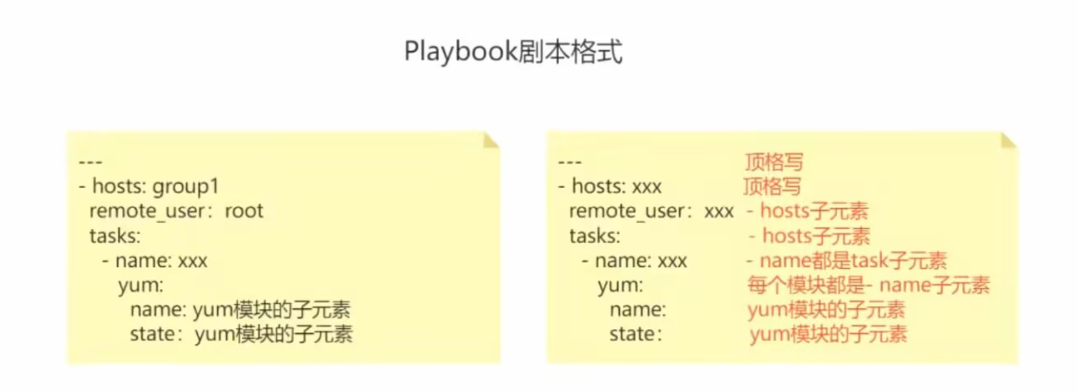
注意:task任务格式
shell
- name: 任务执行时,打印的文本信息,可以是英文也可以是中文(类似注释,但是会打印输出)
   ansible模块,如file、copy、yum
     参数
   notify:与ansible模块是同级关系
     - restart apache,这个地方的名称与 handlers:中name标签同名,代表调用handlers中定义好的任务操作
Playbook格式说明:
第4步: 执行写好的palybook
会显示出执行的过程,并且执行的每一步都有ok,changed,failed等标识
执行如果有错误(failed)会回滚,解决问题后,直接再执行这条命令即可,并会把failed改为changed(幂等性)
shell
# ansible-playbook /etc/ansible/playbook/example.yaml小结:
Playbook剧本就是按照配置的Task任务流程,按顺序执行。
在工作中,主要编写Task任务,一定要完全按照Task任务格式,具体每个模块如何使用,可以参考官网文档。
四、Ansible Roles
作用:把变量、任务、handlers分别作为角色,按文件夹来实现分离编写过程!
把Playbook进一步细化:原来所有操作都是放置于一个yaml文件,有了Roles,可以把变量、任务、handlers分别单独编写,适合团队实现Ansible脚本开发。
1. roles介绍
roles(角色): 就是通过分别将variables, tasks及handlers等放置于单独的目录中,并可以便捷地调用它们的一种机制。
假设我们要写一个playbook来安装管理lamp(Linux+Apache+mysql+PHP=>wordpress博客)环境,那么这个playbook就会写很长。所以我们希望把这个很大的文件分成多个功能拆分, 分成apache管理,php管理,mysql管理,然后在需要使用的时候直接调用就可以了,以免重复写。就类似编程里的模块化的概念,以达到代码复用的效果。
2. 创建roles的目录结构
powershell
files:用来存放由copy模块或script模块调用的文件。
tasks:至少有一个main.yml文件,定义各tasks。
handlers:有一个main.yml文件,定义各handlers。
templates:用来存放jinjia2模板。
vars:有一个main.yml文件,定义变量。
meta:有一个main.yml文件,定义此角色的特殊设定及其依赖关系,类似说明书。
注意: 在每个角色的目录中分别创建files, tasks,handlers,templates,vars和meta目录,用不到的目录可以创建为空目录.
3. 通过roles实现lamp
需定制三个角色: httpd,mysql,php=>没有roles=>lamp.yml(写的很长,很复杂)
有了roles以后,三个角色httpd,mysql,php(每个人开发一个角色)=>每个角色下都需要有6个文件夹
第1步: 创建roles目录及文件,并确认目录结构
shell
master# cd /etc/ansible/roles/
master# mkdir -p {httpd,mysql,php}/{files,tasks,handlers,templates,vars,meta}
master# touch {httpd,mysql,php}/{tasks,handlers,vars,meta}/main.yml

master# yum install tree -y
master# tree /etc/ansible/roles/
/etc/ansible/roles/
├── httpd
│   ├── files
│   ├── handlers
│   │   └── main.yml
│   ├── meta
│   │   └── main.yml
│   ├── tasks
│   │   └── main.yml
│   ├── templates
│   └── vars
│       └── main.yml
├── mysql
│   ├── files
│   ├── handlers
│   │   └── main.yml
│   ├── meta
│   │   └── main.yml
│   ├── tasks
│   │   └── main.yml
│   ├── templates
│   └── vars
│       └── main.yml
└── php
    ├── files
    ├── handlers
    │   └── main.yml
    ├── meta
    │   └── main.yml
    ├── tasks
    │   └── main.yml
    ├── templates
    └── vars
        └── main.yml
第2步: 准备httpd服务器的主页文件,php测试页和配置文件等
shell
master# echo "test main page" > /etc/ansible/roles/httpd/files/index.html

master# echo -e "<?php\n\tphpinfo();\n?>" > /etc/ansible/roles/httpd/files/test.php


master# yum install httpd -y
按需求修改配置文件后,拷贝到httpd角色目录里的files子目录
master# vim /etc/httpd/conf/httpd.conf
master# cp /etc/httpd/conf/httpd.conf /etc/ansible/roles/httpd/files/
第3步: 编写httpd角色的main.yml文件
yaml
master# vim /etc/ansible/roles/httpd/tasks/main.yml
---
- name: 安装httpd
   yum: name=httpd,httpd-devel state=present

- name: 同步httpd配置文件
   copy: src=/etc/ansible/roles/httpd/files/httpd.conf dest=/etc/httpd/conf/httpd.conf
   notify: restart httpd

- name: 同步主页文件
   copy: src=/etc/ansible/roles/httpd/files/index.html dest=/var/www/html/index.html

- name: 同步php测试页
   copy: src=/etc/ansible/roles/httpd/files/test.php dest=/var/www/html/test.php

- name: 启动httpd并开机自启动
   service: name=httpd state=started enabled=yes
第4步: 编写httpd角色里的handler
yaml
master# vim /etc/ansible/roles/httpd/handlers/main.yml
---
- name: restart httpd
  service: name=httpd state=restarted
第5步: 编写mysql角色的main.yml文件
yaml
master# vim /etc/ansible/roles/mysql/tasks/main.yml
---
- name: 安装mysql
  yum: name=mariadb,mariadb-server state=present

- name: 启动mysql并开机自启动
  service: name=mariadb state=started enabled=yes

说明:
mariadb-server:mysql服务器端
mariadb:mysql客户端
第6步: 编写php角色的main.yml文件
yaml
master# vim /etc/ansible/roles/php/tasks/main.yml
---
- name: 安装php及依赖包
  yum: name=php,php-gd,php-ldap,php-odbc,php-pear,php-xml,php-mbstring,php-snmp,php-soap,curl,curl-devel,php-bcmath,php-mysqlnd state=present

  notify: restart httpd

说明:
php:核心包
php-xxx:扩展包,比如php连接mysql,需要php-mysqlnd包,php实现模拟发送http请求,curl模块
php软件在lamp架构中,并不是独立存在的,而是依赖httpd软件,安装时会自动集成在httpd软件中。安装完成后,只需要重启httpd软件即可。
第7步:编写lamp的playbook文件调用前面定义好的三个角色
yaml
master# vim /etc/ansible/playbook/lamp.yaml
---
- hosts: group1
  remote_user: root
  roles:
    - httpd
    - mysql
    - php
第8步: 执行lamp的playbook文件
shell
master# ansible-playbook /etc/ansible/playbook/lamp.yaml小结:
Ansible Roles:把大的yaml文件拆解为若干个小的main.yml文件,好处:方便调试,每个文件都比较小
缺点:文件夹太多,过于冗余
常见问题:
问题1:YAML语法有错误,千万不要按Tab键,如果出错了,可以借助于YAML校检工具
https://www.bejson.com/validators/yaml_editor/index.html
问题2:Roles脚本是一个整体,不要单独执行某个yaml文件应该统一执行最终的yaml,如lamp.yaml
单独执行某个main.yml,报错信息如下:
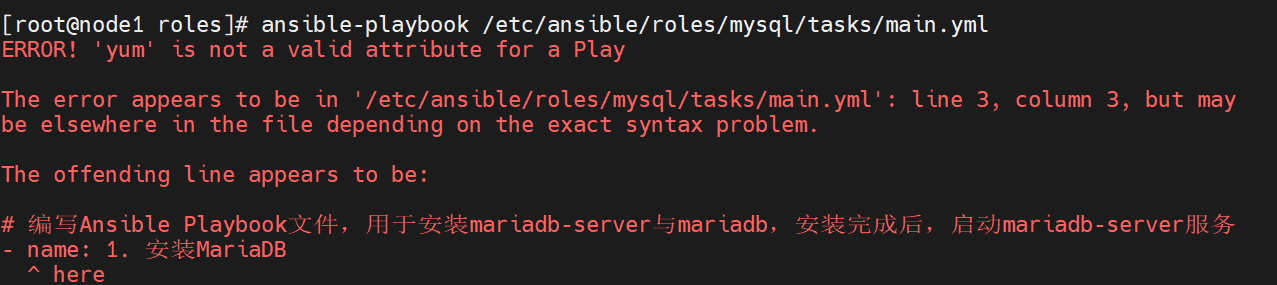
以上其实不是错误,而是也能为main.yml文件不完整导致的!