Day 6 编程实战:决策树与过拟合分析
实战目标
- 手动实现决策树(信息增益和基尼系数)
- 理解不同分裂准则的差异
- 可视化决策树结构
- 观察不同max_depth下的过拟合现象
- 使用剪枝参数控制过拟合
1. 导入必要的库
python
import numpy as np
import pandas as pd
import matplotlib.pyplot as plt
import seaborn as sns
from sklearn.datasets import make_classification, make_regression
from sklearn.model_selection import train_test_split, cross_val_score
from sklearn.tree import DecisionTreeClassifier, DecisionTreeRegressor, plot_tree, export_text
from sklearn.metrics import accuracy_score, classification_report, confusion_matrix
from sklearn.preprocessing import StandardScaler
import warnings
warnings.filterwarnings('ignore')

# 启用LaTeX渲染(如果系统安装了LaTeX)
plt.rcParams['text.usetex'] = False  # 设为False避免LaTeX依赖
# 设置中文显示
plt.rcParams['font.sans-serif'] = ['SimHei', 'Microsoft YaHei', 'DejaVu Sans']
plt.rcParams['axes.unicode_minus'] = False
2. 信息熵与基尼系数可视化
2.1 二分类下的熵和基尼系数
python
def entropy(p):
    """计算二分类熵"""
    p = np.clip(p, 1e-15, 1 - 1e-15)
    return -(p * np.log2(p) + (1 - p) * np.log2(1 - p))

def gini(p):
    """计算二分类基尼系数"""
    return 1 - p**2 - (1-p)**2

# 生成概率值
p = np.linspace(0, 1, 100)
entropy_values = entropy(p)
gini_values = gini(p)

# 绘图
plt.figure(figsize=(8, 3))

plt.subplot(1, 2, 1)
plt.plot(p, entropy_values, 'b-', linewidth=2, label='熵')
plt.plot(p, gini_values, 'r-', linewidth=2, label='基尼系数')
plt.xlabel('正类概率 p')
plt.ylabel('不纯度')
plt.title('二分类不纯度度量')
plt.legend()
plt.grid(True, alpha=0.3)
plt.axvline(x=0.5, color='k', linestyle='--', alpha=0.5)

plt.subplot(1, 2, 2)
plt.plot(p, entropy_values, 'b-', linewidth=2, label='熵', alpha=0.7)
plt.plot(p, gini_values, 'r-', linewidth=2, label='基尼系数', alpha=0.7)
plt.fill_between(p, entropy_values, gini_values, alpha=0.2)
plt.xlabel('正类概率 p')
plt.ylabel('不纯度')
plt.title('熵 vs 基尼系数对比')
plt.legend()
plt.grid(True, alpha=0.3)

plt.tight_layout()
plt.show()

print("观察结论:")
print("- 熵和基尼系数都是凸函数,形状相似")
print("- 基尼系数计算更快(无需对数)")
print("- 实际应用中两者效果相近")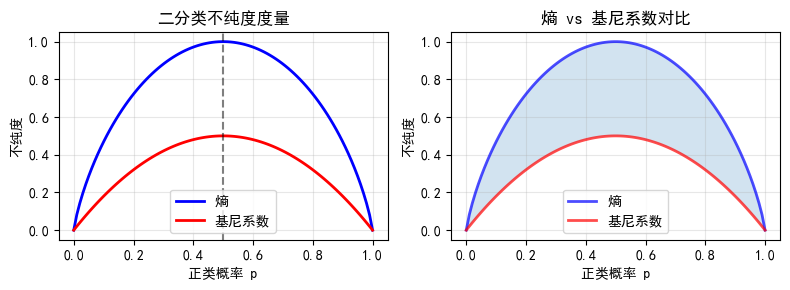
观察结论:
- 熵和基尼系数都是凸函数,形状相似
- 基尼系数计算更快(无需对数)
- 实际应用中两者效果相近
2.2 多分类下的熵
python
def multiclass_entropy(probabilities):
    """计算多分类熵"""
    probabilities = np.clip(probabilities, 1e-15, 1)
    return -np.sum(probabilities * np.log2(probabilities))

# 示例:三分类
classes = ['类A', '类B', '类C']
scenarios = [
    ([1.0, 0, 0], "完全纯(全部是类A)"),
    ([0.6, 0.3, 0.1], "偏斜分布"),
    ([0.34, 0.33, 0.33], "均匀分布")
]

print("多分类熵示例:")
print("-" * 50)
for probs, desc in scenarios:
    ent = multiclass_entropy(probs)
print(f"{desc}: {probs} → 熵 = {ent:.4f}")多分类熵示例:
--------------------------------------------------
完全纯(全部是类A): [1.0, 0, 0] → 熵 = 0.0000
偏斜分布: [0.6, 0.3, 0.1] → 熵 = 1.2955
均匀分布: [0.34, 0.33, 0.33] → 熵 = 1.58483. 手动实现分类决策树
实现基尼系数和信息增益计算
python
class DecisionTreeManual:
    """手动实现决策树(简化版)"""

    def __init__(self, max_depth=None, min_samples_split=2, criterion='gini'):
        self.max_depth = max_depth
        self.min_samples_split = min_samples_split
        self.criterion = criterion  # 'gini' or 'entropy'
        self.tree = None

    def _gini(self, y):
        """计算基尼系数"""
        classes = np.unique(y)
        # 所有样本同一类:Gini = 0(最纯)
        if len(classes) == 1:
            return 0
        probs = [np.sum(y == c) / len(y) for c in classes]
        return 1 - np.sum([p**2 for p in probs])

    def _entropy(self, y):
        """计算熵"""
        classes = np.unique(y)
        # 所有样本同一类:熵 = 0(最纯)
        if len(classes) == 1:
            return 0
        probs = [np.sum(y == c) / len(y) for c in classes]
        return -np.sum([p * np.log2(p) for p in probs if p > 0])

    def _impurity(self, y):
        """计算不纯度"""
        if self.criterion == 'gini':
            return self._gini(y)
        else:
            return self._entropy(y)

    def _best_split(self, X, y):
        """找到最佳分裂特征和阈值"""
        best_gain = -1
        best_feature = None
        best_threshold = None

        n_samples, n_features = X.shape
        current_impurity = self._impurity(y)

        for feature in range(n_features):
            # 获取特征值并排序
            feature_values = X[:, feature]
            unique_values = np.unique(feature_values)

            # 尝试每个可能的分割点
            for threshold in unique_values:
                # 分割数据
                left_mask = feature_values <= threshold
                right_mask = feature_values > threshold

                if np.sum(left_mask) < self.min_samples_split or np.sum(right_mask) < self.min_samples_split:
                    continue

                # 计算加权不纯度
                left_impurity = self._impurity(y[left_mask])
                right_impurity = self._impurity(y[right_mask])
                n_left = np.sum(left_mask)
                n_right = np.sum(right_mask)

                weighted_impurity = (n_left / n_samples) * left_impurity + (n_right / n_samples) * right_impurity

                # 计算信息增益
                gain = current_impurity - weighted_impurity

                if gain > best_gain:
                    best_gain = gain
                    best_feature = feature
                    best_threshold = threshold

        return best_feature, best_threshold, best_gain

    def _build_tree(self, X, y, depth=0):
        """递归构建决策树"""
        n_samples, n_features = X.shape
        n_classes = len(np.unique(y))

        # 停止条件
        if (self.max_depth is not None and depth >= self.max_depth) or \
           n_samples < self.min_samples_split or \
           n_classes == 1:
            # 返回叶节点(多数类)
            unique, counts = np.unique(y, return_counts=True)
            return {'leaf': True, 'prediction': unique[np.argmax(counts)]}

        # 寻找最佳分裂
        feature, threshold, gain = self._best_split(X, y)

        if feature is None or gain <= 0:
            unique, counts = np.unique(y, return_counts=True)
            return {'leaf': True, 'prediction': unique[np.argmax(counts)]}

        # 分割数据
        left_mask = X[:, feature] <= threshold
        right_mask = X[:, feature] > threshold

        # 递归构建子树
        left_subtree = self._build_tree(X[left_mask], y[left_mask], depth + 1)
        right_subtree = self._build_tree(X[right_mask], y[right_mask], depth + 1)

        return {
            'leaf': False,
            'feature': feature,
            'threshold': threshold,
            'left': left_subtree,
            'right': right_subtree,
            'gain': gain
        }

    def fit(self, X, y):
        """训练决策树"""
        self.tree = self._build_tree(X, y)
        return self

    def _predict_single(self, x, node):
        """预测单个样本"""
        if node['leaf']:
            return node['prediction']

        if x[node['feature']] <= node['threshold']:
            return self._predict_single(x, node['left'])
        else:
            return self._predict_single(x, node['right'])

    def predict(self, X):
        """批量预测"""
        return np.array([self._predict_single(x, self.tree) for x in X])

# 测试手动实现
X_test_tree, y_test_tree = make_classification(n_samples=200, n_features=4, random_state=42)
X_train_t, X_test_t, y_train_t, y_test_t = train_test_split(X_test_tree, y_test_tree, test_size=0.3)

# 手动决策树
manual_tree = DecisionTreeManual(max_depth=3, criterion='gini')
manual_tree.fit(X_train_t, y_train_t)
manual_pred = manual_tree.predict(X_test_t)

# sklearn决策树
sklearn_tree = DecisionTreeClassifier(max_depth=3)
sklearn_tree.fit(X_train_t, y_train_t)
sklearn_pred = sklearn_tree.predict(X_test_t)

print(f"手动实现准确率: {accuracy_score(y_test_t, manual_pred):.4f}")
print(f"sklearn实现准确率: {accuracy_score(y_test_t, sklearn_pred):.4f}")手动实现准确率: 0.9000
sklearn实现准确率: 0.90004. 决策树可视化
4.1 生成可解释的示例数据
python
# 生成简单的二分类数据(便于理解)
from sklearn.datasets import make_blobs

# 生成三个簇的数据
X_blob, y_blob = make_blobs(n_samples=300, centers=2, n_features=2,
                            cluster_std=1.5, random_state=42)

# 可视化数据
plt.figure(figsize=(6, 4))
plt.scatter(X_blob[y_blob==0, 0], X_blob[y_blob==0, 1], c='blue', label='类别0', alpha=0.6)
plt.scatter(X_blob[y_blob==1, 0], X_blob[y_blob==1, 1], c='red', label='类别1', alpha=0.6)
plt.xlabel('特征1')
plt.ylabel('特征2')
plt.title('示例数据分布')
plt.legend()
plt.grid(True, alpha=0.3)
plt.show()

# 训练决策树
tree_viz = DecisionTreeClassifier(max_depth=3, random_state=42)
tree_viz.fit(X_blob, y_blob)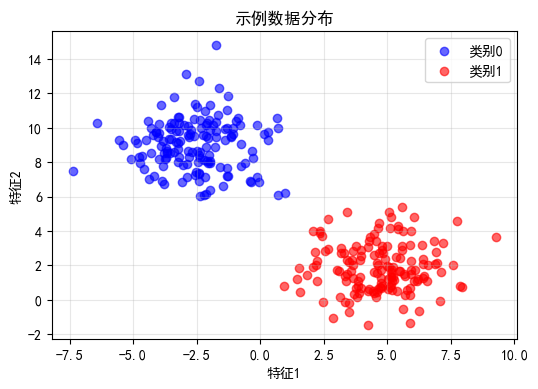
4.2 可视化决策树结构
python
# 绘制决策树
plt.figure(figsize=(8, 4))
plot_tree(tree_viz, filled=True, feature_names=['特征1', '特征2'],
          class_names=['类别0', '类别1'], rounded=True, fontsize=10)
plt.title('决策树可视化', fontsize=16)
plt.show()

# 打印文本形式的决策树
print("决策树规则(文本形式):")
print(export_text(tree_viz, feature_names=['特征1', '特征2']))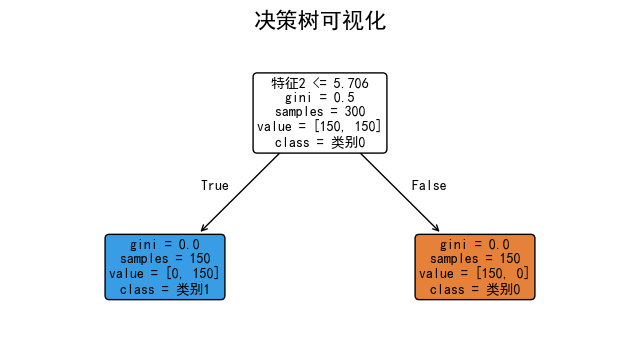
决策树规则(文本形式):
|--- 特征2 <= 5.71
|   |--- class: 1
|--- 特征2 >  5.71
|   |--- class: 0
4.3 决策边界可视化
python
def plot_decision_boundary_tree(model, X, y, title="决策边界"):
    """可视化决策树的决策边界"""
    # 创建网格
    x_min, x_max = X[:, 0].min() - 1, X[:, 0].max() + 1
    y_min, y_max = X[:, 1].min() - 1, X[:, 1].max() + 1
    xx, yy = np.meshgrid(np.arange(x_min, x_max, 0.02),
                         np.arange(y_min, y_max, 0.02))

    # 预测网格点
    Z = model.predict(np.c_[xx.ravel(), yy.ravel()])
    Z = Z.reshape(xx.shape)

    # 绘图
    plt.figure(figsize=(10, 4))

    plt.subplot(1, 2, 1)
    plt.contourf(xx, yy, Z, alpha=0.3, cmap='RdYlBu')
    plt.scatter(X[y==0, 0], X[y==0, 1], c='blue', label='类别0', alpha=0.6, edgecolors='k')
    plt.scatter(X[y==1, 0], X[y==1, 1], c='red', label='类别1', alpha=0.6, edgecolors='k')
    plt.xlabel('特征1')
    plt.ylabel('特征2')
    plt.title(f'{title}\n(决策边界)')
    plt.legend()
    plt.grid(True, alpha=0.3)

    plt.subplot(1, 2, 2)
    # 绘制特征重要性
    importances = model.feature_importances_
    plt.bar(['特征1', '特征2'], importances)
    plt.xlabel('特征')
    plt.ylabel('重要性')
    plt.title('特征重要性')
    for i, imp in enumerate(importances):
        plt.text(i, imp + 0.01, f'{imp:.3f}', ha='center')

    plt.tight_layout()
    plt.show()

plot_decision_boundary_tree(tree_viz, X_blob, y_blob, "决策树决策边界")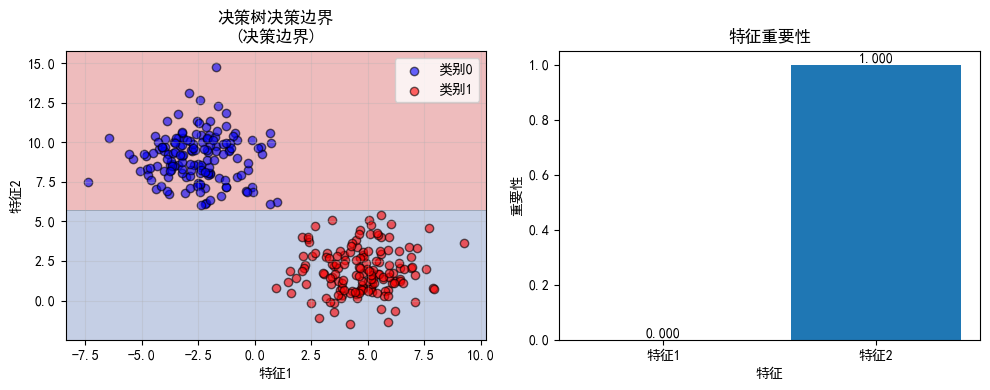
5. 过拟合实验:不同max_depth的影响
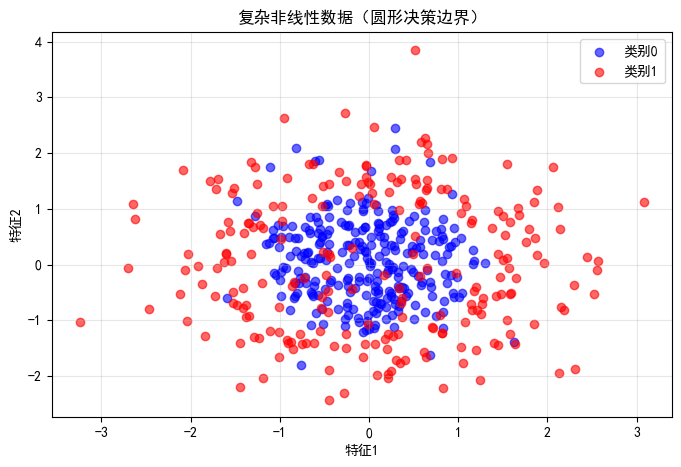
5.1 生成非线性数据
python
# 生成复杂的非线性数据
np.random.seed(42)
n_samples = 500
X_complex = np.random.randn(n_samples, 2)
y_complex = ((X_complex[:, 0]**2 + X_complex[:, 1]**2) > 1.5).astype(int)

# 添加一些噪声
noise_idx = np.random.choice(n_samples, int(n_samples * 0.1), replace=False)
y_complex[noise_idx] = 1 - y_complex[noise_idx]

# 可视化
plt.figure(figsize=(8, 5))
plt.scatter(X_complex[y_complex==0, 0], X_complex[y_complex==0, 1],
            c='blue', label='类别0', alpha=0.6)
plt.scatter(X_complex[y_complex==1, 0], X_complex[y_complex==1, 1],
            c='red', label='类别1', alpha=0.6)
plt.xlabel('特征1')
plt.ylabel('特征2')
plt.title('复杂非线性数据(圆形决策边界)')
plt.legend()
plt.grid(True, alpha=0.3)
plt.show()

# 划分数据
X_train_c, X_test_c, y_train_c, y_test_c = train_test_split(
    X_complex, y_complex, test_size=0.3, random_state=42
)
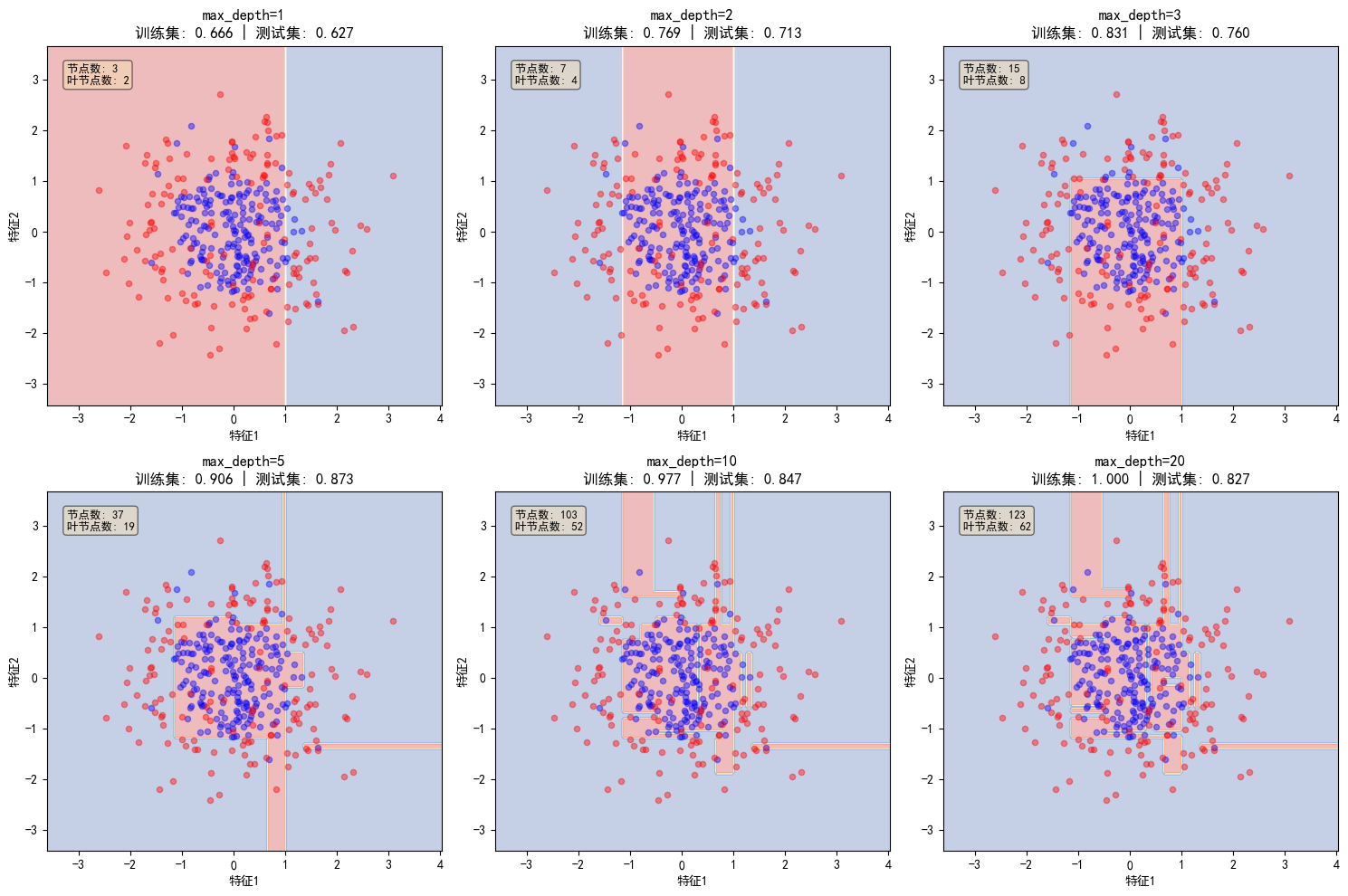
5.2 不同深度对比实验
python
def compare_depths(X_train, X_test, y_train, y_test, depths=[1, 3, 5, 10, 20]):
    """对比不同深度的决策树性能"""
    fig, axes = plt.subplots(2, 3, figsize=(15, 10))
    axes = axes.ravel()

    train_scores = []
    test_scores = []
    tree_models = []

    for idx, depth in enumerate(depths):
        # 训练决策树
        tree = DecisionTreeClassifier(max_depth=depth, random_state=42)
        tree.fit(X_train, y_train)
        tree_models.append(tree)

        # 计算准确率
        train_acc = accuracy_score(y_train, tree.predict(X_train))
        test_acc = accuracy_score(y_test, tree.predict(X_test))
        train_scores.append(train_acc)
        test_scores.append(test_acc)

        # 可视化决策边界
        x_min, x_max = X_train[:, 0].min() - 1, X_train[:, 0].max() + 1
        y_min, y_max = X_train[:, 1].min() - 1, X_train[:, 1].max() + 1
        xx, yy = np.meshgrid(np.arange(x_min, x_max, 0.05),
                             np.arange(y_min, y_max, 0.05))
        Z = tree.predict(np.c_[xx.ravel(), yy.ravel()])
        Z = Z.reshape(xx.shape)

        axes[idx].contourf(xx, yy, Z, alpha=0.3, cmap='RdYlBu')
        axes[idx].scatter(X_train[y_train==0, 0], X_train[y_train==0, 1],
                         c='blue', alpha=0.4, s=20)
        axes[idx].scatter(X_train[y_train==1, 0], X_train[y_train==1, 1],
                         c='red', alpha=0.4, s=20)
        axes[idx].set_title(f'max_depth={depth}\n训练集: {train_acc:.3f} | 测试集: {test_acc:.3f}')
        axes[idx].set_xlabel('特征1')
        axes[idx].set_ylabel('特征2')

        # 计算树的信息
        n_nodes = tree.tree_.node_count
        n_leaves = tree.get_n_leaves()
        axes[idx].text(0.05, 0.95, f'节点数: {n_nodes}\n叶节点数: {n_leaves}',
                      transform=axes[idx].transAxes, fontsize=9,
                      verticalalignment='top', bbox=dict(boxstyle='round', facecolor='wheat', alpha=0.5))

    # 隐藏多余的子图
    for idx in range(len(depths), len(axes)):
        axes[idx].set_visible(False)

    plt.tight_layout()
    plt.show()

    # 绘制性能曲线
    plt.figure(figsize=(8, 5))
    plt.plot(depths, train_scores, 'b-o', label='训练集准确率', linewidth=2, markersize=8)
    plt.plot(depths, test_scores, 'r-s', label='测试集准确率', linewidth=2, markersize=8)
    plt.xlabel('树的最大深度 (max_depth)')
    plt.ylabel('准确率')
    plt.title('决策树深度对性能的影响(过拟合可视化)')
    plt.legend()
    plt.grid(True, alpha=0.3)

    # 标注过拟合区域
    best_depth = depths[np.argmax(test_scores)]
    plt.axvline(x=best_depth, color='g', linestyle='--', label=f'最佳深度={best_depth}')

    # 添加注解
    plt.annotate('欠拟合区域', xy=(1, 0.7), xytext=(2, 0.6),
                arrowprops=dict(arrowstyle='->', color='orange'))
    plt.annotate('过拟合区域', xy=(20, 0.7), xytext=(15, 0.55),
                arrowprops=dict(arrowstyle='->', color='orange'))

    plt.legend()
    plt.show()

    print(f"最佳深度: {best_depth}")
    print(f"最佳测试准确率: {max(test_scores):.4f}")

    return tree_models, train_scores, test_scores

# 执行对比实验
trees, train_scores, test_scores = compare_depths(
    X_train_c, X_test_c, y_train_c, y_test_c,
    depths=[1, 2, 3, 5, 10, 20]
)
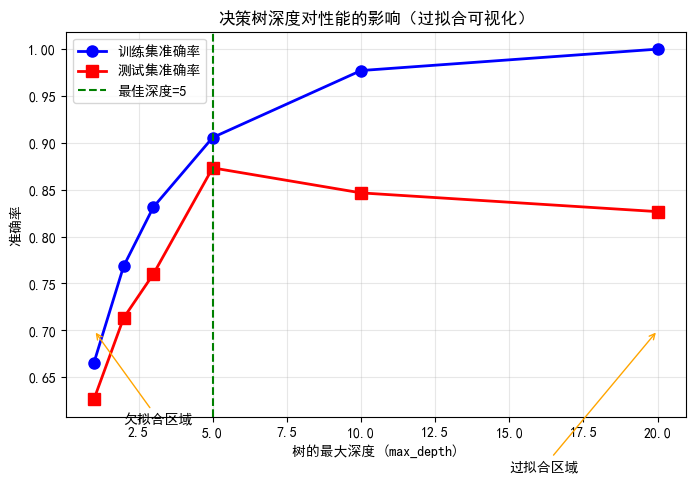
最佳深度: 5
最佳测试准确率: 0.8733
5.3 过拟合详细分析
python
def analyze_overfitting(X_train, X_test, y_train, y_test, max_depth=20):
    """详细分析过拟合现象"""

    # 训练不同深度的树
    depths = range(1, max_depth + 1)
    train_accuracies = []
    test_accuracies = []
    tree_sizes = []

    for depth in depths:
        tree = DecisionTreeClassifier(max_depth=depth, random_state=42)
        tree.fit(X_train, y_train)
        train_accuracies.append(accuracy_score(y_train, tree.predict(X_train)))
        test_accuracies.append(accuracy_score(y_test, tree.predict(X_test)))
        tree_sizes.append(tree.tree_.node_count)

    # 创建可视化
    fig, axes = plt.subplots(1, 3, figsize=(15, 4))

    # 准确率曲线
    axes[0].plot(depths, train_accuracies, 'b-', label='训练集', linewidth=2)
    axes[0].plot(depths, test_accuracies, 'r-', label='测试集', linewidth=2)
    axes[0].fill_between(depths, train_accuracies, test_accuracies,
                         where=(np.array(train_accuracies) > np.array(test_accuracies)),
                         alpha=0.3, color='red', label='过拟合差距')
    axes[0].set_xlabel('树深度')
    axes[0].set_ylabel('准确率')
    axes[0].set_title('训练集 vs 测试集准确率')
    axes[0].legend()
    axes[0].grid(True, alpha=0.3)

    # 过拟合差距
    gap = np.array(train_accuracies) - np.array(test_accuracies)
    axes[1].plot(depths, gap, 'g-o', linewidth=2)
    axes[1].axhline(y=0, color='k', linestyle='--')
    axes[1].fill_between(depths, 0, gap, where=(gap > 0), alpha=0.3, color='red')
    axes[1].set_xlabel('树深度')
    axes[1].set_ylabel('训练-测试准确率差')
    axes[1].set_title('过拟合程度(差距越大,过拟合越严重)')
    axes[1].grid(True, alpha=0.3)

    # 树的大小
    axes[2].plot(depths, tree_sizes, 'm-o', linewidth=2)
    axes[2].set_xlabel('树深度')
    axes[2].set_ylabel('节点数')
    axes[2].set_title('决策树复杂度随深度增长')
    axes[2].grid(True, alpha=0.3)

    plt.tight_layout()
    plt.show()

    # 打印关键观察
    print("\n" + "="*60)
    print("过拟合分析结论")
    print("="*60)
    best_depth = depths[np.argmax(test_accuracies)]
    print(f"1. 最佳深度: {best_depth}")
    print(f"2. 最佳测试准确率: {max(test_accuracies):.4f}")
    print(f"3. 深度{max_depth}时的过拟合差距: {gap[-1]:.4f}")
    print(f"4. 深度从{best_depth}增加到{max_depth}:")
    print(f"   - 训练准确率提升: {train_accuracies[-1] - train_accuracies[best_depth-1]:.2%}")
    print(f"   - 测试准确率下降: {test_accuracies[best_depth-1] - test_accuracies[-1]:.2%}")
    print(f"   - 节点数增加: {tree_sizes[-1] - tree_sizes[best_depth-1]}")

analyze_overfitting(X_train_c, X_test_c, y_train_c, y_test_c, max_depth=20)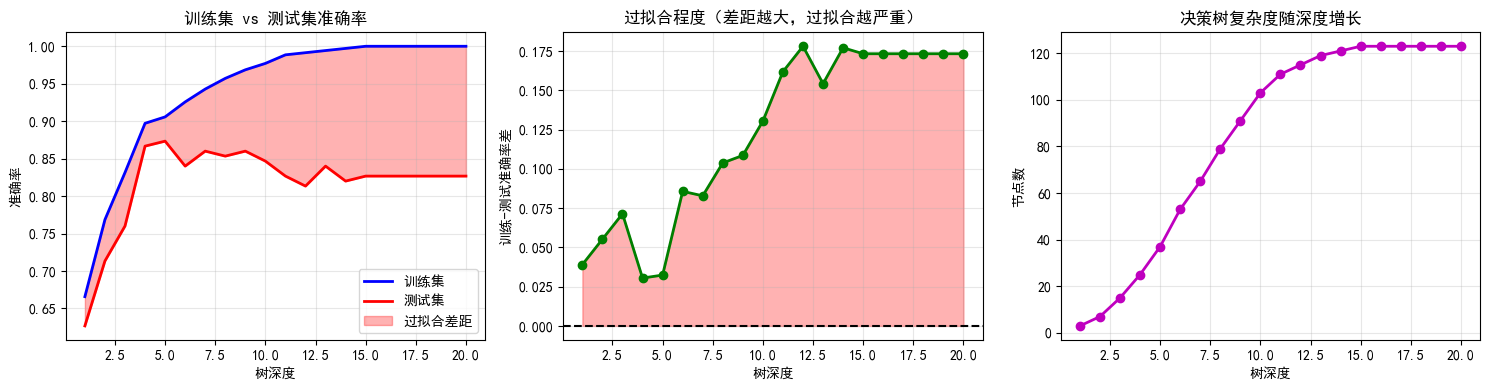
============================================================
过拟合分析结论
============================================================
-
最佳深度: 5
-
最佳测试准确率: 0.8733
-
深度20时的过拟合差距: 0.1733
-
深度从5增加到20:
-
训练准确率提升: 9.43%
-
测试准确率下降: 4.67%
-
节点数增加: 86
6. 金融应用:预测股票涨跌
6.1 加载股票K线数据
python
from pathlib import Path

def read_stock_data(ts_code):
    """生成模拟股票数据,包含多种形态"""

    data_path = Path(r"E:\AppData\quant_trade\klines\kline2014-2024")
    kline_file = data_path / f"{ts_code}.csv"

    df = pd.read_csv(kline_file, usecols=["trade_date", "close", "vol"],
                     parse_dates=["trade_date"]).sort_values(by=["trade_date"]).reset_index(drop=True)

    # 计算收益率
    df['return'] = df['close'].pct_change()

    # RSI
    delta = df['return'].fillna(0)
    gain = delta.where(delta > 0, 0).rolling(14).mean()
    loss = -delta.where(delta < 0, 0).rolling(14).mean()
    rs = gain / (loss + 1e-10)
    df['rsi'] = 100 - (100 / (1 + rs))

    # MACD
    ema12 = df['close'].ewm(span=12, adjust=False).mean()
    ema26 = df['close'].ewm(span=26, adjust=False).mean()
    df['macd'] = ema12 - ema26
    df['macd_signal'] = df['macd'].ewm(span=9, adjust=False).mean()
    df['macd_hist'] = df['macd'] - df['macd_signal']

    # 移动平均线
    df['ma5'] = df['close'].rolling(5).mean()
    df['ma20'] = df['close'].rolling(20).mean()
    df['ma_ratio'] = df['ma5'] / df['ma20'] - 1

    # 波动率
    df['volatility'] = df['return'].rolling(20).std()

    # 成交量指标
    df['volume_ma'] = df['vol'].rolling(10).mean()
    df['volume_ratio'] = df['vol'] / df['volume_ma']

    # 目标变量:3日是否上涨
    df['target'] = (df['close'].shift(-3) > df['close']).astype(int)

    return df.dropna()

# 生成数据
df_finance = read_stock_data("600519.SH")
print(f"数据形状: {df_finance.shape}")
df_finance.head()

# 查看数据分布
print("\n目标变量分布:")
print(df_finance['target'].value_counts(normalize=True))数据形状: (2452, 15)
目标变量分布:
target
1 0.544454
0 0.455546
Name: proportion, dtype: float646.2 特征选择与数据划分
python
# 选择特征
feature_cols = ['rsi', 'macd', 'macd_hist', 'ma_ratio', 'volatility', 'volume_ratio']
X_fin = df_finance[feature_cols]
y_fin = df_finance['target']

# 按时间划分(避免前视偏差)
split_idx = int(len(df_finance) * 0.7)
X_train_f = X_fin[:split_idx]
X_test_f = X_fin[split_idx:]
y_train_f = y_fin[:split_idx]
y_test_f = y_fin[split_idx:]

print(f"训练集大小: {len(X_train_f)}")
print(f"测试集大小: {len(X_test_f)}")
print(f"训练集正样本比例: {y_train_f.mean():.2%}")训练集大小: 1716
测试集大小: 736
训练集正样本比例: 57.28%6.3 训练不同深度的决策树
python
# 训练不同深度的决策树
depths_fin = [2, 3, 5, 7, 10, 15]
train_scores_fin = []
test_scores_fin = []

for depth in depths_fin:
    tree = DecisionTreeClassifier(max_depth=depth, random_state=42)
    tree.fit(X_train_f, y_train_f)

    train_acc = accuracy_score(y_train_f, tree.predict(X_train_f))
    test_acc = accuracy_score(y_test_f, tree.predict(X_test_f))
    train_scores_fin.append(train_acc)
    test_scores_fin.append(test_acc)

    print(f"max_depth={depth:2d} | 训练集: {train_acc:.4f} | 测试集: {test_acc:.4f}")

# 可视化
plt.figure(figsize=(10, 4))

plt.subplot(1, 2, 1)
plt.plot(depths_fin, train_scores_fin, 'b-o', label='训练集', linewidth=2)
plt.plot(depths_fin, test_scores_fin, 'r-s', label='测试集', linewidth=2)
plt.xlabel('树深度')
plt.ylabel('准确率')
plt.title('金融数据预测 - 不同深度性能对比')
plt.legend()
plt.grid(True, alpha=0.3)

# 最佳深度
best_depth_fin = depths_fin[np.argmax(test_scores_fin)]
plt.axvline(x=best_depth_fin, color='g', linestyle='--', label=f'最佳深度={best_depth_fin}')
plt.legend()

# 过拟合差距
plt.subplot(1, 2, 2)
gap = np.array(train_scores_fin) - np.array(test_scores_fin)
plt.bar([str(d) for d in depths_fin], gap, color=['green' if g < 0.05 else 'orange' if g < 0.1 else 'red' for g in gap])
plt.xlabel('树深度')
plt.ylabel('训练-测试准确率差')
plt.title('过拟合程度分析')
plt.axhline(y=0.05, color='green', linestyle='--', label='可接受差距')
plt.axhline(y=0.1, color='red', linestyle='--', label='严重过拟合')
plt.legend()

plt.tight_layout()
plt.show()max_depth= 2 | 训练集: 0.5903 | 测试集: 0.4905
max_depth= 3 | 训练集: 0.5903 | 测试集: 0.4905
max_depth= 5 | 训练集: 0.6090 | 测试集: 0.5408
max_depth= 7 | 训练集: 0.6457 | 测试集: 0.5095
max_depth=10 | 训练集: 0.7273 | 测试集: 0.4796
max_depth=15 | 训练集: 0.8829 | 测试集: 0.5000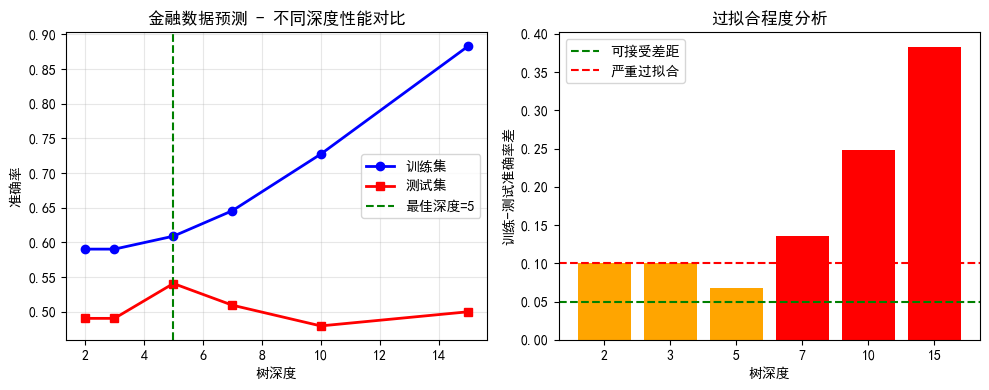
6.4 特征重要性分析
python
# 使用最佳深度的树
best_tree = DecisionTreeClassifier(max_depth=best_depth_fin, random_state=42)
best_tree.fit(X_train_f, y_train_f)

# 特征重要性
importances = best_tree.feature_importances_
feature_importance_df = pd.DataFrame({
    'Feature': feature_cols,
    'Importance': importances
}).sort_values('Importance', ascending=False)

plt.figure(figsize=(10, 6))
plt.barh(feature_importance_df['Feature'], feature_importance_df['Importance'])
plt.xlabel('重要性')
plt.ylabel('特征')
plt.title(f'决策树特征重要性 (max_depth={best_depth_fin})')
for i, (_, row) in enumerate(feature_importance_df.iterrows()):
    plt.text(row['Importance'] + 0.01, i, f"{row['Importance']:.3f}", va='center')
plt.grid(True, alpha=0.3)
plt.show()

print("特征重要性排序:")
print(feature_importance_df.to_string(index=False))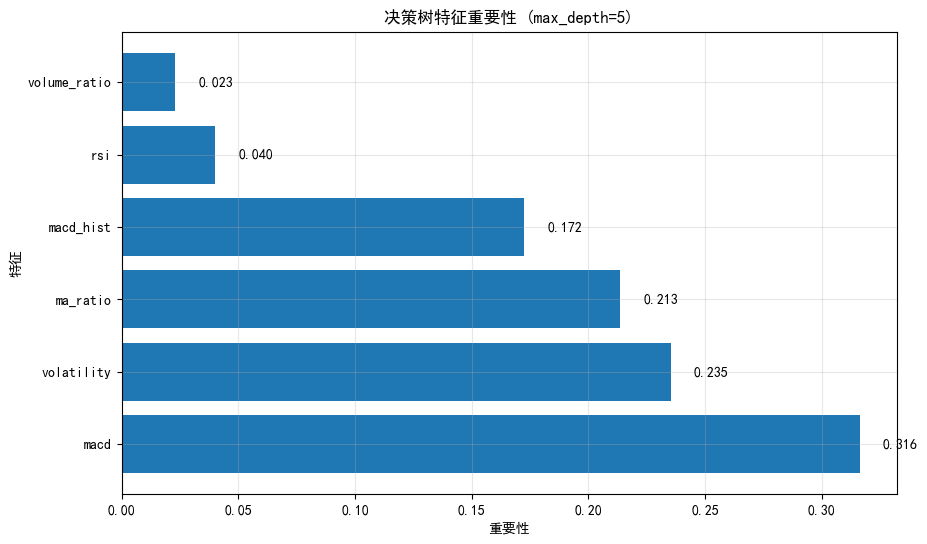
特征重要性排序:
     Feature  Importance
        macd    0.316185
  volatility    0.235141
    ma_ratio    0.213499
   macd_hist    0.172273
         rsi    0.039951
volume_ratio    0.022951
6.5 决策树规则提取
python
# 提取决策树规则
tree_rules = export_text(best_tree, feature_names=feature_cols)
print("决策树规则(可解释的交易信号):")
print("="*60)
print(tree_rules)

# 可视化树结构(简化版)
plt.figure(figsize=(10, 6))
plot_tree(best_tree, feature_names=feature_cols, class_names=['下跌', '上涨'],
          filled=True, rounded=True, fontsize=8, max_depth=3)  # 只显示前3层避免拥挤
plt.title(f'金融预测决策树可视化 (max_depth={best_depth_fin})', fontsize=16)
plt.tight_layout()
plt.show()决策树规则(可解释的交易信号):
============================================================
|--- volatility <= 0.03
| |--- ma_ratio <= -0.04
| | |--- macd_hist <= -4.66
| | | |--- class: 1
| | |--- macd_hist > -4.66
| | | |--- volatility <= 0.02
| | | | |--- class: 0
| | | |--- volatility > 0.02
| | | | |--- macd <= -17.49
| | | | | |--- class: 0
| | | | |--- macd > -17.49
| | | | | |--- class: 1
| |--- ma_ratio > -0.04
| | |--- macd <= 13.59
| | | |--- macd_hist <= 0.79
| | | | |--- volatility <= 0.02
| | | | | |--- class: 1
| | | | |--- volatility > 0.02
| | | | | |--- class: 0
| | | |--- macd_hist > 0.79
| | | | |--- ma_ratio <= -0.01
| | | | | |--- class: 1
| | | | |--- ma_ratio > -0.01
| | | | | |--- class: 0
| | |--- macd > 13.59
| | | |--- macd <= 86.25
| | | | |--- macd <= 39.93
| | | | | |--- class: 1
| | | | |--- macd > 39.93
| | | | | |--- class: 1
| | | |--- macd > 86.25
| | | | |--- macd_hist <= 24.36
| | | | | |--- class: 0
| | | | |--- macd_hist > 24.36
| | | | | |--- class: 0
|--- volatility > 0.03
| |--- macd_hist <= -13.17
| | |--- class: 1
| |--- macd_hist > -13.17
| | |--- macd <= 32.60
| | | |--- rsi <= 34.04
| | | | |--- volume_ratio <= 0.48
| | | | | |--- class: 0
| | | | |--- volume_ratio > 0.48
| | | | | |--- class: 1
| | | |--- rsi > 34.04
| | | | |--- macd <= 30.78
| | | | | |--- class: 0
| | | | |--- macd > 30.78
| | | | | |--- class: 1
| | |--- macd > 32.60
| | | |--- class: 0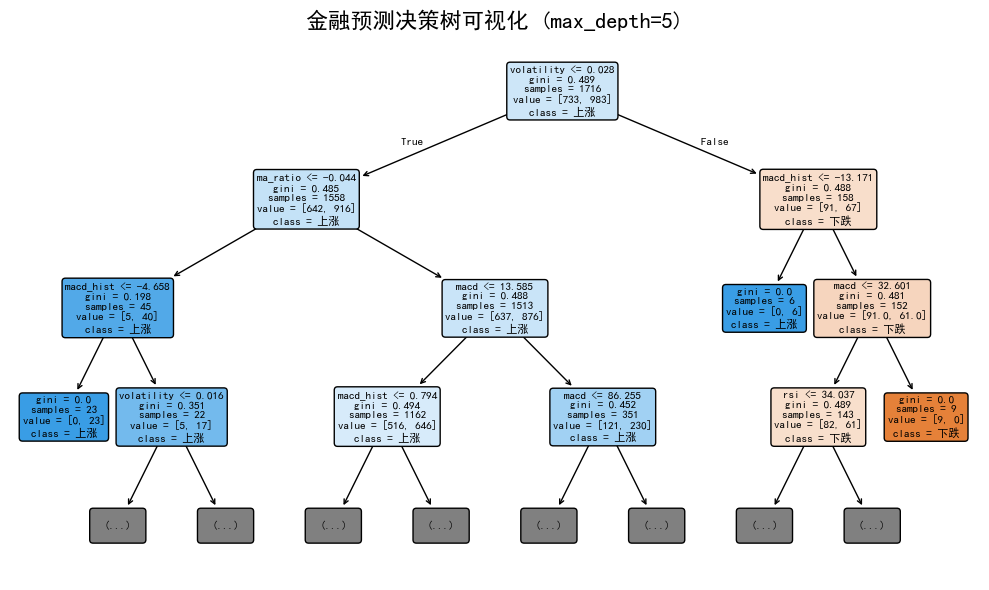
7. 剪枝参数优化
7.1 预剪枝参数实验
python
def experiment_pre_pruning(X_train, X_test, y_train, y_test):
    """实验不同的预剪枝参数"""

    # 参数组合
    param_tests = [
        {'name': '无限制', 'params': {'max_depth': None, 'min_samples_split': 2, 'min_samples_leaf': 1}},
        {'name': 'max_depth=5', 'params': {'max_depth': 5, 'min_samples_split': 2, 'min_samples_leaf': 1}},
        {'name': 'max_depth=10', 'params': {'max_depth': 10, 'min_samples_split': 2, 'min_samples_leaf': 1}},
        {'name': 'min_samples_split=20', 'params': {'max_depth': None, 'min_samples_split': 20, 'min_samples_leaf': 1}},
        {'name': 'min_samples_leaf=10', 'params': {'max_depth': None, 'min_samples_split': 2, 'min_samples_leaf': 10}},
        {'name': '严格限制', 'params': {'max_depth': 5, 'min_samples_split': 20, 'min_samples_leaf': 10}}
    ]

    results = []

    for test in param_tests:
        tree = DecisionTreeClassifier(**test['params'], random_state=42)
        tree.fit(X_train, y_train)

        train_acc = accuracy_score(y_train, tree.predict(X_train))
        test_acc = accuracy_score(y_test, tree.predict(X_test))
        n_nodes = tree.tree_.node_count

        results.append({
            '配置': test['name'],
            '训练集准确率': train_acc,
            '测试集准确率': test_acc,
            '节点数': n_nodes,
            '过拟合差距': train_acc - test_acc
        })

    results_df = pd.DataFrame(results)
    print(results_df.to_string(index=False))

    # 可视化
    fig, axes = plt.subplots(1, 2, figsize=(10, 4))

    x = range(len(results))
    axes[0].bar(x, results_df['测试集准确率'], color='green', alpha=0.7, label='测试集')
    axes[0].bar(x, results_df['训练集准确率'], color='blue', alpha=0.5, label='训练集', width=0.5)
    axes[0].set_xticks(x)
    axes[0].set_xticklabels(results_df['配置'], rotation=45, ha='right')
    axes[0].set_ylabel('准确率')
    axes[0].set_title('不同剪枝配置的性能对比')
    axes[0].legend()
    axes[0].grid(True, alpha=0.3)

    axes[1].bar(x, results_df['过拟合差距'], color=['green' if g < 0.05 else 'orange' if g < 0.1 else 'red' for g in results_df['过拟合差距']])
    axes[1].set_xticks(x)
    axes[1].set_xticklabels(results_df['配置'], rotation=45, ha='right')
    axes[1].set_ylabel('过拟合差距')
    axes[1].set_title('过拟合程度对比')
    axes[1].axhline(y=0.05, color='green', linestyle='--', label='可接受')
    axes[1].axhline(y=0.1, color='red', linestyle='--', label='严重')
    axes[1].legend()
    axes[1].grid(True, alpha=0.3)

    plt.tight_layout()
    plt.show()

    return results_df

# 执行实验
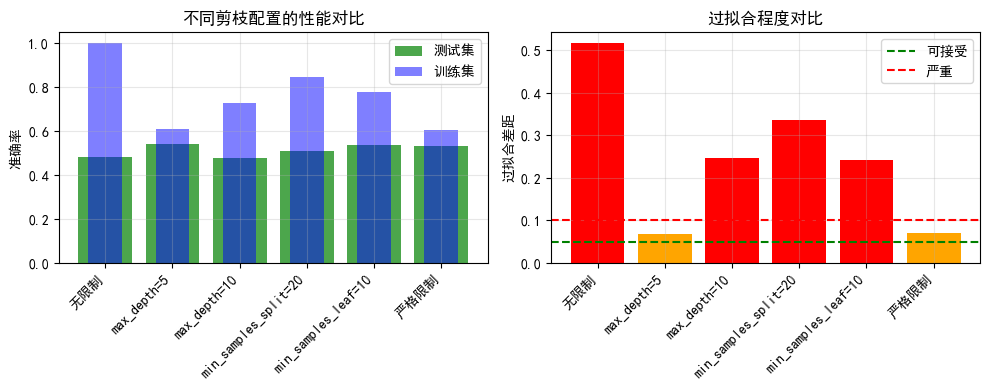
pruning_results = experiment_pre_pruning(X_train_f, X_test_f, y_train_f, y_test_f)| 配置 | 训练集准确率 | 测试集准确率 | 节点数 | 过拟合差距 |
|---|---|---|---|---|
| 无限制 | 1.000000 | 0.483696 | 803 | 0.516304 |
| max_depth=5 | 0.608974 | 0.540761 | 35 | 0.068213 |
| max_depth=10 | 0.727273 | 0.479620 | 207 | 0.247653 |
| min_samples_split=20 | 0.847319 | 0.510870 | 357 | 0.336450 |
| min_samples_leaf=10 | 0.780886 | 0.539402 | 255 | 0.241484 |
| 严格限制 | 0.605478 | 0.533967 | 29 | 0.071510 |
7.2 成本复杂度剪枝(CCP)
python
def ccp_pruning_demo(X_train, X_test, y_train, y_test):
    """演示成本复杂度剪枝"""

    # 先构建一个不剪枝的完整树
    tree_full = DecisionTreeClassifier(random_state=42)
    tree_full.fit(X_train, y_train)

    # 获取剪枝路径
    path = tree_full.cost_complexity_pruning_path(X_train, y_train)
    ccp_alphas = path.ccp_alphas
    impurities = path.impurities

    # 对不同alpha训练树
    trees_ccp = []
    train_scores_ccp = []
    test_scores_ccp = []

    for alpha in ccp_alphas[:-1]:  # 排除最后一个(会变成单节点)
        tree = DecisionTreeClassifier(ccp_alpha=alpha, random_state=42)
        tree.fit(X_train, y_train)
        trees_ccp.append(tree)
        train_scores_ccp.append(accuracy_score(y_train, tree.predict(X_train)))
        test_scores_ccp.append(accuracy_score(y_test, tree.predict(X_test)))

    # 可视化
    fig, axes = plt.subplots(1, 2, figsize=(10, 4))

    # 剪枝路径
    axes[0].plot(ccp_alphas[:-1], impurities[:-1], 'b-o', linewidth=2)
    axes[0].set_xlabel('ccp_alpha')
    axes[0].set_ylabel('总不纯度')
    axes[0].set_title('成本复杂度剪枝路径')
    axes[0].grid(True, alpha=0.3)

    # 性能随alpha变化
    axes[1].plot(ccp_alphas[:-1], train_scores_ccp, 'b-o', label='训练集', linewidth=2)
    axes[1].plot(ccp_alphas[:-1], test_scores_ccp, 'r-s', label='测试集', linewidth=2)
    axes[1].set_xlabel('ccp_alpha')
    axes[1].set_ylabel('准确率')
    axes[1].set_title('CCP剪枝效果')
    axes[1].legend()
    axes[1].grid(True, alpha=0.3)

    # 标记最佳alpha
    best_idx = np.argmax(test_scores_ccp)
    best_alpha = ccp_alphas[best_idx]
    axes[1].axvline(x=best_alpha, color='g', linestyle='--', label=f'最佳alpha={best_alpha:.4f}')
    axes[1].legend()

    plt.tight_layout()
    plt.show()

    print(f"最佳ccp_alpha: {best_alpha:.6f}")
    print(f"最佳测试准确率: {max(test_scores_ccp):.4f}")
    print(f"原始树测试准确率: {test_scores_ccp[0]:.4f}")
    print(f"剪枝后提升: {(max(test_scores_ccp) - test_scores_ccp[0])*100:.2f}%")

    return best_alpha

best_alpha = ccp_pruning_demo(X_train_f, X_test_f, y_train_f, y_test_f)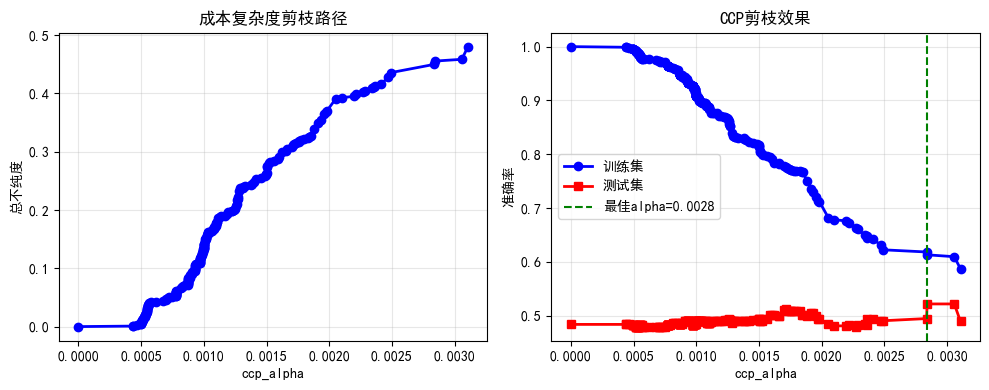
最佳ccp_alpha: 0.002840
最佳测试准确率: 0.5217
原始树测试准确率: 0.4837
剪枝后提升: 3.80%
8. 交叉验证选择最佳参数
8.1 网格搜索
python
from sklearn.model_selection import GridSearchCV

# 参数网格
param_grid = {
    'max_depth': [3, 5, 7, 10, 15],
    'min_samples_split': [2, 5, 10, 20],
    'min_samples_leaf': [1, 2, 5, 10],
    'criterion': ['gini', 'entropy']
}

# 网格搜索
tree_gs = DecisionTreeClassifier(random_state=42)
grid_search = GridSearchCV(tree_gs, param_grid, cv=5, scoring='accuracy', n_jobs=-1)
grid_search.fit(X_train_f, y_train_f)

print("最佳参数组合:")
print(grid_search.best_params_)
print(f"\n最佳交叉验证准确率: {grid_search.best_score_:.4f}")
print(f"测试集准确率: {accuracy_score(y_test_f, grid_search.predict(X_test_f)):.4f}")

# 使用最佳模型
best_tree_cv = grid_search.best_estimator_最佳参数组合:
{'criterion': 'entropy', 'max_depth': 3, 'min_samples_leaf': 1, 'min_samples_split': 2}
最佳交叉验证准确率: 0.5641
测试集准确率: 0.49058.2 最佳模型评估
python
y_pred_best = best_tree_cv.predict(X_test_f)
y_pred_proba = best_tree_cv.predict_proba(X_test_f)[:, 1]

# 混淆矩阵
cm = confusion_matrix(y_test_f, y_pred_best)

plt.figure(figsize=(8, 3))

plt.subplot(1, 2, 1)
sns.heatmap(cm, annot=True, fmt='d', cmap='Blues',
            xticklabels=['预测下跌', '预测上涨'],
            yticklabels=['实际下跌', '实际上涨'])
plt.title('混淆矩阵 - 最佳决策树')

plt.subplot(1, 2, 2)
# 特征重要性
importances_best = best_tree_cv.feature_importances_
plt.barh(feature_cols, importances_best)
plt.xlabel('重要性')
plt.title('特征重要性')

plt.tight_layout()
plt.show()

print("\n分类报告:")
print(classification_report(y_test_f, y_pred_best, target_names=['下跌', '上涨']))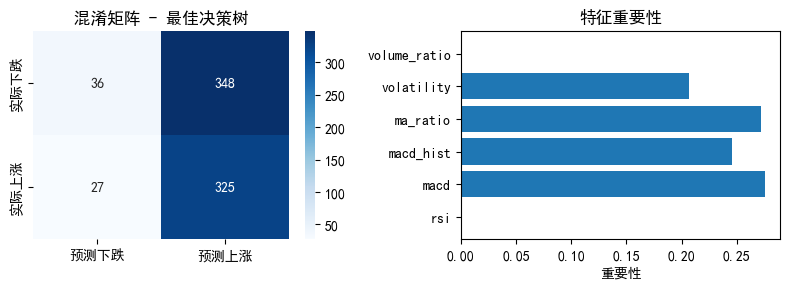
分类报告:
                 precision    recall  f1-score   support

          下跌       0.57      0.09      0.16       384
          上涨       0.48      0.92      0.63       352

      accuracy                           0.49       736
     macro avg       0.53      0.51      0.40       736
  weighted avg       0.53      0.49      0.39       736
9. 决策树 vs 随机森林(预告)
9.1 简单对比
python
from sklearn.ensemble import RandomForestClassifier

# 单棵决策树
single_tree = DecisionTreeClassifier(max_depth=5, random_state=42)
single_tree.fit(X_train_f, y_train_f)

# 随机森林
rf = RandomForestClassifier(n_estimators=100, max_depth=5, random_state=42)
rf.fit(X_train_f, y_train_f)

# 对比
print("="*60)
print("决策树 vs 随机森林对比")
print("="*60)
print(f"决策树 - 训练集: {accuracy_score(y_train_f, single_tree.predict(X_train_f)):.4f}")
print(f"决策树 - 测试集: {accuracy_score(y_test_f, single_tree.predict(X_test_f)):.4f}")
print(f"随机森林 - 训练集: {accuracy_score(y_train_f, rf.predict(X_train_f)):.4f}")
print(f"随机森林 - 测试集: {accuracy_score(y_test_f, rf.predict(X_test_f)):.4f}")

# 可视化对比
plt.figure(figsize=(6, 3))
models = ['决策树', '随机森林']
train_scores_compare = [
    accuracy_score(y_train_f, single_tree.predict(X_train_f)),
    accuracy_score(y_train_f, rf.predict(X_train_f))
]
test_scores_compare = [
    accuracy_score(y_test_f, single_tree.predict(X_test_f)),
    accuracy_score(y_test_f, rf.predict(X_test_f))
]

x = np.arange(len(models))
width = 0.35
plt.bar(x - width/2, train_scores_compare, width, label='训练集', alpha=0.8)
plt.bar(x + width/2, test_scores_compare, width, label='测试集', alpha=0.8)
plt.xlabel('模型')
plt.ylabel('准确率')
plt.title('决策树 vs 随机森林')
plt.xticks(x, models)
plt.legend()
plt.grid(True, alpha=0.3)
plt.show()============================================================
决策树 vs 随机森林对比
============================================================
决策树 - 训练集: 0.6090
决策树 - 测试集: 0.5408
随机森林 - 训练集: 0.6381
随机森林 - 测试集: 0.4823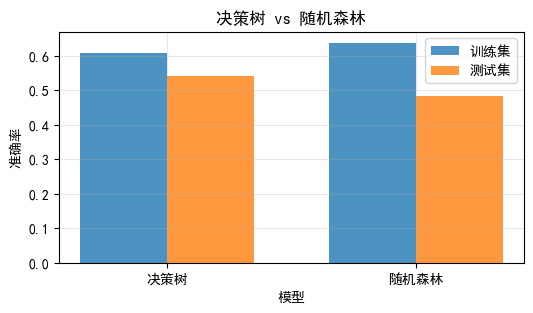
10. 今日总结与练习
核心要点回顾
决策树基础:
- 树形结构,可解释性强
- ID3用信息增益,CART用基尼系数
- 可以处理分类和回归任务
分裂准则:
- 信息增益:基于熵,计算较慢
- 基尼系数:计算快,效果相近
- 均方误差:回归树使用
过拟合控制:
- 预剪枝:限制深度、最小样本数
- 后剪枝:成本复杂度剪枝
- 使用交叉验证选择参数
量化应用:
- 可解释的交易规则
- 特征重要性帮助因子筛选
- 但需注意过拟合
今日练习
python
# 练习1:尝试不同的分裂准则(gini vs entropy),比较效果
# 练习2:使用export_text导出更详细的规则,转化为交易策略
# 练习3:实现回归树预测收益率
# 练习4:使用真实股票数据(yfinance)测试决策树策略
思考题
- 决策树的可解释性在量化交易中有什么价值?
- 如何避免决策树在金融数据中过拟合?
- 从决策树中提取的规则可以直接用于交易吗?需要注意什么?
量化思考
今天的决策树如何应用到量化交易?
- 从树中提取if-then规则作为交易信号
- 分析特征重要性,优化因子组合
- 但要注意过拟合,使用适当的剪枝
- 可以与随机森林等集成方法对比