1. 模型选择






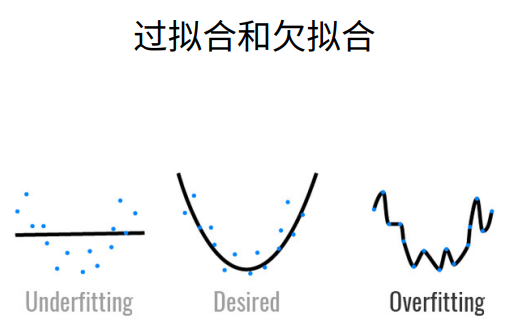
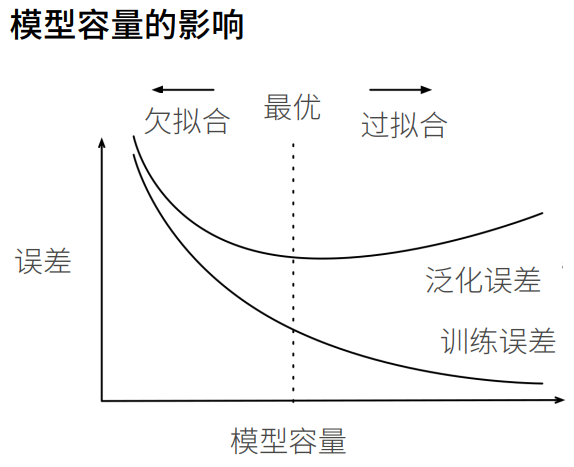
2. 过拟合、欠拟合

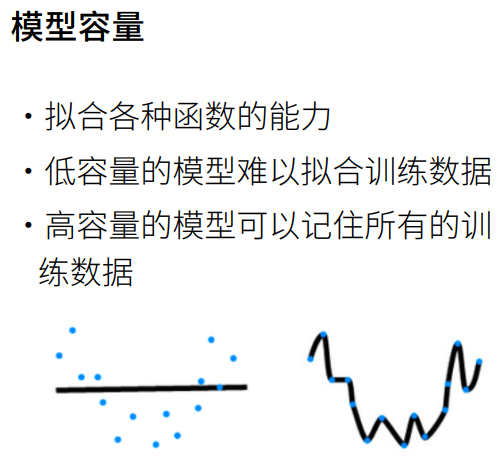
① 在多项式拟合中,模型容量为不同多项式次方。

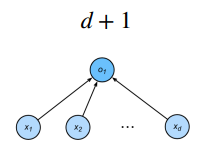
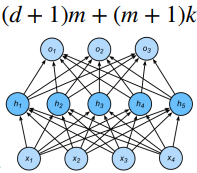
② d是特征向量的维度,1是偏置b的维度。




3. 多项式解释欠拟合、过拟合
① 使用以下三阶多项式来生成训练和测试数据的标签:
② 这个式子只是一个三次多项式,并不是哪个函数的泰勒展开。
python
# 通过多项式拟合来交互地探索这些概念
import math
import numpy as np
import torch
from torch import nn
from d2l import torch as d2l

max_degree = 20 # 特征为20就是每一个样本是一个[20,1]的tensor
n_train, n_test = 100, 100 # 100个测试样本、100验证样本
true_w = np.zeros(max_degree)
true_w[0:4] = np.array([5,1.2,-3.4,5.6]) # 真实标号为5

features = np.random.normal(size=(n_train+n_test,1))
print(features.shape)
np.random.shuffle(features)
print(np.arange(max_degree))
print(np.arange(max_degree).reshape(1,-1))
print(np.power([[10,20]],[[1,2]]))
poly_features = np.power(features, np.arange(max_degree).reshape(1,-1)) # 对第所有维的特征取0次方、1次方、2次方...19次方
for i in range(max_degree):
    poly_features[:,i] /= math.gamma(i+1) # i次方的特征除以(i+1)阶乘
labels = np.dot(poly_features,true_w) # 根据多项式生成y,即生成真实的labels
labels += np.random.normal(scale=0.1,size=labels.shape) # 对真实labels加噪音进去

#看一下前两个样本
true_w, features, poly_features, labels = [torch.tensor(x,dtype=torch.float32) for x in [true_w, features, poly_features, labels]]
print(features[:2]) # 前两个样本的x
print(poly_features[:2,:]) # 前两个样本的x的所有次方
print(labels[:2])  # 前两个样本的x对应的y

# 实现一个函数来评估模型在给定数据集上的损失
def evaluate_loss(net, data_iter, loss):
    """评估给定数据集上模型的损失"""
    metric = d2l.Accumulator(2) # 两个数的累加器
    for X, y in data_iter: # 从迭代器中拿出对应特征和标签
        out = net(X)
        y = y.reshape(out.shape) # 将真实标签改为网络输出标签的形式,统一形式
        l = loss(out, y) # 计算网络输出的预测值与真实值之间的损失差值
        metric.add(l.sum(), l.numel()) # 总量除以个数,等于平均
    return metric[0] / metric[1] # 返回数据集的平均损失

# 定义训练函数
def train(train_features, test_features, train_labels, test_labels, num_epochs=400):
    loss = nn.MSELoss()
    input_shape = train_features.shape[-1]
    net = nn.Sequential(nn.Linear(input_shape, 1, bias=False)) # 单层线性回归
    batch_size = min(10,train_labels.shape[0])
    train_iter = d2l.load_array((train_features,train_labels.reshape(-1,1)),batch_size)
    test_iter = d2l.load_array((test_features,test_labels.reshape(-1,1)),batch_size,is_train=False)
    trainer = torch.optim.SGD(net.parameters(),lr=0.01)
    animator = d2l.Animator(xlabel='epoch',ylabel='loss',yscale='log',xlim=[1,num_epochs],ylim=[1e-3,1e2],legend=['train','test'])
    for epoch in range(num_epochs):
        d2l.train_epoch_ch3(net, train_iter, loss, trainer)
        if epoch == 0 or (epoch + 1) % 20 == 0:
            animator.add(epoch + 1, (evaluate_loss(net, train_iter, loss), evaluate_loss(net,test_iter,loss)))
print('weight',net[0].weight.data.numpy()) # 训练完后打印,打印最终学到的weight值 (200, 1)
[ 0 1 2 3 4 5 6 7 8 9 10 11 12 13 14 15 16 17 18 19]
[[ 0 1 2 3 4 5 6 7 8 9 10 11 12 13 14 15 16 17 18 19]]
[[ 10 400]]
tensor([[-0.9840],
[ 1.2229]])
tensor([[ 1.0000e+00, -9.8401e-01, 4.8414e-01, -1.5880e-01, 3.9065e-02,
-7.6880e-03, 1.2608e-03, -1.7724e-04, 2.1801e-05, -2.3836e-06,
2.3455e-07, -2.0981e-08, 1.7205e-09, -1.3023e-10, 9.1534e-12,
-6.0047e-13, 3.6929e-14, -2.1376e-15, 1.1685e-16, -6.0519e-18],
[ 1.0000e+00, 1.2229e+00, 7.4775e-01, 3.0481e-01, 9.3187e-02,
2.2792e-02, 4.6454e-03, 8.1155e-04, 1.2406e-04, 1.6856e-05,
2.0614e-06, 2.2917e-07, 2.3354e-08, 2.1969e-09, 1.9190e-10,
1.5645e-11, 1.1958e-12, 8.6019e-14, 5.8441e-15, 3.7614e-16]])
tensor([1.1747, 5.7716])
python
# 三阶多项式函数拟合(正态)
train(poly_features[:n_train,:4],poly_features[n_train:,:4],labels[:n_train],labels[n_train:]) # 最后返回的weight值和公式真实weight值很接近 weight [[ 4.988501 1.2836959 -3.3589993 5.405713 ]]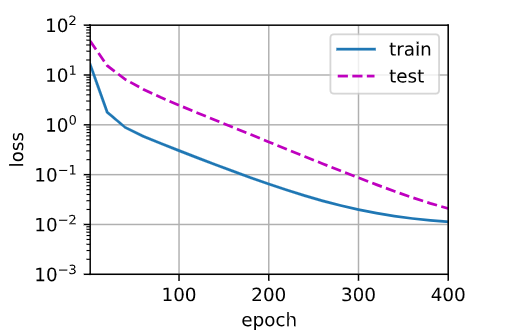
python
# 一阶多项式函数拟合(欠拟合)
# 这里相当于用一阶多项式拟合真实的三阶多项式,欠拟合了,损失很高,根本就没降
train(poly_features[:n_train,:2],poly_features[n_train:,:2],labels[:n_train],labels[n_train:])weight [[3.6593914 3.0195978]]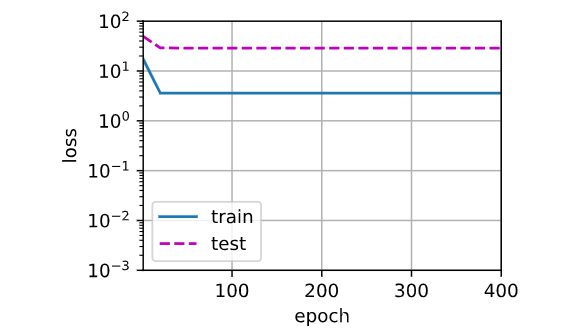
python
# 十九阶多项式函数拟合(过拟合)
# 这里相当于用十九阶多项式拟合真实的三阶多项式,过拟合了
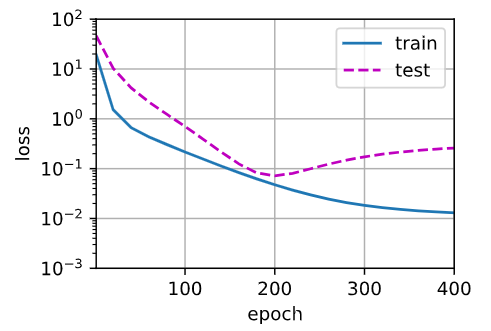
train(poly_features[:n_train,:],poly_features[n_train:,:],labels[:n_train],labels[n_train:])weight [[ 4.95713 1.2931961 -3.142203 5.1588063 -0.683433 1.3676366
-0.22168443 0.30410182 0.22201246 -0.01267278 -0.06214145 -0.1347487
-0.16502385 -0.16112421 -0.10519557 -0.06851828 0.03842303 0.07775125
0.12161571 -0.05093227]]