SynchronousQueue是一个没有数据缓冲的BlockingQueue,生产者线程对其的插入操作put必须等待消费者的移除操作take。
SynchronousQueue运用:
scss
public class SynchronousQueueDemo {
    public static void main(String[] args) {
      //新建一个SynchronousQueue同步队列
      final BlockingQueue<Integer> synchronousQueue = new SynchronousQueue<>();

      //启动一个生产者线程插入对象
      SynchronousQueueProducer queueProducer = new SynchronousQueueProducer(synchronousQueue);
      new Thread(queueProducer).start();

      //启动两个消费者线程移除对象
      SynchronousQueueConsumer queueConsumer1 = new SynchronousQueueConsumer(synchronousQueue);
      new Thread(queueConsumer1).start();

      SynchronousQueueConsumer queueConsumer2 = new SynchronousQueueConsumer(synchronousQueue);
      new Thread(queueConsumer2).start();
    }
}
生产者:
csharp
public class SynchronousQueueProducer implements Runnable {

   protected BlockingQueue<Integer> blockingQueue;
   public SynchronousQueueProducer(BlockingQueue<Integer> queue) {
      this.blockingQueue = queue;
   }

   @Override
   public void run() {
      int i = 0;
      while (true) {
         System.out.println(Thread.currentThread().getName() + " Put: " + ++i);
         try {
            blockingQueue.put(i);
            Thread.sleep(1000);  //每隔一秒生产一次
         } catch (InterruptedException e) {
            e.printStackTrace();
         }
      }
   }

}
消费者:
java
public class SynchronousQueueConsumer implements Runnable {
   protected BlockingQueue<Integer> blockingQueue;

   public SynchronousQueueConsumer(BlockingQueue<Integer> queue) {
      this.blockingQueue = queue;
   }

   @Override
   public void run() {
      while (true) {
         try {
            Integer data = blockingQueue.take();
            System.out.println(Thread.currentThread().getName() + " take(): " + data);
            Thread.sleep(5000);  //每隔5秒消费一次
         } catch (InterruptedException e) {
            e.printStackTrace();
         }
      }
   }

}
执行结果:
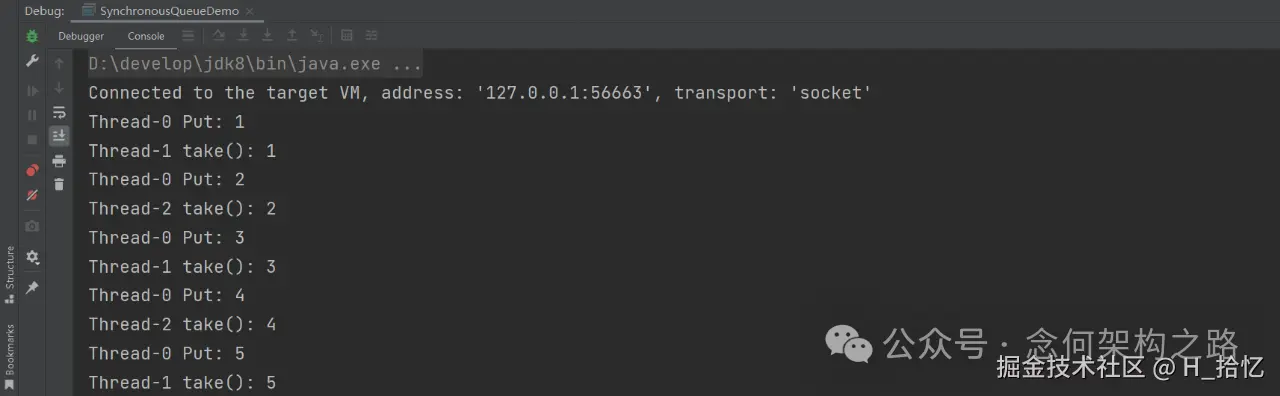
从结果我们可以看出,put一个元素,就会取出一个元素.
构造方法:
java
    /**
     * Creates a {@code SynchronousQueue} with nonfair access policy.
     */
    public SynchronousQueue() {
        this(false);
    }

    /**
     * Creates a {@code SynchronousQueue} with the specified fairness policy.
     *
     * @param fair if true, waiting threads contend in FIFO order for
     *        access; otherwise the order is unspecified.
     */
    public SynchronousQueue(boolean fair) {
        transferer = fair ? new TransferQueue<E>() : new TransferStack<E>();
    }
默认无参的构造方法是非公平的.我们也可以指定参数来选择是否公平模式.
公平情况下是队列结构,先进先出.非公平是栈结构,后进先出.
数据结构:
TransferQueue:
构造方法:
ini
  TransferQueue() {
            QNode h = new QNode(null, false); // initialize to dummy node.
            head = h;
            tail = h;
        }
QNode方法:
arduino
        /** Node class for TransferQueue. */
        static final class QNode {
            volatile QNode next;          // next node in queue
            volatile Object item;         // CAS'ed to or from null
            volatile Thread waiter;       // to control park/unpark
            final boolean isData;

            QNode(Object item, boolean isData) {
                this.item = item;
                this.isData = isData;
            }

            boolean casNext(QNode cmp, QNode val) {
                return next == cmp &&
                    UNSAFE.compareAndSwapObject(this, nextOffset, cmp, val);
            }

            boolean casItem(Object cmp, Object val) {
                return item == cmp &&
                    UNSAFE.compareAndSwapObject(this, itemOffset, cmp, val);
            }

            /**
             * Tries to cancel by CAS'ing ref to this as item.
             */
            void tryCancel(Object cmp) {
                UNSAFE.compareAndSwapObject(this, itemOffset, cmp, this);
            }

            boolean isCancelled() {
                return item == this;
            }

            /**
             * Returns true if this node is known to be off the queue
             * because its next pointer has been forgotten due to
             * an advanceHead operation.
             */
            boolean isOffList() {
                return next == this;
            }

            // Unsafe mechanics
            private static final sun.misc.Unsafe UNSAFE;
            private static final long itemOffset;
            private static final long nextOffset;

            static {
                try {
                    UNSAFE = sun.misc.Unsafe.getUnsafe();
                    Class<?> k = QNode.class;
                    itemOffset = UNSAFE.objectFieldOffset
                        (k.getDeclaredField("item"));
                    nextOffset = UNSAFE.objectFieldOffset
                        (k.getDeclaredField("next"));
                } catch (Exception e) {
                    throw new Error(e);
                }
            }
        }
属性:
next:下一个节点.
item:元素的值.
waiter:执行的线程.
isData:执行的模式.(put添加操作还是take消费操作).
其余的方法不做过多解释了,获取偏移量,然后通过cas赋值.
SNode类:
java
        /** Node class for TransferStacks. */
        static final class SNode {
            volatile SNode next;        // next node in stack
            volatile SNode match;       // the node matched to this
            volatile Thread waiter;     // to control park/unpark
            Object item;                // data; or null for REQUESTs
            int mode;
            // Note: item and mode fields don't need to be volatile
            // since they are always written before, and read after,
            // other volatile/atomic operations.

            SNode(Object item) {
                this.item = item;
            }

            boolean casNext(SNode cmp, SNode val) {
                return cmp == next &&
                    UNSAFE.compareAndSwapObject(this, nextOffset, cmp, val);
            }

            /**
             * Tries to match node s to this node, if so, waking up thread.
             * Fulfillers call tryMatch to identify their waiters.
             * Waiters block until they have been matched.
             *
             * @param s the node to match
             * @return true if successfully matched to s
             */
            boolean tryMatch(SNode s) {
                if (match == null &&
                    UNSAFE.compareAndSwapObject(this, matchOffset, null, s)) {
                    Thread w = waiter;
                    if (w != null) {    // waiters need at most one unpark
                        waiter = null;
                        LockSupport.unpark(w);
                    }
                    return true;
                }
                return match == s;
            }

            /**
             * Tries to cancel a wait by matching node to itself.
             */
            void tryCancel() {
                UNSAFE.compareAndSwapObject(this, matchOffset, null, this);
            }

            boolean isCancelled() {
                return match == this;
            }

            // Unsafe mechanics
            private static final sun.misc.Unsafe UNSAFE;
            private static final long matchOffset;
            private static final long nextOffset;

            static {
                try {
                    UNSAFE = sun.misc.Unsafe.getUnsafe();
                    Class<?> k = SNode.class;
                    matchOffset = UNSAFE.objectFieldOffset
                        (k.getDeclaredField("match"));
                    nextOffset = UNSAFE.objectFieldOffset
                        (k.getDeclaredField("next"));
                } catch (Exception e) {
                    throw new Error(e);
                }
            }
        }
属性:
next:下一个节点.
match:匹配的节点.
item:元素的值.
waiter:执行的线程.
mode:没研究这块相关的代码.
其余的方法不做过多解释了,获取偏移量,然后通过cas赋值.
队列方法:
put方法:
java
    /**
     * Inserts the specified element into this queue, waiting if necessary
     * for space to become available.
     *
     * @param e the element to add
     * @throws InterruptedException if interrupted while waiting
     * @throws ClassCastException if the class of the specified element
     *         prevents it from being added to this queue
     * @throws NullPointerException if the specified element is null
     * @throws IllegalArgumentException if some property of the specified
     *         element prevents it from being added to this queue
     */
    void put(E e) throws InterruptedException;

        /**
     * Adds the specified element to this queue, waiting if necessary for
     * another thread to receive it.
     *
     * @throws InterruptedException {@inheritDoc}
     * @throws NullPointerException {@inheritDoc}
     */
    public void put(E e) throws InterruptedException {
        if (e == null) throw new NullPointerException();
        if (transferer.transfer(e, false, 0) == null) {
            Thread.interrupted();
            throw new InterruptedException();
        }
    }
如果添加的元素为空会抛出空指针异常.所有的焦点都集中在了transferer(数据结构对象)的transfer方法.
transfer方法:
scss
        /**
         * Performs a put or take.
         *
         * @param e if non-null, the item to be handed to a consumer;
         *          if null, requests that transfer return an item
         *          offered by producer.
         * @param timed if this operation should timeout
         * @param nanos the timeout, in nanoseconds
         * @return if non-null, the item provided or received; if null,
         *         the operation failed due to timeout or interrupt --
         *         the caller can distinguish which of these occurred
         *         by checking Thread.interrupted.
         */
        abstract E transfer(E e, boolean timed, long nanos);

          E transfer(E e, boolean timed, long nanos) {

            QNode s = null; // constructed/reused as needed
            boolean isData = (e != null);

            for (;;) {
                QNode t = tail;
                QNode h = head;
                if (t == null || h == null)         // saw uninitialized value
                    continue;                       // spin

                if (h == t || t.isData == isData) { // empty or same-mode
                    QNode tn = t.next;
                    if (t != tail)                  // inconsistent read
                        continue;
                    if (tn != null) {               // lagging tail
                        advanceTail(t, tn);
                        continue;
                    }
                    if (timed && nanos <= 0)        // can't wait
                        return null;
                    if (s == null)
                        s = new QNode(e, isData);
                    if (!t.casNext(null, s))        // failed to link in
                        continue;

                    advanceTail(t, s);              // swing tail and wait
                    Object x = awaitFulfill(s, e, timed, nanos);
                    if (x == s) {                   // wait was cancelled
                        clean(t, s);
                        return null;
                    }

                    if (!s.isOffList()) {           // not already unlinked
                        advanceHead(t, s);          // unlink if head
                        if (x != null)              // and forget fields
                            s.item = s;
                        s.waiter = null;
                    }
                    return (x != null) ? (E)x : e;

                } else {                            // complementary-mode
                    QNode m = h.next;               // node to fulfill
                    if (t != tail || m == null || h != head)
                        continue;                   // inconsistent read

                    Object x = m.item;
                    if (isData == (x != null) ||    // m already fulfilled
                        x == m ||                   // m cancelled
                        !m.casItem(x, e)) {         // lost CAS
                        advanceHead(h, m);          // dequeue and retry
                        continue;
                    }

                    advanceHead(h, m);              // successfully fulfilled
                    LockSupport.unpark(m.waiter);
                    return (x != null) ? (E)x : e;
                }
            }
        }
方法解释:
boolean isData = (e != null):如果为添加操作这个isData就为true,取出操作的话就为false.

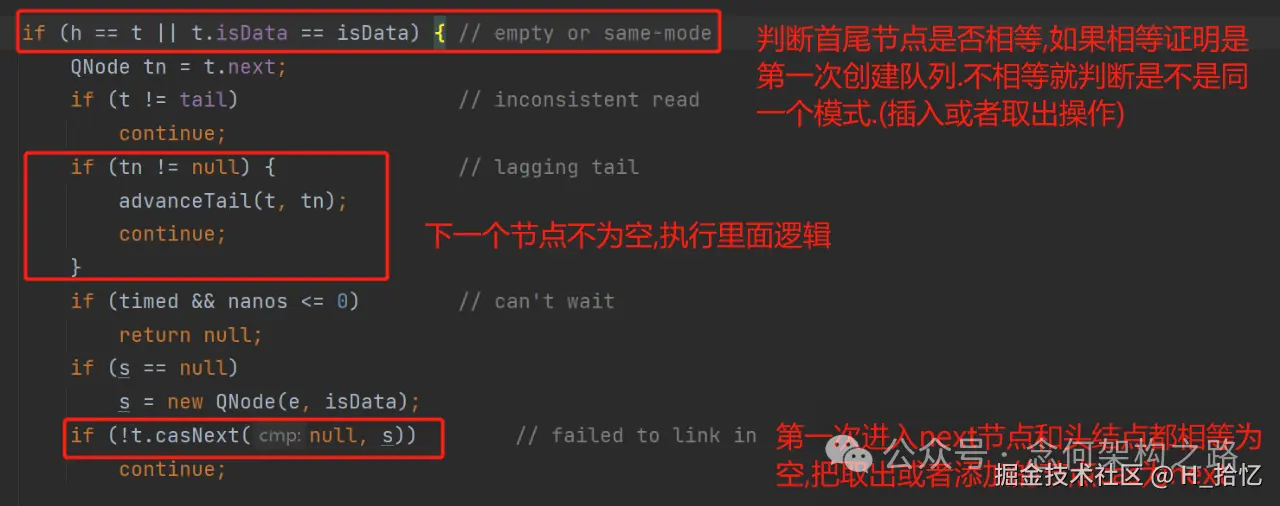
注意:第一个判断条件进入和插入取出的顺序有关.具体理解可以通过断点来看.也可以找我具体了解.
advanceTail方法:
scss
        /**
         * Tries to cas nt as new tail.
         */
        void advanceTail(QNode t, QNode nt) {
            if (tail == t)
                UNSAFE.compareAndSwapObject(this, tailOffset, t, nt);
        }
这个方法就是通过cas操作把tail节点换成新的.(因为这个条件逻辑处理有可能是处理取元素或者新增元素,所以看不懂就尝试这去理解另一种操作)
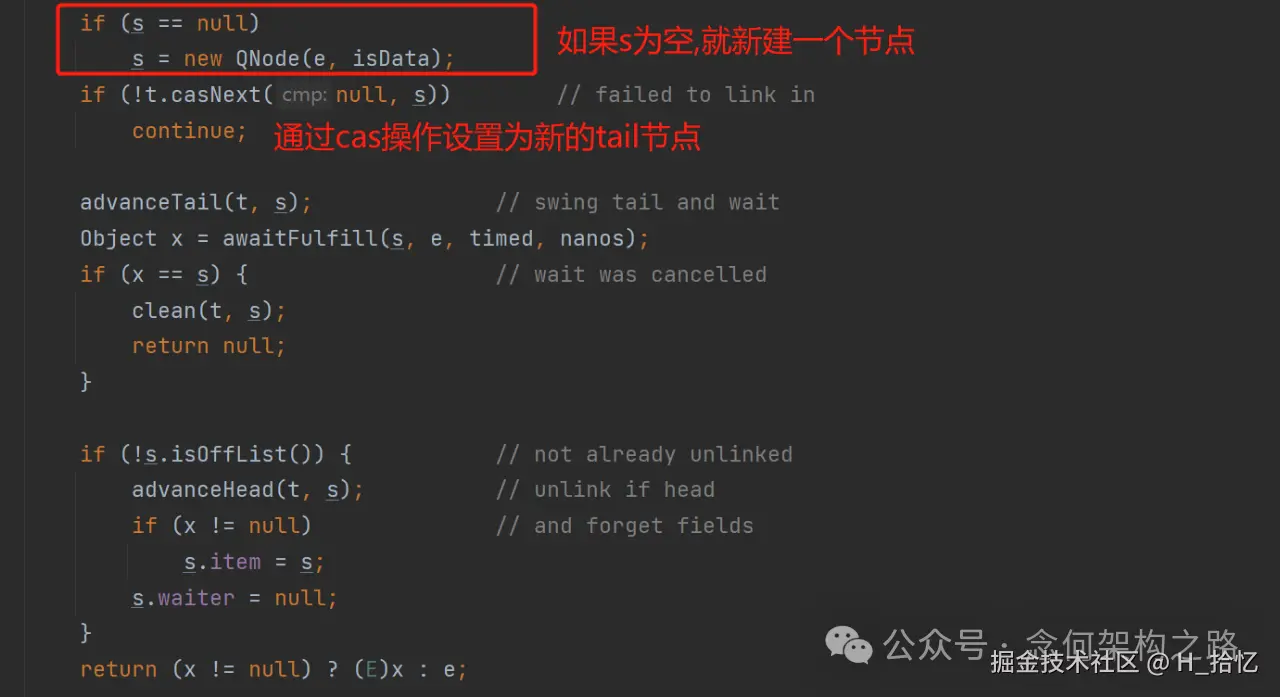
casNext方法:
kotlin
 boolean casNext(QNode cmp, QNode val) {
                return next == cmp &&
                    UNSAFE.compareAndSwapObject(this, nextOffset, cmp, val);
            }
awaitFulfill方法:
ini
        /**
         * Spins/blocks until node s is fulfilled.
         *
         * @param s the waiting node
         * @param e the comparison value for checking match
         * @param timed true if timed wait
         * @param nanos timeout value
         * @return matched item, or s if cancelled
         */
        Object awaitFulfill(QNode s, E e, boolean timed, long nanos) {
            /* Same idea as TransferStack.awaitFulfill */
            final long deadline = timed ? System.nanoTime() + nanos : 0L;
            Thread w = Thread.currentThread();
            int spins = ((head.next == s) ?
                         (timed ? maxTimedSpins : maxUntimedSpins) : 0);
            for (;;) {
                if (w.isInterrupted())
                    s.tryCancel(e);
                Object x = s.item;
                if (x != e)
                    return x;
                if (timed) {
                    nanos = deadline - System.nanoTime();
                    if (nanos <= 0L) {
                        s.tryCancel(e);
                        continue;
                    }
                }
                if (spins > 0)
                    --spins;
                else if (s.waiter == null)
                    s.waiter = w;
                else if (!timed)
                    LockSupport.park(this);
                else if (nanos > spinForTimeoutThreshold)
                    LockSupport.parkNanos(this, nanos);
            }
        }
spins就是下面循环的次数.(很简单,不理解可以打个断点看一下就懂)
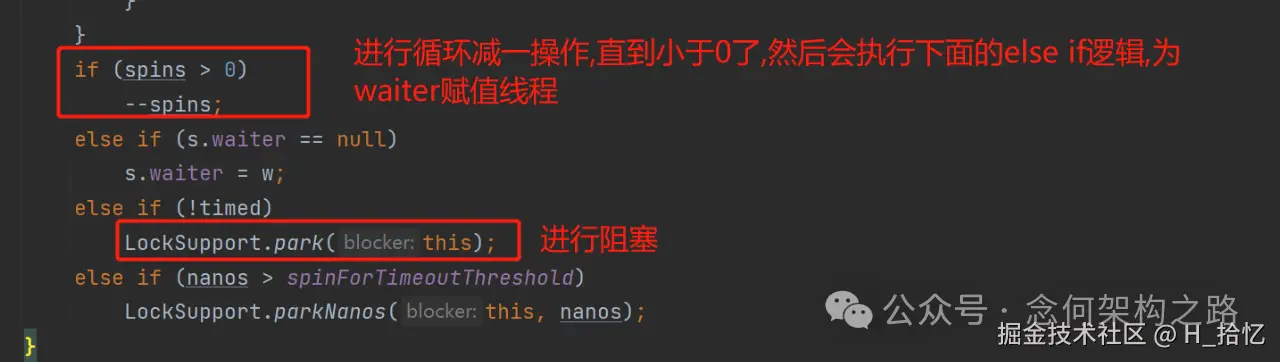
如果上面阻塞被唤醒了,就会继续循环执行.
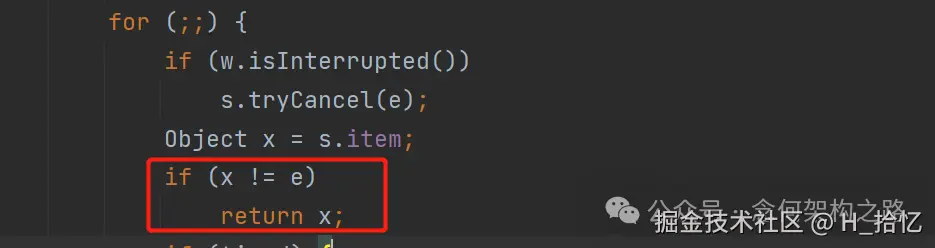
返回这个值.
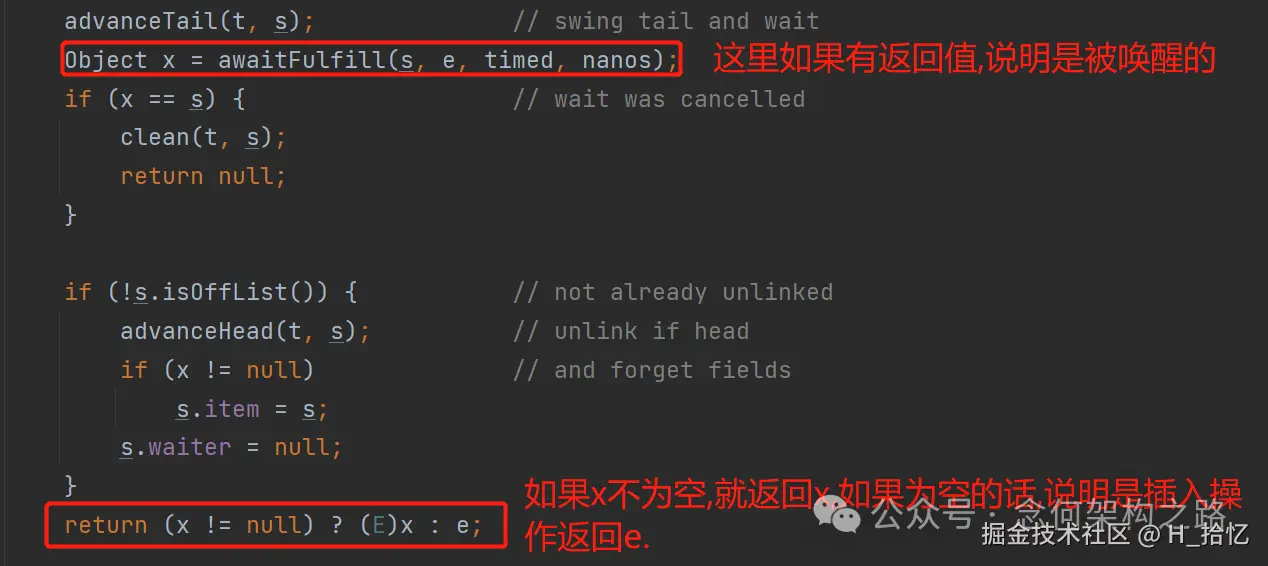
注意:这里是两个操作的逻辑.
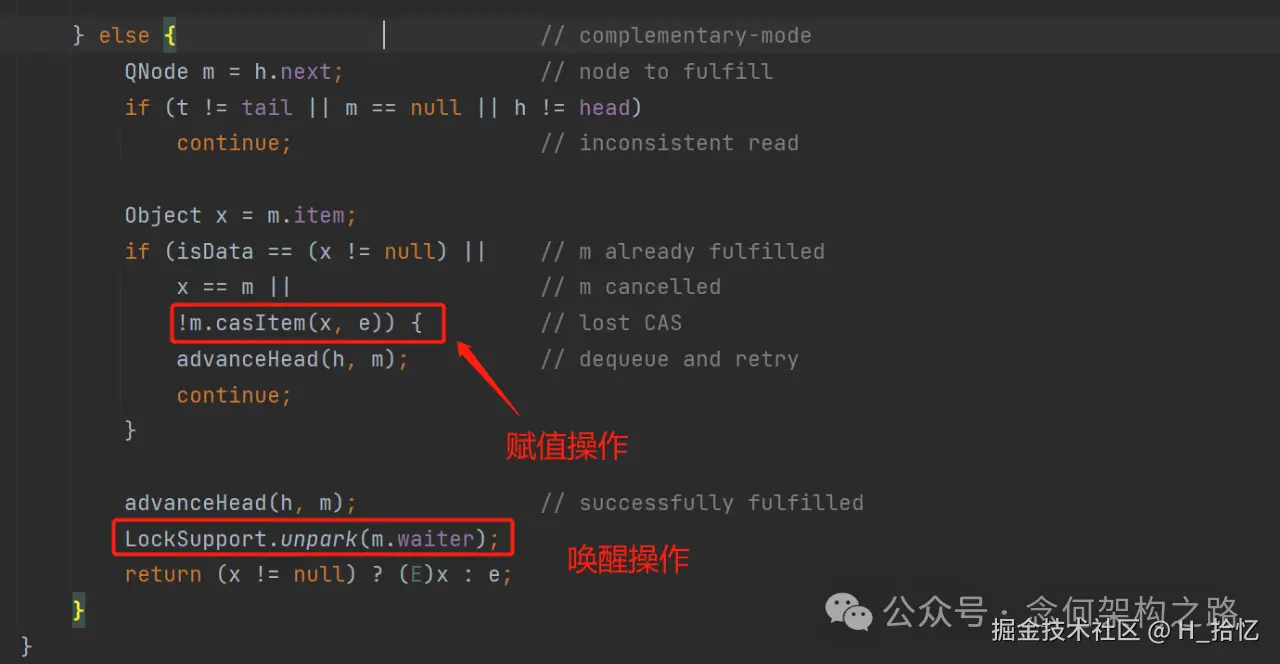
casItem方法:
typescript
 boolean casItem(Object cmp, Object val) {
                return item == cmp &&
                    UNSAFE.compareAndSwapObject(this, itemOffset, cmp, val);
            }
take方法:
java
    /**
     * Retrieves and removes the head of this queue, waiting if necessary
     * until an element becomes available.
     *
     * @return the head of this queue
     * @throws InterruptedException if interrupted while waiting
     */
    E take() throws InterruptedException;

        /**
     * Retrieves and removes the head of this queue, waiting if necessary
     * for another thread to insert it.
     *
     * @return the head of this queue
     * @throws InterruptedException {@inheritDoc}
     */
    public E take() throws InterruptedException {
        E e = transferer.transfer(null, false, 0);
        if (e != null)
            return e;
        Thread.interrupted();
        throw new InterruptedException();
    }
transfer不做过多解释了,参考上面.
ini
        /**
         * Puts or takes an item.
         */
        @SuppressWarnings("unchecked")
        E transfer(E e, boolean timed, long nanos) {

            QNode s = null; // constructed/reused as needed
            boolean isData = (e != null);

            for (;;) {
                QNode t = tail;
                QNode h = head;
                if (t == null || h == null)         // saw uninitialized value
                    continue;                       // spin

                if (h == t || t.isData == isData) { // empty or same-mode
                    QNode tn = t.next;
                    if (t != tail)                  // inconsistent read
                        continue;
                    if (tn != null) {               // lagging tail
                        advanceTail(t, tn);
                        continue;
                    }
                    if (timed && nanos <= 0)        // can't wait
                        return null;
                    if (s == null)
                        s = new QNode(e, isData);
                    if (!t.casNext(null, s))        // failed to link in
                        continue;

                    advanceTail(t, s);              // swing tail and wait
                    Object x = awaitFulfill(s, e, timed, nanos);
                    if (x == s) {                   // wait was cancelled
                        clean(t, s);
                        return null;
                    }

                    if (!s.isOffList()) {           // not already unlinked
                        advanceHead(t, s);          // unlink if head
                        if (x != null)              // and forget fields
                            s.item = s;
                        s.waiter = null;
                    }
                    return (x != null) ? (E)x : e;

                } else {                            // complementary-mode
                    QNode m = h.next;               // node to fulfill
                    if (t != tail || m == null || h != head)
                        continue;                   // inconsistent read

                    Object x = m.item;
                    if (isData == (x != null) ||    // m already fulfilled
                        x == m ||                   // m cancelled
                        !m.casItem(x, e)) {         // lost CAS
                        advanceHead(h, m);          // dequeue and retry
                        continue;
                    }

                    advanceHead(h, m);              // successfully fulfilled
                    LockSupport.unpark(m.waiter);
                    return (x != null) ? (E)x : e;
                }
            }
        }
和上面方法一样.可以参考上面的.
非公平栈结构的put和take方法:
scss
        /**
         * Puts or takes an item.
         */
        @SuppressWarnings("unchecked")
        E transfer(E e, boolean timed, long nanos) {

            SNode s = null; // constructed/reused as needed
            int mode = (e == null) ? REQUEST : DATA;

            for (;;) {
                SNode h = head;
                if (h == null || h.mode == mode) {  // empty or same-mode
                    if (timed && nanos <= 0) {      // can't wait
                        if (h != null && h.isCancelled())
                            casHead(h, h.next);     // pop cancelled node
                        else
                            return null;
                    } else if (casHead(h, s = snode(s, e, h, mode))) {
                        SNode m = awaitFulfill(s, timed, nanos);
                        if (m == s) {               // wait was cancelled
                            clean(s);
                            return null;
                        }
                        if ((h = head) != null && h.next == s)
                            casHead(h, s.next);     // help s's fulfiller
                        return (E) ((mode == REQUEST) ? m.item : s.item);
                    }
                } else if (!isFulfilling(h.mode)) { // try to fulfill
                    if (h.isCancelled())            // already cancelled
                        casHead(h, h.next);         // pop and retry
                    else if (casHead(h, s=snode(s, e, h, FULFILLING|mode))) {
                        for (;;) { // loop until matched or waiters disappear
                            SNode m = s.next;       // m is s's match
                            if (m == null) {        // all waiters are gone
                                casHead(s, null);   // pop fulfill node
                                s = null;           // use new node next time
                                break;              // restart main loop
                            }
                            SNode mn = m.next;
                            if (m.tryMatch(s)) {
                                casHead(s, mn);     // pop both s and m
                                return (E) ((mode == REQUEST) ? m.item : s.item);
                            } else                  // lost match
                                s.casNext(m, mn);   // help unlink
                        }
                    }
                } else {                            // help a fulfiller
                    SNode m = h.next;               // m is h's match
                    if (m == null)                  // waiter is gone
                        casHead(h, null);           // pop fulfilling node
                    else {
                        SNode mn = m.next;
                        if (m.tryMatch(h))          // help match
                            casHead(h, mn);         // pop both h and m
                        else                        // lost match
                            h.casNext(m, mn);       // help unlink
                    }
                }
            }
        }
方法解釋:
mode的属性值是根据是插入操作还是取出操作来决定是什么模式.
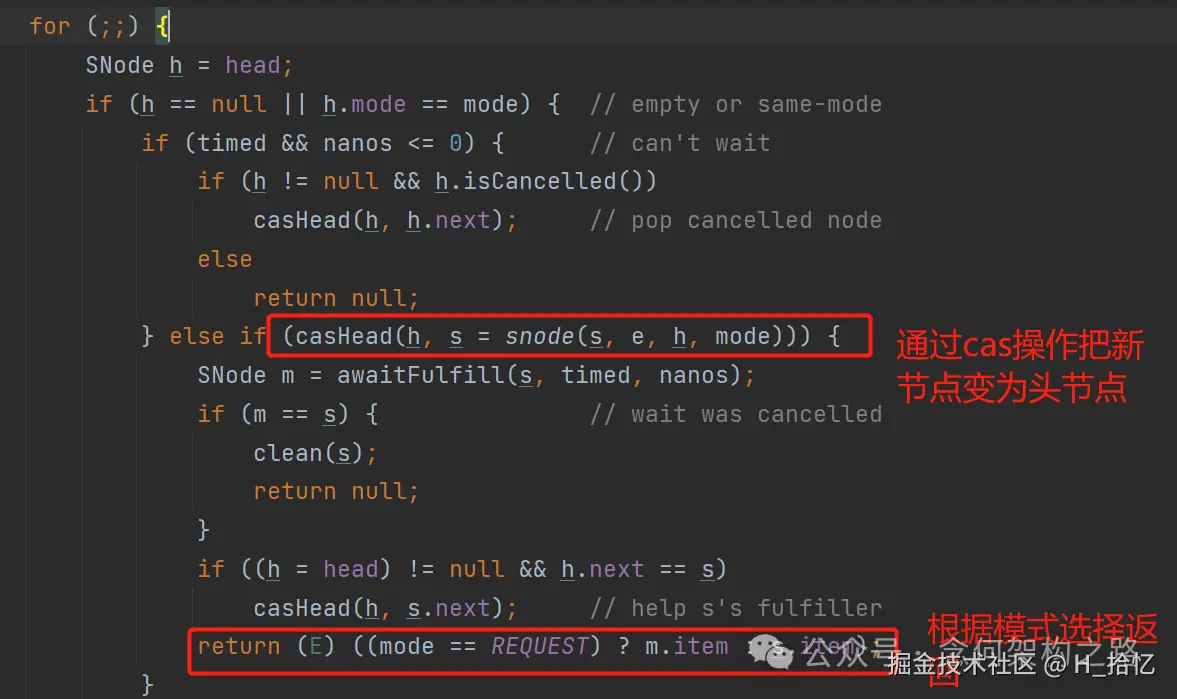
snode方法:
vbnet
        /**
         * Creates or resets fields of a node. Called only from transfer
         * where the node to push on stack is lazily created and
         * reused when possible to help reduce intervals between reads
         * and CASes of head and to avoid surges of garbage when CASes
         * to push nodes fail due to contention.
         */
        static SNode snode(SNode s, Object e, SNode next, int mode) {
            if (s == null) s = new SNode(e);
            s.mode = mode;
            s.next = next;
            return s;
        }
如果节点为空就新创建一个节点,如果不为空就进行指向和赋值模式.
casHead方法:
typescript
 boolean casHead(SNode h, SNode nh) {
            return h == head &&
                UNSAFE.compareAndSwapObject(this, headOffset, h, nh);
        }
就是把头节点通过cas操作换成新的节点.(通过队列模拟栈结构,后进先出.)
awaitFulfill方法:
ini
        /**
         * Spins/blocks until node s is matched by a fulfill operation.
         *
         * @param s the waiting node
         * @param timed true if timed wait
         * @param nanos timeout value
         * @return matched node, or s if cancelled
         */
        SNode awaitFulfill(SNode s, boolean timed, long nanos) {
            final long deadline = timed ? System.nanoTime() + nanos : 0L;
            Thread w = Thread.currentThread();
            int spins = (shouldSpin(s) ?
                         (timed ? maxTimedSpins : maxUntimedSpins) : 0);
            for (;;) {
                if (w.isInterrupted())
                    s.tryCancel();
                SNode m = s.match;
                if (m != null)
                    return m;
                if (timed) {
                    nanos = deadline - System.nanoTime();
                    if (nanos <= 0L) {
                        s.tryCancel();
                        continue;
                    }
                }
                if (spins > 0)
                    spins = shouldSpin(s) ? (spins-1) : 0;
                else if (s.waiter == null)
                    s.waiter = w; // establish waiter so can park next iter
                else if (!timed)
                    LockSupport.park(this);
                else if (nanos > spinForTimeoutThreshold)
                    LockSupport.parkNanos(this, nanos);
            }
        }
isFulfilling方法:
arduino
static boolean isFulfilling(int m) { return (m & FULFILLING) != 0; }一般情况下这里返回的都是false,所以会进入.如果头节点需要出队的话,就会返回true.进入else逻辑.
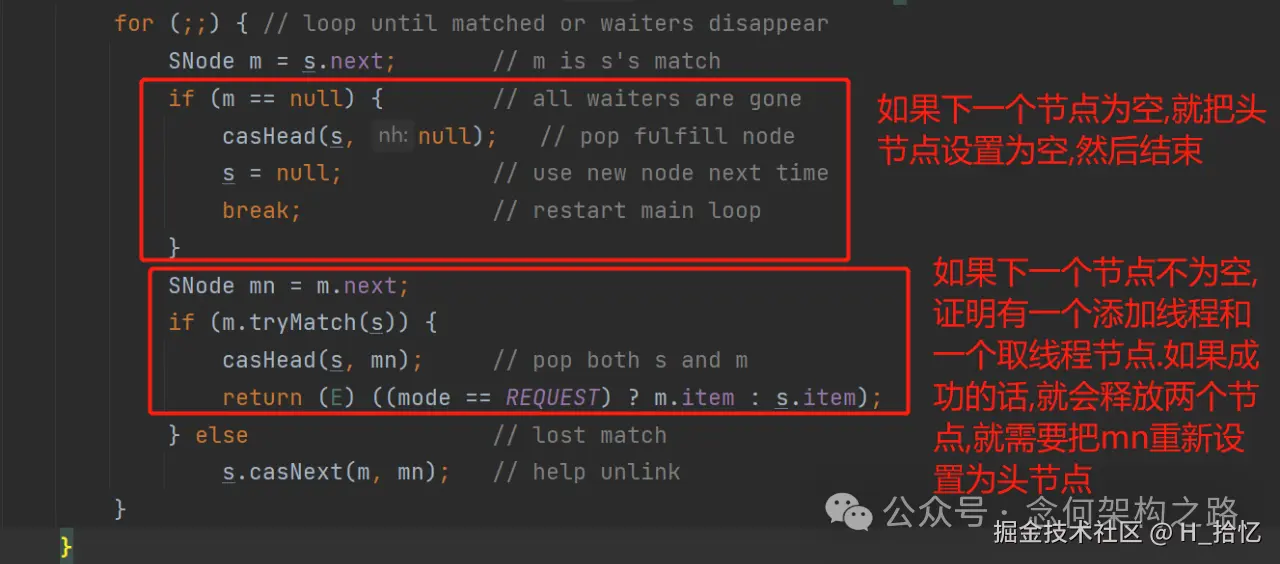
tryMatch方法:
java
            /**
             * Tries to match node s to this node, if so, waking up thread.
             * Fulfillers call tryMatch to identify their waiters.
             * Waiters block until they have been matched.
             *
             * @param s the node to match
             * @return true if successfully matched to s
             */
            boolean tryMatch(SNode s) {
                if (match == null &&
                    UNSAFE.compareAndSwapObject(this, matchOffset, null, s)) {
                    Thread w = waiter;
                    if (w != null) {    // waiters need at most one unpark
                        waiter = null;
                        LockSupport.unpark(w);
                    }
                    return true;
                }
                return match == s;
            }
如果match不为空的话,证明不是取线程,所以需要把下一个线程替换为取线程节点.
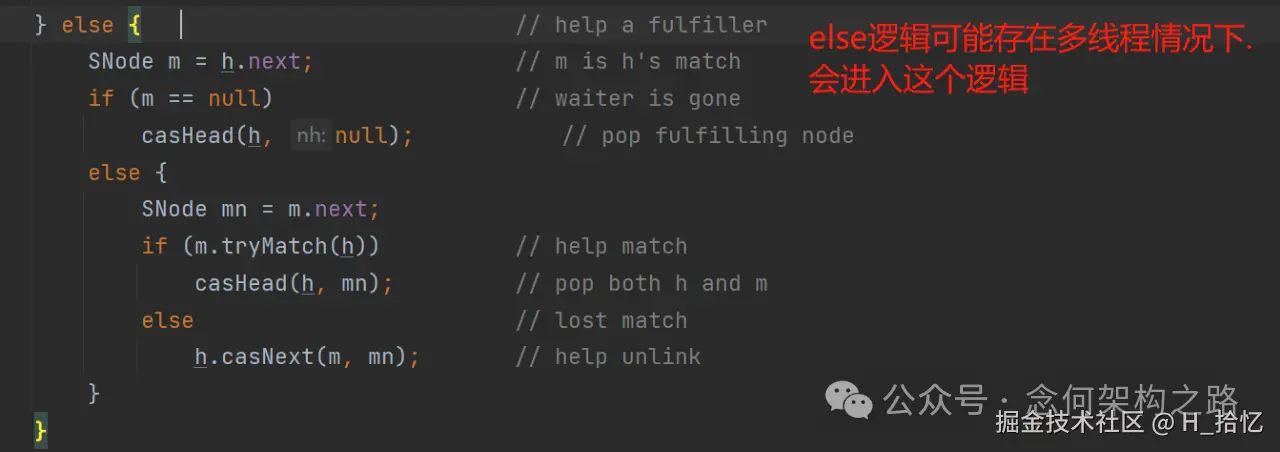
这块理解可能会有偏差,不一定对,有懂的小伙伴们可以指点一二.
语雀地址www.yuque.com/itbosunmian...?
《Go.》 密码:xbkk 欢迎大家访问.提意见.