ForkJoinPool是对AbstractExecutorService类的扩展。ForkJoinPool允许其他线程向它提交任务,并根据设定将这些任务拆分为粒度更细的子任务,这些子任务将由ForkJoinPool内部的工作线程来并行执行,并且工作线程之间可以窃取彼此之间的任务。
ForkJoinPool使用:
ini
public class LongSumMain {
    // 获取逻辑处理器数量
    static final int NCPU = Runtime.getRuntime().availableProcessors();


    public static void main(String[] args) throws Exception {
        //准备数组
        int[] array = Utils.buildRandomIntArray(100000000);

        //递归任务
        LongSum ls = new LongSum(array, 0, array.length);
        // 构建ForkJoinPool
        ForkJoinPool fjp = new ForkJoinPool(NCPU);
        //ForkJoin计算数组总和
        ForkJoinTask<Long> result = fjp.submit(ls);

        System.out.println(result);
        fjp.shutdown();

    }
}

public class LongSum extends RecursiveTask<Long> {
    // 任务拆分最小阈值
    static final int SEQUENTIAL_THRESHOLD = 10000000;

    int low;
    int high;
    int[] array;

    LongSum(int[] arr, int lo, int hi) {
        array = arr;
        low = lo;
        high = hi;
    }

    @Override
    protected Long compute() {

        //当任务拆分到小于等于阀值时开始求和
        if (high - low <= SEQUENTIAL_THRESHOLD) {

            long sum = 0;
            for (int i = low; i < high; ++i) {
                sum += array[i];
            }
            return sum;
        } else {  // 任务过大继续拆分
            int mid = low + (high - low) / 2;
            LongSum left = new LongSum(array, low, mid);
            LongSum right = new LongSum(array, mid, high);
            // 提交任务
            left.fork();
            right.fork();
            //获取任务的执行结果,将阻塞当前线程直到对应的子任务完成运行并返回结果
            long rightAns = right.compute();
            long leftAns = left.join();
            return leftAns + rightAns;
        }
    }
}
传入的任务需要继承RecursiveTask类,然后实现compute方法,里面实现了拆分的逻辑.并且提交子任务给forkJoinPool.
构造函数:
java
    /**
     * Creates a {@code ForkJoinPool} with parallelism equal to {@link
     * java.lang.Runtime#availableProcessors}, using the {@linkplain
     * #defaultForkJoinWorkerThreadFactory default thread factory},
     * no UncaughtExceptionHandler, and non-async LIFO processing mode.
     *
     * @throws SecurityException if a security manager exists and
     *         the caller is not permitted to modify threads
     *         because it does not hold {@link
     *         java.lang.RuntimePermission}{@code ("modifyThread")}
     */
    public ForkJoinPool() {
        this(Math.min(MAX_CAP, Runtime.getRuntime().availableProcessors()),
             defaultForkJoinWorkerThreadFactory, null, false);
    }

        /**
     * Creates a {@code ForkJoinPool} with the indicated parallelism
     * level, the {@linkplain
     * #defaultForkJoinWorkerThreadFactory default thread factory},
     * no UncaughtExceptionHandler, and non-async LIFO processing mode.
     *
     * @param parallelism the parallelism level
     * @throws IllegalArgumentException if parallelism less than or
     *         equal to zero, or greater than implementation limit
     * @throws SecurityException if a security manager exists and
     *         the caller is not permitted to modify threads
     *         because it does not hold {@link
     *         java.lang.RuntimePermission}{@code ("modifyThread")}
     */
    public ForkJoinPool(int parallelism) {
        this(parallelism, defaultForkJoinWorkerThreadFactory, null, false);
    }

        /**
     * Creates a {@code ForkJoinPool} with the given parameters.
     *
     * @param parallelism the parallelism level. For default value,
     * use {@link java.lang.Runtime#availableProcessors}.
     * @param factory the factory for creating new threads. For default value,
     * use {@link #defaultForkJoinWorkerThreadFactory}.
     * @param handler the handler for internal worker threads that
     * terminate due to unrecoverable errors encountered while executing
     * tasks. For default value, use {@code null}.
     * @param asyncMode if true,
     * establishes local first-in-first-out scheduling mode for forked
     * tasks that are never joined. This mode may be more appropriate
     * than default locally stack-based mode in applications in which
     * worker threads only process event-style asynchronous tasks.
     * For default value, use {@code false}.
     * @throws IllegalArgumentException if parallelism less than or
     *         equal to zero, or greater than implementation limit
     * @throws NullPointerException if the factory is null
     * @throws SecurityException if a security manager exists and
     *         the caller is not permitted to modify threads
     *         because it does not hold {@link
     *         java.lang.RuntimePermission}{@code ("modifyThread")}
     */
    public ForkJoinPool(int parallelism,
                        ForkJoinWorkerThreadFactory factory,
                        UncaughtExceptionHandler handler,
                        boolean asyncMode) {
        this(checkParallelism(parallelism),
             checkFactory(factory),
             handler,
             asyncMode ? FIFO_QUEUE : LIFO_QUEUE,
             "ForkJoinPool-" + nextPoolId() + "-worker-");
        checkPermission();
    }

        /**
     * Creates a {@code ForkJoinPool} with the given parameters, without
     * any security checks or parameter validation.  Invoked directly by
     * makeCommonPool.
     */
    private ForkJoinPool(int parallelism,
                         ForkJoinWorkerThreadFactory factory,
                         UncaughtExceptionHandler handler,
                         int mode,
                         String workerNamePrefix) {
        this.workerNamePrefix = workerNamePrefix;
        this.factory = factory;
        this.ueh = handler;
        this.config = (parallelism & SMASK) | mode;
        long np = (long)(-parallelism); // offset ctl counts
        this.ctl = ((np << AC_SHIFT) & AC_MASK) | ((np << TC_SHIFT) & TC_MASK);
    }
构造方法总结:
1.如果我们不传入并行数的话,会在我们的cpu数和0x7fff取一个最小值.
2.如果我们没有传入线程池的话,会用默认的DefaultForkJoinWorkerThreadFactory.
3.想自定义拒绝策略的话可以实现UncaughtExceptionHandler接口.
4.可以根据这个值asyncMode来选择队列结构,为true时.使用先进先出,false时,使用后进先出.
submit方法:
typescript
    /**
     * Submits a ForkJoinTask for execution.
     *
     * @param task the task to submit
     * @param <T> the type of the task's result
     * @return the task
     * @throws NullPointerException if the task is null
     * @throws RejectedExecutionException if the task cannot be
     *         scheduled for execution
     */
    public <T> ForkJoinTask<T> submit(ForkJoinTask<T> task) {
        if (task == null)
            throw new NullPointerException();
        externalPush(task);
        return task;
    }
如果任务为空,则抛出异常.
externalPush方法:
scss
    /**
     * Tries to add the given task to a submission queue at
     * submitter's current queue. Only the (vastly) most common path
     * is directly handled in this method, while screening for need
     * for externalSubmit.
     *
     * @param task the task. Caller must ensure non-null.
     */
    final void externalPush(ForkJoinTask<?> task) {
        WorkQueue[] ws; WorkQueue q; int m;
        int r = ThreadLocalRandom.getProbe();
        int rs = runState;
        if ((ws = workQueues) != null && (m = (ws.length - 1)) >= 0 &&
            (q = ws[m & r & SQMASK]) != null && r != 0 && rs > 0 &&
            U.compareAndSwapInt(q, QLOCK, 0, 1)) {
            ForkJoinTask<?>[] a; int am, n, s;
            if ((a = q.array) != null &&
                (am = a.length - 1) > (n = (s = q.top) - q.base)) {
                int j = ((am & s) << ASHIFT) + ABASE;
                U.putOrderedObject(a, j, task);
                U.putOrderedInt(q, QTOP, s + 1);
                U.putIntVolatile(q, QLOCK, 0);
                if (n <= 1)
                    signalWork(ws, q);
                return;
            }
            U.compareAndSwapInt(q, QLOCK, 1, 0);
        }
        externalSubmit(task);
    }
方法理解:
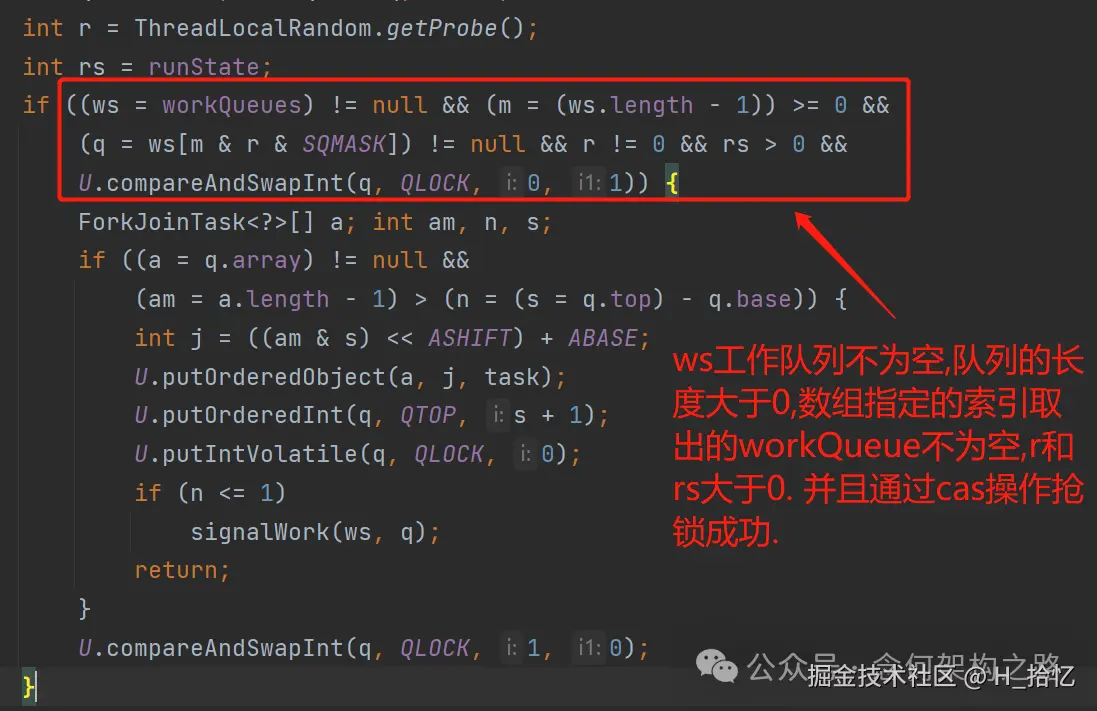
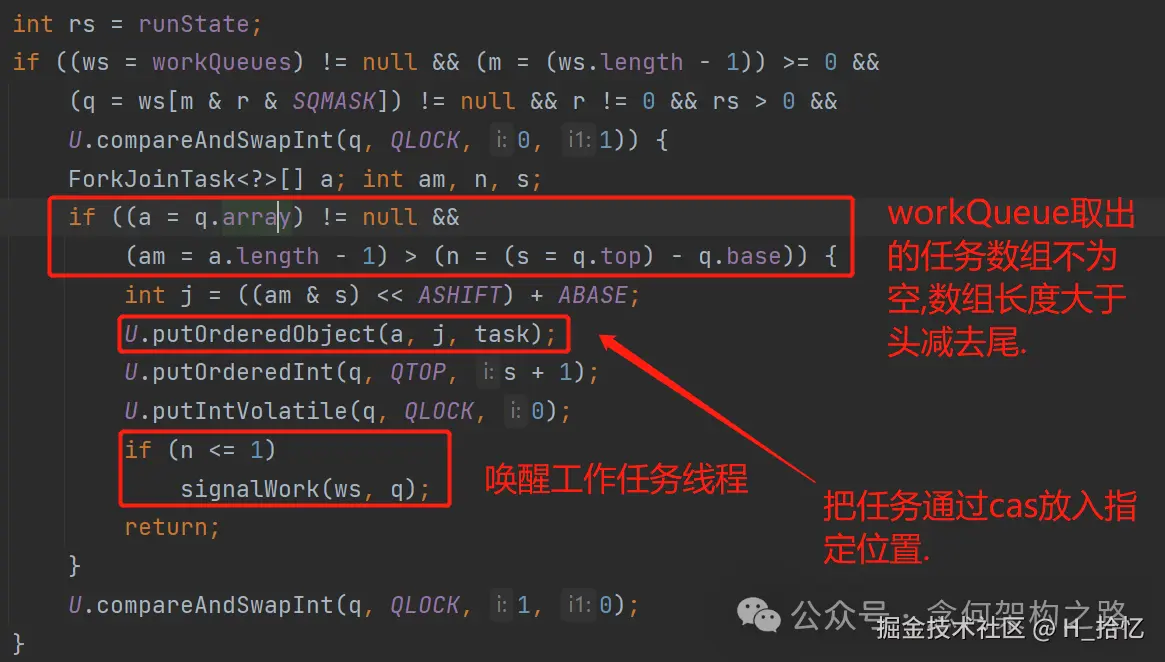
signalWork方法:
ini
    /**
     * Tries to create or activate a worker if too few are active.
     *
     * @param ws the worker array to use to find signallees
     * @param q a WorkQueue --if non-null, don't retry if now empty
     */
    final void signalWork(WorkQueue[] ws, WorkQueue q) {
        long c; int sp, i; WorkQueue v; Thread p;
        while ((c = ctl) < 0L) {                       // too few active
            if ((sp = (int)c) == 0) {                  // no idle workers
                if ((c & ADD_WORKER) != 0L)            // too few workers
                    tryAddWorker(c);
                break;
            }
            if (ws == null)                            // unstarted/terminated
                break;
            if (ws.length <= (i = sp & SMASK))         // terminated
                break;
            if ((v = ws[i]) == null)                   // terminating
                break;
            int vs = (sp + SS_SEQ) & ~INACTIVE;        // next scanState
            int d = sp - v.scanState;                  // screen CAS
            long nc = (UC_MASK & (c + AC_UNIT)) | (SP_MASK & v.stackPred);
            if (d == 0 && U.compareAndSwapLong(this, CTL, c, nc)) {
                v.scanState = vs;                      // activate v
                if ((p = v.parker) != null)
                    U.unpark(p);
                break;
            }
            if (q != null && q.base == q.top)          // no more work
                break;
        }
    }
方法理解:
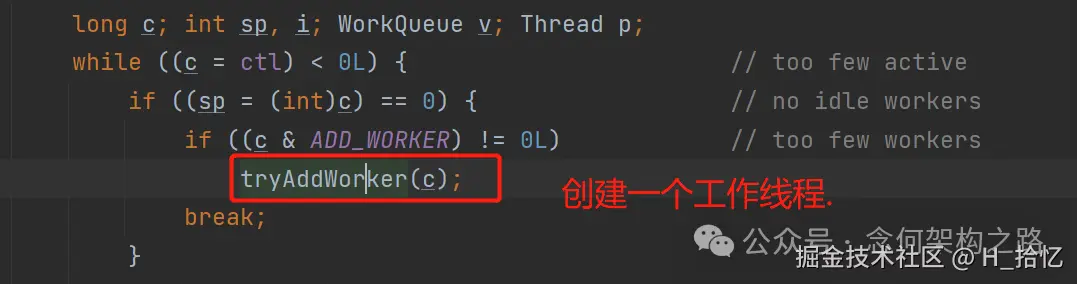
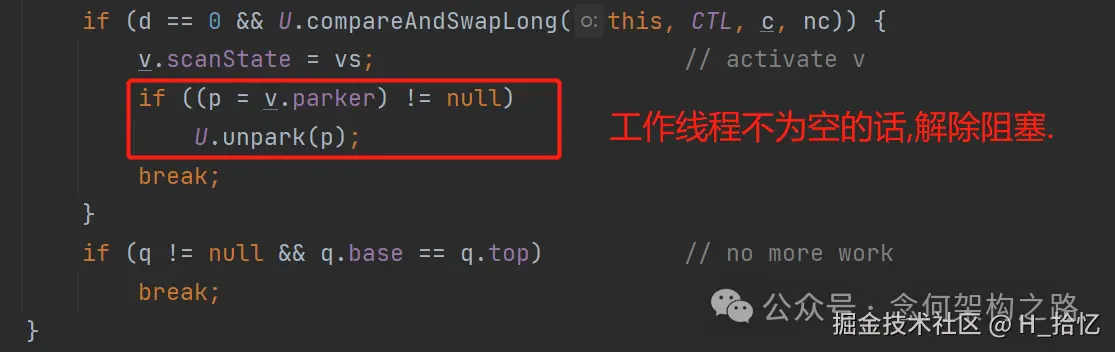
tryAddWorker方法:
arduino
    /**
     * Tries to add one worker, incrementing ctl counts before doing
     * so, relying on createWorker to back out on failure.
     *
     * @param c incoming ctl value, with total count negative and no
     * idle workers.  On CAS failure, c is refreshed and retried if
     * this holds (otherwise, a new worker is not needed).
     */
    private void tryAddWorker(long c) {
        boolean add = false;
        do {
            long nc = ((AC_MASK & (c + AC_UNIT)) |
                       (TC_MASK & (c + TC_UNIT)));
            if (ctl == c) {
                int rs, stop;                 // check if terminating
                if ((stop = (rs = lockRunState()) & STOP) == 0)
                    add = U.compareAndSwapLong(this, CTL, c, nc);
                unlockRunState(rs, rs & ~RSLOCK);
                if (stop != 0)
                    break;
                if (add) {
                    createWorker();
                    break;
                }
            }
        } while (((c = ctl) & ADD_WORKER) != 0L && (int)c == 0);
    }
各种位运算,看着头晕眼花.直接看最关键的方法,了解思路.
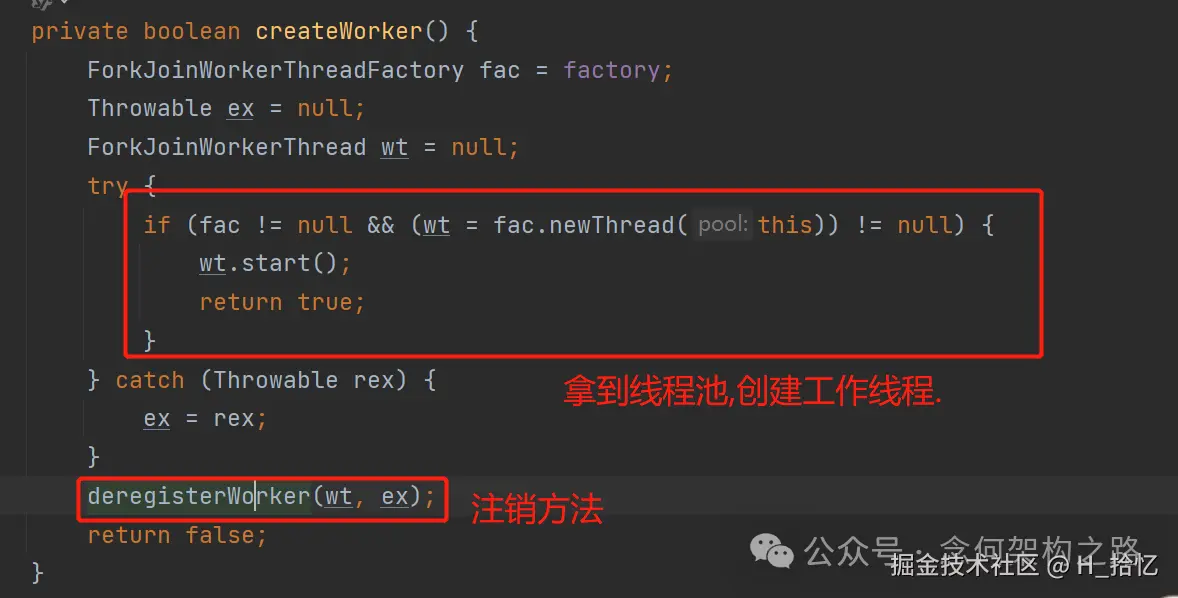
createWorker方法:
java
    /**
     * Tries to construct and start one worker. Assumes that total
     * count has already been incremented as a reservation.  Invokes
     * deregisterWorker on any failure.
     *
     * @return true if successful
     */
    private boolean createWorker() {
        ForkJoinWorkerThreadFactory fac = factory;
        Throwable ex = null;
        ForkJoinWorkerThread wt = null;
        try {
            if (fac != null && (wt = fac.newThread(this)) != null) {
                wt.start();
                return true;
            }
        } catch (Throwable rex) {
            ex = rex;
        }
        deregisterWorker(wt, ex);
        return false;
    }
方法理解:
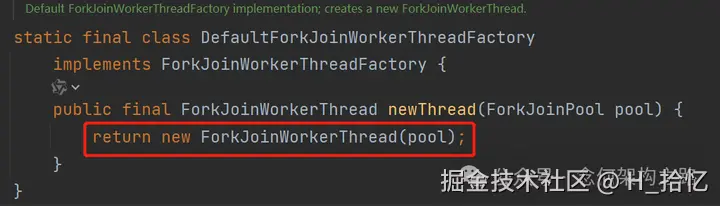
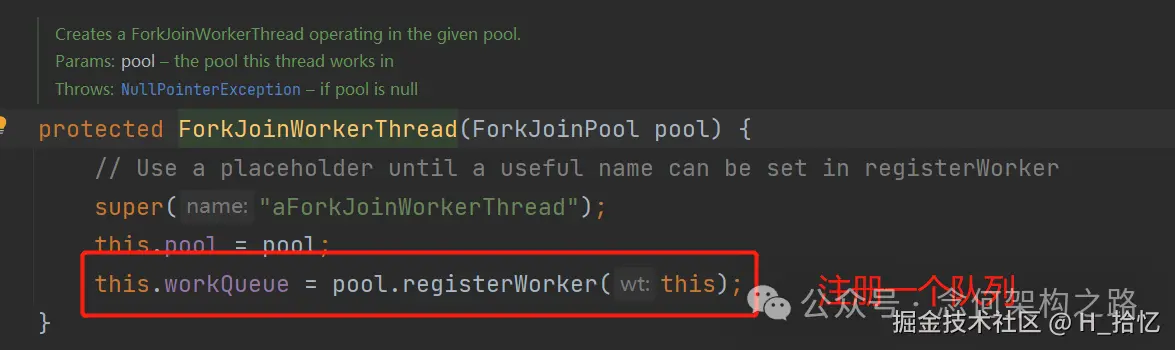
registerWorker方法:
ini
    /**
     * Callback from ForkJoinWorkerThread constructor to establish and
     * record its WorkQueue.
     *
     * @param wt the worker thread
     * @return the worker's queue
     */
    final WorkQueue registerWorker(ForkJoinWorkerThread wt) {
        UncaughtExceptionHandler handler;
        wt.setDaemon(true);                           // configure thread
        if ((handler = ueh) != null)
            wt.setUncaughtExceptionHandler(handler);
        WorkQueue w = new WorkQueue(this, wt);
        int i = 0;                                    // assign a pool index
        int mode = config & MODE_MASK;
        int rs = lockRunState();
        try {
            WorkQueue[] ws; int n;                    // skip if no array
            if ((ws = workQueues) != null && (n = ws.length) > 0) {
                int s = indexSeed += SEED_INCREMENT;  // unlikely to collide
                int m = n - 1;
                i = ((s << 1) | 1) & m;               // odd-numbered indices
                if (ws[i] != null) {                  // collision
                    int probes = 0;                   // step by approx half n
                    int step = (n <= 4) ? 2 : ((n >>> 1) & EVENMASK) + 2;
                    while (ws[i = (i + step) & m] != null) {
                        if (++probes >= n) {
                            workQueues = ws = Arrays.copyOf(ws, n <<= 1);
                            m = n - 1;
                            probes = 0;
                        }
                    }
                }
                w.hint = s;                           // use as random seed
                w.config = i | mode;
                w.scanState = i;                      // publication fence
                ws[i] = w;
            }
        } finally {
            unlockRunState(rs, rs & ~RSLOCK);
        }
        wt.setName(workerNamePrefix.concat(Integer.toString(i >>> 1)));
        return w;
    }
方法理解:

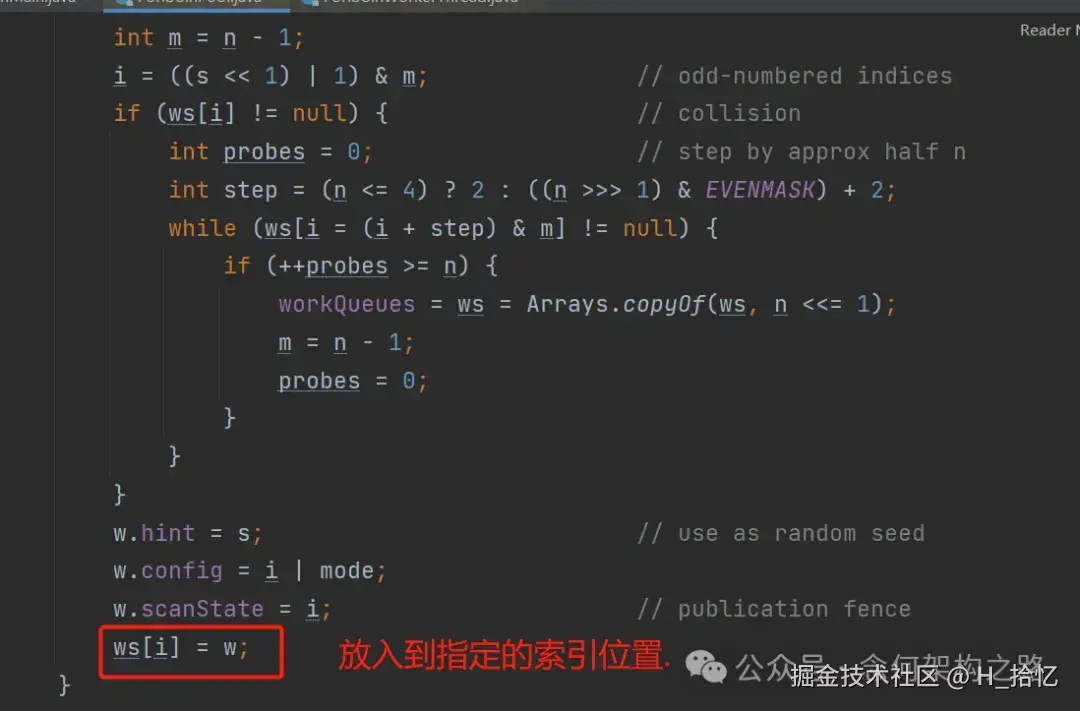
创建完线程,然后进行返回,调用start方法.自然而然的就会执行run方法.
ForkJoinWorkerThread的run方法:
php
    /**
     * This method is required to be public, but should never be
     * called explicitly. It performs the main run loop to execute
     * {@link ForkJoinTask}s.
     */
    public void run() {
        if (workQueue.array == null) { // only run once
            Throwable exception = null;
            try {
                onStart();
                pool.runWorker(workQueue);
            } catch (Throwable ex) {
                exception = ex;
            } finally {
                try {
                    onTermination(exception);
                } catch (Throwable ex) {
                    if (exception == null)
                        exception = ex;
                } finally {
                    pool.deregisterWorker(this, exception);
                }
            }
        }
    }
runWorker方法:
scss
    /**
     * Top-level runloop for workers, called by ForkJoinWorkerThread.run.
     */
    final void runWorker(WorkQueue w) {
        w.growArray();                   // allocate queue
        int seed = w.hint;               // initially holds randomization hint
        int r = (seed == 0) ? 1 : seed;  // avoid 0 for xorShift
        for (ForkJoinTask<?> t;;) {
            if ((t = scan(w, r)) != null)
                w.runTask(t);
            else if (!awaitWork(w, r))
                break;
            r ^= r << 13; r ^= r >>> 17; r ^= r << 5; // xorshift
        }
    }
growArray方法:
ini
        /**
         * Initializes or doubles the capacity of array. Call either
         * by owner or with lock held -- it is OK for base, but not
         * top, to move while resizings are in progress.
         */
        final ForkJoinTask<?>[] growArray() {
            ForkJoinTask<?>[] oldA = array;
            int size = oldA != null ? oldA.length << 1 : INITIAL_QUEUE_CAPACITY;
            if (size > MAXIMUM_QUEUE_CAPACITY)
                throw new RejectedExecutionException("Queue capacity exceeded");
            int oldMask, t, b;
            ForkJoinTask<?>[] a = array = new ForkJoinTask<?>[size];
            if (oldA != null && (oldMask = oldA.length - 1) >= 0 &&
                (t = top) - (b = base) > 0) {
                int mask = size - 1;
                do { // emulate poll from old array, push to new array
                    ForkJoinTask<?> x;
                    int oldj = ((b & oldMask) << ASHIFT) + ABASE;
                    int j    = ((b &    mask) << ASHIFT) + ABASE;
                    x = (ForkJoinTask<?>)U.getObjectVolatile(oldA, oldj);
                    if (x != null &&
                        U.compareAndSwapObject(oldA, oldj, x, null))
                        U.putObjectVolatile(a, j, x);
                } while (++b != t);
            }
            return a;
        }
这是一个扩容的方法.感兴趣的话,可以自己研究下.
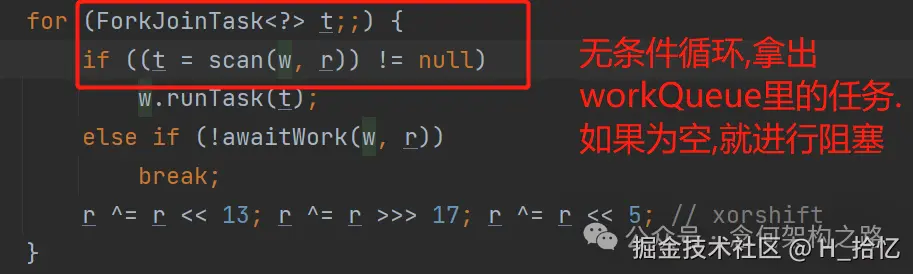
scan方法:
ini
    /**
     * Scans for and tries to steal a top-level task. Scans start at a
     * random location, randomly moving on apparent contention,
     * otherwise continuing linearly until reaching two consecutive
     * empty passes over all queues with the same checksum (summing
     * each base index of each queue, that moves on each steal), at
     * which point the worker tries to inactivate and then re-scans,
     * attempting to re-activate (itself or some other worker) if
     * finding a task; otherwise returning null to await work.  Scans
     * otherwise touch as little memory as possible, to reduce
     * disruption on other scanning threads.
     *
     * @param w the worker (via its WorkQueue)
     * @param r a random seed
     * @return a task, or null if none found
     */
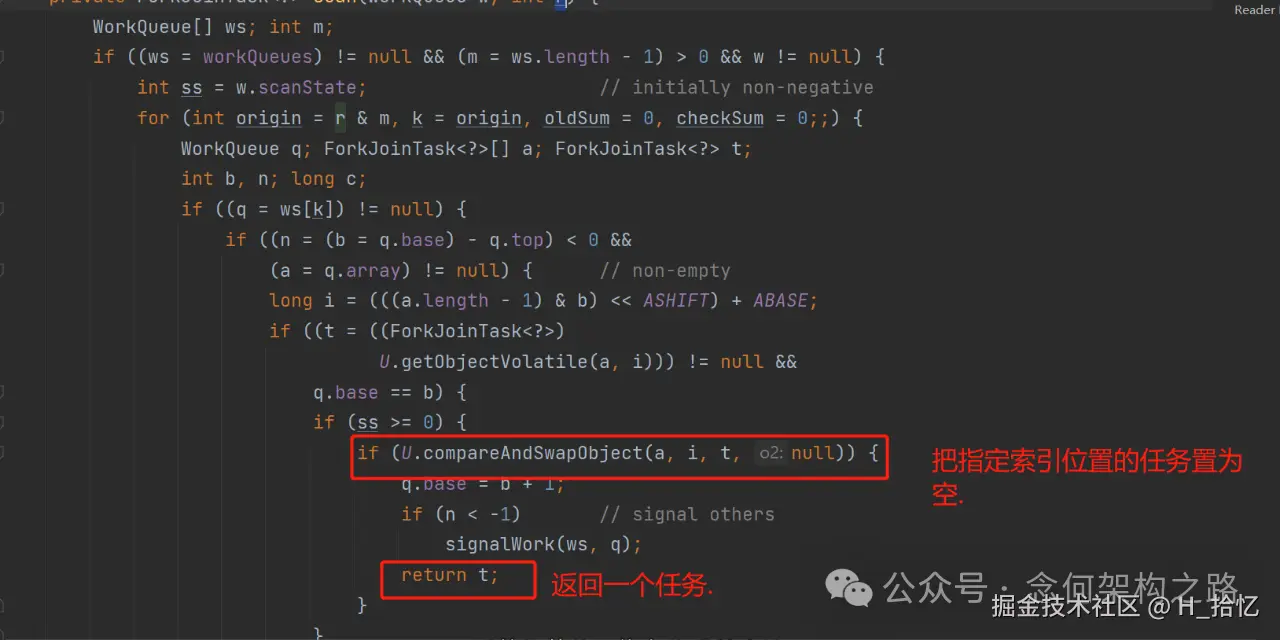
    private ForkJoinTask<?> scan(WorkQueue w, int r) {
        WorkQueue[] ws; int m;
        if ((ws = workQueues) != null && (m = ws.length - 1) > 0 && w != null) {
            int ss = w.scanState;                     // initially non-negative
            for (int origin = r & m, k = origin, oldSum = 0, checkSum = 0;;) {
                WorkQueue q; ForkJoinTask<?>[] a; ForkJoinTask<?> t;
                int b, n; long c;
                if ((q = ws[k]) != null) {
                    if ((n = (b = q.base) - q.top) < 0 &&
                        (a = q.array) != null) {      // non-empty
                        long i = (((a.length - 1) & b) << ASHIFT) + ABASE;
                        if ((t = ((ForkJoinTask<?>)
                                  U.getObjectVolatile(a, i))) != null &&
                            q.base == b) {
                            if (ss >= 0) {
                                if (U.compareAndSwapObject(a, i, t, null)) {
                                    q.base = b + 1;
                                    if (n < -1)       // signal others
                                        signalWork(ws, q);
                                    return t;
                                }
                            }
                            else if (oldSum == 0 &&   // try to activate
                                     w.scanState < 0)
                                tryRelease(c = ctl, ws[m & (int)c], AC_UNIT);
                        }
                        if (ss < 0)                   // refresh
                            ss = w.scanState;
                        r ^= r << 1; r ^= r >>> 3; r ^= r << 10;
                        origin = k = r & m;           // move and rescan
                        oldSum = checkSum = 0;
                        continue;
                    }
                    checkSum += b;
                }
                if ((k = (k + 1) & m) == origin) {    // continue until stable
                    if ((ss >= 0 || (ss == (ss = w.scanState))) &&
                        oldSum == (oldSum = checkSum)) {
                        if (ss < 0 || w.qlock < 0)    // already inactive
                            break;
                        int ns = ss | INACTIVE;       // try to inactivate
                        long nc = ((SP_MASK & ns) |
                                   (UC_MASK & ((c = ctl) - AC_UNIT)));
                        w.stackPred = (int)c;         // hold prev stack top
                        U.putInt(w, QSCANSTATE, ns);
                        if (U.compareAndSwapLong(this, CTL, c, nc))
                            ss = ns;
                        else
                            w.scanState = ss;         // back out
                    }
                    checkSum = 0;
                }
            }
        }
        return null;
    }
方法理解:
tryRelease方法:
java
    /**
     * Signals and releases worker v if it is top of idle worker
     * stack.  This performs a one-shot version of signalWork only if
     * there is (apparently) at least one idle worker.
     *
     * @param c incoming ctl value
     * @param v if non-null, a worker
     * @param inc the increment to active count (zero when compensating)
     * @return true if successful
     */
    private boolean tryRelease(long c, WorkQueue v, long inc) {
        int sp = (int)c, vs = (sp + SS_SEQ) & ~INACTIVE; Thread p;
        if (v != null && v.scanState == sp) {          // v is at top of stack
            long nc = (UC_MASK & (c + inc)) | (SP_MASK & v.stackPred);
            if (U.compareAndSwapLong(this, CTL, c, nc)) {
                v.scanState = vs;
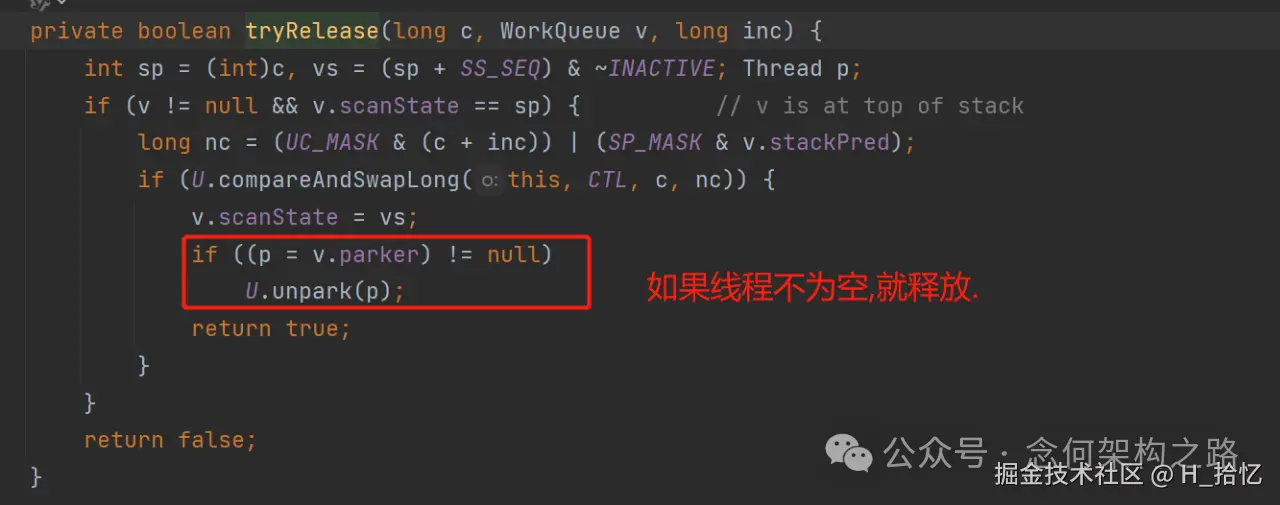
                if ((p = v.parker) != null)
                    U.unpark(p);
                return true;
            }
        }
        return false;
    }
方法理解:
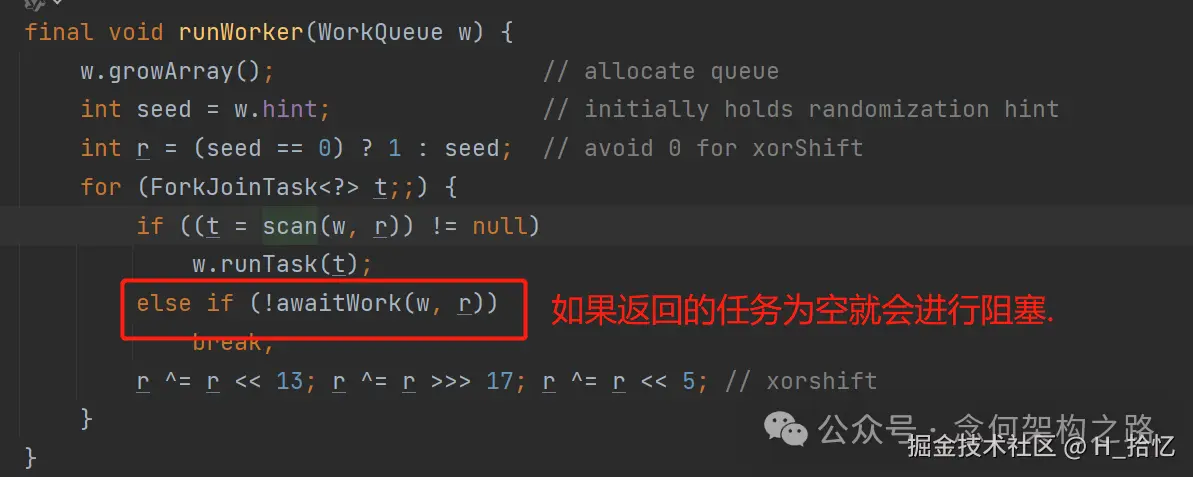
runtask方法:
scss
        /**
         * Executes the given task and any remaining local tasks.
         */
        final void runTask(ForkJoinTask<?> task) {
            if (task != null) {
                scanState &= ~SCANNING; // mark as busy
                (currentSteal = task).doExec();
                U.putOrderedObject(this, QCURRENTSTEAL, null); // release for GC
                execLocalTasks();
                ForkJoinWorkerThread thread = owner;
                if (++nsteals < 0)      // collect on overflow
                    transferStealCount(pool);
                scanState |= SCANNING;
                if (thread != null)
                    thread.afterTopLevelExec();
            }
        }
方法理解:
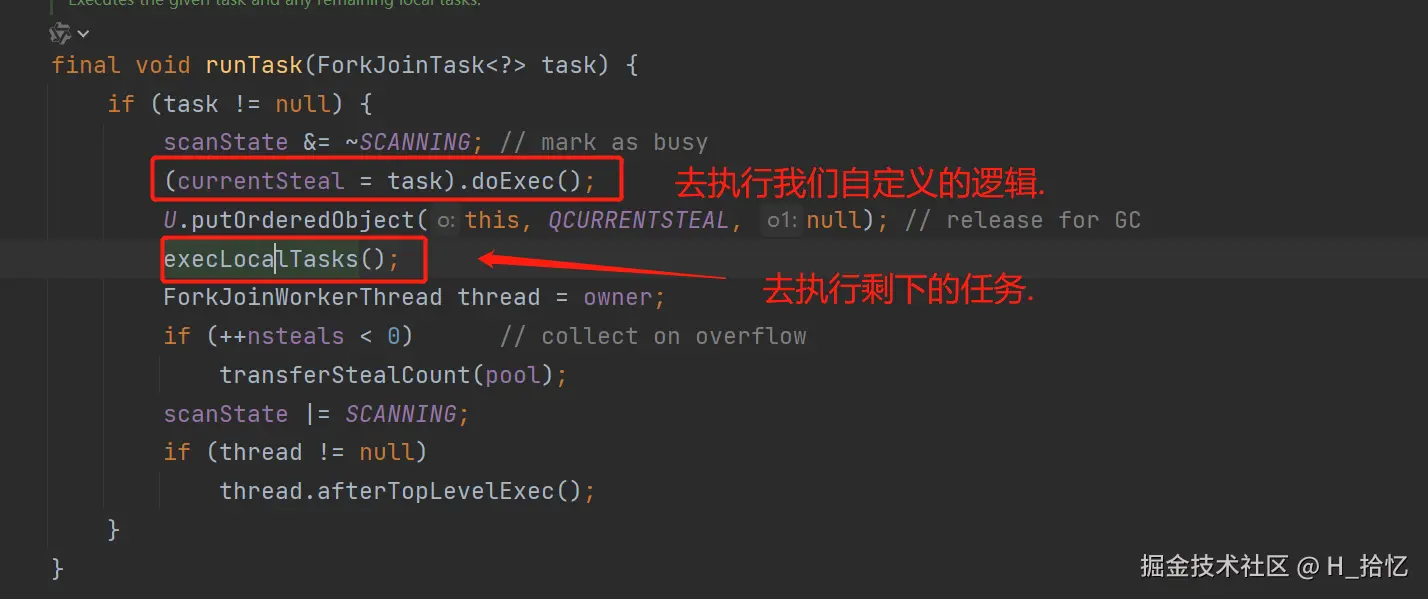
奥妙就在doExec方法中.跟着点进去.就会发现.
doExec方法:
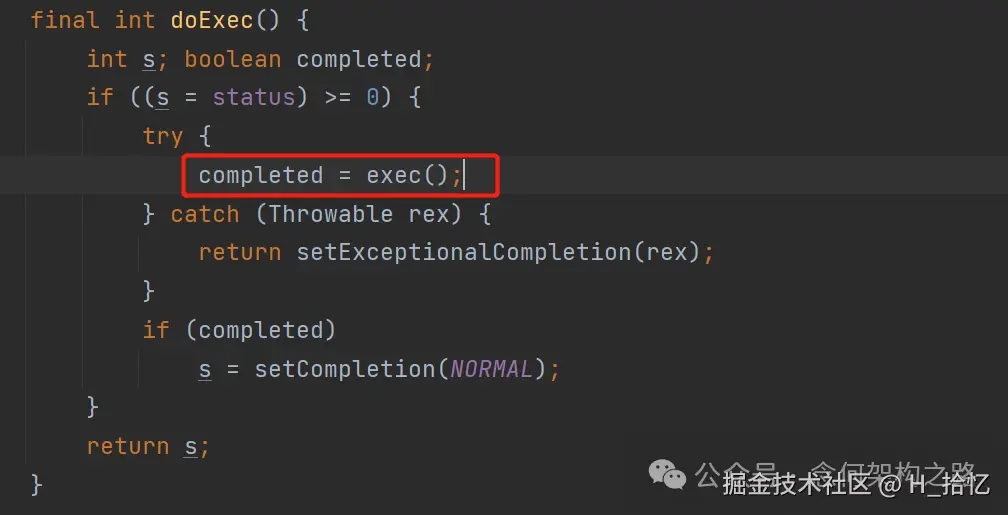
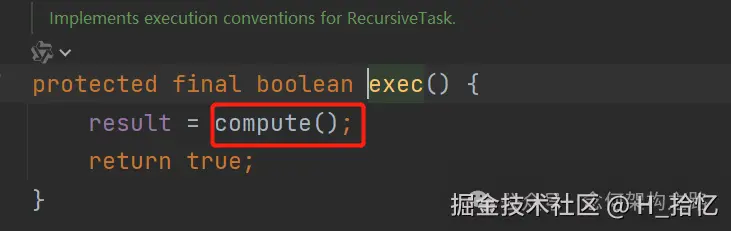
最后会调用到我们实现的compute方法.然后就会去调用fork方法.
fork方法:
kotlin
    /**
     * Arranges to asynchronously execute this task in the pool the
     * current task is running in, if applicable, or using the {@link
     * ForkJoinPool#commonPool()} if not {@link #inForkJoinPool}.  While
     * it is not necessarily enforced, it is a usage error to fork a
     * task more than once unless it has completed and been
     * reinitialized.  Subsequent modifications to the state of this
     * task or any data it operates on are not necessarily
     * consistently observable by any thread other than the one
     * executing it unless preceded by a call to {@link #join} or
     * related methods, or a call to {@link #isDone} returning {@code
     * true}.
     *
     * @return {@code this}, to simplify usage
     */
    public final ForkJoinTask<V> fork() {
        Thread t;
        if ((t = Thread.currentThread()) instanceof ForkJoinWorkerThread)
            ((ForkJoinWorkerThread)t).workQueue.push(this);
        else
            ForkJoinPool.common.externalPush(this);
        return this;
    }
方法理解:
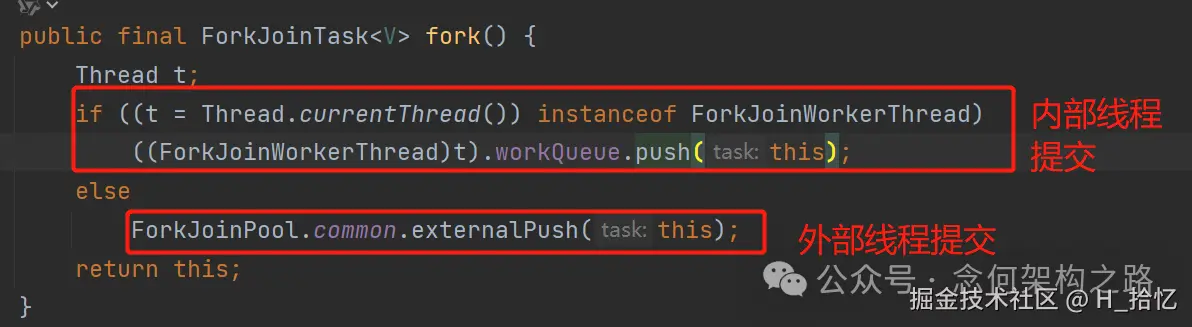
点进去会发现,形成了一个闭环.
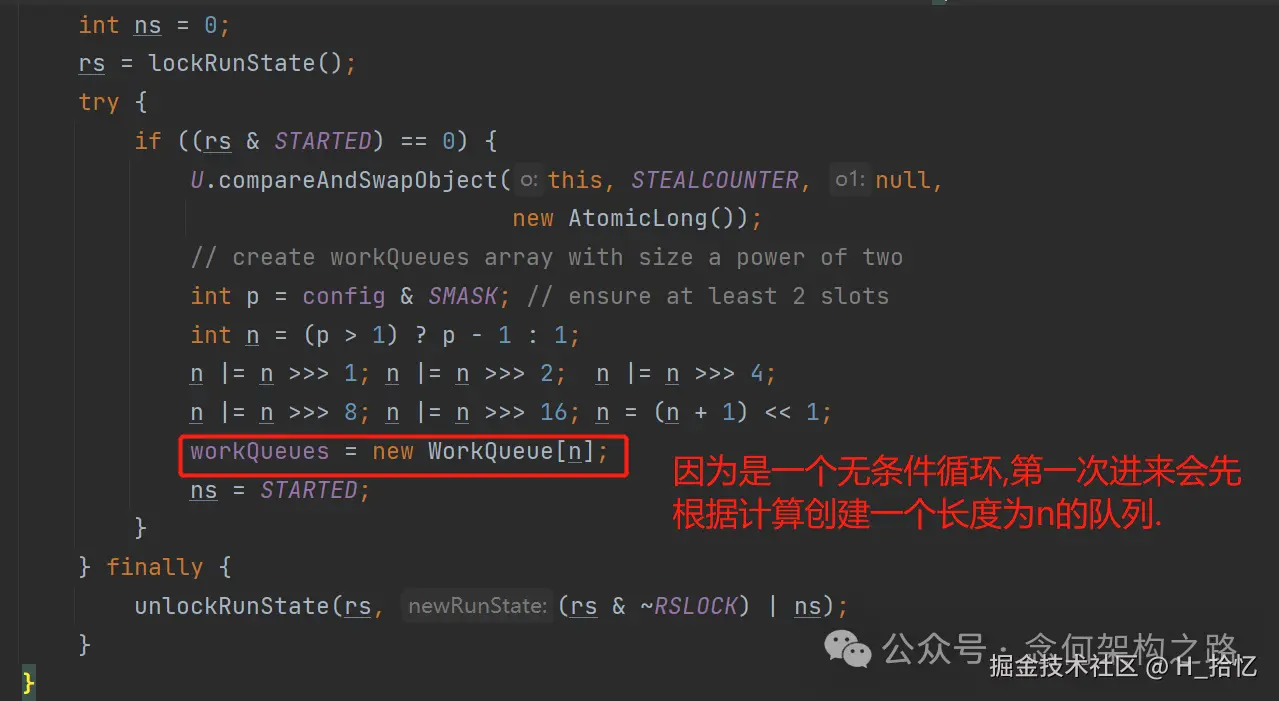
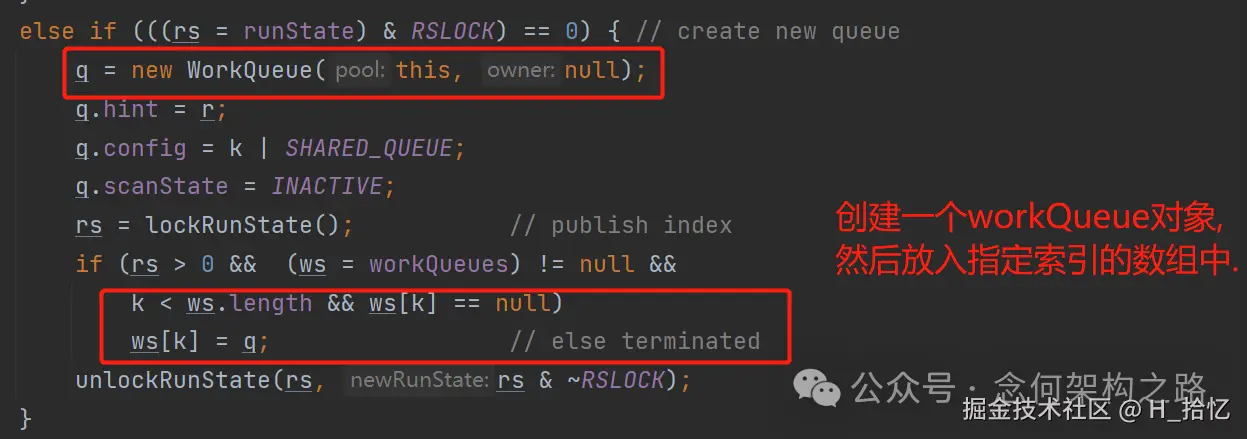
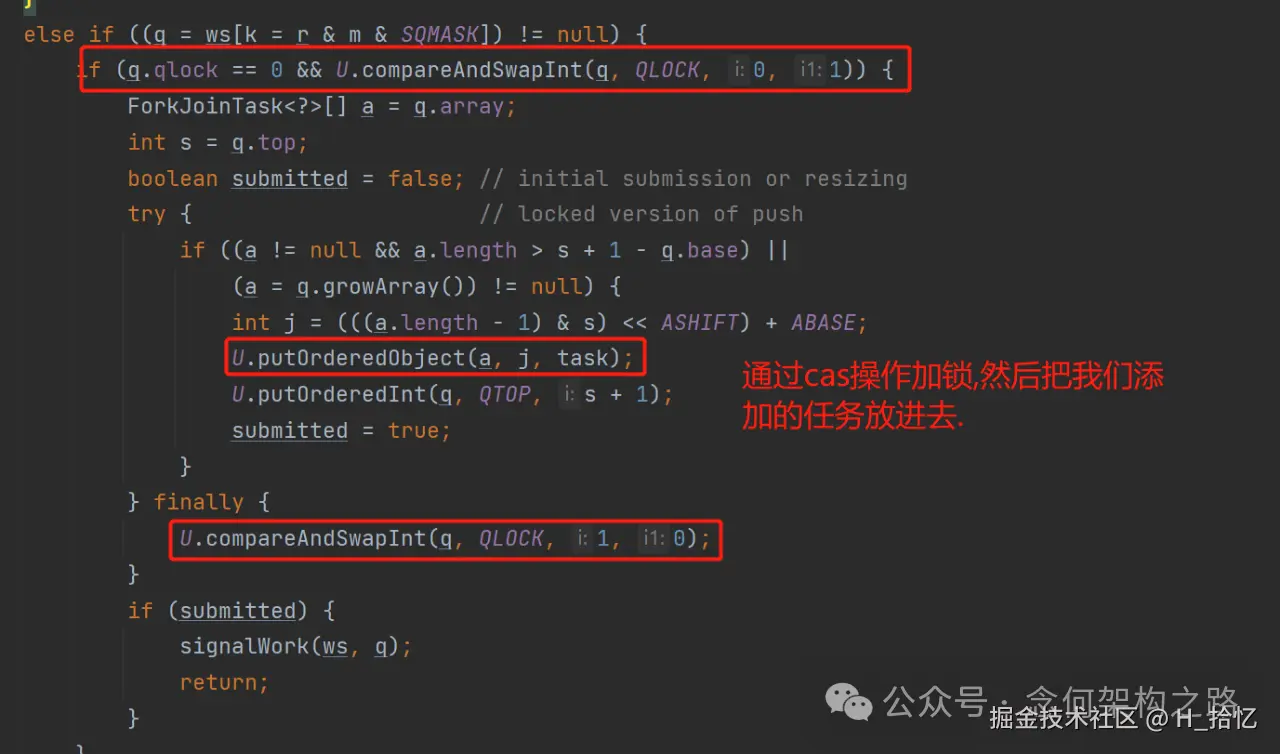
我们还剩一个方法没有点进去看.那就是workQueues为空的时候会进的方法externalSubmit方法.
externalSubmit方法:
ini
    /**
     * Full version of externalPush, handling uncommon cases, as well
     * as performing secondary initialization upon the first
     * submission of the first task to the pool.  It also detects
     * first submission by an external thread and creates a new shared
     * queue if the one at index if empty or contended.
     *
     * @param task the task. Caller must ensure non-null.
     */
    private void externalSubmit(ForkJoinTask<?> task) {
        int r;                                    // initialize caller's probe
        if ((r = ThreadLocalRandom.getProbe()) == 0) {
            ThreadLocalRandom.localInit();
            r = ThreadLocalRandom.getProbe();
        }
        for (;;) {
            WorkQueue[] ws; WorkQueue q; int rs, m, k;
            boolean move = false;
            if ((rs = runState) < 0) {
                tryTerminate(false, false);     // help terminate
                throw new RejectedExecutionException();
            }
            else if ((rs & STARTED) == 0 ||     // initialize
                     ((ws = workQueues) == null || (m = ws.length - 1) < 0)) {
                int ns = 0;
                rs = lockRunState();
                try {
                    if ((rs & STARTED) == 0) {
                        U.compareAndSwapObject(this, STEALCOUNTER, null,
                                               new AtomicLong());
                        // create workQueues array with size a power of two
                        int p = config & SMASK; // ensure at least 2 slots
                        int n = (p > 1) ? p - 1 : 1;
                        n |= n >>> 1; n |= n >>> 2;  n |= n >>> 4;
                        n |= n >>> 8; n |= n >>> 16; n = (n + 1) << 1;
                        workQueues = new WorkQueue[n];
                        ns = STARTED;
                    }
                } finally {
                    unlockRunState(rs, (rs & ~RSLOCK) | ns);
                }
            }
            else if ((q = ws[k = r & m & SQMASK]) != null) {
                if (q.qlock == 0 && U.compareAndSwapInt(q, QLOCK, 0, 1)) {
                    ForkJoinTask<?>[] a = q.array;
                    int s = q.top;
                    boolean submitted = false; // initial submission or resizing
                    try {                      // locked version of push
                        if ((a != null && a.length > s + 1 - q.base) ||
                            (a = q.growArray()) != null) {
                            int j = (((a.length - 1) & s) << ASHIFT) + ABASE;
                            U.putOrderedObject(a, j, task);
                            U.putOrderedInt(q, QTOP, s + 1);
                            submitted = true;
                        }
                    } finally {
                        U.compareAndSwapInt(q, QLOCK, 1, 0);
                    }
                    if (submitted) {
                        signalWork(ws, q);
                        return;
                    }
                }
                move = true;                   // move on failure
            }
            else if (((rs = runState) & RSLOCK) == 0) { // create new queue
                q = new WorkQueue(this, null);
                q.hint = r;
                q.config = k | SHARED_QUEUE;
                q.scanState = INACTIVE;
                rs = lockRunState();           // publish index
                if (rs > 0 &&  (ws = workQueues) != null &&
                    k < ws.length && ws[k] == null)
                    ws[k] = q;                 // else terminated
                unlockRunState(rs, rs & ~RSLOCK);
            }
            else
                move = true;                   // move if busy
            if (move)
                r = ThreadLocalRandom.advanceProbe(r);
        }
    }
方法理解:

语雀地址www.yuque.com/itbosunmian...?
《Go.》 密码:xbkk 欢迎大家访问.提意见.