背景
在日常开发过程中,我们有时候需要查看 class 文件的内容。如果我们对 class 文件的结构有基本的了解,那么就会事半功倍。由于这个话题很大,而且我自己的水平也有限,所以每次只写一个很小的主题。本文的主题是理解 class 文件中字段的 access flags。
要点
目前(JDK26), class 文件中字段的 access flags 一共支持 9 种类型。对每一种类型,本文都提供了对应的代码进行验证。
正文
The Java® Virtual Machine Specification 中的 4.5. Fields 小节详细介绍了 class 文件中 field_info 的结构,它的开头是这样的 ⬇️
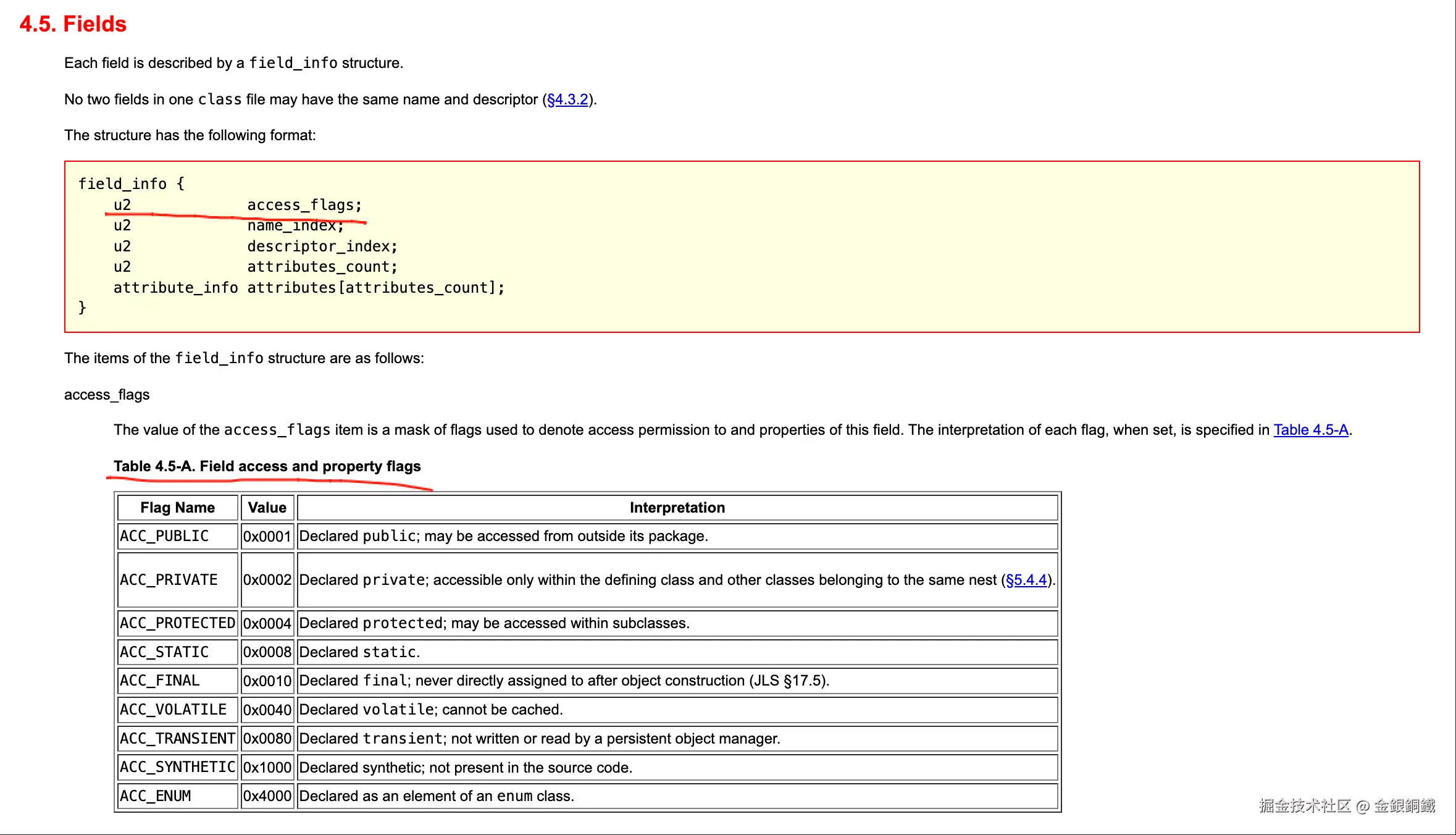
u2 的含义
The Java® Virtual Machine Specification 中的 Chapter 4. The class File Format 开头解释了 u2 的含义 ⬇️ (如下图红色框所示)
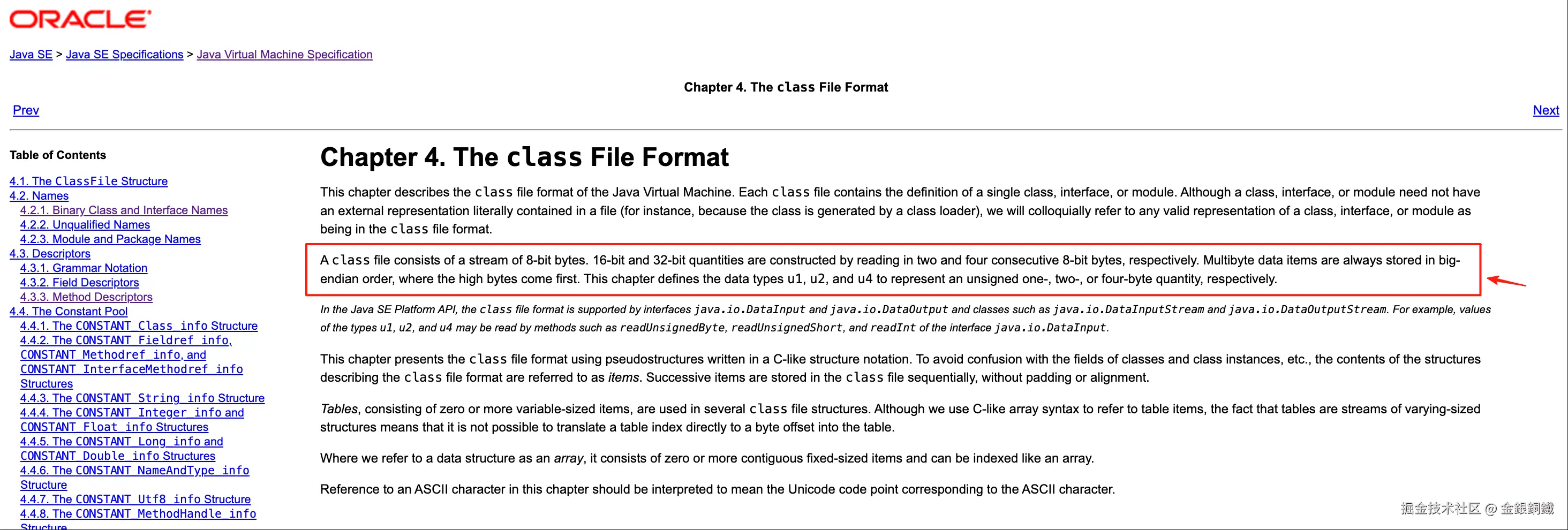
u2 表示 2 byte 的无符号数
字段的 access flags
The Java® Virtual Machine Specification 中的 4.5. Fields 小节的开头提供了一个表格 ⬇️ (表格的名称是 Table 4.5-A. Field access and property flags)
| Flag Name | Value | Interpretation |
|---|---|---|
ACC_PUBLIC |
0x0001 | Declared public; may be accessed from outside its package. |
ACC_PRIVATE |
0x0002 | Declared private; accessible only within the defining class and other classes belonging to the same nest (§5.4.4). |
ACC_PROTECTED |
0x0004 | Declared protected; may be accessed within subclasses. |
ACC_STATIC |
0x0008 | Declared static. |
ACC_FINAL |
0x0010 | Declared final; never directly assigned to after object construction (JLS §17.5). |
ACC_VOLATILE |
0x0040 | Declared volatile; cannot be cached. |
ACC_TRANSIENT |
0x0080 | Declared transient; not written or read by a persistent object manager. |
ACC_SYNTHETIC |
0x1000 | Declared synthetic; not present in the source code. |
ACC_ENUM |
0x4000 | Declared as an element of an enum class. |
表格中一共列举了 9 种情况。我们分别来看。
前 7 种情况
请将以下代码保存为 Simple.java
java
public class Simple {
  public int f1;
  private int f2;
  protected int f3;
  static int f4;
  final int f5 = 1;
  volatile int f6;
  transient int f7;
}
使用如下的命令可以编译 Simple.java
bash
javac Simple.java编译之后,当前目录会多出一个名为 Simple.class 的文件。使用如下的命令可以查看 Simple.class 的详细内容
bash
javap -v -p Simple完整的结果略有点长,我把和本文相关的部分复制到下方了 ⬇️ (... 表示本文不关心的内容)
text
...
public class Simple
...
{
  public int f1;
    descriptor: I
    flags: (0x0001) ACC_PUBLIC

  private int f2;
    descriptor: I
    flags: (0x0002) ACC_PRIVATE

  protected int f3;
    descriptor: I
    flags: (0x0004) ACC_PROTECTED

  static int f4;
    descriptor: I
    flags: (0x0008) ACC_STATIC

  final int f5;
    descriptor: I
    flags: (0x0010) ACC_FINAL
    ConstantValue: int 1

  volatile int f6;
    descriptor: I
    flags: (0x0040) ACC_VOLATILE

  transient int f7;
    descriptor: I
    flags: (0x0080) ACC_TRANSIENT

  public Simple();
    ...
}
...
不难验证,前 7 种情况都出现了。
第 8 种情况: ACC_SYNTHETIC
为了看到这种情况,我们需要生成合成字段。考虑到创建内部类的实例时,内部类的对象会持有宿主类的引用,而这个引用会保存在内部类的合成字段中。
请将以下代码保存为 Case8.java
java
class Case8 {
  int a;
  class Inner {
    int b = a;
  }
}
使用如下的命令可以编译 Case8.java
bash
javac -parameters Case8.java编译之后,当前目录会多出两个文件 ⬇️
Case8.classCase8$Inner.class
使用如下命令可以查看 Case8$Inner.class 的详细内容
bash
javap -v -p Case8\$Inner完整的结果略有点长,我把和本文相关的部分复制到下方了 ⬇️ (... 表示本文不关心的内容)
text
...
class Case8$Inner
  ...
{
  int b;
    descriptor: I
    flags: (0x0000)

  final Case8 this$0;
    descriptor: LCase8;
    flags: (0x1010) ACC_FINAL, ACC_SYNTHETIC

  Case8$Inner(Case8);
    ...
}
...
可以看到 Case8$Inner 这个类中的确有一个合成字段 this$0。借助 javap 命令,我把以下两个 class 文件手动反编译了一下
Case8.classCase8$Inner.class
结果如下 ⬇️
java
// 以下代码是我手动反编译的结果,内容仅供参考,可能有不准确甚至错误的地方

class Case8 {
    int a;
    Case8() {
        super();
    }
}

class Case8$Inner {
    int b;
    // 下方这个字段是合成字段,在 java 代码中看不到。
    final Case8 this$0;
    Case8$Inner(Case8 this$0) {
        this.this$0 = this$0;
        super();
        this.b = this.this$0.a;
    }
}
简要的类图如下 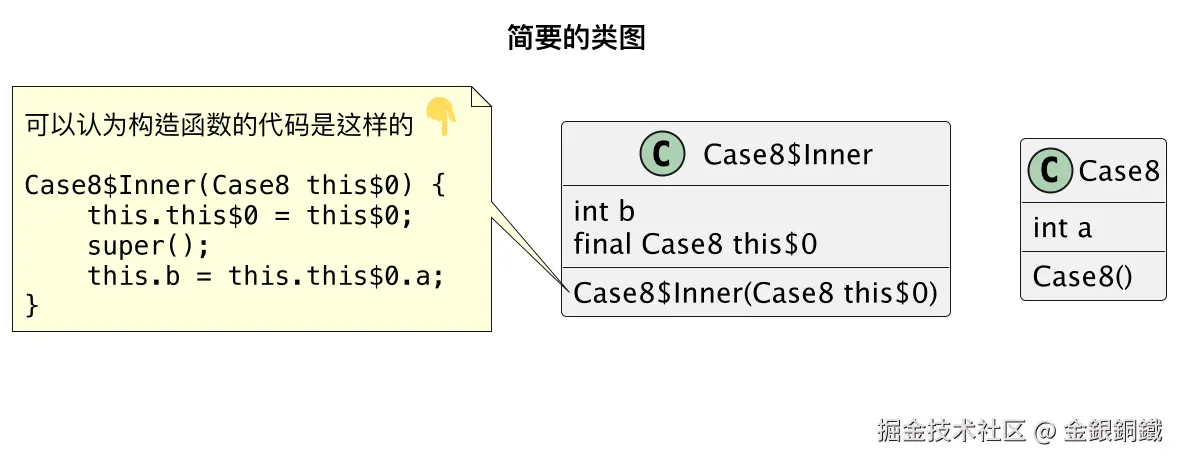
第 9 种情况: ACC_ENUM
第 9 种情况与枚举类型有关。我们写个枚举类来验证一下。请将以下代码保存为 Direction.java
java
public enum Direction {
  EAST,
  WEST,
  SOUTH,
  NORTH;
}
使用如下的命令可以编译 Direction.java
bash
javac Direction.java编译之后,当前目录会多出名为 textDirection.class 的文件。使用如下命令可以查看 Direction.class 的详细内容
bash
javap -v -p Direction完整的结果略有点长,我把和本文相关的部分复制到下方了 ⬇️ (... 表示本文不关心的内容)
text
...
public final class Direction extends java.lang.Enum<Direction>
...
{
  public static final Direction EAST;
    descriptor: LDirection;
    flags: (0x4019) ACC_PUBLIC, ACC_STATIC, ACC_FINAL, ACC_ENUM

  public static final Direction WEST;
    descriptor: LDirection;
    flags: (0x4019) ACC_PUBLIC, ACC_STATIC, ACC_FINAL, ACC_ENUM

  public static final Direction SOUTH;
    descriptor: LDirection;
    flags: (0x4019) ACC_PUBLIC, ACC_STATIC, ACC_FINAL, ACC_ENUM

  public static final Direction NORTH;
    descriptor: LDirection;
    flags: (0x4019) ACC_PUBLIC, ACC_STATIC, ACC_FINAL, ACC_ENUM

  private static final Direction[] $VALUES;
    descriptor: [LDirection;
    flags: (0x101a) ACC_PRIVATE, ACC_STATIC, ACC_FINAL, ACC_SYNTHETIC

...
}
...
不难验证, Direction 中定义的 4 个枚举值(即, EAST, WEST, SOUTH, NORTH),在 class 文件中,其实是 4 个静态字段,而且这 4 个字段的 access flags 中, ACC_ENUM 都处于置位状态(也就是说这一位的值是 1)。至于 java 语言中,实现枚举类型的更多细节,可以参考我之前写的一篇文章:Java 浅析枚举的实现
参考资料
The Java® Virtual Machine Specification 中的
其他
"简要的类图"是怎么画出来的
我用了 IntelliJ IDEA (Community Edition) 中 PlantUML 的插件来绘制那张图,用到的代码如下 ⬇️
puml
@startuml

title 简要的类图
caption \n\n
' caption 的内容是为了防止掘金平台自动生成的水印遮盖图中的文字

class Case8 {
    int a
    Case8()
}

class Case8$Inner {
    int b
    final Case8 this$0
    Case8$Inner(Case8 this$0)
}

note left of Case8$Inner::Case8$Inner
可以认为构造函数的代码是这样的 <:point_down:>

<code>
Case8$Inner(Case8 this$0) {
    this.this$0 = this$0;
    super();
    this.b = this.this$0.a;
}
</code>
end note

@enduml