1.案例描述
用 Q-learning 算法训练智能体在网格世界中自主 学习 避障、找到从起点到终点的最优路径,并展示训练结果。
2.代码实现
python
# -*- coding: utf-8 -*-
import numpy as np
import random
import torch
import torch.nn as nn
import torch.optim as optim
import matplotlib.pyplot as plt

plt.rcParams['font.sans-serif'] = ['Arial Unicode MS']
plt.rcParams['axes.unicode_minus'] = False

device = torch.device("cuda" if torch.cuda.is_available() else "cpu")
print(f"当前运行设备: {device}")

class GridWorld:
    def __init__(self, size=7):
        self.size = size
        self.start = (0, 0)
        self.goals = {(size - 1, size - 1): 1.0, (0, size - 1): 0.5}
        self.walls = {(2, 2), (2, 3), (3, 2), (4, 4)}
        self.traps = {(3, 5), (5, 3)}
        self.state = self.start

    def reset(self):
        self.state = self.start
        return self._state_to_obs(self.state)

    def step(self, action):
        x, y = self.state
        nx, ny = x, y
        if action == 0: nx -= 1    # up
        elif action == 1: nx += 1  # down
        elif action == 2: ny -= 1  # left
        elif action == 3: ny += 1  # right

        nx = np.clip(nx, 0, self.size - 1)
        ny = np.clip(ny, 0, self.size - 1)

        if (nx, ny) in self.walls:
            nx, ny = x, y

        self.state = (nx, ny)
        reward = -0.05
        done = False

        if self.state in self.traps:
            reward = -1.0
            done = True
        if self.state in self.goals:
            reward = self.goals[self.state]
            done = True

        return self._state_to_obs(self.state), reward, done

    def _state_to_obs(self, state):
        obs = np.zeros((4, self.size, self.size), dtype=np.float32)
        obs[0, state[0], state[1]] = 1.0
        for w in self.walls: obs[1, w[0], w[1]] = 1.0
        for t in self.traps: obs[2, t[0], t[1]] = 1.0
        for g in self.goals: obs[3, g[0], g[1]] = 1.0
        return obs.flatten()

class DQN(nn.Module):
    def __init__(self, state_dim, action_dim):
        super(DQN, self).__init__()
        self.net = nn.Sequential(
            nn.Linear(state_dim, 256),
            nn.ReLU(),
            nn.Linear(256, 256),
            nn.ReLU(),
            nn.Linear(256, action_dim)
        )

    def forward(self, x):
        return self.net(x)

class ReplayBuffer:
    def __init__(self, capacity=8000):
        self.buffer = []
        self.capacity = capacity

    def push(self, s, a, r, s_, d):
        if len(self.buffer) >= self.capacity:
            self.buffer.pop(0)
        self.buffer.append((s, a, r, s_, d))

    def sample(self, batch_size):
        batch = random.sample(self.buffer, batch_size)
        s, a, r, s_, d = zip(*batch)
        return (torch.FloatTensor(np.array(s)).to(device),
                torch.LongTensor(np.array(a)).to(device),
                torch.FloatTensor(np.array(r)).to(device),
                torch.FloatTensor(np.array(s_)).to(device),
                torch.FloatTensor(np.array(d)).to(device))

    def __len__(self):
        return len(self.buffer)

def train():
    env = GridWorld(size=7)
    state_dim = 4 * env.size * env.size
    action_dim = 4

    q_net = DQN(state_dim, action_dim).to(device)
    target_net = DQN(state_dim, action_dim).to(device)
    target_net.load_state_dict(q_net.state_dict())

    optimizer = optim.Adam(q_net.parameters(), lr=1e-3)
    criterion = nn.MSELoss()
    buffer = ReplayBuffer()

    gamma = 0.95
    epsilon = 1.0
    epsilon_min = 0.05
    epsilon_decay = 0.995

    episodes = 200
    batch_size = 64
    rewards_history = []

    for ep in range(episodes):
        s = env.reset()
        total_reward = 0

        while True:
            # 动作选择
            if random.random() < epsilon:
                a = random.randint(0, action_dim - 1)
            else:
                with torch.no_grad():
                    s_tensor = torch.FloatTensor(s).unsqueeze(0).to(device)
                    q_values = q_net(s_tensor)
                    a = q_values.argmax().item()

            s_, r, done = env.step(a)
            buffer.push(s, a, r, s_, done)
            s = s_
            total_reward += r

            # 经验回放
            if len(buffer) >= batch_size:
                bs, ba, br, bs_, bd = buffer.sample(batch_size)
                # 计算当前 Q 值
                q_eval = q_net(bs).gather(1, ba.unsqueeze(1)).squeeze(1)
                # 计算目标 Q 值
                with torch.no_grad():
                    q_next = target_net(bs_).max(1)[0]
                    q_target = br + gamma * q_next * (1 - bd)
                loss = criterion(q_eval, q_target)
                # 更新网络
                optimizer.zero_grad()
                loss.backward()
                optimizer.step()

            if done:
                break

        epsilon = max(epsilon * epsilon_decay, epsilon_min)
        rewards_history.append(total_reward)

        if ep % 30 == 0:
            target_net.load_state_dict(q_net.state_dict())
            print(f"Episode {ep}, Reward {total_reward:.2f}, Epsilon {epsilon:.2f}")

    return env, q_net, rewards_history

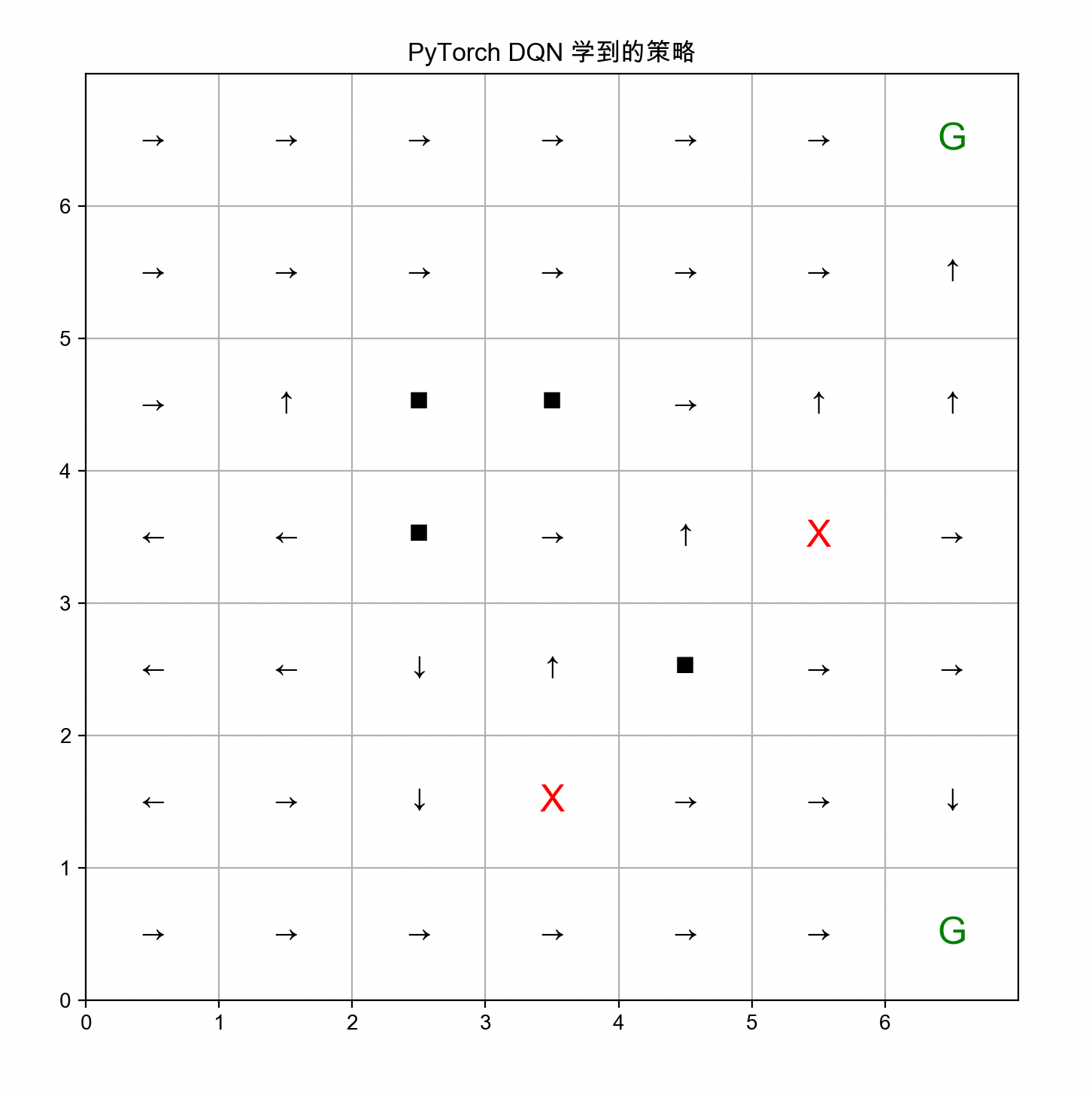
def visualize_policy(env, q_net):
    q_net.eval()
    arrows = {0: '↑', 1: '↓', 2: '←', 3: '→'}

    fig, ax = plt.subplots(figsize=(8, 8))
    ax.set_xlim(0, env.size)
    ax.set_ylim(0, env.size)
    ax.set_xticks(np.arange(env.size))
    ax.set_yticks(np.arange(env.size))
    ax.grid(True)

    for i in range(env.size):
        for j in range(env.size):
            if (i, j) in env.walls:
                ax.text(j + 0.5, env.size - i - 0.5, '■', fontsize=18, ha='center', va='center')
                continue
            if (i, j) in env.traps:
                ax.text(j + 0.5, env.size - i - 0.5, 'X', color='red', fontsize=18, ha='center', va='center')
                continue
            if (i, j) in env.goals:
                ax.text(j + 0.5, env.size - i - 0.5, 'G', color='green', fontsize=18, ha='center', va='center')
                continue

            obs = env._state_to_obs((i, j))
            with torch.no_grad():
                obs_tensor = torch.FloatTensor(obs).unsqueeze(0).to(device)
                q = q_net(obs_tensor)
                a = q.argmax().item()

            ax.text(j + 0.5, env.size - i - 0.5, arrows[a],
                    ha='center', va='center', fontsize=16)

    plt.title("PyTorch DQN 学到的策略")
    plt.show()

if __name__ == "__main__":
    env, q_net, rewards = train()

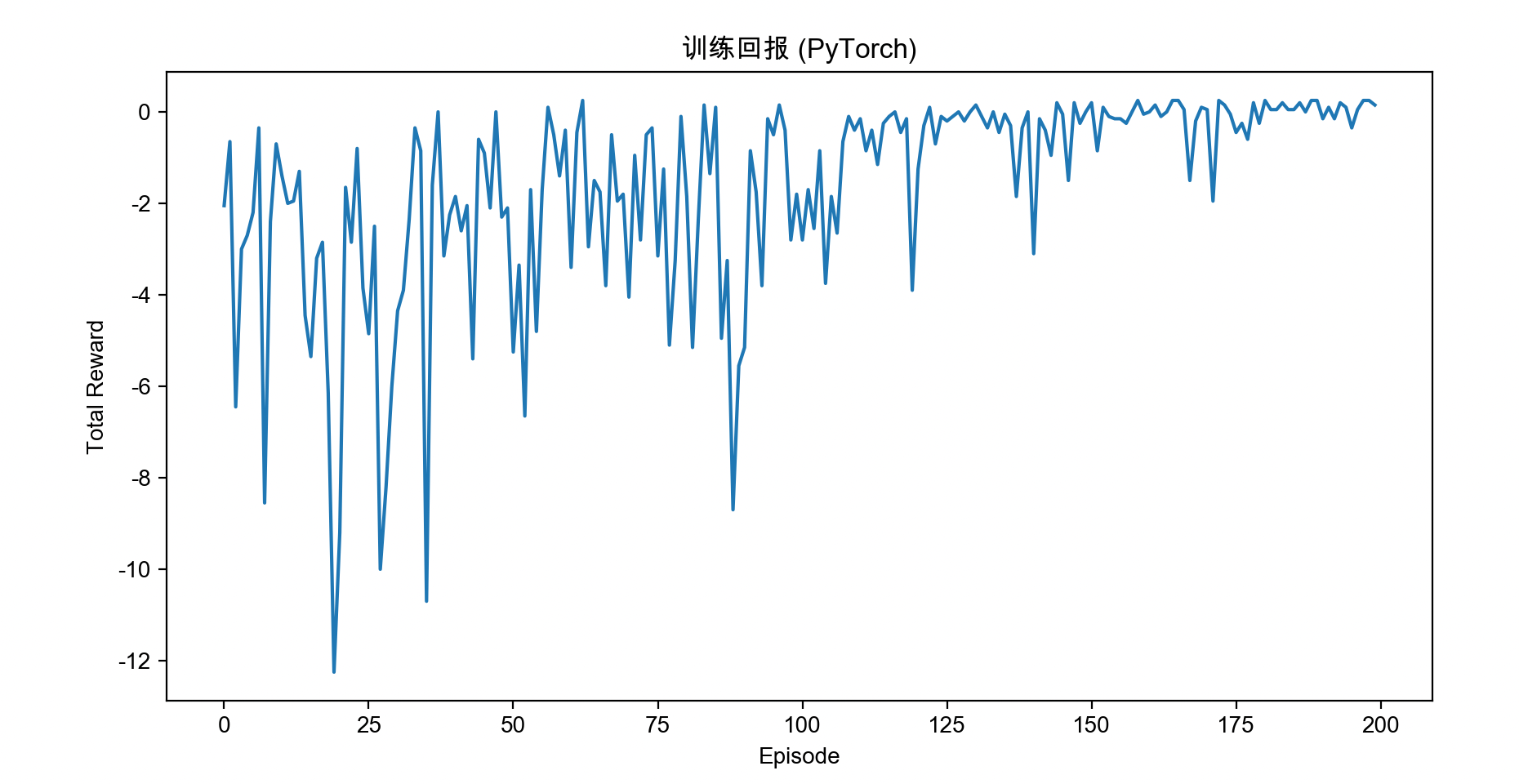
    plt.figure(figsize=(10, 5))
    plt.plot(rewards)
    plt.title("训练回报 (PyTorch)")
    plt.xlabel("Episode")
    plt.ylabel("Total Reward")
    plt.show()

    visualize_policy(env, q_net)
3.效果展示
bash
当前运行设备: cpu
Episode 0, Reward -3.20, Epsilon 0.99
Episode 30, Reward -2.90, Epsilon 0.86
Episode 60, Reward -2.30, Epsilon 0.74
Episode 90, Reward -0.55, Epsilon 0.63
Episode 120, Reward -1.40, Epsilon 0.55
Episode 150, Reward 0.00, Epsilon 0.47
Episode 180, Reward 0.25, Epsilon 0.40