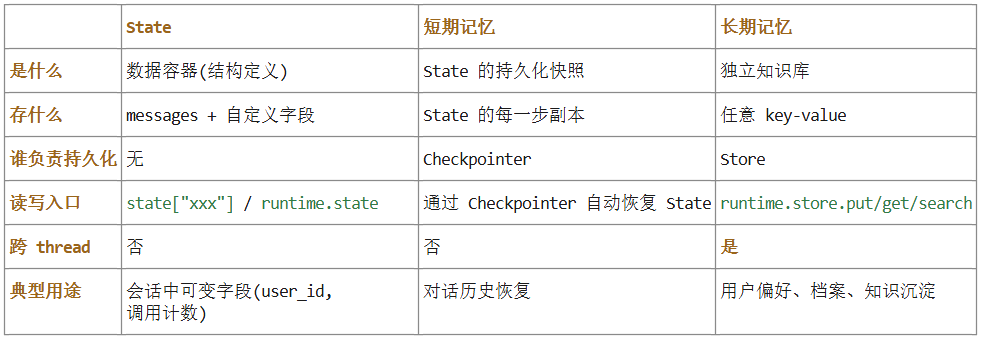
两者都存 MySQL 且都跨重启不丢,但它们的 语义层级 完全不同:
短期记忆 (Checkpointer) 绑定 thread_id,存的是一次会话的完整消息流水账------每轮对话的 HumanMessage、AIMessage、ToolMessage 全部 append。换了 thread_id 就是全新的会话,对之前的事一无所知。
长期记忆 (Store) 绑定 namespace(通常是 user_id),存的是跨会话的结构化知识点------用户的偏好、档案、历史行为。同一个用户在不同 thread 里都能访问到。
Thread 1 存偏好 → Thread 2(新 thread_id)仍然能查出来
result3 = memory_agent.invoke(
{"messages": {"role": "user", "content": "我喜欢什么颜色?"}},
config={"configurable": {"thread_id": "thread2"}}, # ← 不同线程
context=UserContext(user_id="current_user") # ← 相同用户
)
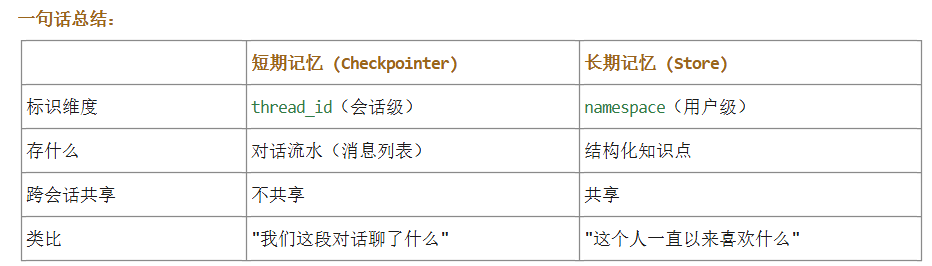
短期记忆保证你重启后同一场对话能继续聊下去;长期记忆保证你换一场对话(不同 thread_id)还能认出这个人是谁。
State(状态)--- 数据的"载体"
short_memory/04_custom_state.py:34-37
class CustomState(AgentState): # 继承内置 AgentState
user_id: str # ← 你定义的业务字段
hobby: str
other_info: dict
messages 字段是 AgentState 自带的,不用声明
State 是一个内存中的字典容器,包含两部分:
-
messages(AgentState 内置):HumanMessage、AIMessage、ToolMessage 的完整列表
-
自定义字段:你通过 state_schema 添加的任何业务数据
State 本身不负责持久化,它只是数据格式的定义。
短期记忆(Checkpointer)--- State 的"存档机制"
Checkpointer 做的事:每一次 Super-Step 结束后,把整个 State 快照保存到存储。
Step 1: 用户说"我叫张三" → State{messages:HumanMsg, AIMsg} → 📸 Checkpointer 拍照存 MySQL
Step 2: 用户说"北京天气" → State{messages:..., HumanMsg, AIMsg, ToolMsg, AIMsg} → 📸 再拍
Step 3: 用户说"我叫什么" → Agent 从 MySQL 恢复 State,看到 Step1 里说过"我叫张三"
关键性质:绑死 thread_id。同一个 thread 内,State 会累积增长(消息越来越长)。换 thread_id → 读不到任何之前的 State。
short_memory/03_short_memory_indb.py:42-49
config = {"configurable":{"thread_id":"session001"}} # ← 钥匙
resp1 = agent.invoke({"messages":{"role":"user","content":"你好,我叫张三"}}, config=config)
resp2 = agent.invoke({"messages":{"role":"user","content":"你知道我的信息吗?"}}, config=config)
第二轮能记住"张三",因为同一个 thread_id 下 Checkpointer 把 State 恢复了
长期记忆(Store)--- 独立于会话的"知识库"
Store 不关心你当前在哪个 thread、聊到哪一步。它用 namespace + key → value 组织数据:
long_memory/04_modify_long_memory_intool.py:43-55
namespace = (user_id, "preferences") # namespace 标识"谁的什么类型的数据"
memory_id = str(uuid.uuid4()) # key 是每条记忆的唯一 ID
runtime.store.put(namespace, memory_id, {"category": "color", "preference": "蓝色"})
同一用户在 thread1 存的偏好,切换到 thread2 照样能查到:
Thread 1 存 → Thread 2 查,跨 session 共享
result3 = memory_agent.invoke(
...,
config={"configurable": {"thread_id": "thread2"}}, # ← 不同线程
context=UserContext(user_id="current_user") # ← 相同用户,同一 namespace
)
三者关系总结
┌─────────────────────────────────┐
│ State (数据容器) │
│ messages + user_id + hobby ... │
└──────────┬──────────────────────┘
│
┌────────────────┼────────────────┐
▼ ▼ ▼
┌─────────────────┐ ┌─────────────┐ ┌─────────────────┐
│ 每次 step 后 │ │ 工具中读取 │ │ 中间件中读写 │
│ Checkpointer │ │ runtime.state│ │ state"xxx" │
│ 自动快照 State │ │ Command 更新 │ │ return dict │
└────────┬────────┘ └──────────────┘ └─────────────────┘
│
▼
┌─────────────────┐ ┌─────────────────────────┐
│ 短期记忆 │ │ 长期记忆 (Store) │
│ = State 的 │ │ 独立于图执行的知识库 │
│ 持久化快照 │ │ namespace + key → value │
│ 绑 thread_id │ │ 跨 thread、跨 session │
└─────────────────┘ └─────────────────────────┘