一、C++11 发展概述
版本 发布年份 核心新增特性 C++98 1998 模板、STL、容器、算法、字符串、流 C++11 2011 列表初始化、 auto/decltype、Lambda、右值引用 / 移动语义、constexpr、多线程、内存模型、正则、智能指针、哈希容器、std::arrayC++14 2014 读写锁、泛型 Lambda C++17 2017 折叠表达式、 constexpr if、结构化绑定、string_view、文件系统、std::any/optional/variantC++20 2020 协程、模块、Concept、Ranges 库 C++23 2023 类模板参数推导、标准库模块化、打印接口、扁平容器等
二、列表初始化 & std::initializer_list
2.1 C++98 旧式
{}初始化仅支持数组、结构体使用大括号初始化,语法零散:
cppstruct Point { int _x; int _y; }; int main() { int arr1[] = {1,2,3,4,5}; int arr2[5] = {0}; Point p = {1, 2}; return 0; }
2.2 C++11 统一列表初始化
C++11 实现万物可用
{}初始化,支持内置类型、自定义类、容器,且可省略 =;同时会做窄转换检查。核心用法
cpp#include <iostream> #include <vector> using namespace std; struct Point { int _x; int _y; }; class Date { public: Date(int year = 1, int month = 1, int day = 1) : _year(year), _month(month), _day(day) {} private: int _year, _month, _day; }; int main() { // 1. 内置类型 int x1 = {2}; int x2{2}; // 省略 = // 2. 自定义结构体/类 Point p1{1, 2}; Date d1{2025, 1, 1}; const Date& d2{2024, 7, 25}; // 引用绑定临时对象 // 3.需要注意的是C++98⽀持单参数时类型转换,也可以不⽤{} Date d3 = { 2025}; Date d4 = 2025; // 4. 容器便捷构造/插入 vector<Date> v; v.push_back({2025, 1, 1}); // 直接传初始化列表,简化代码 return 0; }特性
- 编译器会优化:
Date d = {a,b,c}不会产生额外临时对象 + 拷贝构造,直接构造。- 禁止隐式窄转换:
int a{3.14};编译报错,int a = 3.14;C++98 允许截断。
2.3
std::initializer_list解决容器批量初始化问题,STL 所有容器都增加了接收
initializer_list的构造函数与赋值重载。底层原理
std::initializer_list内部仅保存两个指针(起始、末尾),不拷贝数据,开销极小。- ⭐底层指向栈上数组,支持迭代器遍历。
示例
cpp#include <iostream> #include <vector> #include <map> using namespace std; int main() { // 1. 容器直接批量初始化 vector<int> v1{1,2,3,4,5}; vector<int> v2 = {10,20,30}; // 2. map 结合列表初始化 map<string, string> dict{ {"name", "zhangsan"}, {"age", "20"} }; // 3. 列表赋值 v1 = {100, 200, 300}; return 0; }自定义类支持
initializer_list
cpp#include <initializer_list> #include <vector> class MyVector { private: vector<int> data; public: // 接收初始化列表构造函数 MyVector(initializer_list<int> il) { for (auto val : il) data.push_back(val); } }; // 使用 MyVector mv{1,2,3,4}; std::initializer_list<int> mylist; mylist = { 10, 20, 30 }; cout << sizeof(mylist) << endl; // 这⾥begin和end返回的值initializer_list对象中存的两个指针 // 这两个指针的值跟i的地址跟接近,说明数组存在栈上 int i = 0; cout << mylist.begin() << endl; cout << mylist.end() << endl; cout << &i << endl; // {}列表中可以有任意多个值 // 这两个写法语义上还是有差别的,第⼀个v1是直接构造, // 第⼆个v2是构造临时对象+临时对象拷⻉v2+优化为直接构造 vector<int> v1({ 1,2,3,4,5 }); vector<int> v2 = { 1,2,3,4,5 }; const vector<int>& v3 = { 1,2,3,4,5 }; // 这⾥是pair对象的{}初始化和map的initializer_list构造结合到⼀起⽤了 map<string, string> dict = { {"sort", "排序"}, {"string", "字符串"}};
三、右值引用 & 移动语义(C++11 性能核心)
3.1 左值 & 右值
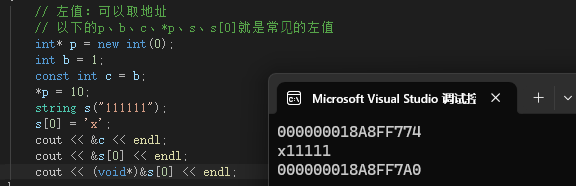
左值 (lvalue):有名字、可寻址、能出现在赋值号左边(普通变量、解引用指针、引用)。
右值 (rvalue):无名字、临时对象、字面量、表达式结果,不可寻址。
int a = 10; // a 左值
int b = a + 20; // a+20 右值
string s = "hello"; // "hello" 字符串字面量是右值
3.2 左值引用 & 右值引用
语法:
- 左值引用:
类型&,只能绑定左值;const 左值引用可绑定右值。- 右值引用:
类型&&,只能绑定右值;想要绑定左值需要 move 。
cppint main() { int a = 10; int& r1 = a; // 左值引用绑定左值 const int& r2 = 20; // const 左值引用绑定右值 int&& rr1 = 20; // 右值引用绑定右值 // int&& rr2 = a; // 报错:右值引用不能直接绑左值 int&& rr3 = move(a);// std::move 将左值转为右值 // 重点:右值引用变量本身是**左值** int&& rr4 = 100; // int&& rr5 = rr4; // 报错 int&& rr6 = move(rr4); return 0; }
3.3 引用延长生命周期
const 左值引用和右值引用都可以延长临时对象生命周期:
cpp#include <string> using namespace std; int main() { string s1 = "test"; const string& r1 = s1 + s1; // 延长生命周期,不可修改 string&& r2 = s1 + s1; // 延长生命周期,可修改 r2 += "end"; return 0; }
3.4 重载匹配规则
同时提供三种重载时:
- 普通左值 → 匹配
T&const左值 → 匹配const T&- 右值 /
move(左值)→ 匹配T&&
cpp#include <iostream> using namespace std; void f(int& x) { cout << "左值引用\n"; } void f(const int& x) { cout << "const 左值引用\n"; } void f(int&& x) { cout << "右值引用\n"; } int main() { int a = 1; const int ca = 2; f(a); // 左值引用 f(ca); // const 左值引用 f(100); // 右值引用 f(move(a)); // 右值引用 return 0; }
3.5 移动构造 & 移动赋值
针对深拷贝类(
string/vector)设计,转移资源所有权,替代深拷贝,提升性能。函数原型
cpp// 移动构造 类名(类名&& 源) noexcept; // 移动赋值 类名& operator=(类名&& 源) noexcept;模拟简易 string(完整示例)
cpp#include <iostream> #include <cstring> #include <algorithm> using namespace std; class String { private: char* _str = nullptr; size_t _size = 0; size_t _capacity = 0; public: String(const char* str = "") { _size = strlen(str); _capacity = _size; _str = new char[_capacity + 1]; strcpy(_str, str); } // 拷贝构造(深拷贝) String(const String& s) { _size = s._size; _capacity = s._capacity; _str = new char[_capacity + 1]; strcpy(_str, s._str); } // 移动构造(窃取资源) String(String&& s) noexcept { swap(_str, s._str); swap(_size, s._size); swap(_capacity, s._capacity); } // 拷贝赋值 String& operator=(const String& s) { if (this != &s) { delete[] _str; _size = s._size; _capacity = s._capacity; _str = new char[_capacity + 1]; strcpy(_str, s._str); } return *this; } // 移动赋值 String& operator=(String&& s) noexcept { if (this != &s) { swap(_str, s._str); swap(_size, s._size); swap(_capacity, s._capacity); } return *this; } ~String() { delete[] _str; _str = nullptr; } const char* c_str() const { return _str; } }; int main() { String s1("hello"); String s2 = s1; // 拷贝构造 String s3 = move(s1); // 移动构造 String s4("world"); s4 = move(s3); // 移动赋值 return 0; }
3.6 移动语义两大应用场景
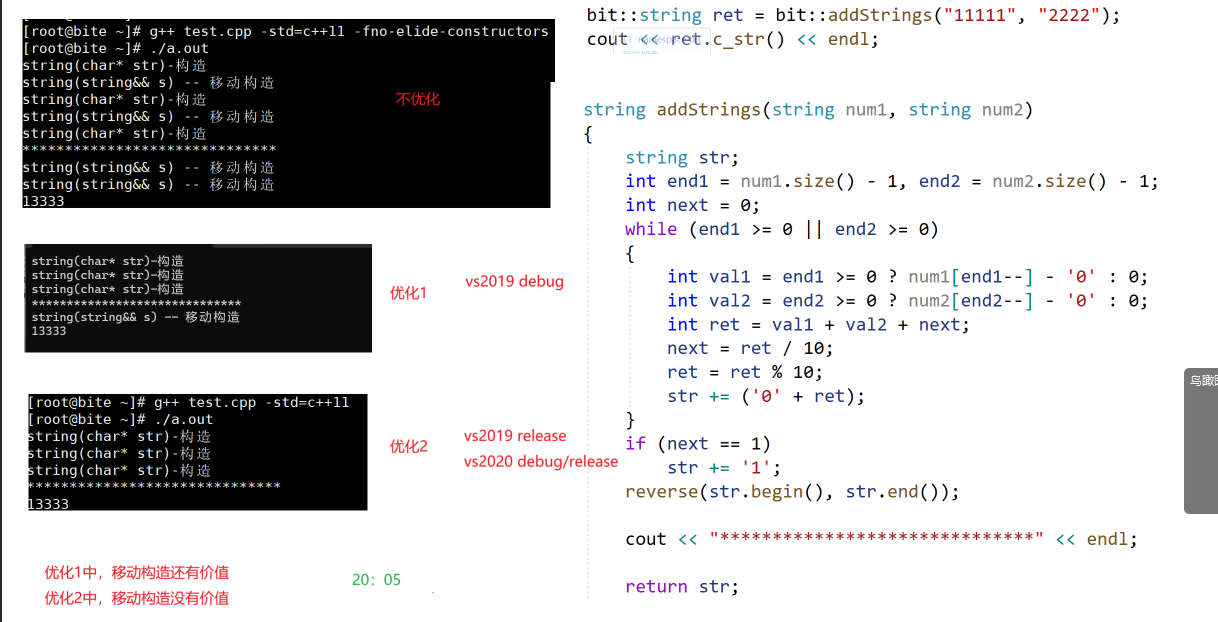
- 函数传值返回局部对象:局部对象作为右值,触发移动构造,减少拷贝。
- 容器接口重载:STL
push_back/insert都提供const T&和T&&两个版本:
- 传入左值 → 拷贝构造
- 传入右值 /
move对象 → 移动构造
cppint main() { std::list<bit::string> lt; bit::string s1("111111111111111111111"); lt.push_back(s1); cout << "*************************" << endl; lt.push_back(bit::string("22222222222222222222222222222")); cout << "*************************" << endl; lt.push_back("3333333333333333333333333333"); cout << "*************************" << endl; lt.push_back(move(s1)); cout << "*************************" << endl; return 0; } 运⾏结果: string(char* str) string(const string& s) -- 拷⻉构造 ************************* string(char* str) string(string&& s) -- 移动构造 ~string() -- 析构 ************************* string(char* str) string(string&& s) -- 移动构造 ~string() -- 析构 ************************* string(string&& s) -- 移动构造 ************************* ~string() -- 析构 ~string() -- 析构 ~string() -- 析构 ~string() -- 析构 ~string() -- 析构
3.7 值类别细分(C++11 扩展)
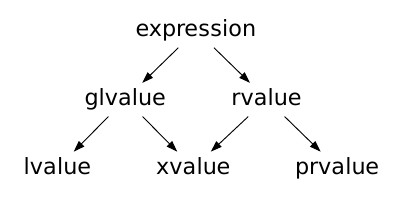
C++11 把右值细分为两类:
- 纯右值 (prvalue)****:字面量、表达式结果、传值返回临时对象(传统意义上的右值)。
- 将亡值 (xvalue)****:
move结果、右值引用转换结果。合称:泛左值 (glvalue) = 左值 + 将亡值。
3.8 引用折叠 & 万能引用
C++ 不允许 "引用的引用",模板中出现时遵循引用折叠规则:
T& &→T&T& &&→T&T&& &→T&T&& &&→T&&万能引用:模板参数
T&&
- 传入左值 → 推导
T = 类型&,折叠后为左值引用- 传入右值 → 推导
T = 类型&&,最终为右值引用
cpptemplate<class T> void f1(T& x) {} // 由于引⽤折叠限定,f2实例化后可以是左值引⽤,也可以是右值引⽤ template<class T> void f2(T&& x) {} int main() { typedef int& lref; typedef int&& rref; int n = 0; lref& r1 = n; // r1 的类型是 int& lref&& r2 = n; // r2 的类型是 int& rref& r3 = n; // r3 的类型是 int& rref&& r4 = 1; // r4 的类型是 int&& // 没有折叠->实例化为void f1(int& x) f1<int>(n); f1<int>(0); // 报错 // 折叠->实例化为void f1(int& x) f1<int&>(n); f1<int&>(0); // 报错 // 折叠->实例化为void f1(int& x) f1<int&&>(n); f1<int&&>(0); // 报错 // 折叠->实例化为void f1(const int& x) f1<const int&>(n); f1<const int&>(0); // 折叠->实例化为void f1(const int& x) f1<const int&&>(n); f1<const int&&>(0); // 没有折叠->实例化为void f2(int&& x) f2<int>(n); // 报错 f2<int>(0); // 折叠->实例化为void f2(int& x) f2<int&>(n); f2<int&>(0); // 报错 // 折叠->实例化为void f2(int&& x) f2<int&&>(n); // 报错 f2<int&&>(0); return 0;
3.9 完美转发
std::forward作用:保留参数原有左 / 右值属性,配合万能引用使用。
std::move:一律转为右值std::forward<T>:原样转发(左值转左值,右值转右值)
cpptemplate<class T> void wrapper(T&& t) { // fun(t); // t 是左值,永远调用左值版本 fun(forward<T>(t)); // 完美转发,保留原值类别 }