注:本文为 "无穷级数" 相关合辑。
英文引文,机翻未校。
中文引文,略作重排。
如有内容异常,请看原文。
欧拉:严谨宗师与直觉先驱的双重面相
在数学史上,莱昂哈德·欧拉(Leonhard Euler, 1707--1783)被公认为最多产的数学家之一。拉普拉斯曾评价:"读读欧拉吧,他是我们所有人的老师。"欧拉在 76 年的人生中留下了约 866 部著作,由圣彼得堡科学院历时 47 年整理为 74 卷全集,其学术产出规模在数学史上罕有匹敌。
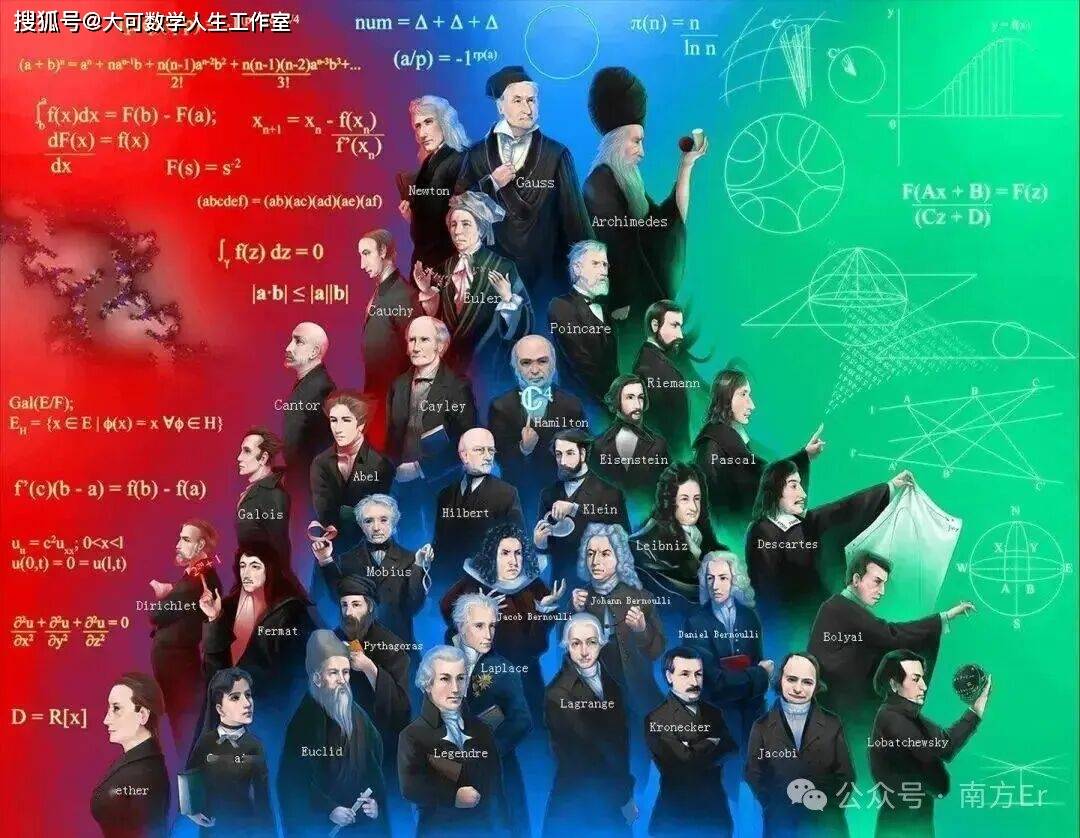
然而,若深入考察欧拉的原始推导,便会发现其工作方式并非全然遵循现代意义上的严格公理化路径。他常常凭借卓越的直觉洞察,在尚未建立完备理论基础的情况下提出正确结论,其方法论呈现出严谨性与探索性并存的复杂面貌。
1. 学术生涯的开端:从巴塞尔到圣彼得堡
欧拉于 1707 年 4 月 15 日生于瑞士巴塞尔一个牧师家庭。1720 年,13 岁的欧拉进入巴塞尔大学,师从约翰·伯努利(Johann Bernoulli)。1723 年,16 岁的欧拉获得哲学硕士学位。尽管父亲希望他继承牧师职业,但欧拉对数学的志趣在约翰·伯努利的指导下得以充分发展。
1726 年,19 岁的欧拉完成了博士学位论文《De Sono》(论声音的传播),并参加了法国科学院主办的有奖征文竞赛,题目为船桅的最优放置问题,获得二等奖。此后,欧拉一生中共 12 次赢得该竞赛的一等奖。
1727 年,在丹尼尔·伯努利(Daniel Bernoulli)的推荐下,欧拉应邀前往圣彼得堡科学院。他于 1727 年 5 月 17 日抵达圣彼得堡,当日恰逢女皇叶卡捷琳娜一世(Catherine I)去世。欧拉最初被聘于生理学研究所,后经丹尼尔·伯努利等人请求,转入数学-物理研究所,由此开启了他在圣彼得堡的学术生涯。
2. 直觉驱动的开创性工作
2.1 哥尼斯堡七桥问题与图论的诞生
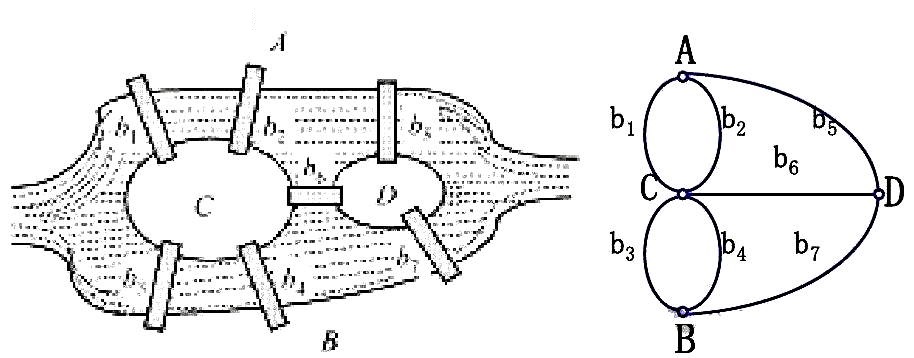
在圣彼得堡期间,欧拉于 1736 年发表了论文《Solutio problematis ad geometriam situs pertinentis》(论与位置几何相关的问题的解),处理了哥尼斯堡七桥问题。他将陆地抽象为顶点、桥梁抽象为边,首次将实际问题转化为图结构模型,证明了当且仅当图中奇度顶点的数目为 0 或 2 时,存在欧拉通路。这一工作标志着图论(Graph Theory)作为数学分支的正式诞生,同时也为拓扑学的发展奠定了思想基础。
2.2 多面体公式
欧拉发现了凸多面体的顶点数 V V V、棱数 E E E 与面数 F F F 之间的基本关系:
V − E + F = 2 V - E + F = 2 V−E+F=2
该公式揭示了拓扑不变量的存在,即欧拉示性数(Euler Characteristic),其适用范围远超凸多面体情形,在代数拓扑与微分几何中具有基础性地位。
2.3 正弦函数的无穷乘积表示
约 1735 年,欧拉将多项式的因式分解定理类比应用于正弦函数的泰勒级数展开,提出如下无穷乘积公式:
sin x = x ∏ n = 1 ∞ ( 1 − x 2 n 2 π 2 ) \sin x = x \prod_{n=1}^{\infty} \left(1 - \frac{x^2}{n^2 \pi^2}\right) sinx=xn=1∏∞(1−n2π2x2)
这一推导在当时缺乏严格的收敛性论证------将有限多项式的根与系数关系直接推广至无穷幂级数,在逻辑上存在跳跃。然而,该公式后来被证明完全正确,且与 19 世纪魏尔斯特拉斯(Weierstrass)建立的整函数因子分解定理(Weierstrass Factorization Theorem)相吻合。欧拉通过比较该乘积展开与泰勒级展开的系数,成功求解了巴塞尔问题(Basel Problem):
∑ n = 1 ∞ 1 n 2 = π 2 6 \sum_{n=1}^{\infty} \frac{1}{n^2} = \frac{\pi^2}{6} n=1∑∞n21=6π2
3. 欧拉公式的推导与审视
欧拉于 1748 年在《无穷小分析引论》(Introductio in analysin infinitorum)中首次明确提出:
e i θ = cos θ + i sin θ e^{i\theta} = \cos \theta + i \sin \theta eiθ=cosθ+isinθ
令 θ = π \theta = \pi θ=π,即得著名的欧拉恒等式(Euler's Identity):
e i π + 1 = 0 e^{i\pi} + 1 = 0 eiπ+1=0
该公式的推导基于指数函数 e x e^x ex 的泰勒级数展开:
e x = ∑ n = 0 ∞ x n n ! e^x = \sum_{n=0}^{\infty} \frac{x^n}{n!} ex=n=0∑∞n!xn
将 x x x 替换为 i x ix ix(其中 i i i 为虚数单位),利用 i 2 = − 1 i^2 = -1 i2=−1 整理实部与虚部,可得:
e i x = ∑ n = 0 ∞ ( i x ) n n ! = ∑ k = 0 ∞ ( − 1 ) k x 2 k ( 2 k ) ! + i ∑ k = 0 ∞ ( − 1 ) k x 2 k + 1 ( 2 k + 1 ) ! = cos x + i sin x e^{ix} = \sum_{n=0}^{\infty} \frac{(ix)^n}{n!} = \sum_{k=0}^{\infty} \frac{(-1)^k x^{2k}}{(2k)!} + i \sum_{k=0}^{\infty} \frac{(-1)^k x^{2k+1}}{(2k+1)!} = \cos x + i \sin x eix=n=0∑∞n!(ix)n=k=0∑∞(2k)!(−1)kx2k+ik=0∑∞(2k+1)!(−1)kx2k+1=cosx+isinx
上述推导中,将 x x x 替换为 i x ix ix 的操作在幂级数的收敛圆内完全合法;三角函数展开式中的自变量采用弧度制,是分析学中的标准约定,而非人为设定。因此,关于"全等式指数不能换元"或"弧度制为预设结论"的质疑,在数学上并不成立。欧拉公式在现代复分析中已通过解析延拓与柯西-黎曼方程获得严格理论基础。
4. 方法论评析:直觉与严谨的辩证关系
对欧拉工作的批评需置于历史语境中考察。18 世纪的数学分析尚未建立极限的 ε \varepsilon ε- δ \delta δ 定义、一致收敛等现代工具,欧拉的推导方式反映了该时代数学探索的典型特征:先通过类比与直觉发现结论,再逐步完善严格证明。
值得注意的是,欧拉基于直觉提出的绝大多数结论后来被证实为正确。例如,他对发散级数的求和操作(如 1 + 2 + 3 + ⋯ = − 1 12 1 + 2 + 3 + \cdots = -\frac{1}{12} 1+2+3+⋯=−121 的启发式推导)虽在 19 世纪被柯西(Cauchy)、魏尔斯特拉斯等人视为不严谨,却在 20 世纪通过黎曼 ζ \zeta ζ 函数的解析延拓、非标准分析(Non-Standard Analysis)以及量子场论的重整化(Renormalization)技术获得了新的数学意义。
5. 从圣彼得堡到柏林再返圣彼得堡
1741 年,欧拉应普鲁士国王腓特烈大帝(Frederick the Great)邀请,前往柏林科学院任职,担任物理数学研究所所长,历时 25 年。在此期间,他发表了超过 380 篇论文,出版了《无穷小分析引论》(1748)与《微积分概论》(1755),并当选为英国皇家学会外籍会员及巴黎科学院外籍院士。欧拉同时参与了普鲁士的造币、运河选址、养老金制度设计及火炮改进等实际工程问题。
腓特烈大帝对数学缺乏兴趣,且因欧拉的虔诚信仰与自身无神论立场相左,双方关系始终紧张。腓特烈曾以"数学独眼巨人"(Cyclops)称呼欧拉,暗指其视力受损。1766 年,欧拉决定返回圣彼得堡。叶卡捷琳娜二世(Catherine II)热情欢迎其回归,并满足了他的各项要求。
6. 失明后的学术高峰
欧拉的视力问题始于 1735 年的一次严重热病,此后右眼逐渐失明。对此,欧拉曾评论道:"这下子能让我分心的事就更少了。"
1766 年重返圣彼得堡后,欧拉左眼亦因白内障恶化。1771 年,一场大火焚毁了其住所与大量手稿,欧拉被仆人冒死救出。1772 年,一次失败的手术使其彻底失明。然而,在完全失明的 17 年间,欧拉凭借超凡的记忆力与心算能力,口述完成了约 400 篇论文及多部专著,包括《月球运动理论》(Theoria Motus Lunae , 1772)与《刚体运动理论》(Theoria Motus Corporum Solidorum, 1776)。这一时期的学术产出约占其一生著作总量的一半。
失明后,欧拉提出了描述刚体转动的欧拉角(Euler Angles)与欧拉方程(Euler's Equations of Motion),为现代航天器姿态控制与刚体动力学奠定了理论基础。其助手回忆称,欧拉能够在脑中同时处理多个复杂计算,其心智运算能力超越了视觉辅助的局限。
7. 历史评价:从争议到确认
19 世纪数学严格化运动中,柯西、魏尔斯特拉斯、戴德金(Dedekind)等人以算术化方法重构分析基础,欧拉的许多推导因缺乏收敛性论证而被视为不严谨的典型。然而,20 世纪以来的数学发展 repeatedly 证实了欧拉直觉的前瞻性:
- 正弦函数的无穷乘积公式与魏尔斯特拉斯因子分解定理一致;
- 发散级数的欧拉求和法与解析延拓理论相容;
- 欧拉乘积公式 ∑ n = 1 ∞ 1 n s = ∏ p ( 1 − 1 p s ) − 1 \sum_{n=1}^{\infty} \frac{1}{n^s} = \prod_p \left(1 - \frac{1}{p^s}\right)^{-1} ∑n=1∞ns1=∏p(1−ps1)−1 成为解析数论的基石,并直接启发了黎曼(Riemann)的 ζ \zeta ζ 函数研究。
8. 信仰与理性的统一
欧拉生活在启蒙时代的宗教氛围中,但始终以科学理性审视自然秩序。他曾在著述中写道:"数学是神的语言,通过它,我们能理解宇宙的秩序。"这种信念为其数学探索提供了深层动机------他坚信数学结构的和谐性必然反映于自然规律之中。
欧拉与腓特烈大帝在信仰上的分歧并未动摇其科学立场。据传,腓特烈曾要求欧拉以数学解决运河问题而非论证神学命题,欧拉始终将数学视为理解宇宙秩序的理性工具。
9. 结语
欧拉既非纯粹的逻辑主义者,亦非无约束的直觉主义者,而是在两者之间保持了动态平衡:其严谨性体现于系统的研究框架、结果的反复验证及《无穷小分析引论》对分析学体系的重构;其直觉性则体现于对非严格方法的灵活运用、跨领域抽象能力及对数学和谐性的信念驱动。
1783 年 9 月 18 日,欧拉在计算热气球上升运动规律、与家人讨论天王星轨道、同孙女嬉戏后,于弯腰拾取烟斗时安详离世。其遗产不仅是 74 卷著作,更是一种方法论启示:在数学研究中,直觉是开拓者的罗盘,严谨是拓荒者的犁铧。欧拉的工作表明,真理既诞生于逻辑的必然,也孕育于创造的偶然------而二者在深层结构中是统一的。
e i π + 1 = 0 e^{i\pi} + 1 = 0 eiπ+1=0
该恒等式以五个基本数学常数 e e e、 i i i、 π \pi π、 1 1 1、 0 0 0 的简洁组合,成为数学统一性与深刻性的象征,亦是对欧拉方法论的最佳诠释。
Several Remarks on Infinite Series
无穷级数若干注记
Comment # 72 from Enestroemiani's Index Commentarii academiae scientarum Petropolitanae 9 (1737), 1744, p. 160--188
《彼得堡科学院论集》第 9 卷(1737、1744 年),第 160--188 页,恩内斯特勒姆索引第 72 号评注
Leonard Euler
莱昂哈德·欧拉
The remarks I have decided to present here refer generally to that kind of series which are absolutely different from the ones usually considered till now.
我在此所要阐述的这些注记,主要针对一类级数,它与以往研究的级数截然不同。
But in the same way that, up to date, the only series which have been considered are those whose general terms are given or, at least, the laws under which, given a few terms the rest can be found are known, I will here consider mainly those series that have neither a general term as such nor a continuation law but whose nature is determined by other conditions.
迄今为止,学界研究的级数均具备明确通项,或至少已知递推规律------仅凭少数几项便可推导出其余项。而本文主要研究既无标准通项、也无递推规则,仅由其他条件定义的级数。
Thus, the most amazing feature of this kind of series would be the possibility of summing them up, as the known methods till now require necessarily the general term or the continuation law without which it seems obvious that we cannot find any other means of obtaining their sums.
这类级数最令人称奇的一点是:我们依然能够求出其和。因为此前所有已知求和方法,都必须依赖通项或递推规则,若无二者,原本无法求解级数和。
I was prompted to these remarks by a special series communicated to me by Cel. Goldbach whose astonishing sum, with the liege of the Celebrated Master, I hereby present in the first place.
戈德巴赫先生向我分享了一个特殊级数,促使我展开此番研究。接下来,我首先介绍这个级数及其出人意料的求和结果。
Theorem 1
定理 1
Consider the following series, infinitely continued,
设有下述无穷级数:
1 3 + 1 7 + 1 8 + 1 15 + 1 24 + 1 26 + 1 31 + 1 35 + ⋯ \frac{1}{3}+\frac{1}{7}+\frac{1}{8}+\frac{1}{15}+\frac{1}{24}+\frac{1}{26}+\frac{1}{31}+\frac{1}{35}+\cdots 31+71+81+151+241+261+311+351+⋯
whose denominators, increased by one, are all the numbers which are powers of the integers, either squares or any other higher degree. Thus each term may be expressed by the formula 1 m n − 1 \frac{1}{m^{n}-1} mn−11 where n n n and m m m are integers greater than one. The sum of this series is 1 1 1.
该级数各项分母加 1 1 1 后,均为整数的幂(包括平方及更高次幂)。因此级数通项可写为 1 m n − 1 \frac{1}{m^{n}-1} mn−11,其中 m , n m,n m,n 均为大于 1 1 1 的整数。此级数的和为 1 1 1。
Proof
证明
This is the first Theorem that Celeb. Goldbach communicated to me and which prompted me to make the statements that follow. For from the close inspection of this series it is seen the irregularity that it shows in its progression and thus anyone versed in these questions will marvel at how the Cel. Master discovered the sum of this singular series; and this is the way in which he proved it to me.
本定理是戈德巴赫先生告知我的第一个结论,也由此启发我开展后续研究。仔细观察该级数可以发现,其项的排列毫无规律,精通级数理论的学者都会惊叹戈德巴赫先生是如何求出这个特殊级数的和的。以下便是他向我展示的证明过程。
Let
设
x = 1 + 1 2 + 1 3 + 1 4 + 1 5 + 1 6 + 1 7 + 1 8 + 1 9 + ⋯ ; x=1+\frac{1}{2}+\frac{1}{3}+\frac{1}{4}+\frac{1}{5}+\frac{1}{6}+\frac{1}{7}+\frac{1}{8}+\frac{1}{9}+\cdots ; x=1+21+31+41+51+61+71+81+91+⋯;
from here, as we have
已知
1 = 1 2 + 1 4 + 1 8 + 1 16 + 1 32 + ⋯ , 1=\frac{1}{2}+\frac{1}{4}+\frac{1}{8}+\frac{1}{16}+\frac{1}{32}+\cdots, 1=21+41+81+161+321+⋯,
it will result, subtracting this series from the former
将两式相减,可得:
x − 1 = 1 + 1 3 + 1 5 + 1 6 + 1 7 + 1 9 + 1 10 ⋯ ; x-1=1+\frac{1}{3}+\frac{1}{5}+\frac{1}{6}+\frac{1}{7}+\frac{1}{9}+\frac{1}{10} \cdots ; x−1=1+31+51+61+71+91+101⋯;
thus all powers of two, including two itself, disappear from the denominators remaining all the other numbers.
上式分母中所有 2 2 2 的幂(包括数字 2 2 2 本身)均被消去,仅余下其余自然数。
Also, if from that series above we subtract this one
再用上述级数减去下式:
1 2 = 1 3 + 1 9 + 1 27 + 1 81 + 1 243 + ⋯ \frac{1}{2}=\frac{1}{3}+\frac{1}{9}+\frac{1}{27}+\frac{1}{81}+\frac{1}{243}+\cdots 21=31+91+271+811+2431+⋯
there will result
得到:
x − 1 − 1 2 = 1 + 1 5 + 1 6 + 1 7 + 1 10 + 1 11 + ⋯ ; x-1-\frac{1}{2}=1+\frac{1}{5}+\frac{1}{6}+\frac{1}{7}+\frac{1}{10}+\frac{1}{11}+\cdots ; x−1−21=1+51+61+71+101+111+⋯;
and subtracting again
继续减去:
1 4 = 1 5 + 1 25 + 1 125 + ⋯ \frac{1}{4}=\frac{1}{5}+\frac{1}{25}+\frac{1}{125}+\cdots 41=51+251+1251+⋯
it will remain
可得:
x − 1 − 1 2 − 1 4 = 1 + 1 6 + 1 7 + 1 10 + ⋯ x-1-\frac{1}{2}-\frac{1}{4}=1+\frac{1}{6}+\frac{1}{7}+\frac{1}{10}+\cdots x−1−21−41=1+61+71+101+⋯
Proceeding similarly deleting all the terms that remain, we get finally
按照同样的方式不断消去剩余项,最终可得:
x − 1 − 1 2 − 1 4 − 1 5 − 1 6 − 1 9 − ⋯ = 1 x-1-\frac{1}{2}-\frac{1}{4}-\frac{1}{5}-\frac{1}{6}-\frac{1}{9}-\cdots=1 x−1−21−41−51−61−91−⋯=1
or
整理为:
x − 1 = 1 + 1 2 + 1 4 + 1 5 + 1 6 + 1 9 + 1 10 + ⋯ x-1=1+\frac {1}{2}+\frac {1}{4}+\frac {1}{5}+\frac {1}{6}+\frac {1}{9}+\frac {1}{10}+\cdots x−1=1+21+41+51+61+91+101+⋯
whose denominators, increased by one, are all the numbers which are not powers. Consequently, if we subtract this series from the series we have considered at the beginning
该级数各项分母加 1 1 1 后得到的所有数均不为完全幂数。因此,若用我们开篇给出的级数减去该级数,
x = 1 + 1 2 + 1 3 + 1 4 + 1 5 + 1 6 + 1 7 + 1 8 + ⋯ ; x=1+\frac{1}{2}+\frac{1}{3}+\frac{1}{4}+\frac{1}{5}+\frac{1}{6}+\frac{1}{7}+\frac{1}{8}+\cdots ; x=1+21+31+41+51+61+71+81+⋯;
we get
与上式相减,即得:
1 = 1 3 + 1 7 + 1 8 + 1 15 + 1 24 + 1 26 + ⋯ , 1=\frac{1}{3}+\frac{1}{7}+\frac{1}{8}+\frac{1}{15}+\frac{1}{24}+\frac{1}{26}+\cdots, 1=31+71+81+151+241+261+⋯,
series whose denominators, increased by one, are all the powers of the integers and whose sum is one. Q .E. D.
此级数各项分母加 1 1 1 后均为整数的幂,其和为 1 1 1。证毕。
Theorem 2
定理 2
The series, continued infinitely,
无穷级数
1 3 + 1 7 + 1 15 + 1 31 + 1 35 + 1 63 + ⋯ \frac{1}{3}+\frac{1}{7}+\frac{1}{15}+\frac{1}{31}+\frac{1}{35}+\frac{1}{63}+\cdots 31+71+151+311+351+631+⋯
where the denominators, increased by one are all the even powers, has sum 1 2 \frac{1}{2} 21, and this series
各项分母加 1 1 1 后均为偶次幂,其和为 1 2 \frac{1}{2} 21;
另一无穷级数
1 8 + 1 24 + 1 26 + 1 48 + 1 80 + ⋯ , \frac{1}{8}+\frac{1}{24}+\frac{1}{26}+\frac{1}{48}+\frac{1}{80}+\cdots, 81+241+261+481+801+⋯,
continued infinitely, whose denominators, increased by one are all the odd powers, has sum 1 − 1 2 1-\frac{1}{2} 1−21. The former series has as general term 1 ( 2 m − 2 ) n − 1 \frac{1}{(2 m-2)^{n}-1} (2m−2)n−11 and the latter responds to 1 ( 2 m − 1 ) n − 1 \frac{1}{(2 m-1)^{n}-1} (2m−1)n−11 where m m m and n n n retain their previous sides.
各项分母加 1 1 1 后均为奇次幂,其和为 1 − 1 2 1-\frac{1}{2} 1−21。
前一个级数的通项为 1 ( 2 m − 2 ) n − 1 \frac{1}{(2 m-2)^{n}-1} (2m−2)n−11,后一个级数的通项为 1 ( 2 m − 1 ) n − 1 \frac{1}{(2 m-1)^{n}-1} (2m−1)n−11,其中 m , n m,n m,n 取值规则与前文一致。
Proof
证明
Let us consider the following series whose sum is
设级数和为:
x = 1 2 + 1 4 + 1 6 + 1 8 + 1 10 + 1 12 + 1 14 + ⋯ . x=\frac{1}{2}+\frac{1}{4}+\frac{1}{6}+\frac{1}{8}+\frac{1}{10}+\frac{1}{12}+\frac{1}{14}+\cdots . x=21+41+61+81+101+121+141+⋯.
Now, as
已知
1 = 1 2 + 1 4 + 1 8 + 1 16 + 1 32 + ⋯ 1=\frac{1}{2}+\frac{1}{4}+\frac{1}{8}+\frac{1}{16}+\frac{1}{32}+\cdots 1=21+41+81+161+321+⋯
subtracting this series from the former, we get the following
两式相减得:
x − 1 = 1 6 + 1 10 + 1 12 + 1 14 + 1 18 + ⋯ , x-1=\frac{1}{6}+\frac{1}{10}+\frac{1}{12}+\frac{1}{14}+\frac{1}{18}+\cdots, x−1=61+101+121+141+181+⋯,
from which, subtracting
再减去
1 5 = 1 6 + 1 36 + 1 216 + ⋯ \frac{1}{5}=\frac{1}{6}+\frac{1}{36}+\frac{1}{216}+\cdots 51=61+361+2161+⋯
it results
可得:
x − 1 − 1 5 = 1 10 + 1 12 + 1 14 + 1 18 + ⋯ ; x-1-\frac{1}{5}=\frac{1}{10}+\frac{1}{12}+\frac{1}{14}+\frac{1}{18}+\cdots ; x−1−51=101+121+141+181+⋯;
in a similar way, from
同理,减去
1 9 = 1 10 + 1 100 + 1 1000 + ⋯ \frac{1}{9}=\frac{1}{10}+\frac{1}{100}+\frac{1}{1000}+\cdots 91=101+1001+10001+⋯
we get
得到:
x − 1 − 1 5 − 1 9 = 1 12 + 1 14 + 1 18 + ⋯ . x-1-\frac{1}{5}-\frac{1}{9}=\frac{1}{12}+\frac{1}{14}+\frac{1}{18}+\cdots . x−1−51−91=121+141+181+⋯.
Subtracting in this way all the terms we get
持续按此方式逐项相减,最终得到:
x = 1 + 1 5 + 1 9 + 1 11 + 1 13 + 1 17 + 1 19 + ⋯ x=1+\frac{1}{5}+\frac{1}{9}+\frac{1}{11}+\frac{1}{13}+\frac{1}{17}+\frac{1}{19}+\cdots x=1+51+91+111+131+171+191+⋯
whose denominators constitute the natural series of odd numbers excepting those that, increased by one are powers; and this can be seen from the progression of this series. But as we have
该级数分母为全体奇数,剔除了分母加 1 1 1 后为整数幂的项,这一点可由级数排列规律看出。
又已知:
1 2 = 1 − 1 2 + 1 3 − 1 4 + 1 5 − 1 6 + 1 7 − 1 8 + ⋯ \frac{1}{2}=1-\frac{1}{2}+\frac{1}{3}-\frac{1}{4}+\frac{1}{5}-\frac{1}{6}+\frac{1}{7}-\frac{1}{8}+\cdots 21=1−21+31−41+51−61+71−81+⋯
and also
且
x = 1 2 + 1 4 + 1 6 + 1 8 + ⋯ x=\frac{1}{2}+\frac{1}{4}+\frac{1}{6}+\frac{1}{8}+\cdots x=21+41+61+81+⋯
it will result
联立可得:
x = 1 + 1 3 + 1 5 + 1 7 + 1 9 + 1 11 + ⋯ − 1 2 . x=1+\frac{1}{3}+\frac{1}{5}+\frac{1}{7}+\frac{1}{9}+\frac{1}{11}+\cdots-\frac{1}{2} . x=1+31+51+71+91+111+⋯−21.
Thus, subtracting from here the value of x x x we had previously found, we have
将上式与此前求得的 x x x 表达式相减,得:
0 = 1 3 + 1 7 + 1 15 + 1 31 + 1 35 + ⋯ − 1 2 0=\frac{1}{3}+\frac{1}{7}+\frac{1}{15}+\frac{1}{31}+\frac{1}{35}+\cdots-\frac{1}{2} 0=31+71+151+311+351+⋯−21
and thus
即:
1 2 = 1 3 + 1 7 + 1 15 + 1 31 + 1 35 + ⋯ , \frac{1}{2}=\frac{1}{3}+\frac{1}{7}+\frac{1}{15}+\frac{1}{31}+\frac{1}{35}+\cdots, 21=31+71+151+311+351+⋯,
series whose denominators are those odd numbers such that, increased by one, are all the even powers. Consequently, the sum of this series is 1 2 \frac{1}{2} 21 as we had contended in the statement of the Theorem.
该级数分母为奇数,且分母加 1 1 1 后均为偶次幂。由此证得此级数和为 1 2 \frac{1}{2} 21。
Q. E. D.(the first statement).
(第一部分结论)证毕。
Now, as from the previous Theorem we have
结合定理 1 的结论:
1 = 1 3 + 1 7 + 1 8 + 1 15 + 1 24 + 1 26 + 1 31 + 1 35 + ⋯ 1={\frac {1}{3}}+{\frac {1}{7}}+{\frac {1}{8}}+{\frac {1}{15}}+{\frac {1}{24}}+{\frac {1}{26}}+{\frac {1}{31}}+{\frac {1}{35}}+\cdots 1=31+71+81+151+241+261+311+351+⋯
where the denominators, increased by one, are all the numbers that are powers, even or odd, we will have, subtracting the previous series from this one,
该级数分母加 1 1 1 后包含所有整数幂(奇次幂与偶次幂)。将两式相减:
1 − 1 2 = 1 8 + 1 24 + 1 26 + 1 48 + ⋯ 1-\frac{1}{2}=\frac{1}{8}+\frac{1}{24}+\frac{1}{26}+\frac{1}{48}+\cdots 1−21=81+241+261+481+⋯
whose denominators are precisely those odd numbers that, increased by one, are all the odd powers. Q .E.D.
此级数分母为奇数,且分母加 1 1 1 后均为奇次幂。证毕。
Theorem 3
定理 3
Let π \pi π be the perimeter of the circle whose diameter is one. We have
设直径为 1 1 1 的圆的周长为 π \pi π,则有:
π 4 = 1 − 1 8 − 1 24 + 1 28 − 1 48 − 1 80 − 1 120 − 1 124 − 1 168 − 1 224 + 1 244 − 1 288 − ⋯ \frac {\pi }{4}=1-\frac {1}{8}-\frac {1}{24}+\frac {1}{28}-\frac {1}{48}-\frac {1}{80}-\frac {1}{120}-\frac {1}{124}-\frac {1}{168}-\frac {1}{224}+\frac {1}{244}-\frac {1}{288}-\cdots 4π=1−81−241+281−481−801−1201−1241−1681−2241+2441−2881−⋯
series whose denominators are those numbers which are at the same time multiples of four and one unity greater or less than a power of an odd number. Those fractions whose denominators exceed a power by a unit will have a + + + sign; the rest a − - − sign.
该级数各项分母均为 4 4 4 的倍数,且与某个奇数的幂相差 1 1 1。若分母比该奇数幂大 1 1 1,则该项取正号;其余项取负号。
Proof
证明
We know that
已知:
π 4 = 1 − 1 3 + 1 5 − 1 7 + 1 9 − 1 11 + 1 13 − ⋯ \frac{\pi}{4}=1-\frac{1}{3}+\frac{1}{5}-\frac{1}{7}+\frac{1}{9}-\frac{1}{11}+\frac{1}{13}-\cdots 4π=1−31+51−71+91−111+131−⋯
series where the fractions with an odd denominator minus one divisible by two have a − - − sign and the rest a + + + sign. If to this series we add the geometric series
该级数中满足特定条件的项取负号,其余项取正号。将其与几何级数
1 4 = 1 3 − 1 9 + 1 27 − 1 81 + ⋯ \frac{1}{4}=\frac{1}{3}-\frac{1}{9}+\frac{1}{27}-\frac{1}{81}+\cdots 41=31−91+271−811+⋯
we get
相加,得:
π 4 + 1 4 = 1 + 1 5 − 1 7 − 1 11 + 1 13 − 1 15 + ⋯ , \frac{\pi}{4}+\frac{1}{4}=1+\frac{1}{5}-\frac{1}{7}-\frac{1}{11}+\frac{1}{13}-\frac{1}{15}+\cdots, 4π+41=1+51−71−111+131−151+⋯,
and subtracting from this last one
再减去
1 4 = 1 5 + 1 25 + 1 125 + ⋯ \frac{1}{4}=\frac{1}{5}+\frac{1}{25}+\frac{1}{125}+\cdots 41=51+251+1251+⋯
we have
可得:
π 4 + 1 4 − 1 4 = 1 − 1 7 − 1 11 + 1 13 − 1 15 + ⋯ , \frac{\pi}{4}+\frac{1}{4}-\frac{1}{4}=1-\frac{1}{7}-\frac{1}{11}+\frac{1}{13}-\frac{1}{15}+\cdots, 4π+41−41=1−71−111+131−151+⋯,
series where neither 3 3 3 nor 5 5 5 nor any of their powers is present. In a similar way we remove 7 7 7 and its powers by adding this series
此级数中已消去分母为 3 , 5 3,5 3,5 及其幂的项。同理,加入级数
1 8 = 1 7 − 1 49 + ⋯ , \frac{1}{8}=\frac{1}{7}-\frac{1}{49}+\cdots, 81=71−491+⋯,
and we have
以消去分母为 7 7 7 及其幂的项,得到:
π 4 + 1 4 − 1 4 + 1 8 = 1 − 1 11 + 1 13 − 1 15 + 1 17 − ⋯ . \frac{\pi}{4}+\frac{1}{4}-\frac{1}{4}+\frac{1}{8}=1-\frac{1}{11}+\frac{1}{13}-\frac{1}{15}+\frac{1}{17}-\cdots . 4π+41−41+81=1−111+131−151+171−⋯.
In the same way we remove those terms which are not powers (at the same time we remove the powers). Finally we will have
按照相同方式持续消去幂次项与非幂次项,最终得到:
π 4 + 1 4 − 1 4 + 1 8 + 1 12 − 1 12 + 1 16 − 1 16 + 1 20 − 1 20 + 1 24 − 1 28 + ⋯ = 1 \frac{\pi }{4}+\frac{1}{4}-\frac{1}{4}+\frac{1}{8}+\frac{1}{12}-\frac{1}{12}+\frac{1}{16}-\frac{1}{16}+\frac{1}{20}-\frac{1}{20}+\frac{1}{24}-\frac{1}{28}+\cdots =1 4π+41−41+81+121−121+161−161+201−201+241−281+⋯=1
or
整理后即为:
π 4 = 1 − 1 8 − 1 24 + 1 28 − 1 48 − 1 80 − 1 120 − ⋯ \frac{\pi}{4}=1-\frac{1}{8}-\frac{1}{24}+\frac{1}{28}-\frac{1}{48}-\frac{1}{80}-\frac{1}{120}-\cdots 4π=1−81−241+281−481−801−1201−⋯
as the repeated terms cancel themselves and only the solitary ones remain; for the solitary ones were fractions whose denominators are multiples of four such that increased or decreased by one are powers of odd numbers. The signs of these terms abide by the prescribed law. Q .E.D.
式中重复项相互抵消,仅保留独立项。这些独立项的分母均为 4 4 4 的倍数,且与某个奇数的幂相差 1 1 1,各项符号遵循前述规则。证毕。
Theorem 4
定理 4
If, as before, π \pi π denotes the perimeter of the circle whose diameter is one we have
沿用前文定义,设直径为 1 1 1 的圆的周长为 π \pi π,则:
π 4 − 3 4 = 1 28 − 1 124 + 1 244 + 1 344 + ⋯ \frac{\pi}{4}-\frac{3}{4}=\frac{1}{28}-\frac{1}{124}+\frac{1}{244}+\frac{1}{344}+\cdots 4π−43=281−1241+2441+3441+⋯
series whose denominators are all multiples of four and at the same time are non-square powers of odd numbers plus or minus unity. Those fractions whose denominator exceed such powers have a + + + sign; the rest, whose denominators are deficient by one unit from a non-square power, have a − - − sign.
该级数各项分母均为 4 4 4 的倍数,且与奇数的非平方幂相差 1 1 1。若分母比该非平方幂大 1 1 1,该项取正号;若分母比该非平方幂小 1 1 1,该项取负号。
Proof
证明
By Theorem 3 above, we have
由定理 3 可得:
π 4 = 1 − 1 8 − 1 24 + 1 28 − 1 48 − 1 80 − 1 120 − 1 124 − ⋯ \frac{\pi }{4}=1-\frac{1}{8}-\frac{1}{24}+\frac{1}{28}-\frac{1}{48}-\frac{1}{80}-\frac{1}{120}-\frac{1}{124}-\cdots 4π=1−81−241+281−481−801−1201−1241−⋯
series in which, at the beginning, there are denominators which are deficient by one unit from odd squares; and these fractions have all a − - − sign. But as we have
该级数前若干项的分母比奇数的平方小 1 1 1,且均为负项。又已知:
1 8 + 1 24 + 1 48 + 1 80 + 1 120 + 1 168 + ⋯ = 1 4 \frac{1}{8}+\frac{1}{24}+\frac{1}{48}+\frac{1}{80}+\frac{1}{120}+\frac{1}{168}+\cdots=\frac{1}{4} 81+241+481+801+1201+1681+⋯=41
we will have, replacing this value of 1 / 4 1/4 1/4 in all places where it appears,
将该结果代入上式,得:
π 4 = 1 − 1 4 + 1 28 − 1 124 + 1 244 + 1 344 + ⋯ \frac{\pi}{4}=1-\frac{1}{4}+\frac{1}{28}-\frac{1}{124}+\frac{1}{244}+\frac{1}{344}+\cdots 4π=1−41+281−1241+2441+3441+⋯
or
整理得:
π 4 − 3 4 = 1 28 − 1 124 + 1 244 + 1 344 + ⋯ \frac{\pi}{4}-\frac{3}{4}=\frac{1}{28}-\frac{1}{124}+\frac{1}{244}+\frac{1}{344}+\cdots 4π−43=281−1241+2441+3441+⋯
series whose denominators are multiples of four which are non-square powers of odd numbers (for the squares are already excluded) plus or minus one; and according to the excess or defect, the fractions have sign + + + or − - −. Q.E. D.
此级数分母为 4 4 4 的倍数,且与奇数的非平方幂相差 1 1 1(平方幂已被剔除),符号由分母相对幂次的大小关系决定。证毕。
Corollary 1
推论 1
In order to continue the series of all odd numbers which are not powers, we must take the powers with odd exponents and increase them or decrease them by one, for thus multiples of four will also appear, and these will be the denominators of the series, abiding by the law of signs.
若要延拓全体非幂次奇数构成的级数,需取奇次幂并对其加 1 1 1 或减 1 1 1;由此得到的 4 4 4 的倍数将作为级数分母,且各项符号遵循既定规则。
Corollary 2
推论 2
In the same way that odd numbers (either of the form 4 m − 1 4 m-1 4m−1 or 4 m + 1 4 m+1 4m+1) the powers with odd exponents of the form 4 m − 1 4m -1 4m−1, increased by one and those with exponents of the form 4 m + 1 4 m+1 4m+1, decreased by one, are also multiples of four, and we will be able to equate π 4 − 3 4 \frac{\pi}{4}-\frac{3}{4} 4π−43 to the series whose terms obey to the formula 1 ( 4 m − 1 ) 2 n + 1 + 1 \frac{1}{(4 m-1)^{2 n+1}+1} (4m−1)2n+1+11 after being subtracted the terms that obey to the formula 1 ( 4 m + 1 ) 2 n + 1 − 1 \frac{1}{(4 m+1)^{2 n+1}-1} (4m+1)2n+1−11, where m m m and n n n have to be replaced by all the positive integers, except those for which either 4 m + 1 4 m+1 4m+1 or 4 m − 1 4 m-1 4m−1 are powers.
形如 4 m − 1 4m-1 4m−1、 4 m + 1 4m+1 4m+1 的奇数,其奇次幂满足: 4 m − 1 4m-1 4m−1 的奇次幂加 1 1 1、 4 m + 1 4m+1 4m+1 的奇次幂减 1 1 1,结果均为 4 4 4 的倍数。因此 π 4 − 3 4 \frac{\pi}{4}-\frac{3}{4} 4π−43 可表示为形如 1 ( 4 m − 1 ) 2 n + 1 + 1 \frac{1}{(4 m-1)^{2 n+1}+1} (4m−1)2n+1+11 的级数,减去形如 1 ( 4 m + 1 ) 2 n + 1 − 1 \frac{1}{(4 m+1)^{2 n+1}-1} (4m+1)2n+1−11 的级数;其中 m , n m,n m,n 取全体正整数,但需排除使 4 m + 1 4m+1 4m+1 或 4 m − 1 4m-1 4m−1 为整数幂的取值。
Corollary 3
推论 3
Thus, π 4 − 3 4 \frac{\pi}{4}-\frac{3}{4} 4π−43 will equal to the following set of infinite series
据此, π 4 − 3 4 \frac{\pi}{4}-\frac{3}{4} 4π−43 可写作下述无穷级数组合:
π 4 − 3 4 = { 1 3 3 + 1 + 1 3 5 + 1 + 1 3 7 + 1 + 1 3 9 + 1 + ⋯ − 1 5 3 − 1 − 1 5 5 − 1 − 1 5 7 − 1 − ⋯ + 1 7 3 + 1 + 1 7 5 + 1 + 1 7 7 + 1 + ⋯ + 1 11 3 + 1 + 1 11 5 + 1 + 1 11 7 + 1 + ⋯ − 1 13 3 − 1 − 1 13 5 − 1 − 1 13 9 − 1 − ⋯ + 1 15 3 + 1 + 1 15 5 + 1 + 1 15 7 + 1 + ⋯ ⋯ \frac{\pi}{4}-\frac{3}{4}=\begin{cases} \frac{1}{3^{3}+1}+\frac{1}{3^{5}+1}+\frac{1}{3^{7}+1}+\frac{1}{3^{9}+1}+\cdots \\ -\frac{1}{5^{3}-1}-\frac{1}{5^{5}-1}-\frac{1}{5^{7}-1}-\cdots \\ +\frac{1}{7^{3}+1}+\frac{1}{7^{5}+1}+\frac{1}{7^{7}+1}+\cdots \\ +\frac{1}{11^{3}+1}+\frac{1}{11^{5}+1}+\frac{1}{11^{7}+1}+\cdots \\ -\frac{1}{13^{3}-1}-\frac{1}{13^{5}-1}-\frac{1}{13^{9}-1}-\cdots \\ +\frac{1}{15^{3}+1}+\frac{1}{15^{5}+1}+\frac{1}{15^{7}+1}+\cdots \\ \cdots \end{cases} 4π−43=⎩ ⎨ ⎧33+11+35+11+37+11+39+11+⋯−53−11−55−11−57−11−⋯+73+11+75+11+77+11+⋯+113+11+115+11+117+11+⋯−133−11−135−11−139−11−⋯+153+11+155+11+157+11+⋯⋯
Corollary 4
推论 4
Consequently, if we continue this series until its denominators become greater than 100000 100000 100000, we will have
若将该级数延拓至分母大于 100000 100000 100000,可得:
π 4 = 3 4 + 1 28 − 1 124 + 1 244 + 1 344 + 1 1332 + 1 2188 − 1 2196 − 1 3124 + 1 3376 − 1 4912 + 1 6860 − 1 9260 + 1 12168 + 1 16808 + 1 19684 − 1 24388 + 1 29792 − 1 35936 + 1 42876 − 1 50652 + 1 59320 − 1 68920 − 1 78124 + 1 779508 − 1 91124 ⋯ \begin{aligned} \frac{\pi}{4} & =\frac{3}{4}+\frac{1}{28}-\frac{1}{124}+\frac{1}{244}+\frac{1}{344}+\frac{1}{1332}+\frac{1}{2188}-\frac{1}{2196}-\frac{1}{3124}+\frac{1}{3376}-\frac{1}{4912} \\ & +\frac{1}{6860}-\frac{1}{9260}+\frac{1}{12168}+\frac{1}{16808}+\frac{1}{19684}-\frac{1}{24388}+\frac{1}{29792}-\frac{1}{35936}+\frac{1}{42876} \\ & -\frac{1}{50652}+\frac{1}{59320}-\frac{1}{68920}-\frac{1}{78124}+\frac{1}{779508}-\frac{1}{91124}\\cdots \end{aligned} 4π=43+281−1241+2441+3441+13321+21881−21961−31241+33761−49121+68601−92601+121681+168081+196841−243881+297921−359361+428761−506521+593201−689201−781241+7795081−911241⋯
Corollary 5
推论 5
As all the denominators are divisible by 4 4 4, we have
由于级数所有分母均可被 4 4 4 整除,对上式化简得:
π = 3 + 1 7 − 1 31 + 1 61 + 1 86 + 1 333 + 1 547 − 1 549 − 1 781 + 1 844 − ⋯ . \pi =3+{\frac {1}{7}}-{\frac {1}{31}}+{\frac {1}{61}}+{\frac {1}{86}}+{\frac {1}{333}}+{\frac {1}{547}}-{\frac {1}{549}}-{\frac {1}{781}}+{\frac {1}{844}}-\cdots . π=3+71−311+611+861+3331+5471−5491−7811+8441−⋯.
It is worth remarking that the two first terms constitute Archimedes' ratio of the perimeter of the circle to the diameter.
值得注意的是,该式前两项恰好对应阿基米德提出的圆周长与直径的比值。
Theorem 5
定理 5
Retaining the previous meaning for π \pi π we have,
沿用 π \pi π 的定义,有:
π 4 − 1 2 = 1 26 + 1 28 ⏟ + 1 242 + 1 244 ⏟ + 1 342 + 1 344 ⏟ + ⋯ , \frac{\pi}{4}-\frac{1}{2}=\underbrace{\frac{1}{26}+\frac{1}{28}}+\underbrace{\frac{1}{242}+\frac{1}{244}}+\underbrace{\frac{1}{342}+\frac{1}{344}}+\cdots, 4π−21= 261+281+ 2421+2441+ 3421+3441+⋯,
series whose law is that the mid--value between the paired denominators whose difference is two, i.e. 27 , 243 , 343 , ... 27, 243, 343, \dots 27,243,343,..., are powers with odd exponent of odd numbers which increased by one are either divisible by four or multiples of four.
该级数两两分组,每组内两个分母差值为 2 2 2;每组两个分母的中间数(如 27 , 243 , 343 , ... 27,243,343,\dots 27,243,343,...)为奇数的奇次幂,且该奇次幂加 1 1 1 后为 4 4 4 的倍数。
Proof
证明
Theorem 3 says
由定理 3:
π 4 = 1 − 1 8 − 1 24 + 1 28 − 1 48 − 1 80 − ⋯ , \frac{\pi}{4}=1-\frac{1}{8}-\frac{1}{24}+\frac{1}{28}-\frac{1}{48}-\frac{1}{80}-\cdots, 4π=1−81−241+281−481−801−⋯,
(fractions affected of the − - − sign have denominators which are multiples of four deficient by one from a power of an odd number whilst the fractions affected of the sign + + + have denominators that which are also multiples of four exceeding by one a power of an odd number), and we also have by Theorem 2,
其中负项分母为 4 4 4 的倍数且比某个奇数幂小 1 1 1,正项分母为 4 4 4 的倍数且比某个奇数幂大 1 1 1。结合定理 2 的结论:
1 − 1 2 = 1 8 + 1 24 + 1 26 + 1 48 + 1 80 + ⋯ , 1-\frac{1}{2}=\frac{1}{8}+\frac{1}{24}+\frac{1}{26}+\frac{1}{48}+\frac{1}{80}+\cdots, 1−21=81+241+261+481+801+⋯,
series whose denominators are deficient by one from all powers of odd numbers and thus comprising all terms affected of the − - − sign and further all the fractions whose denominators are even numbers not divisible by four deficient by one from a power of an odd number. Consequently, if to this series we add the other one, we have
该级数分母均比奇数的幂小 1 1 1,包含定理 3 中所有负项,以及分母为非 4 倍数偶数、且比奇数幂小 1 1 1 的项。将两个级数作运算,可得:
π 4 − 1 2 = 1 26 + 1 28 + 1 242 + 1 244 + 1 342 + 1 344 + ⋯ \frac {\pi }{4}-\frac{1}{2}=\frac {1}{26}+\frac {1}{28}+\frac {1}{242}+\frac {1}{244}+\frac {1}{342}+\frac {1}{344}+\cdots 4π−21=261+281+2421+2441+3421+3441+⋯
the fractions of which are paired in twos in such way that the denominator of the first one of the two is an even number not divisible by four and the second of the two is a multiple of four and the mid--number between the two denominators is a power of an odd number, power that increased by one has to be multiple of four. Q .E. D.
级数项两两成对,每组第一个分母为非 4 倍数的偶数,第二个分母为 4 的倍数;两个分母的中间数为奇数的幂,且该幂加 1 1 1 后为 4 的倍数。证毕。
Corollary 1
推论 1
As these powers of odd numbers are such disposed that, increased by one, become divisible by 4 4 4, they will be powers of odd dimension, coming from numbers of the form 4 m − 1 4m - 1 4m−1 which are not powers themselves.
上述奇数的幂加 1 1 1 后可被 4 4 4 整除,这类幂为奇次幂,其底数为形如 4 m − 1 4m-1 4m−1 的非幂次自然数。
Corollary 2
推论 2
Consequently, if we take all numbers of the form 4 m − 1 4m - 1 4m−1 which are not powers and among them we choose all the powers with an odd exponent, these powers either increased or decreased by one will be all the denominators of the fractions of the series found.
取所有形如 4 m − 1 4m-1 4m−1 的非幂次自然数,再取其全部奇次幂;对这些奇次幂分别加 1 1 1、减 1 1 1,所得结果即为上述级数的全部分母。
Corollary 3
推论 3
If we add the fractions by twos, we have
将级数项两两合并求和,可得:
π 4 = 1 2 + 2 ⋅ 27 26 ⋅ 28 + 2 ⋅ 243 242 ⋅ 244 + 2 ⋅ 343 342 ⋅ 344 + ⋯ \frac{\pi}{4}=\frac{1}{2}+\frac{2 \cdot 27}{26 \cdot 28}+\frac{2 \cdot 243}{242 \cdot 244}+\frac{2 \cdot 343}{342 \cdot 344}+\cdots 4π=21+26⋅282⋅27+242⋅2442⋅243+342⋅3442⋅343+⋯
series which will be formed by adding up all the fractions that come from the formula
该级数通项可统一写为:
2 ( 4 m − 1 ) 2 n + 1 ( 4 m − 1 ) 4 n + 2 − 1 \frac{2(4 m-1)^{2 n+1}}{(4 m-1)^{4 n+2}-1} (4m−1)4n+2−12(4m−1)2n+1
replacing m m m and n n n by all the consecutive integers excepting those values of m m m that make 4 m − 1 4m -1 4m−1 a power.
式中 m , n m,n m,n 取全体连续正整数,剔除使 4 m − 1 4m-1 4m−1 为整数幂的 m m m 值。
Theorem 6
定理 6
The series
无穷级数
1 15 + 1 63 + 1 80 + 1 255 + 1 624 + ⋯ , \frac{1}{15}+\frac{1}{63}+\frac{1}{80}+\frac{1}{255}+\frac{1}{624}+\cdots, 151+631+801+2551+6241+⋯,
whose denominators increased by one are all the squares that are at the same time higher powers, continued infinitely has sum 7 4 − π 2 6 \frac{7}{4}-\frac{\pi^{2}}{6} 47−6π2, where π \pi π denotes the perimeter of the circle of diameter one.
各项分母加 1 1 1 后,均为同时也是更高次幂的平方数。该级数的和为 7 4 − π 2 6 \frac{7}{4}-\frac{\pi^{2}}{6} 47−6π2,其中 π \pi π 为直径为 1 1 1 的圆的周长。
Proof
证明
I also received this Theorem from Celeb. Goldbach, though without proof, but insisting with the same methods I found the following proof.
本定理同样由戈德巴赫先生提出,最初并未附带证明。沿用前文的方法,推导过程如下。
Some years ago I found that the series
数年前我已证得级数
1 + 1 4 + 1 9 + 1 16 + 1 25 + ⋯ 1+\frac{1}{4}+\frac{1}{9}+\frac{1}{16}+\frac{1}{25}+\cdots 1+41+91+161+251+⋯
summed π 2 / 6 \pi^{2} / 6 π2/6, and this very series I saw in this way
的和为 π 2 6 \frac{\pi^2}{6} 6π2,即:
π 2 6 = 1 + 1 4 + 1 9 + 1 16 + 1 25 + 1 36 + ⋯ \frac{\pi^{2}}{6}=1+\frac{1}{4}+\frac{1}{9}+\frac{1}{16}+\frac{1}{25}+\frac{1}{36}+\cdots 6π2=1+41+91+161+251+361+⋯
Now, as
已知
1 3 = 1 4 + 1 16 + 1 64 + ⋯ \frac{1}{3}=\frac{1}{4}+\frac{1}{16}+\frac{1}{64}+\cdots 31=41+161+641+⋯
and also
且
1 8 = 1 9 + 1 81 + 1 729 + ⋯ \frac{1}{8}=\frac{1}{9}+\frac{1}{81}+\frac{1}{729}+\cdots 81=91+811+7291+⋯
and in the same way
同理
1 24 = 1 25 + 1 625 + ⋯ , 1 35 = 1 36 + ⋯ , \frac{1}{24}=\frac{1}{25}+\frac{1}{625}+\cdots ,\quad \frac{1}{35}=\frac{1}{36}+\cdots, 241=251+6251+⋯,351=361+⋯,
if, instead of these geometrical series we replace their sums, we get
将上述几何级数替换为其和,可得:
π 2 6 = 1 + 1 3 + 1 8 + 1 24 + 1 35 + 1 48 + 1 99 + ⋯ , \frac{\pi^{2}}{6}=1+\frac{1}{3}+\frac{1}{8}+\frac{1}{24}+\frac{1}{35}+\frac{1}{48}+\frac{1}{99}+\cdots, 6π2=1+31+81+241+351+481+991+⋯,
series whose denominators, increased by one are all the square numbers except for those which at the same time are powers of other orders. But if we consider only the squares decreased by one, we have
该级数分母加 1 1 1 后为全体平方数,剔除了同时为其他高次幂的平方数。
另外,仅考虑平方数减 1 1 1 构成的级数,有:
3 4 = 1 3 + 1 8 + 1 15 + 1 24 + 1 35 + 1 48 + 1 63 + 1 80 + ⋯ \frac{3}{4}=\frac{1}{3}+\frac{1}{8}+\frac{1}{15}+\frac{1}{24}+\frac{1}{35}+\frac{1}{48}+\frac{1}{63}+\frac{1}{80}+\cdots 43=31+81+151+241+351+481+631+801+⋯
and subtracting from this series the series above, we have
将两式相减,得:
7 4 − π 2 6 = 1 15 + 1 63 + 1 80 + 1 255 + ⋯ \frac{7}{4}-\frac{\pi^{2}}{6}=\frac{1}{15}+\frac{1}{63}+\frac{1}{80}+\frac{1}{255}+\cdots 47−6π2=151+631+801+2551+⋯
whose denominators, increased by one are all the square numbers that, at the same time, are powers of other orders. Q.E. D.
此级数分母加 1 1 1 后,均为同时兼具高次幂属性的平方数。证毕。
These six Theorems constitute the first part of these remarks where the series are obviously considered generated by addition or subtraction of terms. The following Theorems will deal with series whose terms will multiply each other and will not be less admirable than the former as in them, the law of progression is also as irregular. There is, though, a fundamental difference as in the former Theorems the progression of terms followed the series of the powers, in itself quite irregular. In these Theorems the terms will progress according the prime numbers whose progression is not less abstruse.
以上六个定理构成本文第一部分,研究由项的加减运算构造的级数。下文定理将研究由项的乘积构造的级数,这类级数同样奇妙,项的排列也毫无规律。二者存在区分:前六个定理的级数依托整数幂构造,而后续定理的级数依托素数构造,素数的分布规律同样晦涩难解。
next
- 莱昂哈德·欧拉 | 无穷级数若干注记(2)-CSDN博客
https://blog.csdn.net/u013669912/article/details/162045273