【深度学习入门 Day 5】PyTorch 标准训练流程:用 nn.Module 训练 XOR
本文记录深度学习学习第 5 天的内容:把昨天"手动创建参数 + 手动更新参数"的 PyTorch XOR 程序,改写成更标准的 PyTorch 工程写法。今天重点理解
nn.Module、nn.Linear、model.parameters()、optimizer、标准训练循环,以及为什么二分类任务更推荐使用BCEWithLogitsLoss。
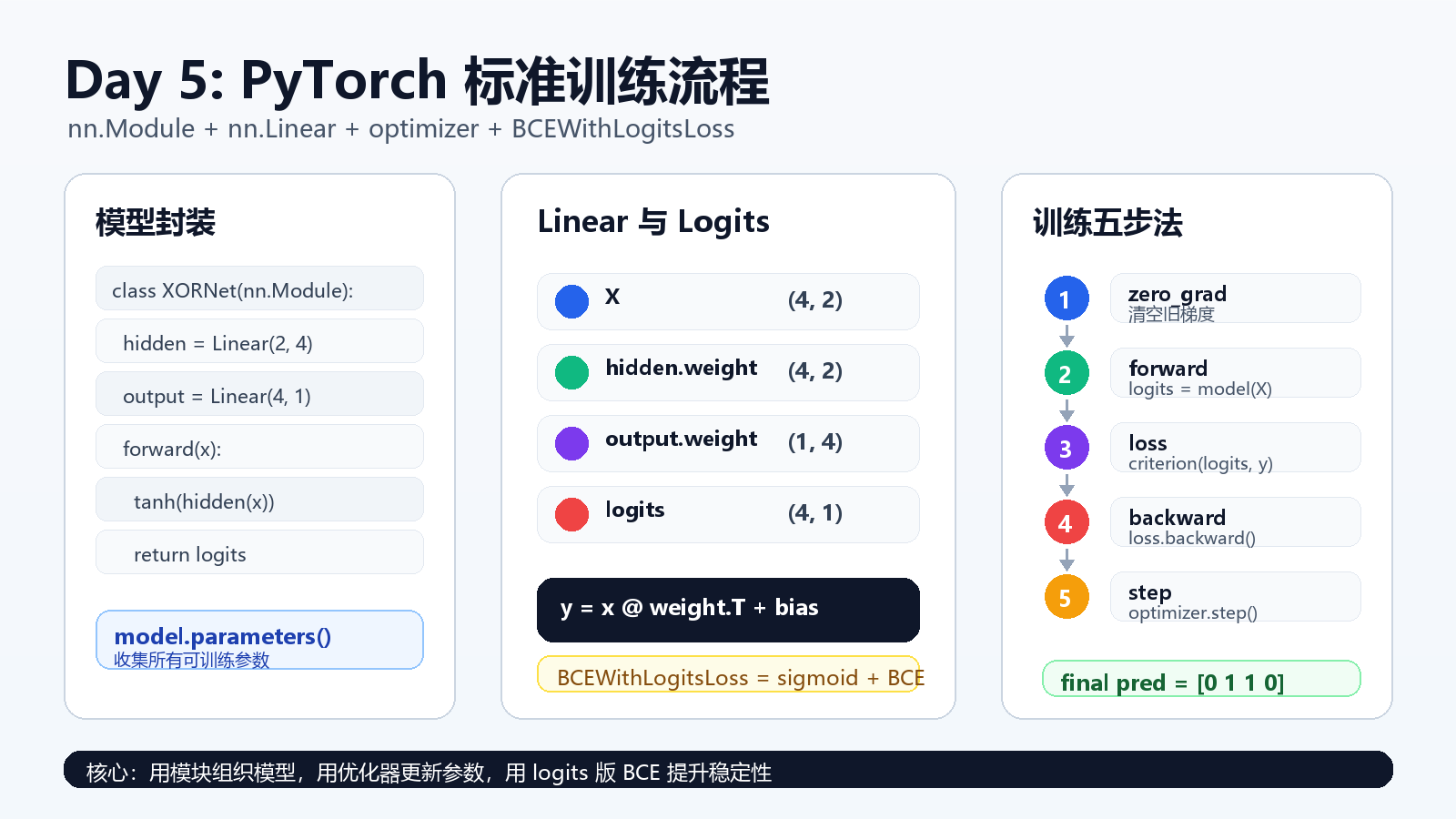
文章目录
- 一、从手动 PyTorch 到标准 PyTorch
- 二、准备 XOR 数据
- 三、用 nn.Module 封装模型
- 四、理解 nn.Linear 的参数形状
- 五、前向传播:model(X) 背后发生了什么
- 六、损失函数:为什么推荐 BCEWithLogitsLoss
- 七、优化器:用 optimizer 管理参数更新
- 八、标准训练循环五步法
- 九、完整训练代码
- 十、运行结果
- 十一、今日总结
- 十二、课后自测
一、从手动 PyTorch 到标准 PyTorch
昨天我们已经用 PyTorch 自动求导训练了 XOR,但参数还是手动管理的:
python
W1 = (torch.randn(2, 4) * 0.1).requires_grad_()
b1 = torch.zeros(1, 4, requires_grad=True)

W2 = (torch.randn(4, 1) * 0.1).requires_grad_()
b2 = torch.zeros(1, 1, requires_grad=True)
更新参数时也手动写:
python
with torch.no_grad():
    W1 -= lr * W1.grad
    b1 -= lr * b1.grad
    W2 -= lr * W2.grad
    b2 -= lr * b2.grad
这对理解自动求导非常有帮助,但在真实项目里,我们更常用 PyTorch 标准写法:
text
nn.Module       封装模型
nn.Linear       自动创建线性层参数
loss.backward() 自动计算梯度
optimizer.step() 自动更新参数
今天的目标是把 XOR 模型写成更正式的训练脚本。
二、准备 XOR 数据
先准备数据:
python
import torch
import torch.nn as nn


def build_xor_data():
    X = torch.tensor([
        [0.0, 0.0],
        [0.0, 1.0],
        [1.0, 0.0],
        [1.0, 1.0],
    ])

    y = torch.tensor([
        [0.0],
        [1.0],
        [1.0],
        [0.0],
    ])

    return X, y
XOR 的目标仍然是:
text
[0, 0] -> 0
[0, 1] -> 1
[1, 0] -> 1
[1, 1] -> 0
形状是:
text
X.shape = (4, 2)
y.shape = (4, 1)
含义:
text
4 个样本
每个样本 2 个特征
每个样本 1 个二分类标签
三、用 nn.Module 封装模型
今天不再手动写 W1, b1, W2, b2,而是定义一个模型类:
python
class XORNet(nn.Module):
    def __init__(self):
        super().__init__()
        self.hidden = nn.Linear(2, 4)
        self.output = nn.Linear(4, 1)

    def forward(self, x):
        x = torch.tanh(self.hidden(x))
        logits = self.output(x)
        return logits
逐行理解。
python
class XORNet(nn.Module):表示 XORNet 是一个 PyTorch 模型。
python
super().__init__()表示先初始化 nn.Module 这个基类。这样 PyTorch 才能正确管理模型里的参数、子模块和训练状态。
python
self.hidden = nn.Linear(2, 4)表示第一层线性层:
text
输入 2 维
输出 4 维
python
self.output = nn.Linear(4, 1)表示第二层线性层:
text
输入 4 维
输出 1 维
python
def forward(self, x):定义前向传播逻辑。
以后调用:
python
logits = model(X)PyTorch 实际会调用:
python
model.forward(X)四、理解 nn.Linear 的参数形状
实例化模型:
python
torch.manual_seed(42)

model = XORNet()
print(model)
输出:
text
XORNet(
  (hidden): Linear(in_features=2, out_features=4, bias=True)
  (output): Linear(in_features=4, out_features=1, bias=True)
)
再打印参数:
python
for name, param in model.named_parameters():
    print(name, param.shape)
输出:
text
hidden.weight torch.Size([4, 2])
hidden.bias torch.Size([4])
output.weight torch.Size([1, 4])
output.bias torch.Size([1])
这里有一个重要细节。
我们手写 NumPy/PyTorch 时,第一层参数常写成:
text
W1.shape = (2, 4)因为:
text
X @ W1 = (4, 2) @ (2, 4) = (4, 4)但 PyTorch 的 nn.Linear(2, 4) 内部保存的是:
text
weight.shape = (out_features, in_features) = (4, 2)它内部计算是:
text
y = x @ weight.T + bias所以:
text
X.shape             = (4, 2)
hidden.weight.shape = (4, 2)
hidden.weight.T     = (2, 4)

X @ hidden.weight.T = (4, 2) @ (2, 4) = (4, 4)
从用户角度看,只需要记住:
python
nn.Linear(in_features, out_features)也就是:
python
nn.Linear(2, 4)表示"输入 2 维,输出 4 维"。
五、前向传播:model(X) 背后发生了什么
做一次前向传播:
python
logits = model(X)它等价于执行:
python
x = torch.tanh(model.hidden(X))
logits = model.output(x)
注意今天的模型输出叫 logits,而不是概率。
text
logits = 模型输出的原始分数
prob = sigmoid(logits) 后得到的概率
也就是说:
python
prob = torch.sigmoid(logits)才是属于 1 类的概率。
为什么今天不在 forward() 里写 sigmoid?
因为我们要使用更稳定的损失函数:
python
nn.BCEWithLogitsLoss()它内部会自动完成:
text
sigmoid + BCE六、损失函数:为什么推荐 BCEWithLogitsLoss
昨天的写法是:
text
模型输出概率 a2
损失函数用 BCELoss
也就是:
python
x = torch.sigmoid(self.output(x))
criterion = nn.BCELoss()
今天更推荐:
text
模型输出 logits
损失函数用 BCEWithLogitsLoss
也就是:
python
logits = self.output(x)
criterion = nn.BCEWithLogitsLoss()
BCEWithLogitsLoss 可以理解成:
text
BCEWithLogitsLoss = sigmoid + BCELoss 的数值稳定合并版它的好处是:
- 不需要在模型最后手动写
sigmoid。 - 内部计算更稳定。
- 当输出分数很大或很小时,更不容易出现数值问题。
对于 XOR 这种小实验,两种写法都可以训练成功。但对于真实二分类任务,更推荐:
python
criterion = nn.BCEWithLogitsLoss()预测时再单独做:
python
prob = torch.sigmoid(logits)
pred = (prob >= 0.5).int()
七、优化器:用 optimizer 管理参数更新
昨天手动更新参数:
python
with torch.no_grad():
    W1 -= lr * W1.grad
    b1 -= lr * b1.grad
    W2 -= lr * W2.grad
    b2 -= lr * b2.grad
今天交给优化器:
python
optimizer = torch.optim.SGD(model.parameters(), lr=0.1)这里:
python
model.parameters()会把模型里所有需要训练的参数交给优化器,包括:
text
hidden.weight
hidden.bias
output.weight
output.bias
之后只要调用:
python
optimizer.step()优化器就会根据这些参数的 .grad 自动更新参数。
也就是说:
text
手动更新 W、b变成了:
text
optimizer 管理所有参数更新八、标准训练循环五步法
PyTorch 的标准训练循环可以压缩成 5 步:
python
optimizer.zero_grad()

logits = model(X)
loss = criterion(logits, y)

loss.backward()
optimizer.step()
逐行理解:
python
optimizer.zero_grad()清空上一轮梯度。因为 PyTorch 的梯度默认会累加。
python
logits = model(X)前向传播,得到模型输出。
python
loss = criterion(logits, y)计算损失。
python
loss.backward()自动反向传播,把梯度保存到各个参数的 .grad 中。
python
optimizer.step()根据梯度更新模型参数。
以后训练 CNN、RNN、Transformer,本质上还是这个骨架,只是:
text
model 更复杂
data 更大
loss 可能不同
optimizer 可能换成 Adam
九、完整训练代码
python
import torch
import torch.nn as nn


def build_xor_data():
    X = torch.tensor([
        [0.0, 0.0],
        [0.0, 1.0],
        [1.0, 0.0],
        [1.0, 1.0],
    ])

    y = torch.tensor([
        [0.0],
        [1.0],
        [1.0],
        [0.0],
    ])

    return X, y


class XORNet(nn.Module):
    def __init__(self):
        super().__init__()
        self.hidden = nn.Linear(2, 4)
        self.output = nn.Linear(4, 1)

    def forward(self, x):
        x = torch.tanh(self.hidden(x))
        logits = self.output(x)
        return logits


def print_model_info(model):
    print(model)
    print("\nparameters:")
    for name, param in model.named_parameters():
        print(f"{name:14s} {tuple(param.shape)}")


def train(model, X, y, epochs=10001, lr=0.1):
    criterion = nn.BCEWithLogitsLoss()
    optimizer = torch.optim.SGD(model.parameters(), lr=lr)

    for step in range(epochs):
        optimizer.zero_grad()

        logits = model(X)
        loss = criterion(logits, y)

        loss.backward()
        optimizer.step()

        if step % 1000 == 0:
            with torch.no_grad():
                prob = torch.sigmoid(logits)
                pred = (prob >= 0.5).int()

            print(
                f"step={step:05d}, "
                f"loss={loss.item():.6f}, "
                f"prob={prob.view(-1).numpy().round(3)}, "
                f"pred={pred.view(-1).numpy()}"
            )


def evaluate(model, X, y):
    with torch.no_grad():
        logits = model(X)
        prob = torch.sigmoid(logits)
        pred = (prob >= 0.5).int()

    print("\nfinal result:")
    print("prob:", prob.view(-1).numpy().round(4))
    print("pred:", pred.view(-1).numpy())
    print("true:", y.view(-1).int().numpy())


def main():
    torch.manual_seed(42)

    X, y = build_xor_data()
    model = XORNet()

    print("X shape:", tuple(X.shape))
    print("y shape:", tuple(y.shape))
    print_model_info(model)

    train(model, X, y)
    evaluate(model, X, y)


if __name__ == "__main__":
    main()
十、运行结果
运行后可以看到:
text
X shape: (4, 2)
y shape: (4, 1)
XORNet(
  (hidden): Linear(in_features=2, out_features=4, bias=True)
  (output): Linear(in_features=4, out_features=1, bias=True)
)

parameters:
hidden.weight  (4, 2)
hidden.bias    (4,)
output.weight  (1, 4)
output.bias    (1,)
训练过程:
text
step=00000, loss=0.759778, prob=[0.664 0.695 0.683 0.7  ], pred=[1 1 1 1]
step=01000, loss=0.051991, prob=[0.016 0.945 0.942 0.073], pred=[0 1 1 0]
step=02000, loss=0.016744, prob=[0.004 0.981 0.981 0.024], pred=[0 1 1 0]
...
step=10000, loss=0.002075, prob=[0.001 0.998 0.998 0.003], pred=[0 1 1 0]
最终结果:
text
final result:
prob: [0.0005 0.9976 0.9976 0.003 ]
pred: [0 1 1 0]
true: [0 1 1 0]
说明模型已经成功学会 XOR。
十一、今日总结
今天的核心内容可以压缩成 6 点:
nn.Module用来封装模型结构和参数。nn.Linear(in_features, out_features)自动创建线性层的权重和偏置。- PyTorch 的
Linear.weight形状是(out_features, in_features)。 model.parameters()会收集模型中所有需要训练的参数。optimizer.zero_grad() -> forward -> loss -> backward -> optimizer.step()是 PyTorch 标准训练骨架。- 二分类任务更推荐
BCEWithLogitsLoss,模型输出 logits,预测时再手动sigmoid。
最终要记住这句话:
Day4 学的是 PyTorch 如何自动求导,Day5 学的是 PyTorch 如何用标准模块组织一次完整训练。
十二、课后自测
nn.Module的作用是什么?- 为什么要在
__init__()里写super().__init__()? nn.Linear(2, 4)表示什么?- 为什么
hidden.weight.shape是(4, 2),而不是(2, 4)? model.parameters()返回的是什么?optimizer.zero_grad()为什么要放在每轮训练开始?optimizer.step()做了什么?- 为什么二分类任务推荐
BCEWithLogitsLoss? - 使用
BCEWithLogitsLoss时,模型最后一层还需要手动写sigmoid吗? - 预测时为什么还要对 logits 调用
torch.sigmoid()?