函数式编程(Functional Programming,FP)是一种把"计算"看作数学函数求值的编程范式------它不像面向对象那样关注"对象状态",而是强调用函数来描述数据的变换过程。Python 并非纯函数式语言,但它对这套思想的支持相当完善,掌握它能让你的代码更简洁、更易测试、更少 bug。下面我们一层一层把这件事讲清楚。
🧭 核心思想:函数式编程在想什么?
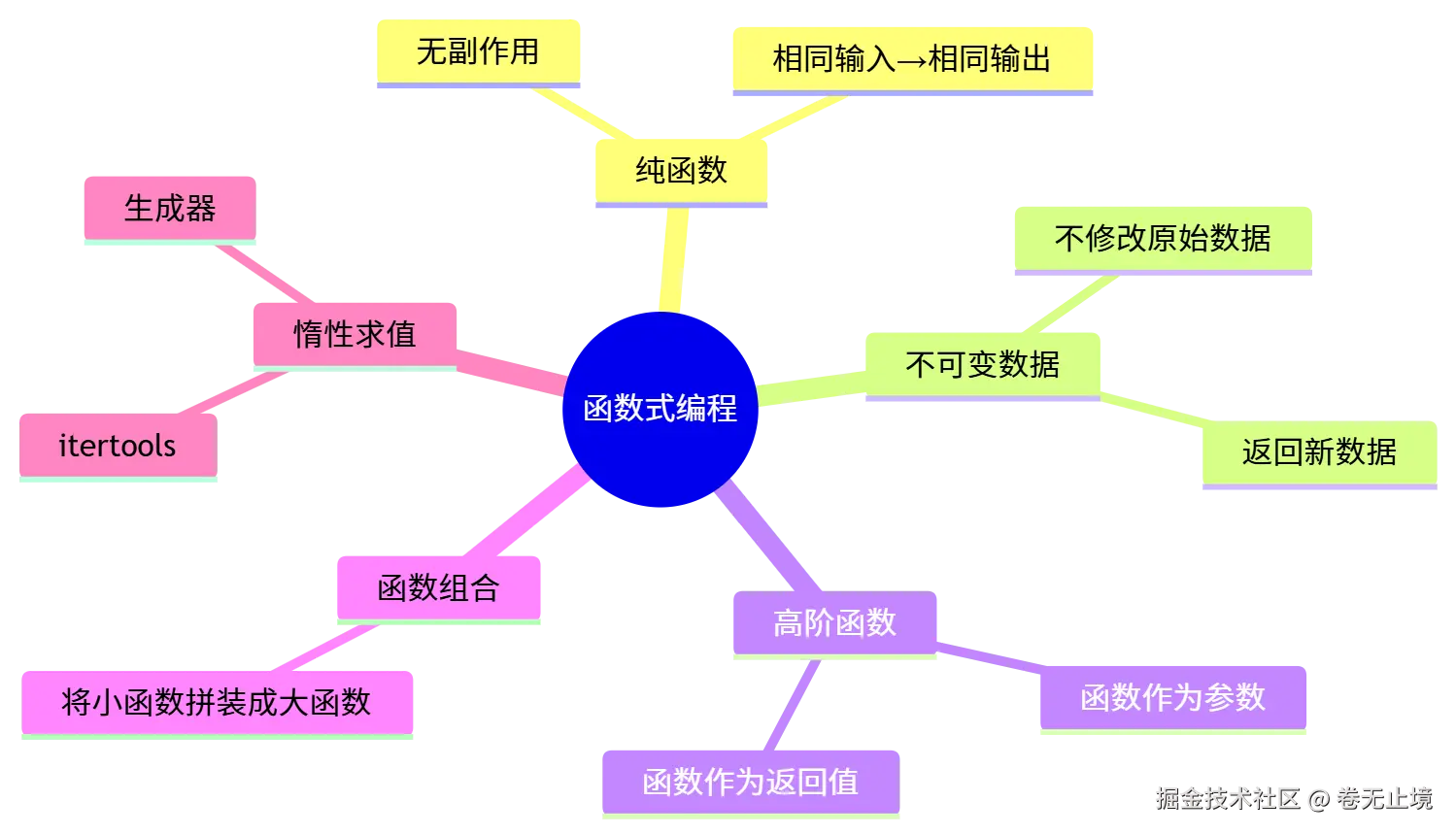
函数式编程的哲学核心只有一句话:数据流过一系列纯函数,产生结果,过程中不改变任何外部状态。 这和流水线工厂很像------每道工序只做一件事,不污染上下游。
🔬 核心概念详解
1. 纯函数(Pure Function)
纯函数有两个铁律:相同输入永远返回相同输出 ,以及不产生任何副作用(不修改全局变量、不写文件、不打印)。
python
# ❌ 非纯函数:依赖外部状态
total = 0
def add_to_total(x):
    global total
    total += x  # 修改了外部变量,有副作用
    return total

# ✅ 纯函数:只依赖输入,不改变外界
def add(x, y):
return x + y # 给定 x=1, y=2,永远返回 3纯函数的好处是极易测试------你不需要准备任何环境,直接喂输入看输出就行。
2. 不可变数据(Immutability)
函数式编程倾向于不修改原始数据,而是返回新的数据结构。
python
# ❌ 命令式风格:直接修改列表
def double_items_imperative(lst):
    for i in range(len(lst)):
        lst[i] *= 2  # 原地修改,危险!
    return lst

# ✅ 函数式风格:返回新列表,原列表不变
def double_items_functional(lst):
    return [x * 2 for x in lst]

original = [1, 2, 3]
result = double_items_functional(original)
print(original)  # [1, 2, 3]  ← 原数据安然无恙
print(result)    # [2, 4, 6]
3. Lambda 匿名函数
Lambda 是一种一行写完的轻量函数,适合在需要临时传递简单逻辑的场合。
python
# 普通函数
def square(x):
    return x ** 2

# 等价的 lambda
square = lambda x: x ** 2

# 多参数 lambda
multiply = lambda x, y: x * y
print(multiply(3, 4))  # 12

# 常见用法:作为排序 key
students = [("Alice", 85), ("Bob", 92), ("Charlie", 78)]
sorted_students = sorted(students, key=lambda s: s[1], reverse=True)
print(sorted_students)
# [('Bob', 92), ('Alice', 85), ('Charlie', 78)]
4. 高阶函数:map、filter、reduce
这三个是函数式编程的"三板斧",思路是把操作逻辑和数据分离。
python
from functools import reduce

numbers = [1, 2, 3, 4, 5, 6, 7, 8, 9, 10]

# map:对每个元素做变换,返回新序列
squares = list(map(lambda x: x ** 2, numbers))
print(squares)  # [1, 4, 9, 16, 25, 36, 49, 64, 81, 100]

# filter:筛选满足条件的元素
evens = list(filter(lambda x: x % 2 == 0, numbers))
print(evens)  # [2, 4, 6, 8, 10]

# reduce:将序列"折叠"成单个值(累积计算)
total = reduce(lambda acc, x: acc + x, numbers)
print(total)  # 55(即 1+2+...+10)

# 组合使用:先筛选偶数,再求平方,再求和
result = reduce(
    lambda acc, x: acc + x,
    map(lambda x: x ** 2, filter(lambda x: x % 2 == 0, numbers))
)
print(result)  # 220(即 4+16+36+64+100)
5. 高阶函数与闭包(Closure)
高阶函数可以接收函数作为参数,也可以返回函数。闭包是高阶函数的一种特殊形式------内层函数"记住"了外层函数的变量。
python
# 高阶函数:接收函数作为参数
def apply_twice(func, value):
    return func(func(value))

print(apply_twice(lambda x: x + 3, 10))  # 16(10+3=13,13+3=16)

# 闭包:工厂函数,返回一个"记住"了 n 的函数
def make_multiplier(n):
    def multiplier(x):
        return x * n  # 这里的 n 被"捕获"了
    return multiplier

double = make_multiplier(2)
triple = make_multiplier(3)

print(double(5))   # 10
print(triple(5))   # 15
print(double(triple(4)))  # 24(先×3得12,再×2得24)
6. 装饰器(Decorator)
装饰器本质上是包裹函数的高阶函数,用来在不修改原函数的前提下增加功能。这是函数式思想在 Python 中最优雅的体现之一。
python
import time

# 定义一个计时装饰器
def timer(func):
    def wrapper(*args, **kwargs):
        start = time.time()
        result = func(*args, **kwargs)         # 调用原函数
        end = time.time()
        print(f"{func.__name__} 耗时 {end - start:.4f} 秒")
        return result
    return wrapper

# 用 @ 语法糖应用装饰器
@timer
def slow_sum(n):
    return sum(range(n))

slow_sum(10_000_000)
# slow_sum 耗时 0.3241 秒
7. functools 与 itertools:函数式工具箱
Python 标准库为函数式编程提供了两个强力模块。
python
from functools import partial, lru_cache
from itertools import chain, takewhile, islice

# --- functools.partial:固定部分参数,生成新函数 ---
def power(base, exp):
    return base ** exp

square = partial(power, exp=2)
cube   = partial(power, exp=3)

print(square(5))  # 25
print(cube(3))    # 27

# --- functools.lru_cache:缓存纯函数结果(记忆化) ---
@lru_cache(maxsize=None)
def fibonacci(n):
    if n < 2:
        return n
    return fibonacci(n - 1) + fibonacci(n - 2)

print(fibonacci(50))  # 12586269025,瞬间完成(无缓存会极慢)

# --- itertools:惰性处理大数据 ---
# chain:拼接多个可迭代对象
combined = list(chain([1, 2, 3], [4, 5], [6]))
print(combined)  # [1, 2, 3, 4, 5, 6]

# takewhile:取满足条件的前缀元素
data = [2, 4, 6, 7, 8, 10]
result = list(takewhile(lambda x: x % 2 == 0, data))
print(result)  # [2, 4, 6](遇到 7 就停了)

# islice:惰性切片,适合超大数据流
def infinite_counter(start=0):
    while True:
        yield start
        start += 1

first_10 = list(islice(infinite_counter(), 10))
print(first_10)  # [0, 1, 2, 3, 4, 5, 6, 7, 8, 9]
8. 函数组合(Function Composition)
把多个小函数串联成一条流水线,是函数式编程最迷人的地方。
python
from functools import reduce

# 手写 compose:从右到左依次应用函数
def compose(*funcs):
    return reduce(lambda f, g: lambda x: f(g(x)), funcs)

# 定义几个小函数
strip_spaces = lambda s: s.strip()
to_upper     = lambda s: s.upper()
add_exclaim  = lambda s: s + "!!!"

# 组合成流水线
shout = compose(add_exclaim, to_upper, strip_spaces)
print(shout("  hello world  "))  # HELLO WORLD!!!
📊 核心概念速查表
| 概念 | 一句话解释 | Python 实现方式 |
|---|---|---|
| 纯函数 | 无副作用,输入决定输出 | 普通 def,避免全局变量 |
| 不可变数据 | 不修改原数据,返回新数据 | tuple、列表推导式 |
| Lambda | 一行匿名函数 | lambda x: x+1 |
| map / filter | 变换 / 筛选序列 | 内置函数 |
| reduce | 将序列折叠为单值 | functools.reduce |
| 闭包 | 函数记住外部变量 | 嵌套函数 |
| 装饰器 | 包裹函数增强功能 | @decorator 语法 |
| partial | 固定部分参数 | functools.partial |
| 记忆化 | 缓存纯函数结果 | functools.lru_cache |
| 惰性求值 | 按需计算,节省内存 | itertools、生成器 |
💡 写在最后
函数式编程不是要你抛弃 Python 的其他特性,而是给你多一把刀。纯函数让代码可预测,不可变数据减少 bug,高阶函数让逻辑复用变得优雅。 实际项目里,最好的做法是混合使用------用面向对象管理复杂状态,用函数式处理数据变换流程。MIT 的课程材料把 map/filter/reduce 称为"序列操作的三驾马车",而 Python 官方文档也专门为此写了一份 Functional Programming HOWTO,值得深读。
从今天起,每次写 for 循环处理列表时,不妨停一秒问自己:这里能不能用一个 map 或列表推导式替代?答案往往是肯定的。
参考来源:
- MIT 6.005 课程 & Python 官方 Functional Programming HOWTO --- docs.python.org/3/howto/fun...
- Medium --- Lambda, Map, Filter & Reduce in Python
- Reddit r/Python --- Functional programming concepts that actually work in Python
- adabeat.com --- Functional Programming in Python