cpp
typedef tskTCB TCB_t;
cpp
typedef struct tskTaskControlBlock 			/* The old naming convention is used to prevent breaking kernel aware debuggers. */
{
	volatile StackType_t	*pxTopOfStack;	/*< Points to the location of the last item placed on the tasks stack.  THIS MUST BE THE FIRST MEMBER OF THE TCB STRUCT. */

	#if ( portUSING_MPU_WRAPPERS == 1 )
		xMPU_SETTINGS	xMPUSettings;		/*< The MPU settings are defined as part of the port layer.  THIS MUST BE THE SECOND MEMBER OF THE TCB STRUCT. */
	#endif

	ListItem_t			xStateListItem;	/*< The list that the state list item of a task is reference from denotes the state of that task (Ready, Blocked, Suspended ). */
	ListItem_t			xEventListItem;		/*< Used to reference a task from an event list. */
	UBaseType_t			uxPriority;			/*< The priority of the task.  0 is the lowest priority. */
	StackType_t			*pxStack;			/*< Points to the start of the stack. */
	char				pcTaskName[ configMAX_TASK_NAME_LEN ];/*< Descriptive name given to the task when created.  Facilitates debugging only. */ /*lint !e971 Unqualified char types are allowed for strings and single characters only. */

	#if ( ( portSTACK_GROWTH > 0 ) || ( configRECORD_STACK_HIGH_ADDRESS == 1 ) )
		StackType_t		*pxEndOfStack;		/*< Points to the highest valid address for the stack. */
	#endif

	#if ( portCRITICAL_NESTING_IN_TCB == 1 )
		UBaseType_t		uxCriticalNesting;	/*< Holds the critical section nesting depth for ports that do not maintain their own count in the port layer. */
	#endif

	#if ( configUSE_TRACE_FACILITY == 1 )
		UBaseType_t		uxTCBNumber;		/*< Stores a number that increments each time a TCB is created.  It allows debuggers to determine when a task has been deleted and then recreated. */
		UBaseType_t		uxTaskNumber;		/*< Stores a number specifically for use by third party trace code. */
	#endif

	#if ( configUSE_MUTEXES == 1 )
		UBaseType_t		uxBasePriority;		/*< The priority last assigned to the task - used by the priority inheritance mechanism. */
		UBaseType_t		uxMutexesHeld;
	#endif

	#if ( configUSE_APPLICATION_TASK_TAG == 1 )
		TaskHookFunction_t pxTaskTag;
	#endif

	#if( configNUM_THREAD_LOCAL_STORAGE_POINTERS > 0 )
		void			*pvThreadLocalStoragePointers[ configNUM_THREAD_LOCAL_STORAGE_POINTERS ];
	#endif

	#if( configGENERATE_RUN_TIME_STATS == 1 )
		uint32_t		ulRunTimeCounter;	/*< Stores the amount of time the task has spent in the Running state. */
	#endif

	#if ( configUSE_NEWLIB_REENTRANT == 1 )
		/* Allocate a Newlib reent structure that is specific to this task.
		Note Newlib support has been included by popular demand, but is not
		used by the FreeRTOS maintainers themselves.  FreeRTOS is not
		responsible for resulting newlib operation.  User must be familiar with
		newlib and must provide system-wide implementations of the necessary
		stubs. Be warned that (at the time of writing) the current newlib design
		implements a system-wide malloc() that must be provided with locks.

		See the third party link http://www.nadler.com/embedded/newlibAndFreeRTOS.html
		for additional information. */
		struct	_reent xNewLib_reent;
	#endif

	#if( configUSE_TASK_NOTIFICATIONS == 1 )
		volatile uint32_t ulNotifiedValue;
		volatile uint8_t ucNotifyState;
	#endif

	/* See the comments in FreeRTOS.h with the definition of
	tskSTATIC_AND_DYNAMIC_ALLOCATION_POSSIBLE. */
	#if( tskSTATIC_AND_DYNAMIC_ALLOCATION_POSSIBLE != 0 ) /*lint !e731 !e9029 Macro has been consolidated for readability reasons. */
		uint8_t	ucStaticallyAllocated; 		/*< Set to pdTRUE if the task is a statically allocated to ensure no attempt is made to free the memory. */
	#endif

	#if( INCLUDE_xTaskAbortDelay == 1 )
		uint8_t ucDelayAborted;
	#endif

	#if( configUSE_POSIX_ERRNO == 1 )
		int iTaskErrno;
	#endif

} tskTCB;
动态创建任务函数xTaskCreate()
cpp
	BaseType_t xTaskCreate(	TaskFunction_t pxTaskCode,
							const char * const pcName,		/*lint !e971 Unqualified char types are allowed for strings and single characters only. */
							const configSTACK_DEPTH_TYPE usStackDepth,
							void * const pvParameters,
							UBaseType_t uxPriority,
							TaskHandle_t * const pxCreatedTask )
	{
	TCB_t *pxNewTCB;
	BaseType_t xReturn;

		/* If the stack grows down then allocate the stack then the TCB so the stack
		does not grow into the TCB.  Likewise if the stack grows up then allocate
		the TCB then the stack. */
		#if( portSTACK_GROWTH > 0 )/*栈地址向上增长*/
		{
			/* Allocate space for the TCB.  Where the memory comes from depends on
			the implementation of the port malloc function and whether or not static
			allocation is being used. */
			pxNewTCB = ( TCB_t * ) pvPortMalloc( sizeof( TCB_t ) );

			if( pxNewTCB != NULL )
			{
				/* Allocate space for the stack used by the task being created.
				The base of the stack memory stored in the TCB so the task can
				be deleted later if required. */
				pxNewTCB->pxStack = ( StackType_t * ) pvPortMalloc( ( ( ( size_t ) usStackDepth ) * sizeof( StackType_t ) ) ); /*lint !e961 MISRA exception as the casts are only redundant for some ports. */

				if( pxNewTCB->pxStack == NULL )
				{
					/* Could not allocate the stack.  Delete the allocated TCB. */
					vPortFree( pxNewTCB );
					pxNewTCB = NULL;
				}
			}
		}
		#else /* portSTACK_GROWTH *//*栈地址向下增长*/
		{
		StackType_t *pxStack;

			/* Allocate space for the stack used by the task being created. */
			pxStack = pvPortMalloc( ( ( ( size_t ) usStackDepth ) * sizeof( StackType_t ) ) ); /*lint !e9079 All values returned by pvPortMalloc() have at least the alignment required by the MCU's stack and this allocation is the stack. */

			if( pxStack != NULL )
			{
				/* Allocate space for the TCB. */
				pxNewTCB = ( TCB_t * ) pvPortMalloc( sizeof( TCB_t ) ); /*lint !e9087 !e9079 All values returned by pvPortMalloc() have at least the alignment required by the MCU's stack, and the first member of TCB_t is always a pointer to the task's stack. */

				if( pxNewTCB != NULL )
				{
					/* Store the stack location in the TCB. */
					pxNewTCB->pxStack = pxStack;
				}
				else
				{
					/* The stack cannot be used as the TCB was not created.  Free
					it again. */
                    /*要么都成功,要么都释放,内存归还给heap_4堆,防止内存泄漏*/
					vPortFree( pxStack );
				}
			}
			else
			{
				pxNewTCB = NULL;
			}
		}
		#endif /* portSTACK_GROWTH */

		if( pxNewTCB != NULL )
		{
			#if( tskSTATIC_AND_DYNAMIC_ALLOCATION_POSSIBLE != 0 ) /*lint !e9029 !e731 Macro has been consolidated for readability reasons. */
			{
				/* Tasks can be created statically or dynamically, so note this
				task was created dynamically in case it is later deleted. */
				pxNewTCB->ucStaticallyAllocated = tskDYNAMICALLY_ALLOCATED_STACK_AND_TCB;
			}
			#endif /* tskSTATIC_AND_DYNAMIC_ALLOCATION_POSSIBLE */

			prvInitialiseNewTask( pxTaskCode, pcName, ( uint32_t ) usStackDepth, pvParameters, uxPriority, pxCreatedTask, pxNewTCB, NULL );
			prvAddNewTaskToReadyList( pxNewTCB );
			xReturn = pdPASS;//任务创建函数返回成功
		}
		else
		{
			xReturn = errCOULD_NOT_ALLOCATE_REQUIRED_MEMORY;
		}

		return xReturn;
	}
portSTACK_GROWTH是什么意思?
芯片堆栈生长方向,STACK_GROWTH<0代表向下增长,适用于几乎所有主流MCU;
pvPortMalloc申请内存来自于哪里?
来自于RAM上面的堆空间;
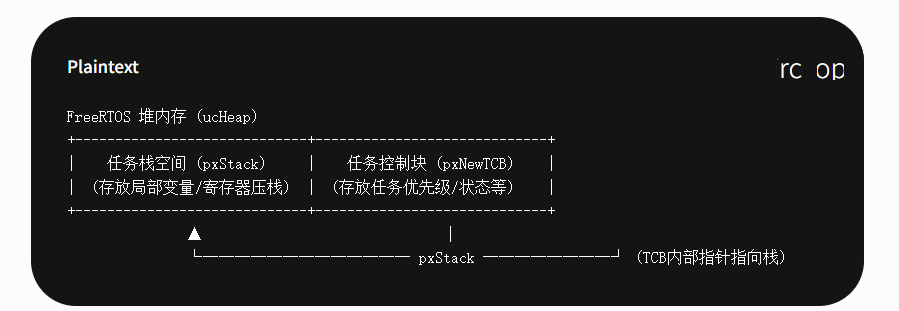
pxStack = pvPortMalloc和pxNewTCB = ( TCB_t * ) pvPortMalloc申请的堆空间关系:
根据heap_4.c,两次分配会在堆上申请两个独立内存空间,相连但互不重叠;
pxStack指向任务空间首地址,pxNewTCB指向任务控制块首地址;