cpp
//Serial.c
#include "stm32f10x.h"                  // Device header
#include "stdio.h"
#include "stdarg.h"

uint8_t Serial_RxPacket[4];
uint8_t Serial_TxPacket[4];
uint8_t Serial_Rxflag;

void Serial_Init(void)
{
	RCC_APB2PeriphClockCmd(RCC_APB2Periph_GPIOA,ENABLE);
	RCC_APB2PeriphClockCmd(RCC_APB2Periph_USART1,ENABLE);

	GPIO_InitTypeDef GPIO_InitStructure;
 	GPIO_InitStructure.GPIO_Mode = GPIO_Mode_AF_PP;
	GPIO_InitStructure.GPIO_Speed = GPIO_Speed_50MHz;
	GPIO_InitStructure.GPIO_Pin = GPIO_Pin_9;
 	GPIO_Init(GPIOA, &GPIO_InitStructure);

	GPIO_InitStructure.GPIO_Mode = GPIO_Mode_IPU;
	GPIO_InitStructure.GPIO_Speed = GPIO_Speed_50MHz;
	GPIO_InitStructure.GPIO_Pin = GPIO_Pin_10;
 	GPIO_Init(GPIOA, &GPIO_InitStructure);

	USART_InitTypeDef USART_InitStructure;
	USART_InitStructure.USART_BaudRate=9600;
	USART_InitStructure.USART_HardwareFlowControl=USART_HardwareFlowControl_None;
	USART_InitStructure.USART_Mode=USART_Mode_Tx|USART_Mode_Rx;
	USART_InitStructure.USART_Parity=USART_Parity_No;
	USART_InitStructure.USART_StopBits=USART_StopBits_1;
	USART_InitStructure.USART_WordLength=USART_WordLength_8b;
	USART_Init(USART1,&USART_InitStructure);

	USART_ITConfig(USART1,USART_IT_RXNE,ENABLE);
	NVIC_PriorityGroupConfig(NVIC_PriorityGroup_2);

	NVIC_InitTypeDef NVIC_InitStructure;
	NVIC_InitStructure.NVIC_IRQChannel=USART1_IRQn;
	NVIC_InitStructure.NVIC_IRQChannelCmd=ENABLE;
	NVIC_InitStructure.NVIC_IRQChannelPreemptionPriority=1;
	NVIC_InitStructure.NVIC_IRQChannelSubPriority=1;
	NVIC_Init(&NVIC_InitStructure);


	USART_Cmd(USART1,ENABLE);


}

void Serial_SendByte(uint8_t Byte)
{
	USART_SendData(USART1,Byte);
	while(USART_GetFlagStatus(USART1,USART_FLAG_TXE)==RESET);//Transmit Data Register Empty",即发送数据寄存器空标志
}

void Serial_SendArray(uint8_t *Array,uint16_t Length)
{
	uint16_t i;
	for(i=0;i<Length;i++)
	{
		Serial_SendByte(Array[i]);
	}

}

void Serial_SendString(char *String)
{
	uint8_t i;
	for(i= 0;String[i]!='\0';i++)
	{
		Serial_SendByte(String[i]);
	}
}

uint32_t Serial_Pow(uint32_t X,uint32_t Y)
{
	uint32_t Result=1;
	while(Y--)
	{
		Result*=X;
	}
	return Result;
}

void Serial_SendNumber(uint32_t Number,uint8_t Length)
{
	uint8_t i;
	for(i=0;i<Length;i++)
	{
		Serial_SendByte(Number/Serial_Pow(10,Length-i-1)%10+'0');//
	}
}

int fputc(int ch,FILE *f)
{
	Serial_SendByte(ch);
	return ch;
}

void Serial_Printf(char *format,...)
{
	char String[100];
	va_list  arg;
	va_start(arg,format);
	vsprintf(String,format,arg);
	va_end(arg);
	Serial_SendString(String);

}

void Serial_SendPacket(void)
{
	Serial_SendByte(0XFF);
	Serial_SendArray(Serial_TxPacket,4);
	Serial_SendByte(0XFE);
}

uint8_t Serial_GetFlag(void)
{
	if(Serial_Rxflag==1)
	{
		Serial_Rxflag=0;
		return 1;
	}
	return 0;
}


void USART1_IRQHandler(void)
{
	static uint8_t RxState =0;
	static uint8_t pRxPacket=0;
	if(USART_GetFlagStatus(USART1,USART_FLAG_RXNE)==SET)
	{
		uint8_t RxData=USART_ReceiveData(USART1);
		if (RxState==0)
		{
			if(RxData==0xFF)
			{
				RxState=1;
				pRxPacket=0;
			}
		}
		else if (RxState==1)
		{
			Serial_RxPacket[pRxPacket]=RxData;
			pRxPacket++;
			if(pRxPacket>=4)
			{
			RxState=2;
			}
		}
		else if (RxState==2)
		{
			if(RxData==0xFE)
			{
				RxState=0;
				Serial_Rxflag=1;
			}
		}


		USART_ClearITPendingBit(USART1,USART_IT_RXNE);

	}
}
cpp
//main.c
#include "stm32f10x.h"                  // Device header
#include "Delay.h"
#include "OLED.h"
#include "Serial.h"
#include "key.h"

uint8_t KeyNum;
int main(void)
{
	Key_Init();
	OLED_Init();
	Serial_Init();

	OLED_ShowString(1,1,"TxPacket");
	OLED_ShowString(3,1,"RxPacket");

	Serial_TxPacket[0]=0X01;
	Serial_TxPacket[1]=0X02;
	Serial_TxPacket[2]=0X03;
	Serial_TxPacket[3]=0X04;


	while(1)
	{
		KeyNum=Key_GetNum();

		if(KeyNum==1)
		{
			Serial_TxPacket[0]++;
			Serial_TxPacket[1]++;
			Serial_TxPacket[2]++;
			Serial_TxPacket[3]++;

			Serial_SendPacket();
			OLED_ShowHexNum(2,1,Serial_TxPacket[0],2);
			OLED_ShowHexNum(2,4,Serial_TxPacket[1],2);
			OLED_ShowHexNum(2,7,Serial_TxPacket[2],2);
			OLED_ShowHexNum(2,10,Serial_TxPacket[3],2);

		}

		if(Serial_GetFlag()==1)
		{
			OLED_ShowHexNum(4,1,Serial_RxPacket[0],2);
			OLED_ShowHexNum(4,4,Serial_RxPacket[1],2);
			OLED_ShowHexNum(4,7,Serial_RxPacket[2],2);
			OLED_ShowHexNum(4,10,Serial_RxPacket[3],2);

		}


	}


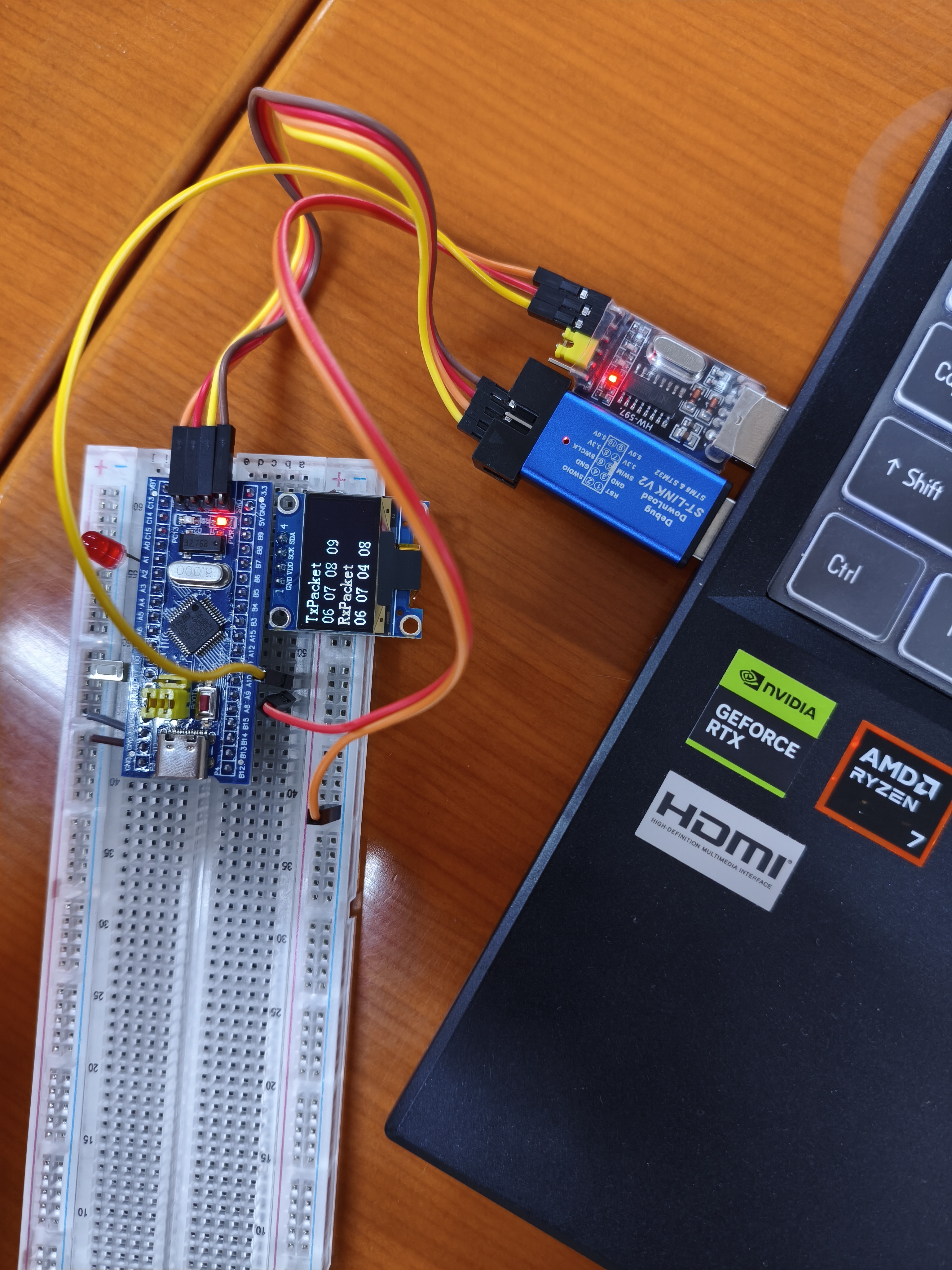
}
1.本程序实现了多字节数据发送和接收,在接收时采用三状态的状态机转换实现连贯的多字节接收
2.void Serial_SendPacket(void)
{
Serial_SendByte(0XFF);
Serial_SendArray(Serial_TxPacket,4);
Serial_SendByte(0XFE);
}
在发送时通过帧头0XFF和帧尾0XFE把数据包裹起来发送。
void USART1_IRQHandler(void)
{
static uint8_t RxState =0;
static uint8_t pRxPacket=0;
if(USART_GetFlagStatus(USART1,USART_FLAG_RXNE)==SET)
{
uint8_t RxData=USART_ReceiveData(USART1);
if (RxState==0)
{
if(RxData==0xFF)
{
RxState=1;
pRxPacket=0;
}
}
else if (RxState==1)
{
Serial_RxPacketpRxPacket=RxData;
pRxPacket++;
if(pRxPacket>=4)
{
RxState=2;
}
}
else if (RxState==2)
{
if(RxData==0xFE)
{
RxState=0;
Serial_Rxflag=1;
}
}
USART_ClearITPendingBit(USART1,USART_IT_RXNE);
}
}
接收时通过中断响应接收,一个字节触发一次中断
RxState:状态机的状态,有0,1,2
0状态:等待帧头,
1状态:接收数据
2状态:等待帧尾
pRxPacket:计数器,状态1时计数,到4之后转到状态2.
RXNE:(R eceive X Data Register N ot E mpty),接收数据寄存器非空
整个中断程序我完整的讲一遍:
第一步,从电脑端的串口发送数据,发送到USART串口,进入STM32
第二步,当发现STM32的USART-DR数据寄存器有数之后,就进入状态机,把接收到的数据给RxData,
注意 :一次中断只能传一个字节的数,比如你发送FF 01 02 03 04 FE,那么一次中断就只能处理一个FF,下一次处理01,以此类推。
第三步:由于初始设置 static uint8_t RxState =0;,所以会进入状态0,开始等待FF,如果FF一直不来,程序就会卡住在这,比如你发送01 02 07 FF,FF之前的数都不会被发送。
第四步:遇到FF之后进入状态1,开始把后面发送的数存到 Serial_RxPacket数组,注意一次中断只能处理一个字节的数,每来一个新的字节又会触发新中断,而不是一次中断处理了4个字节。
第五步:4个字节的数装完之后进入状态2,等待FE,如果FE没来,后面发送的数据也不会被接收,FE来了之后 ,回到状态0,并且Serial_Rxflag置1,意思是已经收到完整数据包,快来处理我吧。
- USART_ClearITPendingBit(USART1,USART_IT_RXNE);
手动清除中断挂起标志位,这里不写这行也行,因为USART_ReceiveData(USART1)会自动清除中断挂起标志位,这里写是给提个醒。