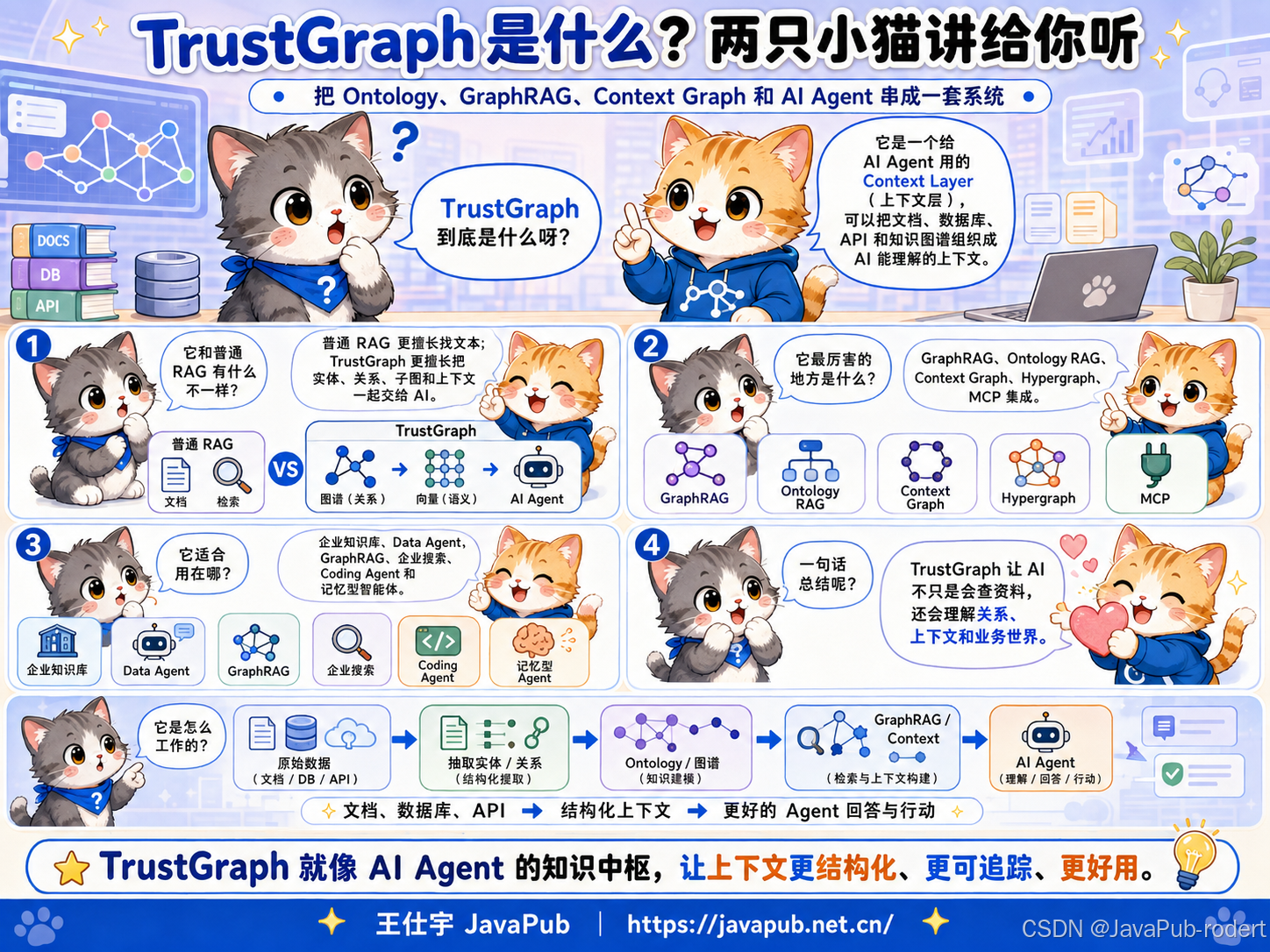
如果说普通 RAG 是"帮 AI 找资料",那么 TrustGraph 更想做的事情是:给 AI Agent 建立一层统一、结构化、可追踪的上下文。
项目名称:
text
TrustGraphGitHub:
text
https://github.com/trustgraph-ai/trustgraph官网:
text
https://trustgraph.ai/一、TrustGraph 是什么?
TrustGraph 是一个开源的 AI Context / Knowledge Graph 基础设施项目。
它现在给自己的定位是:
The Context Interoperability Layer for Agentic AI
翻译一下:
面向 Agentic AI 的上下文互操作层。
这个名字看起来有点抽象。
我们先用最简单的方式理解。
传统 AI 应用:
text
用户
 ↓
LLM
 ↓
回答
后来有了 RAG:
text
用户
 ↓
Vector Search
 ↓
Documents
 ↓
LLM
 ↓
回答
再后来有了 GraphRAG:
text
用户
 ↓
Vector Search
 ↓
Knowledge Graph
 ↓
Graph Traversal
 ↓
LLM
 ↓
回答
而 TrustGraph 想进一步做成:
text
                     AI Agent
                         |
                         ↓
                 Context Layer
                         |
        ┌────────────────────────┐
        |                        |
        ↓                        ↓
   Knowledge Graph           Vector Search
        |                        |
        └───────────┬────────────┘
                    ↓
                Ontology
                    ↓
      ┌─────────────┼─────────────┐
      ↓             ↓             ↓
   Documents      Database       APIs
也就是说:
把企业里的各种数据统一整理成 AI 能理解的 Context。
二、为什么普通 RAG 不够?
先看普通 RAG。
假设公司里有 10 万份文档:
text
合同

产品文档

会议纪要

用户反馈

财务报告

技术文档
传统方法:
text
Document
 ↓
Chunk
 ↓
Embedding
 ↓
Vector Database
用户问:
text
A 客户现在使用哪个产品?系统:
text
问题
 ↓
Embedding
 ↓
Vector Search
 ↓
找到几个 Chunk
 ↓
LLM
这种方式最大的优点:
简单。
但是问题也很多。
三、第一个问题:Chunk 之间没有关系
例如:
文档 A:
text
阿里巴巴购买了产品 X。文档 B:
text
产品 X 使用 PostgreSQL。文档 C:
text
PostgreSQL 数据库部署在服务器 Server-01。用户问:
text
阿里巴巴使用的数据库部署在哪台服务器?这个问题需要:
text
Alibaba

↓

Product X

↓

PostgreSQL

↓

Server-01
至少三跳关系。
普通 Vector RAG 很可能只找到:
text
Alibaba → Product X或者:
text
PostgreSQL → Server-01但是它不一定知道:
这三件事情其实属于同一条关系链。
四、Knowledge Graph 就开始发挥作用了
如果把这些知识变成图:
text
Alibaba
   |
   | purchased
   ↓
Product X
   |
   | uses
   ↓
PostgreSQL
   |
   | deployedOn
   ↓
Server-01
现在问题:
text
Alibaba 使用的数据库在哪台服务器?就可以沿着图:
text
Alibaba
 ↓
Product
 ↓
Database
 ↓
Server
一路查询。
这就是:
Multi-Hop Reasoning。
也就是:
多跳推理。
五、TrustGraph 的 GraphRAG
TrustGraph 一个很重要的能力就是:
text
GraphRAG它并不是完全放弃 Vector Search。
而是把:
text
Vector Search

+

Knowledge Graph
组合起来。
整个流程大概是:
text
Document

↓

Chunking

↓

Entity Extraction

↓

Relationship Extraction

↓

Embedding

↓

Knowledge Graph
查询:
text
Question

↓

Vector Search

↓

找到相关 Entity

↓

Graph Traversal

↓

找到相关子图

↓

Subgraph Context

↓

LLM

↓

Answer
这比:
text
问题

↓

找几个 Chunk
多了一层:
关系理解。
六、举一个更具体的例子
假设有三份文档。
第一份:
text
王仕宇创建了 JavaPub。第二份:
text
JavaPub 主要发布 AI 和编程相关内容。第三份:
text
AI 编程课程属于 JavaPub 的内容体系。普通 RAG:
text
Document 1

Document 2

Document 3
三个 Chunk。
TrustGraph:
text
王仕宇
   |
   | created
   ↓
JavaPub
   |
   | publishes
   ↓
AI / 编程内容
   |
   | includes
   ↓
AI 编程课程
于是用户问:
text
王仕宇创建的品牌主要有哪些 AI 内容?GraphRAG 可以沿着关系找到答案。
这就是:
text
Graph + RAG七、TrustGraph 还有一个更重要的能力:Ontology RAG
如果只是自动抽取知识图谱,会出现一个问题:
LLM 想抽什么就抽什么。
例如:
text
Apple到底是什么?
可能是:
text
Company

Fruit

Product Brand
再例如:
text
Java可能是:
text
ProgrammingLanguage

Island

Coffee
如果没有统一 Schema:
不同文档可能抽出完全不同的结构。
八、Ontology 解决什么问题?
Ontology 解决的是:
世界里有什么,以及这些东西之间可以有什么关系。
例如企业系统:
text
Customer

Product

Order

Employee

Company
定义关系:
text
Customer
   |
   | purchases
   ↓
Product
再定义:
text
Employee
   |
   | worksFor
   ↓
Company
于是:
text
Customer不能随便:
text
worksFor Product因为这不符合 Ontology。
九、TrustGraph 支持 Ontology RAG
TrustGraph 可以使用 OWL Ontology 指导知识抽取。
流程:
text
Document

↓

Chunk

↓

Ontology

↓

LLM Extraction

↓

Typed Entity

↓

Typed Relationship

↓

Knowledge Graph

↓

GraphRAG
这比普通 GraphRAG 多了一步:
text
Ontology Constraint什么意思?
普通 GraphRAG:
text
LLM:

我觉得这是一个实体。
Ontology RAG:
text
Ontology:

允许的实体类型:

Customer

Order

Product

Supplier
LLM:
text
那我按照这些类型抽。十、举一个电商 Ontology
比如我们定义:
text
Customer

Order

Product

Supplier

Payment
关系:
text
Customer
   |
   | places
   ↓
Order

Order
   |
   | contains
   ↓
Product

Product
   |
   | suppliedBy
   ↓
Supplier

Order
   |
   | paidBy
   ↓
Payment
现在给 AI 一份文档:
text
王先生在 8 月 10 日购买了 MacBook,
订单由 Apple Store 提供,
使用支付宝完成付款。
TrustGraph 可以按照 Ontology 抽取:
text
Customer:
王先生

Product:
MacBook

Supplier:
Apple Store

Payment:
支付宝
建立:
text
王先生
 ↓ places
Order-001
 ↓ contains
MacBook
 ↓ suppliedBy
Apple Store
以及:
text
Order-001
 ↓ paidBy
支付宝
这就变成了一套真正可查询的业务知识。
十一、Ontology RAG 和普通 GraphRAG 有什么区别?
可以直接看:
| 能力 | RAG | GraphRAG | Ontology RAG |
|---|---|---|---|
| Vector Search | ✅ | ✅ | ✅ |
| Knowledge Graph | ❌ | ✅ | ✅ |
| Relationship | ❌ | ✅ | ✅ |
| Multi-Hop | 弱 | 强 | 强 |
| Schema | ❌ | ❌ | ✅ |
| 类型约束 | ❌ | ❌ | ✅ |
| OWL | ❌ | ❌ | ✅ |
可以简单理解:
text
RAG

↓

找内容
GraphRAG:
text
找内容

+

找关系
Ontology RAG:
text
找内容

+

找关系

+

理解关系的业务含义
十二、为什么 Ontology 对企业 Agent 特别重要?
假设一个企业数据库里面有:
text
客户

合同

订单

员工

供应商

项目

资产
如果没有统一语义:
CRM 叫:
text
customerERP 叫:
text
client财务系统可能叫:
text
payer实际上:
可能都是:
text
CustomerOntology 可以把:
text
customer

client

payer
统一到:
text
Customer这就是:
Semantic Layer。
十三、TrustGraph 想做的,其实就是 Context Layer
这个概念很重要。
现在 AI 领域越来越多人讨论:
text
Context Engineering以前我们关心:
text
Prompt Engineering也就是:
Prompt 怎么写?
现在越来越多系统开始关心:
到底应该给模型什么 Context?
因为模型本身已经越来越强。
真正影响 AI 输出的往往变成:
text
Context例如:
text
哪些文档?

哪些实体?

哪些关系?

哪些历史?

哪些权限?

哪些业务规则?
TrustGraph 就想解决这件事情。
十四、Context Graph
TrustGraph 现在非常强调:
text
Context Graph可以简单理解:
为 AI Agent 服务的知识图谱。
传统知识图谱更多是:
text
存知识Context Graph 更强调:
text
给 Agent 提供正确上下文例如:
text
                  Agent

                    ↓

               Context Graph

         ┌──────────┼──────────┐

         ↓          ↓          ↓

       User       Order     Contract

         ↓          ↓          ↓

       Role      Product     Policy
Agent 不需要一次读取:
text
100 万条数据而是从图中选择:
text
当前问题真正需要的 Context十五、TrustGraph 为什么开始强调 Hypergraph?
TrustGraph 现在还在强调一个概念:
text
Hypergraph传统 Knowledge Graph 通常:
text
A → B也就是二元关系。
例如:
text
User

↓

purchased

↓

Product
但是企业业务往往更加复杂。
比如:
text
张三

在 2026 年 8 月 1 日

通过支付宝

以 9999 元

购买 MacBook

订单属于 JavaPub 公司
这其实涉及:
text
Person

Time

Payment

Amount

Product

Company
很多实体。
如果只用:
text
A → B表达起来会越来越复杂。
十六、Hypergraph 是什么?
Hypergraph 可以理解成:
一条关系可以连接多个对象。
传统 Graph:
text
A ─── BHypergraph:
text
          A

          |

    ┌─────┼─────┐

    ↓     ↓     ↓

    B     C     D
比如一次采购事件:
text
              Purchase Event

       ┌────────┼─────────┬────────┐

       ↓        ↓         ↓        ↓

     User    Product    Payment   Time
整个:
text
Purchase Event可以作为一个完整 Context。
这对 AI Agent 很有价值。
十七、TrustGraph 的数据处理流程
我们可以把整个流程简化为:
text
         Raw Data

            |

   ┌────────┼─────────┐

   ↓        ↓         ↓

 PDF      Wiki      Database

   \        |         /

        Ingestion

            ↓

         Chunking

            ↓

           LLM

            ↓

Entity / Relationship Extraction

            ↓

      Ontology Mapping

            ↓

      Knowledge Graph

            ↓

       Vector Index

            ↓

          GraphRAG

            ↓

         AI Agent
十八、TrustGraph 可以处理哪些数据?
典型包括:
text
PDF

Text

企业文档

Wiki

API 数据

数据库数据

结构化信息
系统会把这些原始信息:
text
Unstructured Data逐渐转换成:
text
AI-Ready Context这其实就是 TrustGraph 的核心价值之一。
十九、TrustGraph 中的 Collection
TrustGraph 可以通过 Collection 组织知识。
例如:
text
AI Research

Customer Support

Finance

Product Docs
分别建立:
text
Collection例如:
bash
tg-set-collection \
  -n "AI Research" \
  -d "AI 研究资料" \
  ai-research
这样不同业务领域的数据可以分开管理。
二十、添加文档
可以将文档加入 Library。
例如:
bash
tg-add-library-document \
  --name "AI Research Report" \
  --description "AI research report" \
  --tags "ai,research" \
  --id ai-report-001 \
  --kind text/plain \
  ./report.txt
进入系统之后:
text
Document

↓

Library

↓

Processing Flow

↓

Knowledge Graph
二十一、创建 GraphRAG Flow
TrustGraph 使用 Flow 来组织数据处理 Pipeline。
例如:
bash
tg-start-flow \
  -n graph-rag \
  -i graph-rag \
  -d "Graph RAG processing flow"
这个 Flow 可以负责:
text
Document Chunking

↓

Entity Extraction

↓

Relationship Extraction

↓

Embedding

↓

Graph Construction
二十二、开始处理文档
例如:
bash
tg-start-library-processing \
  --flow-id graph-rag \
  --document-id ai-report-001 \
  --collection ai-research \
  --processing-id process-001
然后系统开始:
text
文档

↓

Chunk

↓

LLM 抽取

↓

Graph

↓

Vector
二十三、查询 GraphRAG
处理完成之后,可以直接查询:
bash
tg-invoke-graph-rag \
  -f graph-rag \
  -C ai-research \
  -q "2026 年 AI Agent 主要发展方向是什么?"
查询过程:
text
Question

↓

Semantic Search

↓

找到相关实体

↓

Graph Traversal

↓

提取 Subgraph

↓

LLM

↓

Answer
二十四、什么是 Subgraph Context?
这个概念很重要。
普通 RAG 给 LLM:
text
Chunk 1

Chunk 2

Chunk 3
GraphRAG 给 LLM:
text
            OpenAI

           /      \

          ↓        ↓

       Model      Agent

        |           |

        ↓           ↓

      GPT-X       Tool Use
也就是说:
不是几个孤立文本。
而是一张:
text
小型关系网络这就是:
text
Subgraph Context二十五、TrustGraph + MCP
TrustGraph 还有一个很有意思的能力:
text
MCP项目仓库里面已经包含:
text
trustgraph-mcp也就是说:
未来:
text
Claude Code

Cursor

Codex

AI Agent
理论上都可以通过 MCP 调用 TrustGraph 提供的知识能力。
架构:
text
Claude / Codex

       |

       ↓

      MCP

       |

       ↓

  TrustGraph

       |

       ↓

Context Graph
二十六、为什么 MCP + Knowledge Graph 很有意思?
普通 MCP:
text
Agent

↓

Tool

↓

API
比如:
text
查询数据库

发邮件

查天气
但是 TrustGraph:
text
Agent

↓

MCP

↓

Context Graph

↓

企业知识
这就相当于:
给 Agent 增加一个"理解企业"的工具。
例如 Coding Agent 可以问:
text
这个项目为什么当初选择 PostgreSQL?Graph 里面可能有:
text
Project

↓

Architecture Decision

↓

PostgreSQL

↓

Reason

↓

JSONB + Transaction
于是 Agent 不只是:
text
看代码还可以:
text
理解项目历史。二十七、TrustGraph 和 Graphiti 有什么区别?
前面我们介绍过 Graphiti。
两者确实有一些重叠。
但是侧重点不同。
Graphiti 更强调:
text
Temporal Knowledge Graph

Agent Memory

Fact History
也就是:
世界发生了哪些变化?
TrustGraph 更强调:
text
Context Graph

Ontology

GraphRAG

Enterprise Context
也就是:
AI Agent 应该如何理解整个企业上下文?
简单来说:
text
Graphiti

↓

Memory
TrustGraph:
text
Context二十八、TrustGraph 和 Ontop 有什么区别?
Ontop:
text
Database

↓

Ontology

↓

Virtual Knowledge Graph
它重点解决:
如何让关系数据库变成虚拟知识图谱。
TrustGraph:
text
Documents

Database

APIs

↓

Knowledge Extraction

↓

Context Graph
重点解决:
如何把各种企业数据变成 Agent Context。
所以三者可以这样理解:
text
Ontop

企业结构化数据
     ↓

TrustGraph

企业上下文
     ↓

Graphiti

长期动态记忆
二十九、这三个项目甚至可以组合
可以设想:
text
              AI Agent

                  |

                  ↓

             TrustGraph

                  |

        Context / Ontology

        /               \

       ↓                 ↓

   Graphiti             Ontop

       ↓                 ↓

 Agent Memory      Enterprise DB

       ↓                 ↓

Temporal Graph     MySQL / Oracle
这是一个非常有意思的企业 Agent 架构。
其中:
text
Ontop负责:
当前业务数据。
text
Graphiti负责:
历史变化和长期记忆。
text
TrustGraph负责:
给 Agent 组织统一 Context。
三十、TrustGraph 最大的价值是什么?
我觉得不是:
text
又一个 GraphRAG 框架真正值得关注的是它背后的思想:
AI Agent 需要的不是更多 Token,而是更好的 Context。
以前我们想:
text
上下文 128K

↓

上下文 1M

↓

上下文 10M
似乎:
上下文越大越好。
但是企业 AI 真正的问题可能不是:
text
Context 不够长而是:
text
Context 不够准确。真正需要的是:
text
正确的数据

正确的实体

正确的关系

正确的时间

正确的权限

正确的业务语义
这才是:
text
Context Engineering三十一、Ontology 在这里扮演什么角色?
Ontology 相当于:
Agent 的世界说明书。
例如:
text
Customer

Product

Order

Supplier
这是:
text
概念。然后:
text
Customer purchases Product这是:
text
关系。再进一步:
text
Customer

必须是 Person / Organization
这是:
text
约束。因此:
text
Ontology

↓

定义世界
Knowledge Graph:
text
↓

记录世界
TrustGraph:
text
↓

组织 Context
Agent:
text
↓

理解世界并行动
三十二、未来企业 Agent 很可能是这种结构
我觉得未来很多企业 Agent 不会只是:
text
LLM + Vector DB而会变成:
text
                      AI Agent

                         |

                         ↓

                 Context Engine

                         |

          ┌──────────────┼──────────────┐

          ↓              ↓              ↓

       Ontology      Knowledge       Memory
                       Graph

          |              |              |

          ↓              ↓              ↓

       Schema         GraphRAG       Temporal

          \              |              /

                 Enterprise Data

           ┌─────────┼─────────┐

           ↓         ↓         ↓

          DB       Docs       APIs
TrustGraph 正在尝试做的事情:
其实就是中间这层。
三十三、TrustGraph 更适合什么项目?
我觉得它比较适合:
1. 企业知识 Agent
例如:
text
员工助手

销售助手

客服 Agent

财务 Agent
2. GraphRAG
特别是需要:
text
Multi-Hop Reasoning的场景。
3. Ontology RAG
例如:
text
金融

医疗

制造业

法律
这种有明确 Schema 的领域。
4. 企业 Context Layer
大量系统:
text
CRM

ERP

OA

Wiki

Database
需要统一语义。
5. Coding Agent Memory
把:
text
架构设计

PR

Issue

文档

代码

技术决策
组织成图。
三十四、它不适合什么?
如果你的项目就是:
text
100 个 PDF然后:
text
问答那我觉得:
完全没必要一开始就上 TrustGraph。
一个简单的:
text
Embedding

+

Vector DB

+

LLM
就够了。
TrustGraph 更适合:
text
数据复杂

关系复杂

需要多跳查询

需要 Ontology

需要 Agent

需要企业 Context
这样的场景。
三十五、普通 RAG、GraphRAG、Ontology RAG 怎么选?
可以记住:
text
简单文档问答

↓

RAG
如果问题大量涉及:
text
谁和谁有什么关系?选择:
text
GraphRAG如果业务还有明确:
text
实体类型

业务模型

数据规范
选择:
text
Ontology RAG最终:
text
RAG
 ↓
GraphRAG
 ↓
Ontology RAG
 ↓
Context Graph
 ↓
AI Agent
这条路线其实越来越清晰。
三十六、我怎么看 TrustGraph?
我认为 TrustGraph 最值得研究的并不是:
text
GraphRAG API而是:
text
Context Layer这个概念。
现在的大模型已经很聪明。
真正的问题变成:
如何把正确的信息,在正确的时间,以正确的结构交给 AI?
传统方法:
text
Prompt后来:
text
Prompt + RAG未来可能变成:
text
Agent

+

Context Graph

+

Ontology

+

Tools

+

Memory
所以我觉得:
TrustGraph 本质上更像一个 Agent 的上下文基础设施。
三十七、总结
一句话总结 TrustGraph:
TrustGraph 是一个开源的 AI Context 基础设施,通过 Knowledge Graph、GraphRAG、Ontology、Vector Search 和 MCP 等能力,把企业原始数据组织成 AI Agent 可以理解和使用的结构化上下文。
如果用一张图表示:
text
Documents
Database
APIs
Wiki

   ↓

TrustGraph

   ↓

Ontology

   ↓

Knowledge Graph

   ↓

GraphRAG

   ↓

Context Graph

   ↓

AI Agent
前面我们讲了:
text
Graphiti解决:
text
Agent Memory然后:
text
Ontop解决:
text
Enterprise Data Layer这次的:
text
TrustGraph更像是在解决:
text
Agent Context Layer三者放在一起:
text
                    AI Agent

                       |

                       ↓

                  TrustGraph

                Context Layer

                 /         \

                ↓           ↓

            Graphiti       Ontop

                ↓           ↓

             Memory     Enterprise DB
而最上面贯穿这一切的,其实就是:
text
Ontology因为它负责告诉 AI:
这个业务世界到底是什么样的。
我认为这也是 Ontology 在 AI Agent 时代重新值得研究的真正原因。
项目地址
GitHub:
text
https://github.com/trustgraph-ai/trustgraph官网:
text
https://trustgraph.ai/王仕宇 JavaPub