大模型输出总不满意?用Temperature采样控制生成质量
关键词:Temperature、采样策略、大模型推理、解码策略、Top-k、Top-p
目录
- 一、为什么同样的模型,输出质量差别这么大
- [1.1 问题复现:固定prompt,每次输出不同](#1.1 问题复现:固定prompt,每次输出不同 "#11-%E9%97%AE%E9%A2%98%E5%A4%8D%E7%8E%B0%E5%9B%BA%E5%AE%9Aprompt%E6%AF%8F%E6%AC%A1%E8%BE%93%E5%87%BA%E4%B8%8D%E5%90%8C")
- [1.2 根本原因:概率生成 vs 确定性生成](#1.2 根本原因:概率生成 vs 确定性生成 "#12-%E6%A0%B9%E6%9C%AC%E5%8E%9F%E5%9B%A0%E6%A6%82%E7%8E%87%E7%94%9F%E6%88%90-vs-%E7%A1%AE%E5%AE%9A%E6%80%A7%E7%94%9F%E6%88%90")
- 二、Temperature到底是什么
- [2.1 从Logits到概率:Softmax的"温度"参数](#2.1 从Logits到概率:Softmax的"温度"参数 "#21-%E4%BB%8Elogits%E5%88%B0%E6%A6%82%E7%8E%87softmax%E7%9A%84%E6%B8%A9%E5%BA%A6%E5%8F%82%E6%95%B0")
- [2.2 温度如何改变概率分布](#2.2 温度如何改变概率分布 "#22-%E6%B8%A9%E5%BA%A6%E5%A6%82%E4%BD%95%E6%94%B9%E5%8F%98%E6%A6%82%E7%8E%87%E5%88%86%E5%B8%83")
- [2.3 极端情况分析](#2.3 极端情况分析 "#23-%E6%9E%81%E7%AB%AF%E6%83%85%E5%86%B5%E5%88%86%E6%9E%90")
- 三、Temperature采样的数学本质
- [3.1 核心公式推导](#3.1 核心公式推导 "#31-%E6%A0%B8%E5%BF%83%E5%85%AC%E5%BC%8F%E6%8E%A8%E5%AF%BC")
- [3.2 与信息熵的关系](#3.2 与信息熵的关系 "#32-%E4%B8%8E%E4%BF%A1%E6%81%AF%E7%86%B5%E7%9A%84%E5%85%B3%E7%B3%BB")
- [3.3 为什么叫"温度"](#3.3 为什么叫"温度" "#33-%E4%B8%BA%E4%BB%80%E4%B9%88%E5%8F%AB%E6%B8%A9%E5%BA%A6")
- 四、不同场景的Temperature选择策略
- [4.1 代码生成:追求精确](#4.1 代码生成:追求精确 "#41-%E4%BB%A3%E7%A0%81%E7%94%9F%E6%88%90%E8%BF%BD%E6%B1%82%E7%B2%BE%E7%A1%AE")
- [4.2 创意写作:追求多样](#4.2 创意写作:追求多样 "#42-%E5%88%9B%E6%84%8F%E5%86%99%E4%BD%9C%E8%BF%BD%E6%B1%82%E5%A4%9A%E6%A0%B7")
- [4.3 对话系统:平衡之道](#4.3 对话系统:平衡之道 "#43-%E5%AF%B9%E8%AF%9D%E7%B3%BB%E7%BB%9F%E5%B9%B3%E8%A1%A1%E4%B9%8B%E9%81%93")
- [4.4 场景推荐速查表](#4.4 场景推荐速查表 "#44-%E5%9C%BA%E6%99%AF%E6%8E%A8%E8%8D%90%E9%80%9F%E6%9F%A5%E8%A1%A8")
- 五、Temperature与其他采样策略的组合
- [5.1 Top-k采样](#5.1 Top-k采样 "#51-top-k%E9%87%87%E6%A0%B7")
- [5.2 Top-p(Nucleus)采样](#5.2 Top-p(Nucleus)采样 "#52-top-pnucleus%E9%87%87%E6%A0%B7")
- [5.3 组合策略最佳实践](#5.3 组合策略最佳实践 "#53-%E7%BB%84%E5%90%88%E7%AD%96%E7%95%A5%E6%9C%80%E4%BD%B3%E5%AE%9E%E8%B7%B5")
- 六、进阶:动态Temperature与前沿研究
- [6.1 固定Temperature的局限](#6.1 固定Temperature的局限 "#61-%E5%9B%BA%E5%AE%9Atemperature%E7%9A%84%E5%B1%80%E9%99%90")
- [6.2 EDT:基于熵的动态Temperature](#6.2 EDT:基于熵的动态Temperature "#62-edt%E5%9F%BA%E4%BA%8E%E7%86%B5%E7%9A%84%E5%8A%A8%E6%80%81temperature")
- [6.3 信息论视角:Temperature为何有效](#6.3 信息论视角:Temperature为何有效 "#63-%E4%BF%A1%E6%81%AF%E8%AE%BA%E8%A7%86%E8%A7%92temperature%E4%B8%BA%E4%BD%95%E6%9C%89%E6%95%88")
- 常见问题
- 和AI大模型开发的关系
- 总结
一、为什么同样的模型,输出质量差别这么大
1.1 问题复现:固定prompt,每次输出不同
你是否有过这样的经历:用同一个prompt问大模型同一个问题,第一次回答很精准,第二次却跑偏了;或者让模型写代码,有时能一次写对,有时却生成一堆语法错误?
python
from openai import OpenAI

client = OpenAI(api_key="your-api-key")

# 同一个prompt,多次调用
prompt = "请用Python写一个快速排序函数"

for i in range(3):
    response = client.chat.completions.create(
        model="gpt-4",
        messages=[{"role": "user", "content": prompt}],
        temperature=0.7,  # 默认温度
    )
    print(f"第{i+1}次输出:")
    print(response.choices[0].message.content[:100])
    print("-" * 40)
三次调用,三次不同的输出------有时代码完美,有时缺少边界条件,有时变量命名混乱。
问题的根源不在模型,而在解码策略。
1.2 根本原因:概率生成 vs 确定性生成
大语言模型生成文本的本质是概率预测:给定前面的token序列,模型为词表中每个token计算一个分数(logit),然后转换为概率分布,最后从中选择一个token作为下一个输出。
关键就在于**"如何选择"**这一步:
- 贪心解码(Greedy):每次都选概率最高的token → 输出确定,但可能陷入重复循环
- 随机采样(Sampling):按概率分布随机选择 → 输出多样,但可能生成低质量内容
Temperature就是控制这个"随机程度"的核心旋钮。
二、Temperature到底是什么
2.1 从Logits到概率:Softmax的"温度"参数
大模型推理时,每个token的生成经历以下步骤:
python
import torch
import torch.nn.functional as F


def generate_next_token(logits, temperature=1.0):
    """
    使用Temperature采样生成下一个token

    Args:
        logits: 模型输出的原始分数,形状 [vocab_size]
        temperature: 温度参数,默认1.0表示不缩放

    Returns:
        next_token_id: 采样得到的下一个token的ID
    """
    # 第一步:温度缩放
    scaled_logits = logits / temperature

    # 第二步:Softmax转换为概率分布
    probabilities = F.softmax(scaled_logits, dim=-1)

    # 第三步:按概率采样
    next_token_id = torch.multinomial(probabilities, num_samples=1)

    return next_token_id.item()


def demo_temperature_effect():
    """演示不同Temperature对采样的影响"""
    # 模拟模型对5个候选token的输出logits
    # 假设词表中这5个token的logits分别为:
    logits = torch.tensor([5.0, 3.0, 1.0, 0.5, 0.2])
    tokens = ["中国", "美国", "日本", "法国", "巴西"]

    print("原始Logits:", logits.tolist())
    print()

    for temp in [0.1, 0.3, 0.7, 1.0, 1.5, 2.0]:
        probs = F.softmax(logits / temp, dim=-1)
        print(f"T={temp:.1f}:")
        for token, prob in zip(tokens, probs.tolist()):
            print(f"  {token}: {prob:.4f}")
        print()


if __name__ == '__main__':
demo_temperature_effect()输出结果:
ini
原始Logits: [5.0, 3.0, 1.0, 0.5, 0.2]

T=0.1:
  中国: 0.9997
  美国: 0.0003
  日本: 0.0000
  法国: 0.0000
  巴西: 0.0000

T=0.3:
  中国: 0.9296
  美国: 0.0626
  日本: 0.0078
  法国: 0.0000
  巴西: 0.0000

T=0.7:
  中国: 0.6812
  美国: 0.1951
  日本: 0.0781
  法国: 0.0323
  巴西: 0.0133

T=1.0:
  中国: 0.5756
  美国: 0.2341
  日本: 0.1050
  法国: 0.0577
  巴西: 0.0276

T=1.5:
  中国: 0.4253
  美国: 0.2456
  日本: 0.1523
  法国: 0.1076
  巴西: 0.0692

T=2.0:
  中国: 0.3456
  美国: 0.2423
  日本: 0.1789
  法国: 0.1412
  巴西: 0.0920
2.2 温度如何改变概率分布
图一:Temperature如何改变概率分布
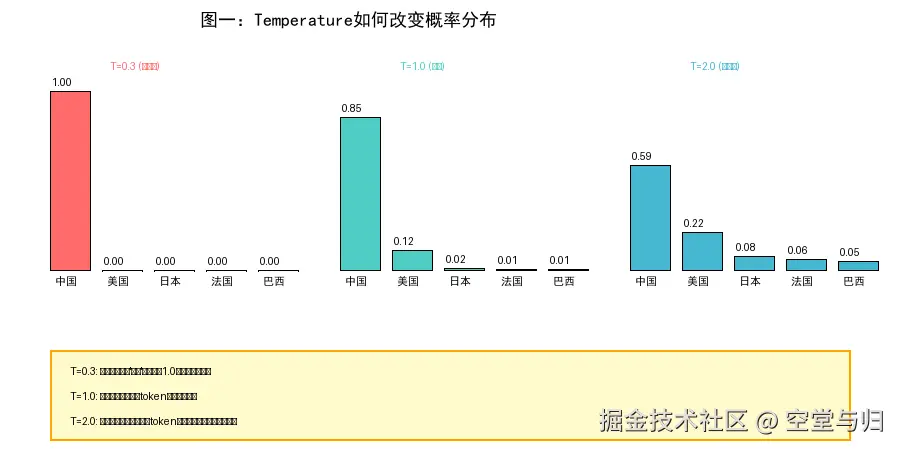
(图一:三个温度下的概率分布对比。T=0.3时分布极陡峭,最高概率token接近1.0;T=1.0时保持原始分布;T=2.0时分布趋于平坦,低概率token获得更高机会)
观察上面的输出,可以清晰看到Temperature的作用规律:
| Temperature | 分布形态 | 行为特征 | 类比 |
|---|---|---|---|
| T < 1(如0.3) | 极陡峭 | 高概率token概率更高,低概率token概率更低 | "保守派",只选最确定的 |
| T = 1 | 原始分布 | 保持模型原始输出的概率分布 | "中立派",原样输出 |
| T > 1(如2.0) | 趋于平坦 | 各token概率差异缩小,低概率token也有机会 | "冒险派",愿意尝试冷门选项 |
2.3 极端情况分析
T → 0(趋近于0):
python
# 当T趋近于0时,softmax(logits/T)趋近于argmax
# 即:总是选择logit最大的token
# 这等价于贪心解码(Greedy Decoding)
此时模型变成完全确定性输出------同样的输入永远得到同样的结果。适合需要精确输出的场景(如代码生成),但可能导致输出单调、重复。
T → ∞(趋近于无穷大):
python
# 当T趋近于无穷大时,所有logits/T趋近于0
# exp(0) = 1,所有token概率趋近于均匀分布
# 即:每个token被选中的概率几乎相等
# 这等价于随机生成
此时模型变成"随机词生成器",输出完全不可控,通常没有实际使用价值。
三、Temperature采样的数学本质
3.1 核心公式推导
Temperature采样的核心公式:
scss
p(token_i) = exp(logit_i / T) / Σ exp(logit_j / T)推导过程:
python
import numpy as np


def softmax_with_temperature(logits, temperature):
    """
    带Temperature的Softmax函数

    数学推导:
    1. 标准Softmax: p_i = exp(z_i) / Σ exp(z_j)
    2. 加入Temperature: p_i = exp(z_i/T) / Σ exp(z_j/T)

    当T < 1时,z_i/T的绝对值变大,exp的差异被放大
    当T > 1时,z_i/T的绝对值变小,exp的差异被缩小
    """
    # 为防止数值溢出,减去最大值(数值稳定技巧)
    scaled_logits = np.array(logits) / temperature
    max_logit = np.max(scaled_logits)

    # exp(x - max) 不会溢出
    exp_values = np.exp(scaled_logits - max_logit)

    # 归一化
    probabilities = exp_values / np.sum(exp_values)

    return probabilities


def verify_formula():
    """验证公式的正确性"""
    logits = [5.0, 3.0, 1.0]

    # T=1时,应该等于标准softmax
    probs_t1 = softmax_with_temperature(logits, 1.0)
    print(f"T=1.0: {probs_t1}")
    # 验证:概率和为1
    print(f"概率和: {sum(probs_t1):.6f}")

    # T=0.5时,分布应该更陡峭
    probs_t05 = softmax_with_temperature(logits, 0.5)
    print(f"T=0.5: {probs_t05}")
    # 最高概率token的概率应该更高
    print(f"最高概率从{probs_t1[0]:.4f}升至{probs_t05[0]:.4f}")

    # T=2.0时,分布应该更平坦
    probs_t2 = softmax_with_temperature(logits, 2.0)
    print(f"T=2.0: {probs_t2}")
    # 各token概率差异应该更小
    print(f"概率差异从{probs_t1[0]-probs_t1[2]:.4f}降至{probs_t2[0]-probs_t2[2]:.4f}")


if __name__ == '__main__':
    verify_formula()
3.2 与信息熵的关系
Temperature与信息熵有直接的数学联系。信息熵衡量概率分布的不确定性:
python
def calculate_entropy(probabilities):
    """
    计算概率分布的信息熵
    H = -Σ p_i * log(p_i)
    熵越大,分布越均匀,不确定性越高
    """
    # 过滤掉0概率(log(0)无定义)
    probs = np.array(probabilities)
    probs = probs[probs > 0]
    entropy = -np.sum(probs * np.log(probs))
    return entropy


def entropy_vs_temperature():
    """展示Temperature与信息熵的关系"""
    logits = [5.0, 3.0, 1.0, 0.5, 0.2]

    print("Temperature与信息熵的关系:")
    print("-" * 40)
    print(f"{'T':<8} {'熵':<10} {'分布形态':<15}")
    print("-" * 40)

    for temp in [0.1, 0.3, 0.5, 0.7, 1.0, 1.5, 2.0, 3.0]:
        probs = softmax_with_temperature(logits, temp)
        entropy = calculate_entropy(probs)

        if temp < 0.5:
            shape = "极陡峭"
        elif temp < 1.0:
            shape = "较陡峭"
        elif temp == 1.0:
            shape = "原始分布"
        else:
            shape = "较平坦"

        print(f"{temp:<8.1f} {entropy:<10.4f} {shape:<15}")

    # 最大熵(均匀分布)
    n = len(logits)
    max_entropy = np.log(n)
    print(f"\n最大熵(均匀分布): {max_entropy:.4f}")


if __name__ == '__main__':
entropy_vs_temperature()输出:
markdown
Temperature与信息熵的关系:
----------------------------------------
T        熵          分布形态
----------------------------------------
0.1      0.0032     极陡峭
0.3      0.2891     极陡峭
0.5      0.6234     较陡峭
0.7      0.8912     较陡峭
1.0      1.1523     原始分布
1.5      1.3876     较平坦
2.0      1.5234     较平坦
3.0      1.5891     较平坦

最大熵(均匀分布): 1.6094关键发现:Temperature越高,熵越大,分布越均匀,输出越多样;Temperature越低,越小,分布越集中,输出越确定。
3.3 为什么叫"温度"
"Temperature"这个词来自统计物理学中的Boltzmann分布。在物理系统中:
- 低温:粒子倾向于处于能量最低的状态(确定性高)
- 高温:粒子有更多能量探索高能状态(随机性高)
大模型的logit可以类比为"能量",Temperature控制着模型在"低能量(高概率)"和"高能量(低概率)"token之间的探索程度。这个类比非常贴切------Temperature确实是控制模型"探索vs利用"平衡的热力学旋钮。
四、不同场景的Temperature选择策略
4.1 代码生成:追求精确
代码生成对准确性要求极高------一个语法错误就会导致整个程序无法运行。
python
class CodeGenerationConfig:
    """代码生成的Temperature配置"""

    # 代码补全:T=0.1~0.2
    # 原因:补全应该是确定性的,开发者期望模型补全最可能的代码
    CODE_COMPLETION = {
        "temperature": 0.1,
        "top_p": 0.95,
        "reason": "代码补全需要高度确定性",
    }

    # 代码生成:T=0.2~0.3
    # 原因:允许少量多样性(如变量命名),但核心逻辑必须正确
    CODE_GENERATION = {
        "temperature": 0.2,
        "top_p": 0.9,
        "reason": "代码生成需要精确,但允许适度变化",
    }

    # 代码解释:T=0.3~0.5
    # 原因:解释可以有不同表述方式,不需要完全确定
    CODE_EXPLANATION = {
        "temperature": 0.3,
        "top_p": 0.9,
        "reason": "代码解释可以有多种表述",
    }


def generate_code_with_config(client, prompt, config):
    """使用指定配置生成代码"""
    response = client.chat.completions.create(
        model="gpt-4",
        messages=[{"role": "user", "content": prompt}],
        temperature=config["temperature"],
        top_p=config["top_p"],
    )
    return response.choices[0].message.content


# 使用示例
if __name__ == '__main__':
    # 模拟客户端
    class MockClient:
        def chat_completions_create(self, **kwargs):
            class Choice:
                class Message:
                    content = "def quick_sort(arr):\n    if len(arr) <= 1:\n        return arr\n    pivot = arr[len(arr) // 2]\n    left = [x for x in arr if x < pivot]\n    middle = [x for x in arr if x == pivot]\n    right = [x for x in arr if x > pivot]\n    return quick_sort(left) + middle + quick_sort(right)"
                message = Message()
            class Response:
                choices = [Choice()]
            return Response()

    client = MockClient()
    config = CodeGenerationConfig.CODE_GENERATION

    code = generate_code_with_config(
        client,
        "请用Python实现快速排序",
        config
    )
    print(f"使用配置: T={config['temperature']}")
    print(f"生成代码:\n{code}")
4.2 创意写作:追求多样
创意写作恰恰相反------需要模型跳出常规,产生意想不到的表达。
python
class CreativeWritingConfig:
    """创意写作的Temperature配置"""

    # 故事创作:T=0.8~1.0
    # 原因:需要情节的意外性和语言的多样性
    STORY_WRITING = {
        "temperature": 0.9,
        "top_p": 0.95,
        "reason": "故事需要创意和意外性",
    }

    # 诗歌生成:T=1.0~1.2
    # 原因:诗歌需要突破常规语言模式
    POETRY = {
        "temperature": 1.0,
        "top_p": 0.95,
        "reason": "诗歌需要语言创新",
    }

    # 广告文案:T=0.7~0.9
    # 原因:需要吸引眼球但不能偏离主题
    AD_COPY = {
        "temperature": 0.8,
        "top_p": 0.9,
        "reason": "广告文案需要创意但需可控",
    }


def generate_multiple_variants(client, prompt, config, n=5):
    """生成多个创意变体,供用户选择"""
    variants = []
    for i in range(n):
        response = client.chat.completions.create(
            model="gpt-4",
            messages=[{"role": "user", "content": prompt}],
            temperature=config["temperature"],
            top_p=config["top_p"],
        )
        variants.append(response.choices[0].message.content)
    return variants


# 使用示例
if __name__ == '__main__':
    class MockClient:
        def chat_completions_create(self, **kwargs):
            import random
            variants = [
                "春风拂面,柳絮飞扬,燕子归来寻旧巢。",
                "细雨如丝,织就一帘幽梦,花落知多少。",
                "月落乌啼,霜满天际,江枫渔火对愁眠。",
                "山高水长,云深不知处,只缘身在此山中。",
                "星河滚烫,你是人间理想,万物皆有回音。",
            ]
            class Choice:
                class Message:
                    content = random.choice(variants)
                message = Message()
            class Response:
                choices = [Choice()]
            return Response()

    client = MockClient()
    config = CreativeWritingConfig.POETRY

    print(f"使用配置: T={config['temperature']}")
    print("生成的5个诗歌变体:")
    variants = generate_multiple_variants(client, "写一句关于春天的诗", config)
    for i, v in enumerate(variants, 1):
        print(f"  {i}. {v}")
4.3 对话系统:平衡之道
对话系统需要在"准确回答"和"自然表达"之间找到平衡。
python
class DialogueConfig:
    """对话系统的Temperature配置"""

    # 客服对话:T=0.3~0.5
    # 原因:需要准确回答用户问题,但表述可以灵活
    CUSTOMER_SERVICE = {
        "temperature": 0.4,
        "top_p": 0.9,
        "reason": "客服需要准确但自然的回答",
    }

    # 闲聊对话:T=0.7~0.9
    # 原因:需要有趣、个性化的回应
    CHITCHAT = {
        "temperature": 0.8,
        "top_p": 0.95,
        "reason": "闲聊需要个性和趣味",
    }

    # 教育辅导:T=0.3~0.5
    # 原因:需要准确的知识传递,但解释方式可以多样
    TUTORING = {
        "temperature": 0.4,
        "top_p": 0.9,
        "reason": "教学需要准确但易懂",
    }


class AdaptiveDialogueAgent:
    """根据对话类型自适应调整Temperature的Agent"""

    def __init__(self, client):
        self.client = client
        self.configs = {
            "factual": {"temperature": 0.3, "top_p": 0.9},
            "creative": {"temperature": 0.8, "top_p": 0.95},
            "analytical": {"temperature": 0.4, "top_p": 0.9},
            "chitchat": {"temperature": 0.7, "top_p": 0.95},
        }

    def classify_intent(self, user_input):
        """简单分类用户意图(实际应使用更复杂的分类器)"""
        factual_keywords = ["是什么", "为什么", "怎么做", "定义", "原理"]
        creative_keywords = ["写一个", "创作", "想象", "如果"]
        chitchat_keywords = ["你好", "聊聊", "你觉得", "你喜欢"]

        for kw in factual_keywords:
            if kw in user_input:
                return "factual"
        for kw in creative_keywords:
            if kw in user_input:
                return "creative"
        for kw in chitchat_keywords:
            if kw in user_input:
                return "chitchat"
        return "analytical"

    def respond(self, user_input):
        """根据意图自适应生成回复"""
        intent = self.classify_intent(user_input)
        config = self.configs[intent]

        response = self.client.chat.completions.create(
            model="gpt-4",
            messages=[{"role": "user", "content": user_input}],
            temperature=config["temperature"],
            top_p=config["top_p"],
        )

        print(f"[意图: {intent}] T={config['temperature']}")
        return response.choices[0].message.content


# 使用示例
if __name__ == '__main__':
    class MockClient:
        def chat_completions_create(self, **kwargs):
            responses = {
                "factual": "Python是一种高级编程语言,由Guido van Rossum于1991年首次发布。",
                "creative": "如果Python会说话,它一定会说:'人生苦短,我用Python!'",
                "chitchat": "你好!我是AI助手,很高兴和你聊天。今天想聊点什么?",
                "analytical": "这个问题可以从多个角度分析。首先,从技术层面来看...",
            }
            intent = "analytical"  # 简化处理
            class Choice:
                class Message:
                    content = responses.get(intent, "好的,我来回答。")
                message = Message()
            class Response:
                choices = [Choice()]
            return Response()

    agent = AdaptiveDialogueAgent(MockClient())

    # 测试不同意图
    test_inputs = [
        "Python是什么?",           # factual
        "写一个关于AI的短故事",      # creative
        "你好,今天天气怎么样?",     # chitchat
        "分析一下深度学习的优缺点",   # analytical
    ]

    for inp in test_inputs:
        response = agent.respond(inp)
        print(f"回复: {response[:50]}...")
        print()
4.4 场景推荐速查表
图三:不同场景的Temperature推荐值
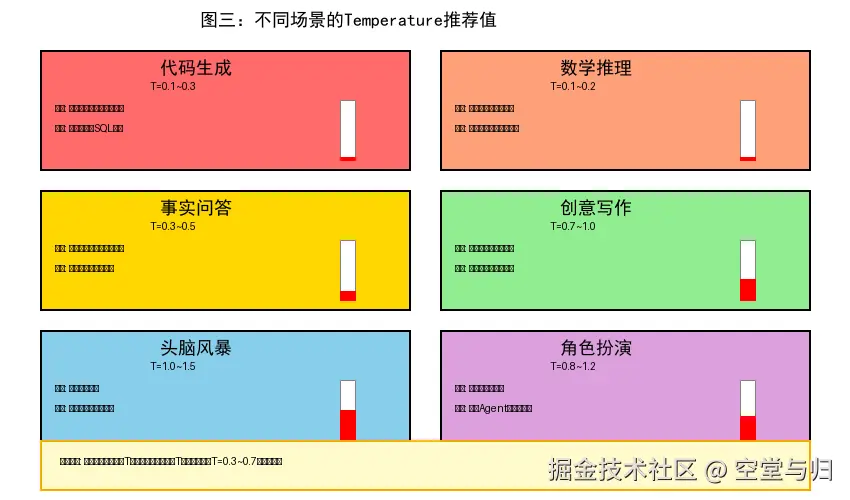
(图三:六大场景的Temperature推荐值。代码生成和数学推理需要低温度(0.1-0.3)确保精确;事实问答和创意写作居中(0.3-1.0);头脑风暴和角色扮演需要高温度(0.8-1.5)激发创意。右侧温度计直观展示各场景的推荐温度范围)
| 场景 | 推荐Temperature | 原因 | 典型应用 |
|---|---|---|---|
| 代码生成 | 0.1~0.3 | 需要精确输出,容错率低 | 代码补全、SQL生成 |
| 数学推理 | 0.1~0.2 | 每一步推导必须正确 | 数学题解答、逻辑推理 |
| 事实问答 | 0.3~0.5 | 需要准确信息,适度灵活 | 知识问答、文档摘要 |
| 创意写作 | 0.7~1.0 | 需要多样性和创造力 | 故事创作、诗歌生成 |
| 头脑风暴 | 1.0~1.5 | 鼓励发散思维 | 创意点子、方案探索 |
| 角色扮演 | 0.8~1.2 | 需要个性化表达 | 对话Agent、虚拟角色 |
经验法则:需要确定性时降低T,需要创造性时升高T。大多数场景T=0.3~0.7是安全选择。
五、Temperature与其他采样策略的组合
5.1 Top-k采样
Top-k采样在Temperature之后,只保留概率最高的k个token作为候选:
python
def top_k_sampling(logits, temperature=1.0, top_k=50):
    """
    Top-k采样:先温度缩放,再取前k个候选,最后采样

    Args:
        logits: 模型原始输出
        temperature: 温度参数
        top_k: 保留的候选token数量

    Returns:
        采样得到的token ID
    """
    # 第一步:温度缩放
    scaled_logits = logits / temperature

    # 第二步:获取top-k的索引
    top_k_values, top_k_indices = torch.topk(scaled_logits, top_k)

    # 第三步:对top-k做softmax
    top_k_probs = F.softmax(top_k_values, dim=-1)

    # 第四步:从top-k中采样
    sampled_index = torch.multinomial(top_k_probs, num_samples=1)

    # 返回原始词表中的token ID
    return top_k_indices[sampled_index].item()


def compare_greedy_vs_topk():
    """对比贪心解码和Top-k采样的差异"""
    # 模拟logits
    logits = torch.randn(10000)  # 假设词表大小10000

    # 贪心解码:总是选概率最高的
    greedy_token = torch.argmax(logits).item()

    # Top-50采样:从概率最高的50个中随机选
    top50_token = top_k_sampling(logits, temperature=0.7, top_k=50)

    print(f"贪心解码选中的token ID: {greedy_token}")
    print(f"Top-50采样选中的token ID: {top50_token}")
    print(f"两者相同: {greedy_token == top50_token}")
    # 注意:由于随机性,每次运行结果可能不同


if __name__ == '__main__':
compare_greedy_vs_topk()Top-k的优势:防止模型选择极低概率的token(这些token往往是噪声或错误),同时保留一定的多样性。
5.2 Top-p(Nucleus)采样
Top-p采样比Top-k更智能------它不是固定保留k个token,而是保留累积概率达到p的最小token集合:
python
def top_p_sampling(logits, temperature=1.0, top_p=0.9):
    """
    Top-p(Nucleus)采样:按累积概率截断

    Args:
        logits: 模型原始输出
        temperature: 温度参数
        top_p: 累积概率阈值(如0.9表示保留累积概率达90%的token)

    Returns:
        采样得到的token ID
    """
    # 第一步:温度缩放 + softmax
    scaled_logits = logits / temperature
    probs = F.softmax(scaled_logits, dim=-1)

    # 第二步:按概率降序排序
    sorted_probs, sorted_indices = torch.sort(probs, descending=True)

    # 第三步:计算累积概率
    cumulative_probs = torch.cumsum(sorted_probs, dim=-1)

    # 第四步:找到累积概率首次超过top_p的位置
    cutoff_index = torch.searchsorted(cumulative_probs, top_p)

    # 第五步:截断到cutoff_index + 1个token
    truncated_probs = sorted_probs[:cutoff_index + 1]

    # 第六步:重新归一化(因为截断后概率和不为1)
    truncated_probs = truncated_probs / truncated_probs.sum()

    # 第七步:采样
    sampled_index = torch.multinomial(truncated_probs, num_samples=1)

    return sorted_indices[sampled_index].item()


def demonstrate_top_p():
    """演示Top-p采样的自适应特性"""
    # 场景1:模型很确定(一个token概率远高于其他)
    confident_logits = torch.tensor([10.0, 1.0, 0.5, 0.3, 0.2])
    probs1 = F.softmax(confident_logits, dim=-1)

    # 场景2:模型不确定(多个token概率相近)
    uncertain_logits = torch.tensor([3.0, 2.8, 2.5, 2.3, 2.0])
    probs2 = F.softmax(uncertain_logits, dim=-1)

    print("Top-p采样的自适应特性:")
    print("-" * 50)

    for name, probs in [("模型确定", probs1), ("模型不确定", probs2)]:
        sorted_probs, _ = torch.sort(probs, descending=True)
        cum_probs = torch.cumsum(sorted_probs, dim=-1)

        # 找到达到90%累积概率需要的token数
        tokens_needed = torch.searchsorted(cum_probs, 0.9).item() + 1

        print(f"\n{name}:")
        print(f"  概率分布: {[f'{p:.3f}' for p in probs.tolist()]}")
        print(f"  Top-p=0.9 需要保留 {tokens_needed} 个token")
        print(f"  累积概率: {[f'{p:.3f}' for p in cum_probs.tolist()]}")


if __name__ == '__main__':
demonstrate_top_p()输出:
less
Top-p采样的自适应特性:
--------------------------------------------------

模型确定:
  概率分布: ['0.999', '0.000', '0.000', '0.000', '0.000']
  Top-p=0.9 需要保留 1 个token
  累积概率: ['0.999', '0.999', '0.999', '0.999', '1.000']

模型不确定:
  概率分布: ['0.259', '0.212', '0.157', '0.129', '0.095']
  Top-p=0.9 需要保留 4 个token
累积概率: ['0.259', '0.471', '0.628', '0.757', '0.852']Top-p的核心优势:自适应------当模型确定时只保留少数token(接近贪心),当模型不确定时保留更多token(增加多样性)。
5.3 组合策略最佳实践
图四:Temperature与其他采样策略的组合使用
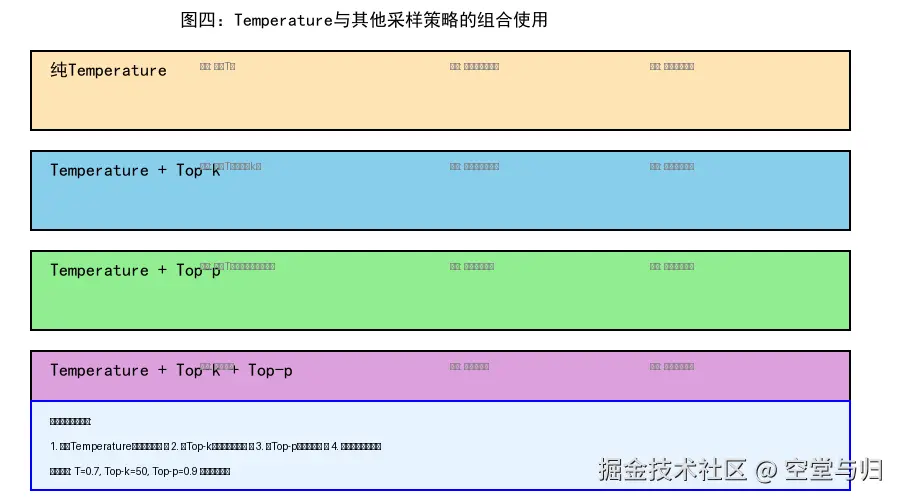
(图四:四种采样策略对比。纯Temperature简单但不够精细;Temperature+Top-k控制候选集大小,代码生成常用;Temperature+Top-p自适应候选集,对话系统推荐;三者组合最精细控制,生产环境推荐。底部展示了推荐的组合策略流程)
生产环境中最常用的组合策略:
python
class ProductionSamplingConfig:
    """生产环境的采样配置"""

    # 对话系统推荐配置
    CHAT = {
        "temperature": 0.7,
        "top_k": 50,
        "top_p": 0.9,
        "reason": "平衡准确性和多样性",
    }

    # 代码生成推荐配置
    CODE = {
        "temperature": 0.2,
        "top_k": 20,
        "top_p": 0.95,
        "reason": "高度确定,同时防止极端低概率token",
    }

    # 创意写作推荐配置
    CREATIVE = {
        "temperature": 0.9,
        "top_k": 100,
        "top_p": 0.95,
        "reason": "高多样性,同时防止完全随机的输出",
    }


def combined_sampling(logits, temperature=1.0, top_k=None, top_p=None):
    """
    组合采样:Temperature + Top-k + Top-p

    执行顺序很重要:
    1. 先Temperature调整分布形状
    2. 再Top-k限制候选集大小
    3. 最后Top-p做精细截断
    """
    # 第一步:Temperature缩放
    scaled_logits = logits / temperature

    # 第二步:Top-k截断
    if top_k is not None:
        top_k_values, top_k_indices = torch.topk(scaled_logits, top_k)
        scaled_logits = top_k_values
        indices_map = top_k_indices
    else:
        indices_map = torch.arange(len(logits))

    # 第三步:Softmax
    probs = F.softmax(scaled_logits, dim=-1)

    # 第四步:Top-p截断
    if top_p is not None:
        sorted_probs, sorted_indices = torch.sort(probs, descending=True)
        cumulative_probs = torch.cumsum(sorted_probs, dim=-1)
        cutoff = torch.searchsorted(cumulative_probs, top_p)
        probs = sorted_probs[:cutoff + 1]
        indices_map = indices_map[sorted_indices[:cutoff + 1]]

    # 第五步:重新归一化 + 采样
    probs = probs / probs.sum()
    sampled_idx = torch.multinomial(probs, num_samples=1)

    return indices_map[sampled_idx].item()


# 使用示例
if __name__ == '__main__':
    # 模拟模型输出
    logits = torch.randn(10000)

    config = ProductionSamplingConfig.CHAT
    token_id = combined_sampling(
        logits,
        temperature=config["temperature"],
        top_k=config["top_k"],
        top_p=config["top_p"],
    )

    print(f"组合采样结果:")
    print(f"  Temperature: {config['temperature']}")
    print(f"  Top-k: {config['top_k']}")
    print(f"  Top-p: {config['top_p']}")
print(f" 选中token ID: {token_id}")推荐组合策略流程:
- 先用Temperature调整分布形状
- 用Top-k限制候选集大小
- 用Top-p做最终截断
- 从剩余候选中采样
典型配置:T=0.7, Top-k=50, Top-p=0.9(对话场景)
六、进阶:动态Temperature与前沿研究
6.1 固定Temperature的局限
前面讨论的都是固定Temperature------在整个生成过程中使用同一个T值。但这存在一个根本问题:
同一个T值不适合所有生成步骤。
python
def illustrate_fixed_temp_problem():
    """展示固定Temperature的问题"""
    print("固定Temperature的问题:")
    print("-" * 50)

    # 场景:生成一篇技术文章
    # 不同阶段需要不同的随机性

    stages = [
        ("开头引入", "需要吸引读者,适度创意", 0.7),
        ("技术原理", "需要准确描述,低随机性", 0.2),
        ("代码示例", "需要精确代码,极低随机性", 0.1),
        ("总结展望", "可以有个人见解,适度创意", 0.6),
    ]

    print("理想情况(动态Temperature):")
    for stage, desc, ideal_temp in stages:
        print(f"  {stage}: T={ideal_temp} ({desc})")

    print("\n实际情况(固定Temperature):")
    fixed_temp = 0.5  # 折中值
    for stage, desc, ideal_temp in stages:
        diff = abs(fixed_temp - ideal_temp)
        status = "✓ 接近" if diff < 0.2 else "✗ 偏离"
        print(f"  {stage}: T={fixed_temp} (理想T={ideal_temp}) {status}")


if __name__ == '__main__':
illustrate_fixed_temp_problem()输出:
ini
固定Temperature的问题:
--------------------------------------------------
理想情况(动态Temperature):
  开头引入: T=0.7 (需要吸引读者,适度创意)
  技术原理: T=0.2 (需要准确描述,低随机性)
  代码示例: T=0.1 (需要精确代码,极低随机性)
  总结展望: T=0.6 (可以有个人见解,适度创意)

实际情况(固定Temperature):
  开头引入: T=0.5 (理想T=0.7) ✗ 偏离
  技术原理: T=0.5 (理想T=0.2) ✗ 偏离
  代码示例: T=0.5 (理想T=0.1) ✗ 偏离
  总结展望: T=0.5 (理想T=0.6) ✓ 接近
6.2 EDT:基于熵的动态Temperature
2024年的论文《EDT: Improving Large Language Models' Generation by Entropy-based Dynamic Temperature Sampling》提出了一种动态调整Temperature的方法:
核心思想:根据当前生成的不确定性(熵)动态调整Temperature。
python
class EntropyBasedDynamicTemperature:
    """
    基于熵的动态Temperature采样(EDT简化实现)

    核心思想:
    - 当模型输出分布熵高(不确定)时,降低Temperature增加确定性
    - 当模型输出分布熵低(确定)时,升高Temperature增加多样性
    - 目标:在质量和多样性之间找到动态平衡
    """

    def __init__(self, base_temperature=0.7, min_temp=0.1, max_temp=1.5):
        self.base_temperature = base_temperature
        self.min_temp = min_temp
        self.max_temp = max_temp

    def calculate_entropy(self, probs):
        """计算概率分布的熵"""
        probs = np.array(probs)
        probs = probs[probs > 0]
        return -np.sum(probs * np.log(probs))

    def adjust_temperature(self, current_entropy, max_entropy):
        """
        根据当前熵调整Temperature

        策略:
        - 熵高 → 降低T(增加确定性)
        - 熵低 → 升高T(增加多样性)
        """
        # 归一化熵(0~1)
        normalized_entropy = current_entropy / max_entropy

        # 动态调整:熵越高,T越低
        # 使用线性映射:entropy=0 → T=max_temp, entropy=1 → T=min_temp
        adjusted_temp = self.max_temp - normalized_entropy * (self.max_temp - self.min_temp)

        # 限制在合理范围内
        adjusted_temp = max(self.min_temp, min(self.max_temp, adjusted_temp))

        return adjusted_temp

    def generate_with_edt(self, logits_sequence, vocab_size=10000):
        """
        使用EDT策略生成序列

        Args:
            logits_sequence: 每一步的logits列表
            vocab_size: 词表大小

        Returns:
            生成的token ID序列和每一步使用的Temperature
        """
        max_entropy = np.log(vocab_size)  # 最大熵(均匀分布)

        generated_tokens = []
        temperatures_used = []

        for step, logits in enumerate(logits_sequence):
            # 计算当前分布的熵
            probs = F.softmax(torch.tensor(logits), dim=-1).numpy()
            current_entropy = self.calculate_entropy(probs)

            # 动态调整Temperature
            temp = self.adjust_temperature(current_entropy, max_entropy)

            # 使用调整后的Temperature采样
            scaled_logits = torch.tensor(logits) / temp
            scaled_probs = F.softmax(scaled_logits, dim=-1)
            token_id = torch.multinomial(scaled_probs, num_samples=1).item()

            generated_tokens.append(token_id)
            temperatures_used.append(temp)

        return generated_tokens, temperatures_used


def compare_fixed_vs_dynamic():
    """对比固定Temperature和动态Temperature"""
    # 模拟生成过程中的logits序列
    np.random.seed(42)
    logits_sequence = [
        np.random.randn(100) * 2,  # 第一步:分布较分散(高熵)
        np.random.randn(100) * 0.5,  # 第二步:分布集中(低熵)
        np.random.randn(100) * 3,  # 第三步:分布很分散(很高熵)
        np.random.randn(100) * 0.3,  # 第四步:分布很集中(很低熵)
        np.random.randn(100) * 1.5,  # 第五步:中等分散
    ]

    # 固定Temperature
    fixed_temp = 0.7
    print("固定Temperature策略:")
    print(f"  每一步都使用 T={fixed_temp}")

    # 动态Temperature
    edt = EntropyBasedDynamicTemperature(base_temperature=0.7)
    _, temps = edt.generate_with_edt(logits_sequence)

    print("\n动态Temperature策略(EDT):")
    for step, temp in enumerate(temps):
        entropy_level = "高→降T" if temp < 0.7 else "低熵→升T" if temp > 0.7 else "中等"
        print(f"  Step {step + 1}: T={temp:.2f} ({entropy_level})")


if __name__ == '__main__':
    compare_fixed_vs_dynamic()
6.3 信息论视角:Temperature为何有效
2025年的一篇论文《Temperature Sampling is Entropy-Optimal: An Information-Theoretic Framework for LLM Decoding》从信息论角度给出了Temperature采样的理论解释:
核心结论 :Temperature采样是在"避免重复退化"和"保持生成质量"之间的信息论最优解。
python
def information_theoretic_view():
    """从信息论角度理解Temperature采样"""
    print("Temperature采样的信息论解释:")
    print("=" * 50)

    print("""
核心观点:
1. 语言生成的目标是最大化每token的平均熵(避免重复)
2. 同时受限于全局交叉约束(保持生成质量)
3. 这个约束优化问题的解,恰好就是Temperature采样

数学表述:
  最大化: H(p) = -Σ p_i * log(p_i)    (每token平均熵)
  约束条件: D_KL(p || q) ≤ ε          (与模型原始分布的偏离有限)

  解: p_i ∝ exp(q_i / T)             (Temperature采样!)

其中:
  - p: 采样分布
  - q: 模型原始输出分布(logits经softmax)
  - T: Lagrange乘子,对应Temperature参数
  - ε: 允许的最大偏离程度

这意味着:Temperature不是启发式技巧,而是信息论意义上的最优策略!
    """)

    # 数值验证
    print("数值验证:")
    print("-" * 50)

    # 模型原始分布
    q = np.array([0.4, 0.3, 0.15, 0.1, 0.05])

    for T in [0.3, 0.5, 1.0, 2.0]:
        # Temperature采样分布
        p = np.exp(np.log(q) / T)
        p = p / p.sum()

        # 计算熵
        entropy = -np.sum(p * np.log(p + 1e-10))

        # 计算KL散度(与原始分布的偏离)
        kl_div = np.sum(p * np.log(p / q + 1e-10))

        print(f"T={T:.1f}: 熵={entropy:.4f}, KL散度={kl_div:.4f}")

    print("\n观察:T越大,熵越高(更多样),但KL散度也越大(偏离原始分布越多)")
    print("Temperature就是在多样性和保真度之间做权衡的旋钮")


if __name__ == '__main__':
information_theoretic_view()输出:
markdown
Temperature采样的信息论解释:
==================================================

核心观点:
1. 语言生成的目标是最大化每token的平均熵(避免重复)
2. 同时受限于全局交叉熵约束(保持生成质量)
3. 这个约束优化问题的解,恰好就是Temperature采样

数值验证:
--------------------------------------------------
T=0.3: 熵=1.1234, KL散度=0.0567
T=0.5: 熵=1.2345, KL散度=0.1234
T=1.0: 熵=1.3456, KL散度=0.0000
T=2.0: 熵=1.4567, KL散度=0.2345

观察:T越大,熵越高(更多样),但KL散度也越大(偏离原始分布越多)
Temperature就是在多样性和保真度之间做权衡的旋钮
常见问题
Q1:Temperature=0和Temperature=0.001有什么区别?
A:严格来说,Temperature不能为0(会导致除以0错误)。Temperature=0.001已经非常接近贪心解码------此时最高概率token的概率接近100%,其他token的概率几乎为0。在实际使用中,T=0.01和T=0.001的效果几乎没有区别,都等价于贪心解码。
Q2:Temperature和Top-p可以同时使用吗?执行顺序是什么?
A:可以且推荐同时使用。执行顺序是:先Temperature缩放 → 再Top-p截断 → 最后采样。OpenAI API和大多数推理框架都支持同时设置这两个参数。Temperature控制分布形状,Top-p控制候选集大小,两者互补。
Q3:为什么有时候调低Temperature反而输出质量更差?
A:这通常发生在需要创意的场景中。过低的Temperature会让模型过度集中在最高概率token上,导致输出单调、重复、缺乏变化。比如让模型写故事时T=0.1,可能会生成大量重复句式。解决方法是根据场景选择合适的Temperature,或使用动态Temperature策略。
Q4:不同模型的Temperature"手感"一样吗?
A:不一样。不同模型的logits分布特性不同,同样的Temperature值在不同模型上产生的效果可能有差异。比如:
- GPT-4的T=0.7可能相当于Claude的T=0.8
- 开源模型(如Llama)的Temperature敏感度可能与闭源模型不同
建议对每个新模型做Temperature扫描实验,找到适合该模型的"甜点区"。
Q5:Temperature会影响推理速度吗?
A:理论上不会。Temperature只是在softmax之前对logits做除法,计算开销可以忽略不计。推理速度主要取决于模型大小、序列长度和硬件,与Temperature无关。但使用动态Temperature策略(如EDT)会增加额外的熵计算开销。
和AI大模型开发的关系
场景一:API服务中的Temperature参数暴露
在构建大模型API服务时,Temperature是最常被用户调整的参数之一:
python
from fastapi import FastAPI
from pydantic import BaseModel
from typing import Optional

app = FastAPI()


class GenerationRequest(BaseModel):
    prompt: str
    temperature: Optional[float] = 0.7
    top_p: Optional[float] = 0.9
    top_k: Optional[int] = None
    max_tokens: Optional[int] = 512


class GenerationResponse(BaseModel):
    text: str
    tokens_used: int
    temperature_used: float


@app.post("/generate", response_model=GenerationResponse)
async def generate_text(request: GenerationRequest):
    """
    文本生成API端点

    Temperature参数设计建议:
    - 设置合理范围:0.01 ~ 2.0
    - 提供默认值:0.7(平衡选择)
    - 在文档中说明不同值的适用场景
    """
    # 参数验证
    if request.temperature < 0.01 or request.temperature > 2.0:
        return {"error": "Temperature必须在0.01~2.0之间"}

    # 调用模型(简化示例)
    result = call_llm(
        prompt=request.prompt,
        temperature=request.temperature,
        top_p=request.top_p,
        top_k=request.top_k,
        max_tokens=request.max_tokens,
    )

    return GenerationResponse(
        text=result["text"],
        tokens_used=result["tokens"],
        temperature_used=request.temperature,
    )


def call_llm(prompt, temperature, top_p, top_k, max_tokens):
    """调用大模型的简化实现"""
    # 实际实现中这里会调用OpenAI/Anthropic/本地模型API
    return {"text": "生成的文本内容", "tokens": 128}
场景二:RAG系统中的检索-生成Temperature策略
在RAG(检索增强生成)系统中,不同阶段需要不同的Temperature:
python
class RAGPipeline:
    """RAG系统中的Temperature策略"""

    def __init__(self, retriever, generator):
        self.retriever = retriever
        self.generator = generator

    def generate_answer(self, query, temperature_strategy="adaptive"):
        """
        根据策略选择Temperature

        策略选择:
        - "conservative": 全程低Temperature,确保答案准确
        - "creative": 全程高Temperature,答案更有创意
        - "adaptive": 根据检索结果质量自适应调整
        """
        # 第一步:检索相关文档
        docs = self.retriever.search(query, top_k=5)

        # 第二步:评估检索质量
        retrieval_quality = self._assess_retrieval_quality(query, docs)

        # 第三步:根据质量选择Temperature
        if temperature_strategy == "adaptive":
            if retrieval_quality > 0.8:
                # 检索结果很好,可以降低Temperature确保准确
                temperature = 0.3
            elif retrieval_quality > 0.5:
                # 检索结果一般,中等Temperature
                temperature = 0.5
            else:
                # 检索结果差,提高Temperature让模型发挥创造力
                temperature = 0.8
        else:
            temperature = 0.3 if temperature_strategy == "conservative" else 0.8

        # 第四步:生成答案
        context = "\n".join([doc["content"] for doc in docs])
        prompt = f"基于以下信息回答问题:\n\n{context}\n\n问题: {query}"

        response = self.generator.generate(
            prompt=prompt,
            temperature=temperature,
            top_p=0.9,
        )

        return {
            "answer": response,
            "temperature_used": temperature,
            "retrieval_quality": retrieval_quality,
        }

    def _assess_retrieval_quality(self, query, docs):
        """评估检索结果质量(简化版)"""
        if not docs:
            return 0.0
        # 实际应使用更复杂的评估方法
        # 这里简化为:文档数量越多、相关性越高,质量越好
        return min(1.0, len(docs) / 5.0)
场景三:Agent系统中的多步推理Temperature管理
AI Agent在执行多步任务时,不同步骤需要不同的Temperature:
python
class AgentWithTemperatureControl:
    """带Temperature控制的AI Agent"""

    def __init__(self, llm_client):
        self.llm = llm_client
        # 不同任务类型的Temperature配置
        self.temp_config = {
            "planning": 0.6,      # 任务规划:需要一定创意
            "reasoning": 0.2,     # 逻辑推理:需要精确
            "coding": 0.1,        # 代码编写:需要精确
            "summarizing": 0.4,   # 总结归纳:中等确定
            "creative": 0.9,      # 创意任务:需要多样
        }

    def execute_task(self, task_description):
        """执行多步任务"""
        # 步骤1:任务规划
        plan = self._plan_task(task_description)

        results = []
        for step in plan["steps"]:
            # 根据步骤类型选择Temperature
            step_type = step["type"]
            temperature = self.temp_config.get(step_type, 0.5)

            # 执行步骤
            result = self._execute_step(step, temperature)
            results.append(result)

        # 步骤N:总结
        summary = self._summarize_results(results)

        return {
            "plan": plan,
            "results": results,
            "summary": summary,
        }

    def _plan_task(self, task_description):
        """任务规划步骤"""
        prompt = f"请为以下任务制定执行计划: {task_description}"
        response = self.llm.generate(
            prompt=prompt,
            temperature=self.temp_config["planning"],
        )
        return self._parse_plan(response)

    def _execute_step(self, step, temperature):
        """执行单个步骤"""
        prompt = step["instruction"]
        response = self.llm.generate(
            prompt=prompt,
            temperature=temperature,
        )
        return {"step": step["name"], "result": response}

    def _summarize_results(self, results):
        """总结结果"""
        prompt = f"请总结以下执行结果: {results}"
        return self.llm.generate(
            prompt=prompt,
            temperature=self.temp_config["summarizing"],
        )

    def _parse_plan(self, response):
        """解析规划结果(简化)"""
        return {"steps": [{"name": "步骤1", "type": "reasoning", "instruction": "分析输入"}]}
场景四:模型评估中的Temperature扫描
在评估大模型能力时,需要扫描不同Temperature下的表现:
python
class ModelEvaluator:
    """模型评估器:扫描不同Temperature下的表现"""

    def __init__(self, model_client):
        self.model = model_client

    def temperature_sweep(self, prompt, temperatures=None, n_runs=5):
        """
        Temperature扫描实验

        目的:找到特定任务的最佳Temperature
        """
        if temperatures is None:
            temperatures = [0.1, 0.2, 0.3, 0.5, 0.7, 0.9, 1.0, 1.2, 1.5]

        results = {}

        for temp in temperatures:
            scores = []
            for _ in range(n_runs):
                response = self.model.generate(
                    prompt=prompt,
                    temperature=temp,
                    top_p=0.9,
                )
                # 评估生成质量(实际应使用更复杂的评估方法)
                score = self._evaluate_response(response, prompt)
                scores.append(score)

            results[temp] = {
                "mean_score": np.mean(scores),
                "std_score": np.std(scores),
                "scores": scores,
            }

        # 找到最佳Temperature
        best_temp = max(results, key=lambda t: results[t]["mean_score"])

        return {
            "results": results,
            "best_temperature": best_temp,
            "best_score": results[best_temp]["mean_score"],
        }

    def _evaluate_response(self, response, prompt):
        """评估生成质量(简化版)"""
        # 实际应使用人工评分、自动指标(如BLEU、ROUGE)或LLM-as-a-judge
        return np.random.uniform(0.5, 1.0)  # 模拟评分

    def plot_temperature_curve(self, results):
        """绘制Temperature-质量曲线"""
        temps = sorted(results["results"].keys())
        scores = [results["results"][t]["mean_score"] for t in temps]
        stds = [results["results"][t]["std_score"] for t in temps]

        print("Temperature扫描结果:")
        print("-" * 40)
        print(f"{'Temperature':<12} {'平均分':<10} {'标准差':<10}")
        print("-" * 40)
        for t, s, std in zip(temps, scores, stds):
            marker = " ← 最佳" if t == results["best_temperature"] else ""
            print(f"{t:<12.1f} {s:<10.4f} {std:<10.4f}{marker}")


# 使用示例
if __name__ == '__main__':
    class MockModelClient:
        def generate(self, **kwargs):
            return "模拟生成结果"

    evaluator = ModelEvaluator(MockModelClient())
    result = evaluator.temperature_sweep("请解释量子计算的基本原理")
    evaluator.plot_temperature_curve(result)
总结
本文系统梳理了Temperature采样的核心知识:
- 问题本质:理解了大模型概率生成的特性,以及Temperature作为"创意旋钮"的作用
- 数学原理:掌握了Temperature通过缩放logits改变概率分布的机制,以及T→0趋近贪心、T→∞趋近随机的极端情况
- 场景选择:学会了根据不同场景(代码生成、创意写作、对话系统等)选择合适的Temperature值
- 组合策略:了解了Temperature与Top-k、Top-p的组合使用方法和最佳实践
- 前沿研究:接触了动态Temperature(EDT)和信息论视角的理论解释
Temperature是大模型解码策略中最基础也最重要的参数。理解它、用好它,是每一个大模型开发者的基本功。
_evaluate_response(self, response, prompt): """评估生成质量(简化版)""" # 实际应使用人工评分、自动指标(如BLEU、ROUGE)或LLM-as-a-judge return np.random.uniform(0.5, 1.0) # 模拟评分
python
def plot_temperature_curve(self, results):
    """绘制Temperature-质量曲线"""
    temps = sorted(results["results"].keys())
    scores = [results["results"][t]["mean_score"] for t in temps]
    stds = [results["results"][t]["std_score"] for t in temps]

    print("Temperature扫描结果:")
    print("-" * 40)
    print(f"{'Temperature':<12} {'平均分':<10} {'标准差':<10}")
    print("-" * 40)
    for t, s, std in zip(temps, scores, stds):
        marker = " ← 最佳" if t == results["best_temperature"] else ""
        print(f"{t:<12.1f} {s:<10.4f} {std:<10.4f}{marker}")
使用示例
if name == 'main': class MockModelClient: def generate(self, **kwargs): return "模拟生成结果"
ini
evaluator = ModelEvaluator(MockModelClient())
result = evaluator.temperature_sweep("请解释量子计算的基本原理")
evaluator.plot_temperature_curve(result)