我在《Go 语言中 YAML to JSON 踩坑笔记》一文中提到了使用 dyno 包来解决 json.Marshal 时遇到不支持的 map[interface{}]interface{} 类型报错的问题。本文就来通过源码的形式为大家详解一下 dyno 包的原理。
dyno 包简介
首先,我们要搞清楚 dyno 包是用来干什么的:dyno 包的主要目标是方便我们操作动态对象,当我们在序列化/反序列化 JSON 或 YAML 文档时,通常选择使用 map[string]interface{} 或 map[interface{}]interface{} 类型来表示对象,使用 []interface{} 来表示数组,而 dyno 包支持在任意嵌套深度和任意组合中处理这些混合类型的结构。
dyno 包实现的所有函数如下:
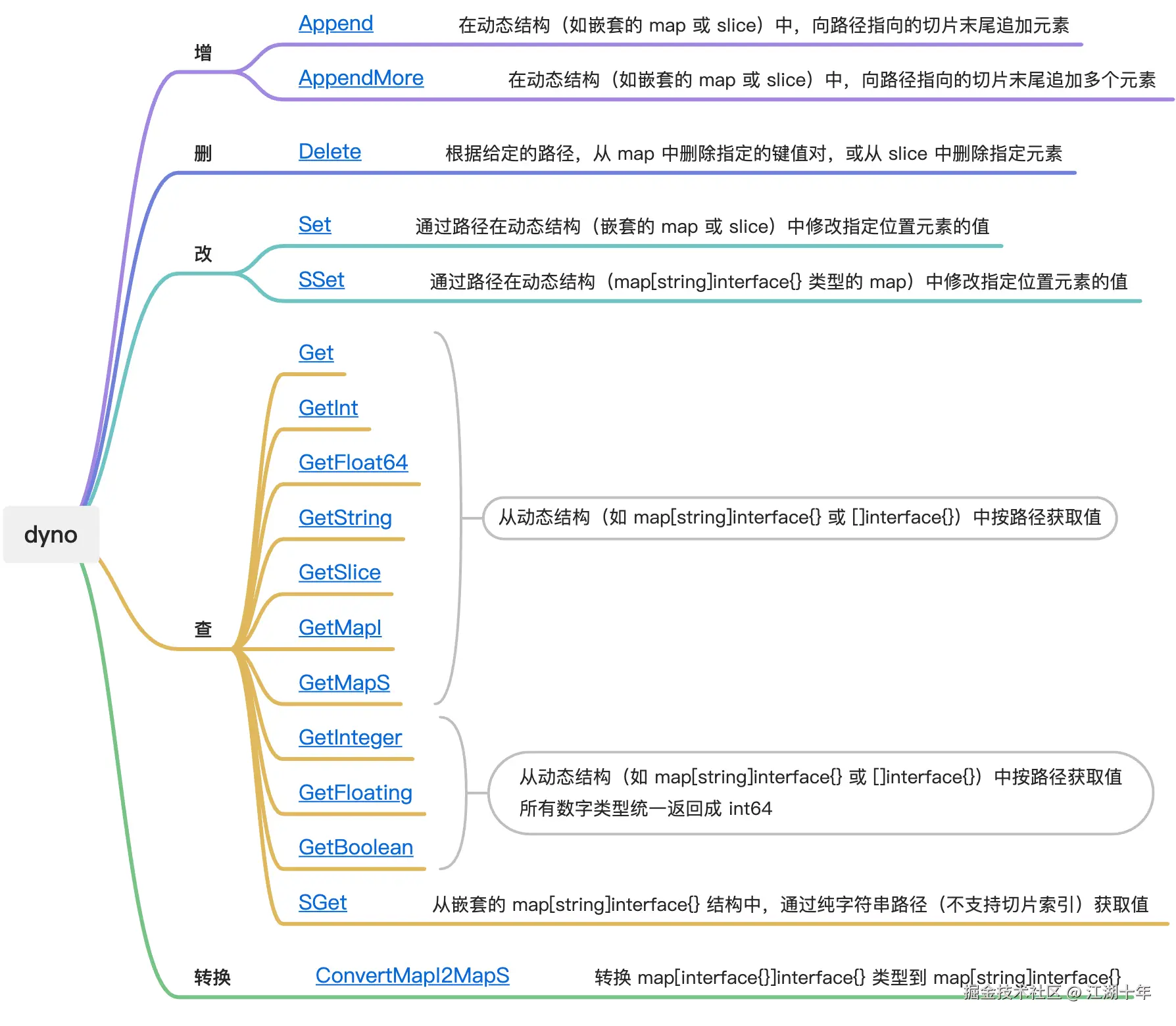
可以发现,dyno 包实现了对嵌套的 map/slice 类型对象的 CRUD 操作,并且可以通过 ConvertMapI2MapS 函数将 map 的 interface{} 类型的 key 转换成 string 类型。
接下来,我们将对 dyno 包的源码进行讲解。
dyno 包源码解析
Get
我们先来从 Get 函数讲起,Get 函数用法如下:
go
package main

import (
	"fmt"

	"github.com/icza/dyno"
)

func main() {
	y := map[string]interface{}{
		"object": map[interface{}]interface{}{
			"a": 1,
			"array": []interface{}{
				map[string]interface{}{
					"null_value": interface{}(nil),
				},
				map[string]interface{}{
					"boolean": true,
				},
				map[string]interface{}{
					"integer": 1,
				},
			},
			"key": "value",
			1:     2,
		},
	}

	// 按路径获取值
	// 混合使用字符串键(字典)和整型索引(切片)
	get, err := dyno.Get(y, "object", "array", 2, "integer")
	if err != nil {
		panic(err)
	}
	fmt.Printf("%T, %#v\n", get, get)
}
我们有一个嵌套的 map 类型对象 y,现在我们想拿到 y["object"]["array"][2]["integer"] 的值,如果手撸代码,这将是"灾难"(这一点相比于 Python 确实不够优雅)。
dyno 包 Get 函数就是来帮我们做这件事情的,只需要将 key 或索引依次传递给 Get 函数即可:
go
get, err := dyno.Get(y, "object", "array", 2, "integer")执行示例代码,得到输出如下:
bash
$ go run main.go
int, 1
我们仅用了一行代码,就获取到了 map 中嵌套多层的对象的值。
而这背后的 Get 的函数到底是如何实现的呢?我们一起来看一下。
dyno 包 Get 函数源码如下:
go
// Get 从动态结构(如 map[string]interface{} 或 []interface{})中按路径获取值
// 如果 path 参数为空,则直接返回 v
func Get(v interface{}, path ...interface{}) (interface{}, error) {
	// 遍历路径参数 path
	for i, el := range path {
		switch node := v.(type) { // 断言 v 的类型,注意每一轮循环中这个 v 都是新的值
		// 情况 1:处理键为 string 的 map
		case map[string]interface{}:
			key, ok := el.(string) // 路径元素必须是 string
			if !ok {
				return nil, fmt.Errorf("expected string path element, got: %T (path element idx: %d)", el, i)
			}
			v, ok = node[key] // 从 map 中获取值
			if !ok {
				return nil, fmt.Errorf("missing key: %s (path element idx: %d)", key, i)
			}

		// 情况 2:处理键为任意类型的 map
		case map[interface{}]interface{}:
			var ok bool
			v, ok = node[el] // 直接使用路径元素作为键,来获取值
			if !ok {
				return nil, fmt.Errorf("missing key: %v (path element idx: %d)", el, i)
			}

		// 情况 3:处理切片
		case []interface{}:
			idx, ok := el.(int) // 路径元素必须是 int
			if !ok {
				return nil, fmt.Errorf("expected int path element, got: %T (path element idx: %d)", el, i)
			}
			if idx < 0 || idx >= len(node) { // 索引越界检查
				return nil, fmt.Errorf("index out of range: %d (path element idx: %d)", idx, i)
			}
			v = node[idx] // 从切片中获取值

		// 情况 4:不支持的类型
		default:
			return nil, fmt.Errorf("expected map or slice node, got: %T (path element idx: %d)", node, i)
		}
	}

	// 返回最终 v 的值
	return v, nil
}
这里源码整体结构还是比较清晰的,首先是一个 for 循环,用来遍历 path(即我们传进来的 "object", "array", 2, "integer" 这些参数)。接着在 for 循环内部,根据 v(即我们传进来的 y 对象)的类型,分 4 种情况来获取元素。
- 如果
v的类型为map[string]interface{},那么path参数就必须是string类型,这样才能在map中获取path这个key对应的值。 - 如果
v的类型为map[interface{}]interface{},那么可以直接使用路径元素作为key,来从map中获取值。 - 如果
v的类型为[]interface{},那么path参数就必须是int类型,以此来从slice中获取值。 - 最后,如果
v的类型不满足上述三者之一,则为不支持的类型,直接返回错误。
Get 函数最终返回 v 的值。
Get 函数源码还是比较好理解的,而与 Get 函数近似的 GetInt, GetFloat64,GetString, GetSlice, GetMapI, GetMapS 这几函数个,其实都是对 Get 函数的包装,我们以 GetInt 函数源码来举例,其他几个函数无需讲解你就都明白了。
GetInt 函数源码如下:
go
// GetInt returns an int value denoted by the path.
//
// If path is empty or nil, v is returned as an int.
func GetInt(v interface{}, path ...interface{}) (int, error) {
	v, err := Get(v, path...)
	if err != nil {
		return 0, err
	}
	i, ok := v.(int)
	if !ok {
		return 0, fmt.Errorf("expected int value, got: %T", v)
	}
	return i, nil
}根据源码可以发现,GetInt 内部调用了 Get 函数来获取值,只不过之后对值 v 进行了类型断言,判断其是否为 Int 类型,其他并无特殊功能。
所以我们只需要学习一个 Get 函数,然后记住其他所有 Get<Type> 函数都是基于 Get 函数来实现的即可。
此外,Get<Type> 类型的函数还有另外 3 个:GetInteger, GetFloating, GetBoolean 。
这 3 个函数源码实现也比较类似,我们以 GetInteger 为例为你讲解,其源码如下:
go
// GetInteger returns an int64 value denoted by the path.
//
// This function accepts many different types and converts them to int64, namely:
//
//	-integer types (int, int8, int16, int32, int64, uint, uint8, uint16, uint32, uint64)
//	 (which implies the aliases byte and rune too)
//	-floating point types (float64, float32)
//	-string (fmt.Sscan() will be used for parsing)
//	-any type with an Int64() (int64, error) method (e.g. json.Number)
//
// If path is empty or nil, v is returned as an int64.
func GetInteger(v interface{}, path ...interface{}) (int64, error) {
	v, err := Get(v, path...)
	if err != nil {
		return 0, err
	}

	switch i := v.(type) {
	case int64:
		return i, nil
	case int:
		return int64(i), nil
	case int32:
		return int64(i), nil
	case int16:
		return int64(i), nil
	case int8:
		return int64(i), nil
	case uint:
		return int64(i), nil
	case uint64:
		return int64(i), nil
	case uint32:
		return int64(i), nil
	case uint16:
		return int64(i), nil
	case uint8:
		return int64(i), nil
	case float64:
		return int64(i), nil
	case float32:
		return int64(i), nil
	case string:
		var n int64
		_, err := fmt.Sscan(i, &n)
		return n, err
	case interface {
		Int64() (int64, error)
	}:
		return i.Int64()
	default:
		return 0, fmt.Errorf("expected some form of integer number, got: %T", v)
	}
}
GetInteger 内部依然调用了 Get 函数来获取值,而这一次,其内部会将所有数字类型全部转换成 int64 类型来返回。
看到这里,另外两个函数 GetFloating, GetBoolean 也就不必我过多讲解,都是同样的套路,你一看源码便知。
最后,Get 类函数还有一个特例,叫 SGet。这个函数专门用来从嵌套的 map[string]interface{} 结构中,通过纯字符串路径(不支持切片索引)获取值。
SGet 函数源码如下:
go
// SGet 从嵌套的 map[string]interface{} 结构中,通过纯字符串路径(不支持切片索引)获取值
// 如果 path 参数为空,则直接返回 m
func SGet(m map[string]interface{}, path ...string) (interface{}, error) {
	if len(path) == 0 {
		return m, nil
	}

	lastIdx := len(path) - 1
	var value interface{}
	var ok bool

	// 遍历 path
	for i, key := range path {
		// 1. 检查当前键是否存在
		if value, ok = m[key]; !ok {
			return nil, fmt.Errorf("missing key: %s (path element idx: %d)", key, i)
		}
		// 2. 若是最后一个路径元素,直接推出循环
		if i == lastIdx {
			break
		}
		// 3. 检查中间节点是否为 map[string]interface{}
		m2, ok := value.(map[string]interface{})
		if !ok {
			return nil, fmt.Errorf("expected map with string keys node, got: %T (path element idx: %d)", value, i)
		}
		// 4. 更新当前节点,继续深入下一层
		m = m2
	}

	return value, nil
}
注意,这里函数签名与 Get 不同,它接收的值是 map[string]interface{} 类型,相应的 path 也必须是 string 类型。
SGet 函数仅处理单一的类型,所以源码实现上比 Get 函数简洁不少。
Set
接下来,我们再来看下 Set 函数是如何使用和实现的。
Set 函数用于通过路径在动态结构(嵌套的 map 或 slice)中修改指定位置元素的值。
使用示例如下:
go
package main

import (
	"fmt"

	"github.com/icza/dyno"
)

func main() {

	m := map[string]interface{}{
		"user": map[string]interface{}{
			"name": "江湖十年",
			"address": map[string]interface{}{
				"city": "Beijing",
				"zip":  10115,
			},
		},
	}

	// 按路径设置值
	err := dyno.Set(m, "Hangzhou", "user", "address", "city")
	if err != nil {
		panic(err)
	}

	// 按路径获取值
	get, err := dyno.SGet(m, "user", "address", "city")
	if err != nil {
		panic(err)
	}
	fmt.Printf("%T, %#v\n", get, get)
}
执行示例代码,得到输出如下:
bash
$ go run main.go
string, "Hangzhou"
Set 函数源码实现如下:
go
// Set 通过路径在动态结构(嵌套的 map 或 slice)中修改指定位置元素的值
func Set(v interface{}, value interface{}, path ...interface{}) error {
	// 1. 路径非空校验
	if len(path) == 0 {
		return fmt.Errorf("path cannot be empty")
	}

	// 2. 分离末位元素
	i := len(path) - 1 // The last index
	if len(path) > 1 {
		var err error
		v, err = Get(v, path[:i]...) // 末位元素的值
		if err != nil {
			return err
		}
	}

	el := path[i] // 末位元素的键或索引

	// 3. 根据末位元素值的类型进行赋值
	switch node := v.(type) {
	case map[string]interface{}: // 情况 1:处理键为 string 的 map
		key, ok := el.(string)
		if !ok {
			return fmt.Errorf("expected string path element, got: %T (path element idx: %d)", el, i)
		}
		node[key] = value

	case map[interface{}]interface{}: // 情况 2:处理键为任意类型的 map
		node[el] = value

	case []interface{}: // 情况 3:处理切片
		idx, ok := el.(int)
		if !ok {
			return fmt.Errorf("expected int path element, got: %T (path element idx: %d)", el, i)
		}
		if idx < 0 || idx >= len(node) {
			return fmt.Errorf("index out of range: %d (path element idx: %d)", idx, i)
		}
		node[idx] = value

	default: // 情况 4:不支持的类型
		return fmt.Errorf("expected map or slice node, got: %T (path element idx: %d)", node, i)
	}

	return nil
}整体上看,Set 函数与 Get 函数要考虑的几种情况相同,因为它们都支持的是同一种类型。并且 Set 函数也需要遍历 path 从外向内逐层获取对象的值,拿到嵌套在最内层对象的值,然后对其进行修改。所以 Set 函数先做的操作就是通过调用 Get 函数拿到末位元素的值,然后根据末位元素值的类型对其进行修改。
此外,修改类操作还包含一个 SSet 函数,SSet 针对的是 map[string]interface{} 类型的 map 进行赋值,这正好与 SGet 函数相对应。SSet 源码我就不解读了,就留作作业交给你自行去探索了。
Append
Append 函数用来为某个对象追加一个值,它最终作用于 slice 类型。
Append 函数源码如下:
go
// Append 在动态结构(如嵌套的 map 或 slice)中,向路径指向的切片末尾追加元素
//
// The slice denoted by path must already exist.
//
// Path cannot be empty or nil, else an error is returned.
func Append(v interface{}, value interface{}, path ...interface{}) error {
	// 1. 路径非空校验
	if len(path) == 0 {
		return fmt.Errorf("path cannot be empty")
	}

	// 2. 获取路径指向的节点(必须是切片类型)
	node, err := Get(v, path...)
	if err != nil {
		return err
	}

	// 3. 类型断言:验证是否为切片
	s, ok := node.([]interface{})
	if !ok {
		return fmt.Errorf("expected slice node, got: %T (path element idx: %d)", node, len(path)-1)
	}

	// 4. 追加元素并更新原切片
	return Set(v, append(s, value), path...)
}
根据源码,可以发现 Append 函数实际上是 Get + Set 操作。与 Set 函数类似,它首先获取路径指向的节点,然后再更新节点对象。
而 AppendMore 函数与 Append 函数唯一的区别是,它能一次追加多个值。
其函数签名如下:
go
func AppendMore(v interface{}, values []interface{}, path ...interface{}) error你能想到它的源码是如何实现的吗?这个函数源码我就不贴的,你自己一看便知。
Delete
我们再来讲讲删除操作,dyno 包提供的 Delete 可以根据给定的 path,从 map 中删除指定的键值对,或从 slice 中删除指定元素。
Delete 函数源码如下:
go
// Delete 根据给定的 path,从 map 中删除指定的键值对,或从 slice 中删除指定元素
func Delete(v interface{}, key interface{}, path ...interface{}) error {
	// 1. 路径校验:若 v 是切片,路径不能为空
	if len(path) == 0 {
		if _, ok := v.([]interface{}); ok {
			return fmt.Errorf("path cannot be empty if v is a slice")
		}
	}

	// 2. 获取路径末位节点
	node, err := Get(v, path...)
	if err != nil {
		return err
	}

	// 3. 根据末位节点类型删除
	switch node2 := node.(type) {
	case map[string]interface{}: // 情况 1:处理键为 string 的 map
		skey, ok := key.(string)
		if !ok {
			return fmt.Errorf("expected string key, got: %T", key)
		}
		delete(node2, skey) // 删除 string 类型的键

	case map[interface{}]interface{}: // 情况 2:处理键为任意类型的 map
		delete(node2, key) // 直接删除键

	case []interface{}: // 情况 3:处理切片
		idx, ok := key.(int)
		if !ok {
			return fmt.Errorf("expected int key, got: %T", key)
		}
		if idx < 0 || idx >= len(node2) {
			return fmt.Errorf("index out of range: %d", idx)
		}
		// 删除元素:移位 + 截断
		copy(node2[idx:], node2[idx+1:]) // 后续元素前移
		// Clear the emptied element:
		node2[len(node2)-1] = nil // 清空尾部引用(防内存泄漏)
		// Must set the new slice value:
		return Set(v, node2[:len(node2)-1], path...) // 将新的节点赋值给 v

	default: // 情况 4:不支持的类型
		return fmt.Errorf("expected map or slice node, got: %T (path element idx: %d)", node, len(path)-1)
	}

	return nil
}
源码讲解到这里,你可能已经注意到了,无论是 Get 或是 Set,还是这里的 Delete,它们需要考虑的情况基本相同,只不过操作不同。
Delete 函数针对每种情况,来实现对应的删除操作。如果节点类型为 map[string]interface{} 或 map[interface{}]interface{},那么可以直接调用 delete 函数对其进行删除,如果节点类型为 []interface{},则需要在删除元素后注意清空对象的引用,防止占用资源。
ConvertMapI2MapS
最后,当我们要通过 json.Marshal 序列化对象时,如果遇到不支持的 map[interface{}]interface{} 类型,那么 ConvertMapI2MapS 函数就派上用场了。
ConvertMapI2MapS 函数源码如下:
go
// ConvertMapI2MapS walks the given dynamic object recursively, and
// converts maps with interface{} key type to maps with string key type.
// This function comes handy if you want to marshal a dynamic object into
// JSON where maps with interface{} key type are not allowed.
//
// Recursion is implemented into values of the following types:
//   -map[interface{}]interface{}
//   -map[string]interface{}
//   -[]interface{}
//
// When converting map[interface{}]interface{} to map[string]interface{},
// fmt.Sprint() with default formatting is used to convert the key to a string key.
func ConvertMapI2MapS(v interface{}) interface{} {
	switch x := v.(type) {
	case map[interface{}]interface{}: // 目标转换类型,需要把 key 为 interface{} 类型的转换成 string
		m := map[string]interface{}{}
		for k, v2 := range x {
			switch k2 := k.(type) {
			case string: // 如果 key 已经是 string 类型,则直接使用
				m[k2] = ConvertMapI2MapS(v2)
			default: // 如果 key 是其他类型则需要转换成 string
				m[fmt.Sprint(k)] = ConvertMapI2MapS(v2)
			}
		}
		v = m

	case []interface{}: // 递归处理数组元素
		for i, v2 := range x {
			x[i] = ConvertMapI2MapS(v2)
		}

	case map[string]interface{}: // key 已经是 string,仅递归处理 value
		for k, v2 := range x {
			x[k] = ConvertMapI2MapS(v2)
		}
	}

	return v
}
这个函数代码还是比较清晰的,就是递归处理 map[interface{}]interface{} 类型,将其转换成目标类型 map[string]interface{}。
你可以在我的另一篇文章《Go 语言中 YAML to JSON 踩坑笔记》中找到 ConvertMapI2MapS 函数的应用。
适用场景与优势
跟我前文我对 dyno 源码的讲解,想必你已经看出来 dyno 包的应用场景了。
dyno 包主要用于支持动态数据解析,方便我们的操作。我们可以使用 dyno 包来处理深度嵌套的 YAML/JSON 结构,无需预定义静态类型。并且结合 dyno.Set/dyno.Append 还支持动态修改结构。
此外,通过源码我们可以发现,dyno 包的源码实现完全不依赖反射(reflection),所以性能不错。
dyno 包有个非常实用的功能,就是在序列化时,用来兼容 encoding/json(不支持 map[interface{}]interface{}),使用 dyno.ConvertMapI2MapS转换键类型(得到 map[string]interface{})。
总结
本文通过对 dyno 包源码的讲解,我们学习了如何方便的在 Go 中处理动态数据解析,并且我们还学会了其实现原理。
dyno 包完全不依赖反射,所以非常推荐使用。它可以很方便的帮我们解决在处理 YAML/JSON 文档时遇到的类型问题。
本文示例源码我都放在了 GitHub 中,欢迎点击查看。
希望此文能对你有所启发。
联系我
- 公众号:Go编程世界
- 微信:jianghushinian
- 邮箱:jianghushinian007@outlook.com
- 博客:jianghushinian.cn
- GitHub:github.com/jianghushin...
加我微信备注「加群」,拉你进 Go 语言学习交流群。