1. 源码和框架
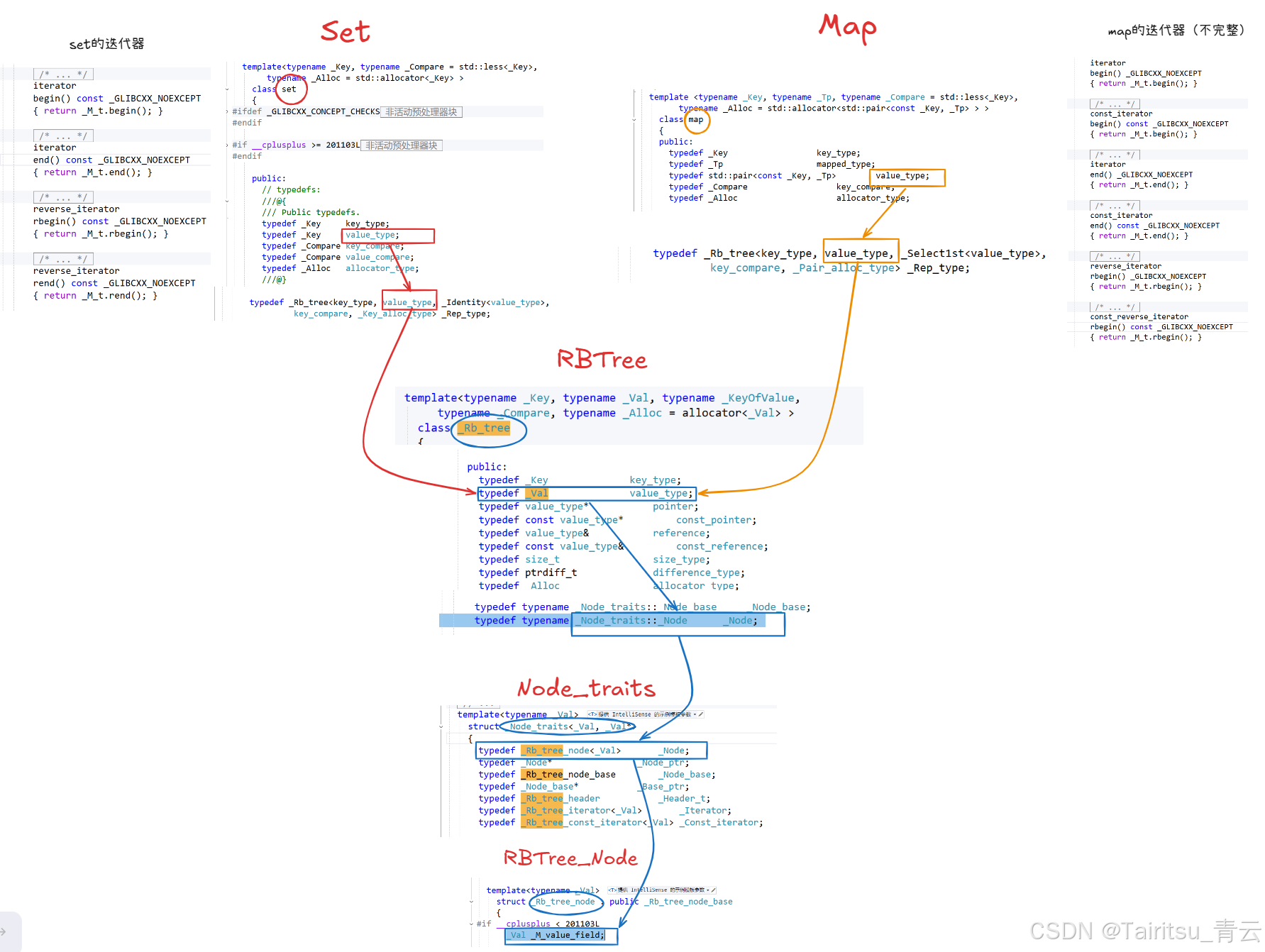
在GCC 15.2.0版本中,map和set的源代码在map/set/stl_map.h/stl_set.h/stl_tree.h等⼏个头⽂件里。通过阅读源代码我们可以大致理解,set和map的底层套用了同一个红黑树 的模板。其中,为了兼容map的key-value键值对,set内部将key同时命名为key和value,以便于后续调用红黑树统一操作,实现了代码复用。以下是源码的大致框架:
2. 模拟实现set和map
2.1 结构和功能
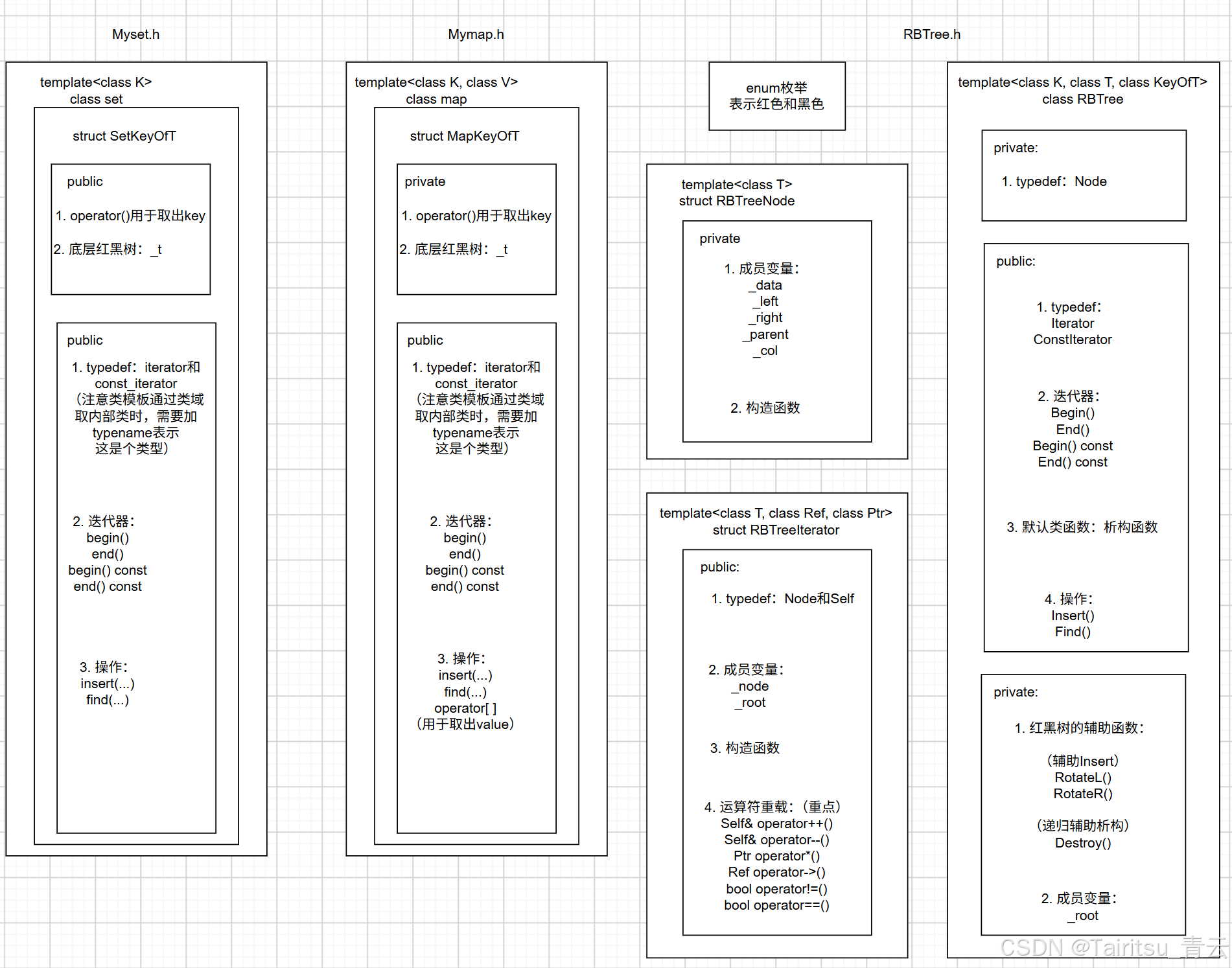
这里主要实现的是基于同一个红黑树模板的set和map,包含以下功能:
- 正向iterator和const_iterator
- 插入和查找操作
代码结构如下:
2.2 代码细节介绍
部分代码在源代码的基础上进行了微调:
- key的参数设置为
K,value的参数设置为V,红黑树使用T(type)作为数据类型。 - 由于红黑树需要同时支持set和map的操作,因此在
insert内部我们无法直接比较,需要实现:容器为set时比较key ,容器为map时取出pair中的key 进行比较。因此我们在set和map层分别实现一个仿函数,用于取出key进行比较。 - set的迭代器不支持修改key,需要把第二个模板参数改成
const K;而map的迭代器不支持修改key但支持修改value,因此第二个参数需设置为pair<const K, V>。
除此之外,代码还支持iterator的实现,其大致框架和list的iterator是一致的。即用类型封装节点的指针,再通过重载运算符达到迭代器像指针一样访问的行为。重点在于operator++和operator--的实现:
2.1 重载operator++
之前我们在学习如何使用set的过程中,我们得知迭代器走的是中序遍历(左->根->右) ,因此在重载++时,核心逻辑就是只看局部,只考虑当前中序需要访问的下一个节点。分类讨论如下:
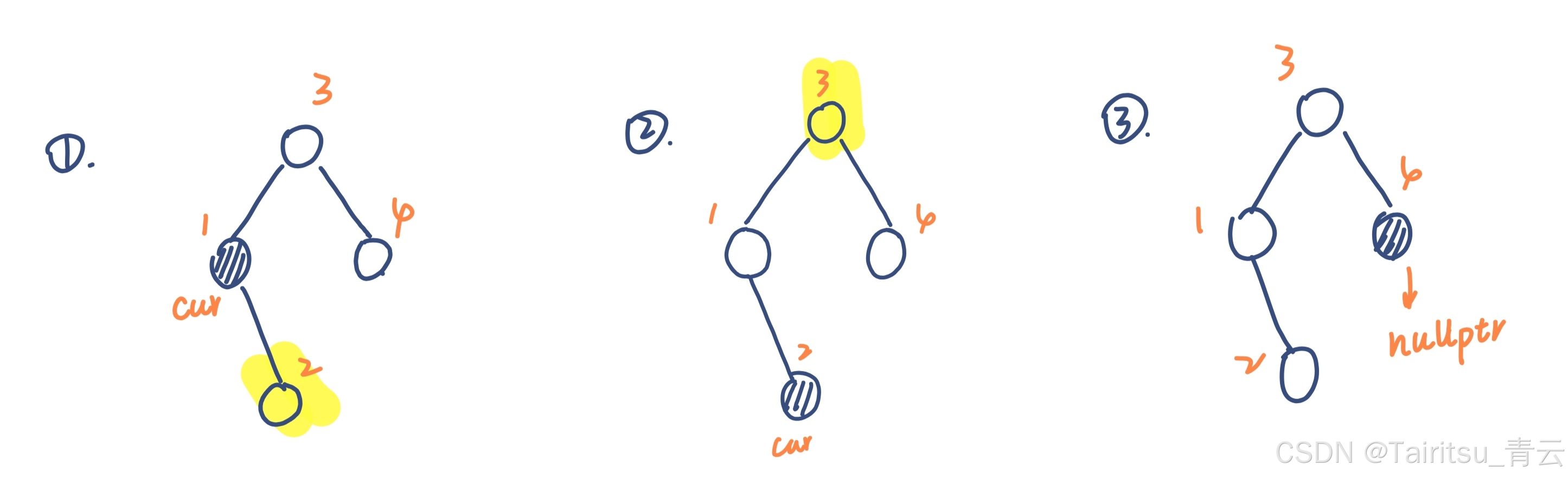
- 当右子树存在时,下一个节点为右 子树的最左节点;
- 当右子树不存在时,向上遍历直至该节点为左孩子,下一个节点即为该节点的父节点。特殊情况 :如果找不到符合标准的节点(遍历到根,此时
parent为nullptr,cur为root),说明下一个节点为end(),此时赋值parent空指针也是符合结果的,因此归为一类。
代码如下:
cpp
//重载++
Self& operator++()
{
    //1.右不为空,则下一个节点为右子树的最左节点
    if (_node->_right)
    {
        Node* leftmost = _node->_right;
        while (leftmost && leftmost->_left)
        {
            leftmost = leftmost->_left;
        }

        _node = leftmost;
    }
    //2.右为空,向上查找直至该节点为左孩子时,返回父节点
    else
    {
        Node* cur = _node;
        Node* parent = _node->_parent;
        while (parent && cur == parent->_right)
        {
            cur = parent;
            parent = parent->_parent;
        }

        _node = parent; //包含了最后一个节点的特殊情况
    }

    return *this;
}
2.2 重载operator--
operator--和operator++的逻辑类似,反过来即可。代码实现如下:
cpp
//重载--
Self& operator--()
{
    //1.节点为end(),则找树的最右侧节点
    if (_node == nullptr)
    {
        Node* rightmost = _root;
        while (rightmost && rightmost->_right)
        {
            rightmost = rightmost->_right;
        }

        _node = rightmost;
    }
    //2.左子树不为空,找左子树的最右节点
    else if (_node->_left)
    {
        Node* rightmost = _node->_left;
        while (rightmost->_right)
        {
            rightmost = rightmost->_right;
        }

        _node = rightmost;
    }
    //2.左子树为空,向上查找直至该节点为右孩子时,返回父节点
    else
    {
        Node* cur = _node;
        Node* parent = _node->_parent;
        while (parent && cur != parent->_right)
        {
            cur = parent;
            parent = parent->_parent;
        }

        _node = parent;
    }

    return *this;
}
2.3 map中operator 的实现
map是支持通过key查找value的,而实现这个功能还需要insert返回值的支持:pair<Iterator, bool> Insert(const T& data)
通过pair中的iterator即可获取对应的value。
cpp
//已知key存在,则可以通过插入的返回值反向找到value
V& operator[](const K& key)
{
    pair<iterator, bool> ret = _t.Insert({ key, V() }); //V()表示value的缺省值
	  return (ret.first)->second; //返回值是iterator的value
}
cpp
pair<iterator, bool> insert(const pair<K, V>& kv)
{
		return _t.Insert(kv);
}
3. 代码实现
3.1 mySet.h
cpp
#pragma once
#include<utility>
#include "RBTree.h"
using namespace std;


namespace mzh
{
	template<class K>
	class set
	{
		//仿函数SetKeyOfT,用于取出set中的key或者map中的pair.first
		struct SetKeyOfT
		{
			const K& operator()(const K& key) const
			{
				return key;
			}
		};

	public:
		//红黑树迭代器中的类型名,加typename保证语法正确,设置const K以免key被修改
		typedef typename RBTree<K, const K, SetKeyOfT>::Iterator iterator;
		typedef typename RBTree<K, const K, SetKeyOfT>::ConstIterator const_iterator;

		//迭代器begin
		iterator begin()
		{
			return _t.Begin();
		}

		//迭代器end
		iterator end()
		{
			return _t.End();
		}

		//const迭代器begin
		const_iterator begin() const
		{
			return _t.Begin();
		}

		//const迭代器end
		const_iterator end() const
		{
			return _t.End();
		}

		//插入
		pair<iterator, bool> insert(const K& key)
		{
			//_t.Insert(key);
			return _t.Insert(key);
		}

		//查找
		iterator find(const K& key)
		{
			return _t.Find(key);
		}

	private:
		RBTree<K, const K, SetKeyOfT> _t; //加const避免插入的返回值被修改
	};
}
3.2 myMap.h
cpp
#pragma once
#include<utility>
#include "RBTree.h"
using namespace std;

namespace mzh
{
	template<class K, class V>
	class map
	{
		struct MapKeyOfT
		{
			const K& operator()(const pair<K, V>& kv)
			{
				return kv.first;
			}
		};

	public:
		typedef typename RBTree<K, pair<const K, V>, MapKeyOfT>::Iterator iterator;
		typedef typename RBTree<K, pair<const K, V>, MapKeyOfT>::ConstIterator const_iterator;

		iterator begin()
		{
			return _t.Begin();
		}

		iterator end()
		{
			return _t.End();
		}

		const_iterator begin() const
		{
			return _t.Begin();
		}

		const_iterator end() const
		{
			return _t.End();
		}

		pair<iterator, bool> insert(const pair<K, V>& kv)
		{
			return _t.Insert(kv);
		}

		iterator find(const K& key)
		{
			return _t.Find(key);
		}

		//出函数后,返回对象未被销毁时才可以返回引用
		//已知key存在,则可以通过插入的返回值反向找到value
		V& operator[](const K& key)
		{
			pair<iterator, bool> ret = _t.Insert({ key, V() }); //V()表示value的缺省值
			return (ret.first)->second; //返回值是iterator的value
		}

	private:
		//底层红黑树:键的类型,节点存储的数据类型,键萃取器(从pair中取出key)
		RBTree<K, pair<const K, V>, MapKeyOfT> _t;
	};
}
3.3 RBTree.h
cpp
#pragma once
#include<utility>
#include<iostream>
using namespace std;
namespace mzh
{
//枚举值表示颜色
enum Colour
{
RED,
BLACK
};
//节点
template<class T>
struct RBTreeNode
{
public:
T _data; //让节点可以同时用于set(key)和map(pair)
RBTreeNode<T>* _left;
RBTreeNode<T>* _right;
RBTreeNode<T>* _parent;
Colour _col;
//构造函数
RBTreeNode(const T& data)
:_data(data)
, _left(nullptr)
, _right(nullptr)
, _parent(nullptr)
, _col(RED)
{
}
};
//迭代器
template<class T, class Ref, class Ptr>
struct RBTreeIterator
{
public:
typedef RBTreeNode<T> Node; //节点类型
typedef RBTreeIterator<T, T&, T*> Self; //红黑树迭代器(根据RBTreeIterator的模板)
Node* _node;
Node* _root;
//构造
RBTreeIterator(Node* node, Node* root)
:_node(node)
, _root(root)
{
}
//重载++
Self& operator++()
{
//1.右不为空,则下一个节点为右子树的最左节点
if (_node->_right)
{
Node* leftmost = _node->_right;
while (leftmost && leftmost->_left)
{
leftmost = leftmost->_left;
}
_node = leftmost;
}
//2.右为空,向上查找直至该节点为左孩子时,返回父节点
else
{
Node* cur = _node;
Node* parent = _node->_parent;
while (parent && cur == parent->_right)
{
cur = parent;
parent = parent->_parent;
}
_node = parent;
}
return *this;
}
//重载--
Self& operator--()
{
//1.节点为end(),则找树的最右侧节点
if (_node == nullptr)
{
Node* rightmost = _root;
while (rightmost && rightmost->_right)
{
rightmost = rightmost->_right;
}
_node = rightmost;
}
//2.左子树不为空,找左子树的最右节点
else if (_node->_left)
{
Node* rightmost = _node->_left;
while (rightmost->_right)
{
rightmost = rightmost->_right;
}
_node = rightmost;
}
//2.左子树为空,向上查找直至该节点为右孩子时,返回父节点
else
{
Node* cur = _node;
Node* parent = _node->_parent;
while (parent && cur != parent->_right)
{
cur = parent;
parent = parent->_parent;
}
_node = parent;
}
return *this;
}
//重载*:返回整个对象(解引用)
Ref operator*()
{
return _node->_data;
}
//重载->:返回对象内部成员的地址
Ptr operator->()
{
return &_node->_data;
}
//重载!=
bool operator!=(const Self& s) const
{
return _node != s._node;
}
//重载==
bool operator==(const Self& s) const
{
return _node == s._node;
}
};
//树
template<class K, class T, class KeyOfT> //KeyOfT是仿函数类型
class RBTree
{
private:
typedef RBTreeNode<T> Node;
Node* _root = nullptr;
public:
typedef RBTreeIterator<T, T&, T*> Iterator;
typedef RBTreeIterator<T, const T&, const T*> ConstIterator;
//迭代器Begin:找树的最左节点
Iterator Begin()
{
Node* leftmost = _root;
while (leftmost && leftmost->_left)
{
leftmost = leftmost->_left;
}
Iterator ret = Iterator(leftmost, _root);
return ret; //或者直接返回构造return RBTreeIterator(leftmost, _root);
}
//迭代器End:根节点的_parent,即空指针
Iterator End()
{
return Iterator(nullptr, _root);
}
//迭代器ConstBegin
ConstIterator Begin() const
{
Node* leftmost = _root;
while (leftmost && leftmost->_left)
{
leftmost = leftmost->_left;
}
return ConstIterator(leftmost, _root);
}
//迭代器ConstEnd
ConstIterator End() const
{
return ConstIterator(nullptr, _root);
}
//析构函数
~RBTree()
{
Destroy(_root);
_root = nullptr;
}
//插入
pair<Iterator, bool> Insert(const T& data)
{
//根
if (!_root)
{
_root = new Node(data);
_root->_col = BLACK;
return { Iterator(_root, _root), true }; //改成iterator的形式
}
//非根
KeyOfT kot; //比较逻辑(可以像类一样使用)
Node* cur = _root;
Node* parent = nullptr;
while (cur)
{
if (kot(cur->_data) < kot(data))
{
parent = cur;
cur = cur->_right;
}
else if (kot(cur->_data) > kot(data))
{
parent = cur;
cur = cur->_left;
}
else
{
return { Iterator(cur, _root), false }; //改成iterator的形式
}
}
//新建节点
cur = new Node(data);
cur->_col = RED;
if (kot(parent->_data) < kot(data)) //右
{
parent->_right = cur;
}
else //左
{
parent->_left = cur;
}
cur->_parent = parent;
//旋转调整
while (parent && parent->_col == RED)
{
Node* grandfather = parent->_parent;
//p在g左
if (parent == grandfather->_left)
{
Node* uncle = grandfather->_right;
//u存在且为红->变色继续向上处理
if (uncle && uncle->_col == RED)
{
parent->_col = BLACK;
uncle->_col = BLACK;
grandfather->_col = RED;
cur = grandfather;
parent = grandfather->_parent;
}
else //u不存在或为黑
{
if (cur == parent->_left)
{
RotateR(grandfather);
parent->_col = BLACK;
grandfather->_col = RED;
}
else
{
RotateL(parent);
RotateR(grandfather);
cur->_col = BLACK;
grandfather->_col = RED;
}
break;
}
}
//p在g右
else
{
Node* uncle = grandfather->_left;
//仅变色
if (uncle && uncle->_col == RED)
{
parent->_col = BLACK;
uncle->_col = BLACK;
grandfather->_col = RED;
cur = parent;
parent = grandfather;
}
else //旋转 + 变色
{
if (cur == parent->_right)
{
RotateL(grandfather);
parent->_col = BLACK;
grandfather->_col = RED;
}
else
{
RotateR(parent);
RotateL(grandfather);
cur->_col = BLACK;
grandfather->_col = RED;
}
break;
}
}
}
//一律设置为黑
_root->_col = BLACK;
return { Iterator(cur, _root), true }; //改成iterator的形式
}
//通过key查找
Iterator Find(const K& key)
{
KeyOfT kot; //比较逻辑(可以像类一样使用)
Node* cur = _root;
while (cur)
{
if (kot(cur->_data) > key)
{
cur = cur->_left;
}
else if (kot(cur->_data) < key)
{
cur = cur->_right;
}
else
{
return Iterator(cur, _root);
}
}
return End();
}
private:
//右旋
void RotateR(Node* pParent)
{
Node* parent = pParent;
Node* subL = parent->_left;
Node* subLR = subL->_right;
//1.parent和subLR
parent->_left = subLR;
if (subLR)
{
subLR->_parent = parent;
}
Node* parentParent = parent->_parent;
//2.parent和subL
parent->_parent = subL;
subL->_right = parent;
//3.subL和parentParent
if (parentParent == nullptr)
{
_root = subL;
subL->_parent = nullptr;
}
else
{
if (parentParent->_left == parent)
{
parentParent->_left = subL;
}
else
{
parentParent->_right = subL;
}
subL->_parent = parentParent;
}
}
//左旋
void RotateL(Node* pParent)
{
Node* parent = pParent;
Node* subR = parent->_right;
Node* subRL = subR->_left;
//1.parent和subRL
parent->_right = subRL;
if (subRL)
{
subRL->_parent = parent;
}
//2.parent和subR
Node* parentParent = parent->_parent;
parent->_parent = subR;
subR->_left = parent;
//3.subR和parentParent
if (parentParent == nullptr)
{
_root = subR;
subR->_parent = nullptr;
}
else
{
if (parentParent->_left == parent)
{
parentParent->_left = subR;
}
else
{
parentParent->_right = subR;
}
subR->_parent = parentParent;
}
}
//递归销毁
void Destroy(Node* root)
{
if (root == nullptr) return;
Destroy(root->_left);
Destroy(root->_right);
delete root;
}
};
}3.4 test_setmap.cpp
cpp
#include<iostream>
#include<utility>
#include "myMap.h"
#include "mySet.h"
#include "RBTree.h"

using namespace std;
using namespace mzh;

void Print(const set<int>& s)
{
    set<int>::const_iterator it = s.end();
    while (it != s.begin())
    {
        --it;
        // 不⽀持修改
        //*it += 2;

        cout << *it << " ";
    }
    cout << endl;
}

void test_set()
{
    set<int> s;
    int a[] = { 4, 2, 6, 1, 3, 5, 15, 7, 16, 14 };
    int b[] = { 72, 19, 45, 8, 93, 31, 57, 62, 14, 87 };
    for (auto e : a)
    {
        s.insert(e);
    }
    for (auto e : b)
    {
        s.insert(e);
    }

    for (auto e : s)
    {
        cout << e << " ";
    }
    cout << endl;

    Print(s);
}

void test_map()
{
    map<string, string> dict;
    dict.insert({ "sort", "排序" });
    dict.insert({ "left", "左边" });
    dict.insert({ "right", "右边" });

    dict["left"] = "左边,剩余";
    dict["insert"] = "插⼊";
    dict["string"];

    map<string, string>::iterator it = dict.begin();
    while (it != dict.end())
    {
        // 不能修改first,可以修改second
        //it->first += 'x';
        it->second += " hehe";

        cout << it->first << ":" << it->second << endl;
        ++it;
    }
    cout << endl;
}


int main()
{
    cout << "test_set:" << endl;
    test_set();
    cout << endl;
    cout << "test_map:" << endl;
    test_map();
    cout << endl;
    cout << "end" << endl;
}