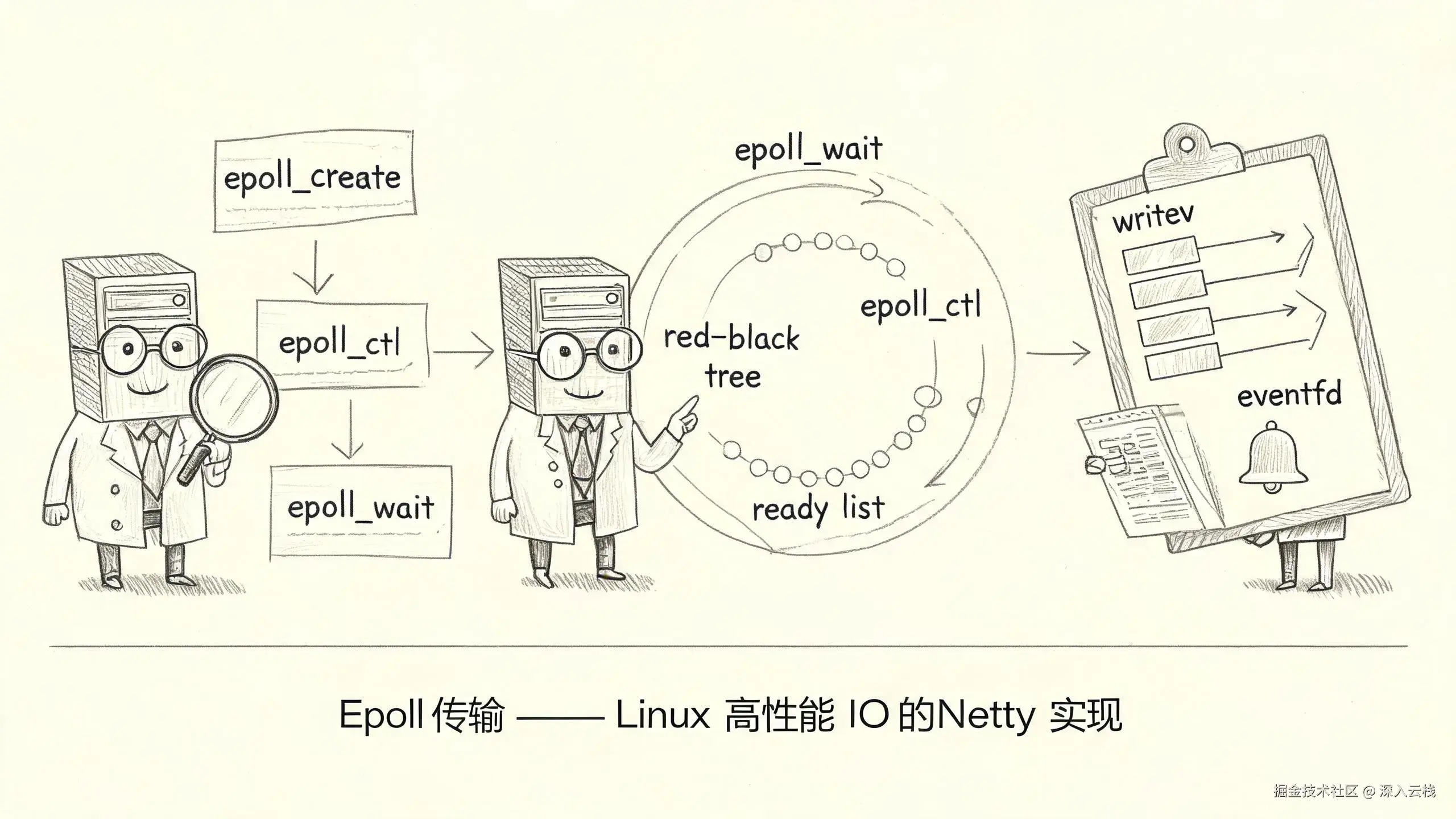
在 Linux 平台上,JDK 自带的 Selector 底层基于 epoll 系统调用,但受限于 JDK NIO 的抽象层设计------SelectionKey 遍历、interestOps 管理、Selector.select() 的唤醒机制------无法充分发挥 epoll 的全部性能潜力。Netty 早在 4.0 时代就引入了 Epoll 原生传输,绕过 JDK 的 Selector 抽象直接调用 epoll_create、epoll_ctl、epoll_wait 系统调用,配合 eventfd 唤醒、timerfd 定时、writev 批量写入等 Linux 特性,在事件获取、批量写入、内存拷贝三个维度上全面超越 JDK NIO 实现。到了 4.2 版本,Epoll 传输进一步适配 IoHandler/IoHandle/IoRegistration 三层抽象架构,EpollIoHandler 取代旧版 EpollEventLoop 成为事件循环的核心,EpollMode.EDGE_TRIGGERED 被废弃并统一使用水平触发模式。本文将沿着"内核机制 → JNI 桥接 → 事件循环 → 事件处理 → Channel 实现 → 批量写入 → 接收优化"的递进逻辑,从 epoll 系统调用的底层原理出发,逐一分析 EpollIoHandler 的事件循环、EpollEventArray 的直接内存设计、EpollSocketChannel 的读写实现、doWriteMultiple 的批量写入优化、EpollRecvByteAllocatorHandle 的接收缓冲区自适应,最后串联从 EpollIoHandler 到 AbstractEpollUnsafe 的完整 IO 处理链路。本文围绕 epoll 传输的核心实现,逐一解答以下问题:
- Netty Epoll 传输如何绕过 JDK
Selector,通过 JNI 直接调用epoll_create/epoll_ctl/epoll_wait系统调用?EpollIoHandler在事件获取、分发、唤醒、定时四个环节上相比NioIoHandler做了哪些结构性改进? EpollEventArray如何通过直接内存(Buffer.allocateDirectBufferWithNativeOrder)和Unsafe访问,将struct epoll_event数组直接映射到 Java 堆外内存,实现零拷贝的事件读取?AbstractEpollStreamChannel.doWriteMultiple如何利用IovArray和writev系统调用实现批量写入,相比逐ByteBuf写入减少多少系统调用次数?EpollRecvByteAllocatorHandle如何利用 epoll 水平触发特性,在单次epollInReady中通过maybeMoreDataToRead()和continueReading()循环读尽数据?
一、Epoll 内核机制速览:epoll_create/epoll_ctl/epoll_wait 三件套
Linux IO 多路复用的演进经历了三个阶段。最早的 select 系统调用要求内核遍历所有注册的文件描述符(时间复杂度 O(n)),且 fd_set 位图默认仅支持 1024 个文件描述符。poll 通过 struct pollfd 数组解除了数量限制,但每次调用仍需拷贝整个数组到内核并遍历所有条目,依然是 O(n) 复杂度。epoll 的出现彻底改变了这一局面:它将"注册文件描述符"和"等待就绪事件"拆分为两个独立的系统调用------epoll_ctl 和 epoll_wait,内核内部维护一棵红黑树存储所有注册的 fd,就绪的 fd 被放入一个双向链表,epoll_wait 仅需从就绪链表中取出事件,时间复杂度 O(1)。
epoll 的核心 API 由三个系统调用组成:
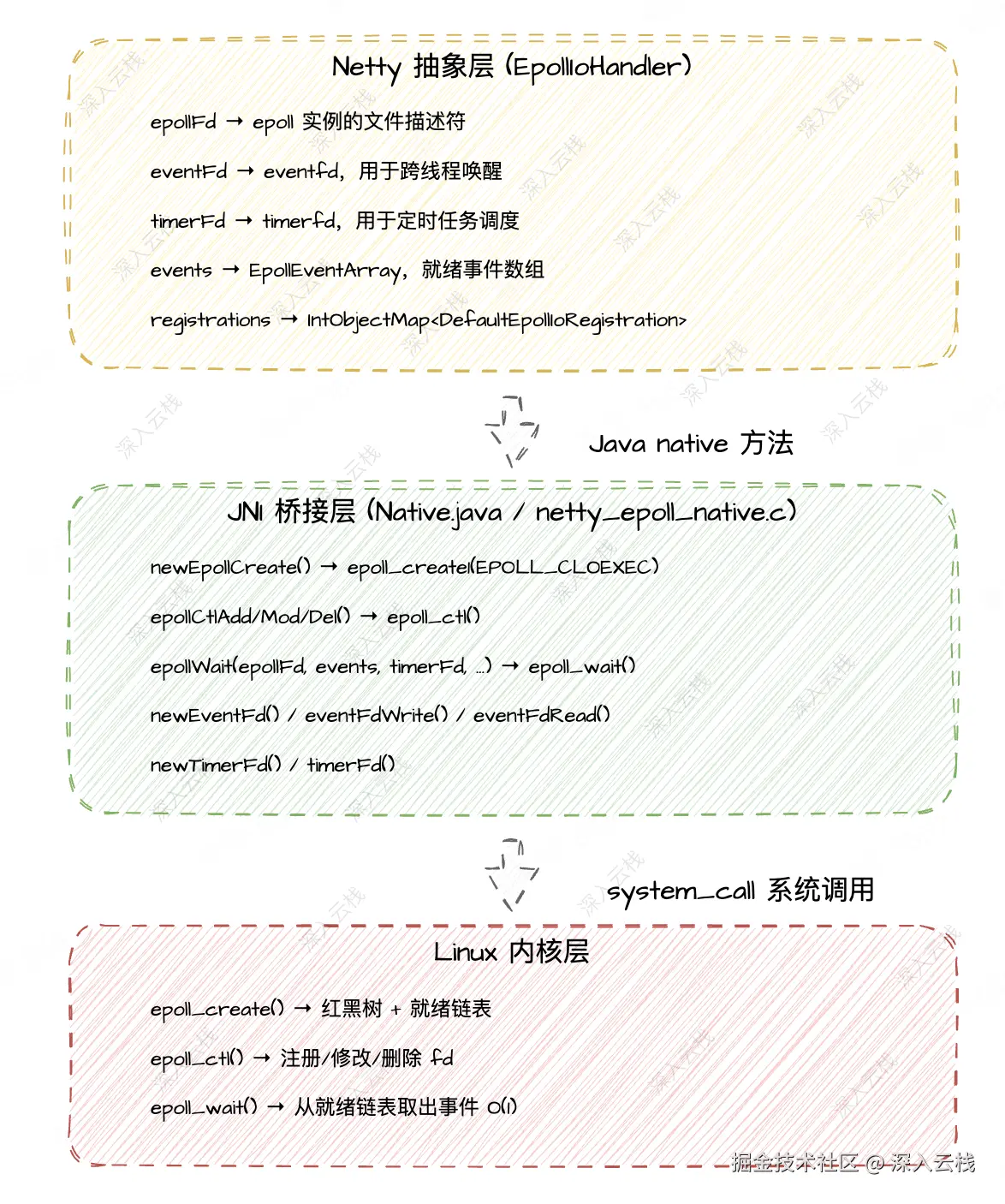
epoll_create(int size) / epoll_create1(int flags) :在内核创建一个 epoll 实例,返回一个 epoll 文件描述符(epollFd)。epoll_create1 支持 EPOLL_CLOEXEC 标志,确保在 exec 系统调用时自动关闭 epoll 实例,避免文件描述符泄漏。Netty 在 JNI 层使用的是 epoll_create1(EPOLL_CLOEXEC)。
epoll_ctl(int epfd, int op, int fd, struct epoll_event *event) :向 epoll 实例注册(EPOLL_CTL_ADD)、修改(EPOLL_CTL_MOD)或删除(EPOLL_CTL_DEL)文件描述符。每次调用需要指定关注的事件类型(位掩码)和关联的用户数据。
epoll_wait(int epfd, struct epoll_event *events, int maxevents, int timeout):阻塞等待就绪事件,返回就绪事件的数量。仅返回活跃的 fd 而非遍历全部注册的 fd,这是 epoll 相比 select/poll 最大的性能优势。
struct epoll_event 是 epoll 的核心数据结构。Linux 内核 UAPI 头文件(include/uapi/linux/eventpoll.h)中的定义为:
c
struct epoll_event {
    __poll_t events;   // 事件标志(4 字节,等价于 unsigned int)
    __u64    data;     // 用户数据(8 字节)
} EPOLL_PACKED;
glibc 用户空间头文件(<sys/epoll.h>)将其中的 data 字段封装为联合体,提供更灵活的访问方式:
c
typedef union epoll_data {
    void    *ptr;
    int      fd;
    uint32_t u32;
    uint64_t u64;
} epoll_data_t;

struct epoll_event {
    uint32_t     events;   // Epoll events (4 bytes)
    epoll_data_t data;     // User data variable (8 bytes)
};
两者在内存布局上完全等价(都是 4 + 8 = 12 字节),glibc 的联合体只是访问同一个 8 字节区域的不同视图。
事件类型包括 EPOLLIN(可读)、EPOLLOUT(可写)、EPOLLERR(错误)、EPOLLRDHUP(对端关闭连接或半关闭写端)等。这些标志通过位掩码组合使用。
水平触发(Level Triggered, LT)与边缘触发(Edge Triggered, ET)是 epoll 的两种工作模式。LT 模式下,只要文件描述符上还有未处理的数据,epoll_wait 就会持续返回该事件;ET 模式下,事件仅在新数据到达或状态变化时触发一次,要求应用层必须使用非阻塞 IO 并循环读尽。Netty 4.2 中 EpollMode.EDGE_TRIGGERED 已被废弃,统一使用 LT 模式。原因在于:ET 模式下应用层处理复杂度高,必须在每次事件触发时循环读尽数据,否则可能永久丢失事件;而 LT 在 epoll 下性能已足够优秀,统一使用 LT 降低了维护成本并避免了边界场景下的 bug。
除了核心的 epoll 三件套,Linux 还提供了两个重要的辅助机制:
eventfd :比 pipe 或 socketpair 更轻量的唤醒机制。创建一个 eventfd 文件描述符并注册到 epoll 实例,调用 write(eventfd, 1) 即可唤醒 epoll_wait,read(eventfd) 消费事件。eventfd 仅需一个文件描述符(pipe 需要两个),且内核开销更小。
timerfd :将定时器转化为文件描述符的机制。timerfd_create(CLOCK_MONOTONIC, TFD_NONBLOCK) 创建一个定时器 fd,timerfd_settime() 设置超时时间,超时后该 fd 变为可读,epoll_wait 可以统一监听 IO 事件和定时器事件。这意味着 Netty 的定时任务调度不需要额外的 ScheduledExecutorService 线程,而是融入 epoll 的事件模型中。
以下是这三层架构的映射关系:
二、Epoll 与 Native:可用性检测与 JNI 桥接
Epoll 类是 epoll 可用性检测的门面类,不包含任何业务逻辑,主要提供五个静态方法:isAvailable()、ensureAvailability()、unavailabilityCause()、isTcpFastOpenClientSideAvailable()、isTcpFastOpenServerSideAvailable()。其核心职责是在 JVM 启动时通过 JNI 调用验证当前环境是否支持 epoll 原生传输。
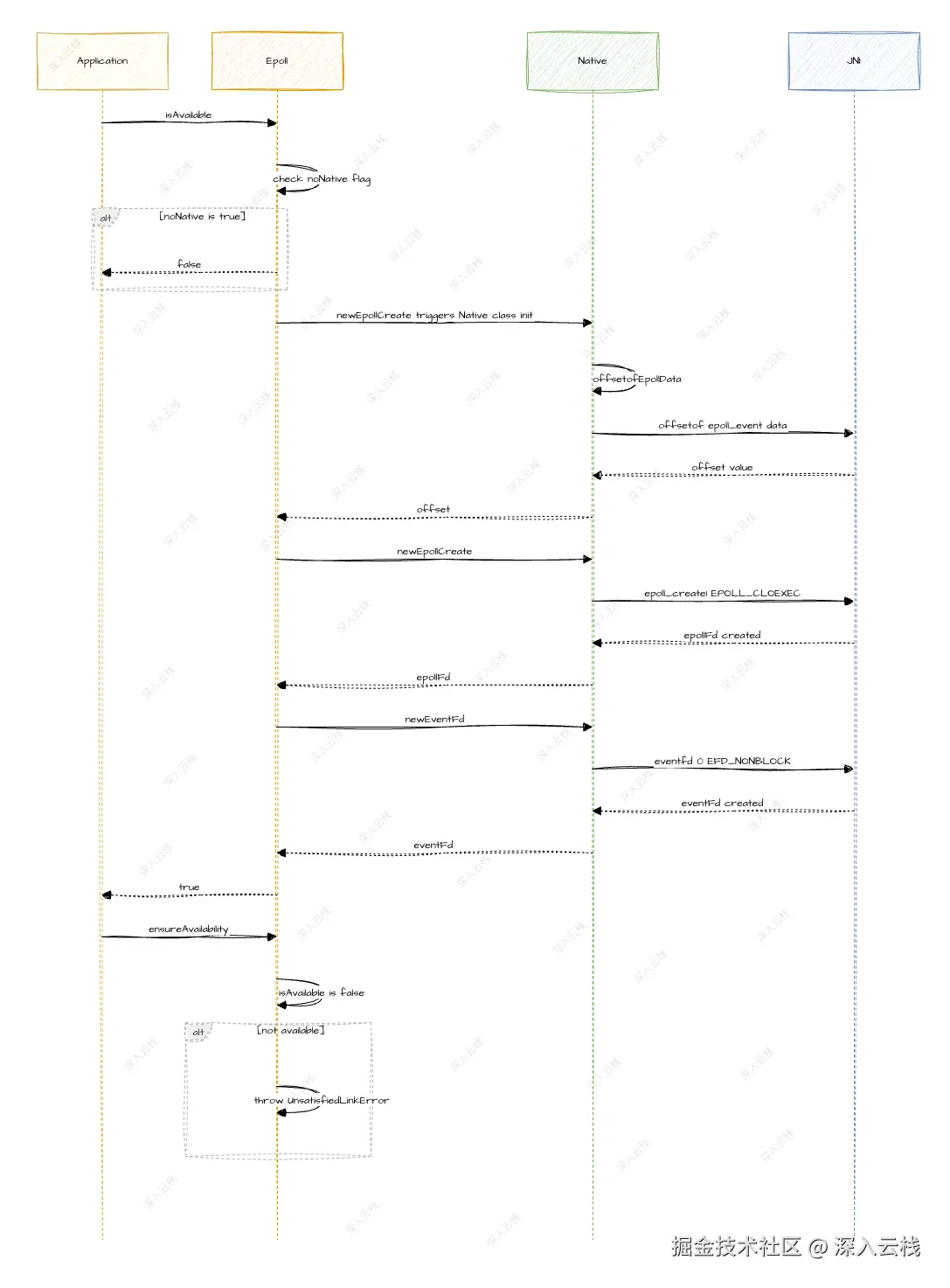
Epoll.isAvailable() 的检测逻辑在类加载时的静态初始化块中完成。检测分为以下步骤:
- 检查
noNative标志 :若io.netty.transport.noNative系统属性为true,则直接标记不可用,跳过所有 JNI 检测。 - 调用
Native.newEpollCreate():通过 JNI 调用epoll_create1(EPOLL_CLOEXEC)创建临时 epoll 实例,验证内核是否支持 epoll 系统调用。 - 调用
Native.newEventFd():通过 JNI 调用eventfd(0, EFD_NONBLOCK)创建临时 eventfd,验证内核是否支持 eventfd。 - 清理临时资源 :无论成功与否,在
finally块中关闭临时创建的 epollFd 和 eventFd。
此外,Native.offsetofEpollData() 在 JNI 库加载时就被调用,用于验证 epoll_event 结构体的内存布局偏移量,确保 Java 侧可以直接通过偏移量访问 native 内存中的事件数据。
时序图:Epoll 可用性检测的完整流程
以下是 Epoll 类的静态初始化块核心代码:
java
io.netty.channel.epoll.Epoll

// 静态初始化块:通过 JNI 调用检测 epoll 可用性
static {
    Throwable cause = null;

    if (SystemPropertyUtil.getBoolean("io.netty.transport.noNative", false)) {
        // 通过系统属性显式禁用原生传输
        cause = new UnsupportedOperationException(
                "Native transport was explicit disabled with -Dio.netty.transport.noNative=true");
    } else {
        FileDescriptor epollFd = null;
        FileDescriptor eventFd = null;
        try {
            // 创建临时 epoll 实例,验证内核支持
            epollFd = Native.newEpollCreate();
            // 创建临时 eventfd,验证内核支持
            eventFd = Native.newEventFd();
        } catch (Throwable t) {
            cause = t;
        } finally {
            // 无论成功与否,释放临时资源
            if (epollFd != null) {
                try {
                    epollFd.close();
                } catch (Exception ignore) {
                    // ignore
                }
            }
            if (eventFd != null) {
                try {
                    eventFd.close();
                } catch (Exception ignore) {
                    // ignore
                }
            }
        }
    }
    UNAVAILABILITY_CAUSE = cause;
}
ensureAvailability() 在 EpollIoHandler 的实例初始化块中被调用,形成双重保障:
java
io.netty.channel.epoll.Epoll

// 不可用时抛出 UnsatisfiedLinkError,确保在使用 Epoll 前 JNI 已正确加载
public static void ensureAvailability() {
    if (UNAVAILABILITY_CAUSE != null) {
        throw (Error) new UnsatisfiedLinkError(
                "failed to load the required native library").initCause(UNAVAILABILITY_CAUSE);
    }
}
Native 类是 JNI 桥接层的核心,所有 native 方法声明集中在此。关键的 epoll 事件常量通过 NativeStaticallyReferencedJniMethods 静态绑定,避免每次 JNI 调用的开销:
java
io.netty.channel.epoll.Native

// epoll 事件标志:通过静态 JNI 方法绑定,避免每次调用 JNI
public static final int EPOLLIN = epollin();        // 可读
public static final int EPOLLOUT = epollout();       // 可写
public static final int EPOLLRDHUP = epollrdhup();    // 对端关闭
public static final int EPOLLET = epollet();         // 边缘触发标志,用于 eventFd/timerFd 内部注册
public static final int EPOLLERR = epollerr();       // 错误
Native.epollWait() 的返回值设计是一个精巧的 packed long 编码。其核心版本 epollWait(epollFd, events, timerFd, timeoutSec, timeoutNs, millisThreshold) 返回一个 long 值,高 32 位是就绪事件数量,低 8 位是 timer 标志,一次 JNI 调用同时返回事件数和定时器状态,减少 JNI 调用次数:
java
io.netty.channel.epoll.Native

// 从 packed long 中提取就绪事件数量(高 32 位)
static int epollReady(long result) {
    return (int) (result >> 32);
}

// 从 packed long 中提取 timer 标志(低 8 位)
static boolean epollTimerWasUsed(long result) {
    return (result & 0xff) != 0;
}
三、EpollIoHandler:epoll 事件循环的核心实现
EpollIoHandler 是 epoll 传输的事件循环核心,其类声明为 public class EpollIoHandler implements IoHandler。它持有 epoll 实例(epollFd)、唤醒 fd(eventFd)、定时器 fd(timerFd)、注册信息映射(IntObjectMap<DefaultEpollIoRegistration>)、就绪事件数组(EpollEventArray)以及 NativeArrays 聚合对象。
EpollIoHandler 的实例初始化块中调用了 Epoll.ensureAvailability(),确保该类只能在 Linux 平台(且 epoll 可用时)被实例化:
java
io.netty.channel.epoll.EpollIoHandler

// 实例初始化块:确保 epoll 可用,实现双重保障
{
    Epoll.ensureAvailability();
}
3.1 openFileDescriptors():创建 epoll 实例
openFileDescriptors() 方法负责创建 epoll 实例、eventfd 和 timerfd,并将 eventFd 和 timerFd 注册到 epoll 实例中。注意 eventFd 和 timerFd 都使用了 EPOLLET(边缘触发)模式,因为只需要获取一次通知,不需要循环读取:
java
io.netty.channel.epoll.EpollIoHandler#openFileDescriptors

// 创建 epoll 实例、eventfd 和 timerfd,支持 CRaC 检查点恢复
public void openFileDescriptors() {
    boolean success = false;
    FileDescriptor epollFd = null;
    FileDescriptor eventFd = null;
    FileDescriptor timerFd = null;
    try {
        this.epollFd = epollFd = Native.newEpollCreate();
        this.eventFd = eventFd = Native.newEventFd();
        try {
            // eventFd 使用 EPOLLET 边缘触发,只需一次通知
            Native.epollCtlAdd(epollFd.intValue(), eventFd.intValue(),
                    Native.EPOLLIN | Native.EPOLLET);
        } catch (IOException e) {
            throw new IllegalStateException("Unable to add eventFd filedescriptor to epoll", e);
        }
        this.timerFd = timerFd = Native.newTimerFd();
        try {
            // timerFd 同样使用 EPOLLET 边缘触发
            Native.epollCtlAdd(epollFd.intValue(), timerFd.intValue(),
                    Native.EPOLLIN | Native.EPOLLET);
        } catch (IOException e) {
            throw new IllegalStateException("Unable to add timerFd filedescriptor to epoll", e);
        }
        success = true;
    } finally {
        if (!success) {
            // 任何一步失败,关闭已创建的文件描述符
            closeFileDescriptor(epollFd);
            closeFileDescriptor(eventFd);
            closeFileDescriptor(timerFd);
        }
    }
}
3.2 nextWakeupNanos 三段式唤醒状态机
nextWakeupNanos 是 EpollIoHandler 的核心并发控制机制,通过 AtomicLong 的 CAS 操作实现无锁状态转换。三种状态:
- AWAKE (-1L):表示 EventLoop 已唤醒,正在处理任务或 IO 事件。
- NONE (Long.MAX_VALUE) :表示无定时任务,
epoll_wait可以无限期阻塞。 - 其他值 T :表示有定时任务,
epoll_wait应该在 T 时刻唤醒。
wakeup() 方法利用这个状态机避免重复写入 eventfd:
java
io.netty.channel.epoll.EpollIoHandler#wakeup

// 三段式唤醒状态机:仅在非 AWAKE 状态时才写入 eventfd
public void wakeup() {
    // 同线程无需唤醒;跨线程则通过 CAS 检测状态
    if (!executor.isExecutorThread(Thread.currentThread())
            && nextWakeupNanos.getAndSet(AWAKE) != AWAKE) {
        // 只有旧值非 AWAKE 时才写入 eventfd,避免重复写入
        Native.eventFdWrite(eventFd.intValue(), 1L);
    }
}
3.3 run() 核心事件循环
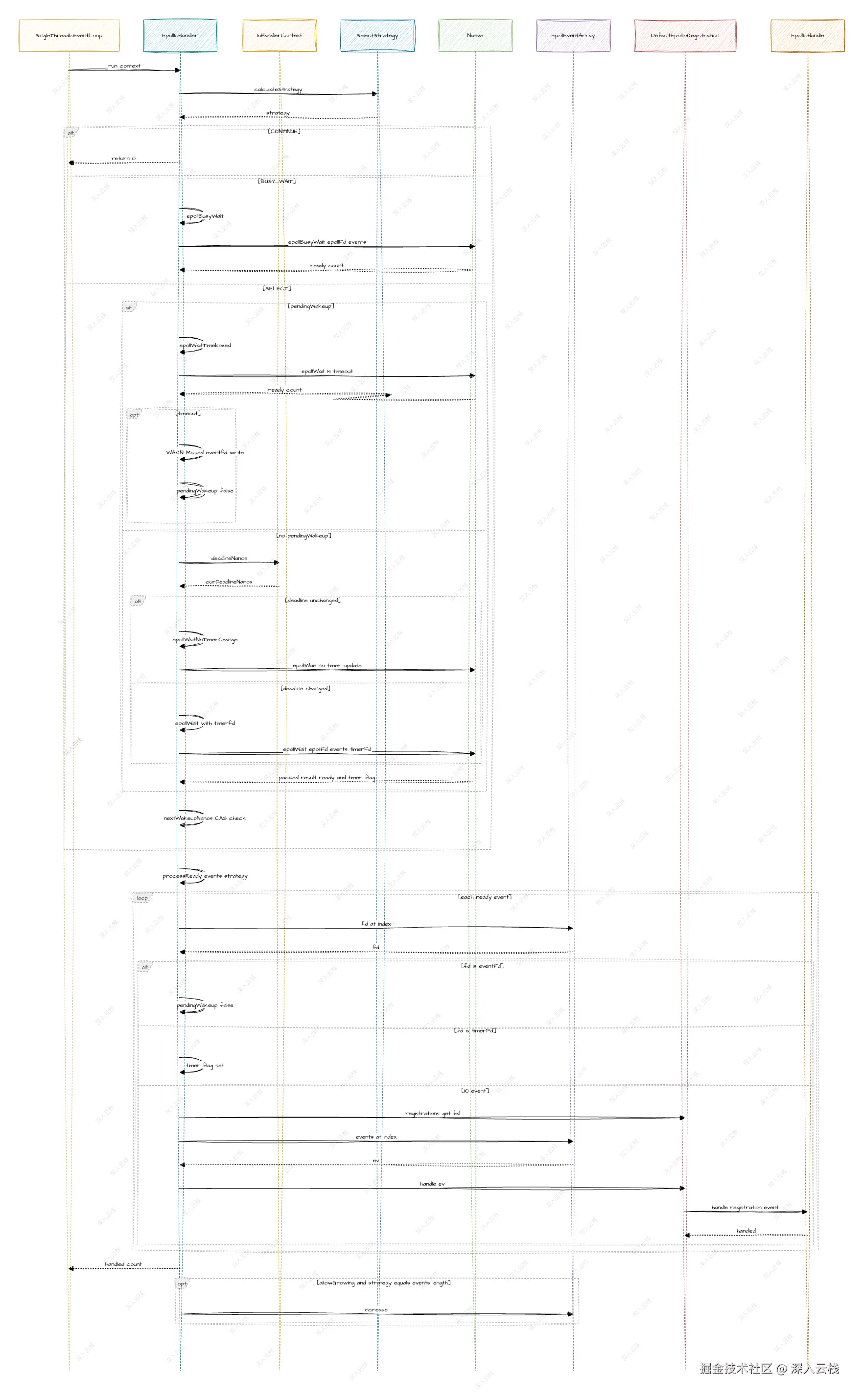
run(IoHandlerContext) 是事件循环的入口方法,其核心流程如下:
java
io.netty.channel.epoll.EpollIoHandler#run

public int run(IoHandlerContext context) {
    int handled = 0;
    try {
        // 1. 策略判定:CONTINUE / BUSY_WAIT / SELECT
        int strategy = selectStrategy.calculateStrategy(selectNowSupplier, !context.canBlock());
        switch (strategy) {
            case SelectStrategy.CONTINUE:
                // 无需阻塞等待,直接返回
                return 0;

            case SelectStrategy.BUSY_WAIT:
                // 非阻塞轮询,立即返回就绪事件
                strategy = epollBusyWait();
                break;

            case SelectStrategy.SELECT:
                // 2. pendingWakeup 兜底机制
                if (pendingWakeup) {
                    // eventfd 已被写入但 epoll_wait 尚未消费,使用固定 1 秒超时兜底
                    strategy = epollWaitTimeboxed();
                    if (strategy != 0) {
                        break;
                    }
                    // 超时未收到事件,说明 eventfd 写入可能丢失
                    logger.warn("Missed eventfd write (not seen after > 1 second)");
                    pendingWakeup = false;
                    if (!context.canBlock()) {
                        break;
                    }
                    // fall-through to normal epoll wait
                }

                // 3. 获取当前截止时间,决定是否需要修改 timerfd
                long curDeadlineNanos = context.deadlineNanos();
                if (curDeadlineNanos == -1L) {
                    curDeadlineNanos = NONE; // 无定时任务
                }
                nextWakeupNanos.set(curDeadlineNanos);
                try {
                    if (context.canBlock()) {
                        if (curDeadlineNanos == prevDeadlineNanos) {
                            // timerfd 无需修改,直接调用 epoll_wait
                            strategy = epollWaitNoTimerChange();
                        } else {
                            // timerfd 需要重新设置
                            long result = epollWait(context, curDeadlineNanos);
                            // 从 packed long 中拆包
                            strategy = Native.epollReady(result);
                            prevDeadlineNanos = Native.epollTimerWasUsed(result)
                                    ? curDeadlineNanos : NONE;
                        }
                    }
                } finally {
                    // 4. 检测是否在 epoll_wait 期间被外部唤醒
                    if (nextWakeupNanos.get() == AWAKE
                            || nextWakeupNanos.getAndSet(AWAKE) == AWAKE) {
                        pendingWakeup = true;
                    }
                }
                // fallthrough
            default:
        }
        // 5. 处理就绪事件
        if (strategy > 0) {
            int packed = processReady(events, strategy);
            // 从 packed int 中拆包:真实 IO 事件数 和 timer 标志
            handled = packed >>> 1;
            if ((packed & 1) != 0) {
                prevDeadlineNanos = NONE; // timer 触发,重置截止时间
            }
        }

        // 6. 动态扩容 EpollEventArray
        if (allowGrowing && strategy == events.length()) {
            events.increase();
        }
    } catch (Error e) {
        throw e;
    } catch (Throwable t) {
        handleLoopException(t);
    }
    return handled;
}
注:为聚焦核心逻辑,上述代码省略了
shouldReportActiveIoTime()性能指标上报。实际源码中CONTINUE分支、strategy > 0分支、else分支均包含shouldReportActiveIoTime()判断以记录活跃 IO 时间。
这个 run() 方法体现了 EpollIoHandler 的四大设计精髓:
- 策略驱动 :
SelectStrategy将 CONTINUE(不阻塞)、BUSY_WAIT(非阻塞轮询)、SELECT(阻塞等待)三种策略分离,EpollIoHandler根据策略选择不同的epollWait变体。 - pendingWakeup 兜底 :当 eventfd 被写入但
epoll_wait尚未消费时,pendingWakeup为 true。此时使用epollWaitTimeboxed()(固定 1 秒超时)作为兜底,防止因异常的 syscall 失败导致事件丢失。 - timerfd 增量更新 :只有当
curDeadlineNanos != prevDeadlineNanos时才修改 timerfd,避免不必要的系统调用。 - packed 返回值 :
processReady()返回 packed int,高效编码 IO 事件数和 timer 状态。
3.4 processReady() 事件分发
processReady() 遍历 EpollEventArray 中的就绪事件,将事件分发给对应的 DefaultEpollIoRegistration。其 packed int 返回值设计:每个真实 IO 事件加 2(result += 2),timerfd 事件加 1(result |= 1),拆包时 handled = packed >>> 1 获取事件数,(packed & 1) != 0 判断 timer 是否触发:
java
io.netty.channel.epoll.EpollIoHandler#processReady

// packed int 返回值:每个 IO 事件加 2,timer 触发加 1
private int processReady(EpollEventArray events, int ready) {
    int result = 0;
    for (int i = 0; i < ready; i++) {
        final int fd = events.fd(i);
        if (fd == eventFd.intValue()) {
            // eventFd 被唤醒,消费 pendingWakeup 标志
            pendingWakeup = false;
        } else if (fd == timerFd.intValue()) {
            // timerFd 超时,标记 timer 触发
            result |= 1;
        } else {
            // 真实 IO 事件:从 registrations 中查找对应的注册信息
            result += 2;
            final long ev = events.events(i);
            DefaultEpollIoRegistration registration = registrations.get(fd);
            if (registration != null) {
                registration.handle(ev);
            } else {
                // fd 已不再使用,从 epoll 中移除
                try {
                    Native.epollCtlDel(epollFd.intValue(), fd);
                } catch (IOException ignore) {
                    // 忽略异常,确保清理
                }
            }
        }
    }
    return result;
}
3.5 DefaultEpollIoRegistration 的三态状态机
DefaultEpollIoRegistration 是 EpollIoHandler 的内部类,实现了 IoRegistration 接口。它通过 RegistrationState 枚举维护一个三态状态机:Pending(未通过 EPOLL_CTL_ADD 添加到 epoll)、Added(已添加)、Cancelled(已移除)。状态转换仅在 submit() 和 cancel() 中发生:
java
io.netty.channel.epoll.EpollIoHandler.DefaultEpollIoRegistration#submit

// 根据当前状态执行不同的 epoll_ctl 操作
public long submit(IoOps ops) {
    EpollIoOps epollIoOps = cast(ops);
    try {
        synchronized (this) {
            switch (state) {
                case Cancelled:
                    return -1;
                case Pending:
                    if (epollIoOps.value == EpollIoOps.NONE.value) {
                        // NONE 表示移除注册,但尚未添加,直接返回
                        return 0;
                    }
                    // 首次添加:EPOLL_CTL_ADD
                    Native.epollCtlAdd(epollFd.intValue(), handle.fd().intValue(), epollIoOps.value);
                    state = RegistrationState.Added;
                    return epollIoOps.value;
                case Added:
                    if (epollIoOps.value == EpollIoOps.NONE.value) {
                        // NONE 表示不再关注任何事件,移除 fd
                        Native.epollCtlDel(epollFd.intValue(), handle.fd().intValue());
                        return 0;
                    }
                    // 修改已注册的事件:EPOLL_CTL_MOD
                    Native.epollCtlMod(epollFd.intValue(), handle.fd().intValue(), epollIoOps.value);
                    return epollIoOps.value;
                default:
                    throw new IllegalStateException();
            }
        }
    } catch (IOException e) {
        throw new UncheckedIOException(e);
    }
}
cancel() 方法通过 synchronized 保证幂等,区分同线程(直接执行 cancel0())和跨线程(通过 executor.execute(this::cancel0) 提交到 EventLoop 线程)两种路径:
java
io.netty.channel.epoll.EpollIoHandler.DefaultEpollIoRegistration#cancel

// 取消注册:synchronized 保证幂等,区分同线程和跨线程
public boolean cancel() {
    synchronized (this) {
        if (state == RegistrationState.Cancelled) {
            return false; // 已取消,幂等返回
        }
        state = RegistrationState.Cancelled;
    }
    if (executor.isExecutorThread(Thread.currentThread())) {
        cancel0(); // 同线程直接执行
    } else {
        executor.execute(this::cancel0); // 跨线程提交到 EventLoop
    }
    return true;
}
3.6 run() 完整事件循环时序图
四、EpollIoHandle 与 EpollIoOps:IO 事件抽象
EpollIoHandle 接口扩展了 IoHandle,增加了 FileDescriptor fd() 方法,用于返回底层 socket 的文件描述符,EpollIoHandler 通过此方法获取 fd 进行 epoll_ctl 操作:
java
io.netty.channel.epoll.EpollIoHandle

// 扩展 IoHandle,增加 fd() 方法返回底层文件描述符
public interface EpollIoHandle extends IoHandle {
    /**
     * Returns the {@link FileDescriptor} that used by this {@link IoHandle}.
     */
    FileDescriptor fd();
}
EpollIoHandle 的实现者是 AbstractEpollChannel.AbstractEpollUnsafe,其 fd() 方法返回 FileDescriptor(即 socket 对象),调用方通过 fd().intValue() 获取 int 型文件描述符,handle() 方法负责事件分发。
EpollIoOps 实现了 IoOps 接口,将 epoll 的事件标志封装为位掩码常量,通过 contains()、with()、without() 方法进行位运算组合:
java
io.netty.channel.epoll.EpollIoOps

// 预定义的事件常量,通过静态 JNI 方法获取底层值
public static final EpollIoOps EPOLLOUT = new EpollIoOps(Native.EPOLLOUT);
public static final EpollIoOps EPOLLIN = new EpollIoOps(Native.EPOLLIN);
public static final EpollIoOps EPOLLERR = new EpollIoOps(Native.EPOLLERR);
public static final EpollIoOps EPOLLRDHUP = new EpollIoOps(Native.EPOLLRDHUP);
public static final EpollIoOps EPOLLET = new EpollIoOps(Native.EPOLLET);
// NONE 表示不关注任何事件,用于从 epoll 移除 fd
public static final EpollIoOps NONE = new EpollIoOps(0);

// 位运算组合:添加事件标志
public EpollIoOps with(EpollIoOps ops) {
    if (contains(ops)) {
        return this;
    }
    return valueOf(value | ops.value());
}

// 位运算组合:移除事件标志
public EpollIoOps without(EpollIoOps ops) {
    if (!contains(ops)) {
        return this;
    }
    return valueOf(value & ~ops.value());
}
EpollIoOps 的 eventOf(int) 方法通过 EVENTS[] 缓存数组实现 O(1) 查找,命中则复用,未命中则新建,减少对象创建开销:
java
io.netty.channel.epoll.EpollIoOps

// 事件缓存数组:O(1) 查找,命中复用,未命中新建
static EpollIoEvent eventOf(int value) {
    if (value > 0 && value < EVENTS.length) {
        EpollIoEvent event = EVENTS[value];
        if (event != null) {
            return event;
        }
    }
    return new DefaultEpollIoEvent(new EpollIoOps(value));
}
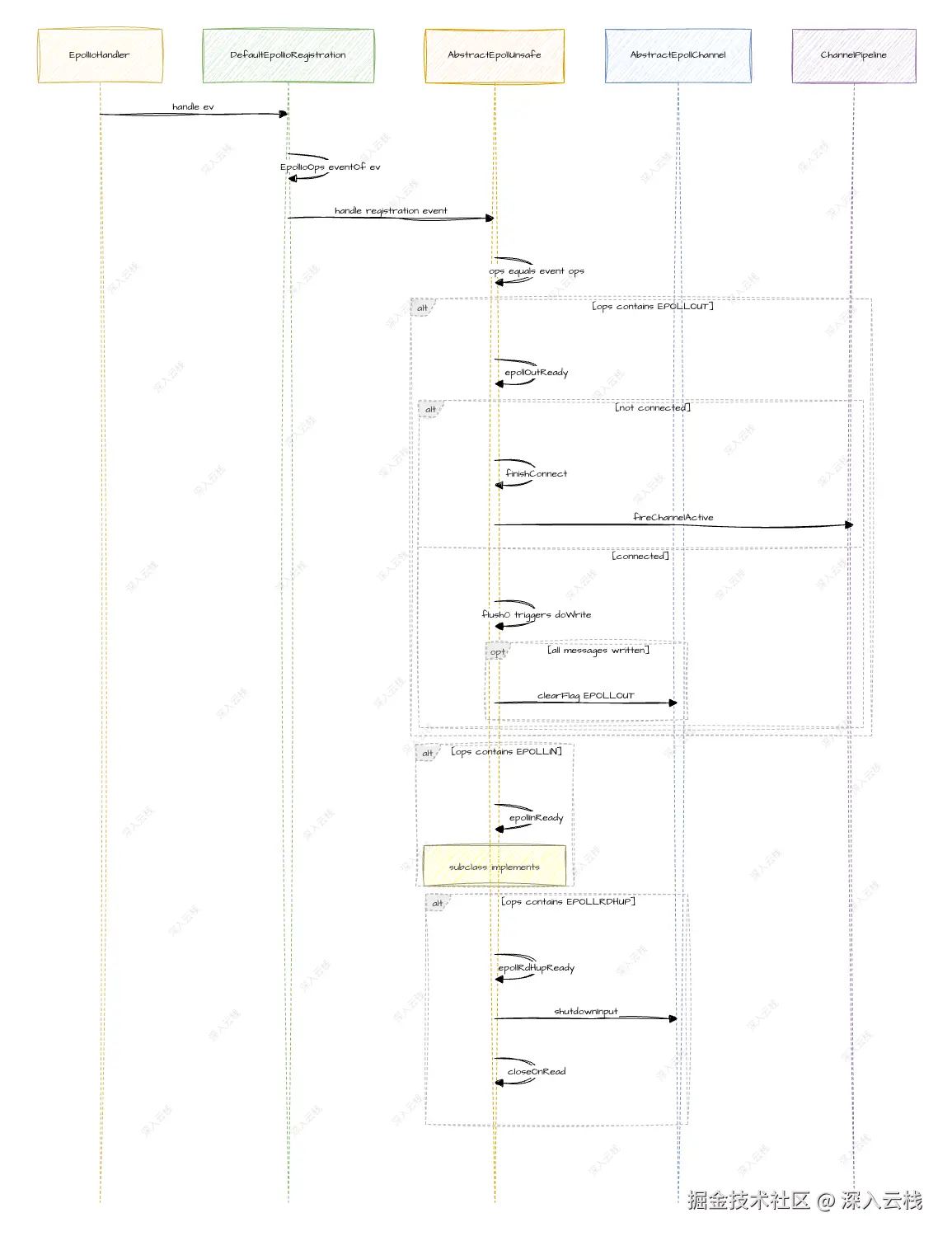
AbstractEpollUnsafe.handle() 是事件分发的核心,按严格的顺序处理:EPOLLOUT(连接完成或写就绪) → EPOLLIN(读就绪) → EPOLLRDHUP(对端关闭)。这个顺序是经过长期实践验证的,不能随意更改------EPOLLOUT 必须优先处理,因为连接完成后才能进行读写;EPOLLIN 必须在 EPOLLRDHUP 之前处理,确保在关闭输入之前读取完所有数据:
java
io.netty.channel.epoll.AbstractEpollChannel.AbstractEpollUnsafe#handle

// 事件分发:EPOLLOUT → EPOLLIN → EPOLLRDHUP,顺序不可更改
public void handle(IoRegistration registration, IoEvent event) {
    EpollIoEvent epollEvent = (EpollIoEvent) event;
    int ops = epollEvent.ops().value;

    // 1. 首先检查 EPOLLOUT:连接完成或写就绪
    if ((ops & EPOLL_ERR_OUT_MASK) != 0) {
        epollOutReady();
    }

    // 2. 检查 EPOLLIN:读就绪
    if ((ops & EPOLL_ERR_IN_MASK) != 0) {
        epollInReady();
    }

    // 3. 检查 EPOLLRDHUP:对端关闭
    if ((ops & EPOLL_RDHUP_MASK) != 0) {
        epollRdHupReady();
    }
}
epollOutReady() 处理连接完成和写就绪两种场景:
java
io.netty.channel.epoll.AbstractEpollChannel.AbstractEpollUnsafe#epollOutReady

// 处理 EPOLLOUT 就绪:连接完成或写就绪
final void epollOutReady() {
    if (connectPromise != null) {
        // 连接未完成,完成连接
        finishConnect();
    } else if (!socket.isOutputShutdown()) {
        // 连接已完成,执行写操作
        super.flush0();
    }
}
时序图 :AbstractEpollUnsafe.handle() 事件分发
五、EpollEventArray:struct epoll_event 的直接内存映射
EpollEventArray 是 epoll 传输性能优势的关键设计之一。它封装了 struct epoll_event 的直接内存数组,作为 epoll_wait 的就绪事件缓冲区,避免了 Java 堆内存与 native 内存之间的数据拷贝。
struct epoll_event 在 x86-64 Linux 上的内存布局为 12 字节(4 字节 events + 8 字节 data,内核通过 EPOLL_PACKED 宏即 __attribute__((packed)) 声明,消除 padding 以保持 32 位和 64 位布局一致)。EpollEventArray 不硬编码大小,而是通过 Native.sizeofEpollEvent() 和 Native.offsetofEpollData() 在运行期从 C 侧动态获取结构体大小和数据偏移量,确保跨平台兼容性。在 Java 侧精确计算每个事件的访问地址:
java
io.netty.channel.epoll.EpollEventArray

// Size of the epoll_event struct
private static final int EPOLL_EVENT_SIZE = Native.sizeofEpollEvent();
// The offset of the data union in the epoll_event struct
private static final int EPOLL_DATA_OFFSET = Native.offsetofEpollData();构造器分配固定大小的直接内存,memoryAddress() 返回内存首地址直接传给 JNI 的 epoll_wait:
java
io.netty.channel.epoll.EpollEventArray

// 构造器:分配 length * sizeofEpollEvent 字节的直接内存
EpollEventArray(int length) {
    if (length < 1) {
        throw new IllegalArgumentException("length must be >= 1 but was " + length);
    }
    this.length = length;
    cleanable = Buffer.allocateDirectBufferWithNativeOrder(calculateBufferCapacity(length));
    memory = cleanable.buffer();
    memoryAddress = Buffer.memoryAddress(memory);
}
fd(int index) 和 events(int index) 方法通过偏移量直接从 native 内存中提取数据。events 位于 epoll_event 结构体的起始位置(偏移 0),fd 则需要加上 EPOLL_DATA_OFFSET 偏移量(位于 data 联合体处):
java
io.netty.channel.epoll.EpollEventArray

// 从直接内存中读取文件描述符(位于 epoll_event 结构体 data 联合体处,偏移 EPOLL_DATA_OFFSET)
int fd(int index) {
    return getInt(index, EPOLL_DATA_OFFSET);
}

// 从直接内存中读取事件标志(位于 epoll_event 结构体起始位置,偏移 0)
int events(int index) {
    return getInt(index, 0);
}

// 底层内存访问:优先使用 Unsafe 直接内存访问
private int getInt(int index, int offset) {
    if (PlatformDependent.hasUnsafe()) {
        long n = (long) index * EPOLL_EVENT_SIZE;
        return PlatformDependent.getInt(memoryAddress + n + offset);
    }
    return memory.getInt(index * EPOLL_EVENT_SIZE + offset);
}
increase() 方法在需要扩容时,将容量翻倍并释放旧数组的内存。EpollIoHandler 中的 allowGrowing 策略控制是否允许扩容:
java
io.netty.channel.epoll.EpollEventArray

// 动态扩容:容量翻倍,释放旧数组内存
void increase() {
    length <<= 1; // 容量翻倍
    // 旧数据无需保留,直接分配新数组
    CleanableDirectBuffer buffer = Buffer.allocateDirectBufferWithNativeOrder(
            calculateBufferCapacity(length));
    cleanable.clean(); // 释放旧内存
    cleanable = buffer;
    memory = buffer.buffer();
    memoryAddress = Buffer.memoryAddress(buffer.buffer());
}
allowGrowing 策略:EpollIoHandler 构造时根据 maxEvents 参数决定,maxEvents == 0 时允许动态扩容(初始容量 4096),maxEvents > 0 时固定容量。当 processReady() 返回的 strategy == events.length()(数组被填满)且 allowGrowing 为 true 时触发 increase():
java
io.netty.channel.epoll.EpollIoHandler

// allowGrowing 策略:maxEvents == 0 时允许动态扩容
if (maxEvents == 0) {
    allowGrowing = true;
    events = new EpollEventArray(4096);
} else {
    allowGrowing = false;
    events = new EpollEventArray(maxEvents);
}
以下是 EpollEventArray 与 struct epoll_event 的内存布局示意图:
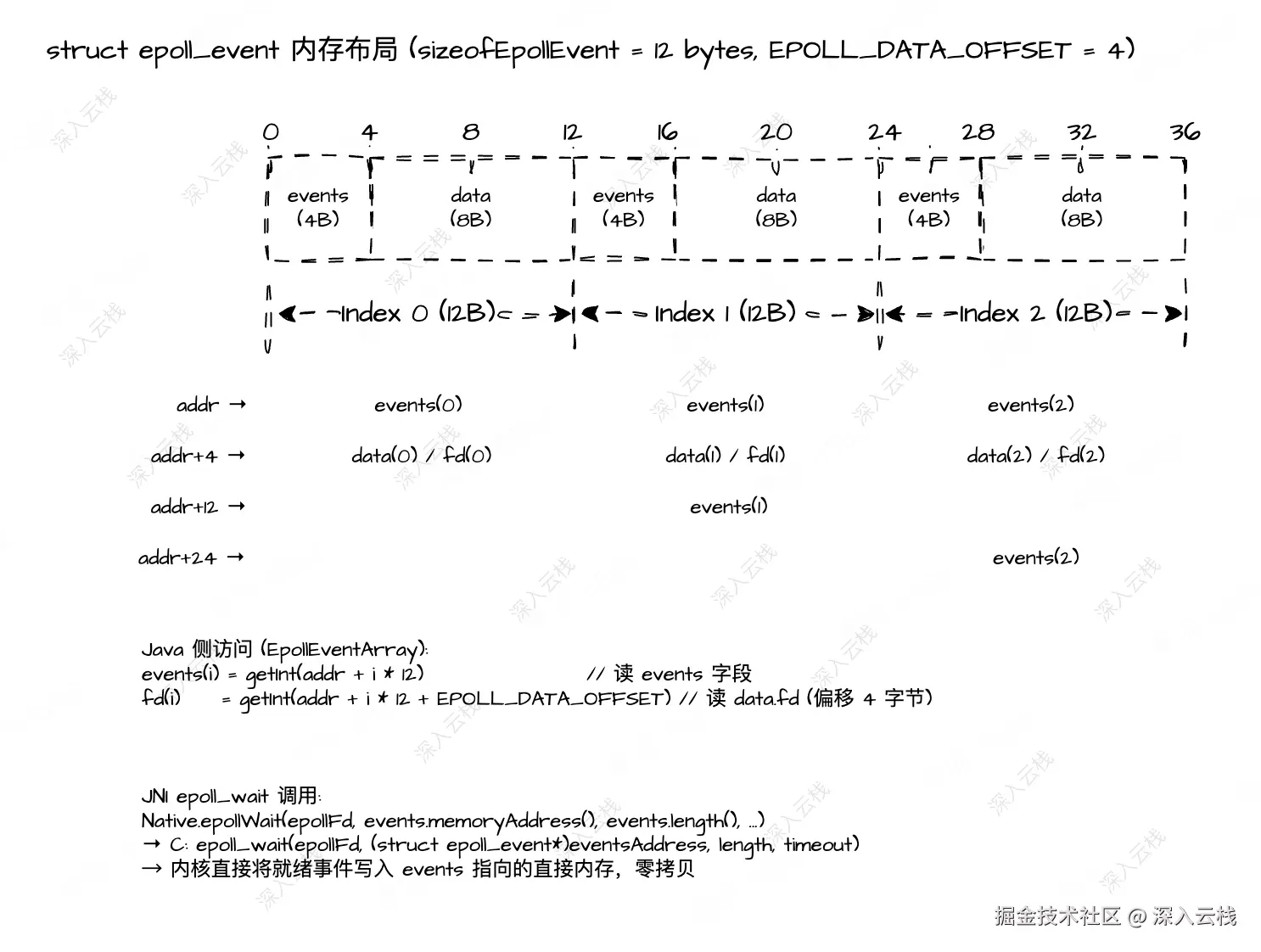
与 JDK Selector 的事件获取相比,EpollEventArray 有两个核心优势:一是通过直接内存避免了内核到 Java 堆的数据拷贝;二是支持按索引 O(1) 访问,无需 Iterator 遍历。
六、EpollSocketChannel 与 EpollServerSocketChannel:Channel 的 Epoll 实现
AbstractEpollChannel 是 Epoll Channel 的抽象基类,继承 AbstractChannel 并实现 UnixChannel。它持有核心字段:socket(LinuxSocket)、ops(EpollIoOps)、registration(IoRegistration)、active、connectPromise 等。
doRegister() 是 Channel 注册到 EventLoop 的入口方法,通过 IoEventLoop.register() 获取 IoRegistration,成功后将初始 ops 提交到 epoll:
java
io.netty.channel.epoll.AbstractEpollChannel#doRegister

// 注册 Channel 到 EpollIoHandler
protected void doRegister(ChannelPromise promise) {
    ((IoEventLoop) eventLoop()).register((AbstractEpollUnsafe) unsafe()).addListener(f -> {
        if (f.isSuccess()) {
            registration = (IoRegistration) f.getNow();
            if (isActive()) {
                // Channel 已激活,立即提交 ops 注册到 epoll
                submitCurrentOps();
            }
            promise.setSuccess();
        } else {
            promise.setFailure(f.cause());
        }
    });
}
setFlag(int) 和 clearFlag(int) 通过位运算修改 ops,再调用 registration.submit(ops) 同步到 epoll。setFlag 中有优化:如果标志已经设置,则跳过系统调用:
java
io.netty.channel.epoll.AbstractEpollChannel#setFlag

// 设置事件标志,已设置则跳过系统调用
protected void setFlag(int flag) throws IOException {
    if (ops.contains(flag)) {
        return; // 标志已设置,节省系统调用
    }
    ops = ops.with(EpollIoOps.valueOf(flag));
    if (isRegistered()) {
        IoRegistration registration = registration();
        registration.submit(ops);
    }
}
doReadBytes(ByteBuf) 将数据从 socket 直接读取到 ByteBuf 的直接内存中,避免 JDK NIO 的 ByteBuffer 中间层:
java
io.netty.channel.epoll.AbstractEpollChannel#doReadBytes

// 从 socket 直接读取数据到 ByteBuf 的直接内存
protected final int doReadBytes(ByteBuf byteBuf) throws Exception {
    int writerIndex = byteBuf.writerIndex();
    int localReadAmount;
    if (byteBuf.hasMemoryAddress()) {
        // 直接内存路径:使用 recvAddress 直接从 socket 读取
        localReadAmount = socket.recvAddress(byteBuf.memoryAddress(), writerIndex, byteBuf.capacity());
    } else {
        // 堆内存路径:使用 internalNioBuffer 转换
        ByteBuffer buf = byteBuf.internalNioBuffer(writerIndex, byteBuf.writableBytes());
        localReadAmount = socket.recv(buf, buf.position(), buf.limit());
    }
    if (localReadAmount > 0) {
        byteBuf.writerIndex(writerIndex + localReadAmount);
    }
    return localReadAmount;
}
6.1 EpollServerSocketChannel
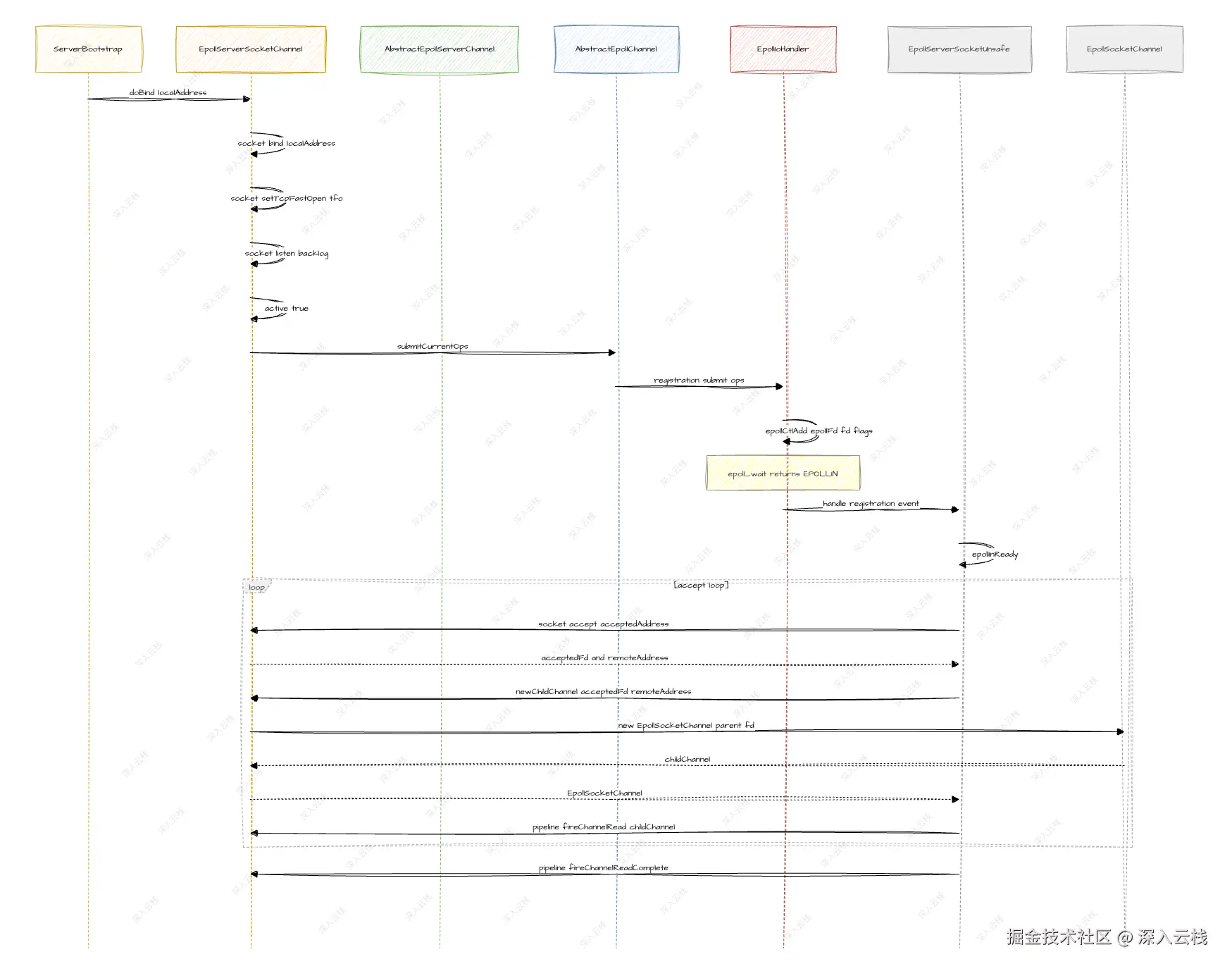
EpollServerSocketChannel 的 doBind() 方法依次执行绑定、TFO 设置、监听、标记 active 和提交 ops:
java
io.netty.channel.epoll.EpollServerSocketChannel#doBind

// 绑定端口并开始监听
protected void doBind(SocketAddress localAddress) throws Exception {
    super.doBind(localAddress);
    final int tcpFastopen;
    // 如果支持 TFO 服务端,设置 TCP Fast Open
    if (IS_SUPPORTING_TCP_FASTOPEN_SERVER && (tcpFastopen = config.getTcpFastopen()) > 0) {
        socket.setTcpFastOpen(tcpFastopen);
    }
    socket.listen(config.getBacklog());
    active = true;
    // 开始监听,提交 ops 注册到 epoll 以接收 EPOLLIN 事件
    submitCurrentOps();
}
newChildChannel() 创建子 Channel,将 accept() 返回的文件描述符包装为 EpollSocketChannel:
java
io.netty.channel.epoll.EpollServerSocketChannel#newChildChannel

// 接受新连接,创建 EpollSocketChannel 子 Channel
protected Channel newChildChannel(int fd, byte[] address, int offset, int len) throws Exception {
    return new EpollSocketChannel(this, new LinuxSocket(fd), address(address, offset, len));
}
6.2 EpollSocketChannel
EpollSocketChannel 的 doConnect0() 支持 TCP Fast Open(TFO),在连接建立时可以直接发送数据,减少一次 RTT:
java
io.netty.channel.epoll.EpollSocketChannel#doConnect0

// 支持 TCP Fast Open 的连接:连接时直接发送数据
boolean doConnect0(SocketAddress remote) throws Exception {
    if (IS_SUPPORTING_TCP_FASTOPEN_CLIENT && config.isTcpFastOpenConnect()) {
        ChannelOutboundBuffer outbound = unsafe().outboundBuffer();
        outbound.addFlush();
        Object curr;
        if ((curr = outbound.current()) instanceof ByteBuf) {
            ByteBuf initialData = (ByteBuf) curr;
            // TFO: 在 connect 时同时发送数据,减少一次 RTT
            long localFlushedAmount = doWriteOrSendBytes(
                    initialData, (InetSocketAddress) remote, true);
            if (localFlushedAmount > 0) {
                // Cookie 存在,TFO 成功,移除已写入的数据
                outbound.removeBytes(localFlushedAmount);
                return true;
            }
        }
    }
    return super.doConnect0(remote);
}
EpollSocketChannelUnsafe.prepareToClose() 处理 SO_LINGER 场景,使用 GlobalEventExecutor 延迟关闭以避免阻塞 EventLoop 线程:
java
io.netty.channel.epoll.EpollSocketChannel.EpollSocketChannelUnsafe#prepareToClose

// SO_LINGER 场景:使用 GlobalEventExecutor 延迟关闭,避免阻塞 EventLoop
protected Executor prepareToClose() {
    try {
        if (isOpen() && config().getSoLinger() > 0) {
            // 取消 epoll 注册,避免在关闭期间持续收到 IO 事件
            registration().cancel();
            return GlobalEventExecutor.INSTANCE;
        }
    } catch (Throwable ignore) {
        // 忽略异常,返回 null
    }
    return null;
}
时序图 :EpollServerSocketChannel 从绑定到接受新连接的完整链路
七、doWriteMultiple:writev 批量写入的核心优化
doWriteMultiple 是 Epoll 传输在写密集型场景下的核心性能优化。它利用 Linux 的 writev 系统调用,将多个 ByteBuf 聚合为 iovec 数组,通过一次系统调用完成批量写入,大幅减少上下文切换和 JNI 调用次数。
AbstractEpollStreamChannel.doWrite() 是写操作的入口,通过 writeSpinCount 控制写操作次数,msgCount > 1 且当前消息是 ByteBuf 时走 doWriteMultiple() 批量写入,否则走 doWriteSingle() 单次写入,msgCount == 0 时清除 EPOLLOUT 标志退出循环:
java
io.netty.channel.epoll.AbstractEpollStreamChannel#doWrite

// 写操作入口:根据消息数量选择批量写入或单次写入
protected void doWrite(ChannelOutboundBuffer in) throws Exception {
    int writeSpinCount = config().getWriteSpinCount();
    do {
        final int msgCount = in.size();
        if (msgCount > 1 && in.current() instanceof ByteBuf) {
            // 多个 ByteBuf:走批量写入路径
            writeSpinCount -= doWriteMultiple(in);
        } else if (msgCount == 0) {
            // 所有消息已写入,清除 EPOLLOUT 标志
            clearFlag(Native.EPOLLOUT);
            return;
        } else { // msgCount == 1
            // 单个消息:走单次写入路径
            writeSpinCount -= doWriteSingle(in);
        }
    } while (writeSpinCount > 0);

    if (writeSpinCount == 0) {
        // writeSpinCount 耗尽,重新提交写任务
        clearFlag(Native.EPOLLOUT);
        eventLoop().execute(flushTask);
    } else {
        // 写缓冲区未清空,注册 EPOLLOUT 等待可写
        setFlag(Native.EPOLLOUT);
    }
}
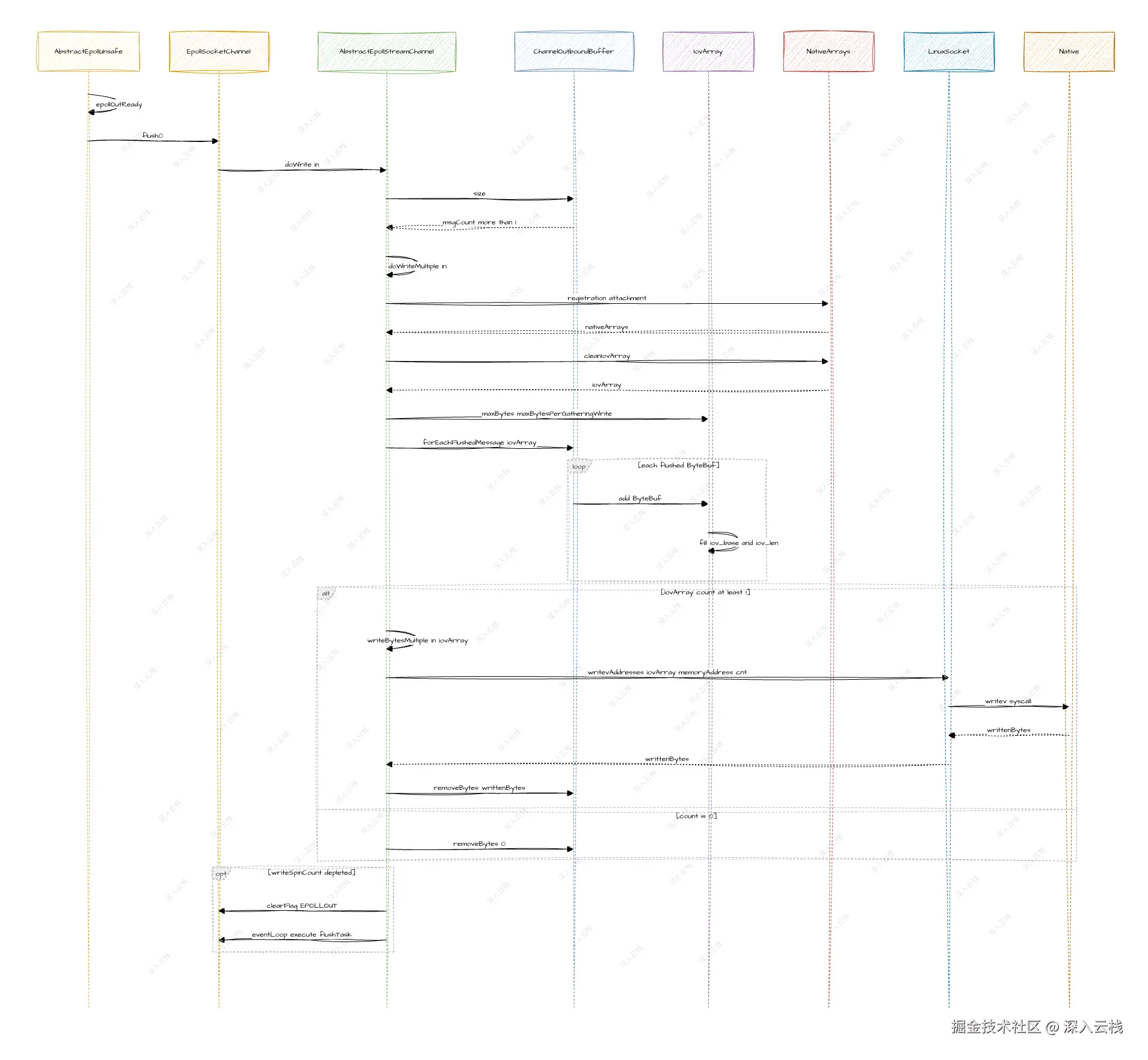
doWriteMultiple(ChannelOutboundBuffer in) 的完整流程:获取 maxBytesPerGatheringWrite 限制 → 从 registration.attachment() 获取 NativeArrays → 取出 IovArray 并设置 maxBytes → in.forEachFlushedMessage(array) 将 ByteBuf 填充到 IovArray → array.count() >= 1 时调用 writeBytesMultiple(in, array) → in.removeBytes(0) 清理空缓冲区:
java
io.netty.channel.epoll.AbstractEpollStreamChannel#doWriteMultiple

// 批量写入:将多个 ByteBuf 聚合为 iovec 数组,通过 writev 一次写入
private int doWriteMultiple(ChannelOutboundBuffer in) throws Exception {
    final long maxBytesPerGatheringWrite = config().getMaxBytesPerGatheringWrite();
    IovArray array = ((NativeArrays) registration().attachment()).cleanIovArray();
    array.maxBytes(maxBytesPerGatheringWrite);
    // 将 flushed 消息填充到 IovArray 中
    in.forEachFlushedMessage(array);

    if (array.count() >= 1) {
        return writeBytesMultiple(in, array);
    }
    // 所有消息都是空缓冲区
    in.removeBytes(0);
    return 0;
}
writeBytesMultiple(in, array) 调用 socket.writevAddresses(array.memoryAddress(0), array.count()),一次 JNI 调用将多个 iovec 通过 writev 系统调用批量写入:
java
io.netty.channel.epoll.AbstractEpollStreamChannel#writeBytesMultiple

// 通过 writev 系统调用批量写入 iovec 数组
private int writeBytesMultiple(ChannelOutboundBuffer in, IovArray array) throws IOException {
    final long expectedWrittenBytes = array.size();
    assert expectedWrittenBytes != 0;
    final int cnt = array.count();
    assert cnt != 0;

    final long localWrittenBytes = socket.writevAddresses(array.memoryAddress(0), cnt);
    if (localWrittenBytes > 0) {
        adjustMaxBytesPerGatheringWrite(expectedWrittenBytes, localWrittenBytes, array.maxBytes());
        in.removeBytes(localWrittenBytes);
        return 1;
    }
    return WRITE_STATUS_SNDBUF_FULL;
}
当 ByteBuf 数量多但 IovArray 容量不足时,降级为使用 ByteBuffer 数组的 writev 路径:
java
io.netty.channel.epoll.AbstractEpollStreamChannel#writeBytesMultiple

// 降级路径:使用 ByteBuffer 数组而非直接内存 iovec
private int writeBytesMultiple(
        ChannelOutboundBuffer in, ByteBuffer[] nioBuffers, int nioBufferCnt,
        long expectedWrittenBytes, long maxBytesPerGatheringWrite) throws IOException {
    if (expectedWrittenBytes > maxBytesPerGatheringWrite) {
        expectedWrittenBytes = maxBytesPerGatheringWrite;
    }
    final long localWrittenBytes = socket.writev(nioBuffers, 0, nioBufferCnt, expectedWrittenBytes);
    if (localWrittenBytes > 0) {
        adjustMaxBytesPerGatheringWrite(expectedWrittenBytes, localWrittenBytes, maxBytesPerGatheringWrite);
        in.removeBytes(localWrittenBytes);
        return 1;
    }
    return WRITE_STATUS_SNDBUF_FULL;
}批量写入与单次写入的性能对比:writev 一次系统调用写入多个 ByteBuf,减少上下文切换和 JNI 调用次数,在写密集型场景下性能提升显著。而 maxBytesPerGatheringWrite 的配置通过 EpollChannelConfig.setMaxBytesPerGatheringWrite() 设置,限制单次 writev 的最大字节数,防止大写入阻塞 EventLoop 线程过久。
时序图 :doWriteMultiple 批量写入的完整链路
八、EpollRecvByteAllocatorHandle:接收缓冲区自适应
EpollRecvByteAllocatorHandle 是 Epoll 传输中接收缓冲区自适应分配的核心,它扩展了 DelegatingHandle 并实现了 ExtendedHandle。其核心设计围绕两个关键点:确保分配 DirectByteBuf(epoll 的 JNI 读取需要直接内存),以及通过 maybeMoreDataToRead() 利用 epoll 水平触发特性判断是否继续读取。
allocate() 方法通过 PreferredDirectByteBufAllocator 确保始终分配直接内存的 ByteBuf:
java
io.netty.channel.epoll.EpollRecvByteAllocatorHandle#allocate

// 确保分配 DirectByteBuf:epoll 的 JNI 读取需要直接内存
public final ByteBuf allocate(ByteBufAllocator alloc) {
    preferredDirectByteBufAllocator.updateAllocator(alloc);
    return delegate().allocate(preferredDirectByteBufAllocator);
}
maybeMoreDataToRead() 是判断是否继续读取的核心逻辑。其设计思想基于 epoll 水平触发的特性:当 lastBytesRead == attemptedBytesRead 时,说明本次读取填满了分配的缓冲区,socket 接收缓冲区中可能还有剩余数据,需要继续读取:
java
io.netty.channel.epoll.EpollRecvByteAllocatorHandle

// 利用 epoll 水平触发特性:如果填满了缓冲区,说明可能还有数据
boolean maybeMoreDataToRead() {
    return lastBytesRead() == attemptedBytesRead();
}
continueReading() 覆盖了默认的 maybeMoreDataSupplier,使用 epoll 特有的 maybeMoreDataToRead() 判断逻辑:
java
io.netty.channel.epoll.EpollRecvByteAllocatorHandle#continueReading

// 使用 epoll 特化的 maybeMoreDataToRead 判断
public final boolean continueReading() {
    return continueReading(defaultMaybeMoreDataSupplier);
}
EpollRecvByteAllocatorStreamingHandle 是流式套接字的扩展版本,覆盖了 maybeMoreDataToRead(),增加了 RDHUP 场景处理------流式套接字收到 RDHUP 后必须执行最后一次"读尽"操作,即使 lastBytesRead < attemptedBytesRead 也要继续读:
java
io.netty.channel.epoll.EpollRecvByteAllocatorStreamingHandle#maybeMoreDataToRead

// 流式套接字:增加 RDHUP 场景下的"读尽"语义
boolean maybeMoreDataToRead() {
    /**
     * For stream oriented descriptors we can assume we are done reading if the last
     * read attempt didn't produce a full buffer (see Q9 in epoll man).
     *
     * If EPOLLRDHUP has been received we must read until we get a read error.
     */
    return lastBytesRead() == attemptedBytesRead() || isReceivedRdHup();
}
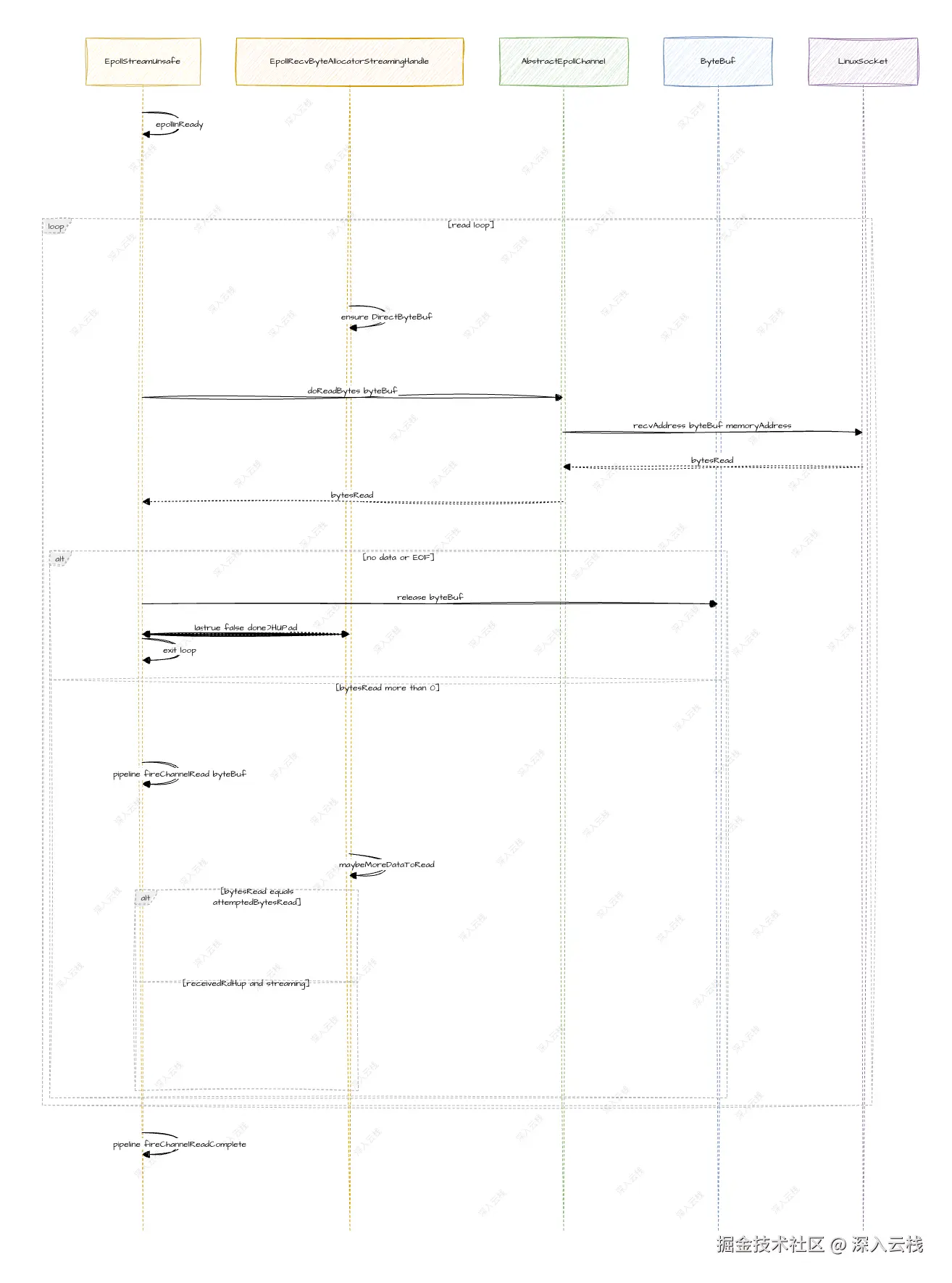
EpollStreamUnsafe.epollInReady() 是 Stream Channel 的读循环,它不断调用 doReadBytes(byteBuf) 读取数据,通过 allocHandle.continueReading() 判断是否继续,利用 EpollRecvByteAllocatorStreamingHandle 的 maybeMoreDataToRead() 逻辑决定是否进行下一轮读取:
java
io.netty.channel.epoll.AbstractEpollStreamChannel.EpollStreamUnsafe#epollInReady

// Stream Channel 的读循环:利用 maybeMoreDataToRead() 判断是否继续
void epollInReady() {
    final ChannelConfig config = config();
    if (shouldBreakEpollInReady(config)) {
        clearEpollIn0();
        return;
    }
    final EpollRecvByteAllocatorHandle allocHandle = recvBufAllocHandle();
    allocHandle.reset(config);
    ByteBuf byteBuf = null;
    boolean allDataRead = false;
    try {
        do {
            // 分配直接内存 ByteBuf
            byteBuf = allocHandle.allocate(allocator);
            allocHandle.lastBytesRead(doReadBytes(byteBuf));
            if (allocHandle.lastBytesRead() <= 0) {
                byteBuf.release();
                byteBuf = null;
                allDataRead = allocHandle.lastBytesRead() < 0;
                if (allDataRead) {
                    readPending = false;
                }
                break;
            }
            allocHandle.incMessagesRead(1);
            readPending = false;
            pipeline.fireChannelRead(byteBuf);
            byteBuf = null;
            if (shouldBreakEpollInReady(config)) {
                break;
            }
        } while (allocHandle.continueReading()); // maybeMoreDataToRead() 判断

        allocHandle.readComplete();
        pipeline.fireChannelReadComplete();
        if (allDataRead) {
            shutdownInput(true);
        }
    } catch (Throwable t) {
        handleReadException(pipeline, byteBuf, t, allDataRead, allocHandle);
    }
}
与 JDK NIO 的 AdaptiveRecvByteBufAllocator 相比,Epoll 版本通过 maybeMoreDataToRead() 利用 epoll 的批量就绪事件特性,避免了 JDK 版本中需要额外 read() 一次来判断是否还有数据的开销。
时序图 :EpollStreamUnsafe.epollInReady() 读循环与 maybeMoreDataToRead() 判断
九、EpollChannelOption:Linux 内核独有的 TCP 选项
EpollChannelOption 定义了 Netty 中对 Linux 内核特有 socket 选项的 ChannelOption 常量,底层通过 setsockopt 系统调用设置。这些选项是 Epoll 传输相比 NIO 传输的额外优势,允许应用层精细控制 TCP 协议栈的行为。
EpollChannelOption 中定义的关键选项如下:
java
io.netty.channel.epoll.EpollChannelOption

// TCP_CORK:延迟发送小数据包,减少网络碎片
public static final ChannelOption<Boolean> TCP_CORK = valueOf(EpollChannelOption.class, "TCP_CORK");

// TCP_NOTSENT_LOWAT:发送缓冲区中未发送数据的最低水位
public static final ChannelOption<Long> TCP_NOTSENT_LOWAT = valueOf(EpollChannelOption.class, "TCP_NOTSENT_LOWAT");

// TCP KeepAlive 参数:空闲时间、探测间隔、探测次数
public static final ChannelOption<Integer> TCP_KEEPIDLE = valueOf(EpollChannelOption.class, "TCP_KEEPIDLE");
public static final ChannelOption<Integer> TCP_KEEPINTVL = valueOf(EpollChannelOption.class, "TCP_KEEPINTVL");
public static final ChannelOption<Integer> TCP_KEEPCNT = valueOf(EpollChannelOption.class, "TCP_KEEPCNT");

// TCP_USER_TIMEOUT:未确认数据超时,强制关闭连接
public static final ChannelOption<Integer> TCP_USER_TIMEOUT =
        valueOf(EpollChannelOption.class, "TCP_USER_TIMEOUT");

// IP_TRANSPARENT:IP 透明代理,允许绑定到非本地 IP
public static final ChannelOption<Boolean> IP_TRANSPARENT = valueOf("IP_TRANSPARENT");

// IP_RECVORIGDSTADDR:接收原始目标地址,用于透明代理
public static final ChannelOption<Boolean> IP_RECVORIGDSTADDR = valueOf("IP_RECVORIGDSTADDR");

// TCP_DEFER_ACCEPT:延迟接受连接,减少无效连接
public static final ChannelOption<Integer> TCP_DEFER_ACCEPT =
        ChannelOption.valueOf(EpollChannelOption.class, "TCP_DEFER_ACCEPT");

// TCP_QUICKACK:启用快速确认,禁用延迟 ACK
public static final ChannelOption<Boolean> TCP_QUICKACK = valueOf(EpollChannelOption.class, "TCP_QUICKACK");

// SO_BUSY_POLL:Socket busy poll 时间(微秒),降低延迟
public static final ChannelOption<Integer> SO_BUSY_POLL = valueOf(EpollChannelOption.class, "SO_BUSY_POLL");

// TCP_MD5SIG:TCP MD5 签名,用于 BGP 等路由协议
public static final ChannelOption<Map<InetAddress, byte[]>> TCP_MD5SIG = valueOf("TCP_MD5SIG");
下面选取三个典型选项进行深入分析:
TCP_CORK (Boolean):启用后,TCP 会延迟发送小数据包,直到数据积累到一定大小或选项被关闭。这类似于 BSD 平台的 TCP_NOPUSH,适合请求-响应式协议场景。例如,当发送 HTTP 响应时,先启用 TCP_CORK,将响应头和响应体写入 socket,再关闭 TCP_CORK,此时 TCP 协议栈会将积累的数据合并为一个 TCP 段发送,减少网络碎片。
TCP_QUICKACK (Boolean):启用快速确认模式,禁用 TCP 延迟确认(Delayed ACK)。在默认情况下,TCP 可能会延迟发送 ACK(最多 200ms),以期望将 ACK 与数据合并发送。但在低延迟场景下,这个延迟是不可接受的。TCP_QUICKACK 让 TCP 立即发送 ACK,减少等待时间。
TCP_DEFER_ACCEPT (Integer):延迟唤醒监听器,直到收到数据才将连接交付给应用层。三次握手仍正常完成,但内核在收到第一个数据包之前不会通知 accept(),因此应用层不会看到未发送数据的空连接。对于 HTTP 等服务,客户端在连接建立后通常会立即发送请求数据,此选项可以避免接受那些仅建立连接但从不发送数据的无效连接,减少资源浪费。
十、整体链路串联:从 EpollIoHandler 到 AbstractEpollUnsafe 的完整闭环
将前文所述的所有组件串联起来,从 EpollIoHandler 的创建到 AbstractEpollUnsafe 的事件处理,形成了完整的 Epoll IO 处理闭环:
- 工厂创建 :
EpollIoHandler.newFactory()创建IoHandlerFactory,在SingleThreadIoEventLoop构造中通过ioHandlerFactory.newHandler(this)创建EpollIoHandler实例。 - 文件描述符创建 :
openFileDescriptors()创建epollFd(epoll 实例)、eventFd(唤醒 fd)、timerFd(定时器 fd),并将eventFd和timerFd注册到 epoll 实例。 - Channel 注册 :
register(IoHandle)方法将 Channel 的AbstractEpollUnsafe(实现了EpollIoHandle)注册到EpollIoHandler,创建DefaultEpollIoRegistration并放入registrations映射中。注意epoll_ctl(EPOLL_CTL_ADD)不在此时调用,而是延迟到submit()首次提交 ops 时执行。 - 事件循环 :
run(IoHandlerContext)方法通过selectStrategy判定策略,选择对应的epollWait变体。epollWait()通过Native.epollWait()JNI 调用epoll_wait系统调用,阻塞等待就绪事件。 - 事件分发 :
processReady()遍历EpollEventArray中的就绪事件,通过registrations.get(fd)获取对应的DefaultEpollIoRegistration,调用handle(ev)分发事件。 - 事件处理 :
DefaultEpollIoRegistration.handle(ev)调用EpollIoHandle.handle(this, eventOf(ev)),最终进入AbstractEpollUnsafe.handle(),按EPOLLOUT→EPOLLIN→EPOLLRDHUP的顺序处理。 - 批量写入 :当
EPOLLOUT就绪时,epollOutReady()触发doWrite(),若msgCount > 1则走doWriteMultiple()路径,通过IovArray聚合多个ByteBuf为iovec数组,调用socket.writevAddresses()一次writev系统调用完成批量写入。 - 接收优化 :当
EPOLLIN就绪时,epollInReady()进入读循环,通过EpollRecvByteAllocatorHandle分配直接内存ByteBuf,利用maybeMoreDataToRead()判断是否继续读取。
总结 Epoll 传输相比 NIO 传输的四大性能优势:
- 直接内存事件数组 :
EpollEventArray避免内核到 Java 堆的数据拷贝,支持 O(1) 索引访问。 - 批量写入 :
doWriteMultiple+writev一次系统调用发送多个ByteBuf,减少上下文切换。 - 内核级定时器 :
timerfd融入epoll_wait统一监听,无需额外的ScheduledExecutorService线程。 - 轻量级唤醒 :
eventfd比Selector.wakeup()更轻量,nextWakeupNanos三段式状态机避免重复写。
与 NioIoHandler 的设计对比:NioIoHandler 依赖 JDK Selector 的 selectedKeys 集合(需要 Iterator 遍历或 SelectedSelectionKeySet 数组优化),EpollIoHandler 通过 EpollEventArray 直接内存数组实现 O(1) 索引访问;NioIoHandler 的定时任务依赖 IoHandlerContext.delayNanos() 计算 select(timeout) 的超时时间,EpollIoHandler 通过 timerfd 将定时器转化为文件描述符融入 epoll_wait,超时精度更高且无需每次重新计算。
设计思想凝练为:"直接内存 + 批量系统调用 + 内核融合" ------EpollEventArray 通过直接内存避免数据拷贝,doWriteMultiple 通过 writev 批量写入减少系统调用次数,timerfd 和 eventfd 将定时与唤醒统一到 epoll 事件模型中,三项设计将 Linux 内核的能力发挥到极致。
Epoll 传输 vs NIO 传输七维对比表:
| 维度 | Epoll 传输 | NIO 传输 |
|---|---|---|
| 事件获取 | EpollEventArray 直接内存 + O(1) 索引访问 | Selector.selectedKeys() + SelectedSelectionKeySet 数组优化 |
| 唤醒机制 | eventfd 写入 + nextWakeupNanos 三段式状态机 | Selector.wakeup() + AtomicBoolean wakenUp 防重复 |
| 定时器 | timerfd 融入 epoll_wait 统一监听 | IoHandlerContext.delayNanos() 计算 select(timeout) 超时 |
| 批量写入 | writev 系统调用 + IovArray 直接内存 iovec 数组 | SocketChannel.write(ByteBuffer\[\]) JDK gathering write |
| 兴趣管理 | DefaultEpollIoRegistration.submit() → epoll_ctl JNI 调用 | IoRegistration.submit() → SelectionKey.interestOps() |
| 空轮询修复 | 无此问题(直接调用 epoll_wait) | SELECTOR_AUTO_REBUILD_THRESHOLD 检测 + rebuildSelector0() 重建 |
| 平台兼容 | 仅 Linux | 全平台(JDK NIO 抽象) |
从对比表可以看出,Epoll 传输在事件获取、唤醒机制、定时器、批量写入、兴趣管理五个维度上全面优于 NIO 传输:EpollEventArray 直接内存避免了 JDK HashSet 的哈希开销和 Iterator 遍历开销,eventfd + timerfd 将唤醒和定时统一为文件描述符融入 epoll_wait,writev 一次系统调用完成批量写入,epoll_ctl 直接通过 JNI 操作内核。同时,Epoll 传输从底层就避免了 JDK 的空轮询 Bug。NIO 传输的唯一优势在于跨平台兼容性------在所有支持 Java 的平台上提供一致的传输能力。
全文小结
本文聚焦 Netty 4.2 中 Epoll 原生传输的完整实现,从内核机制与 Java 实现两个维度,深入分析了 EpollIoHandler 事件循环、EpollEventArray 直接内存映射、EpollSocketChannel 读写实现、doWriteMultiple 批量写入优化以及 EpollRecvByteAllocatorHandle 接收缓冲区自适应的核心机制。
在内核机制层面,epoll 的 epoll_create/epoll_ctl/epoll_wait 三件套提供了 O(1) 的活跃事件获取能力,eventfd 和 timerfd 将唤醒和定时统一为文件描述符,融入 epoll 事件模型。在可用性检测层面,Epoll.isAvailable() 通过 Native.offsetofEpollData()、Native.newEpollCreate()、Native.newEventFd() 三步 JNI 调用验证 epoll 的可用性,ensureAvailability() 在 EpollIoHandler 初始化块中提供双重保障。在事件循环层面,EpollIoHandler.run() 通过 selectStrategy 策略判定、nextWakeupNanos 三段式状态机、processReady() 的 packed int 返回值,实现了 IO 事件、定时器、唤醒事件的统一调度。在事件抽象层面,EpollIoHandle 和 EpollIoOps 将 epoll 的事件标志封装为位掩码常量,AbstractEpollUnsafe.handle() 按 EPOLLOUT → EPOLLIN → EPOLLRDHUP 的顺序分发事件。在 Channel 实现层面,EpollServerSocketChannel 的 doBind() 和 EpollServerSocketUnsafe 的接受循环,EpollSocketChannel 的 doConnect0() 支持 TFO,构建了完整的连接管理链路。在批量写入层面,doWriteMultiple 通过 IovArray 聚合多个 ByteBuf 为 iovec 数组,writev 一次系统调用完成批量写入,writeBytes 提供单次写入回退。在接收优化层面,EpollRecvByteAllocatorHandle 的 maybeMoreDataToRead() 利用 epoll 水平触发特性判断缓冲区是否还有数据,EpollRecvByteAllocatorStreamingHandle 在 RDHUP 场景下执行最后一次"读尽"操作。
原创不易,如果本文对您有帮助,带来了些许灵感或启发,烦请动动小手点赞、关注、转发、收藏。这是作者持续更新的动力源泉,衷心感谢您的支持。我会尽量在工作之余,为大家带来更高品质的内容,努力保持周更。