C语言标准库函数setlocale用法详解
C语言标准库函数setlocale定义在 <locale.h> 头文件中(在C++编程中,这个头文件等价于 <clocale> )。
原型:
c
char* setlocale (int category, const char* locale);函数参数解析
category
int类型,可以取以下几个值:
| 值 | 影响范围 |
|---|---|
| LC_ALL | 全部更改为传入的locale |
| LC_COLLATE | 影响字符串比较函数 strcol1()和 strxfrm()。 |
| LC_CTYPE | 影响字符处理函数的行为。 |
| LC_MONETARY | 影响货币格式 |
| LC_NUMERIC | 影响 printf() 的数字格式 |
| LC_TIME | 影响时间格式 strftime()和 wcsftime()。 |
locale
locale参数是字符串(char*)类型,有以下几种写法:
| "language_country-region\[.code-page]"
- 名称写法,例如中文多字节代码页""
- Windows特有的代码页写法 ".code-page",例如936代码页的locale,".936";65001代码页的locale,".65001"。
- 通用选项"C"、""、NULL
常见的locale本地化参数效果如下表所示:
| 值 | 效果 |
|---|---|
| "C" | 采用仅支持ASCII的最小本地化配置 |
| NULL | 不改变任何设置,函数仅返回当前的locale名称 |
| "" | 采用当前系统环境的默认代码页。例如中文Windows系统默认的locale为ANSI/OEM 936 |
| ".utf8" | 使用UTF-8本地化 |
| ".utf-8" | 使用UTF-8本地化 |
| "en_us.utf8" | 使用UTF-8本地化 |
| "LC_MONETARY=en-US;LC_TIME=ja-JP" | 货币使用en-US本地化(美国货币符号),时间使用ja-JP本地化(日本时间格式) |
更多设置格式,可参考文末UCRT Locale names, Languages, and Country/Region strings链接。
应用
本节给出setlocale函数的具体应用,以便读者体会其功能。
应用1:在控制台打印宽字符
为输出宽字符,调用setlocale是必要的。
看一段例程:
c
/* setlocale example */
#include <stdio.h>      /* printf */
#include <time.h>       /* time_t, struct tm, time, localtime, strftime */
#include <locale.h>     /* struct lconv, setlocale, localeconv */

int main ()
{
    wchar_t* pstr0=L"Wide Character Test 0\n";
    wprintf(pstr0);
    wchar_t* pstr1=L"宽字符测试1\n";
    wprintf(pstr1);
    setlocale(LC_ALL,"");
    wchar_t* pstr2=L"宽字符测试2\n";
    wprintf(pstr2);
    return 0;
}
运行后得到如下输出:
Wide Character Test 0
宽字符测试2
也就是说,调用setlocale之前,程序的默认本地化环境是 "C" ,只支持 ASCII 字符,中日韩等非ASCII字符会被视为无效字符。
而wprintf函数输出字符串到控制台时,需要先将UTF-16编码的字符数据转换成多字节编码(如GBK、UTF-8等)数据。调用setlocale之前,包含了中日韩字符的字符串转换过程必失败,从而导致L"宽字符测试1"未被输出。
将setlocale的调用位置放到程序最开始,再次尝试:
c
/* setlocale example */
#include <stdio.h>      /* printf */
#include <time.h>       /* time_t, struct tm, time, localtime, strftime */
#include <locale.h>     /* struct lconv, setlocale, localeconv */

int main ()
{
    setlocale(LC_ALL,"");
    wchar_t* pstr0=L"Wide Character Test 0\n";
    wprintf(pstr0);
    wchar_t* pstr1=L"宽字符测试1\n";
    wprintf(pstr1);
    wchar_t* pstr2=L"宽字符测试2\n";
    wprintf(pstr2);
    return 0;
}
运行后得到如下输出:
Wide Character Test 0
宽字符测试1
宽字符测试2
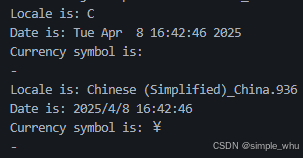
应用2:控制货币、时间日期格式
请运行代码以切实体会setlocale的不同参数对货币符号、时间日期格式的影响:
c
/* setlocale example */
#include <stdio.h>      /* printf */
#include <time.h>       /* time_t, struct tm, time, localtime, strftime */
#include <locale.h>     /* struct lconv, setlocale, localeconv */

int main ()
{
  time_t rawtime;
  struct tm * timeinfo;
  char buffer [80];

  struct lconv * lc;

  time ( &rawtime );
  timeinfo = localtime ( &rawtime );

  int twice=0;

  do {
    printf ("Locale is: %s\n", setlocale(LC_ALL,NULL) );

    strftime (buffer,80,"%c",timeinfo);
    printf ("Date is: %s\n",buffer);

    lc = localeconv ();
    printf ("Currency symbol is: %s\n-\n",lc->currency_symbol);

    setlocale (LC_ALL,"");
  } while (!twice++);

  return 0;
命令行输出结果为:
参考
来自cplusplus.com的setlocale函数定义与示例
微软文档:
setlocale, _wsetlocale
UCRT Locale names, Languages, and Country/Region strings