这个条款揭示了C++多态体系中最重要的规则之一:通过基类指针删除派生类对象时,如果基类没有虚析构函数,将导致资源泄漏和未定义行为。这是理解C++对象生命周期和多态设计的核心。
思维导图:虚析构函数的完整体系
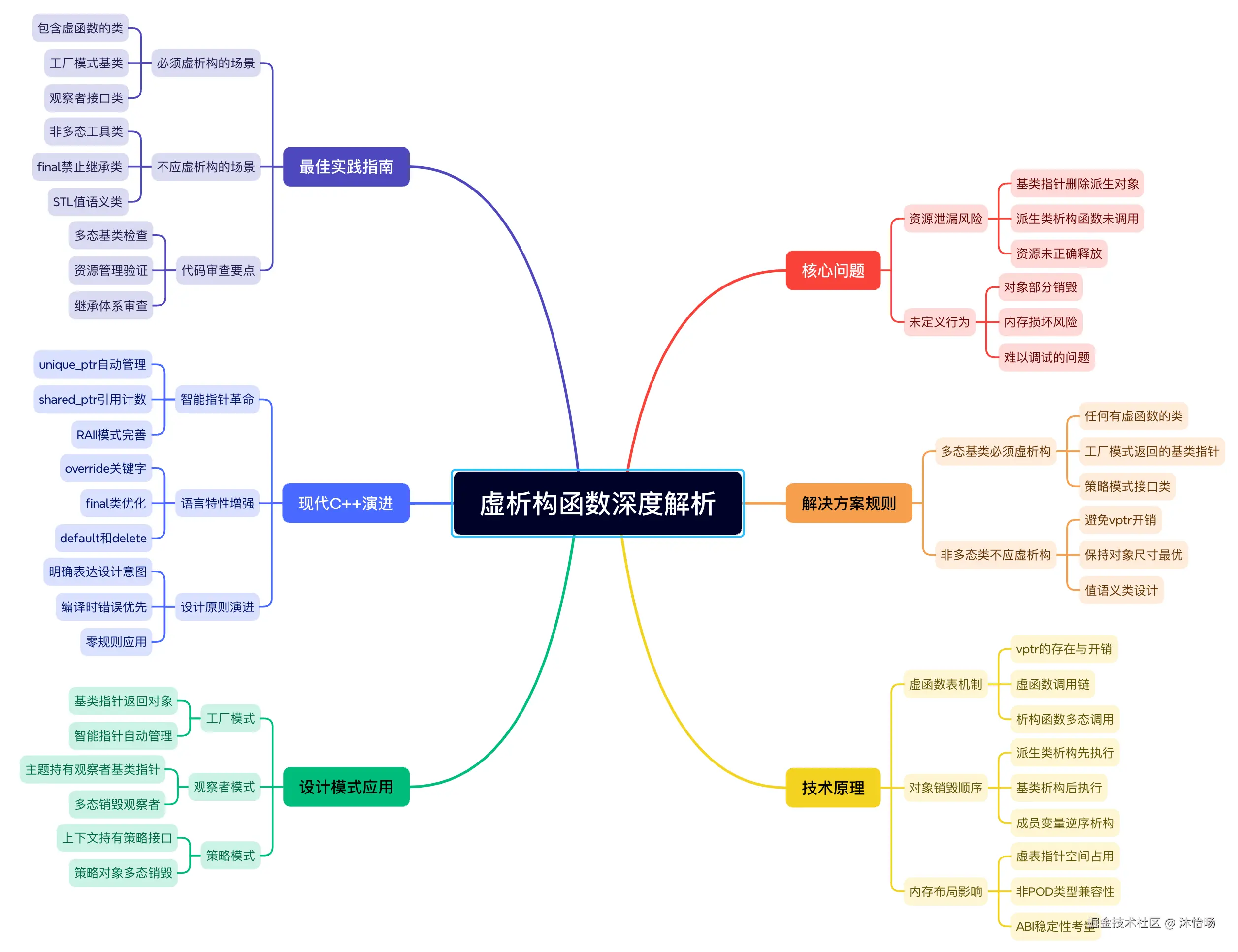
深入解析:虚析构函数的核心价值
1. 问题根源:多态删除的资源泄漏
危险的基类设计:
cpp
// 错误示例:多态基类没有虚析构函数
class TimeKeeper {
public:
    TimeKeeper() = default;
    ~TimeKeeper() { std::cout << "TimeKeeper析构" << std::endl; } // 非虚析构!

    virtual void getTime() { /* 获取时间 */ }
};

class AtomicClock : public TimeKeeper {
private:
    int* heap_resource;  // 派生类独有的堆资源
    std::vector<double> data_cache; // 更多派生类资源

public:
    AtomicClock() : heap_resource(new int(42)) {
        data_cache.resize(1000); // 分配额外资源
    }

    ~AtomicClock() {
        delete heap_resource;  // 释放派生类资源
        std::cout << "AtomicClock析构" << std::endl;
    }
};

void demonstrate_catastrophic_leak() {
    TimeKeeper* ptk = new AtomicClock();  // 基类指针指向派生类对象
    ptk->getTime();                       // 多态调用,正常工作

    delete ptk;  // 灾难!只调用TimeKeeper::~TimeKeeper()
                 // AtomicClock::~AtomicClock()永远不会调用
                 // heap_resource和data_cache内存泄漏!
}
运行结果分析:
TimeKeeper析构注意:AtomicClock析构永远不会输出,派生类的资源永远泄漏!
2. 解决方案:简单的虚析构声明
正确的基类设计:
cpp
// 正确示例:多态基类有虚析构函数
class TimeKeeper {
public:
    TimeKeeper() = default;
    virtual ~TimeKeeper() { std::cout << "TimeKeeper析构" << std::endl; } // 虚析构!

    virtual void getTime() { /* 获取时间 */ }
};

class AtomicClock : public TimeKeeper {
private:
    int* heap_resource;
    std::vector<double> data_cache;

public:
    AtomicClock() : heap_resource(new int(42)) {
        data_cache.resize(1000);
    }

    ~AtomicClock() override {
        delete heap_resource;  // 正确释放!
        std::cout << "AtomicClock析构" << std::endl;
    }
};

void demonstrate_correct_behavior() {
    TimeKeeper* ptk = new AtomicClock();
    ptk->getTime();

    delete ptk;  // 正确!调用AtomicClock::~AtomicClock(),然后TimeKeeper::~TimeKeeper()
}
运行结果分析:
AtomicClock析构
TimeKeeper析构
派生类和基类的析构函数都被正确调用,资源完全释放。
技术原理深度解析
1. 虚函数表机制与析构链
对象销毁的多态调用过程:
cpp
class Base {
public:
    virtual ~Base() {
        std::cout << "Base析构: " << this << std::endl;
    }

    virtual void operation() {
        std::cout << "Base操作" << std::endl;
    }
};

class Derived : public Base {
private:
    std::string resource;

public:
    Derived(const std::string& res) : resource(res) {}

    ~Derived() override {
        std::cout << "Derived析构,释放资源: " << resource << std::endl;
    }

    void operation() override {
        std::cout << "Derived操作,使用资源: " << resource << std::endl;
    }
};

// 编译器生成的伪代码大致如下:
void polymorphic_destruction(Base* obj) {
    // 1. 通过虚表找到正确的析构函数
    auto vtable = *(void***)obj;  // 获取虚表指针
    auto destructor = (void(*)(void*))vtable[0]; // 析构函数在虚表第一个位置

    // 2. 调用派生类析构函数
    destructor(obj);

    // 3. 最终释放内存
    operator delete(obj);
}
2. 纯虚析构函数的特殊用法
抽象基类的设计模式:
cpp
// 抽象基类:包含纯虚析构函数
class AbstractDatabase {
public:
    virtual ~AbstractDatabase() = 0;  // 纯虚析构函数

    virtual void connect() = 0;
    virtual void disconnect() = 0;
    virtual void execute(const std::string& query) = 0;

    // 非虚接口模式
    void runTransaction(const std::string& query) {
        connect();
        execute(query);
        disconnect();
    }
};

// 关键:纯虚析构函数必须提供定义!
AbstractDatabase::~AbstractDatabase() {
    std::cout << "AbstractDatabase基础清理完成" << std::endl;
}

class MySQLDatabase : public AbstractDatabase {
private:
    MYSQL* connection_;
    std::string connection_string_;

public:
    explicit MySQLDatabase(const std::string& conn_str)
        : connection_string_(conn_str), connection_(nullptr) {}

    void connect() override {
        std::cout << "连接MySQL: " << connection_string_ << std::endl;
        // 实际连接逻辑
    }

    void disconnect() override {
        std::cout << "断开MySQL连接" << std::endl;
        // 实际断开逻辑
    }

    void execute(const std::string& query) override {
        std::cout << "执行MySQL查询: " << query << std::endl;
        // 实际执行逻辑
    }

    ~MySQLDatabase() override {
        if (connection_) {
            disconnect();
        }
        std::cout << "MySQLDatabase资源完全释放" << std::endl;
    }
};
实战案例:现代C++设计模式
案例1:图形系统的多态体系
cpp
// 现代图形绘制系统的多态体系
class Drawable {
public:
    virtual ~Drawable() = default;  // 关键:虚析构函数

    virtual void draw() const = 0;
    virtual double area() const = 0;
    virtual std::string name() const = 0;

    // C++11现代特性:明确禁止拷贝
    Drawable(const Drawable&) = delete;
    Drawable& operator=(const Drawable&) = delete;

    // 允许移动语义
    Drawable(Drawable&&) = default;
    Drawable& operator=(Drawable&&) = default;

protected:
    Drawable() = default;
};

class Circle : public Drawable {
private:
    double radius_;
    std::vector<double> rendering_cache_;  // 渲染缓存资源
    mutable std::mutex cache_mutex_;       // 线程安全保护

public:
    explicit Circle(double radius) : radius_(radius) {
        rendering_cache_.resize(1000);  // 模拟大量渲染资源
        std::cout << "Circle分配渲染缓存" << std::endl;
    }

    void draw() const override {
        std::lock_guard<std::mutex> lock(cache_mutex_);
        std::cout << "绘制圆形,半径: " << radius_ << std::endl;
    }

    double area() const override {
        return 3.14159 * radius_ * radius_;
    }

    std::string name() const override {
        return "Circle";
    }

    ~Circle() override {
        std::cout << "Circle释放渲染缓存,半径=" << radius_ << std::endl;
    }
};

class Rectangle : public Drawable {
private:
    double width_, height_;
    std::unique_ptr<double[]> vertex_data_;  // 顶点数据智能指针管理

public:
    Rectangle(double w, double h) : width_(w), height_(h),
                                   vertex_data_(std::make_unique<double[]>(8)) {
        std::cout << "Rectangle分配顶点数据" << std::endl;
    }

    void draw() const override {
        std::cout << "绘制矩形 " << width_ << "x" << height_ << std::endl;
    }

    double area() const override {
        return width_ * height_;
    }

    std::string name() const override {
        return "Rectangle";
    }

    // 不需要显式析构函数 - unique_ptr自动管理
};

// 现代工厂模式
class ShapeFactory {
public:
    static std::unique_ptr<Drawable> createShape(const std::string& type,
                                                double param1, double param2 = 0) {
        if (type == "circle")
            return std::make_unique<Circle>(param1);
        if (type == "rectangle")
            return std::make_unique<Rectangle>(param1, param2);
        return nullptr;
    }
};

void demonstrate_modern_graphics() {
    std::vector<std::unique_ptr<Drawable>> scene;

    // 创建各种图形对象
    scene.push_back(ShapeFactory::createShape("circle", 10.0));
    scene.push_back(ShapeFactory::createShape("rectangle", 5.0, 8.0));
    scene.push_back(ShapeFactory::createShape("circle", 15.0));

    // 渲染场景
    for (const auto& shape : scene) {
        std::cout << "渲染: " << shape->name()
                  << ", 面积: " << shape->area() << std::endl;
        shape->draw();
    }

    std::cout << "场景结束,开始清理..." << std::endl;
    // scene离开作用域时,所有资源自动正确释放
    // 因为Drawable有虚析构函数,unique_ptr能正确调用各派生类析构函数
}
案例2:游戏引擎的组件系统
cpp
// 游戏引擎实体组件系统
class Component {
public:
    virtual ~Component() = default;  // 多态基类必须虚析构

    virtual void update(float deltaTime) = 0;
    virtual void render() = 0;
    virtual std::string getType() const = 0;

    // 现代C++特性
    Component(const Component&) = delete;
    Component& operator=(const Component&) = delete;

protected:
    Component() = default;
};

class PhysicsComponent : public Component {
private:
    std::vector<float> collision_data_;
    std::unique_ptr<class PhysicsBody> physics_body_;

public:
    PhysicsComponent() {
        collision_data_.resize(256);  // 碰撞数据缓存
        physics_body_ = std::make_unique<PhysicsBody>();
        std::cout << "PhysicsComponent初始化物理系统" << std::endl;
    }

    void update(float deltaTime) override {
        std::cout << "物理更新: " << deltaTime << "秒" << std::endl;
        // 物理模拟逻辑
    }

    void render() override {
        std::cout << "渲染物理调试信息" << std::endl;
    }

    std::string getType() const override {
        return "PhysicsComponent";
    }

    ~PhysicsComponent() override {
        std::cout << "PhysicsComponent清理物理资源" << std::endl;
    }
};

class RenderComponent : public Component {
private:
    std::shared_ptr<class Texture> texture_;
    std::vector<float> vertex_buffer_;
    std::vector<uint32_t> index_buffer_;

public:
    RenderComponent() {
        vertex_buffer_.resize(1024);  // 顶点缓冲区
        index_buffer_.resize(2048);   // 索引缓冲区
        std::cout << "RenderComponent分配图形资源" << std::endl;
    }

    void update(float deltaTime) override {
        // 动画更新等
        std::cout << "渲染组件更新" << std::endl;
    }

    void render() override {
        std::cout << "执行渲染命令" << std::endl;
        // 实际渲染逻辑
    }

    std::string getType() const override {
        return "RenderComponent";
    }

    ~RenderComponent() override {
        std::cout << "RenderComponent释放图形资源" << std::endl;
    }
};

// 游戏实体管理组件
class GameEntity {
private:
    std::vector<std::unique_ptr<Component>> components_;

public:
    template<typename T, typename... Args>
    void addComponent(Args&&... args) {
        components_.push_back(std::make_unique<T>(std::forward<Args>(args)...));
    }

    void updateAll(float deltaTime) {
        for (const auto& component : components_) {
            component->update(deltaTime);
        }
    }

    void renderAll() {
        for (const auto& component : components_) {
            component->render();
        }
    }

    // 自动管理所有组件的生命周期
    // 因为Component有虚析构函数,所有派生组件都能正确清理
};
不应使用虚析构函数的场景
1. 非多态工具类优化
cpp
// 不应使用虚析构函数的场景 - 值语义类
class Vector3D {  // 数学向量类,非多态,值语义
public:
    Vector3D(double x, double y, double z) : x_(x), y_(y), z_(z) {}

    // 不需要虚析构函数!避免不必要的虚表指针开销
    ~Vector3D() = default;

    // 值语义操作
    Vector3D operator+(const Vector3D& other) const {
        return Vector3D(x_ + other.x_, y_ + other.y_, z_ + other.z_);
    }

    double dot(const Vector3D& other) const {
        return x_ * other.x_ + y_ * other.y_ + z_ * other.z_;
    }

    double length() const {
        return std::sqrt(x_ * x_ + y_ * y_ + z_ * z_);
    }

private:
    double x_, y_, z_;
};

// 性能敏感的数据结构
class FixedSizeArray {
public:
    static constexpr size_t SIZE = 1000;

    FixedSizeArray() {
        std::fill(data_, data_ + SIZE, 0);
    }

    // 明确禁止继承 - 不需要虚析构函数
    ~FixedSizeArray() = default;

    double& operator[](size_t index) {
        return data_[index];
    }

private:
    double data_[SIZE];
};

void demonstrate_performance_impact() {
    std::cout << "Vector3D大小: " << sizeof(Vector3D) << " 字节" << std::endl;          // 24字节 (3*8)

    class Vector3DWithVirtual {
        double x, y, z;
    public:
        virtual ~Vector3DWithVirtual() = default;  // 不必要的虚析构
    };

    std::cout << "Vector3DWithVirtual大小: " << sizeof(Vector3DWithVirtual)
              << " 字节" << std::endl;  // 32字节 (3*8 + 8虚表指针)

    // 在大量使用时,24字节 vs 32字节有显著的内存和缓存影响
}
2. STL兼容性和final类优化
cpp
// STL风格容器 - 不应使用虚析构函数
template<typename T>
class SimpleVector {
private:
    T* data_;
    size_t size_;
    size_t capacity_;

public:
    SimpleVector() : data_(nullptr), size_(0), capacity_(0) {}

    ~SimpleVector() {  // 非虚析构函数
        delete[] data_;
    }

    // 值语义 - 需要拷贝控制
    SimpleVector(const SimpleVector& other);
    SimpleVector& operator=(const SimpleVector& other);

    // 不应该从这个类继承!
};

// C++11 final类优化
class MathUtilities final {  // final类:明确禁止继承
public:
    static double pi() { return 3.141592653589793; }
    static double degreesToRadians(double degrees) {
        return degrees * pi() / 180.0;
    }

    // 不需要虚析构函数!
    ~MathUtilities() = default;

    // 明确禁止构造
    MathUtilities() = delete;

private:
    // 所有功能通过静态方法提供
};

// 错误尝试继承final类
// class ExtendedMath : public MathUtilities { };  // 编译错误
现代C++最佳实践
1. 明确的设计意图表达
cpp
// 现代C++多态基类设计模板
class PolymorphicBase {
public:
    // 明确表达多态意图
    virtual ~PolymorphicBase() = default;

    // 明确禁止拷贝(多态对象通常不应拷贝)
    PolymorphicBase(const PolymorphicBase&) = delete;
    PolymorphicBase& operator=(const PolymorphicBase&) = delete;

    // 允许移动(如果合理)
    PolymorphicBase(PolymorphicBase&&) = default;
    PolymorphicBase& operator=(PolymorphicBase&&) = default;

    // 纯虚函数定义接口
    virtual void perform() = 0;

protected:
    PolymorphicBase() = default;  // 保护构造,只能通过派生类创建
};

// 具体实现类使用override明确意图
class ConcreteImplementation : public PolymorphicBase {
public:
    void perform() override {
        std::cout << "具体实现工作" << std::endl;
    }

    // C++11 override关键字明确析构函数意图
    ~ConcreteImplementation() override = default;
};
2. 智能指针与RAII自动管理
cpp
class NetworkConnection {
public:
    virtual ~NetworkConnection() = default;

    virtual void send(const std::string& data) = 0;
    virtual std::string receive() = 0;
    virtual bool isConnected() const = 0;

    // 工厂方法返回智能指针
    static std::unique_ptr<NetworkConnection> createTcp(const std::string& host, int port);
    static std::unique_ptr<NetworkConnection> createUdp(const std::string& host, int port);
};

// 使用现代RAII模式
void modern_network_management() {
    // 自动生命周期管理
    auto connection = NetworkConnection::createTcp("example.com", 8080);

    if (connection->isConnected()) {
        connection->send("Hello Server");
        auto response = connection->receive();
        std::cout << "收到响应: " << response << std::endl;
    }

    // 不需要手动delete - 离开作用域时自动调用正确析构函数
    // 即使NetworkConnection有多个派生类也能正确处理
}
关键洞见与行动指南
必须使用虚析构函数的场景:
- 任何包含虚函数的类:虚函数的存在暗示了多态用途
- 工厂模式返回的基类指针:调用者可能通过基类指针删除对象
- 观察者模式中的观察者基类:主题持有基类指针列表
- 策略模式中的策略接口:上下文持有策略基类指针
- 任何可能被多态使用的基类:防御性编程原则
不应使用虚析构函数的场景:
- 非多态工具类:没有虚函数,不打算作为基类
- final类:明确禁止继承的类
- 性能关键的简单类:避免虚表指针的开销
- STL风格的值类型:基于值的语义,不是多态
现代C++开发建议:
- 默认使用=default:让编译器生成正确的析构函数
- 明确override意图:使用override关键字
- 智能指针管理:优先使用unique_ptr和shared_ptr
- 防御性设计:当不确定时,为基类提供虚析构函数
需要警惕的陷阱:
- 标准库继承:不要从STL容器公开继承
- 多重继承:确保所有相关基类都有适当的析构函数
- 菱形继承:虚基类的特殊析构要求
- 异常安全:析构函数不应抛出异常
最终建议: 将虚析构函数视为多态体系中的"保险机制"。培养"多态思维"------在设计每个继承体系时都问自己:"这个基类的析构函数是否需要是virtual的?" 这种严谨的态度是构建健壮C++系统的关键。
记住:在C++多态世界中,虚析构函数不是可选项,而是基类设计的基本契约。 条款7教会我们的不仅是一个语法规则,更是面向对象设计的基本原则。